INTRODUCTION
Bereaved families often experience physical or psychological problems arising from grief (Burnell & Burnell, Reference Burnell and Burnell1989; Stroebe et al., Reference Stroebe, Schut and Stroebe2007). Depression is a serious psychological distress for bereaved family caregivers (Shear, Reference Shear2009), and grief may entail depressive symptoms (Bruce et al., Reference Bruce, Kim and Leaf1990), major depression (Zisook & Shucter, Reference Zisook and Shucter1993), and minor depression (Zisook, Reference Zisook, Kaplan and Sadock1995). Since advanced and serious depression may cause hopelessness (Prigerson et al., Reference Prigerson, Frank and Kasl1995), which has been linked to suicide (Christakis & Allison, Reference Christakis and Allison2006), depression is a particularly important concern. In addition, some family members may lose the meaning or purpose of their lives following a relative's death; such suffering is referred to as spiritual pain. Murata and Morita (Reference Murata and Morita2006) demonstrated that spiritual well-being is associated with peace of mind and meaning to live, while Murray and colleagues (Reference Murray, Kendall and Boyd2010) found that family caregivers experience social, psychological, and spiritual suffering.
Bereavement life review (BLR) is a form of psychotherapy that includes just two sessions that can be employed to improve these feelings (Ando et al., Reference Ando, Morita and Miyashita2010). The bereaved family member reviews memories of the deceased during the first session with a psychotherapist. The therapist constructs a personal history book after the first session, and the bereaved family member reviews it with the therapist in a session held two weeks later. Ando and coworkers (Reference Ando, Morita and Miyashita2010) examined the effect of this therapy for bereaved family members whose deceased relative was treated and died in a palliative care ward and found that the therapy alleviated depression and elevated spiritual well-being.
Palliative care wards offer specialized care for patients, and families receive more care than that given in general wards. It is thus possible that BLR might be useful only in these circumstances. To show that this therapy can be extended to any bereaved family member, we first demonstrated its utility for depression and spiritual well-being in bereaved family members whose relative did not stay on a palliative care ward (Ando et al., Reference Ando, Sakaguchi and Shiihara2013). As the next stage, we wanted to investigate its utility in a population outside Asia, since BLR was developed in Japan, and it was unclear whether it would be useful for bereaved family members in Western nations. For this purpose, we chose a Hawaiian population, since about 40% of the this population is Asian, and the second most common population group in Hawaii is Japanese American (Wikipedia, 2013).
Bereaved family caregivers often say that they have grown or matured through caregiving. One study found that there are positive and negative life changes that may occur after bereavement (Lehman et al., Reference Lehman, Davis and Delongis1993). The positive and negative aspects of caregiving for bereaved family members have also been demonstrated in Japan (Sanjo et al., Reference Sanjo, Morita and Miyashita2009). These studies suggested that post-bereavement reflection can elicit positive thoughts due to caring for a dying patient and that BLR may prompt respondents to recognize the positive aspects of their caregiving activities.
The primary aim of our study was to investigate the effects of BLR on depression and spiritual well-being in bereaved Hawaiian family members. Since this was the first attempt to adapt this therapy outside of Japan, we did not employ a control group, the number of our participants was limited, and we considered the work to be a pilot study. Our second aim was to examine bereaved family members' narratives about the changes they experienced through caring.
METHODS
Participants
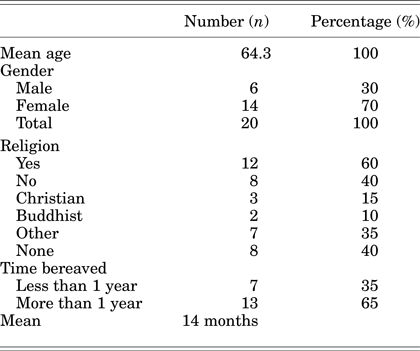
Social workers in a Honolulu hospital identified adults bereaved within the previous two years (mean, 14 months) due to a cancer death at home or in a palliative care unit (PCU). All subjects were capable of completing the questionnaires without psychological distress. The social workers recruited bereaved participants by telephone and visited the homes of those who agreed to participate. Twenty bereaved Hawaiian Americans (6 men and 14 women) aged mainly in their 60s finally participated in BLR therapy (Table 1). The ethical and scientific validity of the study was approved by the institutional review board of St. Mary's College, Fukuoka, Japan.
Background of bereaved family members (n = 20)

PROCEDURE
Social workers or nurses conducted bereavement life reviews for each bereaved caregiver. The therapy consisted of two 30- to 60-minute interview sessions spaced two weeks apart. In the first session, the therapist asked the following questions:
1. What is the most important thing in your life, and why?
2. What are your most vivid memories of the deceased patient?
3. What is your most pleasant memory in caring for the patient?
4. What growth did you experience through taking care of the patient?
5. What is the most important role you have undertaken in your life?
6. What are you proudest of in your life?
The narratives of the subjects were transcribed verbatim, and the therapist utilized the narratives to construct a personal history book. The therapist pasted magazine photos or drawings illustrating the subjects' keywords to beautify the book and provoke memories. During the second session, the patient and therapist reviewed the album and discussed its contents.
Outcome Measures
The Functional Assessment Chronic Illness Therapy–Spiritual (FACIT–Sp) (Peterman et al., Reference Peterman, Fitchett and Brady2002; Noguchi et al., Reference Noguchi, Ono and Morita2004) Questionnaire was employed to measure spirituality. Items were scored on 5-point scales ranging from 4 (strongly agree) to 0 (strongly disagree). The Beck Depression Inventory, Second Edition (BDI-II) (Beck et al., Reference Beck, Steer and Ball1996) was utilized to measure depression. The BDI-II includes 21 items scored on a 4-point scale, ranging from 3 (strongly agree) to 0 (strongly disagree). The validity and reliability of the FACIT–Sp and BDI-II are well established.
Data Analysis
FACIT–Sp and BDI-II scores were calculated for each bereaved family caregiver and used in statistical tests conducted with SPSS, version 21. Comparisons of FACIT–Sp and BDI-II scores pre- and post-intervention were performed by a t test. Narrative data were subjected to qualitative analysis (Funashima, Reference Funashima2001, based on Berelson, Reference Berelson1952), which involves creating codes, subcategories, and categories. Narrative references were employed to examine how caregivers had changed through caregiving and bereavement. Sentences were separated into their shortest meaningful units, referred to as codes. Codes with similar meaning were integrated into subcategories, and subcategories with similar meaning were grouped into categories. To ensure reliability and validity, inconsistencies were discussed among the researchers until agreement was reached.
RESULTS
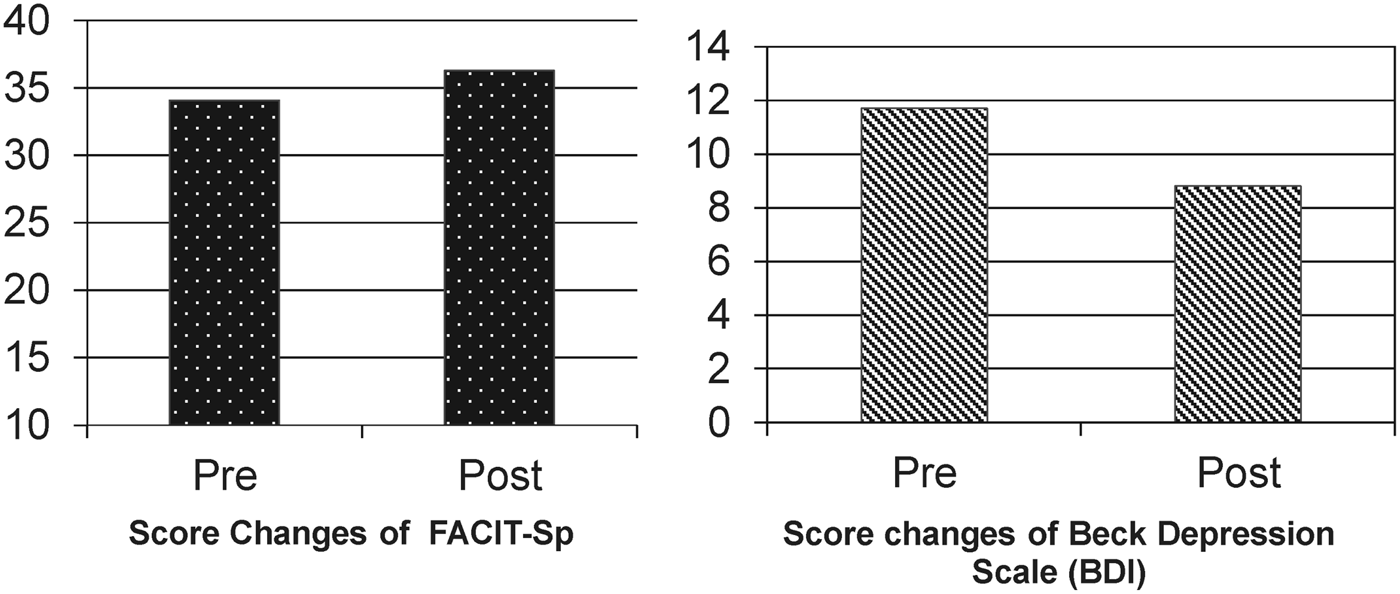
After bereavement life review, FACIT–Sp scores significantly increased from 34.1 ± 9.63 to 36.3 ± 10.6 (r = –2.6, p < 0.05, n = 20), while BDI scores significantly decreased from 11.7 ± 7.7 to 8.8 ± 7.0 (t = 2.27, p < 0.05, n = 20). These results are depicted in Figure 1.
Score changes on the FACIT–PS and BDI pre and post.

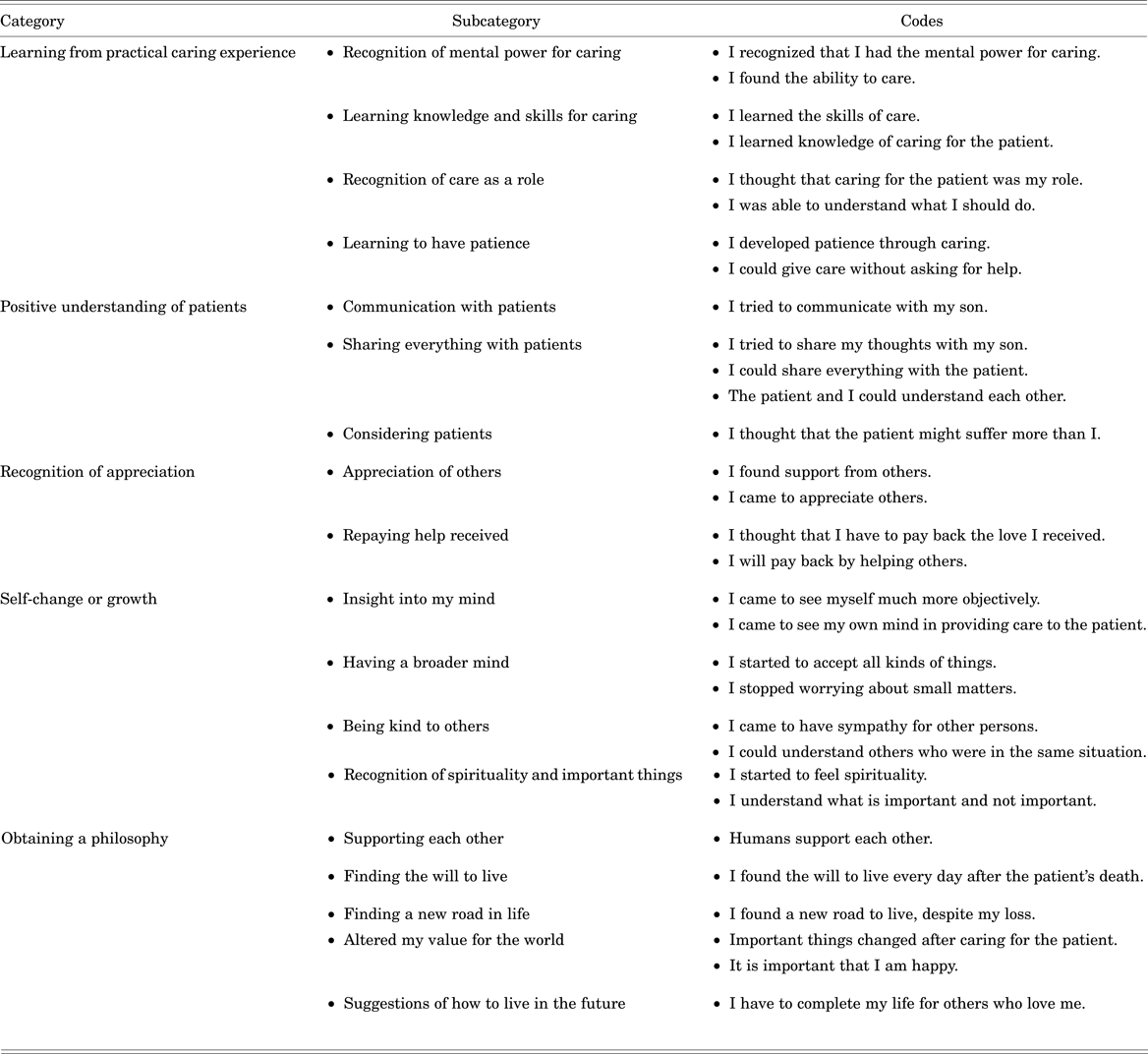
From the qualitative analysis (Table 2), five categories (in italics below) were chosen from narratives describing changes through caring experiences. There were a total of 64 codes.
Categorization of the narratives of bereaved family members
The family caregivers initially thought they could not care for their loved ones, but they patiently acquired knowledge and skills, and some came to experience caring as a meaningful role. We grouped such comments into the subcategories of “Recognition of mental power of caring,” “Learning knowledge and skills for caring,” and “Learning to have patience,” and integrated these subcategories into Learning from practical caring experience. To describe their attempts to communicate better, to share wholeheartedly, and to be considerate to patients, we defined subcategories of “Communication with patients,” “Sharing everything with patients,” and “Considering patients,” and integrated these into Positive understanding of patients. Most bereaved family caregivers appreciated help from others, and some even wanted to pay for this help. We named this single subcategory and its higher level category Recognition of appreciation.
The experience of caring provided some bereaved family caregivers with insight into their own minds; no longer worrying about trivialities, they became kinder or more spiritual. To describe these comments, we chose subcategories such as “Insight into my mind,” “Having a broader mind,” “Being kind to others,” and “Recognition of spirituality and important things,” and we integrated them into Self-change or growth. Finally, some caregivers developed a philosophy of human support, acquiring strength to live, found new ways to cope with their suffering, changed their viewpoints or values, or found clues to future living. We defined these subcategories as “Supporting each other,” “Finding the will to live,” “Finding a new road in life,” “Altering values in the world,” and “Suggesting how to live in the future,” and we integrated these subcategories into the category Obtaining a philosophy.
The following response to the question “What growth did you experience in taking care of your loved one?” is illustrative of the kind of interview data we collected:
Uh, I think that I became more spiritual. I now have a sense of well-being because I attend a Christian church, and I started learning the Bible and started to think to myself because of the sickness that we went through that I owe a lot of people; not really owe, but I feel in my heart that I need to pay back the grace that I've gotten by helping others with the, specifically with sickness and death. And I've offered my assistance, so far, to two people. Even though they may not have said anything yet, in my heart I know I did it, and I'm willing.
DISCUSSION
Spiritual Well-Being and Depression
The significant increase in FACIT–Sp scores suggests that BLR improved the spiritual well-being of the bereaved. These results are consistent with those for bereaved Japanese people found earlier by Ando and colleagues (Reference Ando, Morita and Miyashita2010), and thus BLR therapy seems to be applicable to Americans in Hawaii. The mean FACIT–Sp scores of the Japanese subjects changed from 19.9 to 22.8, whereas those of the American subjects changed from 34.1 to 36.3. Although the Hawaiian interviews were conducted closer to the time of bereavement than the Japanese, the American subjects showed higher levels of spiritual well-being.
Two factors may affect this difference. First, it may be related to religious affiliation, since 60% of the American subjects acknowledged affiliation with some kind of religion compared to 24% of Japanese subjects. The FACIT–Sp asks about religion and meaning of life, so that subjects more willing to express religious preferences score higher on the FACIT–Sp. Second, the Hawaiian Americans emphasized Learning from practical caring experience or Positive understanding of patients, which very few Japanese subjects mentioned, and these changes may have enhanced their spiritual well-being or vice versa.
The significant reduction in BDI scores suggests that BLR reduces depression. A score greater than 17 on the BDI indicates clinical problems. Since the mean scores of the subjects were 11.7 (pre) and 8.8 (post), the mean level of depression had not reached clinical levels. However, the 8 subjects (40%) with pre-intervention scores greater than 17 showed markedly decreased scores after the review. The mean BDI score of Japanese subjects (Ando et al., Reference Ando, Morita and Miyashita2010) decreased from 10.8 to 6.8, showing a tendency similar to, but not stronger than, that of American subjects.
The reasons for the efficacy of BLR with depression may include: (1) the participant's opportunity to freely voice grief, (2) the therapist's attentive listening and expression of care, and (3) the life review, focusing on the deceased, allowing family caregivers to discover new meaning in caregiving and enabling them to reinterpret and reconstruct their lives. It has previously been suggested that therapeutic life review should include both good memories and less positive memories (Haight, Reference Haight1988). With the elevation of spiritual well-being and reduction in depression, BLR may serve usefully as a form of psychological care, in addition to cognitive-behavioral grief therapy and family-focused grief therapy.
Changes Through Caring for a Loved One
The categories we derived from caregiver narratives suggest that caregivers undergo a process of moving from Learning from practical caring experience and Positive understanding of patients to Recognition of appreciation and Self-change or growth or Obtaining a philosophy.
A comparison of American and Japanese cultural differences in categories of positive experiences in caregiving is presented in Table 3. Sanjo and colleagues (Reference Sanjo, Morita and Miyashita2009) found four categories in the Caregiving Consequence Inventory (CCI) among Japanese subjects: “Appreciation of others,” “Meaning of life,” “Reconstruction of priority order,” and “Mastery.” Our category Recognition of appreciation mirrors Sanjo's “Appreciation of others,” while our Self-change or growth resembles “Meaning of life,” and Obtaining a philosophy parallels “Reconstruction of priority order.” These similarities suggest that bereaved family caregivers chose such similar factors as appreciation of others, experience of self-growth, and finding new ways to live, thus transcending cultural differences.
Comparison of American and Japanese categories of positive experiences of caregiving
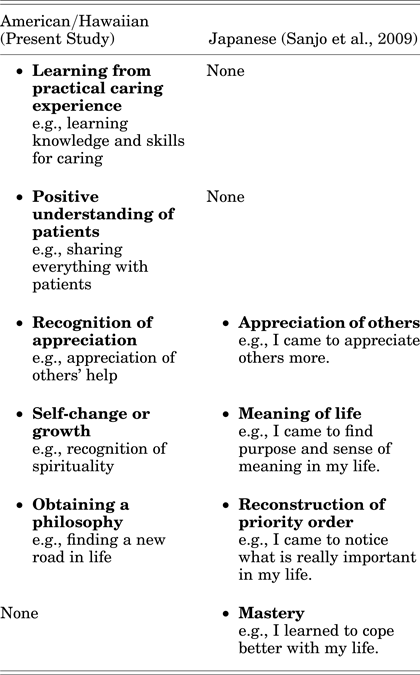
Conversely, Japanese subjects did not mention Learning from practical caring experience or Positive understanding of patients, whereas American subjects did. Bereaved American family members developed caring abilities and tried to communicate more intimately than before, whereas Japanese families expressed more difficulty in caring. Ishi and coworkers (Reference Ishii, Miyashita and Sato2012) found that caregivers feel the most difficulties with “patient's pain and condition.” Ando and colleagues (Reference Ando, Sakaguchi and Shiihara2013) suggested that difficulties in caring lead to complicated grief; however, difficulties in caring for Americans may instead lead to learning from the caring experience. The difference in research and protocol design renders further comparison inappropriate, and comparative studies using identical procedures are required.
CLINICAL IMPLICATIONS AND LIMITATIONS
We found that bereavement life review elevated spiritual well-being and alleviated depression in bereaved Hawaiian-American families. These findings suggest the potential cross-cultural applicability of this intervention, which does not require high levels of professional training. With a modicum of training in life review, community nurses who provide bereavement care (Brownhill et al., Reference Brownhill, Chang and Bidewell2013) may also find BLR useful.
There are some limitations to our present study: (1) the number of participants was small and some were Asian Americans, so our tentative comparison of cultural similarities and differences may not reflect the American population as a whole; (2) there was no control group, and this is required to confirm the efficacy of BLR, so generalization of our results requires further studies with more participants; and (3) although there were significant statistical differences, this does not always translate to clinical significance. We need to confirm the results by means of future study.
CONFLICTS OF INTEREST
The authors declare no conflicts of interest.