Introduction
My own field observations, however, lead me to believe that certain of these forms, such as the rare non-green Monotropsis odorata, sporadic as it often is in its occurrence, may be completely parasitic on the fungus; this organism in turn being further associated with some chlorophyll-bearing ericaceous plant such as Kalmia or Rhododendron (Camp, Reference Camp1940).
Species that obtain carbon from fungi, which in turn obtain their carbon from autotrophs via a mycorrhizal relationship, a tripartite association known as mycoheterotrophy (but see Appendix) and produce extremely small seeds (‘dust seeds’) with a minute undifferentiated (organless) embryo [‘reduced embryo’, sensu Teryokhin (Reference Teryokhin and Batygina2006) and referred to as ‘underdeveloped’ by Boesewinkel and Bouman (Reference Boesewinkel, Bouman and Johri1984) and Werker (Reference Werker1997)], have evolved independently multiple times and are known to occur in nine families of angiosperms (no gymnosperms): Burmanniaceae, Corsiaceae, Ericaceae, Gentianaceae, Iridaceae (including Geosiridaceae), Orchidaceae, Petrosaviaceae, Thismiaceae and Triuridaceae (including Lacadoniaceae). Merckx et al. (Reference Merckx, Mennes, Peay, Geml and Mercks2013a,Reference Merckx, Freudenstein, Kissling, Christenhusz, Stotler, Crandall-Stotler, Wickett, Rudall, Maas-van de Kamer, Maas and Merckxb) included these nine families plus Polygalaceae in their account of the ten fully mycoheterotrophic families of angiosperms. We did not include Polygalaceae (Epirixanthes spp.) in our list because the embryo is not undifferentiated; it is underdeveloped, that is with organs (sensu Grushvitzky, Reference Grushvitzky and Borris1967). See Appendix for comments on some of the terms used in this paragraph.
Thus, although Epirixanthes species have dust seeds and are mycoheterotrophic (Imhof, Reference Imhof2007; Mennes et al., Reference Mennes, Moerland, Rath, Smets and Merckx2015; Tsukaya et al., Reference Tsukaya, Suleiman and Okada2016), the embryo has small (Penzig, Reference Penzig1901) or ‘incipient’ (Verkerke, Reference Verkerke1985) cotyledons. In a study of subterranean structures of preserved specimens of plants identified as Epirixanthes with rhizome, roots and shoots, Imhof (Reference Imhof2007) showed that germination/post-germination development in this taxon into organs is morphologically and ontogenetically similar to that of some other mycoheterotrophs (Imhof et al., Reference Imhof, Massicotte, Melville, Peterson and Merckx2013). Thus, a rhizome is produced that gives rise apically to a shoot; the rhizome also gives rise to roots. Referring to Epirixanthes, Imhof et al. (Reference Imhof, Massicotte, Melville, Peterson and Merckx2013) stated that, ‘A primary root was never found’. However, it seems odd to us that germination of the dicotyledonous embryo of Epirixanthes would not be bipolar! A drawing of the embryo of Epirixanthes cylindrica [Fig. 8c in Wirz (Reference Wirz1910)] from a nearly mature seed of this species clearly shows that it is dicotyledonous.
Of these nine families of mycoheterotrophs [‘epiparasites’, sensu Björkman (Reference Björkman1960), ‘mycotrophs’ (or ‘epiparasitic mycotrophs’), sensu Furman and Trappe (Reference Furman and Trappe1971) and ‘mycoparasites’, sensu Teryokhin (Reference Teryokhin and Batygina2006) (see Appendix)] with dust seeds and an undifferentiated embryo, seed germination of Orchidaceae species has received, by far, more attention from researchers than that in the other eight families combined (see Baskin and Baskin, Reference Baskin and Baskin2014 and references cited therein). Leake (Reference Leake1994) stated that, ‘For the majority of myco-heterotrophs, nothing is known about their germination and initial stages of development’. Thus, except for the orchids, seed germination in mycoheterotrophs (MHs) that produce dust seeds with an undifferentiated embryo is best studied in the Ericaceae (Leake, Reference Leake1994; referring to tribes Monotropeae and Pterosporeae, sensu Kron et al., Reference Kron, Judd, Stevens, Crayn, Anderberg, Gadek, Quinn and Luteyn2002), and this is true today. However, considerable progress has been made in understanding seed germination in mycoheterotropic Ericaceae species since Leake's review in Reference Leake1994.
Our primary purpose was to review what is known about seed germination in Monotropoideae. A second purpose was to collect information from the literature on seed and embryo size and amount of endosperm in order to characterize dust seeds in this subfamily. Finally, it should be noted that aside from being very small, there is considerable variation among dust-size seeds in angiosperms. Thus, the third purpose of this review was to put dust seeds into a broad perspective.
Results and discussion
Mycoheterotrophy in the Ericaceae
In the Ericaceae, MH with dust seeds and an undifferentiated embryo occur in only one of the eight subfamilies recognized by Kron et al. (Reference Kron, Judd, Stevens, Crayn, Anderberg, Gadek, Quinn and Luteyn2002), namely Monotropoideae (three tribes). All 15 or 16 species in the ten genera (Wallace, Reference Wallace1975; Kron et al., Reference Kron, Judd, Stevens, Crayn, Anderberg, Gadek, Quinn and Luteyn2002; Merckx et al., Reference Merckx, Freudenstein, Kissling, Christenhusz, Stotler, Crandall-Stotler, Wickett, Rudall, Maas-van de Kamer, Maas and Merckx2013b) of tribes, Monotropeae and Pterosporeae are fully mycoheterotrophic [nongreen (achlorophyllous), nonphotosynthetic, formerly referred to as ‘saprophytes’, e.g. Furman and Trappe, Reference Furman and Trappe1971; Leake, Reference Leake1994, Reference Leake2005; Merckx et al., Reference Merckx, Bidartondo and Hynson2009; Merckx, Reference Merckx and Merckx2013]. Adults of the about 44 species in the four genera (Chimaphila, Moneses, Orthilia and Pyrola) in tribe Pyroleae, about 35 of which are in Pyrola (Freudenstein, Reference Freudenstein1999), have been reported to be either fully mycoheterotropic (one, Pyrola picta [= P. aphylla], e.g. Zimmer et al., Reference Zimmer, Hynson, Gebauer, Allen, Allen and Read2007; Hynson and Bruns, Reference Hynson and Bruns2009; Hynson et al., Reference Hynson, Preiss, Gebauer and Bruns2009) or partially mycoheterotrophic (or potentially so) (carbon derived via both mycoheterotropy and photosynthesis, also called mixotrophy, e.g. Tedersoo et al., Reference Tedersoo, Pellet, Köljalg and Selosse2007; Zimmer et al., Reference Zimmer, Hynson, Gebauer, Allen, Allen and Read2007; Selosse and Roy, Reference Selosse and Roy2009; Merckx and Freudenstein, Reference Merckx and Freudenstein2010; Hynson et al., Reference Hynson, Weiß, Preiss, Gebauer and Treseder2013b, Reference Hynson, Schiebold and Gebauer2016; Merckx, Reference Merckx and Merckx2013; Lallemand et al., Reference Lallemand, Putseppe, Lang, Luud, Courtney, Palancade and Selosse2017).
However, mixotrophy has been found to be variable within adult pyroloid species, and in some cases, for example Chimaphila umbellata and Moneses uniflora, plants are reported to be autotrophic, that is the fungal acquisition of carbon is low or absent (Johansson et al., Reference Johansson, Mikusinski, Ekblad and Eriksson2015; Selosse et al., Reference Selosse, Bocayuva, Kasuya and Martin2016). Johansson et al. (Reference Johansson, Mikusinski, Ekblad and Eriksson2015) found significant fungal-derived carbon for adult plants of Orthilia secunda and Pyrola chlorantha but not for those of C. umbellata, M. uniflora or P. minor, which suggests autotrophy in the latter three species. Tedersoo et al. (Reference Tedersoo, Pellet, Köljalg and Selosse2007), Hynson et al. (Reference Hynson, Preiss, Gebauer and Bruns2009) and Shutoh et al. (Reference Shutoh, Tajima, Matsubayashi, Tayasu, Kato, Shiga and Suetsugu2020) also reported that adults of C. umbellata are autotrophic and Zimmer et al. (Reference Zimmer, Hynson, Gebauer, Allen, Allen and Read2007) that adults of P. minor are autotrophic. Kranabetter and MacKenzie (Reference Kranabetter and MacKenzie2010) showed that O. secunda and P. asarifolia from the southern boreal forest in British Columbia, Canada, were mixotrophic and Bowler et al. (Reference Bowler, Massicotte and Fredeen2017) that O. secunda and P. chlorantha from the Sub-Boreal Spruce Moist Cool subzone of British Columbia were mixotrophic and C. umbellata autotrophic. Shutoh et al. (Reference Shutoh, Kaneko, Suetsugu, Naito and Kurosawa2016) found various degrees of mycoheterotrophy in P. japonica.
Based on enrichment in both 13C and 15N, M. uniflora from the Olympic Peninsula, WA (USA) is a partial mycoheterotroph (Hynson et al., Reference Hynson, Bidartondo and Read2015). However, plants of this species from Scotland and Sweden were enriched in 15N but not in 13C, what Hynson et al. (Reference Hynson, Bidartondo and Read2015) called ‘cryptic mycoheterotrophy’. According to Tedersoo and Brundrett (Reference Tedersoo and Brundrett2017), mixotrophy is present in adults of nearly all species of Pyrola, O. secunda and M. uniflora, but ‘ … Chimaphila appears to gain little carbon from forest trees via EcM [ectomycorrhizal] fungi’. Lundell et al. (Reference Lundell, Cousins and Eriksson2015) state that, ‘Whether C. umbellata continues to parasitize on fungi as an adult is unclear’. Further, there is variation in mixotrophy due to ontogenetic shifts, that is between the germination/seedling (subterranean and fully mycoheterotrophic) and adult stages (partially mycoheterotrophic or even autotrophic) of the life cycle (Lallemand et al., Reference Lallemand, Gaudeul, Lambourdière, Matsuda, Hashimoto and Selosse2016; Johansson et al., Reference Johansson, Bahram, Tedersoo, Kõljalg and Eriksson2017).
All mycoheterotrophic species germinate symbiotically, that is requiring the presence of fungi, and thus are initially mycoheterotrophic (Massicotte et al., Reference Massicotte, Melville, Tackaberry and Peterson2007; Tedersoo et al., Reference Tedersoo, Pellet, Köljalg and Selosse2007; Zimmer et al., Reference Zimmer, Hynson, Gebauer, Allen, Allen and Read2007; Hynson and Bruns, Reference Hynson and Bruns2009; Hynson et al., Reference Hynson, Preiss, Gebauer and Bruns2009, Reference Hynson, Jolles and Madsen2012a,Reference Hynson, Mambelli, Amend and Dawsonb; Selosse and Roy, Reference Selosse and Roy2009; Matsuda et al., Reference Matsuda, Shimizu, Mori, Ito and Selosse2012; Johansson and Eriksson, Reference Johansson and Eriksson2013; Merckx, Reference Merckx and Merckx2013; Johansson et al., Reference Johansson, Műller and Eriksson2014). Johansson and Eriksson (Reference Johansson and Eriksson2013) and Johansson et al. (Reference Johansson, Műller and Eriksson2014) (also see Hynson et al., Reference Hynson, Jolles and Madsen2012a,Reference Hynson, Mambelli, Amend and Dawsonb; Merckx, Reference Merckx and Merckx2013) state that seedlings of Pyroleae are subterranean and require a fungal host for seed germination and seedling development. The seedlings remain belowground for several years before production of a green shoot. Thus, ‘Pyroleae species are fully mycoheterotrophic during subterranean juvenile development’ (Johansson et al., Reference Johansson, Műller and Eriksson2014, Reference Johansson, Bahram, Tedersoo, Kõljalg and Eriksson2017).
Seeds of Monotropoideae
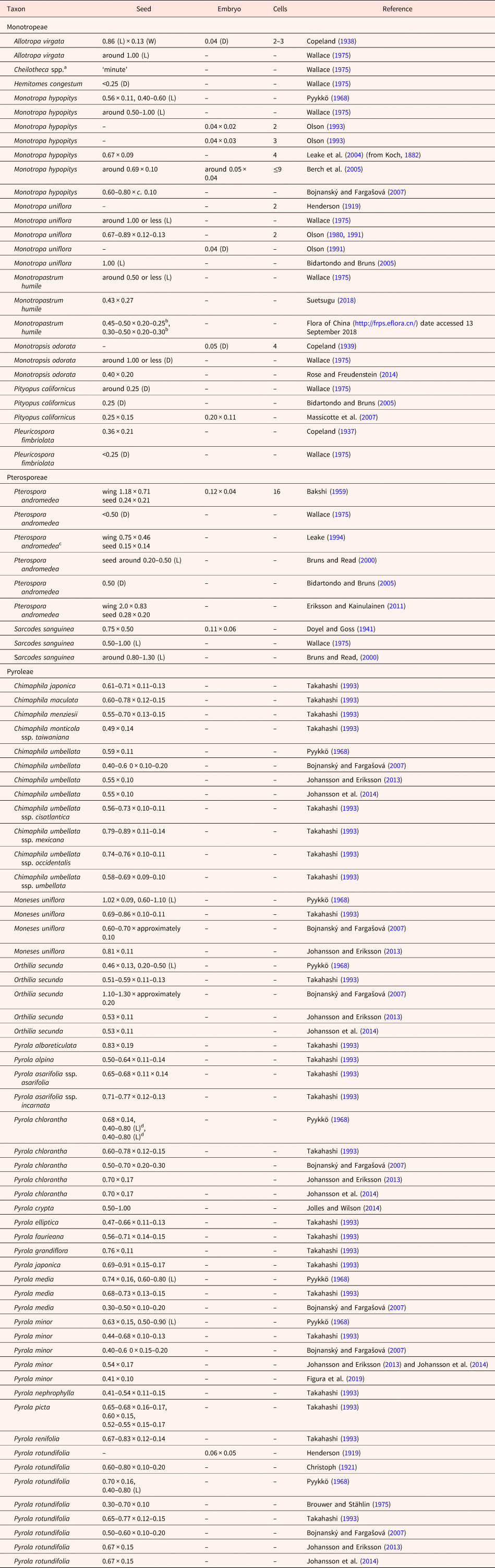
Seed dimensions or to-scale drawings or photographs (from which we calculated seed size) were found for 13 of the 14 genera of Monotropoideae (Table 1), the exception being Cheilotheca (scale not included in publications with illustrations of seeds that we have seen). However, Wallace (Reference Wallace1975) described seed size in this Asian genus as ‘minute’. We found information on both embryo dimension(s) and number of cells for four of the 14 genera and on embryo dimension(s) only for those of three genera (Table 1). In addition, Johri et al. (Reference Johri, Ambegaokar and Srivastava1992a) reported that the embryo in Monotropeae consists of three to four cells, and Henderson (Reference Henderson1919) reported that the embryo in Pyrolaceae (tribe Pyroleae, sensu Kron et al., Reference Kron, Judd, Stevens, Crayn, Anderberg, Gadek, Quinn and Luteyn2002) consists of 25–30 cells, the embryo in Monotropaceae (tribes Monotropeae and Pterosporeae, sensu Kron et al., Reference Kron, Judd, Stevens, Crayn, Anderberg, Gadek, Quinn and Luteyn2002) 5 or 9 cells (but 5 or 9 seems to be based on the number of cells reported for Monotropa hypopitys [syn. Hypopitys monotropa]) and the embryo in Chimaphila ‘several cells’. However, Olson (Reference Olson1993) found that the number of cells in the embryo of M. hypopitys originating from Canada, USA and Sweden was two and rarely three. He stated that ‘ … only one mature embryo out of several hundred examined consists of more than two cells. Such rare embryos are composed of three cells arranged in a linear configuration’.
A survey of seed and embryo sizes (length × width, mm) of the three tribes of Ericaceae subfamily Monotropoideae

Cells, total number in embryo; D, diameter; L, length; W, width; –, no data.
a There are three accepted species of Cheilotheca: C. khastiana, C. malayana and C. sleumerana (The Plant List, accessed 12 September 2018).
b These two measurements are for Cheilotheca humilis and Cheilotheca macrocarpa, respectively, both of which are synonyms for the accepted name Monotropastrum humile (The Plant List, accessed 12 September 2018). As indicated in the table, we have not found measurements for seeds of any of the three accepted species of Cheilotheca.
c Figure 6a in Leake (Reference Leake1994) is a drawing of a seed (with wing) of Pterospora andromedea that was ‘(redrawn from Bakshi, Reference Bakshi1959)’. Our calculations of wing L × W and seed (without wing) L × W from the drawing in Leake (Reference Leake1994) are 0.75 × 0.46 and 0.15 × 0.14 mm, respectively. The actual size of the drawings in the two papers is the same or nearly so. However, Bakshi (Reference Bakshi1959) says the drawing in his paper is x38, whereas Leake (Reference Leake1994) says the one in his paper is x59. We suggest that the enlargement in Leake (Reference Leake1994) is incorrect (i.e. x59 is too high). Thus, although wing size in Bakshi (Reference Bakshi1959) is considerably smaller than the one on a P. andromedea seed in Eriksson and Kainulainen (Reference Eriksson and Kainulainen2011), seed sizes (without wing) in these two papers, as given in our Table 1, are very similar.
d Seeds from two sites.
For the Monotropoideae, Kron et al. (Reference Kron, Judd, Stevens, Crayn, Anderberg, Gadek, Quinn and Luteyn2002) described the embryo as ‘small, with 2 cotyledons, or minute and not differentiated’. They described the embryo of Pyroleae as ‘small, with 2 cotyledons’; that in Monotropeae as ‘minute, undifferentiated, with <30 cells’ and that in Pterosporeae as ‘minute, undifferentiated, with 30–40 cells’. Yet, in the matrix table for morphological traits, Kron et al. (Reference Kron, Judd, Stevens, Crayn, Anderberg, Gadek, Quinn and Luteyn2002) used in their phylogenetic analysis of the Ericaceae, they assign the embryos in the four genera of Pyroleae a character state of 1, that is ‘undeveloped with 30–40 cells’. Embryos in the six species of Monotropeae in this table and those in the two species of Pterosporeae are assigned a character state of 2, that is ‘extremely undeveloped, with approximately 10 cells’. Thus, embryos in none of the 12 species in the matrix table of Monotropoideae are assigned a character state of 0, that is ‘well developed, with 2 cotyledons’.
In sum, the data in Table 1 clearly document the very small to minute size of the seeds and the minute size of the embryos in Monotropoideae. In almost all cases, seeds are <0.9 mm in the greatest dimension. The sizes of the embryos are minute. The smallest ones are those of Allotropa virgata, M. hypopitys and Monotropa uniflora, that is 2–3 cells and 0.038 mm in diameter, 2–3 cells and 0.04 × 0.02 (or 0.03) in size (L × W) and 2 cells and 0.042 in diameter, respectively.
In addition to measurements of (a) dimension(s) on seeds and embryos of Monotropoideae (Table 1), it is of interest to consider the embryo length:seed length (E:S) ratio. In A. virgata, the endosperm (with embryo embedded):seed ratio is 0.21, the embryo:endosperm ratio is 0.21 and the embryo:seed ratio is 0.04 [determined from figures 41 and 42 in Copeland (Reference Copeland1938)]. The endosperm (with embryo embedded):seed ratio in M. hypopitys is 0.23, the embryo:endosperm ratio is 0.38 and the embryo:seed ratio is 0.06 [determined from figures 1–2 and 1–3 in Berch et al. (Reference Berch, Massicotte and Tackaberry2005)]. In M. uniflora, the endosperm (with embryo embedded):seed ratio is 0.18, the embryo:endosperm ratio is 0.29 and the embryo:seed ratio is 0.05 [determined from figures 1 and 4 in Olson (Reference Olson1980)].
However, in some publications on Monotropoideae, one can determine (from to-scale drawings) only the endosperm (with embryo embedded in it and not distinguishable in whole-seed or whole-endosperm/embryo view) length and seed length. From drawings of seeds in a paper by Pyykkö (Reference Pyykkö1968), we determined the endosperm (with embryo embedded):seed ratio of species in the four genera of Pyroleae (from figures 45–52) as follows: C. umbellata, 0.33; M. uniflora, 0.19; O. secunda, 0.27; P. chlorantha, 0.27; P. media, 0.23; P. minor, 0.25 and P. rotundifolia, 0.22 and of the tribe Monotropeae M. hypopitys, 0.20. Takahashi (Reference Takahashi1993, Table 2) provides measurements for endosperm and seed length but not embryo length for 24 species of the four genera of Pyroleae: five species of Chimaphila, the one species of Moneses, the one species of Orthilia and 17 species of Pyrola. From his data, we determined the endosperm (with embryo embedded) length:seed length ratio for each species in the four genera by calculating the inverse of his average seed length (l)/average endosperm length (el), that is 1/(l/el) = el/l: Chimaphila, 0.17–0.27; Moneses, 0.16; Orthilia, 0.22 and Pyrola, 0.16–0.39. From the photograph of M. hypopitys seeds in figure 1a in Leake et al. (Reference Leake, Kendrick, Bidartondo and Read2004), we determined that the endosperm (with embryo embedded) length:seed length ratio was 0.25.
The fact that the dust seeds of many Monotropoideae species are elongated (i.e. high length:width ratio) and the endosperm–embryo occupies only a small portion of the length of the seed means that a lot of the seed volume is free air space (% free air space = [(seed volume – embryo volume)/(seed volume)] × 100). This is also true for seeds of many orchids (up to ≥90%) with a low embryo length:seed length ratio (Curtiss, Reference Curtiss1893; Kurzweil, Reference Kurzweil1993; Arditti and Ghani, Reference Arditti and Ghani2000; Swamy et al., Reference Swamy, Kuma, Ramakrishna and Ramaswamy2004; Tsutsumi et al., Reference Tsutsumi, Yukawa, Lee, Lee and Kato2007; Akçin et al., Reference Akçin, Ozdener and Akçin2009; Verma et al., Reference Verma, Kusum, Thakus, Sembi and Vij2012, Reference Verma, Sharma, Thakur, Sembi and Vij2014; Barthlott et al., Reference Barthlott, Große-Veldmann and Korotkova2014; Chaudhary et al., Reference Chaudhary, Chattopadhyay and Banerjee2014; Diantina et al., Reference Diantina, McGill, Millner, Nadarajan, Pritchard and McCormick2020). Leake et al. (Reference Leake, Kendrick, Bidartondo and Read2004) stated that, ‘The most striking similarity [of the seed of M. hypopitys] to orchid seed is the elongated and inflated testa that very loosely encloses the seeds’. We have not found measurements of seed or embryo volume of Monotropoideae.
No endosperm is present in mature seeds of almost all species of orchids; endosperm development is suppressed in the early stages of its development (Swamy, Reference Swamy1949; Vinogradova and Andronova, Reference Vinogradova, Andronova, Kull and Arditt2002; Yam et al., Reference Yam, Yeung, Ye, Zee, Arditti, Kull and Arditt2002). Based on a study of seed formation in Cypripedium parviflorum (embryo length:seed length ratio is 0.16), Carlson (Reference Carlson1940) reported that the embryo (no endosperm in mature seeds; also see Pace, Reference Pace1907) is suspended in the centre of the seed cavity (free air space) by strands of cells. The large amount of free air space in the dust seeds of orchids and Pyroleae facilitates dispersal by wind (Arditti and Ghani, Reference Arditti and Ghani2000; Fan et al., Reference Fan, Chomicki, Hao, Liu, Xiong, Renner, Gao and Huang2020).
We have found a few reports on the size of the endosperm in Monotropoideae: A. virgata, few-celled (Copeland, Reference Copeland1938); Chimaphila, a few large cells (Henderson, Reference Henderson1919); M. hypopitys, a very few large cells (Henderson, Reference Henderson1919); M. uniflora, 10–14 tightly packed cells (Olson, Reference Olson1980, Reference Olson1991); Monotropeae, 9–10 cells (Johri et al., Reference Johri, Ambegaokar and Srivastava1992a); M. odorata, few cells (Copeland Reference Copeland1939); Pityopus californicus, no endosperm (Massicotte et al., Reference Massicotte, Melville, Tackaberry and Peterson2007); Pterosporeae, 30–40 cells (Johri et al., Reference Johri, Ambegaokar and Srivastava1992a); Pyrolaceae, relatively few large cells (Henderson, Reference Henderson1919); Pyroleae, single layer of cells (Copeland, Reference Copeland1947) [but Pyykkö (Reference Pyykkö1968) says ‘Sometimes, but not always [emphasis ours], the embryo has absorbed all the endosperm except a single layer of cells’.] and Sarcodes, many cells (Copeland, Reference Copeland1933).
Seed germination in the Monotropoideae
In a study by Bakshi (Reference Bakshi1959), no fresh viable seeds of Pterospora andromedea (tribe Pterosporeae) germinated in any of 33 treatments, which included, for example, placing seeds at 4°C and room temperature on media with Hoaglands solution, dextrose, sucrose, vitamins and various combinations thereof. None of the treatments included a fungal associate. Also, no seeds germinated when sown in pots of soil collected from the rooting zone of P. andromedea that were ‘ … implanted under a Picea pungens tree’.
However, Rhizopogon species isolated from roots of Pterospora or Sarcodes (tribe Pterosporeae) plants in flower stimulated germination in both species: 0–13% for Pterospora and 9–73% for Sarcodes (22°C, dark) (Bruns and Read, Reference Bruns and Read2000). No seeds germinated on media without the presence of Rhizopogon species or with the presence of six other genera of Basidomycetes. Most experiments were done with seeds that had been stored for 6–8 months at 5°C in Ziplock plastic bags containing silica gel packets. Seeds of Sarcodes from fruits that overwintered in the field also were stimulated to germinate, but those of Pterospora were not viable. For these two species, Bruns and Read (Reference Bruns and Read2000) reported that the germinated seed (embryo/‘hypocotyl’ emerging mycorrhizal or branched, their stage 3) was associated with fungal hyphae, but that ‘ … hyphae contact was not necessary to reach this stage’. These authors presented evidence for stimulation of germination of Sarcodes sanguinea seeds by a diffusible substance (no direct contact) from the fungus Rhizopogon ellenae.
Leake et al. (Reference Leake, Kendrick, Bidartondo and Read2004) described the germination and development of M. hypopitys (tribe Monotropeae) based on observations of exhumed seeds buried in packets in soil on two coastal dune slacks in the UK dominated by Salix repens scrub within which there were large populations of M. hypopitys. The sequence of events is as follows: nongerminated seed (stage 0); rupturing of seed coat and the emergence of tissue at the radicular end of the embryo and fungal colonization of the seeds in the earliest stages of germination (stage 1) (exhumed after 6 and 7 months of burial at sites 1 and 2, respectively) [Further seedling development depended on colonization by a symbiotic fungal partner.]; embryo elongation and organization of a root apical meristem and development of a fungal mantle surrounding the nonbranched embryo (stage 2) (buried 6 and 9 months, respectively); branched seedlings with one to four side roots that arose from the main root (stage 3a) (buried 9 and 13 months, respectively); branched seedlings with five or more side roots (stage 3b) (buried 13 and 14 months, respectively) and seedling with adventitious shoot buds (stage 4) (buried 25 and 26 months, respectively) from which the inflorescence (shoot) that emerges aboveground is produced by the seedling root system. Thus, shoot buds are produced adventitiously and not by an apical meristem, as occurs, for example in the protocorm of orchids. Further, the development of the plant beyond the earliest germination stage was dependent upon colonization by a fungal symbiont, first shown for M. hypopitys by Francke (Reference Francke1934).
Germination of M. hypopitys seeds in the burial plots was enhanced by the presence of adults of this species or by an S. repens cover (Leake et al., Reference Leake, Kendrick, Bidartondo and Read2004). Furthermore, in the absence of plants of these two species, germination of M. hypopitys seeds did not develop beyond the initial phase of stage 1, whereas in the presence of either M. hypopitys or S. repens seedlings advanced up to stage 4 (see above). Enhancement of germination was due to the presence of two fungal-symbiont Tricholoma species in plots with M. hypopitys and S. repens. Thus, although germination in M. hypopitys can be initiated without fungal infection, it cannot continue beyond the earliest phase of stage 1 (see above) without it. Finally, viable seeds were present in the packets 33 months after burial. Thus, seeds of M. hypopitys can form a persistent soil seed bank.
Bidartondo and Bruns (Reference Bidartondo and Bruns2005) buried packets of seeds of eight species of Monotropeae [A. virgate, Hemitones congestum, M. hypopitys, M. uniflora, P. californicus, Pleuricospora fimbriolata (Monotropoideae), P. andromedea and S. sanguinea (Pterosporeae)] in several native forest sites in the USA near mature Monotropoideae plants or in sites known to contain host fungi. The packets were exhumed over a 2-year period and germination status of the seeds categorized. They recognized the following stages in germination: nongerminated seed → seed coat cracked → embryo/‘hypocotyl’ emerging mycorrhizal → seedling branching. Most nongerminated seeds were viable after burial in soil for 2 years. The best germination (approximately 15%) was for M. uniflora. Each seedling was associated with a single fungal lineage and exclusively with the same fungal genus as the maternal plant. Thus, ‘ … germination is only induced by the same fungus that associates with mature plants or by closely related congeners … ’.
Massicotte et al. (Reference Massicotte, Melville, Tackaberry and Peterson2007) buried the packets of Pityopus californicus (Monotropeae) seeds in soil in the field for up to 681 days near in situ Monotropoideae plants, after which they were exhumed and examined for fungal colonization, embryo growth and germination. The following stages in colonization by fungi and germination were observed: (1) fungal hyphae on the surface of seed coat and between embryo and seed coat; (2) elongation of embryo with an apical root meristematic region and well-developed fungal mantle and (3) root development with an extensive fungal mantle. The presence of fungi on the embryo before it began to grow and develop suggested that fungal colonization was necessary for embryo growth and thus germination.
In a buried seed study of Pyrola asarifolia (tribe Pyroleae), Hashimoto et al. (Reference Hashimoto, Fukukawa, Kunishi, Suga, Richard, Sauve and Selosse2012), also see commentary by Hynson et al. (Reference Hynson, Jolles and Madsen2012a), recognized the following sequential stages in germination/seedling development of this mixotrophic species: (1) nongerminated seed, stage 0; (2) growth (new tissue added to embryo; germination starts with fungal penetration inside the seed), stage 1; (3) elongation of embryo (<2 mm) cracking the seed coat, stage 2; (4) 2–10 mm long seedling (root-like structure) without branching, stage 3; (5) elongated 10–20 mm seedling without branching, stage 4 and (6) elongated branched ‘seedling’, stage 5. Germination started with fungal invasion of the seed and growth of the embryo inside the seed. Seedlings were associated only with very closely related fungi in Sebacinales clade B. However, these results do not agree with those of Hynson et al. (Reference Hynson, Weiß, Preiss, Gebauer and Treseder2013b), who found in an in situ burial experiment a diversity of fungi capable of association with the pyroloids O. secunda and P. chlorantha (tribe Pyroleae) in the initial stages of mycoheterotrophy (germination), that is a diversity of fungi was involved in germination. In their study, ‘A seed was considered germinated when the testa was broken and the embryo was enlarged or emerging’. After 2 years of burial, only a very low percentage of the seeds of both species were recorded as germinated.
Packets of seeds of C. umbellata, M. uniflora, O. secunda, P. chlorantha, P. minor and P. rotundifolia (tribe Pyroleae) were buried in plots at field sites in Sweden with and without the presence of the conspecific adult plants and later exhumed and checked for germination (Johansson and Eriksson, Reference Johansson and Eriksson2013). C. umbellata, O. secunda and P. chlorantha clearly germinated to a higher percentage (but maximum around 25%) in close proximity to the respective adult plants, whereas in the other three species, the results (maximum germination <20%) were not so clear. The authors stated that, ‘Seedlings [seeds] experienced extensive fungal colonization, after which the testas ruptured and a root-like colourless structure was formed’. Results of the effect of soil pH and nutrients and of seed limitation versus microsite limitation on recruitment were mixed.
In another study in Sweden, Johansson et al. (Reference Johansson, Bahram, Tedersoo, Kõljalg and Eriksson2017) buried the seeds of M. hypopitys, C. umbellata, M. uniflora, P. chlorantha and P. rotundifolia in plots with and without the presence of conspecific adults. Seeds were exhumed in autumn in each of 3 years and scored for germination/seedling development and the diversity of EcM fungi associated with germinated seedlings. Overall, the effects of the presence of adults nearby on germination were variable. Germination in a given year ranged from up to 40% for P. rotundifolia to less than or equal to approximately 15% for M. hypopitys, M. uniflora and C. umbellata. Seedlings of all five species were associated with a diversity of EcM fungi. Stages of seed germination/seedling development recognized by these authors were nongerminated seed (stage 0), cracks in seed coat caused by embryo growth (seedling <2 mm) (stage 1), unbranched seedling 2–10 mm long (stage 2), unbranched seedling 10–20 mm (stage 3) and branched seedling (stage 4).
Jacquemyn et al. (Reference Jacquemyn, Waud and Brys2018) compared the germination of seeds of P. rotundifolia during burial in a reciprocal seed transplant study between populations in an inland temperate deciduous forest and coastal sand dunes/dune slacks in Belgium. Native and nonnative seeds to the two populations were buried reciprocally for 2 years in three forest and three dune subpopulations (replicates). The authors tested the hypothesis that differences in species composition of the soil fungal community between forest and dunes were acting as selective agents in the early stages of speciation of P. rotundifolia. Their idea was that the soil fungi differed between the two habitat types (populations), which they found it did, and that the fungi at one site would be more conducive to germination of its native seeds than to immigrant (nonnative) seeds from the other site. Overall, Jacquemyn et al. (Reference Jacquemyn, Waud and Brys2018) found that natives germinated somewhat better than nonnatives. After 2 years of burial, there were, on average, more seedlings from native than from nonnative seeds in packets from five of the six subpopulations. However, germination (well-developed seedlings) percentages were very low. Twenty-eight packets (14 native and 14 nonnative) of 250 seeds each were buried in each of the six subpopulations (28 × 250 × 6 = 42,000 seeds); 159 of the 168 seed packets were retrieved at the end of the 2-year study. One to thirty-five seedlings were present in 148 of the 159 packets retrieved. Using data in Fig. 4 of Jacquemyn et al. (Reference Jacquemyn, Waud and Brys2018), we calculated that 1344 seedlings germinated from the 42,000 seeds buried: (1344/42,000) × 100 = 3.2% germination. Considering that only 159 of 168 seed packets buried were retrieved increases germination a bit: 159 × 250 (seeds/packet) = 39,750 (seeds retrieved) and (1344/39,750) × 100 = 3.4% germination. The authors concluded that selection against immigrants may be a reproductive barrier in the beginning of speciation of P. rotundifolia. In other words, seeds produced in the native population (forest or dunes) are better adapted to promotion of dormancy break/early seedling growth by fungi in the native habitat than are immigrants from the nonnative habitat, suggesting local or ecotypic adaptation for P. rotundifolia.
Figura et al. (Reference Figura, Tylová, Šoch, Selosse and Ponert2019) did an extensive in vitro study on nine different sterile media of asymbiotic germination and post-germination development of representatives of all four genera of tribe Pyroleae (sensu Kron et al., Reference Kron, Judd, Stevens, Crayn, Anderberg, Gadek, Quinn and Luteyn2002). They concluded that, ‘Germination is probably driven mostly by physical dormancy [PY, water-impermeable seed coat] because gibberellins [GA3] had little effect on germination, while intensive pretreatment (chemical scarification) of seeds greatly improved germination’. However, it is very unlikely that the seeds of pyroloids have PY. Ericaceae is not among the 18 families of angiosperms (no gymnosperms) in which PY has been documented (or strongly inferred based on seed coat anatomy). Breaking seed dormancy by scarification of the seed or fruit coat does not prove that the seeds/fruits are water impermeable. Scarification can break dormancy in water-permeable seeds/fruits, for example those with nondeep physiological dormancy (Baskin and Baskin, Reference Baskin and Baskin2014). The authors did not show that the pyroloid seeds are water impermeable by comparing imbibition of intact versus scarified seeds. Furthermore, the seeds do not have the correct anatomy to prevent water-uptake, that is they do not have a water-impermeable palisade layer in the seed coat (Corner, Reference Corner1976) nor a specialized structure called a water gap (Gama-Arachchige et al., Reference Gama-Arachchige, Baskin, Geneve and Baskin2013), which are characteristic of seeds/fruits with PY (Baskin and Baskin, Reference Baskin and Baskin2014; Geneve et al., Reference Geneve, Baskin, Baskin, Jayasuriya and Gama-Arachchige2018). According to the dichotomous key to distinguish nondormancy from the various kinds of dormancy in Baskin and Baskin (Reference Baskin and Baskin2014, Table 3.6), seeds of the pyroloids have either a kind of specialized morphological dormancy or of specialized morphophysiological dormancy. Based on the work of Figura et al. (Reference Figura, Tylová, Šoch, Selosse and Ponert2019), we suggest that seeds of the pyroloids they studied had a kind of specialized morphophysiological dormancy.
Holm (Reference Holm1898) stated that ‘ … Chimaphila maculata (tribe Pyroleae) germinates in the same way as the majority of other dicotyledons’. Holm described and figured what he concluded was a seedling of C. maculata, which he collected in the field near mature plants of the species. The seedling had a long hypocotyl, two normal (epigeal) cotyledons and a main (primary) root with root hairs and a pair of secondary roots. However, according to Henderson (Reference Henderson1919), ‘In the Ericaceae [Ericaceae s.s., i.e. not including Monotropoideae, sensu Kron et al., Reference Kron, Judd, Stevens, Crayn, Anderberg, Gadek, Quinn and Luteyn2002] the seeds are small with abundant endosperm and a well-formed embryo; reduced in size but increased in number in the Pyrolaceae [= tribe Pyroleae, sensu Kron et al., Reference Kron, Judd, Stevens, Crayn, Anderberg, Gadek, Quinn and Luteyn2002] with a less developed endosperm with larger and fewer cells, and a formless embryo composed of about 25–30 cells; still further reduced and more numerous in Monotropaceae [= tribes Monotropeae and Pterosporeae, sensu Kron et al., Reference Kron, Judd, Stevens, Crayn, Anderberg, Gadek, Quinn and Luteyn2002] with an endosperm consisting of a few large cells and very small embryo composed of 9–5 cells’.
Thus, Holm's (Reference Holm1898) description of the seedling of what he thought was C. maculata does not agree with that of a seedling that would have come from the embryo of a species of Pyroleae described by Henderson (Reference Henderson1919). Further, in agreement with Henderson, Copeland (Reference Copeland1947) stated that the ripe seeds of Pyroleae contain an undifferentiated (i.e. organless) embryo covered by a single layer of cells of endosperm. Obviously, the dicotyledonous seedling described and figured by Holm came from an embryo with bipolar (plumular-radicular) growth during germination, not from monopolar (radicular) growth that occurs in Pyroleae (Teryokhin and Nikiticheva, Reference Teryokhin and Nikiticheva1982). According to Teryokhin (Reference Teryokhin and Batygina2006), reduced (= our undifferentiated) embryos occur in ‘ … all species of Chimaphila, Moneses, Orthilia, Pyrola [i.e. in all species in the four genera of tribe Pyroleae]’. Thus, we conclude that the seedling described and figured by Holm (Reference Holm1898) was not that of C. maculata.
The only species of mycoheterotrophs besides Monotropoideae and orchids that produces dust seeds with an undifferentiated embryo whose germination and ontogeny have been described in some detail appears to be Afrothismia hydra in the Thismaceae (Imhof and Sainge, Reference Imhof and Sainge2008; Imhof et al., Reference Imhof, Massicotte, Melville, Peterson and Merckx2013). In this species, germination consists of primary root tubercle (with a filiform extension) development splitting through the seed coat and emerging free of it. In the next stage, ‘ … this initial tubercle has grown a short tail-like extension (only about 150 μm long) and is fully packed with whitish material, which can be interpreted as mycorrhizal fungus … ’ (Imhof and Sainge, Reference Imhof and Sainge2008). Eventually, the successive development of root tubercles elongated by a filiform extension results in dense aggregates of small ‘tuberous roots’, a common axis that gives rise to a shoot axis (rhizome) terminated in a 1-cm-long flower/fruit. Thus, germination in this species is via root tissue only, and the shoot is produced adventitiously.
Putting dust seeds into perspective
According to Arditti and Ghani (Reference Arditti and Ghani2000), dust seeds ‘ … simply means the seeds are small’ (p. 368). Thus, based on size only, dust seeds are not restricted to mycoheterotrophs and holoparasites with undifferentiated embryos and monopolar germination. Eriksson and Kainulainen (Reference Eriksson and Kainulainen2011) included the autotrophic families Buddlejaceae, Gesneriaceae [Peltanthera, Buddlejaceae, sensu Norman (Reference Norman2000), but Gesneriaceae, sensu Oxelman et al. (Reference Oxelman, Backlund and Bremer1999)], Polygalaceae and Rubiaceae in their list of taxa that produced dust seeds. The embryo in Buddlejaceae and Polygalaceae [except for Epirixanthes (see the Introduction section)] is differentiated and fully developed, and the embryo in Rubiaceae is differentiated and either underdeveloped or fully developed (Martin, Reference Martin1946; Robbrecht, Reference Robbrecht1988; Athugala et al., Reference Athugala, Jayasuriya, Gunaratne and Baskin2016; Baskin and Baskin, unpublished embryo database). Thus, germination in these three families is bipolar. Referring to the Buddlejaceae, Johri et al. (Reference Johri, Ambegaokar and Srivastava1992b, p. 716) state that, ‘ … the embryo is small with leafy cotyledons’.
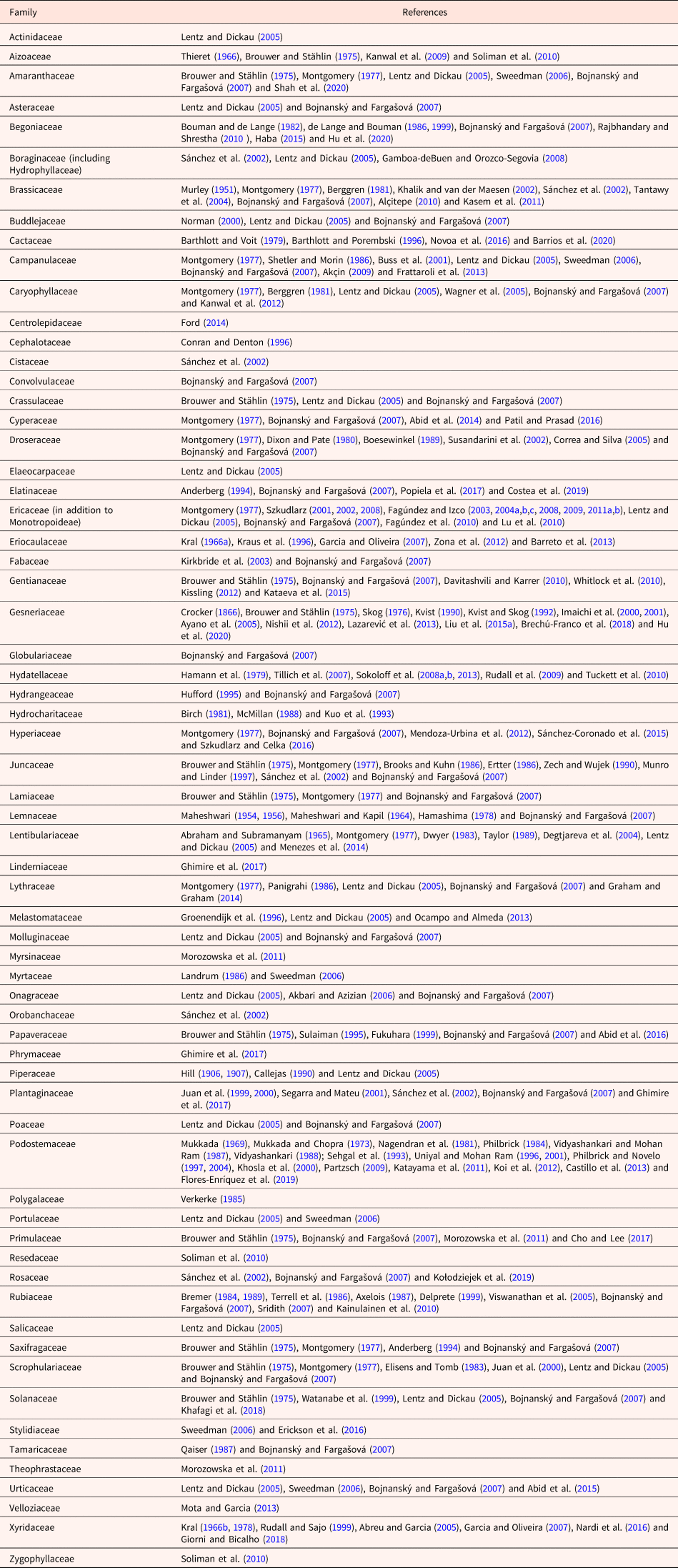
Using a conservative criterion of diaspore size <1.00 mm in greatest dimension, we have identified via a (nonexhaustive) literature search 65 autotrophic families containing at least a few taxa that produce dust-size seeds with bipolar germination (Table 2). These families occur in ANA-grade basal angiosperms (Hydatellaceae), magnoliids (Piperaceae), monocots (9 families) and eudicots (54 families) (sensu APG-IV, 2016). Most of these autotrophic families (or portions thereof) with dust-size seeds have differentiated fully developed embryos. However, some species of Lentibulariaceae and Podostemaceae have reduced embryos (see below), and those of Centrolepidaceae, Eriocaulaceae, Hydatellaceae (see below), Piperaceae, Utricularia (Lentibulariaceae) and Xyridaceae are undifferentiated (organless) (Baskin and Baskin, Reference Baskin and Baskin2018, unpublished embryo database). Some hemiparasites (facultative and obligate) are chlorophyllous (photosynthetic) and have dust seeds, a differentiated embryo and bipolar germination. Examples of hemiparasites (embryo fully developed) include Striga spp. in the family Orobanchaceae (Michell, Reference Michell1915; Tiagi, Reference Tiagi1956; Puff, Reference Puff1978; Press et al., Reference Press, Shah, Tuohy and Stewart1987; Krause and Weber, Reference Krause and Weber1990; Titova, Reference Titova and Batygina2006; Irving and Cameron, Reference Irving and Cameron2009; Těšitel et al., Reference Těšitel, Plavcová and Cameron2010; Joel and Bar, Reference Joel, Bar, Joel, Gessel and Musselman2013; Dong et al., Reference Dong, Wang, Worthley, Li and Lu2015) and various genera and species in tribe Rhinantheae of Orobanchaceae (McNeal et al., Reference McNeal, Bennett, Wolfe and Mathews2013; Dong et al., Reference Dong, Wang, Worthley, Li and Lu2015).
Sixty-five autotrophic angiosperm families in which dust-size seeds (<1 mm) occur in at least some species

Trithuria is the only genus in the ANA-grade family Hydatellaceae (Nymphaeales) and consists of 12 species classified into four sections (two in a tropical clade and two in a temperate/subtropical clade) (Sokoloff et al., Reference Sokoloff, Remizowa, Macfarland and Rudall2008a,Reference Sokoloff, Remizowa, Macfarland, Yoder and Rudallb, Reference Sokoloff, Remizowa, Beer, Yadav, Macfarland, Ramsay and Rudall2013, Reference Sokoloff, Remizowa, Conran, Macfarland, Ramsay and Rudall2014; Iles et al., Reference Iles, Rudall, Sokoloff, Remizowa, Macfarlane, Logacheva and Graham2012). The seeds are very small {i.e. 0.42 (L) × 0.24 mm (W) in T. inconspicua (Hydatella inconspicua) [determined from Fig. 9 in Hamann et al. (Reference Hamann, Kaplan and Rűbsamen1979)]; 0.64 × 0.24 mm in T. submersa and 0.44 × 0.24 mm in T. bibracteata [determined from Fig. 1c, f in Tillich et al. (Reference Tillich, Tuckett and Facher2007)]; 0.61 × 0.22 mm in T. submersa [determined from Fig. 8b in Rudall et al. (Reference Rudall, Eldridge, Trat, Ramsay, Tuckett, Smith, Collinson, Remizowa and Sokoloff2009)]; 0.50 × 0.34 mm in T. austenensis and 0.69 × 0.28 mm in T. submersa [from Table 2 in Tuckett et al. (Reference Tuckett, Merritt, Rudall, Hay, Hopper, Baskin, Baskin, Tratt and Dixon2010)]; 0.30 × 0.22 mm in T. konkanensis [from Fig. 6a, b in Sokoloff et al. (Reference Sokoloff, Remizowa, Beer, Yadav, Macfarland, Ramsay and Rudall2013)] and 0.25 × 0.20 mm in T. konkanensis [from Fig. 6g in Sokoloff et al. (Reference Sokoloff, Remizowa, Beer, Yadav, Macfarland, Ramsay and Rudall2013)]}. Sokoloff et al. (Reference Sokoloff, Remizowa, Macfarland and Rudall2008a) gave the following measurements for fruits in their description of four new species of Trithuria (seeds in all of the species completely filled the one-seeded fruits): T. austinensis, 0.40–0.60 mm long; T. cookeana, 0.30 mm long; T. cowieana, 0.30–0.40 mm long and T. polybracteata, 0.20–0.25 mm long. The short and broad embryo is minute [(e.g. 0.043 (L) × 0.083 mm (W) in T. austenensis and 0.042 × 0.090 mm in T. submersa (Table 2 in Tuckett et al. (Reference Tuckett, Merritt, Rudall, Hay, Hopper, Baskin, Baskin, Tratt and Dixon2010))], and most of the seed volume is a starchy perisperm. A small amount of endosperm surrounds the broad embryo (sensu Baskin and Baskin, Reference Baskin and Baskin2018) and functions to transfer food stored in the perisperm to the embryo (Friedman et al., Reference Friedman, Bachelier and Hormaza2012). Friedman et al. (Reference Friedman, Bachelier and Hormaza2012) suggest that this endosperm–perisperm combination may be pleisiomorphic in angiosperms.
The embryo of Trithuria is not differentiated into organs but has cotyledon initials and protoderm. Germination is bipolar, with most of the growth and differentiation of the embryo into a dicotylar seedlings occurring after the embryo covered by a single layer of endosperm breaks through the seed coat (germination). During the process of germination/embryo development, the root-shoot axis of the seedling becomes oriented perpendicular to the longitudinal axis of the seed (Rudall et al., Reference Rudall, Eldridge, Trat, Ramsay, Tuckett, Smith, Collinson, Remizowa and Sokoloff2009; Tuckett et al., Reference Tuckett, Merritt, Rudall, Hay, Hopper, Baskin, Baskin, Tratt and Dixon2010; Friedman et al., Reference Friedman, Bachelier and Hormaza2012; Sokoloff et al., Reference Sokoloff, Remizowa, Beer, Yadav, Macfarland, Ramsay and Rudall2013, Reference Sokoloff, Remizowa, Conran, Macfarland, Ramsay and Rudall2014). Tuckett et al. (Reference Tuckett, Merritt, Rudall, Hay, Hopper, Baskin, Baskin, Tratt and Dixon2010) proposed that the embryo in Trithuria is an ancestral state in angiosperms. In which case, the seeds differ from the evolutionary-derived condition of dust seeds of holoparasitic and mycoheterotrophic angiosperms that have an undifferentiated (organless) embryo and monopolar germination (Teryokhin, Reference Teryokhin2001; Eriksson and Kainulainen, Reference Eriksson and Kainulainen2011; Willis et al., Reference Willis, Baskin, Baskin, Auld, Venable, Cavender-Bares, Donohue and Rubio de Casas2014). Interestingly, however, (1) seeds of Amborella trichopoda, the sister to all other extant angiosperms (APG-IV, 2016), has a differentiated embryo, morphophysiological dormancy (plesiomorphic trait in angiosperms) and bipolar germination (Fogliani et al., Reference Fogliani, Gâteblé, Villegente, Fabre, Klein, Anger, Baskin and Scutt2017) and (2) Early Cretaceous (125–110 Ma) fossil embryos with affinities to ANA-grade families and Chloranthaceae (i.e. earliest diverging extant angiosperms) were underdeveloped and differentiated (Friis et al., Reference Friis, Crane, Pedersen, Stampanoni and Marone2015), and (presumably) the seeds in which they were found had bipolar germination.
And then, there are dust seeds of the autotrophic ‘morphological misfit’ families Podostemaceae and Lentibulariaceae; misfits because the vegetative organs (roots, stems and leaves) are difficult to recognize by botanists. The growth plan of these families does not fit the classical root-shoot (CR-S) architectural plan, that is ‘bauplan’ typical of angiosperms (see Rutishauser, Reference Rutishauser2016). In both families, the embryo has been reduced from that of a well-developed eudicot. In the Podostemaceae, the mature embryo of the most advanced species consists of two well-developed cotyledons and a short hypocotyl. Thus, there is no plumule, radicle (no embryonic shoot or root meristem) or endosperm; in fact, the endosperm nucleus is not fertilized unlike it is in the orchids that initiate but do not develop endosperm (Mohan Ram and Sehgal, Reference Mohan Ram, Sehgal and Rangaswamy2001; Katayama et al., Reference Katayama, Kato, Nishiuchi and Yamada2011; Koi et al., Reference Koi, Werukamkul, Ampornpan and Kato2012). As in Podostemaceae, in the evolution of Lentibulariaceae the embryo has undergone (‘step by step’) reduction within the family from one or two cotyledons, radicle and meristematic shoot apex in the basal genus Pinguicula to two cotyledons and an aborted root (primary root absent) in Genlisea to organless with the meristematic apex in most species of Utricularia (Kausik, Reference Kausik1938; Khan, Reference Khan1954; Farooq, Reference Farooq1964; Kumazawa, Reference Kumazawa1967; Kondo et al., Reference Kondo, Segawa and Nehira1978; Siddiqui, Reference Siddiqui1978; Degtjareva et al., Reference Degtjareva, Casper, Hellwig, Schmidt, Steiger and Sokoloff2006; Plachno and Świątek, Reference Plachno and Świątek2010).
Concerning species that produce dust seeds with a minute undifferentiated embryo, special mention also should be made of the work of Fraser (Reference Fraser1931) and Warcup (Reference Warcup1988) on four annual Lobelia (Campanulaceae) species of the Australian endemic section Holopogon (Lammers, Reference Lammers2011). Seed sizes of the four species are as follows: Lobelia dentata, 0.31–0.39 mm long × 0.21–0.29 mm wide (Fraser, Reference Fraser1931); L. gibbosa, around 0.20 mm long; L. rhombifolia, around 0.20 mm long and L. simplicicaulis, around 0.45 mm long (Warcup, Reference Warcup1988). The embryo in fresh mature seeds is undifferentiated, the endosperm is copious and germination is bipolar. From a to-scale drawing of a longitudinal section of mature seeds of L. dentata [Fig. 1 in Fraser (Reference Fraser1931)], we made the following determinations: seed size, 0.44 mm long × 0.33 mm wide; embryo size, 0.10 × 0.07 mm; embryo length:seed length (E:S) ratio, 0.23; embryo length:endosperm length ratio, 0.26 and endosperm length:seed length ratio, 0.89. The dicotylar seedlings of these Lobelia species is subterranean, achlorophyllous and internally mycorrhizal. The seedling stage lasts 3–4 months, after which a chlorophyllous aboveground shoot is produced (Fraser, Reference Fraser1931; Warcup, Reference Warcup1988). Although the subterranean seedling is dependent on the fungal association, Warcup (Reference Warcup1988) was uncertain whether this was the case once the plant was aboveground and chlorophyllous.
Warcup (Reference Warcup1988) investigated the germination requirements of L. gibbosa, L. rhombifolia and L. simplicicaulis and found that seeds could produce a short radicle without the presence of a fungus, but a fungus was required for further development. It seems that these species are at least initially mycoheterotrophic; once the shoot is aboveground, the plant would be either partially mycoheterotropic (mixotrophic) or autotrophic. According to Warcup, the seeds ‘ … required a ripening period of several months or longer before germination’. Based on the work of Fraser (Reference Fraser1931) on L. dentata, Teryokhin (Reference Teryokhin and Batygina2006) classified this species as a mycoparasite (mycoheterotroph). However, unlike the mycoheterotrophs in the nine families listed in our introduction, germination of seeds of the Lobelia species is bipolar. We speculate that the organless embryo in fresh seeds differentiates into an underdeveloped (rudimentary) embryo that becomes fully developed prior to radicle emergence (germination), such as has been shown for several autotrophic species with bipolar germination (e.g. Mondoni et al., Reference Mondoni, Probert, Rossi, Hay and Bonomi2008; Vandelook and Van Assche, Reference Vandelook and Van Assche2009; Baskin and Baskin, Reference Baskin and Baskin2014).
Concluding remarks
Except for the Orchidaceae and the Monotropoideae and (to a lesser extent) Thismaceae, virtually nothing is known about the morpho-anatomy of germination of mycoheterotrophs with dust seeds and an undifferentiated embryo. The orchids are the only group that has received much attention from plant physiologists, especially in vitro culture. And furthermore, dust seeds of orchids seem to be the only ones in the nine families of mycoheterotrophs for which germination has been studied at the molecular level (e.g. Valadares et al., Reference Valadares, Perotto, Santos and Lambais2014; Liu et al., Reference Liu, Chen, Li, Zeng, Meng and Guo2015b; Chen et al., Reference Chen, Liu, Kohler, Yan, Luo, Chen and Guo2017). More than 25 years ago, Leake (Reference Leake1994) stated that much more work is required to determine the role of fungi and environmental conditions required for seed germination of the fully mycoheterotrophic Monotropoideae species, that is species in tribes Monotropeae and Pterosporeae (sensu Kron et al., Reference Kron, Judd, Stevens, Crayn, Anderberg, Gadek, Quinn and Luteyn2002). Since then, various burial/phenology studies have been done not only on the seed germination and seedling development of species in these two tribes but also on the partially MH (mixotrophic) species in the four genera in the tribe Pyroleae. A requirement for germination that seems to apply to seeds of species in all three tribes is the presence of fungi. On the other hand, it seems that not much attention has been given to the pure whole-seed physiology (or for that matter biochemistry/molecular biology) of this subfamily, for example such as the many in vitro studies on the requirements for germination of orchid seeds (but see Figura et al., Reference Figura, Tylová, Šoch, Selosse and Ponert2019).
Not all dust-size seeds are alike, and thus they probably need to be divided into categories. For starters, we preliminarily propose that two major categories of dust seeds be recognized: (1) dust seeds sensu stricto, which would include holoparasites and (achlorophyllous and chlorophyllous) mycoheterotrophs with an undifferentiated embryo and monopolar germination [some or all species in each of 19 families, e.g. holoparasitic Orobanche species (Orobanchaceae), fully mycoheterotrophic and achlorophyllous M. hypopitys (Ericaceae) and mixotrophic and chlorophyllous Pyrola species (Ericaceae)] and (2) dust seeds sensu lato, which would include the following subcategories, all of which are chlorophyllous: those with a fully developed differentiated embryo (at least by time of seed germination) and bipolar germination (fully autotrophic, hemiparasitic and some carnivorous species); those with an undifferentiated embryo (at seed maturity) and bipolar germination (e.g. Trithuria); those with a reduced embryo and ‘monopolar’ germination (Genlisea and some Podostemaceae species); and those with an undifferentiated embryo and monopolar germination (no root formed) (e.g. Utricularia).
Appendix: Terminology
Exceptions to autotrophs being the ultimate source of carbon for mycoheterotrophs include some species of orchids that obtain their carbon from dead plant material via a bipartite mycorrhizal association with litter- or wood-decaying fungi (Leake, Reference Leake2005; Merckx et al., Reference Merckx, Bidartondo and Hynson2009, Reference Merckx, Mennes, Peay, Geml and Mercks2013a,Reference Merckx, Freudenstein, Kissling, Christenhusz, Stotler, Crandall-Stotler, Wickett, Rudall, Maas-van de Kamer, Maas and Merckxb, Martos et al., Reference Martos, Dulomne, Pailler, Bonfante, Faccio, Fournel, Dubois and Selosse2009; Ogura-Tsujita et al., Reference Ogura-Tsujita, Gebauer, Hashimoto, Umata and Yukawa2009; Dearnaley and Bougoure, Reference Dearnaley and Bougoure2010; Selosse et al., Reference Selosse, Martos, Perry, Padamsee, Roy and Pailler2010; Hynson et al., Reference Hynson, Madsen, Selosse, Roy, Gebauer and Merckx2013a,Reference Hynson, Mambelli, Amend and Dawsonb; Lee et al., Reference Lee, Yang and Gebauer2015).
‘Epiparasites’ (sensu Björkman, Reference Björkman1960) and ‘mycotrophs’ and ‘epiparasitic mycoheterotrophs’ (sensu Furman and Trappe, Reference Furman and Trappe1971) are equivalent to ‘full mycoheterotrophs’; whereas ‘mycoparasites’ (sensu Teryokhin, Reference Teryokhin and Batygina2006) includes both fully and partially mycoheterotrophic (mixotrophic) species. In which case, all species in tribes Monotropeae and Pterosporeae, but only Pyrola picta [= P. aphylla] in tribe Pyroleae, would be an (a) epiparasite, mycotroph or epiparasitic mycotroph, whereas all species in each of the three tribes would be mycoparasites.
Full mycoheterotrophs have been referred to as ‘cheaters’ because (apparently) they do not compensate for the benefits they receive (Hynson et al., Reference Hynson, Madsen, Selosse, Roy, Gebauer and Merckx2013a). One of the reviewers of our manuscript stated that, ‘One also could add that partial mycoheterotrophs may well be cheating on their hosts. However, on the other hand, we cannot exclude the possibility that all, or some, mycoheterotrophs (full and partial) provide their host with something useful’ (see Hynson et al., Reference Hynson, Madsen, Selosse, Roy, Gebauer and Merckx2013a; Selosse et al., Reference Selosse, Bocayuva, Kasuya and Martin2016). For a general overview of cheating (including its costs/benefits) in symbioses, see Gardes (Reference Gardes2002), Douglas (Reference Douglas2008), Leigh (Reference Leigh2010) and Kiers et al. (Reference Kiers, Duhamel, Beesetty, Mensah, Franken, Verbruggen, Fellbaum, Kowalchuk, Hart, Bago, Palmer, West, Vandenkoornhuyse, Jansa and Bücking2011).
Björkman (Reference Björkman1960) used the term ‘epiparasites’ for full mycoheterotrophs in which the ultimate source of carbon is an autotrophic plant. That is, an achlorophyllous mycoheterotroph is parasitic on the roots of an autotroph, a tripartite association. Thus, orchids that obtain their carbon from litter- or wood-decaying fungi are not epiparasites sensu Bjorkman. Furman and Trappe (Reference Furman and Trappe1971) used the term ‘saprophytic-mycotrophic’ to describe this group of orchids.