Each year in the United States, medical care is sought for ~450,000 burn injuries, but limited data are available regarding burn infections. 1 The most frequent clinically related complication among acute burn admissions reported in the National Burn Repository is pneumonia, which occurs in 5.8% of fire-/flame-injured patients. 2 However, reporting infectious complications to the National Burn Repository is optional, and this database lacks a standard pneumonia definition. Inhalation injury, the immunological response to burn injury, and the need for prolonged mechanical ventilation place burn intensive care unit (BICU) patients at extremely high risk for pneumonia.Reference Mosier and Pham 3 We performed a retrospective cohort analysis of patients admitted to a large regional BICU to examine rates of hospital-associated respiratory infections and associated pathogens. We compared the incidence of respiratory infections and frequency of multidrug-resistant (MDR) pathogens in the BICU to those of other ICUs in the hospital.
METHODS
The University of North Carolina Hospitals (UNCH) is an 806-bed tertiary care facility including a 21-bed ICU for severely ill adult and pediatric patients with burns or extensive exfoliating skin conditions. UNCH’s 7 other adult, pediatric, and neonatal ICUs with 171 beds were used for comparison. Comprehensive hospital-wide surveillance for hospital-associated respiratory infections was prospectively collected over a 5-year period (2008–2012) in accordance with the National Health and Safety Network (NHSN) criteria and entered into an electronic database.Reference Weber, Sickbert-Bennett, Brown and Rutala 4 Methicillin-resistant S. aureus (MRSA) and Gram-negative bacilli susceptible to ≤1 class of clinically relevant antibiotic classes 5 were considered MDR. Incidence of ventilator-associated pneumonia (VAP) was calculated as infections/1,000 ventilator days. Incidence of tracheobronchitis was calculated as infections/1,000 patient days. Denominator data were collected following CDC criteria. 6 Change in incidence rate was assessed by linear regression and compared to a zero slope line. Two-tailed P values for differences in categorical variables were calculated using generalized estimating equations.
RESULTS
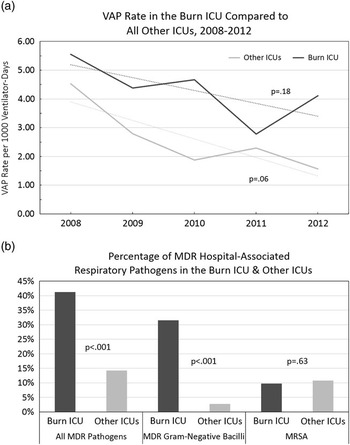
Over the 5-year period with 1,772 admissions to the BICU, 60 VAP (50%), 7 non-ventilator-associated pneumonias (6%), and 52 episodes of tracheobronchitis (44%) occurred. The VAP rate was 4.22/1,000 ventilator days, and yearly rates ranged from 2.78 to 5.55/1,000 ventilator days. In other ICUs, the BICU VAP rate was 2.60/1,000 ventilator days (range, 1.57–4.53/1,000 ventilator days). A trend towards decreased VAP rates over time was noted in both populations (Figure 1A). The BICU tracheobronchitis rate was 1.49 infections/1,000 patient days (range, 0.95–2.14/1,000 patient days). In other ICUs, the tracheobronchitis rate was 1.59/1,000 patient days (range, 1.21–1.8/1,000 patient days). Little difference was found in rates over time or between the BICU and other ICUs.
(A) Incidence of VAP in the BICU compared to all other ICUs from 2008 to 2012. (B) Multi-drug resistance among respiratory pathogens in the BICU compared with all other ICUs.

In the BICU, 165 organisms were isolated from 119 hospital-associated respiratory infections (ie, 1.39 pathogens/infection, excluding 4 with no pathogen identified). The most common BICU respiratory pathogens were P. aeruginosa (24%), enteric Gram-negative bacilli (22%), S. aureus (18%), Acinetobacter spp. (17%), and S. maltophilia (10 %). Many BICU isolates were MDR: 36% of P. aeruginosa, 17% of enteric Gram-negative bacilli, 57% of S. aureus, 100% of Acinetobacter spp., and 18% of S. maltophilia. MDR-Acinetobacter outbreaks occurred in the BICU from September 2007 to April 2008 and from January 2009 to September 2010, and no additional cases were noted in the BICU outside these time periods. The outbreak strain also caused infections among patients in other ICUs, primarily the surgical ICU. The percentage of MDR pathogens in the BICU ranged from 21% to 51% per year with no clear trend over time. Compared with other ICUs, the BICU had a higher percentage of all MDR pathogens (41% vs 14%; P<.001) and MDR-Gram negative bacilli (32% vs 3%; P<.001) but a similar percentage of MRSA infections (10% vs 11%; P=.63) (Figure 1B).
DISCUSSION
The NHSN reported a pooled mean VAP rate in BICUs of 4.4 infections/1,000 ventilator days in 2012, which was similar to the 4.1 infections/1,000 ventilator days noted in our BICU during the same year.Reference Dudeck, Weiner, Allen-Bridson, Malpiedi, Peterson and Pollack 7 Tracheobronchitis comprised nearly half of our BICU hospital-associated respiratory infections. The incidence of VAP and tracheobronchitis is reported to be even higher among those with inhalation burn injury. In a Czech burn center from 2004 to 2009, the VAP rate and the ventilator-associated tracheobronchitis rate among those with inhalation burn were 30.8 and 98.8 infections/1,000 ventilator days, respectively.Reference Lipovy, Rihova, Gregorova, Hanslianova, Zaloudikova and Kaloudova 8 In a Belgian burn unit from 2002 to 2010, the VAP rate among inhalation burn injury patients was 55 episodes/1,000 ventilator days.Reference Brusselaers, Logie, Vogelaers, Monstrey and Blot 9
In this study, a decreasing trend in VAP rates was noted from 2008 to 2012, during which time our hospital began sending Process and Outcome reports to ICU directors on VAP incidence and on compliance with VAP bundle measures. However, the trend was not statistically significant, and our small number of time points did not provide sufficient statistical power to assess for differences in VAP rates between the BICU and other ICUs.
The most common respiratory pathogens in our BICU were P. aeruginosa, enteric Gram-negative bacilli, and S. aureus. Similar pathogens were reported by the NHSN for 2009–2010, with VAPs at all US hospitals most frequently due to Gram-negative enteric bacilli and S. aureus, followed by P. aeruginosa.Reference Sievert, Ricks, Edwards, Schneider, Patel and Srinivasan 10 VAP associated with inhalation burn injury is often caused by Gram-negative pathogens, including P. aeruginosa.Reference Lipovy, Rihova, Gregorova, Hanslianova, Zaloudikova and Kaloudova 8 , Reference Brusselaers, Logie, Vogelaers, Monstrey and Blot 9 Respiratory pathogens in the BICU were more frequently MDR when compared to common VAP pathogens reported for all ICUs in NHSN during 2009–2010: Acinetobacter spp. (100% vs 63%), S. aureus (57% vs 48%), and P. aeruginosa (36% vs 18%).Reference Sievert, Ricks, Edwards, Schneider, Patel and Srinivasan 10
Although the data for this study were prospectively collected by infection preventionists according to standardized definitions, these surveillance data provide only limited insight into all patients treated for respiratory infections in the BICU. Many additional burn patients require treatment for clinically diagnosed respiratory infections that do not meet the very specific NHSN criteria. Frequent inhalation injury and acute respiratory distress syndrome in burn patients often make pulmonary findings difficult to interpret; this difficulty may also make NHSN definitions less reliable in the burn population. Our study was further limited by the inability to identify potentially important differences in respiratory infection rates or pathogens that may exist between child and adult burn patients or among patients with different types of burns, especially inhalational injury.
Hospital-associated respiratory infections remain a major problem in the BICU with a high prevalence of MDR pathogens. The true incidence of burn respiratory infections remains to be determined. In addition, further studies are needed on risk factors, treatment, and the attributable mortality of respiratory infections in this vulnerable population.
Acknowledgments
Financial support. No external funding was received for this study.
Potential conflicts of interest. No potential conflict of interest exists for any of the authors.