Earlier, some of the patients in single-ventricle physiology could not proceed to Fontan operation because they could not fulfill the strict Fontan criteria for various reasons at the post-Glenn stage. Now as they grow up, some are suffering from various complications such as desaturation, fatigue with exertion, or thromboembolism.Reference Gatzoulis, Munk, Williams and Webb 1 , Reference Khairy, Poirier and Mercier 2 However, if the patient's haemodynamics are re-evaluated carefully, some of them still have a chance to safely undergo a Fontan operation to resolve those complications, and their quality of life could be ameliorated by it. We studied five consecutive successful cases of Fontan completion performed more than 10 years after the Glenn procedure and sought to determine the factors that have contributed to the success of Fontan completion in those patients.
Patients and methods
From 2004 to 2010, five consecutive patients underwent Fontan completion who had previously undergone a Glenn procedure more than 10 years ago at another hospital. After the Glenn procedure, they were then categorised as non-Fontan candidates in accordance with the Fontan criteria because of an insufficient pulmonary artery, high pulmonary vascular resistance (Patient 1), or complicated anatomical reasons (Patients 3, 4 and 5). We summarised these patients retrospectively in terms of their pre-operative state, physiological condition, surgical tips, and problems that these patients were experiencing.
All patients were referred to Adult Congenital Heart Disease Program from other institutions to explore the possibility of Fontan completion. They had been followed up by local physicians; however, they gradually manifested symptoms such as low oxygen saturation, fatigue on exertion, or arrhythmias such as paroxysmal supraventricular tachycardia. The study was approved by our local institutional review board, which waived the need for patient consent because of the retrospective data study.
Patient characteristics
Patient characteristics are summarised in Table 1. Their age at Fontan completion ranges from 17 to 31 years. Age at Glenn procedure was between 3 and 19 years. The duration between the Glenn and Fontan procedures was more than 10 years (10 to 13 years, 11 years in median). The primary diagnosis was Asplenia with single ventricle in three patients and double-outlet right ventricle in two patients. With regard to indications for Fontan procedure, four of them suffered from arrhythmias such as supraventricular tachycardia or atrial tachycardia, and four of them had atrio-ventricular valve insufficiency. All patients exhibited hypoxia with the oxygen saturation ranging from 64% to 82%. Of five patients, four retained restricted forward flow from the pulmonary trunk to the pulmonary artery, whereas one patient (Patient 3) had a communication of the hemiazygos vein only with the left Glenn duct.Reference Sughimoto, Matsuo and Niwa 3
Patient characteristics.

AVVR = atrioventricular valve regurgitation; bil. SVC = bilateral superior vena cava; DORV = double-outlet right ventricle; n/a = not available; PA = pulmonary artery; PS = pulmonary stenosis; PSVT = paroxysmal supraventricular tachycardia; SRV = single right ventricle; SV = single ventricle; TAPVR = total anomalous pulmonary venous return
Pre-Fontan catheterisation data
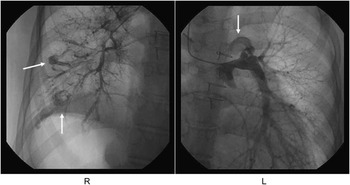
Pre-Fontan catheterisation data are shown in Table 2. Their pulmonary artery index ranged from 128 to 569 mm2/m2,Reference Nakata, Imai and Takanashi 4 although in Patients 4 and 5 we could not measure the pulmonary artery index accurately. The pulmonary vascular resistance was from 0.9 to 3.7 Woods Units (median 2.2). Pulmonary-to-systemic flow ratio (Qp/Qs) ranged from 0.3 to 1.6. Patients 4 and 5 showed increased ventricular volume (201% of normal and 174% of normal). In all, three out of four patients had deteriorated ventricular function with ejection fraction from 34.4% to 42.6%. Aortopulmonary collateral vessels that were coil embolised before the Fontan procedure were seen in Patients 4 and 5. Pulmonary arteriovenous shunt was seen in patients 3 and 5. In Patient 3, the pulmonary arteriovenous malformation was seen only in the right lung, whereas in the left lung, where the hemiazygos vein returns to the left Glenn duct,Reference Sughimoto, Matsuo and Niwa 3 the relatively developed pulmonary branches were confirmed (Fig 1).
Catheterisation data before TCPC.

n/a = not available; PAI = pulmonary artery index; PVR = pulmonary vascular resistance; Qp/Qs = flow ratio of pulmonary artery to aorta; TCPC = total cavo-pulmonary connection
The right and left pulmonary artery angiography in Patient 3. Right: inadequate growth of the right pulmonary artery; white arrows indicate pulmonary arteriovenous fistulas. Left: white arrow indicates the communication of the hemiazygos vein with the left Glenn duct.

Results
Fontan procedure
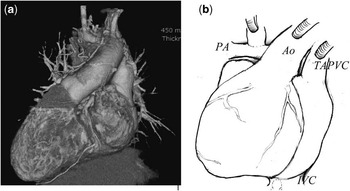
Fontan procedure (Table 3) was performed under general anaesthesia, on cardiopulmonary bypass. All patients needed aortic cross-clamping. There were three patients who underwent extracardiac total cavopulmonary connection using a 22-mm expanded polytetrafluoroethylene conduit (GoreTex; W.L. Gore and Associates, Flagstaff, Arizona, United States of America) and one patient underwent a lateral tunnel total cavopulmonary connection. In Patient 5,Reference Sughimoto, Matsuo and Ohba 5 owing to the complex anatomy, an intracardiac total cavopulmonary connection was performed with a 20-mm conduit. The flow via total anomalous pulmonary venous return engaged at the superior left atrium, leaving no room between the ascending aorta and total anomalous pulmonary venous return entry. The pulmonary artery trunk was situated posterior to the ascending aorta (Fig 2), and the inferior caval vein sat anterior to the vertebral column as it returned to the left atrium. Concomitant procedures included Damus–Kaye–Stansel anastomosis in two patients, resection of subaortic stenosis in one patient (Patient 4). With regard to atrioventricular valve insufficiency, atrioventricular valve plasty was done in three patients, and one underwent valve replacement with On-X (Medical Carbon Research Institute, Austin, Texas, United States of America) as the valve repair was not feasible. In terms of the antiarrhythmic therapy, the maze procedure was performed in two patients, cryoablation to the atrium in two patients, and a pacemaker was implanted in two patients. Central venous pressure weaned from the cardiopulmonary bypass ranged from 10 to 15 mmHg. Surgical fenestration was not created in all cases despite the pulmonary arteriovenous malformations in the right side in Patient 3, which may be inferred to be a natural fenestration.
TCPC procedure.

AVV = atrioventricular valve; CVP = central venous pressure; DKS = Damus–Kaye–Stansel anastomosis; n/a = not available; PMI = pacemaker implantation; TCPC = total cavo-pulmonary connection
Anatomy of Patient 5. Three-dimensional computed tomography ( a ) and diagram ( b ). Owing to the complex anatomy, an intracardiac total cavopulmonary connection was selected.

Outcomes
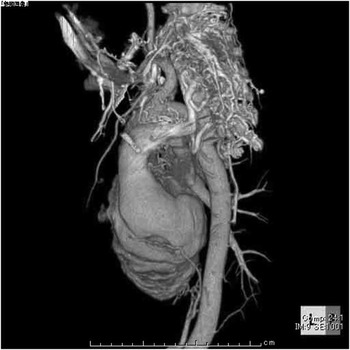
There was no mortality in the follow-up period from 2 to 7 years. All of them are categorised in New York Heart Association Class I. When followed up in the outpatient clinic, all patients’ oxygen saturation was over 90% in room air, except Patient 5. In Patient 5, despite Fontan completion, O2 saturation remained around 78%, which was attributed to large venovenous collateral vessels seen on catheterisation and follow-up computed tomography (Fig 3). Although some of these channels were ultimately ligated via left thoracotomy, saturation peaked at 84% because of inaccessibility for those vessels. In Patient 3, a catheter study was performed 1 year after Fontan completion, showing that the right-sided pulmonary atriovenous fistulae were not diminished and that the fistula had become organised.
Considerable collateral vessels and pulmonary arteriovenous shunts in Patient 5. Image from three-dimensional computed tomography after Fontan completion.

Discussion
Since the inception of the Fontan operation to treat tricuspid atresia as a definitive palliation therapy for patients with single ventricle was reported in 1971,Reference Fontan and Baudet 6 its surgical outcome has improved by the introduction of staged surgical strategy.Reference Di Donato, Amodeo and di Carlo 7 , Reference Miyaji, Nagata, Matsui, Miyamoto and Kitahori 8 However, initially to undergo the Fontan procedure, there were strict criteria patients had to fulfil, especially with regard to pulmonary vasculature problems such as adequate pulmonary vascular branches and bed, as well as low pulmonary vascular resistance, and other issues such as anatomical irregularity, subaortic stenosis in the outflow tract of the systemic ventricle, atrioventricular valve regurgitation, and arrhythmia. These factors are relevant to the operative result of the Fontan procedure.
Owing to the fact that adult congenital heart disease is becoming a fast-growing cardiothoracic speciality because of successful medical and surgical management,Reference Perloff 9 , Reference Niwa, Perloff and Webb 10 one must pay attention to patients who cannot undergo Fontan operation after the Glenn procedure. Day et alReference Day, Etheridge and Veasy 11 previously reported the superiority of Glenn procedure to Fontan procedure, concluding that Glenn procedure had less morbidity and mortality than Fontan procedure. However, owing to the lack of the hepatic factorReference Malhotra, Reddy and Thelitz 12 – Reference Shah, Rychik, Fogel, Murphy and Jacobs 14 in Glenn circulation, the pulmonary arteriovenous fistula may develop. This leads to inadequate gas exchange in the alveolar level resulting in lowering arterial oxygen saturation, as seen in Patients 3 and 5 of our series. Complications such as embolisation due to haemoconcentration, fatigue with exertion, and reduced exercise tolerance are associated with desaturation.Reference Hawkins, Shaddy, Day, Sturtevant, Orsmond and McGough 15 , Reference Robicsek, Riopel and Robicsek 16 To improve quality of life for these patients, we explored the possibility of undergoing Fontan completion. The pulmonary vascular bed and the pulmonary vascular resistance were re-evaluated through a catheterisation study. We concluded that undergoing the Fontan operation is possible, although Patients 3 and 5 were deemed marginal candidates for the Fontan completion. With regard to ventricular volume and ventricular function, although four out of five patients had antegrade additional pulmonary artery flow, only these two patients, Patients 4 and 5, showed volume overloaded (201% of normal and 174% of normal). In addition, this ventricular dilatation would be attributed to atrioventricular valve regurgitation and significant collateral blood flow returning to the pulmonary venous chamber. Out of the four patients, three had deteriorated ventricular function with ejection fraction from 34.4% to 42.6%. Considering these data, most of the patients were regarded as moderately high-risk Fontan candidates in terms of ventricular function at the time of Fontan completion.
There were three patients who underwent an extracardiac total cavopulmonary connection and one underwent a lateral tunnel total cavopulmonary connection. As an institutional policy in the Fontan procedure, a native tissue is preferred if available. This is especially so for small children who are expecting to grow, and when the atrial wall could possibly be used for the lateral tunnel. Owing to the fact that Patient 2 did not have any rhythm problem related to the atrial chamber and therefore maze or cryoablation was not required, we selected a lateral tunnel procedure for this patient. Owing to the complex anatomy of Patient 5,Reference Sughimoto, Matsuo and Ohba 5 the intracardiac route was selected, which confirmed very smooth flow from the inferior caval vein to bilateral pulmonary arteries. Regarding the placement of fenestration for the patients long after the Glenn procedure, as was seen in Patient 3 and 5, atriovenous fistula may occur. Placing a fenestration surgically is deemed unnecessary in such patients, as the pulmonary arteriovenous fistula would work as a natural fenestration. For the other cases where the central venous pressure was below or nearly 15 mmHg at the time of weaning from the cardiopulmonary bypass, fenestration was not placed. Despite the fact that in some patients pleural drainage prolonged to 2 weeks, they were discharged in good condition. Their latest New York Heart Association is all categorised in 1.
In three cases, the pulmonary artery developed well without developing any undesired pulmonary arteriovenous shunts. The reason for this phenomenon would be the regulated additional flow to the pulmonary artery. In Patient 3, there was a stenosis in the mid-portion of the central pulmonary artery, thereby causing relative non-confluence of the laterality of the pulmonary artery. This resulted in a completely distinct system; in the right side, multiple pulmonary arteriovenous malformations were seen, whereas in the left side well-developed pulmonary artery branches were confirmed.Reference Sughimoto, Matsuo and Niwa 3 The role of the additional forward pulmonary arterial flow for the development of the pulmonary artery is still controversial. Gray et alReference Gray, Altmann and Mosca 17 previously reported the outcome of the persistent pulmonary blood flow in patients after Glenn procedure, comparing to the diminished antegrade pulmonary blood flow. They concluded that although bidirectional Glenn with antegrade pulmonary blood flow improved the arterial oxygen saturations, and the pulmonary arterial growth decreased the collateral artery formation, the outcome following the Fontan procedure with persistent antegrade blood flow was not different from those without persistent antegrade blood flow after Glenn procedure. In addition, this additional blood flow may be inefficient under the condition of recirculated pulmonary venous return. Calvaruso et alReference Calvaruso, Rubino and Ocello 18 reported from three joint institutions in Italy about the superiority of bidirectional Glenn with antegrade pulmonary blood flow. They mentioned that a staged surgical option for patients who are considered less than ideal for Fontan operation should be the bidirectional cavopulmonary anastomosis with antegrade pulmonary blood flow because it allows an adequate growth of pulmonary arteries and veins, thus preparing optimal haemodynamic conditions for the Fontan procedure. Another unique article from France by Gérellia et alReference Gérellia, Boulitropa and Van Steenberghea 19 reported the long-term outcome of additional blood flow at bidirectional cavopulmonary shunt. They assert that bidirectional cavopulmonary shunt with antegrade pulmonary blood flow yield long-lasting adequate palliation particularly in high-risk Fontan patients, although it is difficult to define an ‘appropriate’ antegrade pulmonary blood flow. Our case reports differ from their series in terms of limited numbers, all referred patients from other hospitals, and longer duration between Glenn and Fontan procedure (11 years in median versus 7 years in median). In our cases, four out of five had regulated antegrade pulmonary artery flow that may have worked to optimise pulmonary vascular bed as they described.
Considering post-bidirectional Glenn management, a longer period after the Glenn may bring other significant issues. In our cases, two patients manifested arteriopulmonary collaterals that were coil embolised before the Fontan completion. A recent article from Toronto showed that even in childhood, before the Fontan completion, cardiac magnetic resonance revealed that 43% of pulmonary flow resource was collaterals from the aorta.Reference Grosse-Wortmann, Drolet and Dragulescu 20 This amount is never negligible, and the collateral flow to the pulmonary artery leads to volume overload in the ventricle, which could become a risk factor for ventricular failure. Therefore, a longer waiting period may result in the development of more collateral vessels, as was seen in Patient 5.
Another issue is atrioventricular valve insufficiency. In our cases, four out of five patients underwent atrioventricular valve surgeries – atrioventricular valve plasty in three patients and valve replacement in one patient. Owing to the fact that atrioventricular septal defect-like valve or tricuspid valve in the systemic ventricle are more prone to cause valve regurgitation,Reference Wong, Iyengar and Wheaton 21 a longer waiting period may cause more regurgitation, subsequently leading to ventricular failure.
From a surgical point of view, such patients were holding multiple lesions requiring repairs, such as subaortic stenosis, atrioventricular valve regurgitation, or rhythm problems. It is most important to address these complicating factors as much as possible at the Fontan completion.
Other than these five patients, who successfully underwent Fontan completion, four patients were referred to our unit at the state more than 10 years after Glenn procedure. In all, three patients were not opted for Fontan completion – because of severe pulmonary artery obstruction in the left lung in one patient and moderately reduced systemic ventricular function in two patients. These three patients have been followed up medically. There was one patient with corrected transposition of the great arteries, who had relatively unbalanced ventricular sizes, in whom biventricular circulation was attempted but who failed post-operatively, apparently because of excessive collateral vessels to the pulmonary circulation.
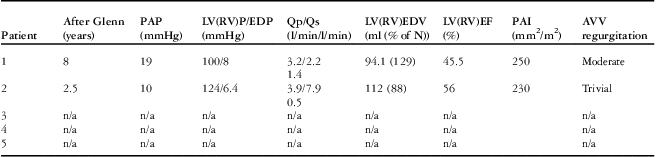
Catheterisation data after Glenn.

AVV = atrioventricular valve; n/a = not available; PAI = pulmonary artery index; PAP = pulmonary artery pressure; Qp/Qs = flow ratio of pulmonary artery to aorta; LV(RV)P/EDP =left ventricular (right ventricular) end-diastolic pressure; LV(RV)EDV = left ventricular (right ventricular) end-diastolic volume; LV(RV)EF = left ventricular (right ventricular) ejection fraction
In summary, five consecutive Fontan completions were successfully performed without fenestration with good outcomes, even more than 10 years after the Glenn procedure. Patients manifested various lesions such as atrioventricular valve insufficiency, subaortic stenosis, arteriopulmonary collaterals, and arrhythmias that have been concomitantly repaired at Fontan completion. To undertake these additional procedures is highly recommended. Furthermore, pulmonary arteriovenous fistulae remained in two patients, which caused desaturation after the Fontan completion. In addition, the antegrade pulmonary blood flow may have contributed to sufficient growth of the pulmonary artery and optimised the pulmonary vascular bed. Some patients are often encumbered with desaturation, arrhythmias, and a poor quality of life long after the Glenn procedure. Of those, if they are examined carefully, some may have a chance to undergo Fontan completion and benefit from it.
Acknowledgements
None.
Financial Support
None.
Conflicts of Interest
None.