Introduction
Manganese is one of the major elements in the earth's crust and exists usually in the soil in the form of Mn oxide minerals due to weathering and pedogenesis (Hong et al., Reference Hong, Gu, Yin, Zhang and Li2010; Huang et al., Reference Huang, Zhao, Liu, Tan and Koopal2011; Namgung et al., Reference Namgung, Chon and Lee2018; Post, Reference Post1999). Mn oxide minerals are ubiquitous in natural environments and are important components of soil (Huang et al., Reference Huang, Zhao, Liu, Tan and Koopal2011). They are important sources of Mn for the nutrition of animals and plants, as well as one of the important adsorbents and carriers of environmental information (Huang et al., Reference Huang, Hong, Tan, Hu, Liu and Wang2008, Reference Huang, Tan, Liu, Hu and Wang2009; Villalobos et al., Reference Villalobos, Toner, Bargar and Sposito2003). The high redox potential of Mn oxide minerals makes them active in the environment, so that they are used commonly as an important redox agent in the soil (Learman et al., Reference Learman, Voelker, Rodriguez and Hansel2011; Liu et al., Reference Liu, Zhang, Gu, Sheng and Zhang2020).
The formation and transformation of Mn oxide minerals in soil are influenced substantially by environmental changes and climate (Feng et al., Reference Feng, Liu, Tan and Liu2004; Hong et al., Reference Hong, Gu, Yin, Zhang and Li2010; Huang et al., Reference Huang, Zhao, Liu, Tan and Koopal2011; Jung et al., Reference Jung, Taillefert, Sun, Wang, Borkiewicz, Liu, Yang, Chen, Chen and Tang2020; McKenzie, Reference McKenzie1971; Zhang et al., Reference Zhang, Chen, Qiu, Liu and Feng2016). The crystallinity of Mn oxides in soil is low, and they are difficult to analyze and identify directly. Therefore, artificial laboratory simulation synthesis methods by reducing potassium permanganate with a divalent Mn salt were utilized to examine indirectly the formation mechanism of Mn oxide minerals. The product is fine-needle spherical crystals, which are very close to natural birnessite (Feng et al., Reference Feng, Liu, Tan and Liu2004, Reference Feng, Tan, Liu, Huang and Liu2005; Handel et al., Reference Handel, Rennert and Totsche2013; Yang & Wang, Reference Yang and Wang2002). Various kinds of Mn oxide minerals have been reported to have formed under different environmental conditions, such as the ratio of Mn2+/MnO4, the concentration of Mn2+, temperature, background electrolyte, etc. (Cornell & Giovanoli, Reference Cornell and Giovanoli1988; Handel et al., Reference Handel, Rennert and Totsche2013; Hella et al., Reference Hella, Romain, Ghouti, Christian and Latifa2017; Kijima et al., Reference Kijima, Yasuda, Sato and Yoshimura2001; Liang et al., Reference Liang, Post, Lanson, Wang, Zhu, Liu, Tan, Feng, Zhu, Zhang and De Yoreo2020; Zhao et al., Reference Zhao, Zhu, Li, Elzinga, Villalobos, Liu, Zhang, Feng and Sparks2016; Zhu et al., Reference Zhu, Vogel, Parikh, Feng and Sparks2010). The average oxidation states of Mn in birnessite are affected by the Mn2+/MnO4 − ratio and birnessite begins to form at low Mn2+/MnO4 – ratios (Luo et al., Reference Luo, Steven and Suib1997). Furthermore, Ma et al. (Reference Ma, Liu, Huang and Sun2013) showed that synthetic Mn oxide minerals were transformed from cryptomelane to birnessite with a decrease in Mn2+/MnO4 – from 1:1 to 1:4. Mn2+ induced the transformation of birnessite to other new phases such as cryptomelane at room temperature (Tu et al., Reference Tu, Racz and Goth1994). Background electrolytes affect the morphology, chemical composition, and crystal structure of birnessite (Zhang et al., Reference Zhang, Liu, Tan, Suib, Qiu and Liu2018; Zhu et al., Reference Zhu, Vogel, Parikh, Feng and Sparks2010). In the dissolution–recrystallization process of birnessite, todorokite was generated easily if the hydration ion radius of interlayer ions was large, such as Ca2+ and Mg2+, while Mn oxides with smaller tunnel sizes such as cryptomelane were formed if the hydration ion radius was small, such as Na+ and K+ (Hella et al., Reference Hella, Romain, Ghouti, Christian and Latifa2017; Zhao et al., Reference Zhao, Liang, Yin, Liu, Tan, Qiu and Feng2015). The dissolution-crystallization process was affected by temperature. Increasing the temperature shortened the induction period, increased the crystallization rate, and accelerated the phase transition from birnessite to other phases (Luo et al., Reference Luo, Steven and Suib1997; Portehault et al., Reference Portehault, Cassaignon, Baudrin and Jolivet2007).
The red soil region of southern China often undergoes periodic flooding in the rainy season due to high soil viscosity, poor drainage capacity, and mountainous and hilly landforms. With much rainfall and concomitant surface runoff in the rainy season, water accumulates and remains in low-lying areas, which leads to imperfect drainage and flooding. In the red soils of Guangxi, Guizhou, Fujian, etc., in particular, due to the geological and climatic factors listed above, the soils experience alternating oxidation/reduction conditions necessary for producing manganese oxide minerals. Therefore, the red soil of southern China is rich in Mn oxide minerals (Hong et al., Reference Hong, Gu, Yin, Zhang and Li2010; Huang et al., Reference Huang, Hong, Tan, Hu, Liu and Wang2008, Reference Huang, Tan, Liu, Hu and Wang2009, Reference Huang, Zhao, Liu, Tan and Koopal2011; Zhao et al., Reference Zhao, He, Wang, Tao and Li2022). The hydrothermal conditions and redox potential of the soil affect significantly the formation, transformation, and surface properties of these Mn oxide minerals (Huang et al., Reference Huang, Zhao, Liu, Tan and Koopal2011; Liang et al., Reference Liang, Post, Lanson, Wang, Zhu, Liu, Tan, Feng, Zhu, Zhang and De Yoreo2020). Mn and Fe oxide minerals are often present simultaneously in red soils, where they are highly active (Chen et al., Reference Chen, Koopal, Xu, Wang and Tan2019; Huang et al., Reference Huang, Zhao, Liu, Tan and Koopal2011; Krishnamurti & Huang, Reference Krishnamurti and Huang1988; Liu et al., Reference Liu, Sayako, Zhu, He and Hochella2021; Luo et al., Reference Luo, Ding, Shen, Tan, Qiu and Liu2018). Iron oxide mineral surfaces can accelerate the oxidation of Mn(II) to form Mn oxides to a certain degree (Davies & Morgan, Reference Davies and Morgan1989). Iron oxide promoted significantly the oxidation of Mn2+ and crystallization of Mn oxide (Liu et al., Reference Liu, Chen, Yang, Wei, Laipan, Zhu, He and Hochella2022), which can be attributed to the fact that Fe oxide can function as a catalyst by promoting electron transfer between Mn2+ and dissolved O2. The formation of manganite was catalyzed by the hematite surface which is explained by the electron transfer from adsorbed Mn(II) to another site with adsorbed O2 via the band structure of the semiconducting hematite (Inoue et al., Reference Inoue, Yasuhara, Ai, Hochella and Murayama2019). Semiconductor minerals (e.g. hematite, goethite, and ferrihydrite) show greater catalytic ability for Mn2+ oxidation than insulating minerals (e.g. albite, amorphous Al(OH)3, and montmorillonite) (Lan et al., Reference Lan, Wang, Xiang, Yin, Tan, Qiu, Zhang and Feng2017). Furthermore, Mn oxide minerals are often coated or stored on the surface of kaolinite in the form of a colloidal film or as fine particles to form complexes (Choi et al., Reference Choi, Komarneni and Park2009; Khan et al., Reference Khan, Khan and Shahjahan2015; Mckenzie, Reference McKenzie1972; Zhu et al., Reference Zhu, Qi, Zhang, Teresa, Xu, Fan and Sun2019). Kaolinite is also an insulating mineral, which may provide a surface to precipitate the Mn mineral via heterogeneous nucleation. The formation and transformation of Fe oxide is significantly inhibited by the presence of kaolinite, while the presence of Fe2+ in solution accelerated it (Chen et al., Reference Chen, Koopal, Xu, Wang and Tan2019; Wei et al., Reference Wei, Liu, Feng, Tan and Koopal2011). Do Mn oxide minerals also form and transform on the surface of kaolinite? The factors which influence their formation and transformation have yet to be discovered.
In view of the above, the present study was performed in order to explore the types and formation mechanisms of Mn oxides synthesized on the surface of kaolinite, a typical mineral in red soil, considering the influencing factors of different Mn2+/MnO4 – molar ratios, cation types, synthesis temperature, and amount of kaolinite added. These results will provide a theoretical foundation for a better understanding of the formation process and reaction mechanism of Mn oxide in red soil and enrich the research of soil-interface chemistry.
Materials and Methods
Materials
Kaolinite was purchased from Sigma-Aldrich (Shanghai, China) Trading Co, Ltd (characterization of the kaolinite is described in the supplementary information), and KMnO4 was acquired from Xilong Science Co., Ltd (Chengdu, China). MnSO4·H2O, MgSO4, and Na2SO4 were provided by Sinopharm Chemical Reagent Co., Ltd (Shanghai, China). Hydroxylamine hydrochloride was purchased from Aladdin Chemical Reagent Co., Ltd (Shanghai, China). All reagents were used without further purification. The HK-UV-10 (Hongke Technology Co., Ltd, Hefei, China) pure water purification system provided the deionized water (DDW) for this study.
Synthesis of Mn oxide Minerals on Kaolinite Surfaces
1 g of kaolinite was placed in a reactor containing 30 mL of 0.067, 0.1, 0.2, or 0.4 M KMnO4 and 0.1 M Na2SO4 or MgSO4. The reactor was placed in an oil bath at a specific temperature (30, 60, or 110°C) and at a stirring speed of 300 r/min. Then, 30 mL of 0.1 M MnSO4 solution was added dropwise into the above-mixed solution using a peristaltic pump. This was followed by agitation of the mixtures for 30 min at constant temperature and aging for 24 h at 60°C after cooling (Frias et al., Reference Frias, Nousir, Barrio, Montes, Lopez, Centeno and Odriozola2007). The aged minerals were centrifuged and cleaned with deionized water until the conductivity was < 20 μS cm–1, then freeze-dried immediately, crushed, sieved with a 100-mesh sieve, and stored for further analysis. The synthesis conditions for all Mn oxides were the same.
Effect of the molar ratio of Mn2+ to Mn7+
The Mn oxide minerals were synthesized at various molar ratios (R) of Mn2+ to Mn7+ (R = 1:0.67, 1:1, 1:2, and 1:4). The pH of the mixture was measured and found to be ~1.4. The synthesis temperature was controlled at 30°C, with Na+ as the background cations. 1 g of kaolinite was added.
Effect of the background cations
The Mn oxide minerals were synthesized with the same concentrations of Na2SO4 or MgSO4 as different background cations. 1 g of kaolinite was added at a synthesis temperature of 30°C. Meanwhile, a control experiment was conducted without background cations, and the other treatments were the same as above.
Effect of the synthesis temperature
The Mn oxide minerals were synthesized at 30, 60, and 110°C. The value of R was 1:4, with Na+ as the background cation. 1 g of kaolinite was added.
Effect of the amount of kaolinite added
When the Mn oxide minerals were synthesized, the amount of kaolinite used was 0.25, 0.50, 1.0, 2.0, or 5.0 g. The value of R was 1:1, with a synthesis temperature of 30°C and Na+ as the background cation. The synthesis procedure of Mn oxide minerals with various values of R was the same as above except that no kaolinite was added.
Mn content in Mineral Determinations
The synthetic kaolinite-Mn oxide mineral complex samples were dissolved by 0.25 M hydroxylamine hydrochloride. The Mn contents of samples were measured using an A3AFG-13 (Purkinje General Instrument Co., Ltd, Beijing, China) flame atomic absorption spectrometer (Yan et al., Reference Yan, Liu, Min, Li, Zhu, Lu and Gao2020).
Relative Mass Ratio of Kaolinite to Mn oxide Determination
0.2 g of the sample was dissolved in 4 mL of 0.25 M hydroxylamine hydrochloride solution, which was placed in a 10 mL centrifuge tube, then centrifuged (8000 rpm, 10 min) and washed with deionized water. The supernatant was poured out and the residues of the samples after the dissolution were dried and weighed. This was the mass of kaolinite. The mass of Mn oxide was obtained from 0.2 g minus the mass of kaolinite. The relative mass ratio of kaolinite to Mn oxide in the final product was calculated (Neaman et al., Reference Neaman, Waller, Mouele, Trolard and Bourrie2004).
Characterization
X-ray diffraction (XRD)
The powder samples were characterized using an XD6 X-ray diffractometer (Purkinje General Instrument Co. Ltd., Beijing, China) using monochromatic CuKα radiation. The diffractometer was operated at a tube voltage of 36 kV and a tube current of 20 mA, and all of the XRD patterns of samples were scanned from 5 to 80°2θ at a scanning rate of 1°2θ per min.
Scanning electron microscopy (SEM)
The samples were mounted on sample holders with carbon glue and then gold coated. The samples were analyzed using the Zeiss Sigma 300 field emission scanning electron microscope (Oberkochen, Baden-Wurttemberg, Germany), with an accelerating voltage of 3 kV, and the microstructure and morphology of minerals were examined by SEM.
Results
Effect of the Molar Ratios of Mn2+ to Mn7+
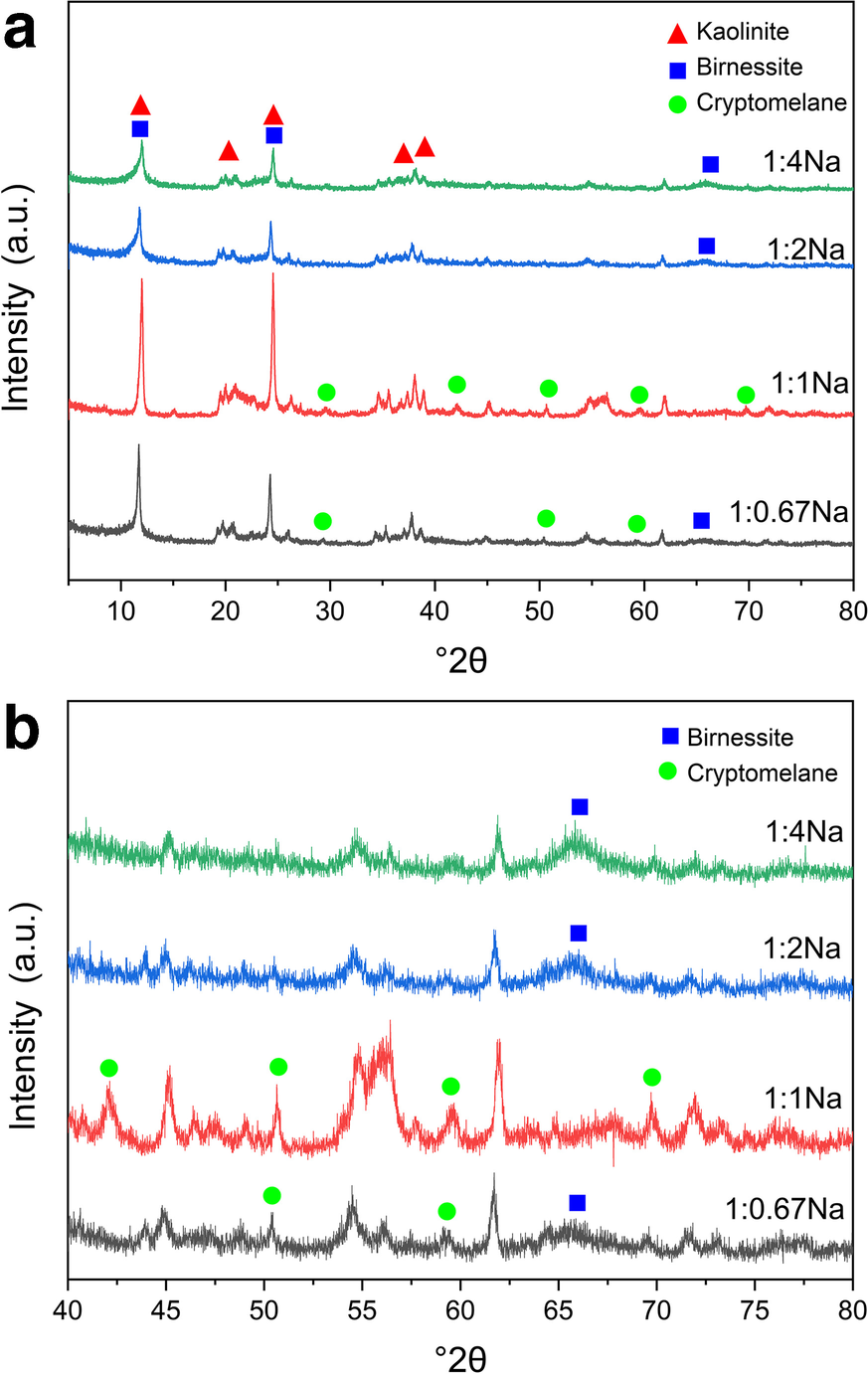
The Mn oxide minerals were synthesized on the surface of kaolinite by reducing potassium permanganate with a divalent Mn salt, controlling the molar ratios of Mn2+ to Mn7+ at 1:0.67, 1:1, 1:2, and 1:4 (Frias et al., Reference Frias, Nousir, Barrio, Montes, Lopez, Centeno and Odriozola2007). In the system of adding kaolinite (Fig. 1), the synthesized kaolinite-Mn oxide complexes showed strong peaks of kaolinite (Choi et al., Reference Choi, Komarneni and Park2009). When R was 1:0.67, the complex also had characteristic diffraction peaks of cryptomelane and birnessite (Kijima et al., Reference Kijima, Yasuda, Sato and Yoshimura2001; Tu et al., Reference Tu, Racz and Goth1994; Zhao et al., Reference Zhao, Zhu, Li, Elzinga, Villalobos, Liu, Zhang, Feng and Sparks2016), indicating that the surface mineral of kaolinite was a mixture of cryptomelane and birnessite. However, when R was 1:1, the only Mn oxide on the surface of kaolinite was cryptomelane; when R was 1:2 and 1:4, Mn oxides formed were single-phase birnessite (Fig. 1a, b). The results showed, thus, that the types of Mn oxides formed on the surface of kaolinite were influenced by the value of R.
XRD patterns of kaolinite-Mn oxide mineral complexes a with various molar ratios of Mn2+ to Mn7+ (R = 1:0.67, 1:1, 1:2, and 1:4); and b in the high-angle region. The synthesis temperature was controlled at 30°C, with Na+ as the background cation. 1 g of kaolinite was added. The labeled peaks are identified

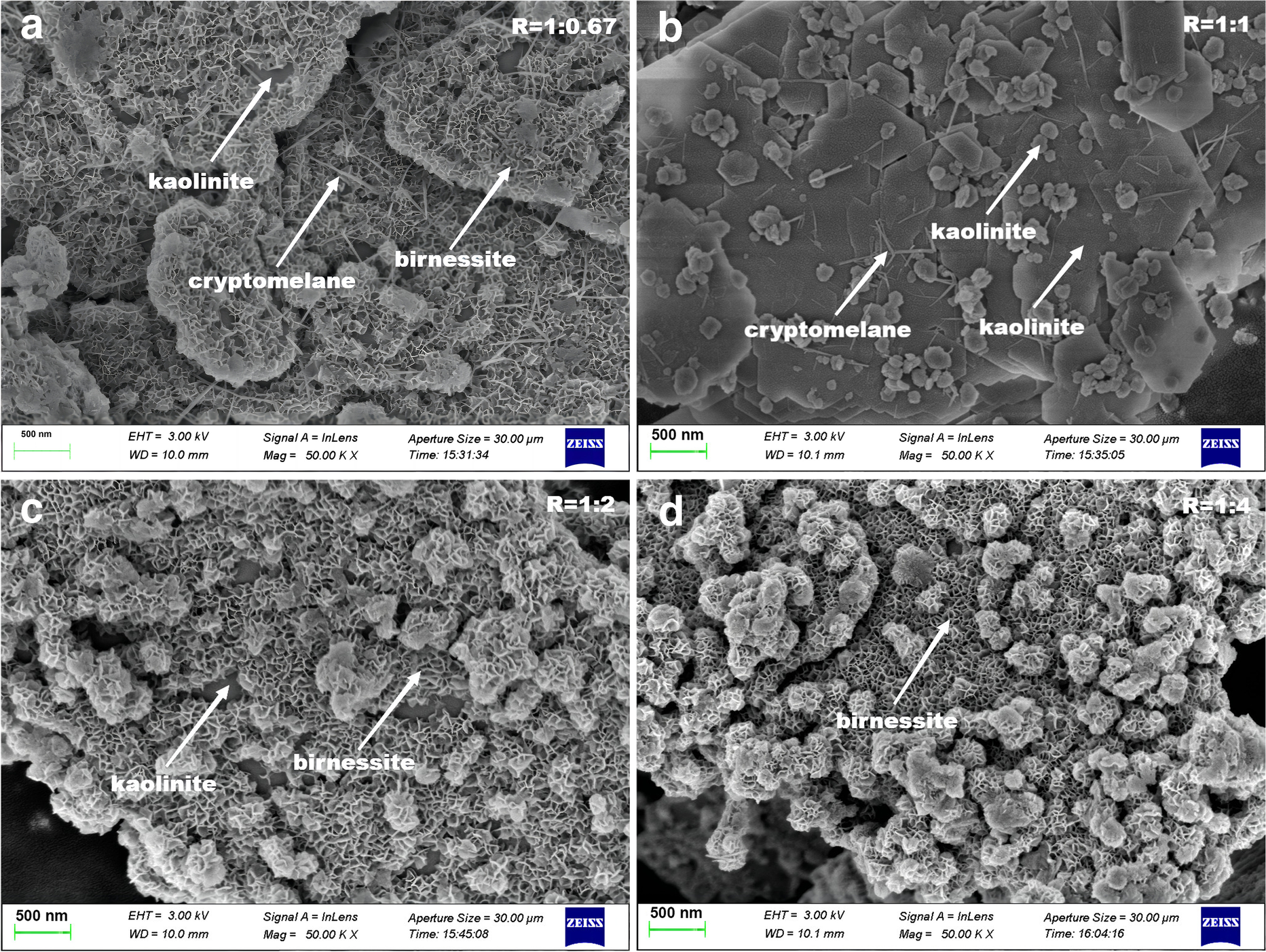
Scanning electron microscopy images of the kaolinite-Mn oxide complexes with various R values and Na+ as the background cation (Fig. 2) showed that kaolinite had a stacked-plate structure (Zhu et al., Reference Zhu, Qi, Zhang, Teresa, Xu, Fan and Sun2019). When R was 1:0.67, nanowire structures (diameter 0.2–2 μm; height 1–10 nm) and flower-spherical aggregate structures (formed by the flaky crystals (diameter 200–300 nm)) were formed on the surface of kaolinite (Fig. 2a). The nanowires structures and flower-spherical aggregate structures were the crystal morphology of cryptomelane and birnessite, respectively (Mckenzie, Reference McKenzie1971; Portehault et al., Reference Portehault, Cassaignon, Baudrin and Jolivet2007; Yin et al., Reference Yin, Wang, Qin, Vogel, Zhang, Jiang, Liu, Li, Zhang and Wang2018). When R was 1:1, the surface mineral of kaolinite was cryptomelane with nanowire structures (Fig. 2b). When R was 1:2 and 1:4, the surface minerals of kaolinite showed uniform flower-spherical aggregate structures (Fig. 2c, d), which was the crystal morphology of birnessite. The morphology changes shown by the SEM images were consistent with the mineral phase transformation results of the XRD patterns.
SEM images of kaolinite-Mn oxide mineral complexes with Na+ as the background cation; the R values were a 1:0.67, b 1:1, c 1:2, and d 1:4

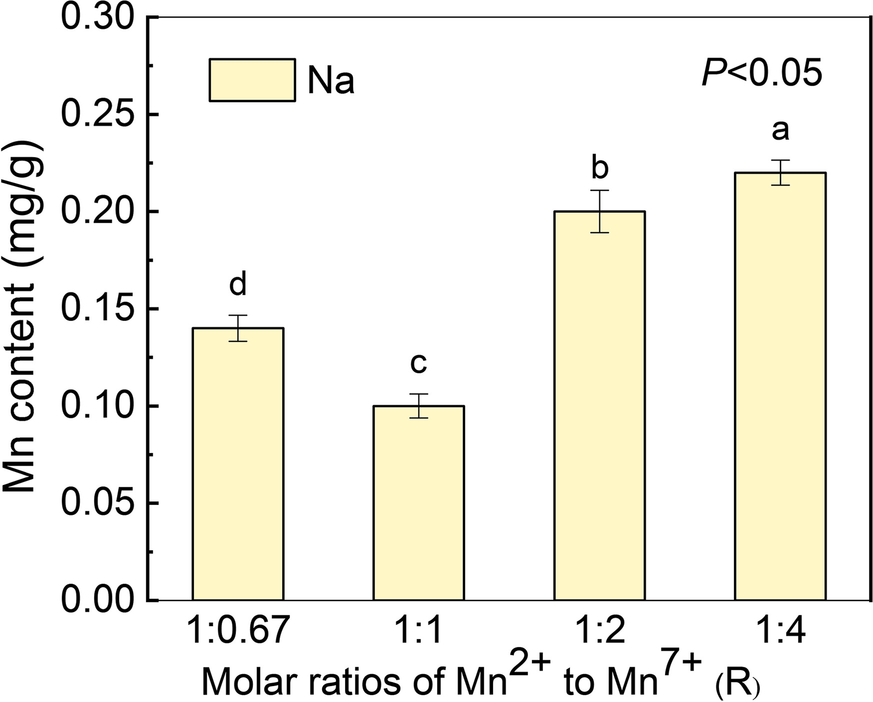
When the R values were 1:0.67, 1:1, 1:2, and 1:4, with Na+ as the background cation, the Mn content in kaolinite-Mn oxide complexes was small, ~ 0.14, 0.10, 0.20, and 0.22 mg/g, respectively (Fig. 3). The Mn content among various treatments was significantly different (P < 0.05). In addition, the relative mass ratios of kaolinite to Mn oxide in the final product were calculated as 1:0.92, 1:0.63, 1:1.15, and 1:1.63. The mass percentage of Mn oxide in the final product increased when the R value decreased, except the sample with R = 1:1.
Mn content in kaolinite-Mn oxide mineral complexes with Mn2+ to Mn7+ molar ratios of 1:0.67, 1:1, 1:2, and 1:4, with Na+ as the background cation

Effect of the Background Cation
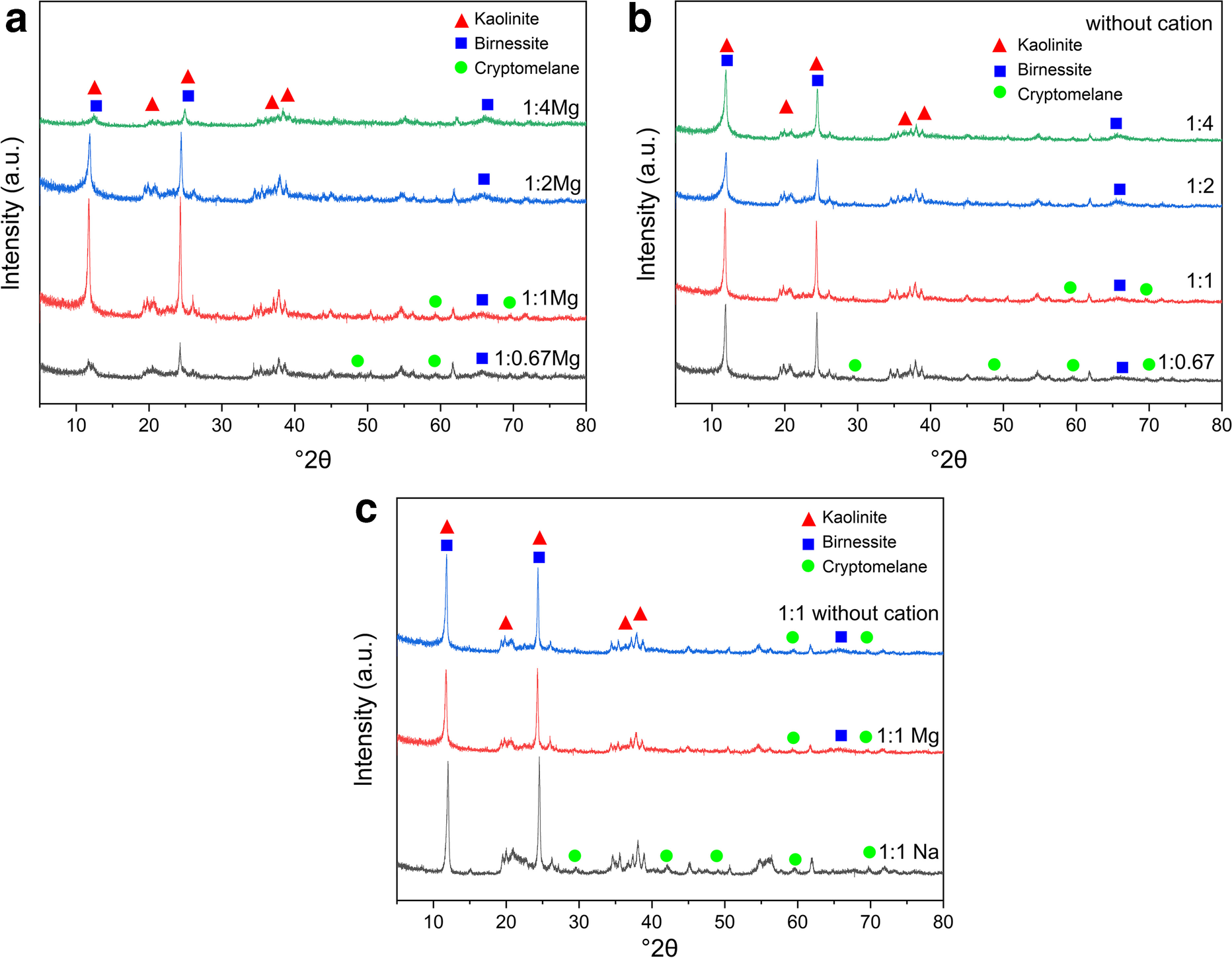
The XRD pattern of kaolinite-Mn oxide complexes formed under the background cations of Na+, Mg2+, and without a background cation (Fig. 4) revealed that when R was 1:0.67, the characteristic peaks of cryptomelane and birnessite were both shown in complexes under different cation backgrounds, suggesting that the Mn oxide minerals synthesized on the surface of kaolinite were a mixture of cryptomelane and birnessite. When R was 1:2 and 1:4, the single-phase birnessite was synthesized under different cation backgrounds. However, when R was 1:1 with Na+ as the background cation (Fig. 1b), the complex had diffraction peaks characteristic of cryptomelane. Under Mg2+ as the background cation (Fig. 4a, c) and without a background cation (Fig. 4b, c), Mn oxides formed were composed of cryptomelane and birnessite. These results indicated that the presence of Na+ as the background cation promoted the transformation from birnessite to cryptomelane, while Mg2+ had no obvious effect.
XRD patterns of products formed after treatment of kaolinite-Mn oxide complex a with background Mg2+cations; b without background cations; and c with background cations of Na+, Mg2+, and without background cations. The R value was 1:1. The labeled peaks are identified

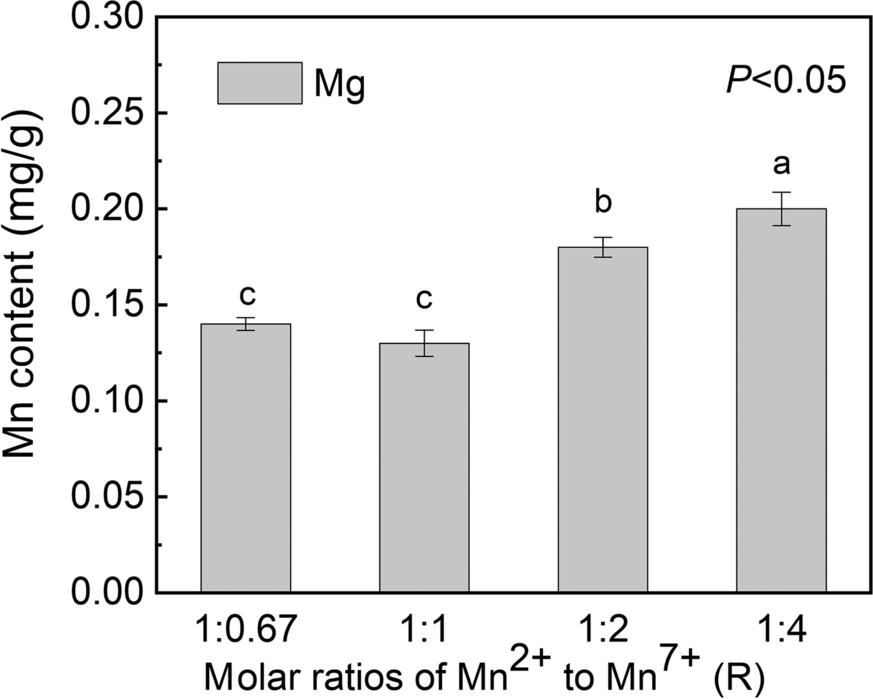
When R was 1:0.67, 1:1, 1:2, and 1:4, the Mn contents of kaolinite-Mn oxide complexes with Na+ (Fig. 3) or Mg2+ (Fig. 5) as the background cation were 0.14, 0.10, 0.20, 0.22 mg/g and 0.14, 0.13, 0.18, 0.20 mg/g, respectively. The relative mass ratios of kaolinite to Mn oxides in the complexes were 1:0.92, 1:0.63, 1:1.15, 1:1.63 and 1:0.81, 1:0.67, 1:1.09, 1:1.53, respectively. This indicated that the Mn content of minerals on the surface of kaolinite was affected by the choice of background cation, although the difference was small. The Mn content and the mass percentage of Mn oxide in the final product with Na2+ as the background cation were generally larger than with Mg2+.
Mn content in kaolinite-Mn oxide mineral complexes with Mn2+ to Mn7+ molar ratios of 1:0.67, 1:1, 1:2, and 1:4, with Mg2+ as the background cation

Effect of the Temperature of Synthesis
From the analysis above, the mineral on the surface of kaolinite under different background cations with an R value of 1:4 was pure phase birnessite (Fig. 4), which is the most abundant Mn oxide mineral in the soil (Feng et al., Reference Feng, Liu, Tan and Liu2004).
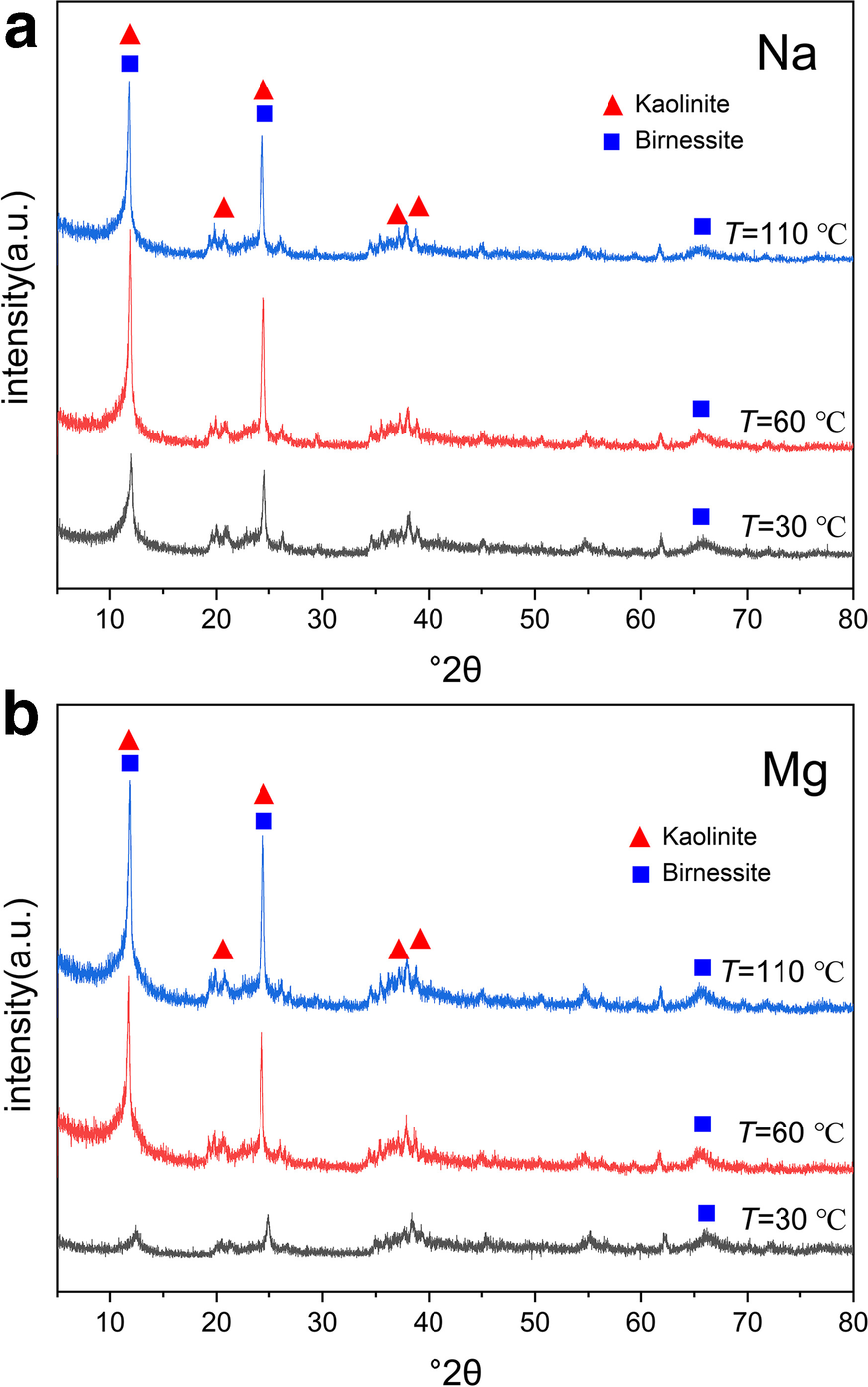
The effect of temperature on the formation of Mn oxides with an R value of 1:4 was studied. The kaolinite-Mn oxide complexes were synthesized at 30, 60, and 110°C. The XRD patterns (Fig. 6) revealed that, besides the characteristic diffraction peaks of kaolinite, there were very obvious peaks of birnessite at various temperatures (Fig. 6a, b), indicating that single-phase birnessite formed on the surface of kaolinite at various temperatures and temperature had no effect on the type of Mn oxide formed.
XRD patterns of kaolinite-Mn oxide mineral complexes formed with R = 1:4 and with 1 g of added kaolinite; the synthesis temperatures were 30, 60, and 110°C, with background a Na+ and b Mg2+ cations. The labeled peaks are identified

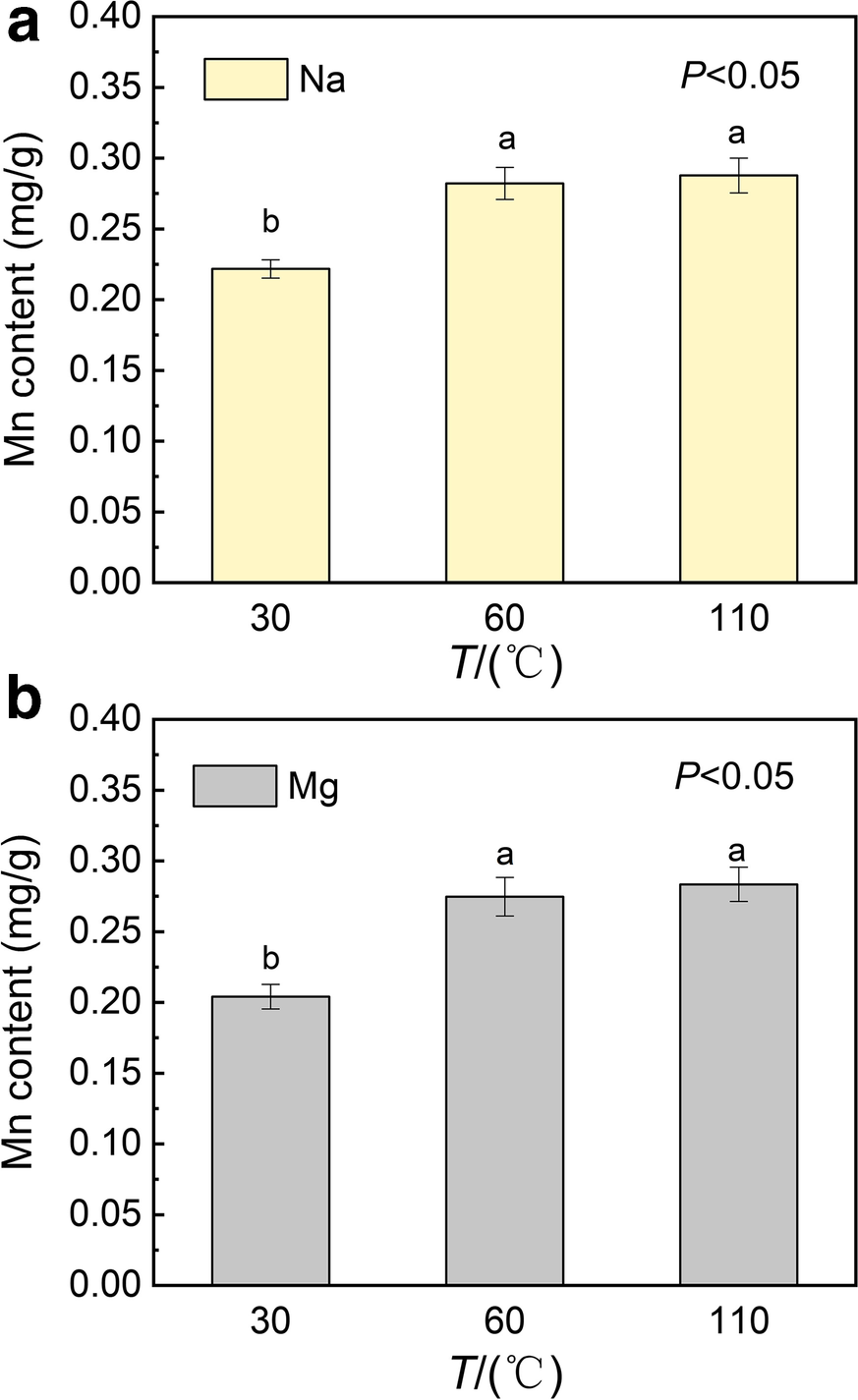
The Mn contents of kaolinite-Mn oxide complexes synthesized at 30, 60, and 110°C in Na+ (Fig. 7a) and Mg2+ (Fig. 7b) were 0.22, 0.28, 0.29 mg/g and 0.20, 0.27, 0.28 mg/g, respectively. The relative mass ratios of kaolinite to Mn oxide were 1:1.63, 1:2.14, 1:2.46, and 1:1.53, 1:1.87, 1:2.20, respectively. The results showed that the Mn content and the mass percentage of Mn oxide in complexes increased gradually with increase in temperature. The amount of birnessite on the surface of kaolinite increased gradually with increasing temperature.
Mn content in kaolinite-Mn oxide minerals under the background of a Na+, b Mg2+ at 30, 60, and 110°C, with the R value = 1:4 and the amount of kaolinite added was 1 g

Effect of Kaolinite Addition
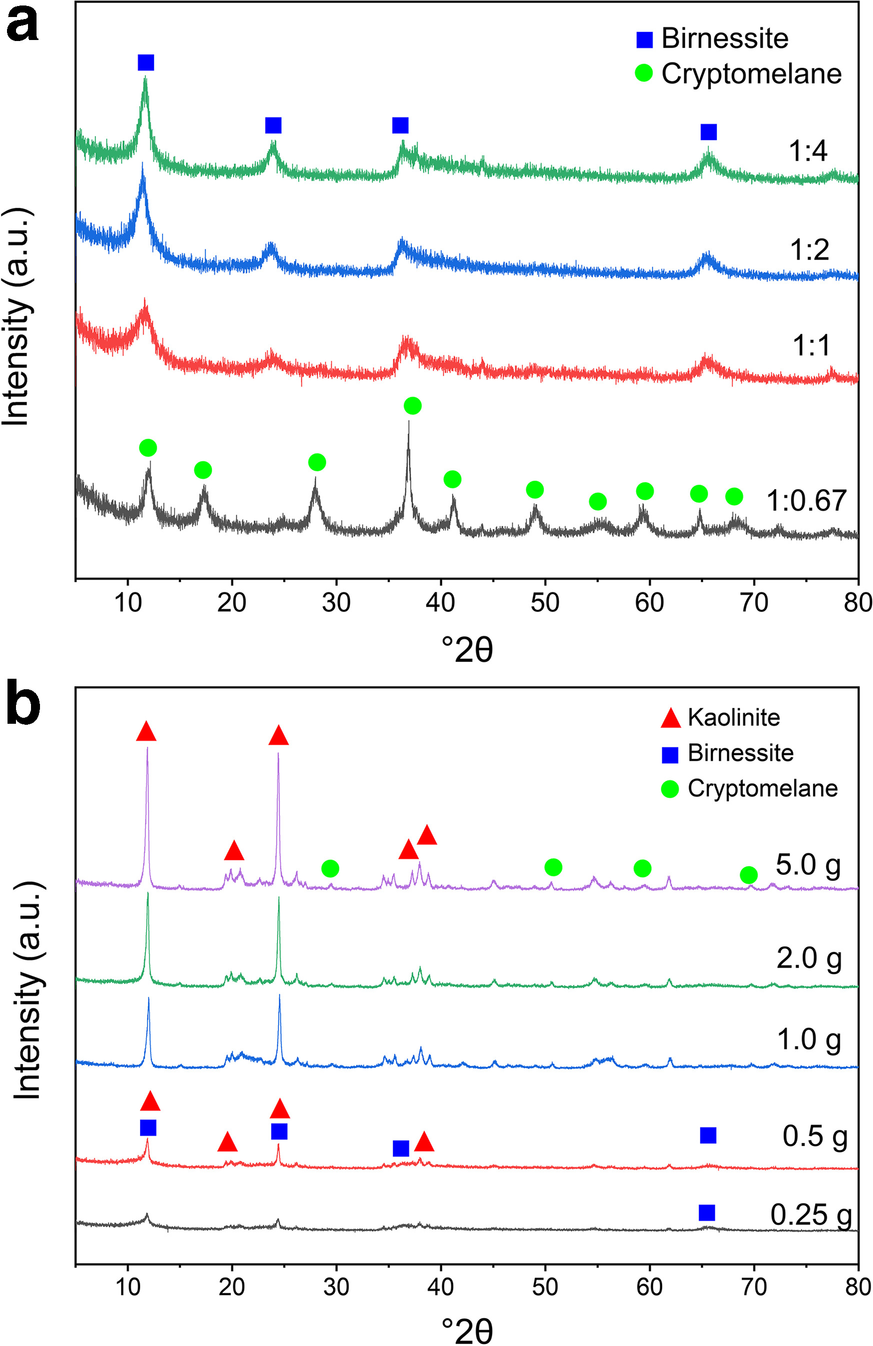
Two different pretreatments were used, one without kaolinite (Fig. 8a) and the other with 0.25, 0.5, 1.0, 2.0, and 5.0 g of kaolinite added (Fig. 8b). With no added kaolinite the XRD pattern of Mn oxide showed that, when R was 1:0.67, only the characteristic diffraction peaks of cryptomelane were present. When R was 1:1, 1:2, and 1:4, the Mn oxide was birnessite (Fig. 8a). In the treatment with added kaolinite, when R was 1:1 and the amount of kaolinite was 0.25 or 0.50 g, the Mn oxide formed was birnessite. However, when 1.0, 2.0, or 5.0 g of kaolinite was added, the Mn oxide formed was cryptomelane (Fig. 8b). In addition, the relative mass ratio of kaolinite and Mn oxide in the end products was calculated as 1:4.67, 1:2.34, 1:0.63, 1:0.53, and 1:0.28, for 0.25, 0.5, 1.0, 2.0, and 5.0 g of added kaolinite, respectively. With the increase in kaolinite content, the mass percentage of Mn oxide in the complex decreased gradually, which is also the reason why the diffraction peak intensity of kaolinite gradually became strong and sharp with the addition of kaolinite from 0.25 g to 5 g. The results showed that the addition of kaolinite affected the Mn oxide mineral type of the complexes; with increase in kaolinite concentration, the conversion rate of birnessite increased gradually, indicating that kaolinite can promote the process of birnessite dissolution and recrystallization into cryptomelane.
XRD patterns of a Mn oxide minerals and b kaolinite-Mn oxide mineral complexes formed when using the following amounts of kaolinite: 0.25, 0.5, 1.0, 2.0, and 5.0 g, with Na+ as the background cation; the value of R was 1:1; the synthesis temperature was 30°C

Discussion
The types of Mn oxide minerals were affected by various environmental conditions in the synthesis process. In the present study, birnessite and cryptomelane were synthesized under different molar ratios of Mn2+ to Mn7+ on the surface of kaolinite. The formation of birnessite on the surface of kaolinite followed one of two processes, and the chemical reaction stoichiometry of which was (Villalobos et al., Reference Villalobos, Toner, Bargar and Sposito2003):


Studies have shown that the transformation of birnessite into cryptomelane is a process of dissolution–recrystallization (Lefkowitz et al., Reference Lefkowitz, Rouff and Elzinga2013; Zhang et al., Reference Zhang, Xiao, Feng, Tan, Qiu and Liu2011), and the interaction between birnessite and Mn2+ in solution promotes the transformation of birnessite (Morgan, Reference Morgan2005; Tu et al., Reference Tu, Racz and Goth1994; Zhang et al., Reference Zhang, Xiao, Feng, Tan, Qiu and Liu2011). When R was 1:0.67 or 1:1, with gradual dropwise addition of of Mn2+, the MnO4 – in the system was exhausted gradually. With continuous dropwise addition of acidic Mn2+, the acidity in the system was relatively strong and promoted the dissolution process and accelerated recrystallization. The dissolution of birnessite and the recrystallization of Mn oxide octahedra continued in the system until birnessite was dissolved completely and transformed into cryptomelane (Zhang et al., Reference Zhang, Xiao, Feng, Tan, Qiu and Liu2011; Zhao et al., Reference Zhao, Liang, Yin, Liu, Tan, Qiu and Feng2015). When R was 1:0.67, the reaction was in the process of dissolution–recrystallization, a mixture of birnessite and cryptomelane was formed. When R was 1:1, and the reaction completed, birnessite was converted into cryptomelane completely. When R was 1:2 and 1:4, the concentration of MnO4 – in the system was greater, and Mn2+ was consumed completely in the reaction system, and the product was single-phase birnessite (Tu et al., Reference Tu, Racz and Goth1994). The Mn oxide mineral types on the surface of kaolinite transformed from the mixture of birnessite and cryptomelane to birnessite as the R value decreased within a certain R value range, which was consistent with the results reported by Ma et al. (Reference Ma, Liu, Huang and Sun2013). The R value affects directly the type of Mn oxide synthesized. In addition, the coating amount of Mn oxide in the complexes was also affected by the R value. When the R value decreased, the amount of Mn in minerals increased, which may be related to the crystallinity of the Mn oxide minerals. When the crystallization of Mn oxide minerals was weaker, the mineral crystals formed were smaller and the effective area in contact with the kaolinite increased, thus more easily covering the kaolinite surface (Khan et al., Reference Khan, Khan and Shahjahan2015). Furthermore, as the R value decreased, the concentration of MnO4 – in the system increased, the reaction between excess MnO4 – in the solution and H+ formed more birnessite (chemical reaction process 2). The amount of Mn in minerals increased accordingly (Zhang et al., Reference Zhang, Xiao, Feng, Tan, Qiu and Liu2011). When the R value was 1:1, the amount of MnO4 – in the system was insufficient (chemical reaction process 1). With continuous dropwise addition of Mn2+, the birnessite transformed into cryptomelane through dissolution-recrystallization (Tu et al., Reference Tu, Racz and Goth1994; Zhang et al., Reference Zhang, Xiao, Feng, Tan, Qiu and Liu2011). At this time, birnessite was in the stage of dissolution-recombination, and the Mn content in the complex was smaller than that in other conditions. This assumption was also confirmed by XRD studies. As seen in the XRD pattern (Fig. 1), when R was 1:1, the kaolinite peak was strongest, probably caused by the amount of Mn oxide synthesized on the kaolinite surface being least.
In addition, coexisting cations will also affect the type of Mn oxide. Studies have shown that coexisting cations can affect the layer structure, microstructure, and crystallinity of the Mn oxide, and a series of new minerals can be obtained from birnessite by ion exchange (Feng et al., Reference Feng, Liu, Tan and Liu2004; Hella et al., Reference Hella, Romain, Ghouti, Christian and Latifa2017; Luo et al., Reference Luo, Steven and Suib1997; Zhu et al., Reference Zhu, Vogel, Parikh, Feng and Sparks2010). The interlayer Na+ of birnessite has been shown (Zhao et al., Reference Zhao, Liang, Yin, Liu, Tan, Qiu and Feng2015) to exchange easily with Mg2+, which indicates that the structure of birnessite with Mg2+ as the interlayer ion is more stable. The hydrated ionic radius of Na+ (3.58 Å) is less than Mg2+ (4.28 Å) (Kuma et al., Reference Kuma, Usui, Paplawsky, Gedulin and Arrhenius1994; Zhang et al., Reference Zhang, Liu, Tan, Suib, Qiu and Liu2018), so Mg2+ with a larger radius (relative to Na+) prevents the structural layer of birnessite from collapsing (Feng et al., Reference Feng, Tan, Liu, Huang and Liu2005; Zhang et al., Reference Zhang, Chen, Qiu, Liu and Feng2016, Reference Zhang, Liu, Tan, Suib, Qiu and Liu2018). The hydrated ionic radius of Na+ was too small to support the layered structure of birnessite in the process of dissolution–recrystallization, and the interlayer space of 0.72 nm in birnessite collapses easily. Finally, the cryptomelane with a tunnel structure was formed (Zhang et al., Reference Zhang, Xiao, Feng, Tan, Qiu and Liu2011). Therefore, when the R value was 1:1, the single-phase cryptomelane was synthesized with Na+ as the background cation. However, with Mg2+ as the background cation, the surface mineral of kaolinite was a mixture of cryptomelane and birnessite. The amount of Mn oxide synthesized under various background cations differs slightly. The Mn content when Mg2+ was the background cation+ was generally smaller than in the background cations of Na+, which may be attributed to the delayed crystallization rate of the system with Mg2+. Birnessite crystallization occurs in three stages: an induction period, a fast crystallization period, and a steady-state period (Luo et al., Reference Luo, Steven and Suib1997). The induction period with Mg2+ was longer than that of the Mg2+ free synthesis; thus, the amount of Mn was smaller with the coexisting Mg2+.
Increasing the temperature can shorten the induction period and increase the crystallization rate (Luo et al., Reference Luo, Steven and Suib1997). In the present study, only birnessite formed on the surface of kaolinite over the temperature range 30 to 110°C. This suggested that increasing the temperature within a certain temperature range (30–110°C) was conducive to the formation of birnessite on the surface of kaolinite. The temperature affected the Mn content in minerals; the Mn content in complexes increased gradually with increasing temperature (Fig. 7).When the temperature was low, the crystallinity of birnessite was obviously impeded, while high temperature accelerated the crystallization rate (Luo et al., Reference Luo, Steven and Suib1997). As a result, birnessite formed quickly and had a larger Mn content at higher temperature.
Mn oxides in soil are not only observed commonly in nodules containing high concentrations of the oxides of Fe and Mn, but also often occur coated or stored on the surface of clay minerals such as kaolinite in the form of colloidal films or fine particles (Choi et al., Reference Choi, Komarneni and Park2009; Khan et al., Reference Khan, Khan and Shahjahan2015; Liu et al., Reference Liu, Sayako, Zhu, He and Hochella2021; McKenzie, Reference McKenzie1972). Studies have shown that mineral surfaces, such as Fe (oxyhydr)oxides, can accelerate the oxidation of Mn2+ to form Mn oxides to a certain degree (Jung et al., Reference Jung, Taillefert, Sun, Wang, Borkiewicz, Liu, Yang, Chen, Chen and Tang2020, Reference Jung, Xu, Wan, Wang, Borkiewicz, Li, Chen, Lu and Tang2021; Lan et al., Reference Lan, Wang, Xiang, Yin, Tan, Qiu, Zhang and Feng2017). Kaolinite is an insulating mineral, which may provide a surface on which to precipitate the Mn oxides via heterogeneous nucleation. SEM images (Fig. 2) demonstrated the uniform distribution of birnessite/cryptomelane on the surface of kaolinite. This is similar to a previous report (Won et al., Reference Won, Jeong, Lee, Dai and Burns2020) which showed that kaolinite particles may play a role as nucleation sites and promote the heterogeneous nucleation of calcite.
Conclusions
The Mn oxide minerals formed on the surface of kaolinite particles were affected by the initial molar ratio of Mn2+ to Mn7+ (R). When R was 1: 0.67, the product contained both birnessite and cryptomelane, while when R was 1:1, the product was single-phase cryptomelane, and single-phase birnessite was formed when R was 1:2 and 1:4. As the R value was decreased, the Mn content in the minerals increased. Background cations also affected the type of Mn oxide formed on the surface of kaolinite. The Na+ ion promoted birnessite transformation by dissolution/recrystallization to cryptomelane, while Mg2+ had no obvious effect. Furthermore, the Mn content in the background Mg2+ cation solution was generally less than in the Na+ solution. The synthesis temperature had no effect on the type of Mn oxide mineral formed, but Mn content increased as the temperature was increased. When the amount of kaolinite added was increased from 0.25 to 5.0 g, the Mn oxide minerals synthesized were transformed gradually from birnessite to cryptomelane. With an increase in kaolinite content, the relative mass ratios of kaolinite to Mn oxide in the end products was calculated as 1:4.67, 1:2.34, 1:0.63, 1:0.53, and 1:0.28.
Supplementary Information
The online version contains supplementary material available at https://doi.org/10.1007/s42860-023-00236-6.
Acknowledgements
The authors acknowledge the support of Anhui Province Key Lab of Farmland Ecological Conservation and Pollution Prevention, the Opening Fund Project of National Red Soil Improvement Engineering Technology Research Center (Grant No. 2020NETRCRSI-13). The authors are also grateful to the Editor-in-Chief and the anonymous reviewers for their very helpful comments and suggestions.
Authors' Contributions
Authors whose names appear on the submission were involved in the writing and revision of the manuscript. All authors have contributed equally to the work.
Funding
Sources are as stated in the Acknowledgments.
Data Availability
All data are contained within the article.
Code Availability
Not applicable.
Declarations
The manuscript has not been submitted to more than one journal for simultaneous consideration and has not been published in full or in part previously. Compliance with ethical statements and all authors consent to participate.
Consent for Publication
All authors give consent for publication.
Conflict of Interest
The authors declare that they have no conflict of interest.