




No CrossRef data available.
Generality above Abstraction: The General Expressed in Terms of the Paradigmatic in Mathematics in Ancient China
Published online by Cambridge University Press: 01 September 2003
Abstract
Argument
Abstraction is commonly valued as being essential to mathematics or even consubstantial with it. In relation to this belief, mathematical texts from Antiquity – be they from Babylon, Egypt, or China –, which are composed of seemingly concrete problems and algorithms solving them, have been considered to be practice-oriented and deprived of theory. This paper offers an alternative view on both issues. Relying on evidence given by third-century commentaries on The Nine Chapters on Mathematical Procedures, a Chinese treatise composed around the beginning of the Common Era,this paper argues that, in the scholarly mathematical tradition of ancient China, generality was more valued than abstraction. In this respect, problems must be interpreted as paradigms, in the sense grammarians use the term. One of the goals of theoretical endeavor was to exhibit the most general operations possible, and this purpose can be read in quite a few specific features of mathematical practice and concepts. Moreover, it is shown that abstraction is not absent from The Nine Chapters, but that it entertains with generality a relationship that requires analysis and can by no means be taken for granted. These ancient sources hence constitute an invitation to develop a critical approach toward the relation of mathematics to abstraction and generality taken separately, as well as the relation of these two values with each other.
Information
- Type
- Articles
- Information
- Copyright
- 2003 Cambridge University Press
Introduction
The oldest extant Chinese mathematical sources, dating from some decades after the time of the unification of the Chinese Empire in 221 BCE, are composed in large part of particular problems and algorithms to solve them. This outward appearance makes these texts look like the writings that survived from the most ancient mathematical traditions. Babylonian tablets and Egyptian papyri, for example, share a common feature with the oldest Chinese sources: the common feature is that mathematics mainly takes the shape of groups of problems. During the nineteenth century, as information concerning these non-Western mathematical sources progressively started to become available, many scholars emphasized the contrast between such texts and those composed in ancient Greece, such as Euclid’s Elements, Archimedes’ writings, or Apollonius’ Conica.1
Raina (1999) shows how, in the case of the history of India, a representation took shape in Europe, according to which “Oriental” scientists of the past had mainly emphasized computing, without developing any theory, whereas Western scholars of the past had concentrated on geometry and theory.
See, for instance, Raina 1999, 233–4, or Charette 1995, 91, which outline the complex history of the knowledge about “non-Western” mathematics and astronomy in nineteenth-century Europe.
In the twentieth century, thousands of pages have been published that contradict such views, yet it is surprising how widespread they still are, even among specialists.3
A quotation from a widely read book will suffice to illustrate this fact. Morris Kline states: “Two independent traditions or concepts of mathematics had now become established: on the one hand, the logical deductive body of knowledge that the Greeks established, which served the larger purpose of understanding nature; and, on the other, the empirically grounded, practically oriented mathematics, founded by the Egyptians and Babylonians, resuscitated by some of the Alexandrian Greeks, and extended by the Hindus and Arabs. The one favored geometry and the other arithmetic and algebra. Both traditions and both goals were to continue to operate” (Kline [1972] 1990, 1:199). I was not able to locate information about mathematics in ancient China in the entire treatise.
I have suggested in recent articles that a mathematical problem is a historical object and that historians need to devise some means for reconstructing how the actors read the problems and for reconstructing the mathematical practices in which the actors involved the problems before they set out to interpret them (Chemla 1997, 2000, 2002). Only by doing so can we hope to account for our sources in a less anachronistic fashion and can we be on sounder grounds to formulate conclusions. How can we do this?
Such a research program is difficult to implement with respect to Babylonian tablets or Egyptian papyri, since, to my knowledge, we cannot rely on any source that would provide information regarding how the problems and the algorithms to solve them were read. Yet, using a very specific method, Jens Høyrup was able to argue against a naive reading of Babylonian procedures.4
See the synthetic approach in Høyrup 2002, especially chap. 2, “A new reading.” The reference list refers the reader to the set of papers through which J. Høyrup elaborated this approach.
However, the case of the earliest Chinese writings is quite different. Regarding the most ancient mathematical book that has been handed down through the written tradition, The Nine Chapters on Mathematical Procedures (Jiuzhang suanshu) (hereafter The Nine Chapters), probably compiled in the first century BCE or CE, commentaries on it were composed from at least the third century until the thirteenth century. The key point in this is that such commentaries bear witness to how the book was read by Chinese scholars. Historians can hence rely on these pieces of evidence to describe how problems were read and used in ancient China. In this paper, I shall put into play part of the evidence thus available to develop an alternative mode for reading these sources. I shall mainly concentrate on the oldest of the extant commentaries, which Liu Hui is said to have completed in 263. Observing these second-order pieces of evidence allows reconstructing ways in which these ancient readers interpreted problems in The Nine Chapters, and the mathematical practice commentators developed on problems. Even though there is a time gap between The Nine Chapters and the composition of the earliest extant commentaries, this is the least inaccurate method I can think of, if we aim to approach problems as historical objects. Moreover, what the commentaries bear witness to can be correlated with features of The Nine Chapters, and this seems to indicate a fair amount of continuity in the way of dealing with problems (Chemla 2002).
In contrast to books such as The Nine Chapters, which survived through the process of transmission, other writings now come to light thanks to archeological excavations. Through this channel, a mathematical source entitled Book of Mathematical Procedures (Suanshushu) that was composed before The Nine Chapters was recently discovered in a tomb that had been sealed before 186 BCE (Peng 2001). This book was not handed down through the written tradition and, in correlation with this, there is no extant ancient commentary on it. However, again, as we shall see, some features of its problems and algorithms disclose an affinity with what we shall reconstruct on the basis of Liu Hui’s commentary.
What is striking is that what these commentaries reveal is clearly different from what we would expect if these practices with problems conformed to our present-day uses. In earlier papers, I have described some of the main features of the practice with mathematical problems seen in Chinese ancient sources, to which the commentaries attest.5
Chemla (1997) develops an initial overview of mathematical problems in ancient China. In the same volume, Lloyd (1997) reacts, from the perspective provided by Greek texts, to a set of papers concerning intellectual practices with examples in several spheres of intellectual activity in ancient China. Relying on Chemla 1997, Chemla 2000 argues for a reading of the chapter devoted to solving systems of simultaneous linear equations in The Nine Chapters (see below).
With respect to the theoretical dimensions of mathematical activity in ancient China, this thesis holds that generality was a value that ancient China’s practitioners of mathematics placed above abstraction. In other words, what mattered most was the generality of the algorithms, and not the abstract character of the framework within which they were presented.
With respect to problems, my thesis holds that the terms of a problem were read as providing a paradigm, in the sense that grammarians use this word, and that the algorithm following it was the basis on which the extension of the validity of the paradigm was determined. The algorithm was not only expected to solve the problem, but was also expected to be general in a sense to be determined more precisely. The relationship of a problem to an algorithm may hence have been different from what may be expected at first sight. If such is the case, this opens up another way of accounting for the shape of ancient Chinese mathematical texts. The fact that they were composed of seemingly concrete problems and algorithms solving them does not imply, as was thought, that they were mainly practice oriented. This simply reflects the emphasis placed on generality, rather than on abstraction. In other words, it was because theory presented itself under quite a specific form in ancient Chinese sources that modern readers failed to recognize it.
In the first, longer part of this paper, I shall present the evidence of a commentary that clearly discloses the interest that the reader Liu Hui manifests in the generality of an algorithm. However, as we shall see, this interest unfolds without his developing an abstract framework for tackling the question of generality. On the contrary, the interest in generality develops in a context where abstraction plays no role. In the second part of this paper, I shall provide clues to support the hypothesis that, more widely, generality was the key value prized by the practitioners of mathematics in ancient China. This hypothesis not only accounts for why mathematical texts assumed the shape of a collection of particular problems, but also helps to explain several other specificities of Chinese mathematical practices. Moreover, I shall show that abstraction was not absent from these texts, but remained ancillary to generality. The thesis for which I argue in this paper seems to me to open onto several distinct, but related, research programs.
One such research program calls for a history of the different theoretical values promoted in mathematics according to time periods and milieus, and their relation to the mathematical practices that put them into play. This would cast light on the process through which abstraction became the chief value in the present-day academic world. What led it to be prized so much in the discourses about mathematics that it outshone other values? Accordingly, we would have to assess the impact of this process on the historiography of mathematics.
Abstraction certainly became increasingly valued in some mathematical milieus of the nineteenth century and is still commonly considered essential for mathematics. On the contrary, in my view, in Chinese ancient sources, abstraction was second to generality. At the time when awareness of the mathematics of the “Orientals,” as they were once called, increased, nineteenth-century mathematics was developing a hierarchy of values that granted abstraction a prominent position. This development may have played a role in the way in which non-Western texts were devalued when they gradually became better known in the West. It undoubtedly contributed to the shaping of a contrasted image. “Western mathematics,” i.e., “the Greeks” and “us,” were fashioned as valuing what appeared to be the “right thing.” In opposition, the “others” who allegedly never understood the importance of abstraction were all grouped in the same set. Let us put aside the fact that it was only ignorance that created the latter aspect of this overall representation. Studying the history of such values may help explain how lasting images took shape. If, as I claim, ancient China’s mathematics bears witness to placing generality above abstraction, we should consider this option seriously before making judgments.
This leads to the second research program with respect to the values themselves. As a consequence of the process mentioned above, in the discussions about mathematics, abstraction has today pride of place. It overshadows the value of generality to such an extent that few attempts have been made to discuss them separately. Somehow, generality appears as a derivative of abstraction. However, as regards mathematics, the example of ancient China highlights generality as a theory-oriented value that could be cultivated independently from, or at least in a different relation to, abstraction. This raises several fundamental issues.
The first range of issues relates to inquiring into generality as such, since it presents itself as another essential, if not alternative, value that has oriented theoretical developments in mathematics. In fact, ancient China’s mathematics is not the only corpus that places importance on generality. Closer to us, in the early nineteenth century for instance, the French geometers of the Monge-Carnot tradition, including Poncelet and Chasles, strongly valued generality.6
See Chemla 1998 for a discussion on this point. I am grateful to Bruno Belhoste for many discussions on the topic of the relationship between abstraction and generality that helped improve my understanding of the problem.
The second range of issues aims at providing a better assessment of the actual role that abstraction plays in mathematics. The sources mentioned above invite us to qualify the commonly held belief that abstraction is, by essence, the leading value in mathematics. In this vein, we feel the need to understand better in which ways it is essential. In addition to this, the nature of the relationship between abstraction and generality deserves to be elucidated, both historically and philosophically, if, as history suggests, these values must be distinguished. The parts played by abstraction and generality in mathematics and the interplay between them throughout history still await clarification. This may, in the end, help us both distinguish several theoretical options for dealing with mathematics in ancient traditions and approach in a critical way the assumptions we make today about its most important values.
However exciting these issues might seem, I shall not be able to tackle them all within the framework of this paper. I shall simply open the discussion by explaining why I think generality was a chief value orienting ancient China’s mathematics and which shapes it took in this corpus of texts.
1. Generality without abstraction
The Chinese source that lies at the center of this paper is The Nine Chapters. This book, which resulted from a compilation of mathematical knowledge available in China at the time of its composition, around the beginning of the Common Era, was to become “the” canon par excellence for mathematics in the scholarly tradition. In relation to this fact, most Chinese mathematicians whose writings have come down to us referred to it and drew inspiration from it. Furthermore, like for all other canons, commentaries were composed on The Nine Chapters. The oldest one among those that came down to us was completed by Liu Hui in 263. Together with later commentaries, presented in 656 to the throne, it was to be selected by the written tradition to be handed down together with the canon. The link between the canon and these commentaries became so essential that there is no extant ancient edition of the Canon that does not contain the commentaries, and conversely. This implies that, most probably, Chinese readers generally used them together.
The reason this mathematical book is relevant for our topic is quite clear. On the one hand, The Nine Chapters for the most part consists of problems followed by algorithms solving them. The problems, the status of which we aim at making clearer, thus constitute the framework of the book. On the other hand, besides systematically establishing the correctness of the algorithms,7
Despite the importance of this topic, we cannot address it fully within the framework of an article. Nor can we provide a full bibliography here. We shall develop aspects of this practice of proof that are related to the theme of the present paper. For other aspects, the reader is referred to Wagner 1979; Wu Wenjun 1982; Volkov 1992, 1994; Chemla 1991, 1992, 1997a. A more exhaustive bibliography can be found in Chemla, Guo forthcoming.
One point should be stressed again right at the outset. The evidence just described enables us to approach the way in which the commentator Liu Hui read problems and used them in his mathematical practice in the third century. Having composed his commentary roughly three centuries after the completion of the canon, he is the earliest reader of The Nine Chapters we can observe. We can rely on his expectations and practices to infer what a problem was and how it was used for the authors of The Nine Chapters. However, when we take this further step, we are in the realm of conjecture. Yet, in my view, this is the least inadequate method to approach how compilers of the canon might have expected readers to deal with the problems. Moreover, as already mentioned, there are hints in The Nine Chapters, and even in the Book of Mathematical Procedures, indicating continuity in the use of problems to which Liu Hui testifies.
In this paper, I want to focus on a specific aspect relating to how problems and algorithms were read. To this end, I shall concentrate on a piece of evidence that demonstrates that the commentator expects an algorithm given after a problem in The Nine Chapters to be general, and not only to solve the problem after which it is presented. Moreover, I shall analyze how, in such a case, Liu Hui proceeds, when the algorithm lacks generality, to extend the range of problems for which it should be efficient.
1.a Problem 6.188 In this paper, I base my translation on the critical edition of The Nine Chapters and the commentaries to appear in Chemla and Guo forthcoming. A problem of The Nine Chapters is located by a pair of numbers: the first number indicates the chapter in the canon, in which it is placed. The second number indicates its position in the sequence of problems of this chapter.
In this paper, I base my translation on the critical edition of The Nine Chapters and the commentaries to appear in Chemla and Guo forthcoming. A problem of The Nine Chapters is located by a pair of numbers: the first number indicates the chapter in the canon, in which it is placed. The second number indicates its position in the sequence of problems of this chapter.
Let us turn to the piece of evidence that constitutes the main basis for this paper. In what follows, I shall comment on the text of The Nine Chapters and the commentary in some detail. For the reader not to lose sight of the whole text, I translate it as it appears in the Chinese source and provide a mathematical analysis in Appendix 1.
The case of problem 18 in chapter 6 of The Nine Chapters is quite interesting, for Liu Hui’s commentary on it reveals unexpected aspects of how he read problems. Let us first consider its terms, since they give a faithful idea of what an ordinary problem of The Nine Chapters looks like. The terms of the problem and the answers provided by The Nine Chapters can be translated as follows:9
In the paper, I print the text of The Nine Chapters in capital letters, and Liu Hui’s commentary in ordinary script. For a more complete interpretation of problem 6.18, with all its variants, I refer the reader to my notes to the translation, in Chemla and Guo forthcoming.
SUPPOSE THAT 5 PERSONS SHARE 5 COINS IN SUCH A WAY THAT WHAT THE TWO SUPERIOR PERSONS OBTAIN IS EQUAL TO WHAT THE THREE INFERIOR PERSONS OBTAIN. ONE ASKS HOW MUCH EACH OBTAINS.
REPLY:
THE FIRST (JIA) OBTAINS 1 COIN 2/6 COIN
THE SECOND (YI) OBTAINS 1 COIN 1/6 COIN
THE THIRD (BING) OBTAINS 1 COIN
THE FOURTH (DING) OBTAINS 5/6 COIN
THE FIFTH (WU) OBTAINS 4/6 COIN.
Before we make clear the mathematical assumptions that underlie the problem, let us make two remarks on it. Firstly, note that, in the answer, the five persons are designated with the help of a set of fundamental markers, the so-called “heavenly stems,” traditionally used to designate ordinal numbers. These markers will recur in Liu Hui’s commentary on the problem.
Secondly, the terms of the problem are particular in two ways. They refer to a concrete situation: that of sharing money between people. Moreover, they provide particular values for each of the data. Most of the problems gathered in The Nine Chapters share these features, and are hence particular at two levels.10
Some rare problems are particular only with respect to the data, since their terms refer to an abstract situation; see Chemla 1997 for a more detailed description of the terms of the problems.
As announced, we aim at grasping how Liu Hui reads such a problem. His reaction to the algorithm given to solve problem 6.18 provides interesting clues with regard to the question of generality. We shall hence describe the algorithm given by The Nine Chapters in some detail before discussing these aspects in Liu Hui’s commentary.
The terms of problem 6.18 refer to the fact that the five persons have unequal rank and that the share they obtain depends on their rank. The procedure of the canon immediately translates this requirement, by deriving weights for the different shares on the basis of a scale consisting in the five first integers: 1, 2, 3, 4, 5, in such a way that the shares form an arithmetical progression. How can we account for the fact that the reader ought to understand this point, without it being made explicit in the terms of the problem? It is most probably by reference to chapter 3 of The Nine Chapters, entitled “PARTS WEIGHTED IN FUNCTION OF THE DEGREE (cuifen),” that the reader is invited to start from the five first integers. Chapter 3 is devoted to unequal sharing, and the fundamental topic in relation to which the mathematical procedure is dealt with is sharing things between five officials according to their different ranks of nobility. Within the context of chapter 3, the commentator makes clear that the procedure described by The Nine Chapters relies on defining the ranks of nobility with the first five integers, 1 to 5. In chapter 3, the parts determined are proportional, or inversely proportional, to these integers. In problem 6.18, in which unequal sharing is taken up again, the first five integers will also define the parts of the various persons, but in a different way. This is the point that the procedure given to solve the problem makes clear right at the outset. The beginning of the procedure reads as follows:
PROCEDURE: PUT (ON THE COUNTING SURFACE) THE (NUMBER OF) COINS AND THE WEIGHTS IN FUNCTION OF THE DEGREE THAT MAKE A PROGRESSION (IN THE SHAPE OF A) CONE.
As usual, the first step consists in placing, on the surface on which computations are carried out, some numbers, on which to operate. In this case, the procedure prescribes to place on it the number of coins as well as “WEIGHTS IN FUNCTION OF THE DEGREE (cui).” The latter technical term refers the topic dealt with to chapter 3, where it designates the coefficients on the basis of which to carry out the unequal sharing. This reference will prove fundamental for the whole procedure analyzed. The description of the procedure for 6.18 borrows its basic structure and terms from the fundamental procedure of chapter 3, i.e. the “PROCEDURE OF THE PARTS WEIGHTED IN FUNCTION OF THE DEGREE (cuifen).”11
See Appendix 3, for a translation of, and commentaries on, the main procedure of chapter 3.
In ancient China, numbers were formed on the counting surface with counting rods.
12Li Yan, Du Shiran ([1963] 1987, 8ff.) gives a concise presentation of the system.

Placed one above the other on the counting surface, they hence compose the shape of a cone, which is how the text of The Nine Chapters refers to them. Liu Hui interprets this first sentence along the same lines:
Commentary: in this procedure, the expression “progression (in the shape of a) cone” means that one has like a cone that is erected. The initial (term) is 1, the next one 2, the next one 3, the next one 4, the next one 5, which respectively form in a uniform way a sequence (yi lie zhe).
At this point, we hence have on the counting surface the number of coins and the first five integers. As indicated above, in chapter 3, the latter numbers define the shares received by officials of different ranks. In problem 6.18 too, in correlation with the use of the technical term of “WEIGHTS IN FUNCTION OF THE DEGREE (cui),” they form the basis for defining coefficients of an unequal sharing that fulfills the condition that the two top officials, associated with the numbers 5 and 4, receive as much as the three lower officials, to which the numbers 1, 2, 3 correspond.
In relation to this new condition, they need to be adjusted and hence undergo transformations, before they can define the proportions according to which the unequal sharing will be carried out. On the basis of the procedure, as we shall see, it becomes clear that, in the sharing, the different persons mentioned receive parts that form the five first terms of an arithmetical sequence. Let us call x1 to x5, respectively, the shares received by the different officials, from the top one to the lower one. Problem 6.18 can hence be understood as asking to determine values for the

, 1≤i≤5, n=5, such that:
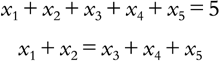
Let us examine the procedure provided by The Nine Chapters to solve it. After the first step that placed on the counting board the number of coins and, from bottom to top, 1 to 5, it goes on as follows:
(I) ADDING UP THE (WEIGHTS IN FUNCTION OF THE DEGREE CORRESPONDING TO) THE TWO SUPERIOR PERSONS MAKES 9. ADDING UP THE (WEIGHTS IN FUNCTION OF THE DEGREE CORRESPONDING TO) THE THREE INFERIOR PERSONS MAKES 6. 6 IS SMALLER THAN 9 BY 3. (II) ONE UNIFORMLY ADDS 3 TO THEM (THE WEIGHTS IN FUNCTION OF THE DEGREE).
On the counting surface, the “3” are added directly to the left column and these operations yield the right column in place of the left one.

At this point, the procedure has determined the coefficients, or “weights,” according to which the coins are to be unequally shared, and it now repeats the formulation of the “PROCEDURE OF THE PARTS WEIGHTED IN FUNCTION OF THE DEGREE (cuifenshu)” to carry out the unequal sharing. We can hence translate its final section as follows:
(III) IN AUXILIARY,14
One has on the counting surface the number of coins and the coefficients according to which one will share. To add the latter “in auxiliary” refers to an addition that does not destroy the representation of the values added on the counting surface. This is important, since they will be used again in a later step.
Let us sketch again the computations of the counting board, as above15
The multiplication of the coefficients by 5 yields the middle column of the table above. On the counting surface, this middle column replaces the left column. The successive divisions then yield the results of the right column in place of the middle column.

The original text contains no Roman numerals. I added them so as to indicate where Liu Hui inserts comments on the steps of the procedure. Instead of analyzing now in modern terms the mathematical meaning of this procedure (for this, see Appendix 1), I suggest to turn to Liu Hui’s commentary, which will guide us for understanding it as he does. Let us hence follow his commentary, which, to account for the correctness of the procedure provided by The Nine Chapters, makes explicit the meaning of the steps of the computation.
1.b Proving the correctness of the procedure
Between steps (I) and (II), Liu Hui inserts the following remark:
“These do not yield equal values, one has only taken 1, 2, 3, 4, 5 to make lü’s.”
Li Jimin (1998, 556), following his critical edition of 1993, does not change the text contained by all ancient editions. In this respect, he agrees with Qian (1963, 196), but he punctuates it differently.
However, he still qualifies them as lü. This interpretation is supported by the fact that, in the following, Liu Hui will again refer to these numbers with the term lü. This can be explained by the fact that they are placed in the positions where the final lü’s will be obtained and that, in the description of algorithms as carried out in ancient Chinese sources, names refer to positions rather than to individual numbers (Chemla 1996). This corresponds, more generally, to the assignment of variables in present-day descriptions of algorithms. Li Jimin (1998, 556) offers another interpretation of the last sentence: “In vain would one take 1, 2, 3, 4, 5 as lü.” Shen et al. (1999, 333–336) presents several inaccuracies in this passage, and, in particular, this sentence is wrongly translated. The reader will find these points developed in the Appendix 1.
This remark by Liu Hui thus indicates that he interprets the procedure as aiming, in the first place, at computing lü’s for the quantities of coins to be distributed to each person. This will be confirmed by the following part of his commentary, inserted after step (III). Let us hence turn to consider how he brings to light that this is the first aim fulfilled by the procedure of The nine chapters in step (II), before showing how step (III) relies on these lü’s to yield the actual values sought for.
Liu Hui first makes explicit what the computations of step (II) aim at, as follows:
In this problem, one makes (what) the two superior persons (obtain) equal to (what) the three inferior persons (obtain). The groups of superiors and inferiors present a difference of 1 person, and the corresponding difference (between the sums of weights) is 3. If one uniformly adds (this difference) to the group of superiors, this hence yields twice 3. If one uniformly adds (this difference) to the group of inferiors, this hence yields thrice 3. The groups of superiors18
This follows the critical edition to appear in Chemla and Guo forthcoming. Li Jimin (1998, 556) considers that the original text is not corrupted, see Appendix 1.
“To bring into communication (tong)” seems here to refer to the fact that one adds two sets of numbers term to term. The first set consists in the numbers originally laid out: 1, 2, 3, 4, 5. The second set consists in the five 3 added to each of the former numbers, which have been considered independently by the commentary. The sum of the first three of the former set was smaller than the sum of its last two terms by 3. The sum of the first three of the latter set set is greater than the sum of its last two terms by 3. Hence “bringing them into communication,” adding them up term to term, yields a situation in which the sum of the first three terms of the new set equals the sum of its last two terms. Tong could also be interpreted as “make a global account” of the two sets of numbers. One recognizes here a general pattern of transformation that Liu Hui identifies at play in several procedures of The Nine Chapters: yi ying bu xu, “Use the excess to fill up the void.” On this operation, see for instance Wu Wenjun 1982, Volkov 1994, and Chemla 1992, which discusses the part played by the operation in proofs.
This is where the term lü recurs to designate the numbers first laid out. The expression ben lü can also be understood as “fundamental lü.”
Liu Hui starts this development of his commentary, by recalling the meaning of the first computation with respect to the situation: there are two groups, the superiors, and the inferiors. The former group has 1 person less than the latter one, and the difference in terms of the coefficients displayed is as follows: what corresponds to the former is greater than what corresponds to the latter by 3.
Liu Hui then dissociates the operations prescribed by the procedure of The Nine Chapters. He first considers that which is added, i.e., the “3”’s that are uniformly added, separately, before they be added. Moreover, he dissociates the set of five 3's that are uniformly added into two sets, those added to the group of the superiors and those added to the group of the inferiors. The former has still 1 person less than the latter, but, in terms of the numbers added, the difference is such that what corresponds to the former is now smaller than what corresponds to the latter by 3. Therefore, by combining the two sets term to term, coefficients are produced for each person of the two groups that are fulfilling the condition required. That is to say, the sum of the coefficients attached to the superiors is equal to that of the coefficients provided for the inferiors.
The reorganization of the set of operations is essential to account for why, and how, the procedure works. Moreover, let us stress that Liu Hui introduces intermediary operations, i.e., the partial summations of the quantities 3 added, that belong only to the sphere of proving, not to that of computing. It is by dissociating and reorganizing in a different way the operations carried out that the commentator can highlight the aim they pursue.
At this point, Liu Hui has established why the coefficients computed by the procedure can be taken as weights in an unequal sharing fulfilling the requirements of the terms of the problem.21
This way of proceeding recurs regularly when Liu Hui accounts for the correctness of other procedures of The Nine Chapters. Quite often, he brings to light that the procedure first determines a microcosm of the situation described by the problem, in which the value corresponding to the unknown sought for is determined. The rule of three is then applied to project the microcosm onto the macrocosm and determine the unknowns. This constitutes a frequent pattern of proof. See the introduction to chap. 2 in Chemla and Guo forthcoming.
Quotation marks indicate when the commentary quotes The Nine Chapters. They usually cannot constitute real quotations in English, because of the difference of syntax between English and Chinese. Here the text makes use of both the “procedure of suppose” and the “procedure of the parts weighted in function of the degree.” The terms “lü of what one has,” “lü’s of what is sought for” and “quantity (shu) of what one has,” are taken from the “procedure of suppose,” whereas the terms “sum in auxiliary”; “the (weights in function of the degree that one had) before they were added” come from the “procedure of the parts weighted in function of the degree.”
With the “procedure of suppose,” the “sum in auxiliary” makes the “lü of what one has”; “the (weights in function of the degree that one had) before they were added” respectively make the “lü’s of what is sought for”; the 5 coins make the “quantity (shu) of what one has,” and one applies to this (procedures) of “suppose,” hence only one obtains the equality (of what is given to the superiors and to the inferiors).
1.c Problem and procedure as paradigm
With this last quotation, Liu Hui’s reasoning to account for the correctness of the procedure prescribed by The Nine Chapters comes to an end. He has established that the procedure does actually solve problem 6.18.
However, there is more to it. The way in which he has established the correctness of the procedure makes explicit the meaning of the operations with respect to the situation presented in the terms of the problem. It thus discloses that the procedure relies on two features that are specific to problem 6.18, and would not apply to all other similar problems with different data. Indeed, why does the uniform addition of the difference 3 to the five first integers yield adequate weights for the sharing? Firstly, it makes use of the fact that there is only a difference of 1 person between the two sets. Secondly, it brings into play the fact that, whereas the inferiors are more numerous than the superiors, the sum of the first three integers is smaller than the sum of the last two. In what follows, Liu Hui immediately formulates a problem similar to 6.18 but for which none of these conditions holds. And he provides another procedure for solving it.
Before we read this second part of his commentary, let us insist on the import of this piece of evidence.
Firstly, let us stress the features of the text examined, to highlight its uniqueness. There are several situations for which, in his commentary on a given procedure, Liu Hui is led to introduce a problem different from the one of The Nine Chapters.23
Chemla (1997) examines several of them.
Secondly, let us analyze what the passage reveals of the commentator’s expectations regarding the nature of a problem and the procedure following it. This situation discloses that the commentator expects that the procedure given after a problem does not only solve the problem as such, but also a class of problems for which the problem stands and which is to be determined. This point is absolutely fundamental for us.
On the one hand, it reveals that, according to the most ancient Chinese reader we can observe, one who wrote less than three centuries after the completion of The Nine Chapters, the relationship of a problem to the procedure following it is not that of a problem to a procedure solving it. If, indeed, the contrary were the case, the commentary could stop at this point. But it goes on. The expectation placed on the procedure is much higher: it should solve a class of problems similar to the one in relation to which it is presented. As a consequence, we come to understand that, even though the procedure is presented in the context of a concrete problem, it is expected to be general. The validity of its operations should extend beyond the particular problem in relation to which it is given. This implies that the unit of a problem and a procedure is to be taken as a paradigm, in the ordinary sense that grammarians use the word. This immediately raises a question: Why thus should a general procedure be given in relation to a paradigmatic case? We shall come back to this issue below. However, a point needs to be emphasized here. The expectation that the procedure should be general is disclosed by a development written by the reader Liu Hui, in reaction to a piece where the canon fails to yield the best procedure possible in this respect. It is not surprising that our evidence is of this kind: The Nine Chapters contains no second-order statement about mathematics. Yet, as is argued below, what the commentator discloses as regards the emphasis placed on generality appears to characterize also the compilers of The Nine Chapters. The expectation of ancient readers regarding the canon would hence not be misplaced and would reveal continuity on this point for some centuries.
On the other hand, the case of 6.18 provides evidence showing how the class of problems for which a given problem stands is defined. Liu Hui’s discussion shows that both the problem and the procedure enter into play for defining the range of problems covered by their combination. The data of a problem can vary, and thereby define a class of problems. However, if the procedure fails to solve them all, the class of problems referred to by a given problem should be restricted to those solved by the procedure. Liu Hui’s commentary offers more evidence as to how both the problem and the procedure combine in defining the class (lei) of problems corresponding to the one displayed in The Nine Chapters.24
Chemla (1997) discusses other parts of Liu Hui’s commentary in this respect.
As rightly stressed by C. Cullen, the concept and practice of “classes” or “categories” (lei) in mathematics is central to the opening sections of The gnomon of the Zhou (Zhoubi)(Cullen 1996, 74–5, 177). In the glossary of mathematical terms that I composed to be published together with Chemla and Guo forthcoming, I discuss the various uses of the term lei in the commentaries on The Nine Chapters.
In the particular case with which we are dealing, we shall observe how Liu Hui strives to provide a new procedure having two properties. First, the new procedure differs from that of The Nine Chapters, since it allows solving a wider set of problems similar to the one offered by the canon. Secondly, it, however, derives from it. As a whole, the commentator thus manifests an interest in increasing the generality of the procedure. We shall now go back to the following section of his commentary to observe how he carries out this program. It can be translated as follows:26
The reader might have the impression that the translation supplies a lot to the text. It should be kept in mind that the problem and the procedure derive from that described by The Nine Chapters. The ellipsis concerns the elements that remain the same.
Suppose27
The expression for “suppose” is not the same as in The Nine Chapters, i.e., jinyou has been replaced by “suppose (jialing),” which is more frequent in the commentaries as well as in some later treatises to introduce a problem. On this other expression of the supposition, see my glossary in Chemla and Guo, forthcoming. The remaining part of the terms of the problem introduced by Liu Hui is similar to that of The Nine Chapters, except that the numerical values change.
I prefer this interpretation to the other common one, such as can be found in Li Jimin 1998, 556: “This gives more for the inferiors and less for the superiors and hence there is not enough for the (sum of weights corresponding to the) inferiors to be subtracted from the (sum of weights corresponding to the) superiors.” The latter interpretation insists on only one of the two elements (sum of the superiors smaller than sum of the inferiors) that combine in the second feature discussed here, by which the problem put forward by Liu Hui brings to light the inability of the procedure of The Nine Chapters to rule all cases similar to 6.18. To get decreasing shares with an arithmetic progression, the number of persons in the group of inferiors needs to be greater than the number of persons in the group of superiors. However, this other element still enters into play in analyzing the situation. I suggest that Liu Hui is here displaying a command of both factors at play. Note that, in the set of cases introduced by Liu Hui, the latter condition is not sufficient for ensuring that the shares be positive (see Appendix 1).
Liu Hui hence introduces a problem similar to the one raised by The Nine Chapters for which he makes two points. Let us consider them in an order inverse of his. Firstly, starting again from the seven first integers, he notices that the procedure of The Nine Chapters, which prescribes to subtract the sum of what corresponds to the inferiors from the sum of what corresponds to the superiors, does not apply to this case. The group of inferiors being the more numerous, one can hence no longer restore the balance by a uniform addition, as the proof showed one did in the previous case. Let us illustrate this on a table similar to the one drawn above:

It is interesting to note that the problem put forward by Liu Hui is the first that can be built on exactly the same model as The Nine Chapters to present this property.
Secondly, the commentator highlights one essential point that he showed underlies the correctness of the procedure of The Nine Chapters, i.e., that the difference between the numbers of persons of the two groups be equal to 1, does not hold. As a consequence, even if one uniformly subtracted the difference between the coefficients in the two groups, instead of adding it, that would not restore the balance either. Again, this last point is quite interesting. It reveals that it is the proof Liu Hui developed to establish the correctness of the procedure provided by The Nine Chapters that indicates that the procedure is not correct for the new similar case he introduces. The proof hence appears to be a tool for inquiring into the range of problems for which the procedure can be used.
The problem introduced by Liu Hui brings to light the fact that the problem formulated by The Nine Chapters represents one case, in the set of similar problems. The commentator introduces a second case. The procedure described to deal with it derives from that of The Nine Chapters. In fact, it can only be understood as a transformation of the latter that extends its validity, since Liu Hui alludes to this other procedure in quite concise terms. He writes:
One must take the “laid-out difference” (lie cha) between (the sums of weights in function of the degree corresponding to) the groups of the superiors and the inferiors, and then uniformly subtract from (the weights in function of the degree). Only then does this conform to what was asked for.
The procedure alluded to clearly consists in transforming the procedure described by The Nine Chapters in two ways.
Firstly, the uniform addition is transformed in uniform subtraction, which addresses the fact that, instead of being smaller, the sum attached to the group of inferiors is greater than that of the group of superiors, whereas its number of persons remains greater. This can be illustrated on the following table:

Secondly, what is to be uniformly subtracted is no longer the “difference (between the sums of weights),” but the “laid-out difference (between the sums of weights).” The meaning of this expression cannot be ascertained. However, given the context, the only reasonable interpretation is to understand that it refers to the difference between the sum of weights divided by the difference between the numbers of persons in each group. If we consider this in the previous example, the quantity a to be uniformly subtracted must be such that:

This implies that
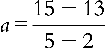
which is the quantity announced. In case the difference between the number of persons in each group becomes 1, a reduces to the “difference (between the sums of weights).” The value of a is to be laid-out (lie) on each line and uniformly subtracted from each corresponding integer among the seven first numbers.29
This is the interpretation on which all contemporary commentators agree (see, for instance, Li Jimin 1998, 557, n. 4; and Shen et al. 1999, 335–6). On the term lie and the expressions composed with it, see my glossary to appear in Chemla and Guo forthcoming.
Several remarks should be made about this additional problem raised by Liu Hui and the procedure to solve it.
First, let us emphasize that the procedure alluded to by Liu Hui clearly derives from the one given by The Nine Chapters. Granted the interpretation we give for the “laid-out difference” is correct, with respect to one feature for which the latter procedure lacked generality, the procedure performs a generalization, when it introduces the “laid-out difference,” in place of the “difference (between the sums of weights).” However, even if, in a sense, the procedure is more general, two procedures are still needed, one prescribing to add the difference, the other to subtract it, and they correspond to the fact that the class of problems divides into two subclasses.
Secondly, it is important for our topic to note that it is also within the framework of a paradigm that Liu Hui introduces both a more general procedure (with the “laid-out difference”) and a procedure solving the other kind of problem. In other words, he himself uses particular problems in the same way as what we grasped he reads in the problems of the canon. The extension he carries out in terms of generality makes use of the same mode of expression as The Nine Chapters. Here, too, the general is expressed in terms of the paradigmatic.
Let us list the main properties characterizing the paradigm Liu Hui introduces. First, it brings to light two ways in which the procedure given by The Nine Chapters fails to solve the set of problems obtained by going through the range of possible values for the data. One failure can be, and is possibly, fixed by the introduction of a more general procedure, using the “laid-out difference” instead of the “difference.” The other failure relates to the fact that, in fact, with respect to this procedure, problems of the kind of 6.18 still constitute two classes. Secondly, as a consequence, the paradigm chosen hence allows Liu Hui to introduce an alternative procedure for dealing with problems of the second class and, possibly, the idea of a more general procedure for the two classes of problems.
A last remark should be made at this point en passant. If our interpretation of the procedure to which Liu Hui alludes is correct, this procedure is in fact much more general than it appears, since it does not require the assumption that we ought to start with the n first integers and yield an arithmetical progression, as the procedure of The Nine Chapters does. In fact, it can be noticed that it is not the problem, but the procedure of The Nine Chapters that introduces this set of integers, on the basis of which to shape an adequate set of weights fulfilling the required condition. Liu Hui’s account for the correctness of the procedure discloses that nowhere is use made of the fact that the weights constitute an arithmetical sequence. In fact, as long as the numbers of persons in the two groups differ, instead of the n first integers, we could start from any decreasing set of numbers, which would comply with the order of hierarchy between the superiors and the inferiors, and apply the same procedure to produce weights. This may be why this point is left open by the terms of the problem. We shall come back to this point below.
1.d Reworking the generality of the procedure
Up to this point, Liu Hui has introduced a second paradigm to stress the inability of the procedure of The Nine Chapters to cover all similar problems, and he alluded to a second procedure, partly more general, and partly complementary to it. However, regarding the use of paradigms as revealed by this passage, this is not all.
In fact, the commentary does not stop here, but suggests relying on the procedure that The Nine Chapters gives to solve the following problem, 6.19, to formulate a new procedure solving 6.18, in a way that now extends to all similar problems.30
As above, the translation of problem 6.19 and the procedure solving it, together with some mathematical explanations, are gathered in Appendix 4.
First, after having stressed the limits of the procedure given by The Nine Chapters to solve 6.18, through introducing a problem similar to 6.18 that it fails to solve, and after having alluded to another procedure that solved the second paradigm and introduced a way of making the first procedure more general, the commentator moves on to define a new and now much more general procedure that allows solving all problems similar31
It is important to stress, however, that here no attention is given to the fact that, in some of these cases, the shares could become negative. This highlights the limits of this practice of generality.
Secondly, to do so, as we shall see immediately, Liu Hui again places himself within the framework of problem 6.18. This implies that, in the commentator’s view, despite its specificity, problem 6.18 can still enter in the definition of a paradigm for the whole class of similar problems, as long as the procedure to solve it is general and does not make use of particular properties of either its situation or its values. It is hence not the problem in itself that constitutes a paradigm, but the combination of a problem with a procedure that is general enough for the unit to become a paradigm. Moreover, the reworking of the procedure, to increase its generality, within the framework of the same particular problem 6.18 shows even more clearly that the relationship of a problem to the procedure provided to solve it cannot be taken for granted and requires to be studied.
Thirdly, in fact, the new procedure introduced is just an “imitation of the procedure that allows solving the following problem” (my emphasis). Through using this other procedure, Liu Hui hence further shapes problem 6.18 not only as representing the set of similar problems, but also as being, itself, a particular case of problem 6.19, which, in a sense, can indeed be considered as more general.
Fourthly, this is all the more interesting that, as the following explanation and Appendix 4 show, problem 6.19 deals with a completely different type of situation. This confirms a result obtained in Chemla 1997: Liu Hui does not stop at the outward appearance of problems when he reads them. Despite the fact that problems may deal with concrete situations that are essentially different, Liu Hui keeps comparing them with respect to the mathematical situations they represent. Using the procedure that solves one in order to solve the other, as is the case here, amounts to formulating statements as to the relative generality of one with respect to the other.32
In chapter A of Chemla and Guo forthcoming, I discuss statements by the commentators relating to this type of generality.
Let us translate the terms of problem 6.19 to see how this comparison between problems operates here. Problem 6.19 reads as follows:
SUPPOSE THAT A BAMBOO HAS 9 INTERNODES AND THAT THE 3 INFERIOR INTERNODES HAVE A CAPACITY OF 4 SHENGWHEREAS THE 4 SUPERIOR INTERNODES HAVE A CAPACITY OF 3 SHENG. ONE ASKS, IF ONE WANTS THAT BETWEEN TWO (NEIGHBORING) INNER INTERNODES CAPACITIES BE UNIFORMLY DISTRIBUTED, HOW MUCH THEY EACH CONTAIN.
This is hence the problem for which The Nine Chapters provides a procedure that Liu Hui imitates for solving problem 6.18. We shall see later how he does so.
If we reformulate both problems in modern terms, their relationship appears clearly. Problem 6.18 provides the sum of, on one hand, the first p terms and, on the other hand, the last n-p terms for n terms in an arithmetical sequence, in a case when the two sums are equal, and asks to determine each of the terms. Problem 6.19 provides, for n terms in an arithmetical sequence, the sum of the first p ones, and the sum of the last n-p-q ones, where p+q is smaller than n, and requires determining all the terms of the arithmetical sequence. In these terms, problem 6.18 appears clearly to be a particular case of 6.19 for which q=0.
But, again, several remarks should be made at this point. First, problem 6.19 only deals with arithmetical sequences. This point is clearly stated in the terms of the problem, in which it is made explicit that the change between the capacities of two neighboring internodes of the bamboo is uniform. Moreover, the procedure given for solving it confirms this point. However, as we noticed above, although The Nine Chapters and Liu Hui treat problem 6.18 in the case of weights that form an arithmetical sequence, the procedures described could apply to any distribution of numbers complying with the hierarchical order. It is hence by reducing the range of problems that could be similar to 6.18 that these problems become particular cases of 6.19.
Secondly, within the assumption that we deal with arithmetical sequences, I reformulated above 6.18 and 6.19 in abstract and general terms to bring their relationship to light. However, in The Nine Chapters, both appear to be particular problems, with respect to, both, the situation and the numerical values. It is only if we read them as paradigms that we can consider 6.18 as representing a set of particular cases, forming part of a larger set of situations encompassed by 6.19. What is important for us here is that, once again, problems that are by no means abstract, or treated abstractly, are actually read as standing for a class, their scope of generality being defined in relation to the procedure solving them. Moreover, it is interesting to stress again that Liu Hui introduces the new procedure for solving 6.18 as “imitating the next procedure.” In other words, he does not describe the procedure for 6.19 in more abstract terms so as to apply it to solving 6.18, but he directly imitates the former to produce the latter.
Let us hence observe how Liu Hui makes use of the procedure described after problem 6.19 to provide a new procedure for 6.18. To do so, we need first to examine how The Nine Chapters prescribes solving problems such as 6.19. Let us translate the procedure, before we explain it, by relying on how Liu Hui accounts for its correctness. The procedure can be translated as follows:
PROCEDURE: (I) ONE SHARES33
The term used (fen) is the same as in the terms of problem 6.18, which I indicate by translating it by the same word, however strange that may sound. Note that, here, the terms “inferior” and “superior” are used in opposition to their use in problem 6.18. In problem 6.19, the base of the bamboo is larger than its higher part, and the internodes of the inferior section hence contain more than those of the superior section. The procedure applies indistinctly. Also note the occurrence, below, of the concept lü. As above, I insert Roman numerals to designate the various steps of the procedure to comment on them below.
(IV) ONE PUTS (ON THE COUNTING SURFACE) THE 4 INTERNODES AND THE 3 INTERNODES, AND ONE RESPECTIVELY HALVES THEM TO SUBTRACT THEM FROM THE 9 INTERNODES. THE REMAINDER MAKES THE DIVISOR. DIVIDING THE DIVIDEND BY THE DIVISOR YIELDS A RESULT INSHENG, WHICH IS THE DISTANCE BETWEEN THE WEIGHTS IN FUNCTION OF THE DEGREE.34
This means here the ratio of the arithmetical sequence. The use of the term “weights in function of the degree,” again, indicates that The Nine Chapters thinks of the situation in terms of unequal sharing.
The formulation of the procedure is interesting in two respects. First, stricto sensu, it does not yield the sequence of numbers sought for, i.e., the list of the capacities of all internodes. On the contrary, it ends with the computation of two numbers, one of which, the result of the division in step (IV), is not required by the terms of the problem. It is left to the reader to complete the solution of the problem and yield the series of capacities on this basis.
Secondly, the procedure states an interpretation for both of the numbers that it yields. The number that was not required, but that proves to be the key to solving the problem, is interpreted as “THE DISTANCE BETWEEN THE WEIGHTS IN FUNCTION OF THE DEGREE.” In fact, it provides the ratio of the arithmetical sequence of numbers sought for. The second number, the “lü of the inferiors,” for which the procedure provides an interpretation in step (V), is in fact determined at the beginning of the computation: it is, in the end, interpreted as constituting one of the terms of the sequence. The reader is thus expected to produce the sequence on the basis of one of its terms and its ratio. These interpretations are both the basis and the aim of Liu Hui’s commentary on this procedure.
Let us sketch the main line of his argumentation: Liu Hui interprets steps (I) and (II) as computing the average of the capacities of, respectively, the inferior internodes, and the superior ones. Given that the capacities form an arithmetical sequence, in case the number of internodes is odd, the average provides the capacity of the internode of the middle. Such is the argument accounting for the statement made in step (V).
As in the proof of the correctness of the procedure given for solving problem 6.18, Liu Hui’s proof proceeds by making explicit, in an adequate way, the “meaning” of the results of the computations prescribed. That is to say, he expounds that which they compute, in terms of the situation outlined in the terms of the problem. Step (IV) is interpreted as computing the number of internodes between the middle terms of, respectively, the superior and inferior sets of internodes — those for which the global capacity is provided in the terms of the problem. As for the result of step (III), which hence computes the difference between the average of the upper internodes and that of the lower internodes, Liu Hui interprets it as computing the sum of differences in capacity between all pairs of neighboring internodes that are to be found between the middle terms of, respectively, the superior and inferior sets of internodes.
In modern terms, the difference between two neighboring internodes is the ratio r of the arithmetical progression. Let us call p (resp. n—(p+q), where n>p+q) the number of internodes that are in the superior (resp. inferior) part, the capacity of which is provided by the terms of the problem.
The computation of step (IV) yields n—[p/2]—[(n-(p+q))/2], or (n+q)/2, which is interpreted as the number of internodes between the middle terms of the superior and the inferior parts.
The superior internodes have, respectively, the capacity a+ir, where 1≤i≤p. The average of these capacities is a+(p+1)r/2, which is the capacity of the internode in the middle if p is odd.
The inferior internodes have, respectively, the capacity a+(p+q)r+ir, where 1≤i≤n—(p+q). The average of these capacities is a+(n+p+q+1)r/2. The difference between the two average capacities yields (n+q)r/2. Liu Hui interprets this as the sum of the differences of capacities of the successive pairs of internodes from the middle internode of the inferior part up to the middle internode of the superior part. This is why, he says, dividing the latter by the former yields r, or, as he calls it “the difference associated to each internode.” As a side remark, it is interesting to note that Liu Hui’s commentary brings to light how essential is, in the case of problem 6.19, the assumption that the capacities of the successive internodes constitute an arithmetical sequence. The correctness of the procedure heavily relies on this fact.
Let us now go back to the last part of Liu Hui’s commentary for problem 6.18, and see how he transfers the procedure given by The Nine Chapters to it. The text can be translated as follows — like above, quotations of the procedure of The Nine Chapters for solving problem 6.19 are indicated by quotations marks, even though, in English, they do not appear as such:
For this (problem), one can imitate the next procedure and make the 2 superior persons share 2 coins and half “to make the lü of the superiors,” make the 3 inferior persons share 2 coins and half “to make the lü of the inferiors.” “Of the lü of the superiors and the inferiors, the smaller is subtracted from the greater, and the remainder makes the dividend.
One puts (on the counting surface) the 2 persons and the 3 persons “and one respectively halves them to subtract them from the” 5 persons. “The remainder makes the divisor. Dividing the dividend by the divisor yields a result in” coins, “which is the distance between the weights in function of the degree. The lü of the inferiors,”35
Here we follow the emendation of Li Jimin (1998, 555).
The text shows clearly that Liu Hui has translated the procedure given after the problem 6.19 directly into the context of 6.18. Several remarks regarding our topic should be made here.
First, even though, when q=0, there could be a much shorter way of computing the distance between the middle terms of each of the superior and inferior sets, by simply halving n, Liu Hui faithfully follows the procedure of 6.19. This means that he does not make use of the particularity of the data of 6.18 to simplify, and thus particularize, the procedure. To the contrary, even though he is in a particular case, he still makes use of the general procedure. This stands in sharp contrast to what the procedure given by The Nine Chapters for 6.18 was doing and that on which Liu Hui commented at length, as we saw above. Again, this can only be explained by assuming that Liu Hui values the generality of a procedure.
Secondly, let us stress that, in correlation with this fact, despite its particularity, the problem 6.18 is hence taken as a paradigm for the procedure solving the problems of the same class as 6.19. The generality of the procedure defines the generality of the problem. It is quite interesting to note here that, in the recently excavated book that was composed at the latest in the second century BCE, the Book of Mathematical Procedures, we have a problem and a procedure that present exactly the same features (Peng 1991, 101–2, bamboo slips 141 and 142).36
I owe this point to a discussion I had with Christopher Cullen on the Book of Mathematical Procedures.
Similar situations can be found in The Nine Chapters, when multiplication or division by 1 are prescribed that guarantee the generality of the procedure described after a particular problem (see, for example, problems 9.6 or 9.9). In early sources, such “useless” operations are common in the description of algorithms.
Thirdly, let us stress again that, with this latter procedure, Liu Hui increases the generality of the procedures he gave so far to deal with problems similar to 6.18. We remember that, on the basis of the former procedures, this set of problems was split into two sets of cases, according to whether one needed uniform addition or subtraction. Now, Liu Hui, by giving a unique procedure to settle both kinds, unifies that which constituted two classes of problem and extends the kind of problems covered. This again betrays an interest in generality, in a context from which abstraction is completely absent.
If we recapitulate what we established so far on the basis of the piece of evidence examined, we can formulate the following conclusions.
First, despite the fact the The Nine Chapters is mainly constituted of problems and algorithms given in relation to them, the oldest readers we can observe betray an expectation that the algorithms be general and their efficiency extend as far as possible beyond the problem in relation to which they are described. This appears clearly in a context, unique to my knowledge, that of problem 6.18, when the procedure fails to be as general as it could. This is, however, nicely complemented by the piece of evidence from the Book of Mathematical Procedures evoked above.
Secondly, the proof of the correctness of the algorithm brings to light how it relies on particular properties of the situation described by the problem. In this context, Liu Hui introduces a new particular problem to expose the lack of generality of the procedure, after which he provides new procedures based on that of The Nine Chapters for solving what then becomes two kinds of similar problems. In the end, within the context of the same problem, he gives an even more general procedure that covers an even wider set of problems. Moreover, it unifies what had been split into two types of problem. We hence see him rewriting the list of operations provided by The Nine Chapters in order to formulate a more and more general algorithm.
All this confirms that, in ancient China, the particular was usually the locus within the framework of which the general was inquired into or formulated. The search for generality clearly oriented the reading, the formulation, or the reformulation of algorithms. In a sense, these conclusions are quite close to those of Alexei Volkov’s when he stresses the importance of analogy in the practice of mathematics in ancient China (Volkov 1992). The nuance is that I put emphasis on the suggestion that there was a drive towards formulating the most general operations possible. The way in which it was carried out can be seen in Liu Hui’s commentary on problem 6.18. We shall meet below with other manifestations of this interest.
We can now easily see how much we would simplify The Nine Chapters were we to read its problems and algorithms as a set of particular situations for which solutions would be provided. To the contrary, these particular situations seem to have been chosen to present general algorithms, the combination of both forming paradigms. This partly explains why, and how, these ancient sources were composed as they were. In what follows, I shall indicate how this fits with other aspects of mathematics in ancient China. Moreover, I shall show why, in my view, it was useful to present general algorithms within the context of particular cases.
2. The various figures of the search for generality in ancient China
The argument above bears on two aspects of the text of The Nine Chapters. On one hand, I suggested that problems are to be read as paradigms, in relation to the procedure with which they are associated. On the other hand, I claimed that procedures were reworked to increase their generality, if necessary and possible. Each of these aspects finds echoes in the singularity of practices and texts from ancient China. In what follows, I shall hint at some of them, with the intention of giving the reader a flavor of the extent to which the value of generality permeates ancient Chinese sources. However, given the size-limitations of this paper, I can only be extremely allusive and refer the reader to other papers (some of which are forthcoming) where the points mentioned are given in more detail.
The assumption that, in ancient China, the general was to be read in the particular allows accounting for other features of mathematical practices. It helps us account for some aspects of how the proof of the correctness of algorithms was carried out. The clearest example can be found in how Liu Hui establishes the algorithm for computing the volume of the pyramid with rectangular basis, yangma (see fig. 1).

Figure 1. The pyramid with rectangular basis, with an edge perpendicular to the basis (yangma)
The commentator’s aim is to prove the correctness of the algorithm, according to which the third of the product of the three dimensions of the pyramid yields its volume. In a first part of his comment, Liu Hui considers a pyramid, the length, width, and height of which are all equal to 1 chi. This constitutes one of the standard blocks that he uses as visual aids for space geometry, whereas he uses figures (tu) in plane geometry. After having introduced this particular pyramid, he then notices that three such pyramids can be assembled to yield a cube (see fig. 2).

Figure 2.
Therefore the fact that the volume of the pyramid is one third of the product of its three dimensions can be easily established in this case. However, immediately after, Liu Hui stresses that this reasoning does not extend to the case when the three dimensions differ, for in this case, the pyramids produced differ, and none of them can be assembled with other identical bodies to constitute a parallelepiped. In other words, he emphasizes the lack of generality of the argument, which hence fails to establish the correctness of the algorithm in all cases. This echoes, in the domain of proof, with the lack of generality in the domain of algorithm, described in detail in the first part of this paper. In the ensuing part of his proof, Liu Hui thus discards this argument that does not account for all cases and sets out to develop another general argument that extends to any such pyramid.38
For a detailed analysis of the argument, which I cannot repeat here, see Wagner 1979. Chemla (1992) suggests modifying the critical edition of the text in such a way that the reasoning appears as bringing into play the general operation: yi ying bu xu, “Use the excess to fill up the void.” We come back to this point below.
This example illustrates several general features of the commentaries. First, Liu Hui regularly develops his proofs of the correctness of algorithms within the framework of a particular situation, with particular values. In fact, he often relies on the situation described by the problem to develop an argument accounting for the correctness of the procedure following it. With all that was said, one can now figure out how what was shown for algorithms extends to their proofs: they are to be read as developing general arguments within the framework of particular situations. In fact, as Chemla (1991, 1992) stressed, algorithms and proofs display many continuities and exchanges. In brief, proofs make use of algorithms. Algorithms may be described in such a way as to point to the reasons why they are correct. In addition to this, proofs also provide means through which to carry out algorithmic investigation. It is hence natural that similar practices of formulation can be found in both cases.39
The case of the commentary on the procedure to multiply fractions provides a striking example of the use of particular problems in proofs (see Chemla 1997, 2000, 2001, and 2002).
Secondly, the commentary on the pyramid also gives a faithful idea of how Liu Hui makes use of visual auxiliaries in his proofs and how this is to be understood (Chemla 1997). Here, too, the particular is, in fact, to be interpreted as paradigmatic. In the general argument he gives for the case of the pyramid, Liu Hui uses solid blocks with particular dimensions, all equal to 1. However, they stand for solids with arbitrary dimensions. Likewise, more generally, in his commentaries, the solid blocks and figures referred to in order to interpret the meaning of computations and establish the correctness of algorithms seem to have the most particular dimensions, being all regularly equal to small integers.40
This feature opposes the visual auxiliaries to which the commentators refer to the particular diagrams referred to in Greek texts such as Euclid’s Elements. However, as rightly stressed by Lloyd (1997, 146–9), one should not underestimate the paradigmatic value of the Greek diagrams.
These figures are included in the 1213 edition of the Gnomon of the Zhou by Bao Huanzhi and one of them is reproduced in Chemla 1997.
Chapter A, in Chemla and Guo forthcoming, develops this comparison.
In another respect, the assumption that, in ancient China, the generality of procedures was particularly valued can also be correlated with specific features that algorithms and the practice with algorithms display in these sources.43
Chemla (2001) emphasizes this dimension. I repeat here the main points of the argument and refer the reader to the bibliography of this other paper.
The earliest descriptions of algorithms to carry out arithmetical operations available, that of square root and cube root extractions in The Nine Chapters, show that iterations were brought into play in the formulation of the procedure.44
A translation of all the algorithms for root extraction mentioned here and below is to be found in Chemla 1994, to which I refer the reader for the points made here.
The case of square and cube root extractions is fundamental for our purpose in another respect, since these algorithms bear witness to a constant rewriting between the beginning of the Common Era and the thirteenth century. Three different stages of description of the algorithms can be identified during this time span. Why, one may ask, are these procedures reworked, even though one already has quite good algorithms in the first century? One can account for the difference between the three stages by saying that they perform a constant increase in the generality of the procedure. In the end, for instance, square root and cube root extractions have become, together with any n-th root extraction, one and the same operation. Hence, here again, generality appears to have been the essential value driving mathematical research.
This example of root extraction discloses an interest in generality in yet another way. Algebraic equations may, at first sight, appear to be linked to root extraction, but different from it. However, in ancient China, the relationship between these two operations is worked out in such a way that one is shaped as a particular case of the other. The solutions of algebraic equations will thus be constantly considered in ancient China as particular cases of root extraction. In other terms, here again, the different, i.e., the equation, is worked out in such a way as to be conceived of as same, since it becomes a particular case of the root extraction. This echoes aspects of Liu Hui’s commentary analyzed above.
In terms of algorithms, the interest in generality can be captured in formulations making use of iterations, or in the emergence of algorithms that unify what was previously thought as different. However, it can also be grasped in another correlated specificity: the abundance of place-value notations throughout the history of mathematics in China.45
In The Nine Chapters, such notations are referred to for numbers and linear equations. In the thirteenth century, they appear to write down algebraic equations and polynomials up to four unknowns (Chemla 1996).
Several other algorithms in The Nine Chapters also reveal an emphasis on the value of generality. Let us mention the case of the “procedure of excess and deficiency (ying buzu shu)” that constitutes the core of chapter 7. Without entering at all into the details, for which I refer the reader to Chemla 1991, let me stress the main features that are relevant to the discussion here. The algorithm is composed of three sections, which I called I, II, III. For some of the problems in chapter 7, the solution requires applying I+II, whereas for the others I+III should be used. However, for the first type, other simpler algorithms do exist. In addition, for problems of the second type, The Nine Chapters does provide other algorithms in chapter 7. This implies that the authors found it interesting to formulate a unique general procedure that could cover all the problems, even though, as is the case for procedure 6.18, there existed simpler procedures in each case. It is all the more interesting that the meanings of the operations in I differ, according to whether they are used in the context of problems of the first or the second type. In my view, only an interest in generality can account for the emphasis placed on the main procedure of the chapter and its structure.
The solution of systems of linear equations described in chapter 8 displays yet another type of feature that may be related to an interest in increasing the generality of algorithms.46
On this chapter, see Chemla 2000. The new interpretation I suggest for the “procedure with positive and negative” was first described in Chemla 1992.
However, interest in the generality of operations is not limited to the sphere of algorithms. In the case of the pyramid mentioned above, we stressed that although the proof was conducted within a paradigm, it was meant to be general. Furthermore, with the example of problem 6.18, we saw how proving could be a tool for increasing the generality of a procedure. But, there is much more to it: proofs reveal an interest in generality at a higher level. The way in which Liu Hui conducts proofs, I have argued elsewhere, is mainly oriented towards bringing to light the most general operations, common to various procedures of the canon and accounting for their efficiency.47
Chemla (1991, 1992) converges towards this conclusion on the basis of different pieces of evidence.
These different hints, in their variety, appear to confirm that the value of generality was prized for mathematicians of ancient China and was diffracted in many dimensions of mathematical activity. In contrast to this, abstraction plays a minor role. It should, however, be stressed that abstraction is not absent from either The Nine Chapters or the commentaries, and it would require a separate study. The example of the formulation of the rule of three, to which we alluded above, provides an interesting example of the form abstraction could take.48
Appendix 3 explains this procedure, placed at the beginning of chapter 2 of the canon.
PROCEDURE OF SUPPOSE:
LET US MULTIPLY, BY THE QUANTITY OF WHAT ONE HAS, THELÜOF WHAT IS SOUGHT FOR, WHICH MAKES THE DIVIDEND.49
Interestingly enough for our purpose, following a suggestion by A. C. Graham in the context of the application of these concepts to right-angled triangles, Cullen (1996, 79–80) suggests reading the two pairs linked by this procedure in terms of paradigm and syntagm. This accords with the way in which the commentator interprets the procedure. Moreover, this brings to light how an algorithm such as the rule of three can be conceived of in relation to the value of generality.
ONE TAKES THELÜOF WHAT ONE HAS AS DIVISOR. AND ONE DIVIDES THE DIVIDEND BY THE DIVISOR.
Two remarks on this procedure prove important for our topic. First, even though the procedure is given outside the context of any problem and before any of the problems in which it will be used later, Liu Hui’s proof of its correctness requires introducing a concrete and particular problem to interpret the meaning of its operations. The context of a problem thus appears to be important not only for describing a procedure, but for proving its correctness (Chemla 1997).
The second remark adds support to this conclusion and casts light on how the commentators interpreted the necessity of paradigms. In fact, the commentary on “the procedure of suppose” starts by the following assertion: “This is a universal procedure (doushu50
The expression doushu seems to qualify a procedure that commands a set of others, like a general commands an army or a capital commands other administrative units. It may convey the idea that the procedure is the place in which several other procedures unite.
In contrast to the rule of three, the procedure for solving systems of simultaneous linear equations is described within the context of a problem dealing with the production of millets. The contrast leads one to infer that Liu Hui considers that the rule of three is formulated “with abstract expressions.” This is the difference between the two procedures that appears to be addressed here by the commentator. This implies that he recognizes and praises the value of abstraction, for which he even has an expression. However, Liu Hui gives this value to be in conflict with another requirement: that of making readers understand the procedure. This is where we come to understand why in his view paradigms prove important. Thereby, Liu Hui establishes a link between the context of a problem, i.e., the paradigmatic presentation of mathematics in The Nine Chapters, and the aim of making a procedure be understood. In fact, as I argue elsewhere, for the commentators, the aim of reaching an understanding of an algorithm is pursued through proving their correctness, as they do.51
Chemla (1997, 2000) develops this point and discusses several other statements the commentators make with respect to problems.
This remark is hence quite important for us, for it gives some indication regarding why, in the commentators’ view, even though procedures are to be read as general, they are usually presented in relation to a particular problem. The problem appears to offer a context, which consists in both a situation and a set of numerical values. Both aspects are brought into play in the proofs, since both allow interpreting the operations of the procedure. This is clearly illustrated in how Liu Hui establishes the correctness of the procedure given after problem 6.18.
In conclusion, we can hence offer an interpretation for why The Nine Chapters is constituted of particular problems and procedures. The combination of a problem and a procedure constitutes a paradigm, requiring that the reader elaborate the class of problems for which they stand. On one hand, the procedure is expected to be general and extend its efficiency as far as possible. It offers the basis on which to determine the range of problems covered by the paradigm. Reshaping it may allow increasing its generality. On the other hand, establishing its correctness requires relying on the field of interpretation offered by the problem to bring to light the meaning of its steps.
This is the way in which generality presents itself as an important value in ancient China. A quick comparison with nineteenth century French geometers shows that mathematicians in both worlds interpreted this value within different kinds of working environments and worked it out in different ways. As a consequence, historians of mathematics could set themselves the task of describing the different ways in which various working communities understood and practiced generality and abstraction in mathematics. This would certainly be of great help in clarifying philosophically the relationship between both values.
Appendices
Appendix 1: Problem 6.18 and Liu Hui’ s commentary
This appendix translates Problem 6.18 of The Nine Chapters together with Liu Hui’s commentary on it — in this case, this is the only commentary attached to the problem, according to what the ancient editions contain. Thereafter, the appendix provides an analysis of the mathematics involved.
Both texts are presented as they appear in the Chinese ancient sources. The text of the Canon is in capital letters — in Chinese, it is written in large characters, in contrast to the text of the commentaries that are reproduced in smaller characters. We imitate this presentation and display the commentaries in small letters. Moreover, we insert the commentaries between the sentences of The Nine Chapters in exactly the same way as they were given to read to Chinese readers, according to the testimony of the most ancient sources. However, to make the reading easier, we insert paragraphs where the original text ran continuously.
Nota bene: For the sake of the analysis, to distinguish the various steps on which we comment separately, we inserted Roman numerals between brackets. The original text contains no such division.
Moreover, the use of the quotation marks in the translation of Liu Hui’s commentary is coded: it refers to the fact that the commentary is using verbatim expressions taken from the Canon. These expressions can be those occurring in problems 6.18 or 6.19 (see Appendix 4). But they can also occur in the “Procedure of suppose” (see Appendix 2) or in the “Procedure of the parts weighted in function of the degree (cuifen)” (see Appendix 3). Be aware, however, that the quotation marks indicate a quotation verbatim in Chinese, which may be impossible to render as verbatim in English.
SUPPOSE THAT 5 PERSONS SHARE 5 COINS IN SUCH A WAY THAT WHAT THE TWO SUPERIOR PERSONS OBTAIN IS EQUAL TO WHAT THE THREE INFERIOR PERSONS OBTAIN.52
Shen et al.1999, 333 translate: “Let the sum of the two greater [shares] equal that of the three lesser.” Even though the meaning is the same, the translation does not correspond to the original text. The same inaccuracy recurs in the translation of the procedure. Shen (1997, 459–462) constitutes the translation and commentary on the basis of which Shen et al. 1999 was produced. The former does not contain the same inaccuracy as the latter.
REPLY:
THE FIRST (JIA) OBTAINS 1 COIN 2/6 COIN
THE SECOND (YI) OBTAINS 1 COIN 1/6 COIN
THE THIRD (BING) OBTAINS 1 COIN
THE FOURTH (DING) OBTAINS 5/6 COIN
THE FIFTH (WU) OBTAINS 4/6 COIN.
PROCEDURE: PUT (ON THE COUNTING SURFACE) THE (NUMBER OF) COINS53
For reasons that are unclear to me, Shen et al. (1999, 333) deletes “the (number) ofcoins.” The same holds true of Shen 1997, 459.
This term refers to the procedure provided in chapter 3 of The Nine Chapters to carry out unequal sharing. It is translated in Appendix 3. The reader can observe how the last part of the algorithm solving problem 6.18 is modeled upon this procedure. Shen et al. (1999, 333) as well as Shen (1997, 459) translate cui as “rates for distribution,” which does not capture the essential point that the sharing meant is unequal.
Commentary: in this procedure, the expression “progression (in the shape of a) cone” means that one has like a cone that is erected.55
Shen et al. 1999, 333 translate: “The cone-shaped rate in the Method means the rate for shares, like a cone with common difference 1.” I do not understand how this links to the original text. The latter half of the sentence raises the same problem in Shen 1997, 459.
(I) ADDING UP THE (WEIGHTS IN FUNCTION OF THE DEGREE CORRESPONDING TO) THE TWO SUPERIOR PERSONS MAKES 9. ADDING UP THE (WEIGHTS IN FUNCTION OF THE DEGREE CORRESPONDING TO) THE THREE INFERIOR PERSONS MAKES 6. 6 IS SMALLER THAN 9 BY 3.
These do not yield equal values, one has only taken 1, 2, 3, 4, 5 to make lü’s.56
Shen et al. 1999, 333 translate: “The terms should be different. Consider 5, 4, 3, 2, 1 as the rates.” Like in Shen 1997, 459, the first sentence mistranslates the text. It seems to me unfortunate to translate cui as “rates for distribution” and lü as “rates.”
(II) ONE UNIFORMLY ADDS 3 TO THEM (THE WEIGHTS IN FUNCTION OF THE DEGREE). (III) IN AUXILIARY,57
See the explanation in the main text. To add “in auxiliary” implies that the terms added are kept on the counting surface. This is in opposition to a usual addition, the execution of which deletes the terms added (Chemla 1996). See my glossary, in Chemla and Guo forthcoming. In this case, it is important to keep a copy of the terms added, since they will be used again in a next step. Shen et al. (1999, 333) and Shen (1997, 459) do not translate this term. This creates a problem in the translation, when Liu Hui’s commentary quotes this expression below. Shen et al. (1999, 334) and Shen (1997, 460) then translate “the sum of the two sums,” which does not correspond to the original text.
Shen et al. 1999, 333 translate: “Multiply the coins to be shared by each of the shares for each dividend.” As in Shen 1997, 459, this does not correspond to the original text, and as a consequence, the textual reference to the main procedure of Chapter 3 and its structure is hidden.
In this problem, one makes (what) the two superior persons (obtain) equal to (what) the three inferior persons (obtain). The groups of superiors and inferiors present a difference of 1 person, and the corresponding difference (between the sums of weights) is 3. If one uniformly adds (this difference) to the group of superiors,59
Shen et al. (1999, 334) contains a misprint here: “Add 4 to each rate of the greater rates.”
This follows the critical edition to appear in Chemla and Guo forthcoming, in which we consider that the character shang “superior” was dropped by a copyist. Li Jimin (1998, 556), following his critical edition of 1993, does not change the text contained by all ancient editions. In this respect, he agrees with Qian (1963), but punctuates it differently. He thus suggests understanding the text in a different way, which I would translate as follows: “The group of inferiors that originally presented a deficit being like lacking 1 person obtains 3.”
“To bring into communication (tong)” seems here to refer to the fact that one adds two sets of numbers term to term. See the interpretation in the main text and my glossary, in Chemla and Guo forthcoming.
On the term lü, see my glossary, in Chemla and Guo forthcoming. Shen et al.(1999, 334) translate these sentences as “The difference between greater and lesser persons is 1 person, and that between the coins is 3. Add 3 to each of the rates so that their sums are equal.” Like in Shen 1997, 460, several characters are not translated: you “still,” tong “bring into communication,” ben “original.”
With the “procedure of suppose,”63
Appendix 2 contains a translation of the “Procedure of suppose,” which corresponds to the rule of three.
Suppose 7 persons share 7 coins and they want to do this in such a way that (what) the two superior persons (obtain) is equal to (what) the five inferior persons (obtain). Then the groups of superiors and inferiors present a difference of 3 persons. Adding up the (weights in function of the degree corresponding to) the group of superiors makes 13. (Adding up the weights in function of the degree corresponding to) the group of inferiors makes 15. The inferiors are more numerous than the superiors and there is not enough for the (sum of weights corresponding to the) inferiors to be subtracted from the (sum of weights corresponding to the) superiors.
One must take the “laid-out difference” between (the sums of weights in function of the degree corresponding to) the groups of the superiors and the inferiors, and then uniformly subtract from (the weights in function of the degree).64
Shen et al. (1999, 334) do not translate jun “uniformly.” Lie cha seems to be translated as “average difference.” The idea corresponds to the quantity computed, but the translation is not faithful to the expression of the original text. Shen (1997, 460) seems to have redistributed the terms of the sentence to yield an interpretation.
For this (problem), one can imitate the next procedure and make the 2 superior persons share 2 and a half coins “to make the lü of the superiors,” make the 3 inferior persons share 2 and a half coins “to make the lü of the inferiors.” “Of the lü of the superiors and the inferiors, the smaller is subtracted from the greater, and the remainder makes the dividend.
One puts (on the counting surface) the 2 persons and the 3 persons “and one respectively halves them to subtract them from the” 5 persons. “The remainder makes the divisor. Dividing the dividend by the divisor yields a result in” coins, “which is the distance between the weights in function of the degree. The lü of the inferiors,”65
Here we follow the emendation of Li Jimin 1998, 555.
Let us briefly analyze the problem from a mathematical point of view. The reader will find in the main text a description of how computations were handled on the counting surface.
The terms of the problem consider five persons of unequal rank, among whom an amount of five coins is to be shared according to their degrees in the bureaucratic hierarchy. The terms of the problem only oppose them as constituting two groups: the superior persons and the inferior ones, without giving further precision as to how parts should be determined accordingly. However, the procedure makes clear that their shares (respectively, in decreasing order, x1, x2, x3, x4, x5) should form an arithmetical progression. The main text of the paper attempts to bring to light what can account for this interpretation of the terms of the problem in the procedure.
The problem raised can thus be understood as follows: find out the five terms of an arithmetical progression

satisfying the two following conditions:

In modern terms, (**) could be rewritten: 9r + 2 a = 6r + 3 a, or 3r = a. And the equality (*) would help determine r and a. This is not, however, the way in which the Chinese text proceeds.
The procedure provided by The Nine Chapters first computes weights proportional to the shares sought for, on the basis of (**). It, then, applies the procedure described in chapter 3 of the Canon to divide 5 in unequal shares proportional to these weights, and thus satisfy (*) (see Appendix 3).
The procedure for determining the weights according to (**) is quite simple. The coefficients of the ratio r in the five terms, grouped according to the requirements of the problem, yield 5+4 and 3+2+1. These partial sums fail to be equal, as they should, by a difference of 3. They hence cannot be taken as that on the basis of which to find out the shares sought for. Given the nature of the problem, it suffices to add the difference 3 to each of these numbers to restore the balance and have:

This amounts to choosing a pair of numbers (a, r) satisfying the equality 3r =a. The five numbers a1, a2, a3, a4, a5 obtained can be taken as coefficients according to which 5 is divided into unequal shares. In other terms, they are proportional to the terms of the arithmetical progression sought for, which are determined on the basis of (*). The numbers sought for are thus yielded by the following computations:
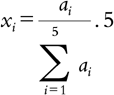
In his commentary, Liu Hui introduces a problem that underlines the failure of this procedure provided by The Nine Chapters to cover the general case. There are two fundamental points preventing the procedure just described to be general, and the particular problem introduced by Liu Hui illustrates them both.
First, the procedure makes use of the fact that the number of terms in the second set of persons exceeds by 1 the number of terms in the first set. This is why, by plainly adding the difference, one can yield coefficients on the basis of which to carry out an unequal sharing. This cannot work in the general case, where this difference can differ from 1.
Secondly, the procedure of The Nine Chapters uses the fact that the sum of coefficients of the ratio in the first set exceeds the sum for the second one, which is not always the case, as illustrated by the problem introduced by Liu Hui.
In modern terms, Liu Hui’s new procedure, which he describes in the framework of another problem, can be grasped as follows. The general problem requires determining the n terms of an arithmetic progression

satisfying the two following conditions:

Since the solutions must form a decreasing sequence, which is what is required both in The Nine Chapters and by the commentator, it is necessary that 2p<n.
Like The Nine Chapters, Liu Hui first sets out to determine weights ai, satisfying (**). In a second step, in the same way as above, n will be shared into unequal parts proportional to the ai.
The main difference between his procedure and that of The nine chapters to determine the ai is that, instead of restoring the unbalance between

and

by making use of the difference between these two sums, he makes use of
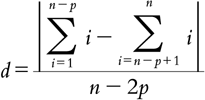
, which is called “the laid-out difference.”
The idea can be easily grasped as above:

To determine the ai, it suffices to choose a pair (a, r) satisfying this equality, and one can hence choose r=1. Liu Hui’s actual procedure runs as follows:
— In case
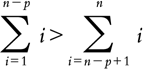
, which is the case for the problem Liu Hui introduces, then one can define

, where
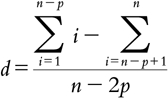
.
As a consequence,

The ai can hence be used as coefficients on the basis of which to determine the xi, with the equation (*). A point should however be stressed: to get only positive shares, d must be smaller than 1, which is not always the case.
— In case
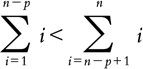
, which is the case for the problem introduced by The Nine Chapters, the procedure provided can be made more general by making use of the same idea as above, by defining

, where

.
As a consequence,

Like above, the ai can hence be used as coefficients on the basis of which to determine the xi, with the equation (*). A general remark is in order at this point: for the procedure to work, it is necessary that the two groups not be composed of the same number of persons. This might explain the reason why, at the end of his commentary, Liu Hui mentions imitating the procedure given for problem 6.19 (see Appendix 4).
Appendix 2: The rule of three in The Nine Chapters
The algorithm corresponding to the rule of three in The Nine Chapters, entitled “PROCEDURE OF SUPPOSE,” opens chapter 2 and reads as follows:
PROCEDURE OF SUPPOSE:
LET US MULTIPLY, BY THE QUANTITY OF WHAT ONE HAS, THELÜOF WHAT IS SOUGHT FOR, WHICH MAKES THE DIVIDEND.
ONE TAKES THELÜOF WHAT ONE HAS AS DIVISOR. AND ONE DIVIDES THE DIVIDEND BY THE DIVISOR.
The formulation of the procedure introduces a terminology that will often be used in other mathematical contexts, such as the commentary on problem 6.18, for example. The use of these expressions regularly indicates that the rule of three is put into play in these other contexts.
The procedure opposes the quantities attached to the thing given (“The quantity of what one has,” “The lü of what one has”) to those attached to the thing, the equivalent amount of which is to be determined (“The lü of what one seeks,” and, for the sake of completeness, “The quantity of what one seeks”).
What one has————————what one seeks
The quantity of what one has———————The quantity of what one seeks
The lü of what one has—————the lü of what one seeks
The known quantities that express the mode of equivalence between the thing given and the one sought for are qualified by the technical term of lü. This indicates that they can be both multiplied or divided by the same quantity and still express the same relationship.
We can represent the computation prescribed as follows:

Appendix 3: Unequal sharing in The Nine Chapters
The algorithm provided by The Nine Chapters to carry out unequal sharing is entitled “PROCEDURE OF THE PARTS WEIGHTED IN FUNCTION OF THE DEGREE (cuifen)” and opens chapter 3. Like the rule of three, it introduces a set of terms that will be used in other contexts to indicate that the algorithm is put into play. This is the case of the formulation of the procedure described in The Nine Chapters after problem 6.18 (see above): the final section takes its terms and its structure from the “PROCEDURE OF THE PARTS WEIGHTED IN FUNCTION OF THE DEGREE (cuifen).”
Let us first outline this important procedure, before we translate the text from The Nine Chapters. Suppose one has to share A in parts proportional to a, b, c… respectively.
The procedure prescribes setting down the coefficients according to which the sharing is to be carried out on the counting surface66
Chemla (1996, 120–2) discusses the earliest known text making clear how to arrange the numbers on the counting surface.
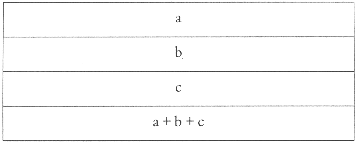
One then multiplies each of the coefficients by the quantity to be shared, to yield dividends to be divided by the number in the lower line, as follows:
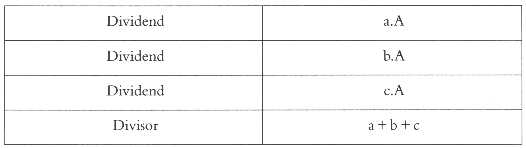
Dividing the dividends by the divisor respectively yields the size of each of the parts sought for. The first one is hence, for example,

The text of The Nine Chapters reads as follows:
PROCEDURE OF THE PARTS WEIGHTED IN FUNCTION OF THE DEGREE (cuifen): ONE PUTS RESPECTIVELY (ON THE COUNTING SURFACE) THE ARRAY OF COEFFICIENTS FOR WEIGHTING IN FUNCTION OF THE DEGREE (CUI) AND, IN AUXILIARY, ONE ADDS THEM (THE WEIGHTS IN FUNCTION OF THE DEGREE) TOGETHER, TO MAKE THE DIVISOR. ONE MULTIPLIES, BY THAT WHICH IS SHARED, THE (WEIGHTS IN FUNCTION OF THE DEGREE THAT ONE HAD) BEFORE THEY WERE ADDED TOGETHER, WHICH RESPECTIVELY MAKES THE DIVIDENDS. CARRYING OUT THE DIVISIONS OF THE DIVIDENDS BY THE DIVISOR YIELDS THE RESULTS. (…)
Appendix 4: Problem 6.19
Problem 6.19 of The Nine Chapters deals with a stalk of bamboo, composed of n sectors, between its nodes. Their successive capacities form an arithmetic progression. Let us consider the terms and procedure, before providing some mathematical explanations. The text reads as follows:
SUPPOSE THAT A BAMBOO HAS 9 INTERNODES AND THAT THE 3 INFERIOR INTERNODES HAVE A CAPACITY OF 4 SHENG67
Sheng is a unit of capacity.
(…)
PROCEDURE: (I) ONE SHARES68
As for problem 6.18, the term (fen) designates “dividing.” As above, I insert Roman numerals to designate the various steps of the procedure to comment on them.
This designates here the ratio of the arithmetical sequence. The use of the term “weights in function of the degree” refers this topic to the procedure to carry out unequal sharing, as dealt with in The Nine Chapters (see Appendix 3).
Let us reformulate the problem in modern terms. Problem 6.19 considers n quantities forming an arithmetical progression,

. It suggests determining each of these quantities, provided that we know the sum of the first p terms
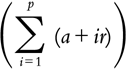
, the sum of n-p-q last terms (

and the number of terms

.
Step (II) computes
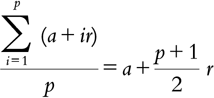
If p is odd, this yields the capacity of the middle sector of the first p ones.
Likewise, step (I) computes
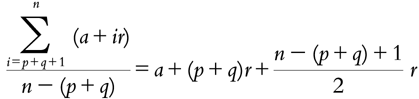
As a consequence, step (III) yields

Step (IV) determines
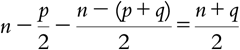
This explains why dividing the “dividend” by the “divisor” yields the ratio of the progression, and hence all its terms.
Acknowledgments
It is my pleasure to express my thanks to all those whose comments allowed me to improve this paper: Prof. Geoffrey Lloyd, Prof. Reviel Netz, Anne Robadey, and an anonymous reader. Furthermore, in a forthcoming paper, Anne Robadey explains how Poincaré’s research on the geodesics, published in 1905, can be analyzed along lines similar to those developed here. This contributes to both enlarging the corpus of texts relevant for the present study and highlighting the variety of practices linked to generality in mathematics. We plan to develop a research project on this issue.
References
Charette, F.1995. “Orientalisme et histoire des sciences. L’historiographie européenne des sciences islamiques et hindoues, 1784–1900.” Mémoire présenté à la Faculté des études supérieures en vue de ľobtention du grade de Maître ès arts (M.A.) en histoire. Département ďhistoire. Faculté des arts et des sciences. Université de Montréal.
Chemla, K.1991. “Theoretical Aspects of the Chinese Algorithmic Tradition (first to third century).” Historia Scientiarum 42:75–98+errata in the following issue.Google Scholar
Chemla, K.1992. “Résonances entre démonstration et procédure. Remarques sur le commentaire de Liu Hui (3° siècle) aux Neuf Chapitres sur les Procédures Mathématiques (1° siècle).” In Regards obliques sur ľargumentation en Chine, edited by K. Chemla. Extrême-Orient, Extrême-Occident 14:91–129CrossRef
Chemla, K.1994. “Similarities between Chinese and Arabic Mathematical Documents (I): root extraction.” Arabic Sciences and Philosophy 4:207–266.CrossRefGoogle Scholar
Chemla, K.1996. “Positions et changements en mathématiques à partir de textes chinois des dynasties Han à Song-Yuan. Quelques remarques.” Extrême-Orient, Extrême-Occident 18:115–47.CrossRefGoogle Scholar
Chemla, K.1997. “Qu’est-ce qu’un problème dans la tradition mathématique de la Chine ancienne? Quelques indices glanés dans les commentaires rédigés entre le 3ième et le 7ième siècles au classique Han Les neuf chapitres sur les procédures mathématiques.” Extrême-Orient, Extrême-Occident 19:91–126.CrossRefGoogle Scholar
Chemla, K.1997a. “What is at Stake in Mathematical Proofs from Third Century China?” Science in Context 10:227–51.Google Scholar
Chemla, K.1998. “Lazare Carnot et la généralité en géométrie. Variations sur le théorème dit de Menelaus.” Revue ďhistoire des mathématiques 4:163–90.Google Scholar
Chemla, K.2000. “Les problèmes comme champ ďinterprétation des algorithmes dans Les neuf chapitres sur les procédures mathématiques et leurs commentaires. De la résolution des systèmes ďéquations linéaires.” Oriens-Occidens 3:189–234.Google Scholar
Chemla, K.2001. “I ‘Nove capitoli sui procedimenti matematici’: la costituzione di un canone nella matematica (The nine chapters on mathematical procedures, the constitution of a Canon in mathematics).” In “La scienza in Cina,” edited by K. Chemla, with F. Bray, Fu Daiwie, Huang Yi-Long, G. Métailié. In Sandro Petruccioli (gen. ed.), Storia della scienza, , 131 & 133–141. Roma: Enciclopedia Italiana.
Chemla, K.2002. “What was a mathematical problem in ancient China?Preprint for the conference organized by Roger Hart and Bob Richards, The disunity of Chinese science, Chicago, May 10-12, 2002, http://hal.ccsd.cnrs.fr/, section Philosophie, sub-section [Lt ]Histoire de la logique et des mathématiques[Gt ]. The final version will appear in the proceedings of the conference.
Chemla, K.and Guo Shuchun. Forthcoming. Les neuf chapitres. Edition critique, traduction et présentation des Neuf chapitres sur les procédures mathématiques (les débuts de ľère commune) ainsi que des commentaires de Liu Hui (3ième siècle) et de Li Chunfeng (7ième siècle). Paris: Dunod.
Cullen, C.1996. Astronomy and Mathematics in Ancient China: The Zhou bi suan jing. Needham Research Institute Studies, 1, Cambridge: Cambridge University Press.
Guo Shuchun. 1984. “Analysis of the concept and uses of Lü in The nine chapters on mathematical procedures and Liu Hui’s commentary.” Kejishi Jikan (Journal for the history of science and technology) 11:21–36 (in Chinese).Google Scholar
Høyrup, J.2002. Lengths, Widths, Surfaces: A Portrait of Old Babylonian Algebra and its Kin. New York: Springer.
Kline, M.[1972]1990. Mathematical Thought from Ancient to Modern Times. New York: Oxford University Press. Quoted according to the paperback edition of 1990, 3 vols.
Li Jimin. 1982. “Ratio theory in The nine chapters on mathematical procedures.” In Jiu zhang suanshu yu Liu Hui (The nine chapters on mathematical procedures and Liu Hui), edited by Wu Wenjun, 228–45. Beijing: Beijing shifan daxue chubanshe (in Chinese).
Li Jimin. 1998. Jiuzhang suanshu daodu yu yizhu (Guidebook and annotated translation of The nine chapters on mathematical procedures). Xi’san: Shaanxi kexue jishu chubanshe.
Li Yan, Du Shiran. [1963]1987. Mathematics in Ancient China: A Concise History (Zhongguo gudai shuxue jianshi). Beijing: Zhongguo Zhonghua Shuju. Updated and translated in English by J. N. Crossley and A. W. C. Lun, Chinese Mathematics: a Concise History. Oxford:Oxford Science Publications.
Lloyd, G. E. R. L.1997. “Exempli gratia: to make an example of the Greeks.” Extrême-Orient, Extrême-Occident 19:139–151.CrossRefGoogle Scholar
Peng Hao. 2001. Zhangjiashan hanjian [Lt ]Suanshushu[Gt ] zhushi (Commentary on the Han book on bamboo slips found at Zhangjiashan Book of Mathematical Procedures). Beijing: Kexue chubanshe.
Qian Baocong. 1963. Suanjing shi shu (Ten Classics of Mathematics), 2 vols. Beijing: Zhonghua shuju.
Raina, Dhruv. 1999. “Nationalism, Institutional Science, and Politics of Representation: Ancient Indian Astronomy in the Landscape of French Enlightenment Historiography.” Ph.D. thesis, Faculty of Arts, Göteborg University (Sweden).
Shen Kangshen. 1997. Jiuzhang suanshu daodu (Guidebook for reading The nine chapters on mathematical procedures). Wuhan (Hankou): Hubei jiaoyu chubanshe.
Shen Kangshen, John N. Crossleyand Anthony W.-C. Lun. 1999. The nine chapters on the mathematical art. Companion and commentary. Beijing: Oxford University Press and Science Press.
Unguru, S.1975. “On the need to rewrite the history of Greek mathematics.” Archive for the History of Exact Sciences 15:67–114.Google Scholar
Volkov, A.1992. “Analogical Reasoning in Ancient China. Some Examples.” In obliques sur ľargumentation en Chine, edited by K. Chemla. Extrême-Orient, Extrême-Occident, 14:15–48.
Volkov, A.1994. “Transformations of geometrical objects in Chinese mathematics and their evolution.” In Notions et perceptions du changement en Chine, edited by V. Alleton and A. Volkov, 133–48. Paris: Collège de France(Mémoires de ľInstitut des Hautes Etudes Chinoises, vol. XXXVI).
Wagner, D.1979. “An early Chinese derivation of the volume of a pyramid. Liu Hui, third century A.D.” Historia mathematica 6:164–188.Google Scholar
Wu Wenjun. 1982. Churu xiangbu yuanli (“The principle 'What comes in and what goes out compensate each other'“). In Jiu zhang suanshu yu Liu Hui (The nine chapters on mathematical procedures and Liu Hui), edited by Wu Wenjun, 58–75. Beijing: Beijing shifan daxue chubanshe.
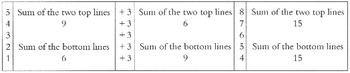
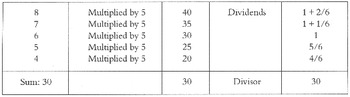
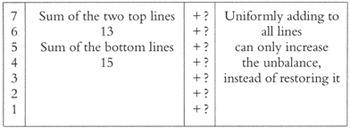
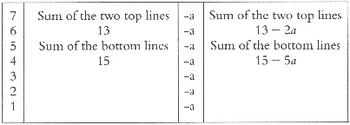
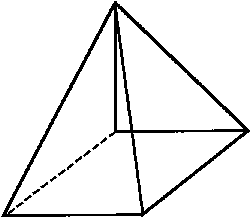
Figure 1. The pyramid with rectangular basis, with an edge perpendicular to the basis (yangma)
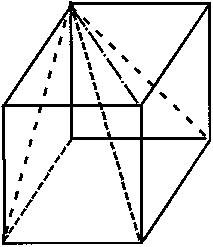
Figure 2.
 You have
Access
- 28
- Cited by