Introduction
Conservation of animal genetic resources (AnGR)
There are many reasons for the conservation of indigenous breeds listed by researchers and conservation organizations, as well as international conventions (Notter, Reference Notter1999; Mendelssohn, Reference Mendelssohn2003; Gandini and Villa, Reference Gandini and Villa2003; Verrier et al., Reference Verrier, Tixier-Boichard, Bernigaud and Naves2006; Anhtempelman and Cardellino, Reference Anhtempelman and Cardellino2007; Oldenbroek, Reference Oldenbroek2007, pp. 19–22; Soini, Reference Soini, Karja and Lilja2007a). However, multifaceted reasons for conserving indigenous farm animal breeds and political will to carry out the conservation are not necessarily enough to safeguard the farm AnGR in reality. There is usually a long period of transition from political will and interests to real implementations of conservation programmes at the grassroots level, which makes the conservation of indigenous farm animal breeds and their genetic resources challenging (Tamminen, Reference Tamminen2010).
Zimmerer (Reference Zimmerer2006, pp. 3–6; 2007) has noted that conservation of biodiversity has new characteristics as a result of globalization. It has not only accelerated the loss of biodiversity, but also the growth of environmental globalization introducing new means and actors in biodiversity conservation (Zimmerer, Reference Zimmerer2006, p. 1). Therefore, it is increasingly important to recognize the spatiality of conservation, which takes place at different scales. With spatiality Zimmerer (Reference Zimmerer2006, p. 9) refers to a concept that helps us to see environmental spaces and configurations in which the physical extent is fused with social intent. Usually, the challenge of environmental conservation is that the scales of the environmental problem and the solutions are incompatible (Kaljonen, Reference Kaljonen2006; Soini, Reference Soini2007b). Therefore, it is important to analyse and identify the distinct spaces and their interaction. Owing to the diversity of spaces and scales, the conservation of indigenous breeds as an environmental issue is about the governance of conservation.
In environmental policy the concept of governance suggests that we look beyond government, towards new partnerships, as a way of dealing with the shortcomings of top-down management (e.g. Berkes, Reference Berkes1999). Kooiman (Reference Kooiman2003) recognizes three models of governance. Hierarchical governance is characterized by the state intervention. Self-governance can be used to describe a people or group being able to exercise all the necessary functions of power without intervention from any authority that they cannot themselves alter. Co-governance, in turn, consists of collaboration and interplay among different actors suggesting that people whose livelihoods are affected by management decisions should be able to participate in decision making. Therefore, it is suggested that self-governance would increase compliance and empowerment leading to more legitimate, socially and culturally acceptable management measures (Kooiman, Reference Kooiman2003).
The case of Yakutian Cattle
In the Far East of Siberia there are small populations of Yakutian Cattle, which are the only surviving cattle originating from the Siberian ox taurus cattle (Kantanen et al., Reference Kantanen, Ammosov, Meng-Hua, Osva, Popov, Granberg, Soini and Kantanen2009). The changing institutional and political environment, as well as globalization and modernization, constitute a continuous challenge to the general livelihood system in the region, and for the conservation of the cattle in the future.
The ultimate aim of this article is to examine the spatiality and the governance of the conservation of the Yakutian Cattle. We will first examine how the conservation of the Yakutian Cattle has emerged and evolved at various spatial scales: in global biodiversity policy, at the Union, Federation and republic level, in the Eveno-Bytantay district and in the media. Second, we will ask how the conservation of the cattle is promoted and argued for by various actors at different spatial scales. Finally, based on the results, it is possible to discuss the governance of the conservation of the Yakutian Cattle.
The Yakutian Cattle in the three villages of Eveno-Bytantay district
The Yakuts migratedFootnote 1 with their horses and cows in several waves to the central Yakutian regions after the ninth century, introducing the tradition of raising cattle into these northern areas, which were traditionally settled by peoples living from reindeer herding and hunting. The Yakuts were transhumant, moving from wintertime dwellings to summer pastures, following the needs of their cattle and sharing their houses with the animals (Basharin, Reference Basharin1962).
Until the 1930s, native Siberian cattle existed in all central Sakha, but the collectivization brought changes to cattle husbandry. The replacement of the Yakutian Cattle with more productive animals decreased the numbers of the original breed. Already by the late 1950s, Yakutian Cattle existed only in the remote northern territories, where the transport connections were poor and distances long (Romanov, Reference Romanov1959, Reference Romanov1984).
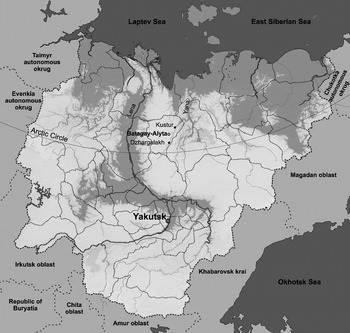
Currently, the population of about 1 000 head of Yakutian Cattle exists in the Eveno-Bytantay district, in three villages, Batagay-Alyta (Sakkyryr), Kustur and Dzhargalakh, which are located above the Arctic Circle, approximately 1 000 km to the north of the capital of the republic, Yakutsk. Map 1 shows the location of these villages in the Sakha Republic. Since the collapse of the Soviet Union, most of the cattle are privately owned. The remainder are located in the state-owned enterprise Bytantay (until 2005, Yakutsky skot) that keeps Yakutian Cattle in the villages of Kustur and Batagay-Alyta. Another state-owned farm for research work is located in a village in Gorny district in Uluu-Syhyy near Yakutsk, and has operated since the mid-1990s.
The Sakha Republic (map by Jari Johansson).

The Yakutian Cattle are black, red or piebald with white markings on the head and other parts of the body. They are characterized by their small size, deep but relatively narrow chest and short, firm legs. They possess a solid trunk and thick coat, as well as efficient thermoregulation, quick formation of subcutaneous fatty tissue and low metabolic rates at low temperatures. The head of the animals is typically short but broad. The live weight of cows ranges from 350 to 400 kg, and that of the bulls from 500 to 600 kg. On average, the breeding bulls stand 121 cm high. The current average annual milk yield of the cattle breed is 1 000 kg, and the milk has a high percentage of fat and protein, 5.03 and 4.69 percent, respectively, on an average (Kantanen et al., Reference Kantanen, Ammosov, Meng-Hua, Osva, Popov, Granberg, Soini and Kantanen2009; Tapio et al., Reference Tapio, Tapio, Li, Popov, Ivanova and Kantanen2010).
Kantanen et al. (Reference Kantanen, Ammosov, Meng-Hua, Osva, Popov, Granberg, Soini and Kantanen2009, pp. 37–39) reported that the conservation value of the Yakutian Cattle is high in genetic terms. Molecular genetic analysis has revealed that due to a long period under extreme environmental conditions, geographic and genetic isolation, the purebred native cattle breed has a high conservation value for the maintenance of cattle diversity.
Moreover, it has been found that the cattle constitute an important part of local livelihood system from the social, economic and cultural points of view (Soini and Partanen, Reference Soini, Partanen, Granberg, Soini and Kantanen2009). Since the 1950s, there have been various attempts to preserve the cattle. These activities culminated in the law on conservation in 2001, which among other measures guarantees economic incentives for keeping the cattle. Besides the conservation of live animals, the basis for ex situ conservation has been established and genetic research is conducted.
Material and methods
Our analysis aims to investigate the socio-cultural and political context of conservation of the Yakutian Cattle that is transmitted to us through various sources concerning reasons for the conservation. The various sources of information were used to verify and falsify information provided, and to create a coherent understanding of the values of the Yakutian Cattle. We assume that attitudes are intertwined both in the direct and indirect social and cultural contexts as well as in individuals arguing them (Vesala and Rantanen, Reference Vesala, Rantanen, Vesala and Rantanen2007, p. 54). It is also essential to understand the situation in which the information we gathered was created e.g. in an interviewing situation or publishing media representations. Understanding the situation is essential for understanding different phenomena, attitudes and values that the members of a certain society share (Goffman, Reference Goffman1986).
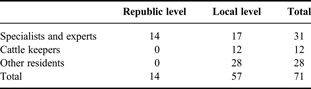
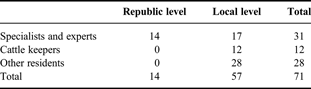
The research material consists of various documents on the history of Russia and in particular of Siberia, modernization of agriculture and emergence of environmental awareness related to AnGR. We have also used coeval literature written by scholars who were engaged in the conservation of Yakutian Cattle already during the Soviet time. In addition, there are political programmes and laws enacted by the United Nations (UN), the Soviet Union, the Russian Federation and the Yakut ASSR or Sakha Republic, as well as 71 interviews made during our fieldwork. Three distinct groups of interviews can be identified: First, the local residents,Footnote 2 who either have a subsidiary farm or work at the state farm and have a lot of experiential, traditional or local knowledge related to the cattle husbandry, and also other residents, who work in other occupations and who do not have any cattle themselves. Second, the specialists and experts in the local administration and in cattle breeding, production or research. They can be termed as local certified expertsFootnote 3 whose main concern is how to organize and develop cattle husbandry in the district and to meet all the technological, financial and social requirements, and also conduct the scientific experiments required by the republic. Third, the researchers, politicians and administrators in Yakutsk, who perceive the issue from the republic's, and even a wider point of view, but are not necessarily very familiar with the realities of the three distant villages. The interviews are classified in Table 1. The interviews were conducted in Russian and translated into English. In addition to the interviews, we rely on observations made by a multidisciplinary research team during our fieldwork in spring 2005 in the three villages and in Yakutsk.Footnote 4
Number of interviews.
Moreover, newspaper articles published by two Sakha newspapers in 2003–2005 were analysed: Yakutia (Y) published in Russian and Sakha Sire published in Yakutian and translated into Russian by local students. The media plays a significant cultural and social role as it produces and transmits different public awareness messages. It also reflects the societal reality and common currencies already existing in the society (McQuail, Reference McQuail1992; Kunelius, Reference Kunelius2001). The research material includes newspaper articles dealing with the Yakutian Cattle and the current development of traditional agricultural livelihoods in the Sakha Republic. The media representations are studied with the help of a text analysis, and the results are dealt with in a wider societal context.
The spaces of conservation of the Yakutian Cattle
Conservation of local breeds in the Soviet Union and Russian Federation in the frames of global biodiversity policy
Early steps of AnGR conservation in the Soviet Union
In the early 1970s, the erosion of farm AnGR raised international attention for the first time. The conference of the UN on the Human Environment, held in Stockholm in 1972, recognized that conservation is the most crucial part of any genetic resources programme, and therefore the conference recommended that governments, in cooperation with the Secretary-General and the Food and Agriculture Organization (FAO) of the UN, make inventories of the genetic resources most endangered by depletion or extinction (Report of the United Nations Conference on the Human Environment, 1972).
The inventory of farm animal breeds that were either endangered or at risk of becoming endangered was also made in the Soviet Union in the mid-1970s. Several cattle breeds were included on the list, including Yakutian Cattle, comprising 300 dairy cows. The Soviet Union made recommendations to conserve the genetic resources of their endangered farm animal breeds (Romanov, Reference Romanov1984, pp. 10–11). According to Romanov (Reference Romanov1984),Footnote 5 the conservation policy had two main goals: to support regional policy and to utilize the genetic resources of Yakutian Cattle in breeding.
The failures in the modernization of Soviet agriculture, such as continuous problems in productivity, enabled the development of farm AnGR in the Yakut ASSR from the mid-1970s (Plan plemennoy raboty, 1981; Romanov, Reference Romanov1984). Earlier, the small size of the Yakutian Cattle had been regarded as an undesirable attribute by agricultural modernizers (Smith, Reference Smith2006, p. 81). After the Stockholm Conference, the Soviet genetics researchers legitimized the conservation of Yakutian Cattle relying on the arguments underlying international development in the conservation of genetic resources (Romanov, Reference Romanov1984). The goals of Soviet agricultural policy had conventionally not only been about producing food but also about geopolitical and environmental issues, the latter especially in terms of overcoming environmental barriers such as harsh climatic conditions in most parts of the country (Smith, Reference Smith2006, pp. 5–6).
In the late 1970s and early 1980s, agricultural productivity decreased. It was argued that among other issues one of the reasons for this was the poor state of animal breeding in the country (Naukhatsky, Reference Naukhatsky1996, pp. 60–61, 65, 116, 123). The Soviet Union aimed to improve and intensify agricultural production by creating new farm animal breeds of high quality in terms of production. The special aim of agricultural production in Siberia was to provide local people with local food and to promote self-sufficiency (Prodovol'stvennaya programma SSSR, 1982, pp. 55–57, 64; Materialy XXVI s'ezda KPSS, 1981). The coming years did not bring any major relief to the difficult agricultural situation (Neuvostoliiton maatalousuudistus, 1989, pp. 7–10).
Conservation of AnGR in the Russian Federation
The question of AnGR advanced internationally as FAO developed activities in cooperation with UNEP during the 1980s. In particular, FAO provided training in the establishment of gene banks (Wiener, Reference Wiener1989).
According to our interviews, there are currently some research projects at the federal level that aim to study breeds that are in danger of becoming extinct, and they are processing a nationwide conservation programme for endangered breeds. There is also a federal law that regulates animal breeding, and a law specifically directed at endangered breeds has been planned (researcher in Yakutsk, interview 67). The federal laws direct the administrative frameworks for the conservation work on genetic resources. In 2002, the Russian Federation enacted the Federal Law on Environmental Protection that defines the roles of different subjects of the Russian Federation in nature conservation work (Silfverberg et al., Reference Silfverberg, Piispa, Silvennoinen and Furman2004, pp. 14–16). Consequently, in the case of Yakutian Cattle, the Sakha Republic is in a very important position and it has worked for the conservation of the genetic resources of Yakutian Cattle within the frameworks set out by the Federation (Agreement, 1995).
Conservation of the Yakutian Cattle at the republic level
The turbulent years of system change
A substantial impact in conservation during the 1980s was the establishment of a research station for Yakutian Cattle in Batagay-Alyta. This was achieved according to the plans to conserve the cattle breed that were made in the late 1970s. The head of the research station was P.A. Romanov who had also been the initiator in the beginning of the conservation. According to our interviews, he had been the main actor in convincing the party officials at the republic level of the need to safeguard the breed. Although the plans to conserve the cattle had been more ambitious, this provides an example of state intervention on the conservation of the Yakutian Cattle.
The cattle breed was also conserved by means of self-governance; in other words, the people living in the local communities had the opportunity to participate in the decision making some years later. The privatization of agriculture started in the late 1980s and accelerated in the 1990s at the federal level. At the time of the privatization process, Soviet state authorities were losing their influence, and the former chairmen of collective farms mainly held the knowledge about new legislation designed at the federal level (Lindner, Reference Lindner2006).
According to our interviewees, the state farm in Eveno-Bytantay district collapsed in 1993–1995, and there were gatherings organized for the local people to discuss the matter with the administration. The animals were to be divided among the people according to years in service, and therefore mainly elder people together with some local administrators were in favour of dividing the cattle (local expert, interview 5). As noted above, the importance of Yakutian Cattle was already recognized at the republic level and the Yakutian Cattle were saved, although great numbers of farm animals had been slaughtered in connection with the privatization. Following Granberg and Kopoteva (Reference Granberg, Kopoteva, Granberg, Soini and Kantanen2009), the people in favour of conserving the cattle breed at republic and local levels probably influenced the decision.
The cattle were also safeguarded by the republic and the scientific community by transferring some of them to the southern parts of the Sakha Republic, Gorny district. The cattle are kept in a state farm for research purposes, and simultaneously as a living gene bank to secure the maintenance of their genetic resources. Hence, the state intervened to keep the cattle pure-bred and live in the turbulent years after the collapse of the Soviet system.
The law on conservation of Yakutian Cattle
In 2001, the conservation reached a new phase when the Sakha Republic enacted a law on the conservation and use of the cattle. It elevated the Yakutian Cattle to the status of an endangered breed (researcher in Yakutsk, interview 67). The law is unique, even in the global context. The law aims at promoting the genetic diversity of the breed, keeping the breed pure and preserving it for future breeding. It consists of regulations concerning the insemination, registration and farming of the cattle as well as of financial support designed for the public and private farms that keep the Yakutian Cattle (Zakon ot 7 iyunya 2001 goda 3 No 291 – II).
The financial support is directed at the animal keepers according to the number of cattle they manage. It also includes buying their milk and meat products. The law guarantees both tax and credit privileges for the cattle keepers. Another factor in the support system is the financing of scientific research work on the conservation. It is intended that the work be financed by the republic, using local budgets together with income from the farms (Zakon ot 7 iyunya 2001 goda 3 No 291 – II).
The conservation programme included in the law works at the republic level, but it is formally part of the federal programme that aims at developing rural areas (administrator in Yakutsk, interview 65). Furthermore, the presidential programme for social and economic development of villages has been working since 2002 in Sakha Republic and addresses the conservation of Yakutian Cattle (researcher in Yakutsk, interview 67). In practice the Ministry of Agriculture in Sakha initiated the funding for the conservation process, and it is the Agricultural Institute that takes care of the practical responsibilities, with the support of the Ministry. Each district has a branch within the Ministry of Agriculture and takes care of accounting and budgeting for cattle and reindeer production (local administrator, interview 1).
Genetic value
Many of our interviewees in Yakutsk emphasized that the main objective of conservation was to preserve the genetic resources of Yakutian Cattle to be exploited in cattle breeding for the republic. From the republic's point of view, agricultural production should be increased, and the Yakutian Cattle represent valuable material for cross-breeding. Consequently, only after ensuring conservation of the genetic resources could the focus be on development of production.
As with the international experts in conservation of the Yakutian Cattle, our interviewees in Yakutsk favoured in situ conservation in Eveno-Bytantay district. They considered that the distant and isolated location guarantees the purity of the breed. The long history of cattle breeding within the same area was respected, and it was considered important to continue breeding in the same geographical district from the genetic research point of view. Researchers and politicians had also realized that it is not possible to increase the numbers of cattle in Eveno-Bytantay because of the limited hay production and feeding possibilities. They also considered general socio-economic conditions critical for the conservation of the cattle. For that reason many of them highlighted the importance of improving the socio-economic conditions both in the state farms and in the villages.
Cultural value
As to the researchers and politicians, many of whom were Yakuts themselves, the cultural value of the Yakutian Cattle primarily represented preservation of a traditional way of life and the conservation of a cultural heritage related to the cattle. Cattle were also needed for research, which would provide new information about the history of the Sakha people. Thus, besides the value the Yakutian Cattle might have for cattle breeding, the cattle were seen as a means to preserve and strengthen the cultural identity of Sakha people in the republic.
Conservation of the Yakutian Cattle at the local level
Cattle – food and income
The local people, the residents keeping cattle and the local administration and extensionists in the field of cattle production, play a very important role in the conservation of the cattle. At the local level, distinct arguments were mainly based on economic reasoning but the role of the breed as part of their cultural heritage and social structure were also emphasized. The local people also knew that the cattle were genetically unique and adapted to the local environment.
The most obvious value to the local residents of the Yakutian Cattle was related to their direct use in local food production. Milk products and meat provided an important share of the diet of local people, in particular during summertime. Besides foodstuffs, the cattle provided other products and services to the local community, for example, manure for the construction of cow houses, fertilizer for the greenhouses and gardening.
The subsidies for milk and credits for buying cattle had made many people from various social groups start cattle raising. The additional incomes were used for purchasing or exchanging for other goods and services they needed. Thus, the cattle provided a way to ensure a better future for their children, and a sort of long-term social insurance for the whole family, many of them seemed to think. Some people kept the cows because of the support system (local administrator, interview 41).
Cattle – social insurance, inclusion and interaction
The social aspects of cattle production, as for local agriculture in general, extend to cover local employment, social status, social cohesion, and social inclusion and exclusion. Cattle provided supplementary income for many households or even entire livelihoods for people who were otherwise unable to make their living.
However, there were also social problems related to the work with the cattle. The working conditions were hard both in the private households and state farm, where they had problems with delayed payment of the salaries in the mid-2000s resulting in the reduced well-being of the cattle. The main concern was related to the bad condition and poor level of mechanization of the cowsheds and lack of mechanical devices for the haymaking.
The cattle production with all its implications extended to a wider social sphere, to the kin and to the local community at large (see also Crate, Reference Crate2006). Working together, cooperating in various phases of work and the allocation of material resources and know-how contributed to the formal and informal networks, which is of crucial importance for the formation of social capital (Pretty, Reference Pretty2003) and thus, for the local development.
Cattle production has also been responsible for both crossing and setting borderlines between the main nationalities, the Yakuts and the Eveny. Traditionally, reindeer herding was mainly a livelihood of the Eveny, whereas cattle raising was the means of livelihood of the Yakuts, but recently many Eveny have also started to keep cattle.
Cattle – food, traditions and cultural landscape
Considering other cultural values of local breeds identified by Gandini and Villa (Reference Gandini and Villa2003), the cattle products in the local food culture and gastronomy have persisted partly because there has been no real choice in supplying milk products. However, it was not only the nutrition aspect, but also the gastronomic characteristics, the taste of the meat and fat content of the milk, which were emphasized by the local residents. One should note that due to the isolated location of the area there was only little choice for the fresh food products.
In addition to the food culture, the traditional knowledge related to cattle breeding and building a cowshed suitable for local conditions, was known among the population. This culturally embedded local knowledge constitutes an essential part of the “memory bank” that is needed for the conservation of genetic resources in the district (Nazarea, Reference Nazarea1998).
The cattle is also a part of traditional rituals, e.g. funerals when, for men, bulls or horses and, for women, cows, calves or bullocks are butchered to provide the dead with means of transport (Pääkkönen, Reference Pääkkönen, Granberg, Soini and Kantanen2009, p. 62).
The Yakutian Cattle husbandry has a wide range of impacts on the landscape of present-day villages in the form of cowsheds, grazing lands, manure stocks, haystacks, fences as well as the cattle themselves, which frequently walk along the streets of the villages. Landscape elements related to the cattle were displayed almost everywhere in the village; the cattle are a part of the everyday life of the local community and belong to the physical landscape.
The long history of cattle production in the district, a tradition that has lasted for centuries, was highlighted both by the local experts and residents, and they consider it important to continue it. The local experts considered the Yakutian Cattle as a local cultural property or “capital”, which gave them a certain status among the rural districts in Sakha.
The conservation discussed in the media
In the Eveno-Bytantay district people seemed to understand the value of their native breed. When asked, they often mentioned having read about the conservation programme from the newspapers. Sometimes their arguments of why the conservation was important seemed very similar, and it is likely that they repeated the official line transmitted by the administration and the media. On the other hand, the local administration and media do not necessarily share their views about the state of affairs (Zassoursky, Reference Zassoursky, Nordenstreng, Vartanova and Zassoursky2001, p. 158).
The media representations about the Yakutian Cattle focused on the conservation of the cattle, the economic, cultural and genetic significance, as well as on the holistic situation of farming in the republic. The articles were written in connection with current events, and both the newspapers adopted the role of criticizing the authorities and defending the ordinary people.
Although the newspapers were highly supportive of the idea of preserving the Yakutian Cattle for improving cattle production in Sakha, it was debated as to how the conservation should be financed. It was stated that keeping the Yakutian Cattle is not economically profitable.
The Yakutian Cattle were stated to be the only cows that survived in the harsh climate with poor nourishment. Therefore, they were the only cows that could be kept in the far north. Regardless of the low output, it was acknowledged that the cattle enable the residents of the small villages to remain in their homes and keep the area settled. The expenses of keeping the northern areas settled are considerable and after the Soviet era they have to be taken into account more than before. The idea of utilizing the north and its resources does not necessarily include the idea of keeping it permanently settled (Möller and Pehkonen, Reference Möller, Pehkonen, Möller and Pehkonen2003, p. 3). Therefore, the animals were seen as the guarantee for the self-sufficiency of the district, which indicates that the main reason to conserve the cattle has not changed from the old times when the remoteness of the district protected the cattle breed from replacement with more productive cows.
According to the media, the most significant achievement of the Sakha people is that they created their own culture of horse and cattle production, and that the severe conditions created the unique Yakutian Cattle. The cattle were often mentioned in the newspapers as a cultural heritage of the Sakha people, and it is possible that the cultural meaning and its emphasis is the easiest way to convince ordinary people about the importance of conserving the cattle. In addition, it was probably meant to result in a defensive attitude towards the cattle among the citizens, and to raise their self-esteem and respect for their way of life. The media is important in the construction process of cultural, local and national identities as it strengthens the feeling of togetherness among its readers (Kunelius, Reference Kunelius2001, pp. 168–169). In the current post-Soviet time the Sakha people are in general rediscovering their ethnic roots and cultural traditions, which strengthens their ethnic identity (Jordan, Reference Jordan2002, pp. 260–261).
Discussion
Arguments for the conservation of the cattle production
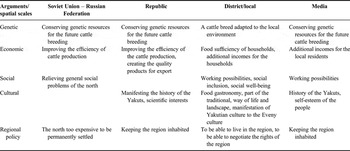
By examining the phases of the conservation of the Yakutian cattle we have found various arguments for the conservation of the Yakutian Cattle. These arguments have been summarized in the Table 2. The reasons have been categorized in the genetic, economic, social, cultural and regional political. As we have seen, the arguments differ from scale to scale.
Arguments for conserving the Yakutian cattle presented by different actors at various spatial scales.

The governance of the conservation of the Yakutian Cattle between the scales
How can the spatiality of conservation of the Yakutian Cattle be assessed from the governance point of view? The beginning of the conservation was initiated and carried out based on hierarchal governance and top-down policy in a similar way as the modernization of agriculture had been some decades earlier.
In the early and mid-1990s, there were signals of self-governance as in the new system the state control was loosened and the voice of local residents was heard in the privatization process. Yet, the state was to intervene in the conservation soon again.
By ratifying the Convention on Biological Diversity (CBD) in 1995, the Russian Federation divided power in the conservation to the regions. The northern parts of the Federation have, nevertheless, lost their status as an ideologically important area (Möller and Pehkonen, Reference Möller, Pehkonen, Möller and Pehkonen2003, pp. 3). The cancellation of federal subsidies for northern regions and abandoning of Soviet era social programmes that provided even rural areas with large numbers of state jobs have been important factors in the development of the republic (Jordan, Reference Jordan2002, pp. 227–230).
According to Speth and Haas (Reference Speth and Haas2006, p. 85), nations are the principal legal actors in environmental policy because they respond to pressure from a number of different actors. This is the case also regarding the Yakutian Cattle. The Sakha Republic is the main financer of the conservation and it is in its interests to develop remote areas and their agriculture as well as to take care of the cultural aspects of traditional cattle breeding. The crucial thing is the general socio-economic and political development of the republic. The lack of financial resources has made the conservation of Yakutian Cattle more complicated and there are fears that the new self-governance of districts,Footnote 6 including Eveno-Bytantay district, aggravates the situation because the remote areas will largely be left to fend for themselves. In other words, the question of conservation may in the future be in the hands of the district or local level.
Recently, hierarchal governance and state intervention have played a central role in the conservation in the form of the law on the conservation and introduction of subsidies. The law and other conservation activities conducted by the republic may help to conserve the cattle. Our research also revealed that the local people having cattle were viewed by the republic more as objects of conservation than as equal partners in the conservation process.
Therefore, we argue that there is an urgent need for co-governance, sharing of power and increase participatory and community-based approaches in cattle production and conservation activities. That kind of approach would generate trust among the various actors and result in sustainable future for the cattle and the people who are living with them.
Conclusions
Our study revealed that the conservation and existence of the Yakutian Cattle is primarily based on local and national interests, rather than on global ones concerning conventions on biological or cultural diversity. Moreover, it showed that the aim of the various actors at various hierarchal scales of conservation is the same, to conserve the cattle breed. Yet, the underlying reasons for the conservation as well as the means for conservations are relatively different. Currently at the local level, the values of the cattle were more related to everyday livelihood strategies of single households, whereas the representatives of the republic, with the newspapers, highlighted the importance of the cattle for developing cattle production in the republic and the national identity. The diversity of reasons constitutes a challenge for developing collaboration between the various actors. On the other hand, the networking of scales and actors will develop with increasing globalization and new spaces for conservation will emerge. Our research project also constitutes a kind of space for conservation. By using a multidisciplinary approach it has been possible to increase awareness of the Yakutian Cattle and this will shape future conservation work.