

The increasingly complex needs of elderly residents in long-term care (LTC) homes and the shortage of physicians have been driving forces for the introduction of nurse practitioners (NPs) into Ontario LTC homes and the creation of collaborative relationships with physicians (Stolee, Hillier, Esbaugh, Griffiths, & Borrie, 2006). Historically, some have reported collaboration between physicians and nurse practitioners (NPs) as satisfying; others, as challenging; and still others, as mixed experiences (Caprio, Reference Caprio2006; Keith & Askin, Reference Keith and Askin2008; Ryan, Reference Ryan1999; Stevenson, Kamholz, & Siegler, 1994). Physician territoriality and NP role confusion are two key obstacles to effective collaboration (Caprio, Reference Caprio2006; Neale, Reference Neale1999).
Review of the Literature
A Cochrane review examining physician-nurse collaboration in health care settings between 1967 and 2000 revealed that little empirical research exists on this topic and that relevant literature is predominantly editorial or speculative in nature (Zwarenstein & Reeves, Reference Zwarenstein and Reeves2000). The review identified theories and hypotheses that sought to describe collaboration.
A 2007 study of the NP role in pain management in LTC homes found that poor collaboration between the physicians and NPs was a barrier to effective pain management (Kaasalainen, DiCenso, Donald, & Staples, 2007). Few research studies specific to collaboration in LTC homes are reported (Abdallah, Fawcett, Kane, Dick, & Chen, Reference Abdallah, Fawcett, Kane, Dick and Chen2005; Rosenfeld, Kobayashi, Barber, & Mezey, Reference Rosenfeld, Kobayashi, Barber and Mezey2004; Stolee, Hillier, & æstima research, Reference Stolee and Hillier2002), and only one study includes both NPs and physicians (Stolee et al., Reference Stolee and Hillier2002). Abdallah et al. (Reference Abdallah, Fawcett, Kane, Dick and Chen2005) found that NPs’ collaborative practice activities included collaborating with the physician for diagnosing and/or managing acute and chronic issues and calling the physician with patient status changes; physicians were not sampled in this study. In a mailed survey of physician members of the American Medical Directors Association, Rosenfeld et al. (Reference Rosenfeld, Kobayashi, Barber and Mezey2004) found that the majority reported adequate collaboration between the NP and physician and that 90 per cent of the physician respondents were satisfied with NP practice.
When NPs were introduced into selected Ontario LTC homes in 2000, there was an expectation that NPs and physicians would collaborate to meet residents’ primary care needs (Stolee et al., Reference Stolee, Hillier, Esbaugh, Griffths and Borrie2006). In a qualitative program evaluation, Stolee et al. (Reference Stolee and Hillier2002) examined the roles, perceived outcomes, and barriers to the establishment of this new NP role. Data collection included an NP focus group and individual interviews with physicians, NPs, administrators, directors of care, and registered nurses; however, matched-pair physician and NP comparison was not done. Stolee et al. found that the NPs’ heavy workloads compromised their ability to establish collaborative relationships with physicians. Some participants raised concern about physicians’ remuneration for the time required to collaborate with the NPs as a potential financial disincentive for working with NPs in LTC homes. However, findings indicated that the collaborative nature of NP and physician work in LTC homes resulted in more efficient use of physician time.
Way, Jones, and Busing (Reference Way, Jones and Busing2000) define collaborative practice as “an inter-professional process for communication and decision making that enables the separate and shared knowledge and skills of care providers to synergistically influence the client/patient care provided” (p. 3). Their definition was adopted for this study, as it incorporates the major components of collaboration found in the literature and recognizes that collaboration is a process, rather than limiting the definition to interactions between different types of health care providers.
The objectives of this study were to assess the extent to which physicians and NPs, working in Ontario LTC homes, collaborate and their satisfaction with that collaboration.
Methods
In this cross-sectional study, a questionnaire was mailed to NPs and physicians who worked together in LTC homes. Ethics Review Board approval was received from Ryerson University and McMaster University. Funding for the study was provided by the Ontario Ministry of Health and Long-Term Care (MoHLTC), Nursing Secretariat.
Setting and Sample
The LTC homes were residential for-profit nursing homes and not-for-profit homes for the aged in Ontario, hereafter referred to as “homes.” Homes were excluded if their focus was on retirement, rehabilitation, complex continuing care, paediatrics, or acute care. For the purposes of this study, an NP was defined as a registered nurse with additional university education as a primary health care or family NP and an extended class license, with the independent authority to perform advanced nursing skills and activities, to diagnose, order and interpret diagnostic tests, and to prescribe medications (College of Nurses of Ontario, 2006). Primary health care NPs who held licensure in the College of Nurses of Ontario extended class, were currently working in LTC homes, and were directly funded by the MoHLTC were eligible for study inclusion. NPs on a leave of absence were excluded. Licensed physicians who focused on family practice and worked in homes with the NPs were eligible for inclusion in the study. Ability to read and write English was an inclusion criterion for both groups.
Questionnaire Development
The research team developed the NP and physician questionnaires that included selected questions from a previous study (DiCenso, Paech, & IBM Corporation, 2003) and the adaptation of two instruments, the Measure of Current Collaboration (MCC) and the Provider Satisfaction with Current Collaboration (PSCC) (Way, Jones, & Baskerville, Reference Way, Jones and Baskerville2001). Although psychometric testing of these instruments had not been done, their use in previous studies confirmed that the instrument items were understandable, relevant, and demonstrated face validity for NPs and physicians across Ontario (DiCenso et al., Reference DiCenso and Paech2003; Way et al., Reference Way, Jones and Baskerville2001).
The MCC contains 9 items about the nature and extent of current collaboration between the NP and physician, and the PSCC has 11 items designed to measure provider satisfaction with current physician-NP collaboration (Way et al., Reference Way, Jones and Baskerville2001). The original Jones and Way collaboration instruments had 7-point Likert scale response options, ranging from 1 [strongly agree (MCC)/very satisfied (PSCC)] to 7 [strongly disagree (MCC)/very dissatisfied (PSCC)], with 4 representing neutral. Mean instrument scores were calculated by summing the score for each item and then dividing the score by the number of items. For this study, the Likert-scale response options were reverse scored to be consistent with other Likert scales in the questionnaire (McColl et al., Reference McColl, Jacoby, Thomas, Soutter, Bamford and Steen2001). In order to encourage each respondent to declare an opinion about the extent of their collaboration and their level of satisfaction with that collaboration (Converse & Presser, Reference Converse and Presser1986) and to avoid interpretation challenges and central tendency bias, the neutral option was omitted. Consequently, each item was scored using a 6-point Likert scale ranging from 1 (strongly disagree/strongly dissatisfied), 2 (disagree/dissatisfied), 3 (slightly disagree/slightly dissatisfied), 4 (slightly agree/slightly satisfied), 5 (agree/satisfied), and 6 (strongly agree/strongly satisfied). The term resident was substituted for patient to reflect common terminology in LTC.
There were two parts to the physician and NP questionnaires. Part A included items designed to learn more about the participants: (1) demographics (e.g., age, sex, education, length of practice); (2) previous experience with NP-physician collaboration; and, (3) for the physicians, method of payment for services provided in the homes and the perceived impact of the NP on their income. Some have speculated that previous experience with physician-nurse collaboration may help to improve subsequent collaboration (Henneman, Lee, & Cohen, Reference Henneman, Lee and Cohen1995; Hojat et al., Reference Hojat, Nasca, Cohen, Fields, Rattner and Griffiths2001). To examine whether previous experience with physician-NP collaboration related to the current collaborative relationship, respondents were asked if they had previous experience with NP-physician collaboration. If so, they were asked to identify the setting where the previous collaboration occurred and their satisfaction with the previous collaborative relationship.
Part B of the questionnaires included questions and statements intended to: (1) learn more about the homes in which they worked (e.g., number of homes and the size and location of each); (2) describe the physician-NP collaborative practice structure and processes (e.g., time spent collaborating, communication methods); and (3) quantify the extent of (MCC) and satisfaction with (PSCC) current NP-physician collaboration. Four questions about satisfaction with collaboration were added to examine aspects not covered in the PSCC. These questions addressed satisfaction with the availability of the collaborating partner, amount of time spent consulting with one another, satisfaction with the appropriateness of consultations, and the quality of care provided by the collaborating partner (DiCenso et al., Reference DiCenso and Paech2003). These four additional questions were also scored on a 6-point Likert scale ranging from 1 to 6 (strongly dissatisfied to strongly satisfied). Physicians were asked whether or not the NP role affected their income and, if so, whether in a positive or negative way. The NPs were asked to identify all methods of communication (e.g., telephone, health record) and reasons for interaction with the physicians (e.g., regularly scheduled meetings, as needed for resident situations).
The questionnaires were pilot tested with three NPs and three physicians who worked in Ontario homes, but who did not meet inclusion criteria because they were not directly funded by the MoHLTC. The physician and NP respondents reported that the questionnaire items were clear, comprehensive, and applicable to NP-physician collaboration in LTC homes. Psychometric testing of the two instruments was not completed for this study because of the small population of NPs (n = 18) directly funded by the MoHLTC.
Data Collection Strategy
An e-mail was sent to all 18 NPs who were funded by the MoHLTC to work in Ontario LTC homes. The e-mail introduced the study and the inclusion and exclusion criteria. Based on their replies, three NPs were excluded as one was not registered in the extended class and two were on a leave of absence. The NPs were asked to provide the name of the one family practice physician with whom they worked most frequently at each home, so that a questionnaire could be sent to the collaborating physician. The NPs identified 33 physicians with whom they frequently worked. The larger number of physicians reflects the fact that most of the NPs worked in more than one home, typically with different physicians at each home. Of the 15 eligible NPs, seven NPs each identified one physician with whom they frequently worked, four NPs each identified two physicians, three NPs each identified three physicians, and one NP identified nine physicians with whom she most frequently worked. Three NPs identified that they worked equally often with two MDs per home. None of the identified physicians worked with more than one NP.
Fifteen NPs were mailed one copy of Part A of the questionnaire (demographic data) and sufficient copies of Part B so that each NP could complete one Part B for each physician identified by the NP. Parts A and B of the physician questionnaire were mailed to the 33 physicians. The corresponding collaborative partner’s name was written on the questionnaire to ensure that the data could be matched by pairs.
Edwards et al.’s (2002) recommendations to increase questionnaire response rates were used. The initial mailed questionnaire included a personalized cover letter, a $5 gift certificate to a nationwide coffee shop, and a self-addressed stamped envelope. Two weeks later, a second questionnaire was mailed to non-respondents. The third questionnaire mailing to non-respondents, sent three weeks after the second mailing, included a brief, handwritten note soliciting responses and a second coffee shop gift certificate. Three weeks later, a fourth mailing was sent with a brief cover letter signed by a research team member (M.S.) who is a medical director in a home and who did not work with the non-respondents. Data were collected between March and June 2007.
Outcome Measures
The two main outcomes were extent of collaboration and satisfaction with collaboration for NPs and physicians working in LTC homes. Secondary outcomes included the physicians’ perceptions of the impact of the NP role on their income, the relationship between current perceptions of collaboration for those who did and did not have previous experience with physician-NP collaboration, and the NPs’ reported communication methods and reasons for interactions with the physicians.
Data Analysis
Data were analyzed using descriptive statistics and nonparametric tests with SPSS version 14.0 for Windows (SPSS Inc., Chicago, IL). Nonparametric statistical testing was used because the physician instrument scores were not normally distributed. The Wilcoxon matched-pairs signed-rank test was used to measure the differences between the matched-pairs of NPs and physicians for the MCC and PSCC instruments (Howell, Reference Howell2002). The four additional questions regarding satisfaction with collaboration were analyzed separately from the PSCC instrument using the Wilcoxon matched-pairs signed-rank test. The Mann-Whitney U-test was used to test the difference between the instrument scores for those individuals with and without previous NP-physician collaborative experience and to determine if an impact on physician income affected instrument scores. Probability levels were set at p < 0.05.
Results
NP Demographics
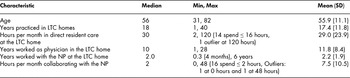
Of the 15 NPs, 14 (93%) returned 14 completed Part A and 32 completed Part B questionnaires. All 14 NPs were female, employed full-time, and baccalaureate prepared. Three respondents also had a master’s degree. Almost all (93%) had obtained their NP education through the Ontario Primary Health Care Nurse Practitioner Program offered collaboratively at 10 universities and had graduated between 1 and 10 years ago, with the median graduating 4 years ago. The NPs were middle-aged with many years of previous RN experience and had been NPs for approximately 4 years, the majority of which was spent in an LTC home (Table 1).
Description of nurse practitioner participants (n = 14)

SD = standard deviation; RN = registered nurse; NP = nurse practitioner; LTC = long-term care
Ten NPs worked in more than one home (Table 2), typically with a different physician in each home. Approximately 70 per cent of the NPs worked in one to two homes. As the number of homes in which the NP worked increased, the number of hours per month spent in each home and the time spent collaborating with the identified physician decreased.
Number of long-term care homes per nurse practitioner, hours spent in each home, and hours per month spent collaborating with the physician

LTC = long-term care; NP = nurse practitioner
Physician Demographics
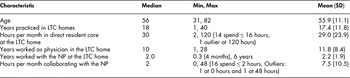
Of the 33 physicians, three did not return the questionnaire and three returned incomplete questionnaires. Of the 27 physicians who returned complete questionnaires, 23 (85%) were male. The physicians completed medical school between 1954 and 2000, with a median graduation year of 1974. Over half (52%) of the physician respondents were medical directors. Most physicians were middle-aged with substantial experience working in LTC homes. On average, the physicians collaborated with the NP approximately two hours per month, and they had worked together for a median of 2 years (Table 3). Most physicians divided their time between office practice and other settings, such as the emergency department and other homes, and 10 were semiretired. One physician was employed full-time at one home.
Description of physician participants (n = 27)
SD = standard deviation; LTC = long-term care; NP = nurse practitioner
LTC Home Settings
The 14 NPs worked in a total of 36 LTC homes. For-profit nursing homes accounted for 29 (81%), and 7 (19%) were not-for-profit homes for the aged. There was a median 140 residents per home (min = 38, max = 378), and 22 (61%) were located in urban and 14 (39%) in rural settings.
Extent of and Satisfaction with Collaboration
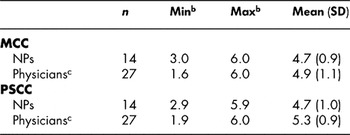
Overall, the mean scores for the NPs (n = 14) and physicians (n = 27) were in the moderately positive range for both the MCC and PSCC (Table 4). However, the physicians reported a greater extent of and higher satisfaction with collaboration than did the NPs.
Overall mean scores for the extent of and satisfaction with collaboration for nurse practitioners and physiciansFootnote a
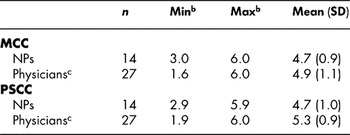
MCC = Measure of Current Collaboration; NPs = nurse practitioners; PSCC = Provider Satisfaction with Current Collaboration
a The mean scores are provided for information purposes but were not used for statistical comparisons.
b Minimum mean score = 1.0, Maximum mean score = 6.0.
c Includes one physician who cannot be matched with an NP.
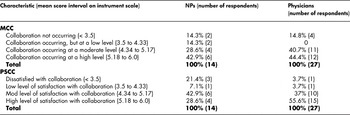
On the 6-point Likert scales, an instrument mid-point mean score of ≥ 3.5 was considered a positive response. Using the mean 3.5 cut-point, the majority of NPs (86%) and physicians (85%) indicated on the MCC that collaboration was occurring, and 79 per cent of NPs and 96 per cent of physicians indicated satisfaction with collaboration on the PSCC (Table 5). Of the four physicians who reported on the MCC that collaboration was occurring below the 3.5 cut-point, only one indicated dissatisfaction with this on the PSCC.
Nurse practitioner (n = 14) and physician (n = 27) frequency of response to measure of and satisfaction with collaboration
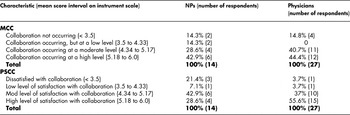
NPs = nurse practitioners; MCC = Measure of Current Collaboration; PSCC = Provider Satisfaction with Current Collaboration
For those NPs who worked with more than one physician, their ability to assign a different score to the MCC and PSCC for each physician was examined. The MCC and PSCC instrument score differences for each NP who scored two physicians varied from 0.89 to 3.33 and 0.73 to 2.82, respectively. For those who identified three or more physicians, the score differences were from 1.00 to 2.22 and 1.46 to 1.73, respectively. The MCC and PSCC instrument score differences for the physicians who reported on NPs who worked in two homes varied from 0.00 to 3.12 and 0.00 to 1.00, respectively. For those in which the NP worked in three or more homes, the score difference was 0.67 to 3.44 and 0.73 to 4.0, respectively.
Prior to analyzing scores for matched-pairs of NPs and physicians, an overall mean score for each of the 10 NPs who completed an MCC for more than one physician was calculated by averaging the mean scores for each physician. This process was repeated for the PSCC and the four additional satisfaction questions. Similarly, the corresponding physicians’ scores were averaged to obtain an overall mean score for the NP. For example, in a situation where an NP identified two physicians and completed two questionnaires, an overall mean MCC instrument score was calculated by summing the two individual mean MCC instrument scores and then dividing by two. Similarly, the overall mean MCC instrument score for the physicians was calculated by averaging those two physicians’ individual mean MCC instrument scores. This process resulted in 14 NP-physician matched-pairs.
Using the Wilcoxon matched-pairs signed-rank test, there was no statistically significant difference between physicians’ and NPs’ overall mean scores on extent of collaboration on the MCC instrument (z = -1.748, p = 0.081). Based on the PSCC instrument results, physicians were significantly more satisfied with collaboration than were the NPs (z = -2.67, p = 0.008).
Of the four additional items related to satisfaction with availability, time spent consulting, appropriateness of consultations, and quality of care, physicians reported higher levels of satisfaction than did NPs for all four items. The difference was statistically significant for only one item, satisfaction with appropriateness of consultations initiated by the physician/NP (z = -2.4, p = 0.018).
Impact of Collaboration on Physician Income
Twenty-six (96%) of the 27 physicians were remunerated through fee-for-service. For the 13 physicians who indicated that the NP affected their income, 8 physicians identified that the NP had a negative effect and 5 reported a positive effect on income. There were no statistically significant differences in mean instrument scores between those who reported a negative effect and those who reported a positive effect on income for the MCC (z = -0.540, p = 0.589) or the PSCC (z = -0.541, p = 0.589).
Relationship Between Previous and Current Collaboration
Approximately half of the physicians and the NPs reported previous physician-NP collaboration. Both the physicians and NPs rated their satisfaction with previous collaboration in the moderately satisfied range ( mean = 4.8 ± 1.1; 4.6 ± 1.6, respectively) in settings such as acute care, hospital outpatient clinics, community health centres, and family health networks. None of the respondents reported previous experience with NP-physician collaboration in LTC homes.
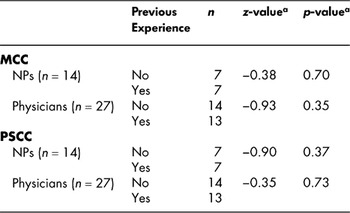
The NPs and physicians without previous collaboration experience scored slightly higher on the MCC and PSCC instruments than did those with previous experience (Table 6). There were no statistically significant differences in the instrument scores of physicians or NPs who did or did not have previous experience with NP-physician collaboration.
Difference between mean instrument scores for nurse practitioners and physicians with and without previous collaboration experience

NPs = nurse practitioners; MCC = Measure of Current Collaboration; PSCC = Provider Satisfaction with Current Collaboration
a Mann-Whitney U-Test
Communication Methods and Reasons for Interactions
The NPs identified methods of communication between the NPs and physicians. Communication methods varied not only between NPs, but also for the same NP depending on the physician with whom the NP was working. Telephone discussion with the physicians was the most common form of communication, as identified by 97 per cent of the NPs, followed by written messages (59%), messages via staff (56%), review of medical records (56%), and face-to-face contact with the physician (16%). Nine per cent of the NPs reported e-mail or fax communication methods. Communication on an “as needed” basis was reported by 75 per cent of the NPs, and 22 per cent identified regular NP-physician meetings. Nine per cent of the NPs reported participation in quarterly drug reviews or scheduled rounds.
Discussion
The physicians reported a statistically significant greater satisfaction with collaboration than did the NPs; however, both physician and NP scores were in the moderately positive range. In general, scores for physicians and NPs support Stolee et al.’s (2002) previous qualitative findings that NPs working in Ontario LTC homes have established positive collaborative relationships with physicians. As well, these results lend support to Rosenfeld et al.’s (2004) findings that medical directors of LTC homes reported adequate collaboration between the physician and NP. However, this study also found that some physicians and NPs perceived that collaboration did not occur at a level they would have expected; nor were they satisfied with the collaborative relationship.
Although the overall scores were moderately positive, there is room for improvement in both the extent of and satisfaction with physician-NP collaboration. Poor collaboration has potentially serious implications for safety and continuity of care, as well as communication with residents, their family members, and LTC staff. The NP and physician may not be communicating important information to one another, and that could negatively influence the quality of care provided (Truscott, Reference Truscott2007). From a policy perspective, the MoHLTC should be encouraged to require annual evaluations of how the NP and physician collaboration is going, what is going well, what needs to be improved, and what strategies have been put in place to address identified concerns and to strengthen the collaborative relationship.
The overall higher MCC and PSCC scores for physicians may reflect differences in the way they define or perceive collaboration compared with the NPs or the power differential between the two professions (Caprio, Reference Caprio2006). Differences in education of physicians and NPs may affect personal definitions of and expectations for collaboration (Fagin, 1992; Knaus, Draper, Wagner, & Zimmerman, Reference Knaus, Draper, Wagner and Zimmerman1986; Larson, Reference Larson1999; Scott & Thurston, Reference Scott and Thurston2004; Siegler & Whitney, Reference Siegler, Whitney, Siegler and Whitney1994; Yurkow, Reference Yurkow1999). The physicians in this study graduated from medical school on average 30 years ago when there was likely little or no education about collaboration. In the past, physicians were traditionally taught to work independently in a hierarchical system, referring to specialists rather than collaborating on a plan of care with other professionals (Ryan, Reference Ryan1999; Scott & Thurston, Reference Scott and Thurston2004). In contrast, the NPs received their education within the last eight years, and the curriculum included content about collaboration. The NPs’ more recent education and the emphasis on collaboration in their education programs may help to explain the NPs’ slightly lower scores on both collaboration instruments, as their expectations for collaboration likely differed from those of the physicians.
Another explanation for the lower NP scores on the MCC and PSCC may relate to the limited NP scope of practice in Ontario. For instance, an Ontario NP can order a number of antibiotics from a legislated medication list; but if a resident develops pneumonia and the first-line antibiotic is not on the approved list, the NP must contact the physician to request the drug order. Contacting the physician can take a considerable amount of time, delaying resident care, prolonging and possibly exacerbating the disease process, and placing an additional burden on the busy physician and NP. A negative impact on satisfaction with collaboration may occur when NPs must contact and rely on physicians to order tests and medications and make diagnoses that are within the realm of the NPs’ knowledge and skill, but are not within their legislated scope of practice. The variability in the NPs’ instrument scores, for those who worked with more than one physician, indicated that the NPs were able to discriminate between collaborative relationships with physicians. It is not known if the time spent contacting individual physicians impacted on the MCC and PSCC scores. However, the time spent by the NP contacting physicians for orders that are within the knowledge and skill of the NP results in time being taken away from caring for residents. Medical directives that delineate courses of action based on specific criteria are an interim measure, pending changes in legislation, that can reduce the time spent contacting the collaborative partner.
Role overlap between physicians and NPs may facilitate timely access to primary care within the home given the increased availability of a qualified care provider. However, the role overlap can also lead to role confusion and “turf protection,” which can impact quality collaboration (Neale, Reference Neale1999). In a literature review regarding NP and physician assistant collaboration with physicians in LTC, Caprio (Reference Caprio2006) concluded that physicians fear a loss of professional identity and relevance in LTC practice. These two fears, compounded by role overlap, have created role confusion. He calls for clear role definitions for physicians and NPs to strengthen collaborative practice and enhance clinical outcomes. A written agreement, such as a collaboration contract, may open dialogue between the NP and physician to discuss their roles (Truscott, Reference Truscott2007), and regular review is important to clarify further the roles and collaborative agreement. Clinical practice guidelines that are mutually agreed upon can further clarify the roles and decision making regarding resident care. Administrators need to work closely with the NPs and physicians to define clearly their respective roles and areas of overlap at the time the NP role is planned and at regular intervals after the role is established. Regular meetings between the NP and physician would provide a forum to discuss the quality of the collaborative relationship and strategies to strengthen the collaboration.
Some Ontario physicians have expressed concern that working with an NP might negatively impact their income (DiCenso et al., Reference DiCenso and Paech2003; Stolee et al., Reference Stolee and Hillier2002). Although the current study had a small number of participants, this is the first study that revealed differing views as to whether the effect was negative or positive. For those reporting a positive impact on income, the effect might relate to an increase in billing time outside the LTC homes. There were no differences in MCC or PSCC scores between physicians reporting a positive or negative effect on income, suggesting that changes in physicians’ income did not influence the extent of or satisfaction with collaboration with NPs.
Hojat et al. (Reference Hojat, Nasca, Cohen, Fields, Rattner and Griffiths2001) and Henneman et al. (Reference Henneman, Lee and Cohen1995) suggest that prior experience with collaboration facilitates future collaborative processes, but an association between previous and current collaboration was not found in this study. Previous collaboration occurred in settings other than LTC homes, such as acute care and community health centres. The previous collaboration was in settings where NPs and physicians worked together in close physical proximity, which is not the case in LTC homes. It may be that previous experience in a different type of setting does not provide an accurate comparison or guide for the current relationship. Finally, the use of a single question to measure satisfaction with previous collaboration may not have fully captured this issue.
Communication between physicians and NPs was typically via telephone on an “as needed” basis, rather than working face-to-face or during regularly scheduled meetings. There is a recognized need in the literature for regular communication to strengthen collaboration (Flaherty, Reference Flaherty2000). Few of the NPs reported collaboration during rounds or quarterly reviews, when the goals and plans for resident care often are discussed. The reasons for NPs not collaborating during rounds and quarterly reviews were not specified. It may be that NPs did not attend these review meetings because they were not available at the time the meetings were scheduled or because they did not feel welcome to attend. Although “ad hoc” telephone communication may be satisfactory to address specific, and possibly urgent, issues as they arise, collaboration during rounds or quarterly reviews would allow the NP, physician, and health care team to discuss fully a resident’s health status and to develop a coordinated plan of care in which everyone’s role is clear. Given that lack of clarity of the NP role has been a barrier to NP integration in various settings (DiCenso et al., Reference DiCenso and Paech2003), these meetings would provide regular opportunities to clarify the NP’s role and to articulate the NP’s role in relationship to others’ roles.
Stevenson et al. (1994) postulate that communication barriers might be amplified in LTC homes when a physician is seldom on site. Most of the study physicians reported spending relatively little time on-site in the LTC home, with half averaging four hours per week. In the case of NPs who work in multiple homes, their time on-site is also limited. Yet, even with this limited time to collaborate, the majority of physicians and NPs agreed that there was an adequate extent of and moderate satisfaction with collaboration. It is interesting to note that two of the three physicians who identified that collaboration was happening to a small extent were nonetheless satisfied with the collaboration. Possibly, these physicians viewed the NP as a physician extender (Caprio, Reference Caprio2006), an extra pair of eyes and ears, hence satisfying the physicians’ concerns about medical care for residents, rather than specifically being satisfied with collaboration about resident needs. It may be that increased face-to-face, planned communication to discuss resident and family needs and plans of care, as well as existing and future programs in the LTC home, and other collaborative practice decisions is needed to further strengthen these physician-NP collaborative relationships. However, the extent to which face-to-face communication is required to establish successfully, and then maintain, a strong physician-NP collaborative relationship is not known. This is an important area requiring further research.
Although the NP caseload was not specifically addressed in this survey, the number of residents per home was high for those who work in multiple homes. Experts in the United States recommend 12 to 18 NP visits to LTC residents per day, in addition to other activities such as committee work and team meetings. This recommended caseload depends on the experience level of the NP, resident acuity, and LTC home characteristics (Mezey et al., 2005). Policy makers are encouraged to consider these factors when planning for future NP positions in LTC.
The older cohort of physicians in this study reflects a dilemma now facing many health human resource planners. According to the 2007 National Physician Survey, approximately 2,100 physicians work in Ontario LTC homes, and 28 per cent of them are 55 years or older (College of Family Physicians of Canada, 2007). Although older physicians may more readily identify with the issues of aging of LTC residents, they may not be available to respond to emergent needs or willing to collaborate with NPs and members of the health care team. The existing shortage of physicians who work in LTC homes may be exacerbated as this older cohort of physicians retires. To prepare young physicians better to work in LTC, an increased curricular content about the aging process is needed in medical education programs. The teaching nursing home (Mezey, Mitty, & Burger, 2008) is a concept that may attract medical students as they begin to formulate their career plans. If teaching nursing homes can facilitate effective collaborative relationships between physicians and NPs, the support provided by NPs to physicians might help to attract and retain physicians in LTC.
Study Strengths and Limitations
A search of the literature did not reveal any other studies that compared the perceptions of physician-NP partners with respect to the extent of and satisfaction with their collaboration or a matched-pair analysis. Although the study may be limited by its small sample size, it has included the entire population of eligible NPs and physicians in Ontario, and the response rates of both groups were very high.
This study focused on NPs and the physicians with whom the NPs most frequently collaborated in each home. Because the NP role in LTC homes typically requires collaboration with a number of physicians within each home, it would have been ideal to measure the extent of and satisfaction with collaboration between the NP and each physician with whom he or she worked. However, this was not possible because of time and budget limitations, as well as the respondent burden for the NP to complete a questionnaire for every physician.
Social desirability and self-reporting biases may have overestimated the extent of and satisfaction with collaboration. The small number of NPs and physicians in one province limits the generalizability of the findings. Replication of this study is recommended with a larger sample size that incorporates psychometric testing of the MCC and PSCC.
Conclusions
Both physicians and NPs reported that collaboration was occurring at a moderate level and they were relatively satisfied with it. Territorialism and role confusion are recognized barriers to collaboration and require further study to determine if these are barriers to collaboration in Ontario. Ineffective collaboration is an important barrier to quality resident care (Truscott, Reference Truscott2007). Research addressing factors that support or impede collaboration in LTC homes is needed so that plans to strengthen collaboration can be developed.
To facilitate successful collaborative relationships, NP and physician partners who collaborate effectively could act as mentors for physicians and NPs for whom collaboration in LTC homes is new. As well, physician and NP attendance at interprofessional education sessions provides the opportunity for the pair to collaborate in the application of their new learning to specific resident needs.
Interprofessional collaboration has become a necessity in the current health care delivery system (Baggs et al., 1997). Collaborative teams of NPs and physicians in LTC homes have demonstrated reductions in hospitalizations and in hospital cost savings (Kane, Keckhafer, Flood, Bershadsky, & Siadaty, 2003), enhanced resident health knowledge, better working relationships between nurses and physicians, and improved resident access to care (Bouchard, Holdway, Corbeil, Tasse, & Joanisse, 2004). It is important to understand the process by which individuals from two different health care professions collaborate in order to begin to understand how multiple professions collaborate.
This study is a building block in an area where little research has been conducted to examine NP-physician collaboration in LTC homes. Although this study suggests that collaboration is occurring between NPs and physicians in Ontario’s LTC homes and they are moderately satisfied with their collaboration, further research is needed to understand how NPs and physicians collaborate in their daily practice in LTC homes, to identify the major facilitators and barriers to collaboration, to design and to evaluate interventions to improve collaboration, and to identify resident-important outcomes of collaboration.