Introduction
The propagation of flowering plants by seeds involves two critical determinant stages of overall life history: sexual reproduction and seed germination. Sexual reproduction involves pollen transfer from anther to stigma, thereby enabling fertilization and seed development (Barrett, Reference Barrett2002). The embryo, contained within the seed, is the next generation of the plant, and seed germination is completed when the embryonic root emerges visibly through the outer structures of the seed (Bewley et al., Reference Bewley, Bradford, Hilhorst and Nonogaki2013).
Hermaphroditic spermatophytes display complex mating patterns, with individual parents often mating simultaneously with other sexual partners as well as with themselves, and the extent to which seeds are produced via self- or cross-pollination has important consequences for the viability of a population and its evolutionary potential (Husband and Schemske, Reference Husband and Schemske1996; Eckert et al., Reference Eckert, Kalisz, Geber, Sargent, Elle, Cheptou, Goodwillie, Johnston, Kelly, Moeller, Porcher, Ree, Vallejo-Marín and Winn2010). Although self-pollination may provide reproductive assurance independently from pollen vectors, autogamy entails inbreeding depression that may affect several fitness traits throughout the plant life history (Lloyd and Schoen, Reference Lloyd and Schoen1992; Husband and Schemske, Reference Husband and Schemske1996). Based on the genetic purging theory, Lande and Schemske (Reference Lande and Schemske1985) argued that only two mating systems should be evolutionarily stable: selfing with low inbreeding depression, and complete outcrossing. To these two systems we must add a third reproduction mode, characterized by a mixture of self- and cross-fertilization, known as a mixed mating system (Goodwillie et al., Reference Goodwillie, Kalisz and Eckert2005; Winn et al., Reference Winn, Elle, Kalisz, Cheptou, Eckert, Goodwillie, Johnston, Moeller, Ree, Sargent and Vallejo-Marin2011). This remarkable diversity of mating systems arises primarily because of the hermaphroditic nature of most angiosperms, often driven by diverse ecological factors (Barrett, Reference Barrett2002).
Seed germination is the first and most important early stage transition, determining the conditions that plants experience after they germinate (Baskin and Baskin, Reference Baskin and Baskin1998; Donohue et al., Reference Donohue, de Casas, Burghardt, Kovach and Willis2010). Germination is influenced by a large number of genes and environmental factors, often mediated by seed dormancy (Koornneef et al., Reference Koornneef, Bentsink and Hilhorst2002; Finch-Savage and Leubner-Metzger, Reference Finch–Savage and Leubner-Metzger2006; Bewley et al., Reference Bewley, Bradford, Hilhorst and Nonogaki2013). Seed dormancy is usually defined as ‘a seed characteristic, the degree of which defines what conditions should be met to make the seed germinate’ (Vleeshouwers et al., Reference Vleeshouwers, Bouwmeester and Karssen1995; Thompson and Ooi, Reference Thompson and Ooi2010; Finch-Savage and Footitt, Reference Finch–Savage and Footitt2012). A seed able to germinate over the widest possible range of conditions is non-dormant, while any narrowing of this range is, by definition, an increase in the degree of seed dormancy. Seed dormancy is therefore a quantitative trait of great adaptive importance in ensuring that seedling emergence occurs at the most advantageous time and place (Fenner and Thompson, Reference Fenner and Thompson2005; Donohue et al., Reference Donohue, de Casas, Burghardt, Kovach and Willis2010; Bewley et al., Reference Bewley, Bradford, Hilhorst and Nonogaki2013; Willis et al., Reference Willis, Baskin, Baskin, Auld, Venable, Cavender-Bares, Donohue and Rubio de Casas2014).
Freshly harvested, water-permeable, dormant seeds are said to have primary dormancy, which has been acquired during seed maturation (Finch-Savage and Leubner-Metzger, Reference Finch–Savage and Leubner-Metzger2006). Apart from its genetic nature, the degree of primary dormancy may be determined by other factors, such as maternal environment during development and maturation, age of the mother plant during maturation and position of the seed on the mother plant (Andersson and Milberg, Reference Andersson and Milberg1998; Fenner and Thompson, Reference Fenner and Thompson2005; Hoyle et al., Reference Hoyle, Daws, Steadman and Adkins2008; Kendall and Penfield, Reference Kendall and Penfield2012).
In some heterocarpic plants, differences in seed dormancy are often associated with the different fruit morph (Venable, Reference Venable1985) and, possibly, with the breeding systems too. Indeed, Picó and Koubek (Reference Picó and Koubek2003) found that pollination type had opposite effects on the inner and outer florets of the Scorzoneroides autumnalis (Asteraceae) inflorescence, with peripheral achenes germinating more rapidly when resulting from self-pollination than when outcrossed. However, the effect of breeding system on seed dormancy in homocarpic species, producing many seeds per fruit, has been poorly investigated (Kobayashi and Yamamura, Reference Kobayashi and Yamamura2000). In this context, differences in seed germination between inbred and outbred seeds may be due to the effects of inbreeding depression on seed size, seed viability or processes regulating germination (Baskin and Baskin, Reference Baskin and Baskin1998; Keller and Waller, Reference Keller and Waller2002), but it can also originate from different degrees of seed dormancy. In such cases, the plant may gain more long-term fitness via seeds being more dormant (Baskin and Baskin, Reference Baskin, Baskin, Pendleton, Meyer and Schultz2010). Thus, the breeding system might facilitate the onset of environment-driven adaptation through the variation in degrees of dormancy, allowing the seeds to spread germination across time and bet-hedge against an unpredictable, variable environment. Hypericum elodes L., a typical species of periodically inundated shores of softwater ponds (Murphy, Reference Murphy2002), is a good model for the study of these issues: recent studies highlighted a mixed mating system (Carta et al., Reference Carta, Savio, Bedini, Peruzzi, Fisogni and Galloni2015b) and also the existence of dormancy-degree variation (Carta et al., Reference Carta, Probert, Puglia, Peruzzi and Bedini2015a) for this perennial, insect-pollinated herb displaying an Atlantic–European distribution. As in other plants, the maintenance of a mixed mating system is not yet fully clarified (Goodwillie et al., Reference Goodwillie, Kalisz and Eckert2005; Winn et al., Reference Winn, Elle, Kalisz, Cheptou, Eckert, Goodwillie, Johnston, Moeller, Ree, Sargent and Vallejo-Marin2011). Indeed, although the genetic aspects of the consequences of selfing have been widely explored, i.e. transmission advantage versus inbreeding depression (Lande and Schemske, Reference Lande and Schemske1985; Charlesworth and Charlesworth, Reference Charlesworth and Charlesworth1987), little is known about the eventual ecological benefits of selfing (Lloyd and Schoen, Reference Lloyd and Schoen1992; Kalisz et al., Reference Kalisz, Vogler and Hanley2004). Hence, to explore these issues, we examined whether degree of seed dormancy is affected by different experimental pollination treatments.
Materials and methods
Study species
Plants have opposite tomentose leaves and creeping stems that root at the nodes. The pseudotubular, homostylous flowers are borne in irregularly corymbose panicles composed of 5–7 flowers. Flowering starts in July, proceeds throughout summer, and ripe seeds are dispersed in September–October. In nature H. elodes normally produces seeds by both self-fertilization and outcrossing. Indeed, its breeding system promotes outcrossing by morphological and physiological traits and ensures reproductive success when outcrossing is erratic, by means of competitive autogamy (Carta et al., Reference Carta, Savio, Bedini, Peruzzi, Fisogni and Galloni2015b).
Fruits contain about 30 dormant seeds each. Exposure to cold temperature while in the wet state is the most important factor to break primary dormancy prior to placing the seeds at the required light and alternating temperature regime conditions for germination (Carta et al., Reference Carta, Probert, Puglia, Peruzzi and Bedini2015a). The seeds are dark, small (c. 0.6–0.8 mm long; c. 0.06 mg), ovoid–cylindrical or ellipsoid, with a typical ribbed scalariform testa sculpturing.
Pollination treatments and seed production
This study was carried out in a natural population located within the Regional Natural Park of Migliarino-San Rossore-Massaciuccoli (Bosco del Palazzetto, 5 m above sea level, Pisa, Italy). Plants grow over an area of 4000 m2 in a system of shallow pools which is flooded in the winter–spring season and completely dry during the summer. The water level can vary among years, leading to a marked oscillation of seedling recruitment and of the number of flowering individuals (Carta et al., Reference Carta, Savio, Bedini, Peruzzi, Fisogni and Galloni2015b).
Pollination treatments were carried out during the peaks of the 2009, 2011 and 2013 flowering seasons (July–August). The years 2010 and 2012 were excluded because of extraordinary drought. In addition to sexual reproduction, plants form clumps by vegetative reproduction, but the propagation has rarely been observed at distances greater than 5 m. Furthermore, despite the geographic isolation, the studied population shows higher genetic variability compared to other populations considered (Carta et al. Reference Carta, Probert, Puglia, Peruzzi and Bedini2015a). Hence, plants with inflorescences spaced at least 5 m from one another were considered as putatively different genets. For all treatments, except controls, flowers were bagged before opening in nylon bags (0.5 mm mesh), preventing visits by insects, but allowing normal flower and fruit development. Bags were removed following the completion of anthesis of each treated flower.
Non-manipulated flowers, where open-pollination was allowed, were chosen as controls: 30 flowers (15 plants) in 2009 and 2011, 73 flowers (30 plants) in 2013. Hand cross-pollination experiments were performed on 11 flowers (11 plants) in 2009, 25 flowers (20 plants) in 2011 and 52 flowers (35 plants) in 2013, by collecting dehiscent anthers from three different donor plants, and brushing them on freshly opened emasculated flowers. Spontaneous selfing experiments were carried out in 2009 and 2011 involving 30 intact bagged flowers (15 plants) and in 2013 involving 69 flowers (25 plants).
In most cases, three distinct pollination treatments (control, self- and cross-pollination) were applied on different flowers of the same inflorescence. Flowers were randomly selected within the inflorescences to minimize the possible effect of position on seed maturation, and randomly assigned to a pollination treatment.
Treated flowers were monitored until fruit production and fruits (capsules) were harvested just before seed dispersal around mid-September. After collection, the seeds spent a 3-week period at moderate humidity (approximately 20°C, 50% relative humidity) to ensure a homogeneous maturation state before being cleaned and used in the germination experiments. Seed length and width were measured on 30 seeds recovered from each treatment; seed mass was assessed by weighing five replicates of 100 seeds for each pollination treatment.
Germination assays and primary dormancy characterization
Each assay consisted of four samples of 25 seeds for each pollination treatment. Experiments were conducted using temperature ( ± 1°C) and light (40 μmol m− 2s− 1) controlled incubators under a 12-h daily thermo- and photoperiod ( = light hereafter). Light was provided during the warm phase by white fluorescent tubes. All experiments were carried out in 90-mm-diameter Petri dishes containing 1% distilled water agar. Germination was defined as radicle emergence from the testa by at least 1 mm; germinated seeds were counted and removed every 5 d. At the end of the experiments (6 weeks), the number of non-germinated but viable seeds was determined by a cut test; defective seeds (i.e. empty, damaged and infected) were excluded from subsequent calculations.
Primary dormancy was characterized by testing for germination percentage after seed dispersal from the maternal plant, hereafter ‘germination at dispersal’, and after different times of cold–wet stratification, hereafter ‘primary dormancy strength’. Seeds were cold stratified for 0 (germination at dispersal), 3 and 8 weeks at 5°C before being placed under the germination condition of 25/15°C (regarded as near optimal for germination once dormancy is broken; Carta et al. Reference Carta, Probert, Puglia, Peruzzi and Bedini2015a). This experiment simulates the conditions that seeds experience after release in the field. Seeds released in late summer (here simulated by 0 weeks of cold stratification) fall on the surface of the emerged pond fringes and are exposed to warm daily temperature fluctuations (with an average ~20°C). Then, the seeds experience cooling temperature (~5°C) and inundation of the pond, contributing to breakage of primary dormancy (simulated by 3 and 8 weeks of cold stratification).
Despite our tests being performed under a single temperature treatment, not allowing for interpreting the base and ceiling thermal thresholds for germination (Steadman and Pritchard, Reference Steadman and Pritchard2004), this procedure offers valuable information on differences in dormancy among seed collections (Andersson and Milberg, Reference Andersson and Milberg1998).
Statistical analyses
We fitted generalized linear mixed models (GLMMs, logit link function, binomial distribution) using the R package lm4 (Bates et al., Reference Bates, Maechler, Bolker and Walker2014) to test for mating effects on germination at dispersal, considering year as a random effect (Bolker et al., Reference Bolker, Brooks, Clark, Geange, Poulsen, Stevens and White2009). We analysed the variation of dormancy degree after the different periods of cold stratification by fitting generalized linear models (GLMs) to the germination response data (degree of dormancy) with pollination treatments and cold-stratification length as predictors. To describe the dynamics of germination in the laboratory, the Weibull function (Weibull, Reference Weibull1951) was fitted to cumulative germination data (one of the most appropriate functions to describe germination dynamics; Brown and Mayer, Reference Brown and Mayer1988) by using the R package drc (Ritz and Streibig, Reference Ritz and Streibig2005). To determine whether there were differences between treatments, analysis of residual deviance (variance ratio test which follows the F-distribution) was used to test for significance when constraining data for multiple treatments to a single line.
The effect of breeding system on seed length, width and weight was analysed by means of analysis of variance (ANOVA). All calculations were performed using the R environment for statistical computing (R Development Core Team, 2014).
Results
Pollination treatments and seed production
Although seed set was slightly lower for self-pollination (see Carta et al., Reference Carta, Savio, Bedini, Peruzzi, Fisogni and Galloni2015b for further details), all pollination treatments produced fruits and set viable seeds with no significant differences in seed weight (F 2,15= 2.505; P > 0.05), length (F 2,87= 2.173; P > 0.05) and width (F 2,87= 1.486; P > 0.05) (Table 1).
Average 100-seed mass, seed length and seed width (mean ± SE) for seeds recovered from each pollination treatment

Germination assays and primary dormancy characterization
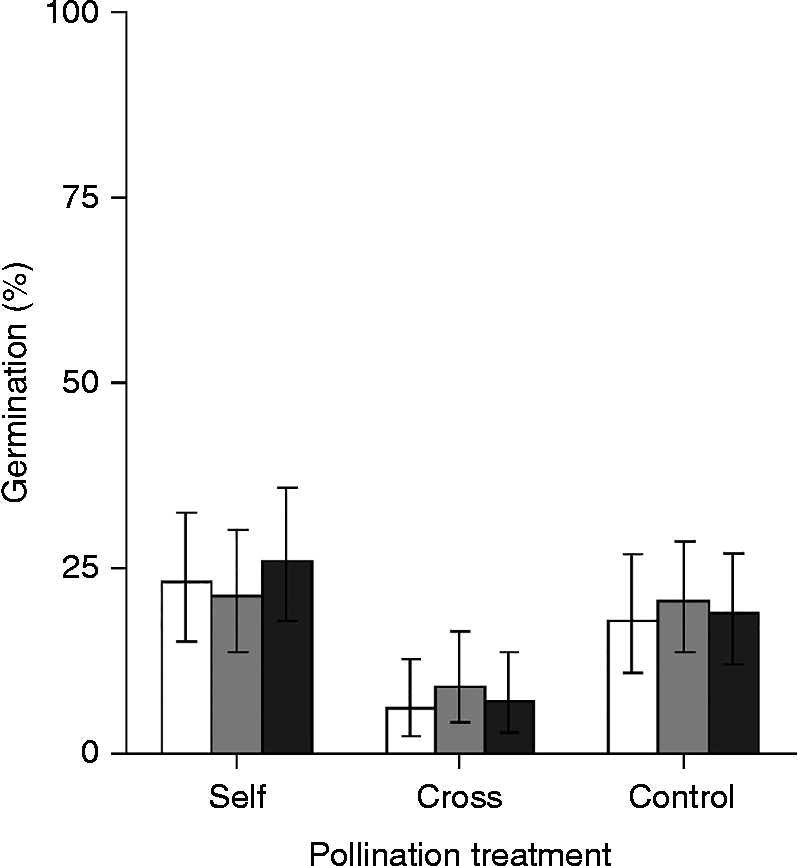
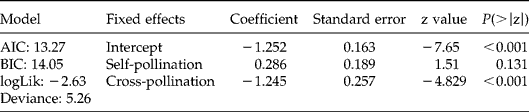
Irrespective of pollination treatments, germination at dispersal was lower than 30% (Fig. 1). However, seed germination varied considerably and this variation was not associated with the year of treatment. Seed germination was instead significantly affected (P < 0.05) by breeding treatments (Table 2), with the highest proportion of germination for inbred and lowest for outbred seeds. Control seeds showed a similar germination response to inbred seeds.
Germination at dispersal (mean ± 95% binomial confidence intervals) of seeds resulting from control, self- and cross-pollination (as indicated) in experimental treatments conducted in 2009 (white bars), 2011 (grey bars) and 2013 (black bars), incubated at 25/15°C and exposed to a 12-h daily photoperiod.

Generalized linear mixed model (GLMM) results for the effect of pollination treatment on seed germination. The year of treatment was considered as a random factor (variance, 0.2; SD, 0.15)

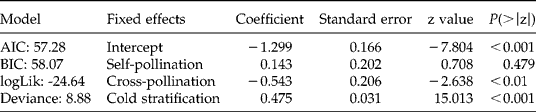
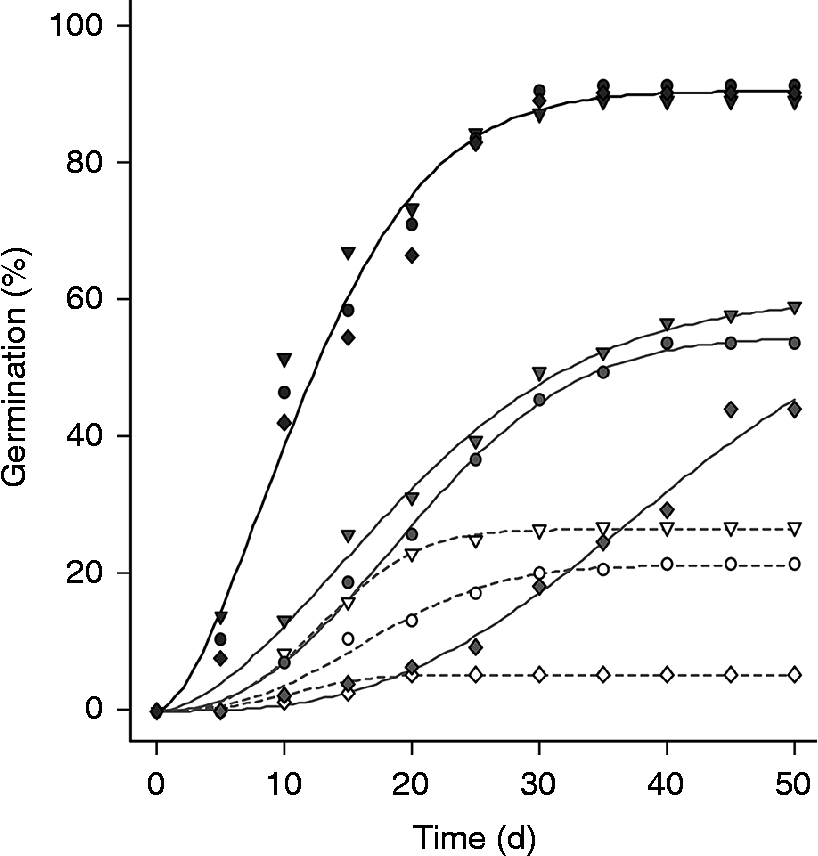
Although seeds of all treatments gradually germinated at higher percentages at the end of each period of cold stratification (Table 3, Fig. 2), we also found significant variation in primary dormancy strength (P< 0.05), with germination percentages and dynamics that differed significantly among pollination treatments after 0 and 3 weeks of cold stratification before being placed under germination conditions (Fig. 2). With progressively longer stratification (8 weeks), germination of seeds increased in all pollination treatments and the progress of germination could be constrained to a single line (Fig. 2). Seeds recovered from all pollination treatments had ~90% germination, so the viability was high for all treatments.
Generalized linear model (GLM) results for the effect of pollination treatment and cold stratification on seed germination

Germination progress curves fitted using the Weibull function for seeds resulting from control (dots), self- (triangles) and cross-pollination (diamonds), following 0 (white symbols, broken lines), 3 (grey symbols, solid lines) and 8 (dark symbols, single dark solid line) weeks of cold stratification, incubated at 25/15°C and exposed to 12-h daily photoperiod. Data of the three pollination treatments after 8 weeks of cold stratification could be constrained to a single regression without a significant increase of residual deviance (P > 0.05).

Discussion
H. elodes is a perennial, insect-pollinated herb, characteristic of acid, pool-fringe, shallow-water swards, a habitat that is inundated during the greater part of the year but which emerges temporarily in summer. This habitat hosts high biodiversity under intermediate intensities of environmental disturbance, associated with a degree of spatial-time variability in habitat conditions and vegetation processes (Grime, Reference Grime1979; Murphy, Reference Murphy2002). Seed dormancy in H. elodes should be referred to as non-deep physiological dormancy (PD, Baskin and Baskin, Reference Baskin and Baskin1998), with exposure to cold temperature while in the wet state playing the most important role in primary dormancy release (Carta et al., Reference Carta, Probert, Puglia, Peruzzi and Bedini2015a). Primary seed dormancy in H. elodes is influenced by environmental cues, such as maternal effects, and modulated according to local climate (Carta et al., Reference Carta, Probert, Puglia, Peruzzi and Bedini2015a). In this study we have shown that the breeding patterns can also influence the degree of seed dormancy in the seed population produced annually. Seeds obtained from control flowers showed a similar degree of dormancy to self-pollinated treatments, confirming that the natural reproduction in this species often occurs through spontaneous autogamy (Carta et al., Reference Carta, Savio, Bedini, Peruzzi, Fisogni and Galloni2015b). The seeds recovered from self-pollination treatments exhibited a weak degree of primary dormancy which was quickly lost after cold stratification, while a stronger degree of dormancy was found in seeds obtained through cross-pollination. The other seed traits measured (namely seed mass and seed dimensions) were correlated neither with the seed viability (Carta et al., Reference Carta, Savio, Bedini, Peruzzi, Fisogni and Galloni2015b) nor with pollination treatments, which, on the contrary, caused a variation in the degree of seed dormancy.
Although some evidence of the breeding system accounting for seed dormancy variation has been reported (Picó and Koubek, Reference Picó and Koubek2003), because of the heterocarpic nature of the plant studied therein, some distinct features should be noted. First, the pollination type had opposite effects between morphs that corresponded to single seeds (the dispersal unit was the single-seeded fruit typical of Asteraceae, the cypsela). Second, in such heterocarpic plants differences in seed dormancy (or germination-regulating processes) between morphs are mainly due to thickness and structure of the fruit-covering layer (Imbert, Reference Imbert2002; Puglia et al., Reference Puglia, Grimaldi, Carta, Pavone and Toorop2015). On the contrary, our results indicate a more continuous variation, with seeds having non-deep physiological dormancy. Given the great adaptive potential of physiological dormancy and its association with high diversification of spermatophytes (Willis et al., Reference Willis, Baskin, Baskin, Auld, Venable, Cavender-Bares, Donohue and Rubio de Casas2014), it seems appropriate to further investigate the relationship between breeding system and seed dormancy in other homocarpic plants.
It is not uncommon for studies of inbreeding depression to find differences in germination percentage for inbred and outbred seeds. Some authors found that outbred seeds germinate more readily, while others found that inbred seeds germinate more readily (Husband and Schemske, Reference Husband and Schemske1996). These influences of pollen source (self-, cross-) on seed germination have usually been interpreted per se as a measure of fitness of inbreeding vs. outbreeding. However, when the differences in seed germination depend on variation of seed dormancy degree, the germination at dispersal does not reflect the fitness potential of inbred and outbred seeds. This assumption is consistent with the view that plants, in some cases, would gain more long-term fitness via seeds being dormant (slow germinators) than being non-dormant (Baskin and Baskin, Reference Baskin, Baskin, Pendleton, Meyer and Schultz2010). For this reason, we suggest avoidance of the use of gross seed germination percentages in the calculation of inbreeding depression indices (Lande and Schemske, Reference Lande and Schemske1985) for those species known, or suspected, to have seed dormancy, unless dormancy is effectively removed. Furthermore, the evaluation of how dormancy and germination fit into the life cycle of the plant in its habitat should always be assessed. Indeed, when inbred seeds germinate more readily, it could be improperly argued that dormancy is adaptive and the lack of dormancy in inbred seeds is maladaptive, simply because it is often assumed that inbred seeds will have lower fitness. Prediction of germination behaviour and emergence phenology in the field is far beyond the scope of our paper; however, it may be argued that the weaker degree of dormancy of inbred seeds maximizes the potential for short-term establishment of seedlings, while, in contrast, the stronger degree of dormancy exhibited by outbred seeds is more finely tuned to the seasonal variation in the environment to increase the likelihood of seedling survival (high risk–low risk strategies; Venable, Reference Venable1985). In this context, it should be noted that multiple strategies for germination are also reported as the major ecological consequence of heterocarpy (Venable, Reference Venable1985; Imbert, 2002). The association between the degree of primary dormancy and seasonal germination response should be verified to demonstrate the presence of polymorphism in germination phenology within a population, classically interpreted as bet-hedging in an unpredictable environment (Venable, Reference Venable1985; Montesinos-Navarro et al., Reference Montesinos-Navarro, Picó and Tonsor2012; Carta et al., Reference Carta, Bedini, Müller and Probert2013).
As seeds retrieved from all pollination treatments showed high viability, we have not found evidence of inbreeding depression at the seed germination stage; instead we have shown that seed germination at dispersal varies among pollination treatments due to variation in degree of seed dormancy. The association between pollination treatments and degree of primary dormancy indicated that the breeding system should be considered as a source of variation for dormancy degree, proportional to selfing rate within populations of this species. By shedding seeds with various degrees of dormancy, plants may distribute their offspring across time by means of polymorphism in germination response, suggesting the possible ecological benefits of selfing (Kalisz et al., Reference Kalisz, Vogler and Hanley2004). Thus, the evaluation of seed germination–dormancy traits related to self- and cross-fertilization has provided useful insights to understand the potential advantages of the mixed breeding strategy in H. elodes, and could be used to explore the evolution of mating systems in plants.
Acknowledgements
This research was conducted according to the national and regional laws for plant protection and with the permission of local authorities under the auspices of the San Rossore–Migliarino–Massaciuccoli Regional Park (Italy).
Financial support
This research was supported by EX60% from University of Pisa.
Conflict of interest
None.