Introduction
Latin America has experienced an economic growth rate between 2.5 and 5% in the past 10 years (http://data.worldbank.org/indicator/NY.GDP.MKTP.KD.ZG/countries). However, this growth has occurred without proper sustainable development for both urban and rural environments, resulting in land degradation, deforestation, overfishing, extinction of plant and animal species, and carbon emissions leading to climate change (Castro-Diaz & Kuna, Reference Castro-Diaz and Kuna2007). Furthermore, these environments are constantly receiving pesticides, heavy metals and persistent organic pollutants (POPs), such as polychlorinated biphenyls (PCBs), polycyclic aromatic hydrocarbons (PAHs) and polybrominated diphenyl ethers (PBDEs), as a consequence of human activities (e.g. Vidal-Martínez et al., Reference Vidal-Martínez, Aguirre-Macedo, Noreña-Barroso, Gold-Bouchot and Caballero-Pinzón2003, Reference Vidal-Martínez, Aguirre-Macedo, Del Rio Rodríguez, Gold-Bouchot, Rendón-von Osten and Miranda-Rosas2006). As there is an obvious need for effective control of these environmental issues and proper disposal of pollutants and contaminants (for FAO definitions, see Sciortino & Ravikumar, Reference Sciortino and Ravikumar1999), we must understand and prevent the outcomes of harmful environmental degradation processes and toxic exposures. One strategy to obtain this information is the use of bioindicators. These are species that reflect the environmental impact because they respond to habitat alterations with changes in their numbers, physiology or chemical composition. Bioindicators can be indicators of effect or accumulation. Effect bioindicators can range from functional molecular or physiological changes to changes in population size; accumulation bioindicators must accumulate substances from the environment efficiently without showing adverse effects (Sures, Reference Sures2003). These bioindicators measure exposure to pollutants at different levels of organization, from the subcellular to the ecosystem level, and are useful indicators of different effects (Amiard-Triquet et al., Reference Amiard-Triquet, Amiard and Rainbow2013).
Traditionally, ecologists have used free-living organisms as bioindicators to assess the environmental quality of both terrestrial and aquatic environments (e.g. Ortega-Álvarez & MacGregor-Fors, Reference Ortega-Álvarez and MacGregor-Fors2011; Tweedley et al., Reference Tweedley, Warwick, Clarke and Potter2014). However, there are limitations to the use of free-living organisms as bioindicators, such as: (1) the large number of samples (and funding) required for quantitative sampling; (2) the seasonal variation affecting the distribution and abundance of the organisms; (3) the large number of methods (and indices) available for the analyses, suggesting a large heterogeneity in the interpretation of the results (Warwick, Reference Warwick1993; Wright, Reference Wright2010).
The helminth parasites of both terrestrial and aquatic organisms are also useful bioindicators because they are affected by anthropogenic and natural environmental factors (Vidal-Martínez, Reference Vidal-Martínez2007; Sures, Reference Sures2008; Vidal-Martínez et al., Reference Vidal-Martínez, Pech, Sures, Poulin and Purucker2010, Reference Vidal-Martínez, Torres-Irineo, Romero, Gold-Bouchot, Martínez-Meyer and Aguirre-Macedo2015). There are several advantages to using parasites as bioindicators of environmental quality: (1) their communities are far less speciose than those of free-living organisms, especially in benthic marine environments; (2) their taxonomy and life cycles are relatively well-known; and (3) from a parasite point of view, each individual host is an island (or habitat), and statistically, each host becomes a ‘sampling unit’ with its own set of parasite species (Kuris, Reference Kuris1980); (4) parasites of top predators are also considered top trophic consumers, and consequently good bioindicators of food web accumulation (Sures et al., Reference Sures, Slidell and Taraschewski1999; Ikemoto et al., Reference Ikemoto, Kunito, Tanaka, Baba, Miyazaki and Tanabe2004; Tellez & Merchant, Reference Tellez and Merchant2015). During their studies of the heavy metal accumulation of alligators (Alligator mississippiensis), Tellez & Merchant (Reference Tellez and Merchant2015) found that in most cases the intestinal parasites accumulated higher concentrations of heavy metals than their reptilian host, which could, in turn, even be beneficial for the top predator. At this point, parasites are accepted as an integral part of the environment, with natural and anthropogenic variables influencing their various life stages (e.g. transmission forms, such as cercariae or coracidia; larval stages, such as metacercariae or cystacanths; and adult stages) (Marcogliese, Reference Marcogliese2005). Because a limited number of papers have been published on this subject in Latin America, we included information on parasitic helminths, crustaceans and protozoans, hereafter referred to as ‘parasites’. This review evaluates the available published research linking parasite responses to environmental degradation on terrestrial and aquatic (marine, coastal and freshwater) environments in Latin America.
Methods and data
From the Web of Science, we obtained 25 peer-reviewed papers and two conference abstracts, published between 2003 and 2015 from Latin America, using the keywords ‘bioaccumulation’, ‘bioindicator’, ‘biotic relationships’, ‘biotic and abiotic effects’, ‘birds’, ‘chemical pollution’, ‘coastal lagoon’, ‘crustacean’, ‘ectoparasites’, ‘diseases’, ‘environmental impact’, ‘environmental variables’, ‘environmental alteration’, ‘fish’, ‘fish parasite’, ‘frogs’, ‘heavy metals’, ‘helminths’, ‘helminth communities’, ‘human harvesting’, ‘indicators of environmental impact’, ‘impact assessment’, ‘mammals’, ‘marine reserves’, ‘oil spill’, ‘parasites’, ‘pathogens’, ‘pollution’, ‘polychlorine biphenyls’, ‘polyaromatic hydrocarbons’, ‘pesticides’, ‘reptiles’, ‘snails’, ‘trematodes’ and ‘urbanization’. However, data analysis requirements further limited the studies based on additional criteria: an alleged effect of environmental impact on parasites, quantitative data on parasites and host population sizes for control and impacted localities and/or treatments, and pollutant accumulation for parasites and hosts. These criteria yielded a dataset of 26 studies (marked with an asterisk in the References section), with 44 total associations between environmental variables and parasite metrics.
We used a meta-analysis to determine whether there was a significant parasite response at the population or community level to specific environmental variables. The effect size was defined as a measure of the strength of the statistical association between the values of the metrics describing the parasite populations or communities and the values of the environmental variables. There were different effect size estimators in different papers, such as Pearson's correlation coefficients, P values, F values or χ2 values. For the meta-analysis, we used the Comprehensive Meta-Analysis (CME) software, which transforms each individual value into a single effect measurement, in this case Hedges’ g. This effect size metric measures the difference between experimental and control means, divided by a pooled standard deviation and multiplied by a sample size correction factor (Rosenberg et al., Reference Rosenberg, Adams and Gurevitch2000). We used the 95% confidence intervals (CI) as a measure of the precision of the mean for a fixed effects model. The null hypothesis was that overall there were no significant effects of environmental insults on parasites. The value of the overall effect (see the black square in fig. 4) was judged to be significantly different from zero if its confidence interval (CI) did not overlap zero. We used Cohen's scale to establish the thresholds for small, medium and large effects at 0.2, 0.5 and 0.8, respectively (Cohen, Reference Cohen1988). The individual effect estimates from the studies were combined in a fixed effects model, and the Q statistic was used to calculate heterogeneity (Rosenberg et al., Reference Rosenberg, Adams and Gurevitch2000). This indicates whether the variation between studies is sufficiently large to reject a homogeneity assumption (Hedges et al., Reference Hedges, Gurevitch and Curtis1999). We did not divide the dataset into subsets to determine variation within and between study approaches because there were not enough studies.
General patterns of the literature on parasites as bioindicators of environmental degradation in Latin America
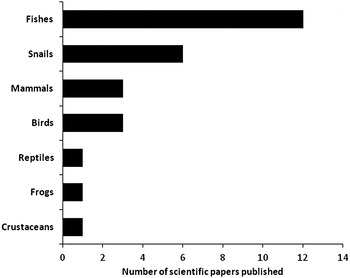
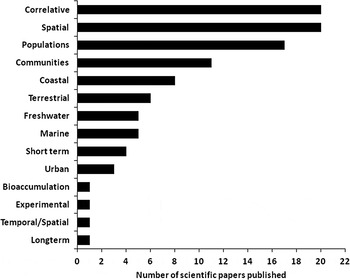
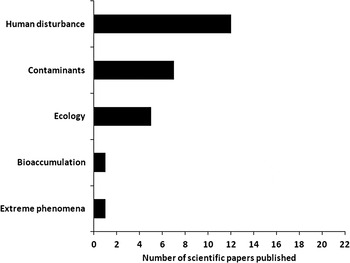
Of the 26 papers published on the subject of parasites as bioindicators of environmental degradation, the country with the largest contribution was Brazil (10 papers), followed by México (9), Chile (5) and the United States of America (2). These last two papers (Lafferty et al., Reference Lafferty, Hechinger, Lorda and Soler2005; Hechinger et al., Reference Hechinger, Lafferty and Kuris2008) were published by North American researchers but were based on data from Latin American countries. No other Latin American countries have contributed papers on this subject. Figure 1 illustrates the number of papers devoted to specific animal groups: fishes were by far the most studied group (11 papers), followed by snails (6), birds and mammals (3 each), and crustaceans, reptiles and frogs (1 each). Figure 2 shows several important characteristics of the papers. First, 20 of the 26 papers were correlative studies and related to spatial issues, comparing non-disturbed and disturbed zones in many cases. Second, 17 of 26 papers were devoted to parasite populations, followed by those related to communities of parasites. Third, there were 18 papers related to aquatic ecosystems (freshwater, coastal and marine), and the remainder for terrestrial environments. It is very important to note that for bioaccumulation of pollutants, there was only one paper each for experimental studies and long-term studies (fig. 2). For short-term studies (≤2 years), there were four papers and all of them investigated terrestrial environments. Figure 3 shows the different types of impacts that were studied in each of the 26 papers included in the analysis. Eleven of the 26 studies were related to ‘human disturbance’. This category included comparisons of the number of parasite species and population or community metrics between disturbed and non-disturbed habitats, such as marine protected areas vs. open areas for fisheries (Loot et al., Reference Loot, Aldana and Navarrete2005; Hechinger et al., Reference Hechinger, Lafferty and Kuris2008) or contaminated vs. non-contaminated river sections (Ribeiro et al., Reference Ribeiro, Ghisi, Prioli, Oliveira and Takemoto2013). In this group of papers, even when there was a mention of contaminated areas, no contaminant data or their concentrations were provided. A second group of papers included eight correlative studies showing statistical associations between parasite populations or community metrics and the concentrations of pollutants, such as heavy metals, pesticides or polyaromatic hydrocarbons (e.g. Centeno-Chalé et al., Reference Centeno-Chalé, Aguirre-Macedo, Gold-Bouchot and Vidal-Martínez2015; Vidal-Martínez et al., Reference Vidal-Martínez, Torres-Irineo, Romero, Gold-Bouchot, Martínez-Meyer and Aguirre-Macedo2015). The third group of papers (5 of 26) included comparisons of the number of parasite species and population or community metrics between seasons for relatively short periods of time (≤2 years) in urban habitats (e.g. Simões et al., Reference Simões, Gentile, Rademaker, D'Andrea, Herrera, Freitas, Lanfredi and Maldonado2010, Reference Simões, Maldonado, Olifiers, Garcia, Bertolino and Luque2014).
Host groups for the parasites studied as bioindicators of environmental degradation in Latin America. The numbers for each host group come from the scientific papers marked with an asterisk in the References section.

Characteristics of the scientific papers published on parasites as bioindicators of environmental degradation in Latin America. The numbers come from the papers marked with an asterisk in the References section.

Environmental influences on studies of parasites as bioindicators of environmental degradation in Latin America. The numbers come from the papers marked with an asterisk in the References section.

Most of the papers mentioned above concluded that parasites showed a response to the environmental insult. However, it was also evident that only 8 of 26 papers included specific information on pollutants, such as the name or concentrations of the compounds. Chemical pollution may be an issue, but there is a lack of data on pollutants for Latin American countries. Without this information, is very difficult to establish a clear statistical association between the environmental insult and the biological response. The most likely reason for this pattern is that the pollutant analysis is very expensive, and many countries do not yet have the required analytical infrastructure. An alternative is the use of less expensive techniques, such as spectrofluorometry, which would be useful to demonstrate at least the host response to the presence of pollutants, such as PAHs. This method has been successfully applied in México (e.g. Sánchez-Ramírez et al., Reference Sánchez-Ramírez, Vidal-Martinez, Aguirre-Macedo, Rodríguez-Canul, Gold-Bouchot and Sures2007; Pech et al., Reference Pech, Vidal-Martínez, Aguirre-Macedo, Gold-Bouchot, Herrera-Silveira, Zapata-Pérez and Marcogliese2009). Another option is to collaborate with geochemistry laboratories (e.g. Vidal-Martínez et al., Reference Vidal-Martínez, Aguirre-Macedo, Noreña-Barroso, Gold-Bouchot and Caballero-Pinzón2003, Reference Vidal-Martínez, Aguirre-Macedo, Del Rio Rodríguez, Gold-Bouchot, Rendón-von Osten and Miranda-Rosas2006, Reference Vidal-Martínez, Torres-Irineo, Romero, Gold-Bouchot, Martínez-Meyer and Aguirre-Macedo2015; Woelfl et al., Reference Woelfl, Mages and Torres2008).
Parasites as bioindicators of environmental degradation in Latin America: the meta-analysis
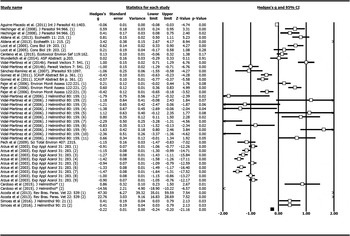
The meta-analysis showed a small but still significant negative mean overall effect (−0.221; 95% CI: −0.241 to −0.200; fig. 4) using Cohen's scale (Cohen, Reference Cohen1988). The magnitudes and directions of the significant effects in the papers varied widely, and the original interpretation of the authors for these magnitudes was respected (fig. 4). The heterogeneity for the whole dataset was high (Q = 2201). However, other ecological meta-analyses with Q values >1000 have yielded valuable interpretations of the data (Rosenberg et al., Reference Rosenberg, Adams and Gurevitch2000; Vidal-Martínez et al., Reference Vidal-Martínez, Pech, Sures, Poulin and Purucker2010). The response of the parasites was negative or positive to different types of environmental insults, such as chemical pollutants, fisheries management or seasonality (fig. 4). These results suggest that different groups of parasites (helminths, symbionts, arthropods) provide distinct information and that once there are more studies from Latin America, the groups of parasites should be separated for analysis.
The overall effect of the environmental impacts on parasite metrics (black square), which in this case was negative and significant (Hedges’ g = −0.221; 95% CI: −0.241 to −0.200; P < 0.0001). The g values for overall effects are significantly different from zero if the confidence interval (CI) does not overlap zero. Each row represents the effect on a parasite population or community metric by a specific environmental factor. The g values are followed by the lower and upper limits of confidence intervals at 95%, the Z value and P values. Several studies were used several times because we obtained more than one effect from them (numbers in brackets). The asterisks of the study of Cardoso et al. (Reference Cardoso, Simões, Luque, Maldonado and Gentile2015) is related to its DOI number, which in turn is presented in the References section.

The results obtained in the present meta-analysis were consistent with the findings of Lafferty (Reference Lafferty1997) and Vidal-Martínez et al. (Reference Vidal-Martínez, Pech, Sures, Poulin and Purucker2010). Both authors attributed the overall weak association between the environmental impact and parasite metrics to the wide range of stressor intensities, as well as to the inherent variability of parasite responses. The problem then, is how can we determine that parasites are responding to environmental variability or to pollution? To overcome this problem, we consider it necessary to increase the number of studies determining the concentration of pollutants in both free-living and parasitic organisms, since it has been demonstrated that in many cases parasites accumulate higher concentrations of pollutants (especially heavy metals) in comparison with their hosts (e.g. Sures, Reference Sures, Slidell and Taraschewski1999; Malek et al., Reference Malek, Haseli, Mobedi, Ganjali and Mackenzie2007; Khaleghzadeh-Ahandar et al., Reference Khaleghzadeh-Ahangar, Malek and Mackenzie2011; Nachev et al., Reference Nachev, Schertzinger and Sures2013; Golestaninasab et al., Reference Golestaninasab, Malek, Roohia, Karbassib, Amoozadeha, Rashidinejada, Ghayoumib and Sures2014; Tellez & Merchant, Reference Tellez and Merchant2015). As a recent example we have cestodes of rays, which are very effective at accumulating Pb and Cd in comparison with their hosts, but are not as effective as barnacles in the Gulf of Oman (Middle East) (Golestaninasab et al., Reference Golestaninasab, Malek, Roohia, Karbassib, Amoozadeha, Rashidinejada, Ghayoumib and Sures2014). In this case, the author's recommendation was to include both sessile organisms, like the barnacles, and parasitic organisms, to properly describe the environmental pollution, at both local and large geographical levels, respectively. In another recent paper, Tellez & Merchant (Reference Tellez and Merchant2015) showed that the intestinal parasites (especially trematodes) of alligators (A. mississippiensis) were much more efficient bioconcentrators of heavy metals (As, Cu, Se and Zn) than their hosts. However, the alligators were able to concentrate more Fe, Cd and Pb than the parasites as a whole. The possible reason for this difference, suggested by Tellez & Merchant (Reference Tellez and Merchant2015), would be the detoxification capacity of the host in comparison with that of the parasites.
Vidal-Martínez et al. (Reference Vidal-Martínez, Pech, Sures, Poulin and Purucker2010) suggested that another alternative way to overcome the difficulties of determining whether parasites, host or both are responding to environmental variability or to pollution, would be using field data in combination with laboratory experimental exposure of hosts and their parasites to media from polluted and control sampling areas. For example, Sánchez-Ramírez et al. (Reference Sánchez-Ramírez, Vidal-Martinez, Aguirre-Macedo, Rodríguez-Canul, Gold-Bouchot and Sures2007) obtained experimental evidence that the monogenean Cichlidogyrus sclerosus and its host, the Nile tilapia Oreochromis niloticus, were negatively affected after 15 days of exposure to polluted sediments. These data corroborated the field studies of the polluted lakes from which the sediments were obtained (Sánchez-Ramírez, Reference Sánchez-Ramírez2007). In areas critical for species conservation, such as marine protected areas (MPAs), the method proposed by Palm et al. (Reference Palm, Kleinertz and Rückert2011) would be useful. These authors suggested the use of floating cages with fish to monitor environmental quality in tropical aquatic environments. Expanding their proposal, it would be useful to maintain floating cages in polluted and non-polluted areas to monitor the environmental quality of these critical habitats. Therefore, our recommendation is that field and experimental data should be obtained simultaneously. If experimental studies in semi-field conditions (mesocosms or artificial streams) are conducted, the use of realistic conditions of exposure and field studies in the long-term is not only recommended but absolutely necessary in environmental risk assessment (Caquet et al., Reference Caquet, Lagadic and Sheffield2000). For example, Johnson et al. (Reference Johnson, Chase, Dosch, Hartson, Gross, Larson, Sutherland and Carpenter2007) tested the hypothesis that the transmission and pathology of the trematode parasite Ribeiroia ondatrae, would be affected by manipulating nutrient inputs into outdoor mesocosms stocked with snails, larval amphibians and parasites. Experimentally elevated nutrient levels led to an increase in periphytic algal growth, which enhanced growth and reproduction of snail hosts (Planorbella trivolvis). Higher snail densities increased the likelihood that hatching parasites (miracidia) found a snail host successfully, thereby leading to a larger number of infected snails. Infected snails from the high-nutrient condition also produced, on average, twice as many parasites per 24 h relative to snails in a low-nutrient treatment. The combination of more infected snails and a greater per snail release of parasites led to a three- to fivefold increase in amphibian infection (Johnson et al., Reference Johnson, Chase, Dosch, Hartson, Gross, Larson, Sutherland and Carpenter2007). A final, but no less important, point is the inclusion of both environmental variables and the pollutant concentrations in the same study. Otherwise, it is very difficult to determine the relative contribution of these variables, or whether there are any synergistic effects.
Temporal patterns
With the exception of one long-term study on helminth larval stages in coastal snails (Aguirre-Macedo et al., Reference Aguirre-Macedo, Vidal-Martínez and Lafferty2011), there were no temporal studies lasting longer than 2 years using parasites as bioindicators of environmental impact in Latin America. These long-term parasitological data are important to monitor the environmental quality of tropical aquatic environments, as Palm et al. (Reference Palm, Kleinertz and Rückert2011) did with grouper floating cages in Indonesia for 6 years. For terrestrial environments, the sampling strategies of Simões et al. (Reference Simões, Gentile, Rademaker, D'Andrea, Herrera, Freitas, Lanfredi and Maldonado2010, Reference Simões, Maldonado, Olifiers, Garcia, Bertolino and Luque2014) have produced useful data regarding the seasonality of the parasite population and community metrics, respectively, for as long as 2 years. Simões et al. (Reference Simões, Gentile, Rademaker, D'Andrea, Herrera, Freitas, Lanfredi and Maldonado2010) found that both helminth species richness, and the abundance of the most common helminth species of the rodent Thrichomys pachyurus, were higher during the wet season in Brazil, attributing it to an increased habitat availability and rodent population increase. Simões et al. (Reference Simões, Maldonado, Olifiers, Garcia, Bertolino and Luque2014) also found that the abundance of the zoonotic nematode Angiostrongylus cantonensis in an urban population of Rattus norvegicus was influenced by seasonality, and host gender and weight. Our recommendation would be to continue this sampling strategy as long as possible. The rationale for this recommendation is that for tropical environments (frequent in Latin America), key events in parasite population dynamics, such as peaks of aggregation of larval and adult stages, frequently occur in time periods longer than 2 years (e.g. May-Tec et al., Reference May-Tec, Pech, Aguirre-Macedo, Lewis and Vidal-Martínez2013; Vidal-Martínez et al., Reference Vidal-Martínez, Pal, Aguirre-Macedo, May Tec and Lewis2014a).
Parasites as accumulation bioindicators
The use of parasites as accumulation bioindicators in aquatic and terrestrial environments is a general trend on a global scale (e.g. Sures et al., Reference Sures, Scheible, Bashtar and Taraschewski2003; Sures, Reference Sures2008; Nachev & Sures, Reference Nachev and Sures2016). To date, in Latin America, only one paper has been published on this subject (Woelfl et al., Reference Woelfl, Mages and Torres2008). We need many more papers on this specific subject because parasites are very sensitive indicators of environmental degradation, especially the presence of heavy metals. Additionally, accumulation bioindicators provide more precise information on the habitat environmental quality than studies assessing numerical changes in parasite populations or communities (Sures, Reference Sures2008). However, to use parasites as accumulation bioindicators, there are requirements that should be considered (Sures, Reference Sures2003; Nachev & Sures, Reference Nachev and Sures2016). Some of the most important characteristics for a parasite to qualify as an accumulation bioindicator are: (1) parasites with a high pollutant accumulation capacity and resistance to the pollutant; (2) parasites that are regionally common and locally abundant, long-lasting and easy to identify; (3) parasites that are large enough to provide sufficient tissue for chemical analyses; and (4) parasites that are sessile or have a narrow home range (for a complete list of the requirements for suitable accumulation bioindicators, see Sures, Reference Sures2003). Recently, Kleinertz et al. (Reference Kleinertz, Eckhardt, Theisena, Palma and Leinweber2015) reported that pyrolysis-field ionization mass spectrometry was able to detect pollutants, such as diesel particles, in individual acanthocephalans Rhadinorhynchus zhukovi from Indonesia. This seems to be a very promising technique, since very good results can be obtained, even from the very small amount of biomass provided by individual parasites.
The interdisciplinary approach
Another general global trend in the study of parasites as bioindicators of environmental impact is the simultaneous use of different types of biomarkers in the same individual (Marcogliese, Reference Marcogliese2005; Vidal-Martínez, Reference Vidal-Martínez2007; Pech et al., Reference Pech, Vidal-Martínez, Aguirre-Macedo, Gold-Bouchot, Herrera-Silveira, Zapata-Pérez and Marcogliese2009). In Latin America, this interdisciplinary approach would increase our understanding of the best set of biomarkers for individuals, populations and communities, for both hosts and parasites responding to environmental insults. In field studies, there are two approaches. First, determining the concentrations of pollutants (e.g. pesticides, hydrocarbons, heavy metals) in the individual hosts (by gas chromatography or by using the method of Kleinertz et al., Reference Kleinertz, Eckhardt, Theisena, Palma and Leinweber2015) and, at the same time, obtaining biomarkers, such as ethoxyresorufin-O-deethylase (EROD) activity, vitellogenin, oxidative stress, differential numbers of white and blood cells, and condition factors, as well as changes in the numbers of parasites (Vidal-Martínez et al., Reference Vidal-Martínez, Aguirre-Macedo, Noreña-Barroso, Gold-Bouchot and Caballero-Pinzón2003, Reference Vidal-Martínez, Aguirre-Macedo, Del Rio Rodríguez, Gold-Bouchot, Rendón-von Osten and Miranda-Rosas2006; Sánchez-Ramírez et al., Reference Sánchez-Ramírez, Vidal-Martinez, Aguirre-Macedo, Rodríguez-Canul, Gold-Bouchot and Sures2007; Pech et al., Reference Pech, Vidal-Martínez, Aguirre-Macedo, Gold-Bouchot, Herrera-Silveira, Zapata-Pérez and Marcogliese2009). Second, correlating the physiological or immunological responses of the hosts, as well as the response of the parasites, to the concentrations of pollutants in sediments (e.g. Gold-Bouchot et al., Reference Gold-Bouchot, Zapata-Pérez, Ceja-Moreno, Rodríguez-Fuentes, Simá-Álvarez, Aguirre-Macedo and Vidal-Martínez2007; Vidal-Martínez et al., Reference Vidal-Martinez, Centeno-Chale, Torres-Irineo, Sánchez-Ávila, Gold-Bouchot and Aguirre-Macedo2014b, Reference Vidal-Martínez, Torres-Irineo, Romero, Gold-Bouchot, Martínez-Meyer and Aguirre-Macedo2015). From our point of view, the first option is the best choice because both hosts and parasites are being exposed simultaneously to the concentration of pollutants that are bioavailable. Certainly, as Vidal-Martínez (Reference Vidal-Martínez2007) noted, the more biomarkers we study, the greater will be our understanding of the way organisms respond to environmental insults. However, studying biomarkers in the parasites themselves has not been undertaken in previous studies from Latin America. Podolska et al. (Reference Podolska, Nadolna and Szostakowska2014) published a very interesting study on the mirror effect of acetylcholinesterase activity (AChE) in the cod Gadus morhua and the acanthocephalan Echinorhynchus gadi from the southern Baltic Sea. These authors found that variables that were irrelevant for the AChE cod activity, such as the sampling site and the gonadal stage, had highly significant effects on the AChE activity of the acanthocephalan. Consequently, these authors concluded that the evaluation of AChE activity in this host–parasite system may be a promising tool for monitoring the biological effects of neurotoxic agents. Clearly, this could be a very interesting field of research in Latin America.
Concluding remarks
Our meta-analysis based on publications from Latin America to date suggested that different types of environmental impacts have significant effects on parasites of terrestrial and aquatic organisms. However, several critical weaknesses were detected during the analysis. (1) A lack of information on the identity and concentration of specific pollutants in most papers. We consider it extremely important to present this information together with that on the environmental variables, as it is the only way to determine the relative contribution of the environment and chemical pollution to environmental health of the ecosystems. (2) A large number of correlative studies using numerical changes in parasite populations and communities as indicators of environmental impact. We recommend increasing the number of studies on parasites as accumulation bioindicators because they provide more precise information on the habitat environmental quality compared to numerical changes in parasite populations or communities. (3) Only one long-term study on parasites as indicators of environmental impact. Long-term studies in the region are needed because this will be the only way to determine the potential effect of seasonality on the capability of host–parasite systems to perform as effective bioindicators of environmental impact. For example, temperature is a variable that changes seasonally and influences the infection dynamics of parasites in tropical aquatic hosts, but also affects the uptake of toxic substances by fish (e.g. Jezierska & Witeska, Reference Jezierska, Witeska, Twardowska, Allen, Häggblom and Stefaniak2006). (4) Only one experimental study, which exposed tilapia and its parasites to polluted sediments (Sánchez-Ramírez et al., Reference Sánchez-Ramírez, Vidal-Martinez, Aguirre-Macedo, Rodríguez-Canul, Gold-Bouchot and Sures2007). This experimental approach is urgently needed in our region because it is the only way to corroborate the effects observed in the field data. Therefore, we suggest that investigations on parasites as bioindicators of environmental degradation should include field surveys combined with bioassays. Altogether, we hope that this information will be useful for scientists to develop tools to understand, and prevent the outcomes of, harmful environmental degradation processes and toxic exposures in Latin America.
Acknowledgements
The authors thank Clara Vivas-Rodríguez, Gregory Arjona-Torres, Nadia Herrera Castillo, Genny Ail, Arturo Centeno-Chalé and Francisco Puc-Itza of CINVESTAV-Mérida for support with the field and laboratory work.
Financial support
We also thank the Gerencia de Seguridad y Protección Ambiental de Petróleos Mexicanos (RMNE; PEMEX) for the financial support provided by the contracts 428818804, 4120028470 and 4120038550. This study was also partially supported by the grant no. 201441 financed by the Sectorial Hidrocarbon Fund CONACYT-SENER to the CIGoM Consortium in which V.M.V.M. participates. This work was also supported by the Brazilian National Council for Scientific and Technological Development (A.C.W., grant number 202567/2015-0).
Conflict of interest
None.