INTRODUCTION
While democracy cannot be reduced to elections alone (Schmitter & Karl Reference Schmitter and Karl1991: 85; Bratton Reference Bratton1998: 52), elections can provide a stepping board for the development of a democratic culture (see e.g. Linz & Stepan Reference Linz and Stepan1996: 15f; cf. Schedler Reference Schedler1998: 91, 93, 100; Lindberg Reference Lindberg2009), and toward democracy, especially in a post-war setting (Reilly Reference Reilly2002: 118f; Höglund et al. Reference Höglund, Jarstad and Söderberg Kovacs2009: 536). Most importantly, the ‘legitimacy of the electoral process is crucial for the establishment and maintenance of a healthy democracy’ (Birch Reference Birch2008: 305).
Particularly in post-war countries, elections can create the foundation for the legitimacy of the new regime (Reilly Reference Reilly2002: 118; Lyons Reference Lyons2004: 37). However, research related to the legitimacy of elections in post-war countries has often focused on institutional aspects, the behaviour of central political actors, or the importance of providing legitimacy for the exit of the international community (e.g. Reilly Reference Reilly2002; Lyons Reference Lyons2004; Höglund et al. Reference Höglund, Jarstad and Söderberg Kovacs2009). The citizenry is largely left out of this equation. However, I would argue that citizens provide the causal link through which these issues, and by consequence the entire election, gain legitimacy. It is through them that these institutional aspects are interpreted and carried over.
Yet, we know very little about the meaning attached to and perceptions of legitimacy of elections in general, and in Africa in particular (Young Reference Young1993: 307; Schaffer 1998: 23, 88–9, 106–31; Birch Reference Birch2008: 305). At the same time, despondent expectations of the depth of the electorate's attachment and experience with elections in Africa abound (Cowen & Laakso Reference Lindberg1997: 741, 743–4). And, as noted by Birch, ‘perceptions of the legitimacy of elections have been largely bypassed as a topic of study’ (2008: 305). The first democratic elections are often met with great enthusiasm, although this fervour lessens over time. However, it is only with repeated experiences with elections that we can talk about a process of democratisation and consolidation. Lindberg (Reference Lindberg2004) notes a learning process related to re-occurring elections, albeit at the macro-level, but this should also be noticeable among individual voters. Experiencing elections over time should induce learning about the democratic process, allow voters to re-evaluate politicians and political claims and deepen their sensitivity to electoral fairness as a result of being able to compare events over time. This article therefore focuses on perceptions and engagement in second elections, and their resulting legitimacy.
In post-war countries ex-combatants are central, as this group can form the bedrock for renewed violence. A precondition for a sustainable peace and democracy is that the ex-combatants accept new ways of solving political issues without resorting to arms. Ex-combatants represent the segment of the population that has most directly challenged and questioned the legitimacy of the past regime through their armed resistance. If we want to demilitarise society, which Lyons describes in part as the creation of norms that support peace and democracy (2004: 38), this process is particularly relevant, and challenging, for ex-combatants. Ex-combatants therefore provide a crucial component of re-building political legitimacy. Their political engagement conditions the quality of the new political regime (Jennings Reference Jennings2007; Nilsson Reference Nilsson2008: 192; Sawyer Reference Sawyer2008: 188); this is particularly true in Liberia where the ex-combatants constitute a significant portion of the population (about 100,000Footnote 1 in a population of 3·5 million).
Electoral legitimacy is not only important because of what it signals about the overall development of democracy in a regime, but also because of its impact on voters in turn. Voters who experience an election as legitimate will engage in a virtuous circle, increasing their democratic involvement and participation, whereas voters who experience an election as illegitimate are in danger of falling into a vicious circle instead. In the latter case, this can either be a question of voicing discontent through the use of violence, or simply decreasing their democratic involvement and political participation (see e.g. Birch Reference Birch2008: 306, 315). Such withdrawal from the process lessens the demands for improving the regime, and consequently heightens the risk for further deterioration.
After the end of the 14 year-long civil war (1989–2003), Liberia conducted elections in 2005. New elections were then held in 2011. The extraordinary elections of 2005 saw the election of the first female president in Africa, Ellen Johnson Sirleaf. They were competitive, free and fair (Harris Reference Harris2006: 377f, 393; NDI 2007: 29), moving Liberia away from war and toward democracy. Yet, there are reasons for concern, as they ‘failed to produce unconditionally positive results with respect to the general electorate’ (Söderström Reference Söderström2010: 10). While the ex-combatants saw participation as the norm and criticised vote buying, there was a mistrust of the results and a feeling of abandonment after the elections, indicative of a lack of legitimacy (Söderström Reference Söderström2010). Contestation over, and distrust of, election results question the legitimacy of the procedures and by extension of democracy itself. Understanding how the second experience with elections resonates with the ex-combatant community can provide important cues to the continued democratisation process in Liberia. Their perceptions of electoral legitimacy and engagement in the electoral process will highlight if previous challenges remain or if these challenges have been overcome. The aim is therefore to understand how the second experience with an election has changed and deepened the ex-combatants' relation with democracy. In particular, the research question pursued in this article is: How do ex-combatants in Liberia assess and understand the legitimacy of the second election after the end of the war?
Studies on democratisation and consolidation have been criticised for not sufficiently taking into account their long-term trajectories, patterns of both continuity and discontinuity (Cowen & Laakso 1997: 733). Through re-interviewing the same individuals about their electoral experience, and asking them to contrast the first and second post-war election, issues related to continuities and discontinuities will be explicitly addressed. Addressing the trajectories of ex-combatants as they make their way in post-war politics increases our understanding of war-to-peace transitions at the micro-level,Footnote 2 and how legitimacy is created or made visible. This article begins with a discussion of the advantages (and limitations) of the unique panel data collected through re-interviewing a number of ex-combatants in Monrovia in 2012. The next section describes how legitimacy is created and destroyed, or made visible among ex-combatants in Liberia in three areas: individual participation in the process, the relationship with the institutional landscape, and the perceptions of the integrity of the electoral process.
BACKGROUND TO THE ELECTIONS
The election of 2005 produced a divided and fragmented political party system, where the president's party, the Unity Party (UP), lacked a clear majority. The position of UP was strengthened in 2011, through gaining additional seats in the Senate and the House of Representatives, and as two parties merged with UP.Footnote 3 While UP still does not have a majority in either house, they are the largest party in both. The incumbency advantage was apparent in 2011 (see also Bøås & Utas forthcoming), and similar to experiences in other parts of Africa (Lindberg Reference Lindberg2004: 62), as the election did not lead to a turnover, suggesting that Liberia may also be on the path to a dominant political party system.
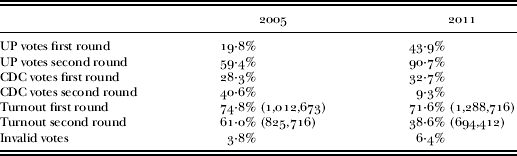
On 11 October 2011, UP candidate Johnson Sirleaf received the most votes (43·9%), followed by the Congress for Democratic Change (CDC) ticket of Winston A. Tubman and George Weah (32·7%) (see Table 1 for details).Footnote 4 While the election turnout was slightly smaller, in per cent, for the first round in 2011 compared with 2005, more people voted in total. During the second round on 8 November voter turnout decreased considerably (38·6%). This time, 90·7% voted for Sirleaf Johnson and only 9·3% voted for CDC, mainly in response to the CDC boycott. The number of invalid votes increased in 2011, raising the question of what learning process occurred between these elections (in terms of the electoral organisation and among the voters).
Election results
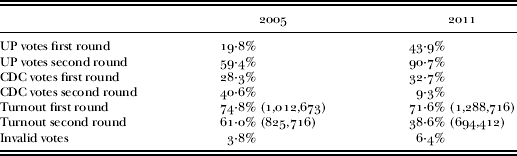
Source: Compiled by the author, based on various sources (Harris Reference Harris2006: 380; National Elections Commission 2011a: 3–5, 2011b: 3–4).
The CDC claimed fraud in the first round and partiality on the behalf of the National Election Commission (NEC), and therefore boycotted the second round. Improprieties on behalf of the NEC, with faulty tallies of the election results, eventually led to the resignation of the NEC Chairman. On the eve of the second round the CDC organised a demonstration, when campaigning was supposed to be over, prompting an intervention by the police. During these events, at least one person was killed. In the months leading up to the elections, several attacks against UP candidates were also noted (for more on this see Bøås and Utas forthcoming). On 7 October, a few days before the first round, Ellen Johnson Sirleaf was, together with Leymah Gbowee and Tawakkol Karman, awarded the Nobel peace prize for their work to include women in peacebuilding.
DATA COLLECTION
This article is based on interviews with ex-combatants in Monrovia (February 2012), as distrust and lack of legitimacy was more evident in the urban communities in earlier studies (Söderström Reference Söderström2009, Reference Söderström2010: 11). In total 72 ex-combatants were interviewed concerning their 2005 electoral experiences in Monrovia, constituting the main sampling target for this article. This enables a comparison between their experience of the first election and the second election after the end of the war, creating the added advantage of a panel study.
Recruitment was mainly dependent on active cell phone numbers and a functioning cell phone, although some were reached via participants from the same original focus group. As the first round of interviews was carried out in 2008 not all 42 cell phone numbers (31 from focus groups and 11 from individual interviews) were active or with the original owner.Footnote 5 As coverage varies a lot in Liberia, it is also possible that failure to reach some of them was due to the individual not currently being in Monrovia. In the end, 15 of the previously interviewed were successfully contacted, out of which 12 were re-interviewed. Two of those contacted were not in Monrovia during fieldwork and one individual failed to show up for a scheduled interview. As a result, interviews were carried out both in groups and individually. These data are contrasted with findings from interviews carried out in 2008 and 2010 (totalling 18 focus groups with 101 ex-combatants, and 14 individual interviews).Footnote 6 While the original sample contained a broad cross-section of the ex-combatant community, this sample is biased in that only men were included, and the recruitment channel may also have contributed to a bias towards more well-established and financially secure ex-combatants.
In contexts where political freedoms are new and politics has been conflict-ridden people tend to be more worried about exposing their views to strangers (see e.g. Holmberg & Petersson Reference Holmberg and Petersson1980: 68; Fujii Reference Fujii2010; Höglund & Öberg Reference Höglund and Öberg2011). Ex-combatants have been noted as a group whose trust is particularly difficult to obtain (Utas Reference Utas2003: 49–59, Reference Utas, Richards and Helander2005; Christensen & Utas Reference Christensen and Utas2008; Nilsson Reference Nilsson2008: 55; Fujii Reference Fujii2010). In order to alleviate these concerns, different strategies have been used. During the first interview, I used focus groups, as the trust already established within the group of ex-combatants can be borrowed by the focus group (Söderström Reference Söderström, Höglund and Öberg2011b: 148, Reference Söderström2011c). However, for the second round of interviews in 2012, the importance of using group interviews was diminished, as re-interviewing in itself is a well-known strategy for increasing trust (Fujii Reference Fujii2010: 240).
As the use of photos of election events was useful as a way of introducing the topic in past work (Söderström Reference Söderström2010: 6f), this technique was also used in 2012. The pictures included people voting, standing in line and campaigns for both presidential candidates. The use of photos acts as an important memory cue, bringing the participant back to the event in question. Secondly, they allow the participants to voice spontaneous ideas in relation to the pictures, allowing them to address their issues of concern. Thirdly, as this technique was also used in the first interviews, this increased the comparability of the data.
THE EX-COMBATANTS' ELECTORAL EXPERIENCE
Ex-combatants' electoral experiences can be understood in relation to how legitimacy is expressed and created in the process. In what follows I first analyse the ways in which the ex-combatants opt in and out of the electoral process, since participation can be seen as an indication of whether the process is seen as legitimate. Second, I examine the aspects of the institutional environment that drove the ex-combatants' experience of the election as legitimate or not. Finally, I discuss their perceptions concerning the integrity of the process, as a direct evaluation of the election's legitimacy.
Opting in and out of the electoral process
Voting and abstaining with intent
In contrast with 2005, where the norm was to vote in both rounds, this election was different. In 2011, all voted in the first round, but there was a clear division between CDC supporters and others, where the former actively refrained from voting in the second round, heeding the CDC boycott call.
When discussing their motivation for voting, there was an explicit focus on accountability this time, contrary to 2005. They expressed a clear sense of evaluating past performance when deciding whom to vote for, which some connected with their decision to pick a different political party than in 2005. BishopFootnote 7 remarked that ‘I will evaluate them’ and discussed politicians' tendency to deliver on campaign promises or alternatively leaving the country as the basis for his evaluation. While this gave an advantage to the president compared with those without a past term in office to make their performance visible, this incumbency bias was not noted among the ex-combatants. Voting was again seen as an obligation, a civic duty, important for determining the future of Liberia.
The centrality of evaluating the performance of various politicians was present in these interviews in a way that had not been the case in earlier years. Indeed, this was an area where they saw improvement, and instead of being connected to personal identification and trust, or tribal issues, the basis for voting was instead related to performance and issue representation: ‘people voted on the basis of their personal beliefs in this individual […]. Let me vote my youth. […] But this TIME, this ELECTION, is different on the basis of performance’ (Alex). The ex-combatants expressed a clear sense of being able to hold politicians accountable. This focus on performance and accountability is perhaps unsurprising, but it is crucial in terms of second elections deepening democracy, revealing a social learning process related to repeated election experiences.
However, since voter turnout in the first round (as a percentage of registered voters) was lower than in 2005, and the participation in the second round was truly abysmal, the ex-combatants discussed motivations behind abstention as well. Several heeded the call from CDC to abstain in the second round, and considered participation as a violation or a ‘contradiction with our constitution, so I don't want to be a lawless man. There are other people who are lawless, only because they want to seek power. I did not vote’ (Moses).
When they tried to explain the low turnout more in general, they discussed motivations of people in general, rather than their own motivations (as they all voted in the first round). However, these discussions reveal areas where they questioned the process. Several turned to the experience of failed campaign promises, and disappointment with the 2005 elections. The experience with the election in 2005 was so negative for some people that this carried over into 2011, resulting in abstention. This past experience involved a lack of attention on the part of the politicians, resulting in a feeling of being ignored among the ex-combatants. Campaign promises were continually seen as an absolute promise, as a debt. It was quite forcefully described by Eamon:
So, these people, were disenfranchised by the level of disappointment, the level of lies! And the level of deceit, that these representatives, these people that they went into the rain, the sun for! Eh! […] And these people could not deliver anything to them. […] They will lie to us, and go back and do the same thing. (Eamon)
Past elections had resulted in the election of representatives even without the ex-combatants' participation. A lack of endorsement of the process (due to expectations of fraud), or a lack of a noticeable impact (having one's vote determine the election outcome, or seeing visible changes in one's own life as a result of the election) were central explanations for abstention. They also believed that voter turnout would continue to drop over the coming elections as a result of these perceptions, indicating a vicious circle.
In contrast with earlier interviews, one additional explanation for abstention also figured in these interviews. Several ex-combatants argued that the demarcation of the electoral districts, which had been carried out after the registration process, led to lower voter turnout because it ruptured the attachment to a particular district. Either the individual voter became disconnected to the district where he or she has substantive interests, or the candidates lost the incentive to encourage participation, as voters whom they had helped to register ended up in the wrong district.
Vanguards, but not party loyalists
The ex-combatant community continued to carry political relevance in 2012. Daily contact with other ex-combatants was the norm, often in conjunction with politics, and politics was a central component of this interaction. As before, some tried to disassociate themselves socially from this network, but continued to use it as an important reference point for their discussion of politics. As a social sphere of politics, the ex-combatant community seems as relevant in 2012 as it was during earlier interviews. This should not be equated with all ex-combatants being ready to use violence in politics, but rather it suggests that they still have coinciding interests and a shared identity. Their past behaviour only suggests a longer distance to travel before the relationship with the state is rebuilt, and scrutinising their electoral experiences is one way to gauge this development. If we turn to the ex-combatants' deeper involvement in the electoral process, as seen from their party attachment, they were all very engaged in politics, even if the channels used and the political parties endorsed varied. Several had shifted political allegiance between the elections, and while most had become UP supporters, some had also moved in the opposite direction, joining CDC.
One ex-combatant's explanation for his shift from CDC to UP reveals clear financial motives; he found a job during Sirleaf Johnson's first term in office, and he associated this with her presidency. When explaining his choice between Tubman and Sirleaf Johnson, he noted that:
Yes, they are capable to produce. But something, in economics […], we discuss the imaginary cost and benefit analysis. Now. Madam Ellen has already produced. So I know her potential! […] if I look at my imaginary cost and benefit analysis, how much will it cost me to give my vote to this woman, and how much benefit will I receive? Before 2005, I didn't give her any vote! And now I am reaping! So if I would give her another vote, what will my reap be then? It will be double! That's the common analysis. Holding all other factors constant. (Oliver)
Weighing his options for the future, he is not convinced that he will stay with UP once Sirleaf Johnson is no longer the standard bearer: ‘I will cross row. […] politics is all about what serve interest. Politics is about interest. Where you find your interest is where you go. Where you find your benefits is where you go.’ And when asked if he would campaign for CDC instead of UP next time, he replied ‘Me? Mmmhh! As a politician we don't say yes, we don't say no, but maybe. maybe’ (Oliver). This is yet another indication of the importance of personal connections and being part of big men networks (Utas Reference Utas2012b), rather than party agendas. Politics is personal, both for the individual voter and in terms of the specific politicians running for office.
In contrast, Moses decided to vote for CDC in 2011, although he had voted for UP in 2005. The main reason for his shift was dissatisfaction with the current government; he did not describe himself as a CDC man, but rather he had voted for CDC as a sign of his criticism of the ruling party's dominance.
Campaigning
An even deeper form of participation is involvement in campaign activities, which further demonstrates the extent to which the electoral process was seen as important and relevant. Most of the ex-combatants had been actively and intimately involved in campaign activities. One ex-combatant also ran for the House of Representatives for a district in Margibi. Campaign activities included ways of persuading others of their political views, mainly through engaging in discussions and debates, but also by ‘doing underground work’. Handing out favours, such as money, rice and t-shirts were also central campaign activities. Some chose not to be openly involved in campaigning, as they needed to appear neutral at work. The ex-combatant who ran for election felt let down by his party, because he had expected more financial help from them than he received. His campaign team of about 50 people consisted mainly of youth, many of them former combatants. As they walked between villages, he referred to them as his ‘foot soldiers’. Despite interference from other parties (election posters that were torn down and rallies where other parties showed up), his spirits remained high throughout the campaign.
Oliver, a former CDC man, who was targeted by UP as a result of his influence with young people to join their campaign, described his campaign work for UP in the following way:
What I started doing? To win people over. To recruit! […] When the individual seems to be, he has this fixed mind, that is to vote for CDC. What do I do? I console him, I provide food, not only biscuit not only water, but something attractive. […] we eat from the same pan. Let him feel that we are from the same place. That's the strategy of the politician. […] then I go into discussion. […] After when I get to intervene a young man, I give you cash, giving scratch card, giving 20 USD, just to pay your way […]. So I didn't rest. I keep persuading, persuading until we won! And finally we won!
Another ex-combatant was engaged by someone who had sponsored his education, and placed some of his children in school, to work on his campaign team in Lofa County. Bishop noted that it had been very easy to convince people to re-elect his candidate, because he had lived up to his promises from 2005 and been very present in his district, and shared much of the wealth he had amassed in office with his community. Hence, Bishop's main strategy was to point out the things in the community that were there as a result of the candidate: ‘It is a matter of selling someone.’
As we have seen, ex-combatants opt in and out of the electoral process through varying forms of participation, and opting in is indicative of viewing the electoral process as relevant and legitimate. Campaigning and election involvement was often a very personal issue, concerned with personal attachment and creating such attachments among others, rather than party agendas. Creating confidence in the candidates was in part based on their past performance, but also on personal linkages. These ex-combatants continue to take on a leading role in politics, often referring to themselves as the vanguards of politics in Liberia, demonstrating how seriously they take the electoral process.
Responding to the institutional landscape
The institutional landscape is a central factor shaping ex-combatants' experience of the election's legitimacy. Certain areas of institutional improvement and the eventual acceptance of the election results by the elite fed a sense of legitimacy. In contrast, the persistence of an elite and political parties driven by self-interest, who fail to deliver on the patronage sought after by the ex-combatants, detracted from the legitimacy of the election.
Institutional improvement
Most felt that the 2011 elections were more democratic than previous ones. Yet, there was a large division between those who voted for UP and those who voted for CDC in terms of how legitimate they deemed the election. Progress was in particular noted in the following areas:Footnote 8 access to polling centres; domestic ownership of the process; transparent reporting of election results; participation levels; more informed voters; freedom of speech; absence of duress; and a more competitive election, due to a more developed interest among the electorate and because more individuals ran for office. Many of the ex-combatants also felt that the election in 2011 was more legitimate and democratic due to the reduction in the number of political parties. This sense of improvement hinged on mergers between political parties, increasing the number of smart people in the resulting party.
Some also felt that the government's inclusion of the opposition at the executive level was indicative of democratic progress, and an example to follow in the future. Many positively evaluated the election of 2011 because it was more spirited than in 2005, with more ‘fever’. Many expressed a deepened democratic experience, in part as the experience of 2005 had imparted a learning experience. Importantly, however, for some the democratic progress noted in 2011 was dependent on the severity of their criticism of 2005. Those who experienced an improvement in the overall institutional landscape of the election also had an increased sense of legitimacy of the second election.
Recycling elites and social responsibilities
In general, the ex-combatants' depiction of politics in Liberia was centred around aspects of deceit and tension, politicians deceiving voters and other politicians, trying to gain an advantage by spying on their campaign. This perspective was lucidly summarised by Oliver: ‘Politics is not all about sugar and milk.’ Most felt the campaigning had become more developed, strategic and intense compared with 2005. The politicians themselves, however, were judged very much the same: greedy, corrupt, and only motivated by self-interest rather than communal concerns. In the aftermath of this election, the ex-combatants discussed generational divisions to a larger extent than in past interviews. Even those who voted for UP expressed a serious critique of the pattern of recycling politicians, where the same political elite continues in power, even if they shift positions. This angered the ex-combatants, because it disadvantaged the younger generations and their access to power. Some explained this vying for power in terms of the candidates' financial self-interest, whereas others believed they were trying to avoid prosecution for war crimes by excluding the younger generations. This behaviour and tendency of the elite seriously undermined the ex-combatants' view of politics as legitimate overall.
As before, some expressed a sense of abandonment in relation to individual politicians: ‘some of them we put them in the House, but we haven't even seen them after the six years. So, we got problem with them. […] They gotta come around us, ask what we need. So they can do it for us' (Aaron). Others were more appreciative, and felt that many representatives were living up to their expectations, through writing and passing good laws. Carter, who ran for office, described the responsibilities of legislators by dividing it into two: the constitutional responsibility (represent your district, lobby their interests and write laws) and the social responsibility:
You get back to the people in your favourite district you come from, you interact with the people, you have programme with the people, you go to church with the people. You fellowship with the people. You associate with the people. So that they can be used to that representative. So that anything they have to tell you, they can be free to offer it to you. Then you can be able to tell them what you have in mind to help develop and build their livelihood capacity. That is the social responsibility. (Carter)
Their expectations of the political elite and their representatives clearly resonated with Carter's description of this social responsibility, a personalisation of politics, often coupled with longings for politicians who take societal responsibility as well as a more active leadership role. However, their actual experience with the political elite was dominated by a sense of abandonment and depiction of the elite as greedy, rupturing this ideal relationship and decreasing the legitimacy of the election even further.
Political parties – the building blocks of democracy?
Some ex-combatants noted how the ruling party had increased its dominance since 2005, using extensive resources, force and corruption. They described how the ruling party co-opted strong voices within the opposition: ‘You notice that people who talk two, three times on state radio about the ills of society, they take you and place you somewhere in government, and you will no longer talk’; and ‘the state controls law enforcement, so she has all necessary power to strangulate all who may want to take her from power’ (Moses). The creation of a one party state was seen as unconstitutional and undemocratic, and for some as the de facto result of the 2011 election. They also noted how the other opposition parties' support of UP in the second round de facto reduced the formal opposition to CDC alone (for more on views on opposition among ex-combatants in Liberia, see Söderström Reference Söderström2011a). Their explanations for the other parties' decision to support UP were centred on the personal interests of the leaders: either vying for a job with the ruling party or trying to avoid the implementation of the TRC report, for which CDC had pledged support.
The critics of UP and Johnson Sirleaf felt that the opposition was demonised, and believed that several deaths during the second round had been concealed. They also argued that the current government was not supportive of the rule of law, and saw Johnson Sirleaf as a central protagonist of the war, one who today claimed to be willing to cooperate, but who in the past had failed to do so. They also criticised the patronage system of the current government, as they felt the only way to get work was to be pro-government.
Most of the ex-combatants noted an improvement in organisational skills and behaviour across all the political parties, which they depicted as signs of political maturity and civilisation. Yet, they did not believe that they had changed in terms of their agendas: ‘They still remain the same. They have not changed. Their philosophies, their ideas have not changed’ (Shiloh). Despite this, it is interesting that the ex-combatant who ran for office could not depict the agenda of the other parties: ‘Well, I don't really know their platform. I don't really know their visions or aspirations’ (Carter). In fact, none of the ex-combatants would refer to differences in agendas when discussing the various parties. Rather, the focus was on organisational differences, qualities and behaviour of the leaders, and what groups in society the parties appealed to.
The CDC was described as a youth orientated and grass roots party, with a lack of organisation and a disorganised elite wanting more power for themselves. The non-‘CDCians’ (CDC supporters) tended to stress the self-interest of the CDCians, their reluctance to respect procedural rules, and their lack of compromise. For instance, Eamon made the following caricature of CDC leaders:
Madam Sirleaf will tell you […]: if I don't win election, I will work with whosoever that wins. But if you ask a CDCian, you know what they will tell you? If I do not win, in fact, nothing associated with losing for our own side, so we don't want to hear you talking about if you don't win, we will win. It is our time to win! That was their mind. You can't go into election with that mind!
The lack of organisation and authority within CDC caused some to depict them as a political movement rather than as a party. The CDC and supporters were described as immature: ‘Opposition, they are very naïve in their way of thinking. Very, very naïve. Their level of thinking is very, very elementary’ (Oliver); and:
The UP, those are veteran politicians! They know their engagement, where to talk, where not to talk. […] CDC carry almost like eighty per cent noise maker. You understand, people who cannot easily reason politically. Because, as soon as you question some of them about their own party, they are fragmented. They take it as abuse. But to that of Unity Party, you can twist question and hit on the man, and the man will take his own time and answer your question, and then you will say this man is mature. (Bishop)
The inconsistency of the CDC, as demonstrated by the fact that the boycott was followed by a number of CDCians attending the inauguration, was also seen by some as evidence of this immaturity. It was also linked to the youth identity of CDC, where youths were often deemed to be less able to evaluate politics.Footnote 9 While some recognised their right to protest, CDC behaviour lacked resonance with the non-CDCians as they did not trust their aims or motives. Many also questioned the legitimacy of CDC's claims of electoral fraud, arguing that they had been unable to provide evidence thereof. This failure to provide evidence was also seen as problematic in itself, and reinforced their image of CDC as a destructive force to be blamed for the death of the protestors. Some also depicted the boycott as an attempt to stall the elections, due to a lack of finances to continue the campaigning.
Thus even a CDC voter, like Moses, expressed the following critique: ‘CDC in the political administration is not systematic. It does not go by the chain, and for my rational perspective this is why God has not given them the opportunity to take state power. Because they are irresponsible in their conduct’ (Moses). However, most CDC supporters disagreed with this critique. They did not see the boycott as a threat, but as a legitimate action to address irregularities by NEC, and for the most part felt that it had been a good strategy (because it had communicated their discontent). They also had a strong belief in the numerical advantage of CDC, even if UP is financially stronger, in part due to their access to state resources. Their self-image was of a party that welcomes everyone, a grass-roots party, with fervent supporters. However, they felt this was used against them, to depict them as ignorant and poor. They also felt that this image was reinforced by the media, which allowed anyone to speak for CDC even if they were not formally connected with the party, whereas they would turn to formal party representatives when discussing UP. Elliot's concern for how CDC is mocked in Liberia also fed into his own abstention: ‘if we even go, the people will mock our party. So we better stay away’ (Elliot).
Election results
Even if the claims of fraud were more fervent in 2011, many ex-combatants repeated a sort of mantra: the only thing citizens have in common is their country Liberia, and for the sake of that, they need to keep the peace and move on. The acceptance for the sake of peace, and the opposition's (eventual) recognition of the government, were seen as signs of democratic consolidation and created a sense of pride, on both sides of the divide: ‘on the day of the inauguration, they were even represented on the inauguration day. You know, that is when I felt proud of Liberia […], of Liberians, because the democracy of our country is smoother than it was six years ago’ (Shiloh), and similarly noted by a CDC supporter: ‘CDC, they are people that are more indigenous, they are more problem free, so they let it go. […] And, we prove our maturity and our intelligence, by letting that result go and giving UP the victory’ (Elliot). Their acceptance of the results was largely dependent on the behaviour and public comments by the political elite.
A former general who stood for election but lost (not for UP but a kindred party), envisioned future engagement in politics:
Yes, I am planning ahead. You know, I have philosophy that say, a politician never die. We metamorphose, we change from one stage to another stage. […] I will start my ball rolling before 2018, then I am prepared now for the election. […] I will never be deterred. […] Going to engage in the process. (Carter)
His continued involvement in politics includes both working with his opponents and running against them in the next election. His acceptance of the outcome was also motivated on democratic grounds: ‘Democracy is also centred around the will and right of the people. […], so nothing we can do, but just to cooperate and collaborate.’ Despite the loss, he was very clear on his future engagement with the same party: ‘And you know, I am not really defeated, I am a winner, for the fact that I took part of election. It has paved the way for me in the next thing. […] I will continue to work with my people, for 2018 election. […] I will stay, contest and win with the special grace of God.’
On the other hand, those who questioned the legitimacy of the election in 2011 did so more forcefully than before. Here, some noted that the acceptance seen today is only superficial, and that in fact there are hidden and persistent divisions in society that can be used for mobilisation in the future: ‘this is why you see today that even Monrovia is in peace. But the guys are still determined, whenever their political leaders call on them, they are ready. Seriously’ (Moses). Again, pointing to the importance of the actions of the political elite.
The integrity of the electoral process
The ex-combatants' experience concerning the integrity of the election will be scrutinised through a discussion of: the integrity of the vote itself; the role fear and violence had in undermining the integrity of the election; and the extent to which external actors were seen as influencing the election.
Vote buying and fraud
Vote buying and corruption were seen as endemic to Liberian politics, and some ex-combatants had witnessed clear attempts at vote buying during the election. Comparing their experiences between the two elections, their judgements varied. For some, their experience of vote buying was the same in 2011 as in 2005, and most saw it as a normal part of elections, unlikely to disappear. Yet there was a sense that people can play the game, and benefit from vote-buying practices. You could simply take the money, and still vote for whom you want, thereby safeguarding the integrity of the election as a whole (see similar observations from Sierra Leone by Christensen & Utas Reference Christensen and Utas2008).
In contrast, Carter, who ran for office, felt that things had worsened in 2011: ‘It was more in 2011 than 2005. More! Unscrupulous behaviour was too much’; whereas Oliver, a UP campaigner claimed that UP's conduct had improved in 2011. Carter described how his own campaign had been made difficult by vote-buying attempts from other parties, and voters he had initially convinced were lost as a result. His criticism of vote buying rested in part on his own failure to compete financially. But he also saw vote buying as something reprehensible, where the voters cannot count on proper representation and those elected will focus on their own financial benefits, whereas ‘everyday the people will not benefit anything out of you. So we used to tell people, it is not good to sell your vote, do not sell your right, it is a constitutional right given by God.’
Some felt that the election of 2011 was more fraudulent than 2005, recognising that their feelings of distrust in 2005 were not substantiated. Elliot who was very disappointed and critical of the election in 2005, had revised his position this time: ‘2005 election there was a series of rumours going around that there was a fraud, but then there was no, substantial or empirical evidence to PROVE that there was a fraud. But unlike this gone election, there are things that people saw.’ Others judged the two elections as rather similar.
During the interviews concerning the 2005 election, some ex-combatants noted how the integrity of the election was undermined by fraudulent voters, in particular Mandingos who these ex-combatants did not want to accord voting rights. No such arguments were made during the second round of interviews, and indeed ethnicity as a topic never surfaced in their discussions of the 2011 elections.
The opposition's boycott of the second round of the election engendered two types of responses among the ex-combatants. Depending on party affiliation, the events surrounding the boycott were judged differently, with rather polarised views. The boycott was for some a clear indication of the extent of fraud and severity of the opposition's allegations. Others saw the actions of CDC as inappropriate and illegal, and the police intervention as justified. Even those who did not support the opposition's boycott, or their claims of fraud, saw this aspect of the election as one of the main differences with 2005, which signalled a decrease in the integrity and quality of the election. Eamon noted that the boycott and the following violence was an indication of a lack of maturity among the political parties. Shiloh also felt that democratic ideals compelled him to listen to the opposition's complaints: ‘you have to listen to them. Because that is what democracy calls for. […] That is what democracy is about. […] We agree to disagree.’
While vote buying was noted as a problem, many ex-combatants felt they could safeguard the integrity of the election as a whole through ignoring such attempts at the polls. For the CDC supporters, the boycott and NEC behaviour clearly indicated fraud, which for them seriously detracted from the integrity of the election.
Electoral violence and fear
Some claimed that the behaviour of the opposition, and in particular CDC, created fear among the electorate, leading to abstention in the second round. The anticipation of violence, and the unpredictability thereof, intimidated voters to stay away from the second round. While not everyone agreed that the fear of electoral violence caused voters to stay away from the polls, there was a general agreement that this election was more filled with fear than 2005. Most were worried about election violence, and claimed a general fear among the electorate, which none of the previous interviews indicated. Eight of those interviewed had witnessed electoral violence, and eight of those interviewed were also worried about being injured during the elections (only two of those interviewed were not worried and had not witnessed electoral violence). There was a clear fear of returning to war among the ex-combatants.
The ex-combatants expressed varying levels of fear, dependent on whether they felt able to read the political game and their past ability to cope with violence: ‘I was not afraid, because I feel that in a war I will survive. Outside of war I will survive. Yes. So I was not afraid. Because I am very qualified when it comes to revolutionary activities' (Moses). Those who were afraid clearly focused on the unpredictability of violence, and the desperation and limitlessness of the perpetrators: ‘I myself, when I went and voted I was afraid, because if I was standing in line, CDCian go incite people and help, maybe kill people in line or shot people, chunk people’ (Oliver). Eamon only felt brave enough to go and vote because he lived next to the polling centre.
The fear related to the opposition's boycott also made some people hide the fact that they had voted, by washing the ink from their fingers after voting. Because they saw the protest and the boycott of the opposition as a potential threat to the peace, some expressed a sense of gratitude to the police: ‘so that day, I refer to it as a God blessing day for our peace. Yeah. That is God blessing day, although we lost one. But we saved the life of 3·5 [million]’ (Alex). They also noted the importance of statements from the international community for calming things down in Liberia, in part because such statements created a fear for repercussions.
The actual behaviour of the CDC during the election is beyond the scope of this article (but see Utas Reference Utas2012a), but the non-CDCians demonised CDC and their intent to violently disturb the peace and take power: ‘All of this was masterminded by CDCians. […] because they wanted to hinder state power, aggressively’ (Oliver); and ‘So, they wanted to bring fear, by bringing confusion’ (Bishop). This tendency to demonise CDC was strongest among previous CDCians. They describe a political and meticulously engineered plan to obstruct the election, through the use of fear and chaos, which only those who are intellectually inferior will follow.
Most had witnessed protests and felt that there had been many, but only two admitted to participating. Again, the link between protests and violence was apparent, an association intact from previous interviews: ‘Protests, that is just a reckless thing. It is a reckless phenomenon in the African setting’ (Shiloh); and: ‘What we saw was […] a normal African political protest. […] an African man protest will result in […] mayhem and other stuff’ (Alex). Just as in previous interviews, protests were seen as an expression of undemocratic practices, often engineered by the political elite, disrupting the integrity of the electoral process.
The prominence of fear in the interviews in 2012 may reflect several things. In part, it may be the result of ex-combatants being more familiar with the risks of politics, and thus more likely to comment on such consequences. Their own exposure and proximity to violence during the last election may also have led them to see and feel the risks of the election more than the general population. However, some of the ex-combatants may also have used the argument about violence and fear, as a way to discredit CDC further and thus exaggerated this element on purpose. Yet, this group of ex-combatants clearly expressed how violence and the threat of violence undermined the integrity of the election.
External interference
Many experienced the 2011 election as more democratic than the 2005 election, which they felt was dominated by selection, rather than election. Several of the ex-combatants had expressed how they felt the international community had interfered with the outcome of 2005, an experience which was not repeated in 2011 (even despite the Nobel peace prize award, as discussed below). This also resonates with the feeling that the NEC was under domestic control this time around. For instance, a former CDC supporter who now termed himself a freethinker and who campaigned for UP in 2011, noted that:
Election in 2005 was on the basis of international selection, it was not on the basis of performance. […] the selection in 2005 was totally wrong but it has benefited our lives in many ways, so there is a need that we, we go to the ballot box and cast our vote and this person will be president. (Alex)
Thus, even for the ex-combatants who changed parties, the criticism of 2005 remains.
Given the concern in 2005 about international interference in Liberian politics, awarding the Nobel peace prize to Johnson Sirleaf in the days preceding the first round of the 2011 elections should have been expected to result in a fair amount of criticism and concern about interference. However, while the peace prize was seen by some as an endorsement by the international community of Johnson Sirleaf, they did not express disappointment or lack of ownership over the elections as a result. Instead, most expressed a sense of pride, and saw the award as a confirmation of Sirleaf's appropriateness. Concomitantly, they recognised that it created a campaign advantage for UP, as it influenced voters in their decision, even if it was not actively used by partisans during the election:
So we were looking for an individual who will perform. Who will be on the path! […] and during that critical period we heard the international community, the Norwegian legislature were giving our first female historical president of Africa, a peace laureate. It was a pride to the Liberian people. So it played a major role in the campaign process […]. This is a clear manifestation, that indeed, the international community has seen Madam Sirleaf's performance. So they are telling us this is the authority. (Alex)
While they clearly saw the prize as an advantage and a signal of the international community's preference, it did not diminish their sense of ownership of the process. For some, however, this interference was rather interpreted as originating from an even higher power: ‘Today Liberia is being counted. Liberia, today, this madam has received award, peace award. This madam, she is somebody that has been sent by God!’ (Eamon).
Even some of the more staunch critics of Johnson Sirleaf believed that the prize had reduced tension during the election, because it meant that she was held to a higher standard, where she could not act out violently: ‘The very moment she was awarded the prize she started preaching peace, otherwise she would have been very dangerous. […] the woman is wicked!’ (Moses). So an event that could have seriously detracted from the legitimacy of the election did not do so, even among a group that in the past would have reacted quite vehemently toward such a signal from the international community.
CONCLUSION
This article has taken stock of the emerging democratic culture among ex-combatants in Liberia through an analysis of their personal experiences of the elections of 2011 in contrast with that of 2005. In many ways, there was a more profound acceptance of the outcome the second time, paradoxically even among those with more fervent claims of fraud. However, the lines of division are stronger this time compared with 2005, where those who are politically more marginalised, in terms of not supporting the ruling party, are also more radicalised, in contrast with those who joined the ruling party. Electoral legitimacy comes through in three ways: (1) the ex-combatants' choices related to electoral participation signal the extent to which the process is viewed as legitimate; (2) the ex-combatants' interaction with the institutional landscape surrounding the election, as this environment gives rise to legitimacy (or fails to do so); and finally (3) the ex-combatants' perceptions of the integrity of the electoral process as a direct evaluation of the election's legitimacy.
The electoral involvement of the ex-combatants was very pronounced, deserving their self-assigned title as vanguards. Thus, their previous sense of alienation from politics seems to have been overcome. The political realignment of several of the ex-combatants is also noteworthy, often explained in calculated terms. Campaigning and electoral participation was often focused on personal attachments, rather than on a party agenda. The creation of confidence in those running for office was largely based on their past performance. Here, the ex-combatants expressed a strong sense of being able to hold politicians accountable. This focus on performance and accountability is crucial in terms of second elections deepening democracy. Aside from whether such expectations were met or not, determining the balance between patronage per se and policy implementation is difficult. What is noticeable, however, is that the relative balance between the two has shifted between the two rounds of interviews. In contrast, the idea of using elections to create accountability was not present in earlier interviews, signalling an important deepening of the democratic political culture. As such, this constitutes an indispensable part of an electoral learning process. This shift, however, was not as prominent for all the ex-combatants interviewed. The ex-combatants' extensive participation, and often reflective involvement, in the electoral process indicates that the process was seen as relevant and legitimate enough to precipitate this engagement. Clearly, for those who chose to abstain in the second round this reflected their view of the electoral process as flawed, and its lack of legitimacy. Again, however, this was a conscious and reflected decision on their part, which indicates the importance they accord elections as an idea.
Certain aspects of the institutional landscape are particularly important for driving the ex-combatants' experience of electoral legitimacy. Firstly, experiencing an institutional improvement compared with the previous election functioned as a strong source of legitimacy (for instance, related to increased transparency; easier access to voting; feeling more free to speak their mind openly). In contrast, their experience with the political elite and the political parties revealed areas of the institutional landscape that detracted from the election's legitimacy. In particular, the ex-combatants' experience of politics reveals an extreme personalisation of politics, but also a continued defiant and antagonistic relationship with the political establishment. The disdain noted both for parties and politicians was largely true irrespective of whether it concerned their own party or the other side, often as a result of a failure to live up to expectations (campaign promises, personal promises or setting aside personal interest). Importantly, however, as the entire political elite accepted the election results this reinforced the acceptance of the results among the ex-combatants as well. This interaction with the institutional environment demonstrates how the citizenry constitutes an important link in determining the overall legitimacy of the election.
Finally, perceptions related to the integrity of the electoral process speak directly to their experiences of the legitimacy of the election. The ex-combatants felt the boycott detracted from the democratic quality of the election, which was either related to a disappointment with the opposition's behaviour or because they felt there were legitimate claims of fraud. While there was disagreement concerning the degree to which the election was fraudulent, the procedures in themselves were seen as legitimate. Voting decisions were seen as based on an evaluation of performance this time, rather than the result of external selection. Importantly, other events that could have been interpreted as an external interference in the election, such as the Nobel prize, were not.
Thus while many aspects of the elections and politics in Liberia seem the same in 2011 as in 2005 through the eyes of the ex-combatants, the widespread sense of fear the ex-combatants described in relation to the election in 2011 was a serious regression compared with 2005. The experience of fear, even if the amount of actual violence was rather limited, is likely to structure the voter's behaviour in many ways, such as willingness to campaign, party choice, and the likelihood of abstention, possibly reinforcing a vicious circle. Being able to practice your democratic citizenship free of fear is essential, but this was not the case for these ex-combatants during the election of 2011. This, in conjunction with experiences of fraud and corruption, were the strongest threats to the integrity of the electoral process, denoting serious concerns related to the legitimacy of the election among the ex-combatants.