Case report
A 5.5-year-old girl presented since the age of 2.5 years with exercise intolerance. She was unable to do minor physical activity without subsequent dyspnoea and fatigue; a stroller was necessary for any walk outside the house. The parents reported a remarkable need to sleep for 20 hours a day. She also had numerous vague complaints such as intermittent epigastric pain and headaches, leading to significant social-emotional developmental regression. Her growth parameters were normal and no abnormalities were detected during routine clinical examination and cardiac auscultation.
Over the course of years she visited numerous paediatricians and paediatric specialists, namely a gastroenterologist, neurologist, rheumatologist, endocrinologist, nephrologist, and pneumologist. She underwent countless investigations such as multiple blood tests, sweat tests, several X-rays, ultrasounds and scans – CT scan of cervical vertebrae, MRI of the brain, bone scintigraphy, abdominal ultrasound – lumbar puncture, lactose intolerance breath test, pulmonary function tests, and a renal biopsy, all of which yielded no specific cause. Cardiac ultrasound at that stage revealed no abnormalities, neither in function nor morphology of both ventricles. An adeno-tonsillectomy was performed on the basis of upper airways obstruction. She was treated with cytostatic drugs and steroids for presumed renal tubular acidosis.
As her complaints were notably worse during exercise, she got an exercise test during the work-up in our hospital. While walking on the treadmill, her saturation dropped from 96 to 73%.
Assuming a cardiac right-to-left shunt, echocardiography was repeated. Contrast study, however, was inconclusive as the patient was not able to perform a good Valsalva manoeuvre.
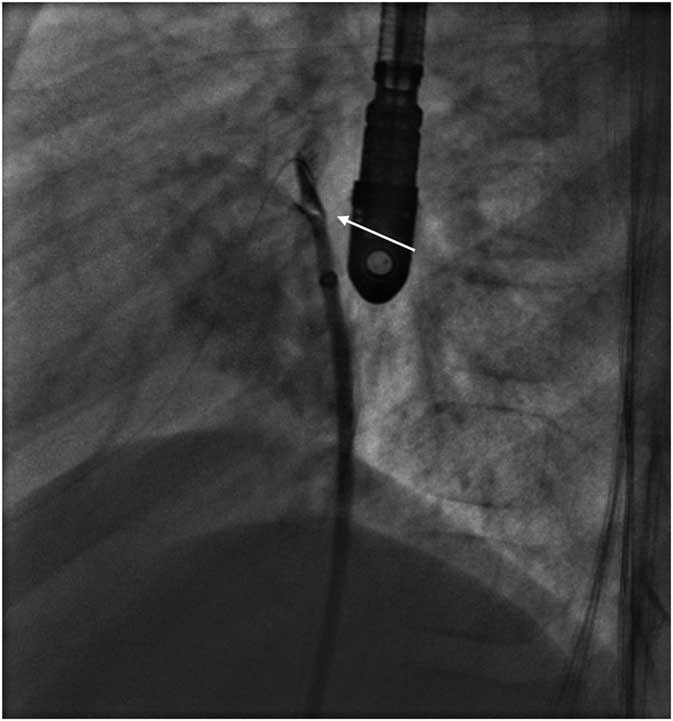
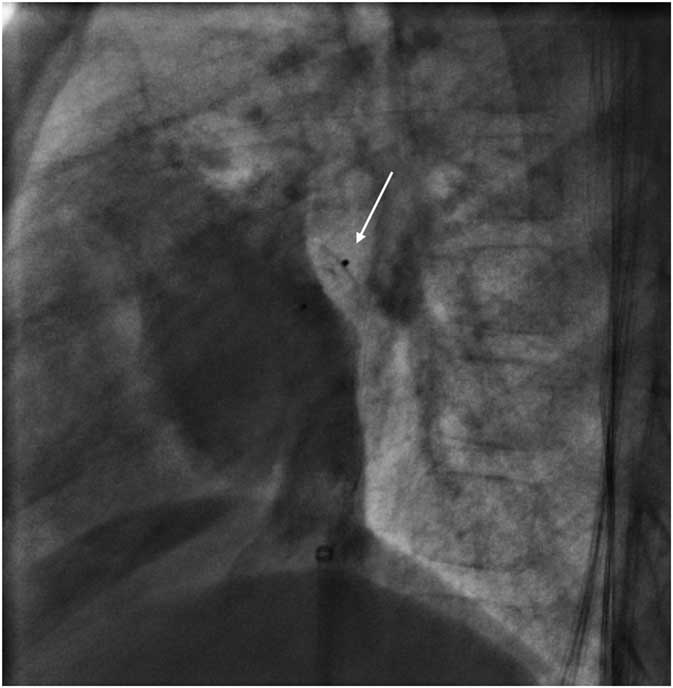
A cardiac catheterisation was performed to close a suspected patent foramen ovale. All morphologic and functional parameters of right and left heart were within the normal limits: mean right atrial pressure 6 mmHg, right ventricle pressure 26/6 mmHg, pulmonary artery pressure 26/12 with mean 18 mmHg. Simple inferior caval vein injection showed no shunt. The catheter, however, easily crossed the interatrial septum (Fig 1). Transoesophageal echocardiography showed a tunnel-like patent foramen ovale, somewhat more cranially located than usual, but directly above the inferior caval vein. The anatomy of the patent foramen ovale was interrogated by means of an 8 mm Tyshak balloon and the defect was closed using an Amplatzer PDA2-05-04 (St Jude Medical, St Paul, MN, United States of America) (Fig 2). A low dose of aspirin was started for 2 months.
Lateral view angiogram: wire through foramen ovale (white arrow); contrast injection through 6F sheath show patent foramen ovale.

Right atrial angiogram, lateral view. Amplatzer PDA2 device (white arrow) in place straddling the atrial septum.
The child improved dramatically. At 6 weeks follow-up she was lively and energetic. Her saturations supine, upright and during exercise remained at 99%. The parents reported that she was happier and that they had not used her stroller since closure of the foramen ovale.
Discussion
A patent foramen ovale is the persisting of the foramen ovale, one of the structures responsible for filling of the left heart in the prenatal blood circulation. A patent foramen ovale is a flap-like structure in the interatrial septum, allowing blood flow from right to left when the pressure in the right atrium exceeds this in the left atrium.Reference Johansson, Eriksson and Dellborg 1 , Reference Ptaszek, Saldana, Palacios and Wu 2 Physiological situations that might cause an increased right atrial pressure or transatrial flow are Valsalva manoeuvre, early ventricular systole, exercise, or coughing. There are some pathological circumstances that can facilitate shunting: any mechanism leading to pulmonary hypertension such as chronic obstructive pulmonary disease and obstructive sleep apnoea syndrome, pericardial tamponade, right atrial myxomas, CHD (e.g. Ebstein malformation). A patent foramen ovale occurs in up to 25% of all humans. It is mostly an asymptomatic finding. Symptomatic right to left shunt is rare in healthy persons and remains often unnoticed.Reference Johansson, Eriksson and Dellborg 1 – Reference Gomperts, Fowler, Horlick and McLaughlin 3 In elderly it is often detected after a paradoxal embolism. Given the high prevalence, historically, it has been controversial to confirm causality between certain symptoms and a patent foramen ovale. Data on symptomatic patent foramen ovale, particularly in children, are scarce. Cryptogenic stroke and migraines associated with a patent foramen ovale are described in childrenReference Johansson, Eriksson and Dellborg 1 , Reference Menon, Grove, McFadden, Korgenski and Cowley 4 , Reference Devendra, Rane and Krasuski 5 as well as the phenomenon of platypnea–orthodeoxia in which patients get desaturated while in upright position. In this case, however, a significant, profound desaturation occurred only during exercise. It caused exercise-intolerance and induced a true dislike for any physical activities with severe secondary social-emotional developmental regression. In rest, laying and at standing up, our patient was fully saturated. Only at physical activities, when the inferior vena caval flow increased, a right to left shunt occurred. We presume that some local flow characteristics in this patient enhanced flow though the foramen ovale was in such a more cranial position just above the inferior caval vein; however, the difference with other foramens that presented for closure is not impressive.
This case is a good reminder of the importance of provoking symptoms when elaborating specific situational complaints. This girl had been experiencing fatigue and dyspnoea, typically provoked by exercise: the clue to her diagnosis was found during monitored exercise.
Conclusion
A patent foramen ovale is a common cardiac variant, with mostly no, but sometimes quite divergent and vague symptoms. Exercise-provoked desaturation is an often-missed symptom of patent foramen ovale, in adults as well as in children. In the diagnostic process, provoking the symptoms in a monitored and controlled environment is essential. Closure of the patent foramen ovale appears the best treatment option, with a high success rate and rare complications.
Acknowledgements
None.
Financial Support
This work was supported by The Eddy Merckx Research Grant.
Conflicts of Interest
None.