Introduction
Numerous studies have found that neuropsychological functioning in people with a psychotic disorder is worse than in healthy controls (Andreasen et al. Reference Andreasen, Paradiso and O'Leary1998; Heinrichs & Zakzanis, Reference Heinrichs and Zakzanis1998). Most of the studies investigating the neuropsychological functioning of patients after their first psychotic episode have found that these first-episode patients performed significantly worse than normal controls on many cognitive functions, including memory, attention, executive function and language skills (Bilder et al. 1992; Hoff et al. 1992; Sweeney et al. 1992, all in Riley et al. Reference Riley, McGovern, Mockler, Doku, O'Ceallaigh, Fannon, Tennakoon, Santamaria, Soni, Morris and Sharma2000; Addington & Addington, Reference Addington and Addington2002), although considerable heterogeneity in performance on different domains has been reported (Joyce et al. Reference Joyce, Hutton, Mutsatsa and Barnes2005). Riley et al. (Reference Riley, McGovern, Mockler, Doku, O'Ceallaigh, Fannon, Tennakoon, Santamaria, Soni, Morris and Sharma2000) showed that, even at the very first presentation of psychotic symptoms, schizophrenia patients show significant impairment on delayed recall from non-verbal memory and tasks of executive function such as mental flexibility, strategy planning and organization. No significant differences, however, were found between controls and schizophrenia patients on immediate and delayed recall from verbal memory, immediate non-verbal memory, recognition memory, finger tapping and measures of attention. By contrast, Heinrichs & Zakzanis (Reference Heinrichs and Zakzanis1998) found in their quantitative review that the majority of the described studies indicated that schizophrenia patients score significantly lower than control patients on measures of non-verbal memory, verbal memory and attention.
It is possible that development goes awry long before schizophrenia begins (Isohanni et al. Reference Isohanni, Murray, Jokelainen, Croudace and Jones2004). Studies of pre-morbid function in schizophrenia patients have revealed abnormalities or developmental delays in neuropsychological functioning (McNeil & Cantor-Graae, Reference McNeil and Cantor-Graae2000). Isohanni et al. (Reference Isohanni, Jones, Moilanen, Veijola, Oja, Koiranen, Jokelainen, Croudace and Jarvelin2001) found that ages at learning to stand, walk and become potty trained were related to subsequent risk for schizophrenia and other psychoses. Earlier milestones reduced, and later milestones increased, the risk.
Crow et al. (Reference Crow, Done and Sacker1995) found that people who suffer from schizophrenia had more problems with spelling and reading at ages 7, 11 and 16 years than people with other psychiatric disorders and controls. These results suggest that the origin of schizophrenia lies partially in the developmental trajectory. Additionally, the same children who have a delay in gross motor milestones at age 1 also have difficulties with spelling and reading at age 7 (Isohanni et al. Reference Isohanni, Murray, Jokelainen, Croudace and Jones2004). In a meta-analytical review by Woodberry et al. (Reference Woodberry, Giuliano and Seidman2008), schizophrenia samples demonstrated a reliable, medium-sized impairment in pre-morbid IQ. A cross-sectional analysis of all studies by age and a descriptive review of studies that used repeated measures of IQ in a single sample did not support the presence of a relative decline in IQ during the pre-morbid period in individuals with schizophrenia.
To determine cognitive deterioration, it is important to investigate and compare cognitive functioning of the same people before and after a psychotic episode. Research efforts have focused recently on groups of patients with ultra-high-risk (UHR) symptoms who are in the putatively prodromal stage of psychosis. In summary, these studies found that cognitive functioning of UHR patients at baseline (when it is unknown whether a subject will proceed to a psychotic state) is generally intermediate between first-episode schizophrenia patients and normal controls (Wood et al. Reference Wood, Pantelis, Proffitt, Phillips, Stuart, Buchanan, Mahony, Brewer, Smith and McGorry2003; Keefe et al. Reference Keefe, Perkins, Gu, Zipursky, Christensen and Lieberman2006; Lencz et al. Reference Lencz, Smith, McLaughlin, Auther, Nakayama, Hovey and Cornblatt2006; Niendam et al. Reference Niendam, Bearden, Johnson, McKinley, Loewy, O'Brien, Nuechterlein, Green and Cannon2006; Eastvold et al. Reference Eastvold, Heaton and Cadenhead2007; Simon et al. Reference Simon, Cattapan-Ludewig, Zmilacher, Arbach, Gruber, Dvorsky, Roth, Isler, Zimmer and Umbricht2007). More recently, Hawkins et al. (Reference Hawkins, Keefe, Christensen, Addington, Woods, Callahan, Zipursky, Perkins, Tohen, Breier and McGlashan2008) reported on neuropsychological functioning in UHR patients before and after they made a transition to psychosis. The neuropsychological course did not differ between converters to psychosis and non-converters. By contrast, Wood et al. (Reference Wood, Brewer, Koutsouradis, Philips, Francey, Proffitt, Yung, Jackson, McGorry and Pantelis2007) reported a specific decline in performance on the Trail-Making Test B (Adjutant General's Office, Reference Addington and Addington1944) in a small sample of UHR patients after conversion to psychosis. There was no decline in performance on the other neuropsychological tests carried out.
In the present study, a group of UHR patients were tested neuropsychologically before and after experiencing a first psychotic episode. UHR patients who did not experience a psychotic episode were also tested within the same time-frame. A normal control group was used for comparison at both assessments.
We investigated the following hypotheses: (1) cognitive functioning after transition to a psychotic episode is reduced compared to cognitive functioning before a psychotic episode in the same subjects; and (2) before psychosis occurs, cognitive functioning in UHR subjects who make the transition to psychosis later on is already more impaired than in UHR subjects who do not develop a psychosis (and in normal controls).
Method
Participants
The UHR sample consisted of help-seeking individuals who were referred to the Academic Medical Centre, Amsterdam, The Netherlands by psychiatrists or psychologists for a second opinion regarding whether a psychotic development or risk factors for psychosis were present. All potential subjects were interviewed by a psychiatrist and a psychologist; parents or caretakers were interviewed by an experienced family worker. All assessments were discussed in a consensus meeting where a consultant psychiatrist was present.
All patients were assessed at intake with the Structured Interview for Prodromal Syndromes (SIPS; Miller et al. Reference Miller, McGlashan, Rosen, Somjee, Markovich, Stein and Woods2002) and the Bonn Scale for the Assessment of Basic Symptoms – Prediction List (BSABS-P; Klosterkötter et al. Reference Klosterkötter, Ruhrmann, Schultze-Lutter, Salokangas, Linszen, Birchwood, Juckel, Morrison, Vazquez-Barquero, Hambrecht and von Reventlow2005).
Patients were eligible for the study if they met the criteria for one or more of the following groups: attenuated symptoms, that is psychotic-like symptoms that have not proceeded to frank psychosis, Brief Limited Psychotic Symptoms (BLIPS), a frank psychotic period that subsided spontaneously in less than 1 week, a first-degree family member with a psychotic disorder or a schizotypal personality disorder in the identified patient and reduced functioning [operationalized by a decrease in Global Assessment of Functioning (GAF) score of at least 30% in the past year] or at least two basic symptoms.
Patients were excluded when they were <14 or >30 years old, had an estimated pre-morbid IQ <85, had a clear organic brain disorder or when symptoms were occurring primarily as sequelae of drug or alcohol use. Cannabis use at intake was not an exclusion criterion but the use of other illicit drugs (e.g. ecstasy) 3 months prior to assessment was. Previous psychotic episodes (treated or untreated) were ruled out by administering the Structured Clinical Interview for DSM-IV (SCID; Spitzer et al. Reference Spitzer, Williams, Gibbon and First1992). Substance use was assessed by administering the substance abuse module of the Comprehensive International Diagnostic Interview (CIDI; Andrews & Peters, Reference Andrews and Peters1998).
A transition to psychosis was operationalized for hallucinations as a score ⩾4 on the Positive and Negative Syndromes Scale (PANSS P3 item) or delusions as a score ⩾4 (PANSS items P1, P2 or P6 items), or formal thought disorders as a score of ⩾4 (PANSS P2-item) for longer than 1 week. To establish a formal DSM-IV diagnosis, the SCID was administered to all patients after transition to psychosis.
Patients, their relatives and treating professionals were encouraged to contact the assessment team during the time intervals between formal assessments when they felt the patient's condition was worsening. All patients who contacted the assessments team were seen within a week. This enabled the assessment team to monitor the clinical condition of the patient closely and to establish psychosis transition accurately.
In addition, a control group was included. Inclusion and exclusion criteria for the control group were: age 14–30 years, no psychiatric history, no psychiatric family history, no use of cannabis or other drugs and IQ >85.
Neuropsychological test battery
A battery of cognitive measures was used to assess the cognitive functioning of participating subjects. This battery included measures of attention, executive function, verbal and visuospatial memory and motor speed.
Pre-morbid IQ was estimated by the Dutch version of the National Adult Reading Test (NART). In this test subjects are asked to pronounce 50 words as accurately as possible (Nelson & O'Connell, Reference Nelson and O'Connell1978; Schmand et al. Reference Schmand, Lindeboom and Van Harskamp1992).
Verbal Fluency (VF; on the Stanford–Binet Intelligence Scale) measures the ease of verbal production. This test requires the subject to say as many words as possible in 1 min, without saying sentences or number series (Lezak, Reference Lezak1995). Subjects are asked to name as many words as possible starting with the letter ‘s’, and then to name as many animal species as possible. The dependent variable for this task was the mean number of acceptable words produced in both conditions (first letter and categories).
The Finger Tapping Test (FTT; Lezak, Reference Lezak1995) gives an indication of motor speed. During 1 min as many finger taps as possible have to be made on the computer mouse key with the left and right index finger.
The Spatial Working Memory Test (SWMT; Keefe et al. Reference Keefe, Roitman, Harvey, Blum, DuPre, Prieto, Davidson and Davis1995) is a task that investigates visuospatial memory. In this test a spot appears for several seconds somewhere on the computer screen and the subject has to remember the location of that spot. When the spot disappears, the subject has to read out loud 30 words that appear one after another on the screen. When finished, the subject is asked to click on the location of the absent spot. The variable we use is the distance between this location and the absent spot.
The Dutch translation of the California Verbal Learning Test (CVLT) is a task of auditorily presented material (Kibby et al. Reference Kibby, Schmitter-Edgecombe and Long1998) that measures the successive phases of the learning process (encoding, consolidating, retrieval). The test consists of a shopping list of 16 articles (list A, Monday list) that the subject is asked to remember. The researcher reads out the shopping list five times and after each presentation the subject is asked to name as many articles as possible. Then another list (list B, Tuesday list) is presented auditorily to the subject, and again the subject has to name as many articles as possible of the Tuesday list. After this interference, the subject is asked to name as many articles as possible of the Monday list. The articles then have to be named by category. After a period of 20 min, free and cued recall of the Monday list is tested once more. Then a list of articles is read out and the subject has to say which of the articles belongs to the Monday list (recognition). The variable total recall list A summarizes performance on the CVLT and includes other subvariables. The other subvariables are norm scores based on a representative sample of Dutch subjects corrected for age and gender with a mean of 0 and a standard deviation (s.d.) of 2.
The Continuous Performance Test (CPT) is a vigilance task on the computer that examines ability to sustain attention (Lezak, Reference Lezak1995). This test involves a sequential presentation of digits and shapes over an extended period of time. Subjects have to respond as quickly as possible by letting go of the computer mouse if they see two equal targets. The images are presented in high speed, one image per second. We used two different versions of the CPT: the four figures and the symbols version. Two important outcome measures of the CPT are d prime and log beta: d prime is a sensitivity index that is derived from the hit rate and the false alarm rate; log beta is a response bias index that is calculated by using the ratio of the hit rate to the false alarm rate (Egan et al. Reference Egan, Goldberg, Gscheidle, Weirich, Bigelow and Weinberger2000).
The Complex Figure of Rey (CFR) is a drawing and visual memory test that examines the ability to construct a complex figure and remember it for later recall. It measures memory and also visual-motor organization. The CFR consists of two test conditions: Copy and Delayed Recall. In the first step, subjects are given the CFR stimulus card and then asked to draw the same figure. After a delay of 20 min, they are required to draw the same figure once again (Shin et al. Reference Shin, Park, Park, Seol and Kwon2006). The variable reported here is the total score on the delayed condition.
The number of subjects is lower in this test than in the other tests because it was added to the neuropsychological test battery while we were already in the process of testing subjects.
Procedure
The participants of the UHR group were neuropsychologically tested shortly after inclusion (T0 measurement). Eighteen months after inclusion, participants and controls were again contacted for a follow-up assessment (T1 measurement). Subjects who had experienced a psychotic episode were tested when stabilized on medication. In the follow-up assessment, the same neuropsychological tests were performed as in the first assessment.
Statistical analyses
All analyses were conducted using SPSS version 14.0 for Windows (SPSS Inc., USA). Demographic information was compared between the three groups using a χ2 test (male/female ratio) and a one-way ANOVA (age, NART IQ, GAF score). A series of two-way repeated measures ANOVAs was conducted to compare changes in the neuropsychological test results over time.
Results
Analyses were carried out on data from a total of 58 participants. Seventeen people were included in the control group. At intake, the UHR group consisted of 41 subjects, of whom 17 later developed a psychosis (the transition group). After transition, 10 subjects had a diagnosis of schizophrenia, three schizophreniform disorder, three schizo-affective disorder and one psychosis not otherwise specified (NOS).
The frequencies, means and standard deviations of gender, age at intake, pre-morbid IQ and GAF score are presented in Table 1. A χ2 test showed that the groups were equal in their gender distribution (χ2=3·52, df=2, p=0·17). No significant differences were found between the groups in terms of mean age at intake and mean pre-morbid IQ respectively [F(2, 68)=1·02, p=0·37 and F(2, 68)=2·24, p=0·11]. GAF scores were significantly different between the three groups (F=166·3, p=0·0001). Both the transition group and the UHR group had a lower GAF score than the control group.
Describing variables of the UHR, transition and control groups at intake

UHR, Ultra-high risk; GAF, Global Assessment of Functioning; s.d., standard deviation.
Pre-morbid IQ was measured by the Dutch National Adult Reading Test (NART).
* p<0.001.
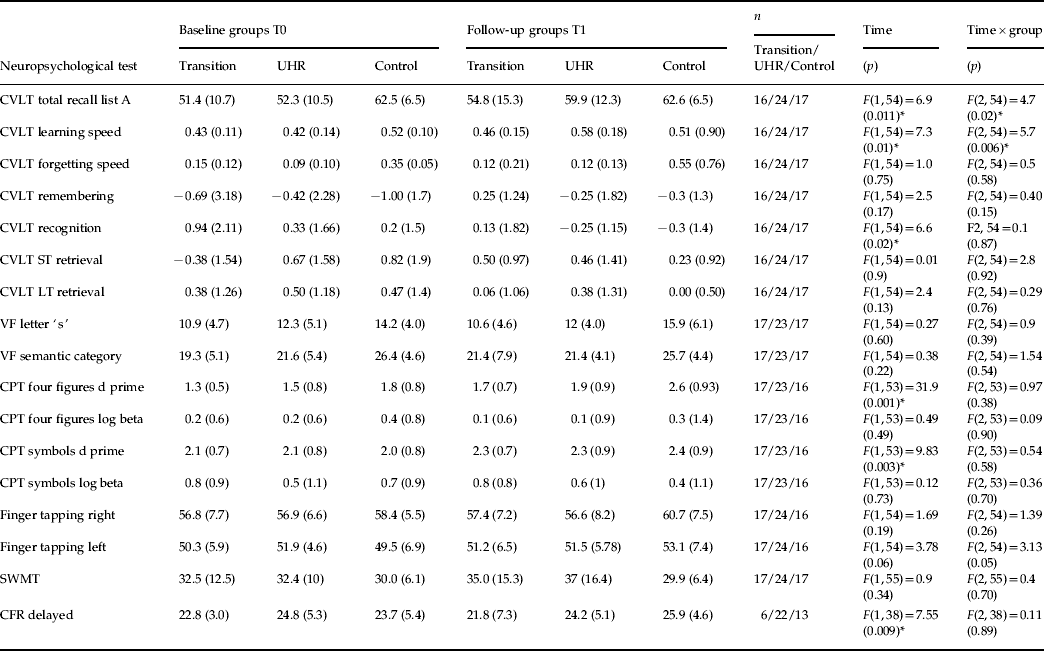
Repeated-measures analyses revealed a significant effect of time for CVLT total recall list A, CVLT learning speed, CVLT recognition, CPT four figures d prime, CPT symbols d prime and CFR (see Table 2). A significant time×group interaction effect was found for CVLT total recall list A, CVLT learning speed and finger tapping left hand. Post-hoc analysis revealed that only the UHR group showed a significant improvement over time in both the CVLT total recall list A (p=0·001) and CVLT learning speed (p=0·001). The control group and the transition group did not show a significant change in performance over time. Control subjects showed a significant improvement over time on the FTT left (p=0·004) whereas the other two groups did not. Performance on the other neuropsychological tests did not change significantly in any of the groups.
Neuropsychological test results in the three groups at baseline and follow-up

UHR, Ultra-high risk; CVLT, California Verbal Learning Test; ST, short term; LT, long term; VF, Verbal Fluency; CPT, Continuous Performance Test; SWMT, Spatial Working Memory Test; CFR, Complex Figure of Rey.
At baseline, we found differences between the three groups on the VF test categories [F(2, 54)=7·05, p=0·002] and CVLT total recall list A [F(2, 54)=3·67, p=0·03]. Post-hoc tests showed that both the transition and the UHR groups scored significantly worse on VF semantic categories than the control group (p=0·003 and p=0·01 respectively) On the CVLT test the transition group performed worse than the control group (p=0·03).
Discussion
Cognitive functioning after psychosis
There was no cognitive task on which the participants of the transition group scored worse on the second compared to the first assessment, indicating that the participants of the transition group did not deteriorate cognitively after they experienced their first psychosis. These results are in line with a recently published study in which UHR subjects also showed no decline on several cognitive measures after experiencing their first psychotic episode (Hawkins et al. Reference Hawkins, Keefe, Christensen, Addington, Woods, Callahan, Zipursky, Perkins, Tohen, Breier and McGlashan2008).
The hypothesis that participants who experienced a psychosis would perform worse than participants who are at UHR to develop a psychosis (but have not experienced one) at T1 proved to be untrue. It is noteworthy that the UHR group improved more on the CVLT at the second assessment than the transition group and the control group, indicating that more practice effects occurred in the UHR group than in the transition and control groups. Another possibility is that improvement in symptomatology influenced performance of the UHR group at T1.
One explanation of our main finding is that the largest part of cognitive deterioration occurs before psychosis manifests itself. In that case, cognitive deterioration does not occur during or just after psychosis, but rather in the course leading up to psychosis. This explanation is confirmed by the finding that participants who later developed psychosis had already performed worse on verbal learning and memory measures and verbal fluency than healthy controls at the first assessment.
An alternative explanation is that, during psychosis, cognitive decline did occur but the brain recovered slowly to almost the same level as before the psychosis. If this was the case, then cognitive functioning would decline minimally after each psychosis, as a result of which the effect can only be measured clearly after several psychoses.
A third explanation is suggested by studies that have examined the association between duration of untreated psychosis (DUP) and cognitive decline. These studies found that longer DUP predicted cognitive impairment (Scully et al. Reference Scully, Coakley, Kinsella and Waddington1997; Barnes et al. Reference Barnes, Hutton, Chapman, Mutsatsa, Puri and Joyce2000; Amminger et al. Reference Amminger, Edwards, Brewer, Harrigan and McGorry2002). However, Amminger et al. (Reference Amminger, Edwards, Brewer, Harrigan and McGorry2002) showed that the group of patients with psychosis untreated for up to 4 weeks had no signs of cognitive deterioration. The individuals who participated in the current study were monitored from intake (before psychosis developed). When they became psychotic, treatment was started almost immediately. Because of this, the DUP was very short and cognitive impairment could therefore be limited.
In contrast with our findings, some evidence for active structural brain changes over the transition to psychosis has been reported (Pantelis et al. Reference Pantelis, Velakoulis, McGorry, Wood, Suckling, Phillips, Yung, Bullmore, Brewer, Soulsby, Desmond and McGuire2003; Borgwardt et al. Reference Borgwardt, McGuire, Aston, Berger, Dazzan, Gschwandner, Pfluger, D'Souza, Radue and Riecher-Rossler2007). However, the rate of change in both studies was small and all patients had taken neuroleptics at follow-up, which makes it difficult to determine whether these changes were the result of treatment or the occurrence of psychosis.
Cognitive deficits are not necessarily related to structural brain changes. IQ tends to increase in first-episode schizophrenia patients over a period of 10 years (Kurtz, Reference Kurtz2005) whereas structural magnetic resonance imaging (MRI) research shows brain volume loss.
In all UHR studies, transition to psychosis is defined as the occurrence of positive psychotic symptoms beyond a certain threshold. In schizophrenia patients, neuropsychological functioning is relatively independent of positive symptoms and more closely linked to negative symptoms and daily functioning. Therefore, the occurrence of more pregnant positive symptoms could be independent of neuropsychological functioning.
Positive symptoms may not be a core deficit in the schizophrenia disease process. Neurocognitive deficits may be more fundamental in the development of schizophrenia.
Cognitive functioning at baseline
The finding that participants of the UHR and the transition groups performed worse on verbal memory and verbal fluency than the control group at T0 is consistent with the findings of Cosway et al. (Reference Cosway, Byrne, Clafferty, Hodges, Grant, Abukmeil, Lawrie, Miller and Johnstone2000) and Brewer et al. (Reference Brewer, Francey, Wood, Jackson, Pantelis, Phillips, Yung, Anderson and McGorry2005). Cosway et al. (Reference Cosway, Byrne, Clafferty, Hodges, Grant, Abukmeil, Lawrie, Miller and Johnstone2000) found impairments in executive function assessed with verbal fluency in an UHR group. It is interesting, however, that no differences between the groups on measures of attention, visuospatial memory and motor speed were found, suggesting that only verbal memory deficits and verbal fluency are indicative of UHR for psychosis. These results are in contrast with the findings of others (Wood et al. Reference Wood, Pantelis, Proffitt, Phillips, Stuart, Buchanan, Mahony, Brewer, Smith and McGorry2003; Morey et al. Reference Morey, Inan, Mitchell, Perkins, Liebermann and Belger2005) and need to be replicated in future studies.
Limitations
The results should be considered in the context of several limitations. The study groups were relatively small and therefore we cannot exclude the possibility that we were not able to find differences because of a lack of power. Some participants of the transition group, unlike those of the UHR group, could not be tested as scheduled. The second assessment of a few participants took place after more than 18 months because some patients had become psychotic, were recovering from their psychosis (and therefore not clinically stable) or were not feeling ready to handle the pressure of an assessment at the time they were scheduled. Because of this, differences between these groups could be explained by differences in time between the two measurements. Rund et al. (Reference Rund, Melle, Friis, Larsen, Midboe, Opsjordsmoen, Simonsen, Vaglum and McGlashan2004), however, did not find differences between patients (from the same group) tested as scheduled and patients who were tested later, from which it may be concluded that cognitive deficits seem to be stable early on.
In the present study no cognitive decline occurred in UHR patients who experienced their first episode of psychosis. This might be accounted for by the early treatment the patients received. Nevertheless, problems in verbal fluency and verbal memory were found, especially in patients who developed psychosis. Further research is planned to show how these impairments arise and how these deficits might be prevented or treated.
Acknowledgements
This study was supported by a grant for the Dutch Prediction of Psychosis Study from Zorg Onderzoek Nederland/NWO-Medische Wetenschappen (ZON-MW) project number 2630.0001.
Declaration of Interest
None.