Introduction
Phlyctis (Wallr.) Flot. (nom. cons.) is a cosmopolitan genus with c. 20 species (Tønsberg Reference Tønsberg, Nash, Ryan, Diederich, Gries and Bungartz2004) but the number of species reported in the literature varies (cf. CABI Bioscience et al. 2010; Ma et al. Reference Ma, Li, Wang and Zhao2010). The genus in India is currently represented by four species: P. himalayensis (Nyl.) D. D. Awasthi, P. polyphora Stirt., P. karnatakana S. Joshi & Upreti and P. subagelaea S. Joshi & Upreti. Phlyctis himalayensis and P. polyphora occur in the dense, moist rainforests of the eastern Himalayas, whereas P. karnatakana and P. subagelaea are reported from the evergreen forests of the Western Ghats. Three other species, Phlyctella indica D. D. Awasthi, Phlyctis arachnoides Kremp. and Phlyctis effusa Müll. Arg., reported from West Bengal and the Andaman and Nicobar Islands, are now placed in Graphidastra, Lasioloma and Cryptothecia as G. byssiseda (Müll. Arg.) G. Thor, L. arachnoideum (Kremp.) R. Sant. and C. effusa (Müll. Arg.) R. Sant. respectively. The genus Phlyctis has traditionally been separated from the closely related genus Phlyctella Kremp. on the basis of the muriform ascospores in Phlyctis, which are in contrast to the septate ascospores in Phlyctella. However, ascospore septation is no longer considered a sufficient diagnostic character for formal recognition of Phlyctella as a genus independent of Phlyctis and consequently all taxa in Phlyctella have been transferred to Phlyctis (Galloway & Guzmán Reference Galloway and Guzmán1988). The genus Phlyctis is usually characterized by the presence of depsidones but recent collections of Phlyctis from the Indian Himalayan region were found to lack secondary lichen metabolites; otherwise they were referable to Phlyctis and are included here in the genus.
Material and Methods
Specimens of Phlyctis in the herbarium of the CSIR-National Botanical Research Institute, Lucknow (LWG), were examined. Morphological and anatomical characters were studied using stereozoom and compound microscopes [LEICA S8APO and LEICA DM500]; colour tests and thin-layer chromatography, using solvent A, were performed following Orange et al. (Reference Orange, James and White2001).
The New Species
Phlyctis monosperma S. Joshi & Upreti sp. nov.
MycoBank No.: MB 563687
Phlyctis megalospora (P. James) D. Galloway & Guzmán similis sed ab hac species ascosporis minoribus et acido protocetrarico cum atranorin deficiens differt.
Typus: India, West Bengal, Darjeeling district, Sukhia forest, on bark among moss, 22 June 1976, S. Chandra & M. Ranjan 26815 (LWG—holotypus; FM—isotypus).
(Fig. 1)
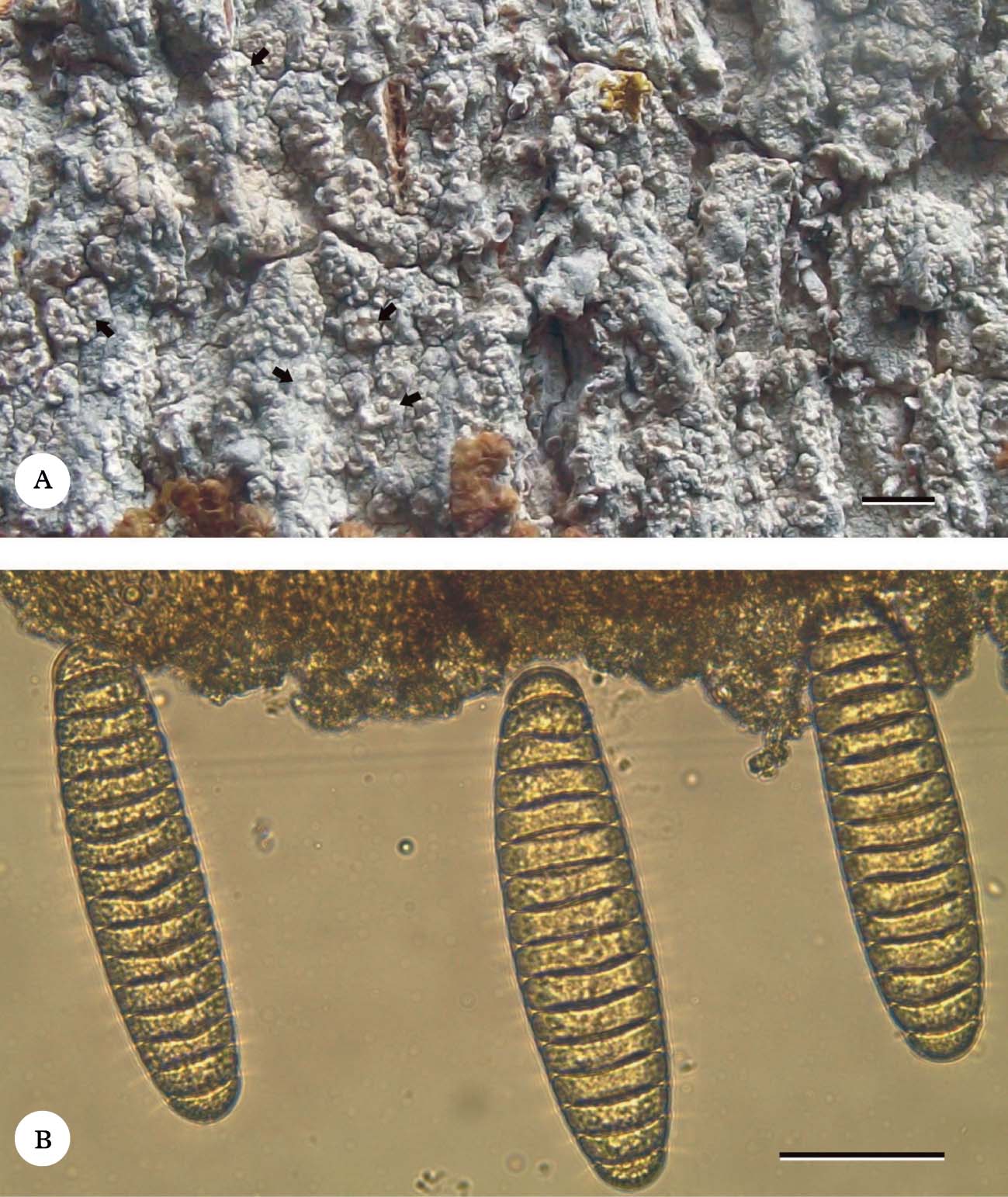
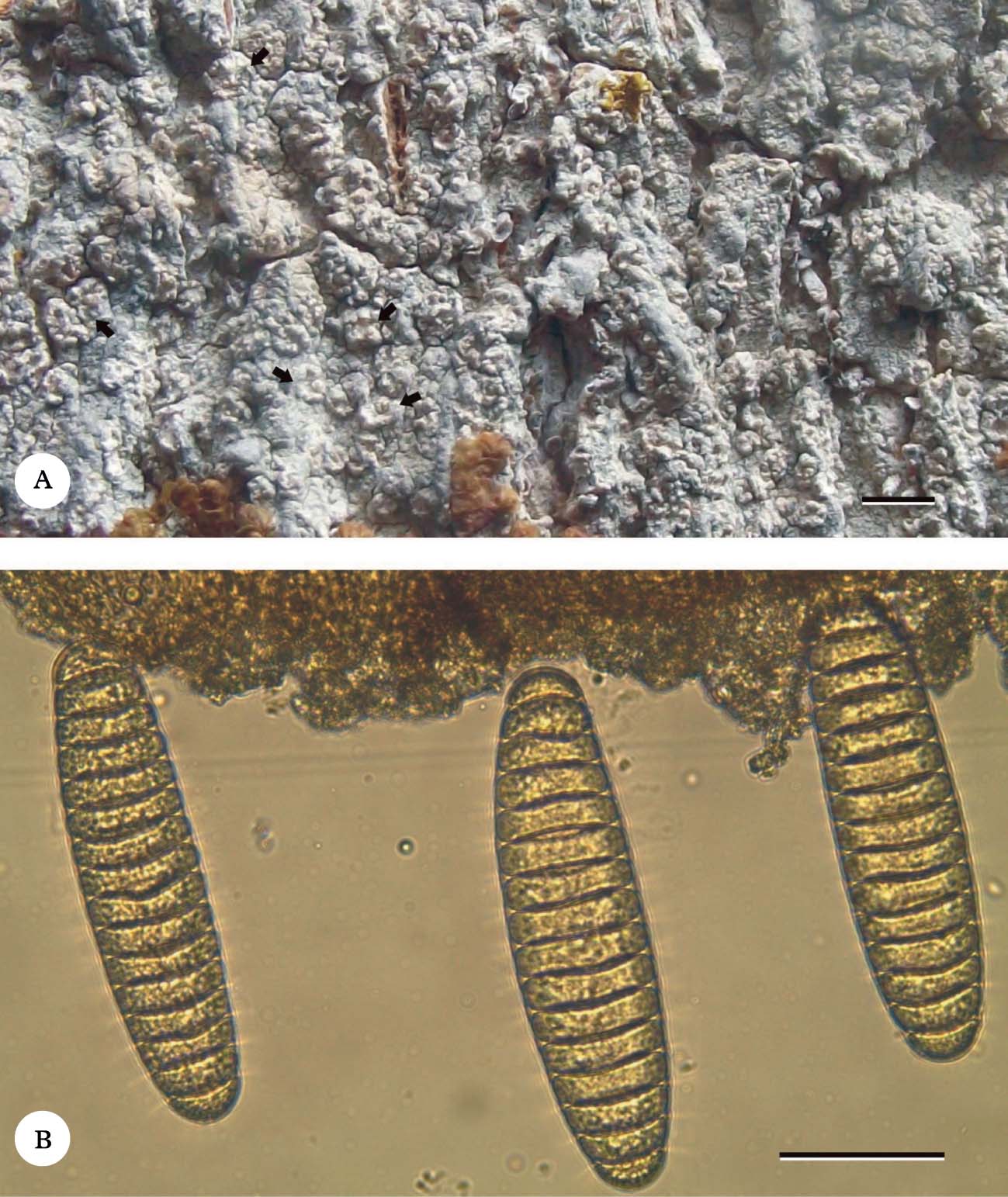
Phlyctis monosperma. A, habit (holotype), note the irregular margins of apothecia; B, ascospores. Scales: A=1·5 mm; B=50 µm. In colour online.
Thallus corticolous, crustose, growing in association with epiphytic bryophytes, uneven, off-white to greyish white, coarsely to finely granular, loose, continuous, ±cracked due to bark texture, photobiont chlorococcoid; prothallus white to indistinct.
Apothecia numerous, scattered, sometimes aggregated in groups of 2–3, mostly irregular, rarely round, uneven, 0·5–1·5 mm diam., immersed. Disc concave to flat, greyish to brownish, heavily covered with irregular, loose, white, granular pruina. Margins concolorous with the thallus, up to 0·3 mm thick, raised, vertical to slightly incurved, entire, eroded in older apothecia, ±granular. Proper exciple indistinct to poorly developed. Epihymenium brownish, granular, opaque, 25–35 µm thick, K−, I+ reddish. Hymenium hyaline, 170–190 µm thick, K−, I−. Hypothecium pale to hyaline, 35–40 µm thick, K−, I−. Paraphyses densely anastomosing, branched, conglutinate, coherent, 2·0–2·5(–3·0) µm thick. Asci 1-spored, broadly clavate, 135–170(–197) µm tall, 35–45 µm wide, K−, I+ pale yellow becoming reddish. Ascospores hyaline, non-halonate, oblong-ellipsoid with rounded apices, thin walled, lenticular, consistently transversely 15-septate, appearing muriform in older ascospores due to the disintegration of the transverse septa, (130–)140–150(–180) µm long, 30–40 mm wide, locules 9–13(–15) µm long, I+ wine red.
Chemistry. K−, KC−, C−, P+ yellow; psoromic acid chemosyndrome detected by TLC.
Etymology. The specific epithet refers to the single-spored asci of the new species.
Ecology and distribution. The species occurs in the subtropical evergreen forests of the eastern Himalayas and Western Ghats of India. It grows on rough tree bark in close association with epiphytic bryophytes above 2000 m.
Remarks. Phlyctis monosperma is characterized by the greyish white, loose, ±granular thallus, 1-spored asci, transversely 15-septate ascospores and the presence of the psoromic acid chemosyndrome. It resembles the New Zealand species, P. megalospora (P. James) D. Galloway & Guzmán, in that both species have 1-spored asci, contain psoromic acid and grow with mosses. The new species differs in possessing smaller ascospores with fewer septa, 130–180×30–40 µm and 15-septate compared to 285–390×79–95 µm and 17–23-septate in P. megalospora, and lacking the atranorin and protocetraric acid present in the New Zealand species. The chemically similar species, P. psoromica Elix & Kantvilas, differs in possessing 4–8-spored asci with smaller, 3–7-septate ascospores, 30–52×4–6 µm.
Specimens examined. India: West Bengal: Darjeeling district, Sukhia forest, on bark among moss, 1976, S. Chandra & M. Ranjan 26815 (LWG). Tamil Nadu: Kodaikanal, Silver cascade, on bark, 1979, S. Chandra & M. Ranjan 26816 (LWG).
Phlyctis subhimalayensis S. Joshi & Upreti sp. nov.
MycoBank no.: MB 563688
Phlyctis himalayensis (Nyl.) D. D. Awasthi similis sed ab hac species ascosporis minoribus et material chemica in thallo non detecta.
Typus: India, Uttarakhand, Pithoragarh district, Munsiyari, Kalamuni, 2500 m on Quercus semecarpifolia, 17 November 2006, Y. Joshi & R. Bajpai 06-007019 (LWG—holotypus; FM—isotypus).
(Fig. 2)
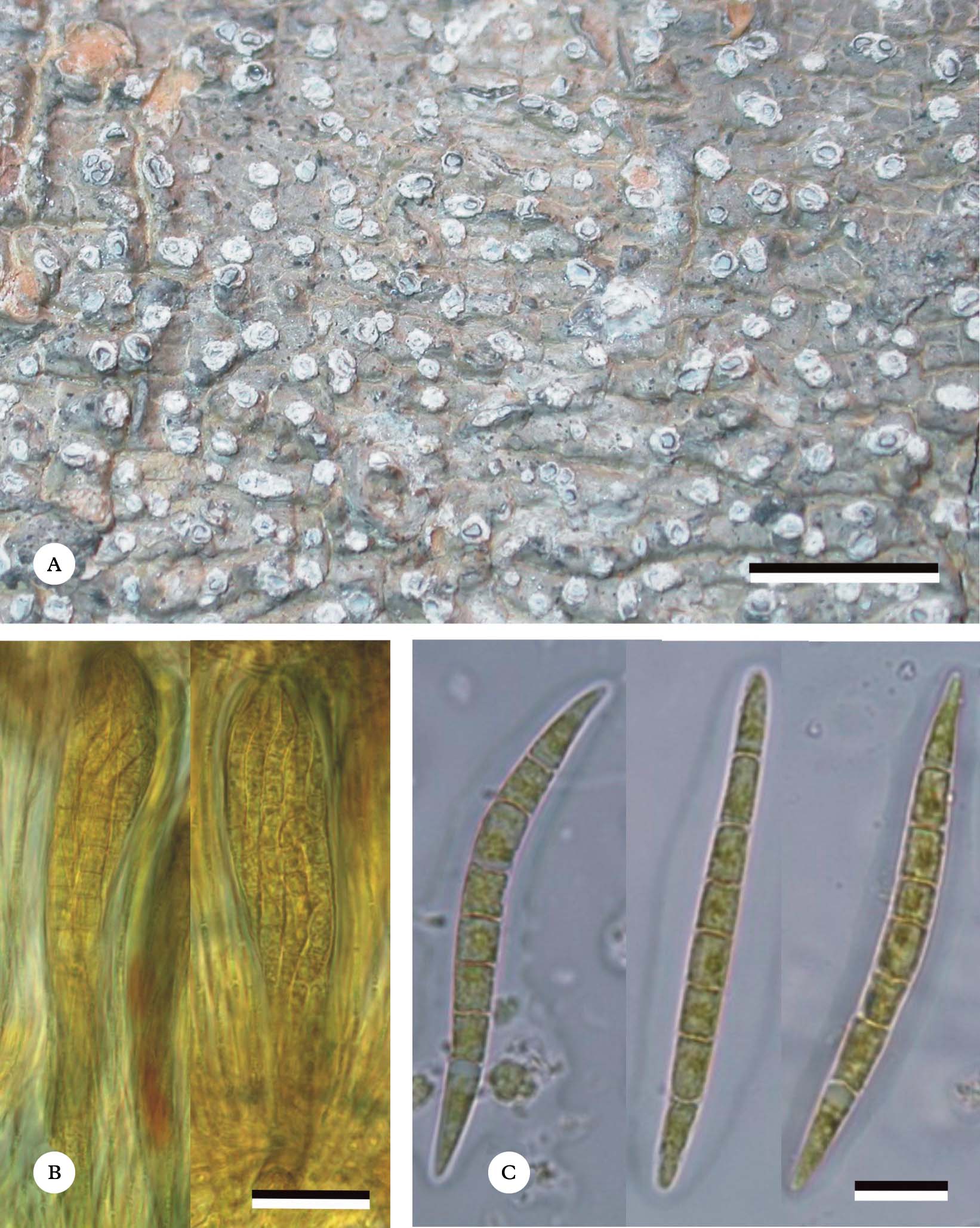
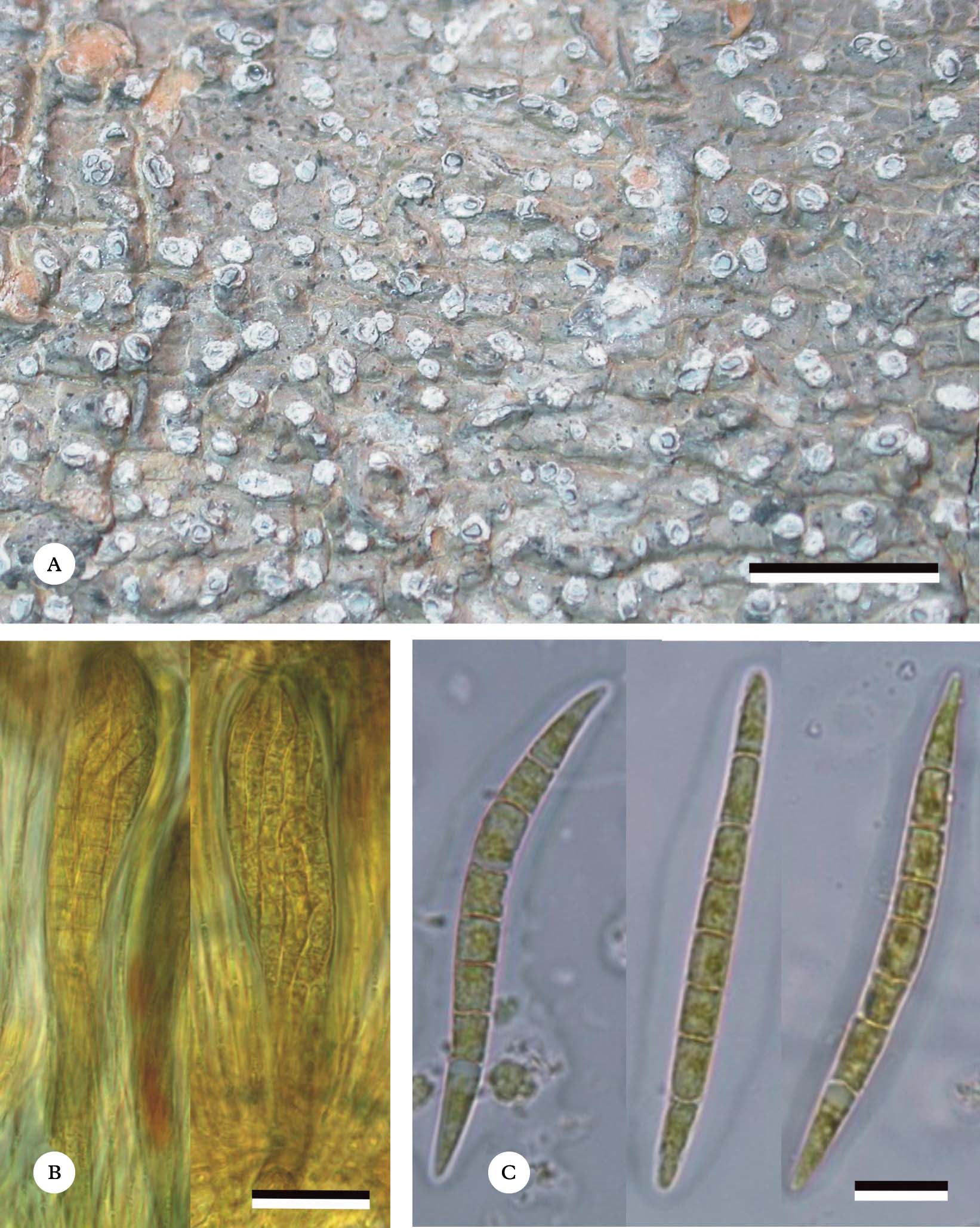
Phlyctis subhimalayensis. A, habit (holotype); B, ascus with ascospores; C, ascospores. Scales: A=5 mm; B=20 µm; C=5 µm. In colour online.
Thallus corticolous, crustose, thin, smooth, greenish grey to greyish white, continuous, cracked, photobiont chlorococcoid; prothallus indistinctly white or absent.
Apothecia numerous, scattered, sometimes 2–3 confluent, subcircular, elongate to angular, uneven, 0·5–1·0 mm diam., immersed or semi-immersed to chroodiscoid. Disc concave to flat, black, pruinose, circular when completely exposed or sometimes slit-like when occluded by margins, rarely irregular. Margins off-white, indistinctly 2–5 lobate, up to 0·3 mm thick, exfoliating in older apothecia, radially fissured and divided into 2–3 lamellae. Proper exciple undeveloped to poorly developed. Epihymenium opaque, brownish, minutely granular, 10–25 µm thick, K−, I+ blue, turning wine red. Hymenium hyaline, clear, 60–90 µm thick, K−, I−. Hypothecium pale brown to pale yellow, 15–30 µm thick, K−, I−. Paraphyses simple, straight, slender, unbranched, coherent, up to 1·0 µm thick. Asci 8-spored, clavate, cylindrical, (45–)60–90×6–10 µm, K−, I+ blue, contents turning yellow-orange. Ascospores hyaline, non-halonate, transversely 5–7-septate, cells 2–6 µm high, acicular to fusiform, mostly curved, 20–35(–40) µm long, 2–4 µm wide, contents I+ turning yellow.
Chemistry. Thallus K−, C−, KC−, P−. No lichen substances detected by TLC.
Etymology. The epithet refers to the similarity to Phlyctis himalayensis and the place of collection, the Himalayas.
Ecology and distribution. The species is known only from cool temperate forests in Uttarakhand in the northern Himalayas, and Arunachal Pradesh in the eastern Himalayas in India. It grows luxuriantly on Quercus semecarpifolia and Acer nepalensis at altitudes of 2500 m and above.
Remarks. Phlyctis subhimalayensis is characterized by the thallus lacking lichen substances, the chroodiscoid apothecia with pruinose black apothecial discs, white exfoliating margins, and transversely 5–7-septate ascospores. It shows a close resemblance to Phlyctis himalayensis (Nyl.) D. D. Awasthi and P. karnatakana S. Joshi & Upreti in having transversely 7-septate ascospores, but differs in thallus chemistry and ascospore size. Both P. himalayensis and P. karnatakana have a K+ red thallus with unidentified lichen compounds in the former and norstictic acid in the latter. Phlyctis himalayensis has a subleprose thallus with comparatively larger ascospores of 60–75×6–8 µm, compared to 20–35(–40)×2–4 µm in P. subhimalayensis.
Phlyctis subhimalayensis somewhat resembles the New Zealand taxa P. longifera (Nyl.) D. Galloway & G. Guzmán, and P. megalospora (P. James) D. Galloway & G. Guzmán, both of which have transverse spore septation. However, the latter two species have larger ascospores (55–86×5–7 µm and 285–390×79–95 µm in size) and both contain depsidones, viz. stictic acid and psoromic acid, respectively.
In its morphology and chroodiscoid apothecia, Phlyctis subhimalayensis can be confused with members of the thelotremoid Graphidaceae (e.g. Chapsa), and also the non-lichenized genus Stictis. However, the absence of periphysoids, the presence of chlorococcoid algae and a poorly developed proper exciple clearly separate the new species from these. Further, the amyloid asci of P. subhimalayensis are unusual in the thelotremoid Graphidaceae, and the genus Stictis is characterized by a well-developed crystalline layer between proper exciple and hymenium which is lacking in the new taxon.
Specimens examined. India: Uttarakhand: Pithoragarh district, Munsiyari, Kalamuni, alt. 2500 m, 2006, on Quercus semecarpifolia tree trunk, Y. Joshi & R. Bajpai 06–007019 (LWG); Ginny band, alt. 2500 m, 2009, on bark, D. K. Upreti et al. 09–012423 (LWG). Arunachal Pradesh: west Kameng district, en route to Sela, 10 km before Sang, 2008, on Acer nepalensis, D. K. Upreti, U. Dubey, R. Khare & G. K. Mishra 08–009294 (LWG).
Discussion
Recent investigations show that the family Phlyctidaceae contains two genera, Phlyctis (Wallr.) Flot. and Psathyrophlyctis Brusse, and is placed in the order Ostropales (Wedin et al. Reference Wedin, Wiklund, Crewe, Döring, Ekman, Nyberg, Schmitt and Lumbsch2005; Baloch et al. Reference Baloch, Lucking, Lumbsch and Wedin2010; Lumbsch & Huhndorf Reference Lumbsch and Huhndorf2010). The current concept of the genus Phlyctis includes taxa previously treated under Phlyctomia, Phlyctella and Phlyctidea. The genus is recognized by the crustose, granular to leprose thalli, innate apothecia, a poorly developed proper exciple, muriform to transversely septate ascospores and by the presence of depsidones such as norstictic and psoromic acids and the occasional presence of atranorin. However, Phlyctis subhimalayensis, vide supra, lacks lichen compounds.
Phlyctis species are poor in taxonomically useful characters. Species delimitation within the genus is based on differences in substratum, ascospore septation, thallus chemistry and minor variations in thallus morphology. Many taxa share features in common, such as ecorticated, granular to subleprose thalli (e.g. Phlyctis karnatakana, P. himalayensis and P. uncinata Stirt.); white, greyish white to greenish thallus colour [e.g. Phlyctis speirea G. Merr., P. agelaea (Ach.) Flot. and P. polyphora] and others have similar ascospore size and septation (e.g. Phlyctis himalayensis and P. uncinata). Most species are corticolous apart from a few that grow over bryophytes and rocks (e.g. Phlyctis megalospora). Norstictic acid is the most common depsidone in the genus and is found either as a major compound or as traces. The K+ red reaction of the thallus of Phlyctis himalayensis (Awasthi Reference Awasthi1991) probably indicates the presence of norstictic acid; the species then resembles P. uncinata (K+ yellow turning red, norstictic acid). The two New Zealand species Phlyctis sordida C. Knight and P. subuncinata Stirt. are barely distinguishable and are separated on the basis of disc colour and apothecial margins, as both species have ascospores of a similar size (c. 35–75 µm long) and septation and both contain stictic acid.
Species of Phlyctis are mainly distributed in cool-temperate forests in New Zealand, South America, Africa, Australia and China and the investigation of Indian species extends the distribution range of the genus to the tropical rainforests of India. It is interesting to note that 18 taxa in the Phlyctis key have similar climate requirements, as reflected by their distribution patterns in cool-temperate regions of the Northern and Southern Hemispheres. Species from India, such as Phlyctis karnatakana and P. subagelaea, have disjunct distribution patterns centred on tropical to subtropical areas. However, the number of Phlyctis species present in India is expected to be much greater and to have a wider distribution range that may also extend to temperate areas. The present study suggests that more extensive collection and detailed, worldwide monographic study, supported by molecular data, are prerequisites for improving our understanding of phylogenetic relationships and species delimitations within the genus, and to confirm their systematic placement.
Key to the species of Phlyctis
A key to the known species of Phlyctis is given here. Except for the species described above, the characters used in the key are adapted from Galloway & Guzmán (Reference Galloway and Guzmán1988), Awasthi (Reference Awasthi1991), James & Hitch (Reference James, Hitch, Purvis, Coppins, Hawksworth, James and Moore1992), Tønsberg (Reference Tønsberg, Nash, Ryan, Diederich, Gries and Bungartz2004), Galloway (Reference Galloway2007), Joshi et al. (Reference Joshi, Upreti, Mishra and Divakar2010) and Ma et al. (Reference Ma, Li, Wang and Zhao2010).
1 Thallus lacking lichen substances ... P. subhimalayensis
Thallus containing lichen substances ... 2
2(1) Ascospores muriform ... 3
Ascospores transversely septate ... 11
3(2) Thallus sorediate ... 4
Thallus esorediate ... 5
4(3) Apothecia frequent, ascospores 2 per ascus, 42–78×30–42 µm; only norstictic acid present ... P. subargena
Apothecia rare, ascospores 1 per ascus, 100–150×25–50 µm; norstictic and connorstictic acids present ... P. argena
5(3) Psoromic acid present; thallus blue-grey ... P. ludoviciensis
Psoromic acid absent; thallus otherwise ... 6
6(5) Ascospores 1 (rarely 2) per ascus ... 7
Ascospores 2–8 per ascus ... 10
7(6) Thallus K−, greyish green; ascospores 1 per ascus, 45–53×12–16 µm; unknown grey spot at Rf class 5 ... P. nepalensis
Thallus K+ yellow to yellow-red… ... 8
8(7) Fumarprotocetraric acid present; thallus whitish grey; ascospores 1 per ascus, 60–130×12–30 µm ... P. subagelaea
Norstictic acid present ... 9
9(8) Ascospores 67–180×19–53 µm, 1 (rarely 2) per ascus ... P. speirea
Ascospores 190–285×55–70 µm, 1 per ascus ... P. chilensis
10(6) Thallus K+ yellow to red (norstictic acid); ascospores 35–91×11–35 µm ... P. agelaea
Thallus K−; ascospores 60–110×7·5–9·5 µm ... P. polyphora
11(2) Ascospores 1 per ascus ... 12
Ascospores more than 1 per ascus ... 13
12(11) Ascospores 285–390×79–95 µm, 17–23-septate; thallus arachnoid-byssoid; bryophilous/ saxicolous in habitat ... P. megalospora
Ascospores 130–180×30–40 µm, consistently 15-septate; thallus ±granular; corticolous, growing among mosses ... P. monosperma
13(11) Ascospores 4–8 per ascus, 30–52×4–6 µm; psoromic acid present ... P. psoromica
Ascospores 8 per ascus; psoromic acid absent ... 14
14(13) Thallus smooth corticated, glossy ... P. oleosa
Thallus roughened, ecorticated, subleprose, scurfy, granular or powdery ... 15
15(14) Ascospores 20–30×5–7 µm; thallus K+ yellow ... P. karnatakana
Ascospore size more than 30 µm long ... 16
16(15) Thallus K+ red (? norstictic acid); ascospores 60–75×6–8 µm ... P. himalayensis
Thallus K+ yellow turning red/yellow… ... 17
17(16) Thallus K+ yellow turning red; ascospores 45–100×5–10 µm; norstictic acid present ... P. uncinata
Thallus K+ yellow; stictic acid present ... 18
18(17) Thallus chalky white, areolate; ascospores 55–86×5–7 µm ... P. longifera
Thallus glaucous-green to grey, granular, leprose to areolate ... 19
19(18) Apothecial disc red to red-brown; thallus granular-leprose; ascospores 40–72×5–7 µm ... P. subuncinata
Apothecia disc dark grey to black; thallus areolate; ascospores 35–60×5–7 µm ... P. sordida
We are grateful to the Director of the National Botanical Research Institute (CSIR-NBRI), Lucknow, for providing laboratory facilities and to the Ministry of Environment and Forests, New Delhi, for financial assistance. Santosh Joshi also thanks Dr Alan Archer for improving the manuscript.