INTRODUCTION
Executive functioning (EF) refers to top-down control processes essential for the regulation of goal-directed behavior, such as goals formulation, anticipation of consequences, and the organization, monitoring, and adaptation of behavior (Cicerone et al., Reference Cicerone, Levin, Malec, Stuss and Whyte2006). Executive dysfunction is one of the most disruptive and persistent symptoms following acquired brain injury (ABI), with chronic EF deficits being associated with lasting disadvantage, including long-term negative psychosocial, emotional, and vocational outcome (Konrad et al., Reference Konrad, Geburek, Rist, Blumenroth, Fischer, Husstedt, Arolt, Schiffbauer and Lohmann2011; Ponsford et al., Reference Ponsford, Downing, Olver, Ponsford, Acher, Carty and Spitz2014). Despite this, relatively few studies have specifically targeted executive dysfunction in ABI. Although the overall goal of cognitive rehabilitation is to enable people with disabilities due to neurological insult to function optimally in their environments (Wilson, Reference Wilson2008), there is in fact lack of studies that have stressed transfer of treatment effects to daily living, and explored long-term effects. However, there is growing evidence that structured group-based metacognitive interventions that include problem-solving strategies, such as Goal Management Training (GMT; Levine et al., Reference Levine, Robertson, Clare, Carter, Hong, Wilson, Duncan and Stuss2000), can produce significant benefits for EF in individuals with ABI (Cicerone et al., Reference Cicerone, Langenbahn, Braden, Malec, Kalmar, Fraas, Felicetti, Laatsch, Harley, Bergqvist, Azulay, Cantor and Ashman2011).
Goal Management Training relies on metacognitive strategies to reengage top-down attention processes, in addition to teaching problem-solving techniques, to enhance EF (Stamenova & Levine, Reference Stamenova and Levine2018). By targeting sustained attention, improvements may transfer to broader domains of goal-directed functioning (Adnanet al., Reference Adnan, Chen, Novakovic-Agopian, D’Esposito and Turner2017; Stubberudet al., Reference Stubberud, Langenbahn, Levine, Stanghelle and Schanke2013). Nevertheless, the main objectives of GMT are to train participants to periodically stop ongoing behavior, attend to task goals, evaluate performance, and monitor performance as they proceed (Stamenova & Levine, Reference Stamenova and Levine2018).
Goal Management Training has been evaluated in individuals with neurological conditions (neuro)psychiatric disorders, and normal aging, with positive outcomes observed for performance on laboratory analogs of real-life tasks, neuropsychological tests, and questionnaires of real-life EF deficits (Stamenova & Levine, Reference Stamenova and Levine2018). However, as encouraging as those data are, long-term maintenance of improvement is typically not assessed. Actually, only one case report (i.e., 2 years: Levaux et al., Reference Levaux, Laroi, Malmedier, Offerlin-Meyer, Danion and Van der Linden2012) and one group-based GMT (i.e., 2 years: Loya et al., Reference Loya, Novakovic-Agopian, Binder, Rossi, Rome, Murphy and Chen2017) study have reported follow-up analyses more than 7 months post-intervention, limiting the evidence for long-term effects. In the study by Loya et al.’s (Reference Loya, Novakovic-Agopian, Binder, Rossi, Rome, Murphy and Chen2017), 16 participants with ABI were interviewed by phone 20 months following completion of a multifaceted intervention with elements from GMT (Goal-Oriented Attentional Self-Regulation (GOALS) training). Of note, 75% of participants reported improved functioning resulting from GOALS. In summary, the evidence regarding long-term maintenance of treatment effects in cognitive rehabilitation trials is extremely scarce, and more knowledge is sorely needed.
In a randomized controlled trial (RCT) performed by our research group (Tornås, Løvstad, Solbakk, Evans, et al., Reference Tornås, Løvstad, Solbakk, Evans, Endestad, Hol and Stubberud2016), 70 individuals with ABI and chronic executive dysfunction demonstrated significant improvement of self-reported everyday EF, with effects lasting at least 6 months post-treatment, following GMT (n = 33), when compared to a psychoeducational active control intervention (Brain Health Workshop (BHW); n = 37). In general, both groups improved on various neuropsychological tests following the interventions, although a tendency toward fewer errors on tests demanding executive attention was observed in the GMT group. Beneficial effects of GMT on emotional regulation skills and in health-related quality of life (HRQoL) were also found for the GMT group (Tornås et al., Reference Tornås, Løvstad, Solbakk, Schanke and Stubberud2016). Perhaps of most interest, the strongest effects were seen on self-report measures of EF and HRQoL 6 months post-treatment, suggesting that strategies learned in GMT were applied and consolidated in everyday life after the end of training. Evidence that treatment strategies can lead to improved EF in daily life and HRQoL is certainly important, but the ultimate goal should be long-term improvement. As such, additional follow-up is needed to assess the long-term effects of the intervention. Here, we provide follow-up data from the abovementioned RCT on an average of 5 years post training. The aim of the present study was to determine 5-year outcome following GMT, hypothesizing that GMT would still be associated with improved EF in daily life and HRQoL, when compared to BHW.
METHODS
Participants and procedures
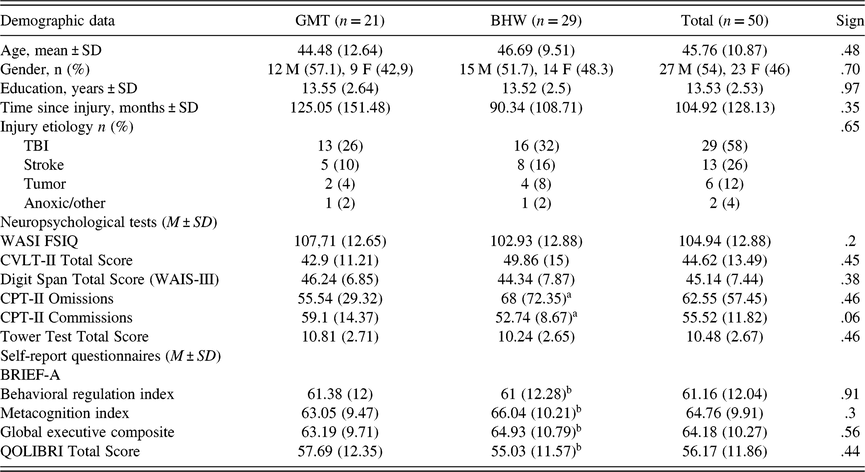
A total of 67 subjects who completed the 6-month follow-up (T3) of the initial RCT (Tornås et al., Reference Tornås, Løvstad, Solbakk, Evans, Endestad, Hol and Stubberud2016) were invited to participate in the 5-year follow-up (T4). An information letter and two questionnaires from the initial study, the Behavior Rating Inventory of Executive Function – Adult Version (BRIEF-A: Gioia et al., Reference Gioia, Isquith, Guy and Kenworthy2000) and the Quality of Life (QoL) after Brain Injury (QOLIBRI: von Steinbuechel et al., Reference von Steinbuechel, Wilson, Gibbons, Muehlan, Schmidt, Schmidt, Schmidt, Sasse, Koskinen, Sarajuuri, Hofer, Bullinger, Maas, Neugebauer, Powell, von Wild, Zitnay, Bakx, Christensen, Formisano, Hawthorne and Truelle2012) were sent through mail. Fifty persons (74.6%, 21 GMT participants) returned the questionnaires. A slight majority were males (54%), mean age was 45.8 years (SD = 10.9), and mean length of education was 13.5 years (SD = 2.5). Traumatic brain injury (TBI) was the dominant cause of injury (58%), and mean time since injury was 104.9 months (SD = 128.1) (Table 1). In subsequent post hoc analyses, potential differences between 50 subjects participating in the 5-year follow-up and 17 persons who did not respond were examined. There were no significant differences in the cause of injury, time since injury, gender, IQ, EF in daily life (all BRIEF-A indexes), or HRQoL (QOLIBRI) scores. The participants in the 5-year follow-up study were, however, significantly older (M = 45.7, SD = 10.7; t(65) = 2.48, p = 0.016) than the 17 persons (10 GMT/7 BHW) who did not participate (M = 37.2, SD = 16.0).
Baseline characteristics of the participants

Note. Percentage totals may not add to 100% due to rounding. All neuropsychological scores reported are standardized scores. Higher scores represent better performance, except for scores on the CPT-II where T scores above 60 indicate poor performance.
a N = 27.
b N = 28.
GMT = Goal Management Training; BHW = Brain Health Workshop; Sign = Significance; WASI FSIQ = Wechsler Abbreviated Scale of Intelligence Full Scale Intelligence Quotient (M = 100, SD = 15); CVLT-II = California Verbal Learning Test II (M = 50, SD = 10); WAIS-III = Wechsler Adult Intelligence Scale III (M = 10, SD = 3); CPT-II = Conners Continuous Performance Test II (M = 50, SD = 10); RT = reaction time. BRIEF-A = Behavior Rating Inventory of Executive Function Adult version. BRIEF-A scores are norm-referenced T scores (M = 50, SD = 10), with higher scores indicating greater impairment; QOLIBRI = Quality Of Life after Brain Injury, QOLIBRI total scores are total scaled scores (0–100), with higher scores indicating better HRQoL; M = men; F = female.
This study was approved by the Regional Committee for Medical Research Ethics (2012/1436), South-Eastern Norway, and was conducted in accordance with the Declaration of Helsinki. Participants provided written informed consent.
Interventions
Both GMT and BHW were adapted from Levine and colleagues’ manual-based protocols, translated into Norwegian and matched regarding the amount of group training (8 sessions of 2 hr), educational material, homework, and therapist contact (Stubberud et al., Reference Stubberud, Langenbahn, Levine, Stanghelle and Schanke2013; Tornås et al., Reference Tornås, Løvstad, Solbakk, Schanke and Stubberud2016). Efforts to maximize treatment adherence included reminders the day before the upcoming session, emphasizing the importance of using the personal workbooks, prompting for future sessions, and reviewing all homework in the consecutive session. In addition, all participants received a daily text message stating “STOP” following the fourth session throughout the training (28 per participant) (Fish et al., Reference Fish, Evans, Nimmo, Martin, Kersel, Bateman and Manly2007). Future maintenance of the interventions was addressed in the last session by discussing the strategies learned, and the importance of continued use. Otherwise, no further actions were taken to ensure maintenance.
Goal management training
The nine original GMT modules were merged into seven, carefully addressing all core concepts of GMT in the same order, emphasizing mindfulness exercises heavily throughout the training. A new emotional regulation module was also included, introducing core concepts from Cognitive Behavioral Therapy (CBT), the mutual relationship between thoughts, situations and emotions, and how negative self-talk becomes “automatic” and can interfere with goal achievement.
Brain health workshop
The BHW involved the use of educational materials and lifestyle topics, similar to many psychoeducational ABI rehabilitation programs. Key topics included brain anatomy, brain injury, brain plasticity, memory, executive functioning, sleep, physical activity, fatigue, and nutrition (Tornås et al., Reference Tornås, Løvstad, Solbakk, Schanke and Stubberud2016).
Baseline measures
Cognitive functioning at baseline was characterized by intellectual capacity (Wechsler Abbreviated Scale of Intelligence, WASI), verbal learning and memory (California Verbal Learning Test – II, CVLT-II), Digit Span (from Wechsler Adult Intelligence Scale III, WAIS-III), sustained attention (Conners’ Continuous Performance Test II, CPT-II), and strategic thinking (Tower Test from the Delis-Kaplan Executive Function System, D-KEFS).
Outcome measures
The 5-year follow-up of self-reported EF in daily life was assessed with the BRIEF-A, and Health Related Quality of Life was assessed by QOLIBRI. Thus, both outcome measures were applied at baseline (T1), post-intervention (T2), at 6-month follow-up (T3) (initial study), and at 5-year follow-up (T4).
Statistical analyses
Data were analyzed with SPSS version 25 for Windows. Descriptive statistics are provided for demographic, neuropsychological, and questionnaire variables. Between-group differences were analyzed using t tests for continuous and Chi-square for dichotomous variables. A general linear model (GLM) with repeated measures analysis of variance (RM ANOVA) was used to examine group-related treatment effects, with Group (GMT, BHW) as between-subjects factor, and Time (baseline T1, post-intervention T2, 6-month follow-up T3, and 5-year follow-up T4) as within-subjects factor. Analyses included all subjects returning the 5-year follow-up quetsionnaires. Due to limited statistical power and a risk of missing interesting tendencies, we used t tests to explore change within groups (T1-T2, T1-T3, and T1-T4). Effect-size statistics were provided with partial eta-squared for ANOVA and eta-squared (η 2) for t tests, interpreting η 2 < .06 as small, .06–.14 as medium, and >.14 as large effects (Cohen, Reference Cohen1988). Due to numerous comparisons, a conservative significance threshold of <.01 was applied.
RESULTS
Baseline functioning
The GMT and BHW groups were comparable at baseline with regard to demographic, medical, neuropsychological, and self-reported symptom variables (Table 1). In general, the results from neuropsychological measures and self-report of EF problems in daily life (BRIEF-A) indicated mild to moderate impairments.
Treatment effects
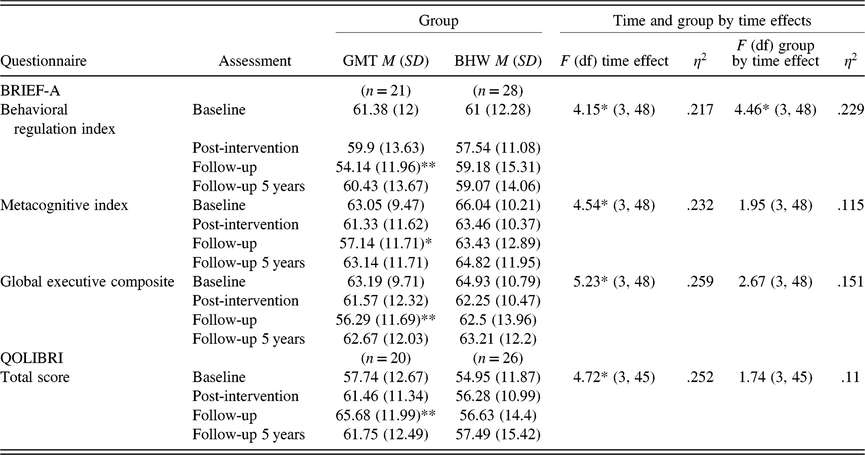
Table 2 provides mean scores for self-reported EF and perceived HRQoL for GMT and BHW, with time, group-by-time effects, and intra-group change.
Mean scores on outcome measures by time for the GMT and the BHW group, with time and group by time effects

Note. Significant effects are in comparison to baseline *p < .01; **p < .001. All F-tests use Wilks’ lambda statistic. N’s are provided as data were missing for certain measurements.
GMT = Goal Management Training; BHW = Brain Health Workshop; BRIEF-A = Behavior Rating Inventory of Executive Function Adult version; QOLIBRI = Quality of Life After Brain Injury. BRIEF-A scores are norm-referenced T scores (M = 50. SD = 10), with higher scores indicating greater impairment. QOLIBRI total scores are total scaled scores (0–100), with higher scores indicating better HRQoL.
A significant main effect of time was seen for all three BRIEF-A indexes, as well as a significant time-by-group interaction for the Behavioral Regulation Index (BRI). Subsequent post-hoc analyses showed a significant increase in BRI symptoms for the GMT-group from T3 (M = 54.1, SD = 11.9) to T4 (M = 60.4, SD = 13.2; t(20) = − 2.31, p = 0.031), that was not present for the BHW-group. Further, for the GMT-group, the paired-samples t-tests showed a significant reduction in self-reported executive problems for all BRIEF-A indexes from T1 to T3, but then returned to baseline levels at T4. A significant main effect of time was also observed for HRQoL (QOLIBRI total score). Of interest, the paired-samples t tests showed a significant increase (i.e., improvement) from baseline to 6-month follow-up (T1–T3) for the GMT group. However, these changes in HRQoL failed to reach significance from baseline to 5-year follow-up (T1–T4) for the GMT group. All significant findings had medium to large effect-size estimates.
DISCUSSION
The aim of this study was to determine 5-year outcome following GMT, hypothesizing that GMT would be associated with improved EF in daily life and HRQoL, when compared to BHW. The results of this study parallel the trends from the original study, indicating that GMT after ABI is efficacious in improving self-reported EF and HRQoL 6-month post-treatment. However, changes in EF in daily life and HRQoL did not remain significant at 5-year follow-up. As all EF and HRQoL scores at the 5-year follow-up returned to the baseline score level, the time-by-group interactions observed are likely to be explained by the significant reduction in self-reported dysexecutive symptoms from T1 to T3 seen in the GMT group.
An important component of rehabilitation trials is to examine the long-term effects of the intervention. Our findings suggest that GMT is an effective metacognitive strategy training method, ameliorating executive dysfunction in daily life for patients with chronic ABI. However, the significant GMT-related improvements on perceived EF in everyday life and HRQoL seem to be limited to the 6-month follow-up. Although the greatest effects following GMT have been observed in subjective EF ratings by proxy, Stamenova and Levine (Reference Stamenova and Levine2018) observed in their meta-analysis that the subjective ratings of EF (rated by either proxy or patients) were not maintained at follow-up. They argued that since questionnaire responses are based on subjective ratings, they may be less reliable than, for example, neuropsychological test performance. It is, thus, possible that the long-term effects of GMT could differ between the two assessment types (Stamenova & Levine, Reference Stamenova and Levine2018). The participants in the 5-year follow-up study were significantly older than those who did not respond. Still, the role of age remains unclear, and we cannot know if the broader sample would have displayed the same pattern.
While some participants may have sought additional treatment due to a less-than-adequate response to initial treatment, the participants in this study did not receive any form of GMT maintenance intervention or activities following the end of treatment. If indeed the performance gains presented are temporary, it is imperative to explore the potential effects of some type of maintenance intervention (e.g., sessions or activities) post-treatment.
Maintenance intervention
Although strategies for the remediation of executive dysfunction have improved, little attention has been paid to techniques that might be employed to increase long-term preservation or retention of learned EF skills. Identifying more precisely who are at relatively greater risk for relapse and targeting those individuals with maintenance intervention would be a cost-effective strategy. For the time being, we have limited knowledge about which interventions and intervention mechanisms work best for whom, when in the course of recovery, and under what conditions (Tornås et al., Reference Tornås, Stubberud, Solbakk, Evans, Schanke and Løvstad2017).
In general, it seems necessary to make long-term maintenance plans. In addition to include booster sessions and enlist involvement from significant others, the identification of potential barriers to maintenance and plan for high risk situations, should of course also be included in this work (Sohlberg & Mateer, Reference Sohlberg and Mateer2001). Furthermore, the delivery of exogenous, content-free cues (e.g., random tones) has been shown to aid patients with EF and sustained attention deficits in reorienting attention to goal relevant tasks (Fish et al., Reference Fish, Evans, Nimmo, Martin, Kersel, Bateman and Manly2007). As such, external cuing following training might support the maintenance of EF strategies embedded in GMT. Finally, future cognitive rehabilitation studies should also aim to increase the maintenance of positive findings by exploring techniques that have been shown to be effective in learning and retention, such as overtraining, and periodic testing (Friedman et al. Reference Friedman, Sullivan, Snider, Luta and Jones2017).
Study limitations
In addition to participants being unblinded for treatment allocation at 5-year follow-up, reduced insight, cognitive deficits, social desirability bias, and demand characteristics might have influenced the validity of the self-reports. New treatments, services or significant life-events between the 6-month and 5-year follow-up might have affected the participants’ health trajectories, and subsequently the self-reports of EF and HRQoL. Future follow-up studies should comprise information from significant others and functional status, data on what participants did between the end of the study and the follow-up, recruit larger samples, and include more frequent follow-ups and assess plural domains, such as cognitive tests and/or questions or interviews relating to strategy use (i.e., GMT) and EF in daily life.
CONCLUSIONS
Data from 50 patients receiving either GMT or a nonspecific psychoeducational service indicated that the significant GMT-related improvements on perceived EF in everyday life and HRQoL that were observed at 6-month follow-up were no longer present at 5-year follow-up. These findings underscore the importance of long-term follow-up of clinical interventions as part of evidence-based recommendations. Furthermore, the findings might also indicate a need to explore the effect of booster sessions, external cuing, and techniques that have been shown to be effective in learning and retention (e.g., overtraining, and periodic testing).
ACKNOWLEDGEMENTS
This study was funded by the Norwegian ExtraFoundation for Health and Rehabilitation through EXTRA funds (grant number 2011/2/0204). The authors thank the participants and the staff at the Cognitive Rehabilitation Unit Sunnaas Rehabilitation Hospital.
CONFLICTS OF INTEREST
The authors have nothing to disclose.