I
On 25 April 1974, the dictatorship installed by Salazar in Portugal was brought to an end by a bloodless military coup after forty-eight years. The institution of parliamentary democracy and inclusion in the western European family was far from certain in the spring of 1974, and seemed unlikely at several points over the course of the following two years. Political competition was fierce, and the possibility of a NATO country turning socialist was considered a reasonable scenario, discussed at the highest international levels.Footnote 1 Three decades on, it is easy to underestimate both the uncertainty and the expectancy that accompanied the Portuguese transition.
This article is an investigation of the political struggles that resulted in the establishment of democracy in Portugal, and particularly of the role played by collective actors in that process. More broadly, it is also a reflection on processes of mobilization, radicalization, and demobilization, which address the relationship between the preferences of ordinary citizens and the establishment of democracy.
Between the April 1974 coup and the military confrontation in November 1975 of army units loyal to the revolutionary left and those siding with the moderate coalition, Portugal experienced unprecedented levels of popular participation. Labour mobilization, growing throughout the final years of the dictatorship, remained unabated beyond the coup. Workers took control of factories and workplaces and, from late 1974, landless wage-labourers in the south began a series of land seizures that would win them control of nearly a quarter of all arable land in the country.Footnote 2 In Portugal's largest cities, a movement emerged composed of thousands of poor urban dwellers, mostly from shanty, run-down, and social housing neighbourhoods. This article examines the role of this urban movement in the transition to democracy as part of the wider mobilization of civil society witnessed during those two years.
For many on the left these popular movements held the promise of a new form of direct and popular democracy. Yet these hopes were dashed by the outcome of the transition, the establishment of a western-style parliamentary democracy, and the demobilization of grassroots movements. Struggling to make sense of this outcome, those on the left blamed the right, accusing it of cutting short the legitimate aspirations of the people. For the left, the coalition of forces which supported the military operation of 25 November 1975 smothered ‘the beginnings of a dual power … revolutionary situation’.Footnote 3 Conversely, the victors set about dismantling the idea that there had been a broad-based popular movement embodying the possibility of a different society. They sought to demonstrate that the popular movement had been nothing but the result of manipulation by revolutionary groups, citing the support given to moderates in the elections of 1975 as the real source of popular legitimacy.Footnote 4 Either way, to many contemporary commentators, popular mobilization, the ‘street’, was inherently opposed to the preferences expressed by the people at the ballot box. This interpretation has remained dominant since the transition, not least because it has proved a convenient myth for all sides. For the left, the notion that the people's will was defeated by the counter-revolution exonerated it from any responsibility in the failure to take Portugal further towards a real revolution. For the moderates, arguing that popular mobilization was a paper tiger allowed them first to deal with social protest during the difficult years of economic recession in the late 1970s, and later to shift their positions away from socialist policies, which both the main parties (PS and PPD) had advocated to different extents at the time of the transition.Footnote 5
Academic research on the Portuguese transition has mirrored these interpretations, reinforced by international comparative work on democratization, dominated by elite-level explanations of transition for much of the last two decades. In these accounts, the independent agency of grassroots collective actors is downplayed in favour of pact making and bargaining between political elites.Footnote 6 More recently, these models of elite-led transition have been challenged by research asserting an independent role for collective actors in episodes of political contention. According to these accounts, democratization cannot occur without the support, or at least against the wishes of, grassroots collective actors.Footnote 7
This debate calls for a reassessment of the Portuguese case, the beginnings of which can be seen in the labour movement and the land-seizures in southern Portugal.Footnote 8 Yet, surprisingly, there have been no in-depth studies of the urban social movement, arguably one of the central aspects of popular mobilization during the Portuguese Revolution.Footnote 9 The urban movement's size and reach involved many thousands of ordinary citizens in recurring political participation (as opposed to one-off demonstrations), to an extent that is comparable with other forms of extraordinary political involvement during the revolutionary period.Footnote 10 Moreover its visibility and impact at the heart of Portugal's largest cities, through waves of occupations threatening urban property, made it immediately present to the country's middle-class and political elites. In short, it is impossible to understand the role of collective actors in the transition without considering the urban movement.
II
When the Armed Forces Movement (Movimento das Forças Armadas – MFA) executed the coup in April 1974, it was unprepared for the upsurge of popular feeling that followed. Overnight, the military found itself running a country where, unchecked by repression, social demands exploded, and citizens flooded on to the streets, looking to the new rulers of the country to address long-held grievances.Footnote 11
The urban movement emerged in the forty-eight hours following the coup when shantytown residents occupied social housing blocs they claimed had been promised to them.Footnote 12 Moreover, in the shanty and poor neighbourhoods, newly formed residents’ commissions sent petitions and delegations to the overburdened new authorities. Their demands focused primarily on housing, seeing state provision as a social right. They also attacked the perceived corruption of local housing and welfare officials; demanded the provision of urban public goods such as water, sewerage, and transport; and sought access to childcare, medical, and leisure facilities. The movement was driven by the desire of local populations to have their problems addressed, and by their perception that an opportunity to do so had arisen.
The transition authorities reacted positively to the actions of the emerging urban movement. Unwilling to be seen to use force against the people, the military tacitly accepted the occupation of social housing. According to the minister for housing, this was a ‘political price’ that had to be paid to avoid clashes between the new authorities and the population.Footnote 13 Yet, at the same time, it also legitimized the organization of the urban social movement and signalled the authorities' willingness to listen, encouraging the spread of the mobilization.
The response of the provisional government was not purely rhetorical, as there were concrete measures that rewarded the mobilization of the urban poor, namely a co-operative housing scheme for shantytown dwellers (the SAAL) and a new rental law aimed at controlling speculation.Footnote 14 These measures, enacted in September 1974, were seen as victories for the urban movement and further contributed to its development. Residents' commissions from neighbourhoods involved in the cooperative housing scheme began holding joint meetings in November 1974 and, by January 1975, had formed a federation, the Inter-comissões dos Bairros Pobres e de Lata de Lisboa (Inter-commissions of the Shantytowns and Poor Neighbourhoods of Lisbon), which was to become the largest residents' organization and a major player in the urban movement.Footnote 15 In other areas, particularly in older central neighbourhoods where the proportion of empty housing was greatest, the Rental Law encouraged the formation of commissions that would assist the authorities in identifying vacant housing and speculating landlords.Footnote 16 The Rental Law also had the unintented consequence of encouraging the spread of occupations to private homes, and the subsequent creation of a number of occupiers' commissions that further swelled the ranks of the movement. Up to early 1975, most occupations had targeted social housing, driven by perceived inequities and corruption in its allocation. However, at the end of the period specified by the Rental Law for landlords to rent their vacant properties, shantytown residents seized thousands of apartments across the city. Contemporary newspaper accounts and interviews make it clear that these occupations had been made justifiable by the authorities' rhetoric on ‘speculating landlords’ and that occupiers believed the new law would protect them from eviction.Footnote 17 The police and military were called to act and indeed some occupations were prevented or reversed. Despite this, many occupiers remained in place, awaiting legal review, and were widely backed by public opinion.Footnote 18 By March 1975 there were fifty-seven neighbourhood commissions active in Lisbon, mobilizing thousands of residents, gaining concessions from the government and city council and winning widespread sympathy from most political quarters. Yet, in the next few months, the movement would grow larger, and become entangled in the complex political competition of the transition.
The Portuguese political process entered a new phase when, on 11 March 1975, right-wing groups in the military staged a counter-coup. While the plot was easily crushed, it strengthened the hand of the left faction within the MFA, who had been warning of the dangers posed by reactionaries. This allowed the institutionalization of the military at the heart of the political system through the creation of the Council of the Revolution, appointed by and composed of the representatives of the three branches of the armed forces, and with wide-ranging powers over the direction of the country.Footnote 19 A newly formed 3rd provisional government, dominated by MFA radicals and Communists was able to introduce a number of radical policies, including an extensive programme of nationalization. From March onwards, political discourse came to be dominated by revolutionary slogans and vociferous attacks on ‘reactionaries’ and ‘counter-revolutionaries’.
This leftward lurch was also felt in the relationship between the authorities and the urban movement. Under pressure to deliver on its housing promises, the government and the city council changed their position and began, in April 1975, officially to condone the seizure of private dwellings, creating the conditions for an expansion of housing occupations. At the end of March, a fire in one of the largest shantytowns in Lisbon, Curraleira, left hundreds homeless. As residents began occupying property to house these people, the city council issued a decree giving ward executives and residents' commissions powers to seize vacant properties in emergency situations.Footnote 20 This volte-face by the city authorities was mirrored by the government, which passed legislation regulating occupation of vacant houses in certain conditions, stating that ‘while there are people without houses, there cannot be houses without people’.Footnote 21
Although this was little more than the post hoc legalization of consummated facts on the ground, it reveals a shift in the positions of both the government and the city council that must be understood in the context of both pressure from below, and the dynamics of increasing competition between all the political actors in the run up to the elections for the constituent assembly, set for April 1975. While Communist and radical MFA ministers were at the forefront of such legislation, the moderate parties were also represented at cabinet level. The positions of the PS and PPD were, in essence, supportive of the authorities' intervention.Footnote 22
While the lead-in to the elections meant that all political factions sought to court favour with the urban movement, the shift in power brought about by the electoral results was to drag the urban movement even further to the centre of events. The significance of the elections had become far more immediate than the drafting of a new constitution. Radicals in the MFA and their allies in the civilian parties feared that their project for the transformation of Portuguese society would be derailed by an electoral victory for the moderate parties, who had already begun to express reservations about the role of the military in politics. Prime Minister Vasco Gonçalves defended the MFA, warning that the country would ‘not lose through the electoral route that which has cost the Portuguese so much’.Footnote 23 But despite the ascendancy of the radical camp since 11 March, the elections delivered a stunning victory for the moderates. Between them, the Socialists and the Popular Democrats attained nearly two-thirds of the total vote, while the Communist share was surprisingly low.Footnote 24
With these results, the stage was set for a confrontation between the electoral legitimacy claimed by the moderates, and the revolutionary legitimacy asserted by MFA radicals and Communists and far-left revolutionaries. While the former advocated that the provisional government should reflect the electoral results, the latter remained in the driving seat, claiming a deeper, revolutionary, mandate for the construction of socialism. While to some this situation evoked the ‘dual power situation’ of the Russian Revolution, for the time being, neither side possessed the strength to achieve a decisive victory over the other.Footnote 25
This impasse proved fruitful ground for the urban movement to expand and extract concessions from the city and government authorities, whose eagerness to earn the favour of the neighbourhood commissions was now even stronger. Between March and July 1975, sixty-six new commissions were formed, particularly in inner-city and middle-class areas where housing seizures were most common.
The birth of a new body, which represented many of the newly created commissions, is testament to the impact of this favourable environment on the movement. From late April, supported by the Lisbon Tenants' Union, occupiers' commissions began appearing in middle-class and older inner-city areas that had the highest number of vacant properties. As their leaders stated, they were explicitly taking advantage of the authorities' change of attitude towards housing occupations, and set themselves up to organize seizures, distribute houses, and defend the rights of occupiers.Footnote 26 These commissions were organized into a federation calling itself the secretariat of Comissões Revolucionárias e Autónomas de Moradores e Ocupantes (Autonomous and Revolutionary Residents' and Occupiers' Commissions – CRAMO). The CRAMO's programme and discourse was the most radical of all the urban movement organizations. It criticized many of the existing commissions for being ‘only concerned with sectional problems such as garbage, health or housing etc.’ rather than addressing ‘residents’ real problems'. Its objective was to develop a ‘revolutionary consciousness’, departing from housing to ‘more global perspectives’.Footnote 27
Despite the birth of the CRAMO, the shantytown-led Inter-comissões remained the most influential federation of residents' commissions, and used its position to organize the largest demonstration on the issue to be held in Portugal, extracting further concessions from the government. It was co-ordinated with residents' commissions from Oporto, where a similar rally took place, and from the districts surrounding Lisbon, which brought their members to the capital. The CRAMO also gave its support. A number of slogans were agreed, which included ‘an end to the shantytowns’; ‘the people build the houses, the houses to the people’; ‘repression of speculating landlords’; ‘against unemployment, against auto-construção’; ‘the struggle of the neighbourhoods is one’.Footnote 28 The demonstration was a success. Enjoying the backing of a wide range of parties and organizations – including the Socialists – it was widely covered by the media and some reports put the combined Lisbon and Oporto protest at around 100,000 strong, although the real numbers are probably somewhat lower.Footnote 29 On the back of this show of strength, the movement won a number of concessions: the assurance that new neighbourhoods would be built in the same areas as the existing shantytowns, a cap on social housing rent at one tenth of the household head's salary, a rise in the direct grant and a 3 per cent ceiling on interest rates for loans to house-building co-operatives. There was also the promise of an investigation of allegations of corruption in housing allocation, and the guarantee of further legislation in support of the occupation of empty houses by families in urgent need.Footnote 30 This was confirmed a week later when the newspapers announced that the Lisbon city council, the miltary high command, and the police decreed that all vacant houses in the city would be immediately requisitioned.Footnote 31
The 17 May 1975 demonstration, with its show of unity, support, and the victories it achieved, was the high-water mark of the urban movement in Lisbon. This was the result of an iterated process, a cycle of mobilization initiated by the actions of shantytown residents back in April 1974: each time their strength forced a concession from the authorities, it increased the incentives for other areas to organize, swelling the ranks of the movement and increasing the pressure of the authorities. But the response of the authorities was conditioned not just by the strength of pressure from below, but also by the nature of state power and political competition during the transition: initial concessions had been granted as an attempt to quench social unrest for fear that instability would bring about a counter-coup. By mid-1975, in addition to the growing strength and popularity of the urban movement, evolving attitudes towards grassroots collective actors were also connected to the political struggle within the coalition that had hitherto sustained the provisional government.
III
The upshot of the elections, for all the protestations of the Communists, extreme left, and MFA radicals, was to give the moderate civilian parties a plausible claim to power. Faced with this challenge, the radical camp sought alternative forms of legitimation, appealing to mobilized sectors of the population. If they were successful in bringing those in step with their cause and programme, they stood a better chance of denying the moderates control over the process of transition.
The result was the growing polarization of politics in Portugal during what came to be known as the ‘Hot Summer’ of 1975. The emergence of factions defined by a growing ideological opposition and mutually exclusive political principles will often lead, as Sartori argued, to the impossibility of generating the coalitions and consensus that sustain democracy.Footnote 32 At first sight, the Portuguese Hot Summer seems to fit neatly into Sartori's definition of a polarized political arena. On one hand, military radicals, revolutionary parties, and, hesitantly but crucially, the Communist Party backed a political trajectory that sidelined the moderates and emphasized revolutionary, rather than electoral, legitimacy. In turn, the moderates responded by refusing to continue to collaborate in the provisional governments, sparking a crisis that would only be resolved by the November confrontation.
Threatened by calls from the moderate camp for control over the process of transition, the radical wing of the military put forward a revolutionary project that maintained the MFA at the helm of the country and bypassed the civilian parties in favour of an alliance between the military and grassroots organizations as the organizational basis of the political system. This was a set of political ideas and approaches that came to be generally termed ‘Popular Power’, codified by a ‘guiding document’, the Alliance People–MFA Document. This programme, approved by the MFA assembly at the beginning of July 1975, sanctioned a rush to promote, create, and empower grassroots organizations in neighbourhoods, factories, and southern agricultural estates. Its objective was to ‘mobilize the People for the Revolution’, for which it was necessary to consolidate the alliance between the ‘dual engine of the revolutionary process’: the People and the MFA.Footnote 33 The document envisaged three axes of political power: the MFA, Popular Power, and the government. The MFA's Council of the Revolution would be the highest sovereign entity. The state was to be gradually purged and decentralized, with its powers devolved to ‘popular bodies’. These would be composed of a network of local popular assemblies gathering residents' and workers' commissions alongside other ‘popular organizations’. These local bodies would send representatives to a municipal assembly, which would also include delegates from democratic assemblies in local military units. A further two layers of regional assemblies would in turn filter representation to a national popular assembly. Significantly, the structure and functions of the directly elected government were not specified.Footnote 34 In the long run, this plan sidelined the civilian parties; in the short term, it gave all levels of the military a directive to forge direct links between barracks and popular organizations.Footnote 35
In a short period of time, military units assigned to public order duties – namely the COPCON – went from dislodging occupiers to defending them.Footnote 36 Across the city, soldiers and officers were actively involved in the creation of popular assemblies. The first of these to be held in Lisbon took place in late June 1975, gathering fourteen workers' commissions and twenty-five residents' commissions under the auspices of the 1st Engineers Regiment. The officer chairing the meeting made its position clear, rejecting ‘the deviations of “socialism in freedom” and social democracy, reminding [the assembly] that the false socialists are against the creation of Popular Power organizations’.Footnote 37 The Communist Party tentatively joined in, wary of the anti-party rhetoric of the military, but also fearful of being left behind if the pendulum was to swing definitely towards the radical wing of the military. As such, the party set about promoting its own grassroots umbrella organizations: the PCP and MDP-led Lisbon City executive drew up proposals for a municipal council composed of representatives of residents' and workers' commissions which would take over the running of the city.Footnote 38
Throughout 1974 and the first half of 1975, the moderates' attitude to grassroots participation had been mostly positive. Now, given the dangers of the mobilization of Popular Power in opposition to the electoral legitimacy of the constituent assembly, they distanced themselves from the urban movement, accusing some residents' commissions of undemocratic practices.Footnote 39 Soon after, the moderate parties raised the stakes further: on 16 July, the Socialist Party abandoned the government, followed a few days later by the PPD. A 5th provisional government took office without moderate representation, held together by the coalition of MFA radicals with the Communists and the MDP. Once in opposition, the moderate coalition became increasingly critical of grassroots mobilization.Footnote 40
Despite its circumstantial alliance under the 5th government, the coalition of Communists, military radicals, and revolutionary populists was never secure. The various civilian parties (the PCP in particular) were wary of being sidelined by the MFA factions in a Peruvian-style military regime; MFA radicals under Gonçalves held the reins of power but were increasingly isolated even within the military, while the far left (both civilian and military) was historically suspicious and critical of the Communist Party. Attempts were made to cement an alliance, but the ‘United Popular Front’ (Frente Unitária Popular, FUP) folded when the Communists walked out of the preliminary meetings, blaming the ‘instability’, ‘desperation’, and ‘radicalism’ of the extreme-left parties.Footnote 41 The result was the fall of the 5th provisional government at the beginning of September, and the appointment of a new cabinet (the 6th) with a majority of moderates. The Communist Party did take seats in the new government, but its influence was greatly diminished. The far left, which had been a cornerstone of the 5th government through its influence on the COPCON commander Otelo Saraiva de Carvalho, found itself marginalized. The 6th provisional government was able to score an important tactical victory against the Popular Power camp by courting Otelo, who gave the new government hesitant, but important support.
The new government presented a relatively moderate programme, emphasizing the normalization of political life and distancing itself from the Popular Power project. Soon after taking power it authorized a police charge on a demonstration in support of the Oporto municipal council, a Popular Power organization it refused to recognize as a legitimate representative body.Footnote 42 In Lisbon, the city executive remained in the hands of the PCP–MDP coalition, but in a press statement the government warned that a municipal council created on the terms proposed by the city authorities ran the risk of being unrepresentative, and could be ‘manipulated by privileged individuals from the high and even middle bourgeoisie, who naturally have more time to dedicate to such tasks than the working class’.Footnote 43 Speaking on television, Prime Minister Pinheiro de Azevedo blamed the ‘generous revolutionary impulse’ behind the housing occupations for a frontal attack on private property against the wishes of the majority of the population. Without doubting the ‘social validity’ of the desire to house the homeless, Azevedo called the occupations ‘an example of apparent revolutionary coherence’ which was ‘more naïve than efficient’, to the extent that it plunged the construction sector into crisis and caused a break in output which far outstripped the gains in housing through occupation.Footnote 44
With a moderate government intent on rolling back the advances of Popular Power, the far left took an increasingly insurrectional stance, further polarizing the political landscape and increasing fears of a civil war. Within the military, as the MFA moderates assumed control, radical organizations began threatening mutiny. A clandestine organization, ‘United Soldiers will Win’ (Soldados Unidos Vencerão – SUV), appeared in barracks across the country, criticizing the reactionary command structure of the military, threatening to supply arms to the people, and turning out in Popular Power demonstrations in uniform, with covered faces.Footnote 45 The PCP, in turn, remained in the cabinet, but continued actively to support strikes and street demonstrations against the government in the hope that a crisis would allow it to carve a more prominent role for itself.
It was by no means only the left that was driving Portuguese politics to extremes. In the north of the country, political violence directed at PCP and far-left party headquarters and supporters was on the increase, and right-wing paramilitary groups appeared claiming responsibility for bombings against ‘communist’ targets. Throughout October and November, the newspapers repeatedly warned of plots and bombs, adding to the feeling that the crisis could easily slip into civil war.
As the situation grew tenser, some in the moderate camp saw the urban movement as building up to something that could have serious consequences. Speaking at the constituent assembly on 21 October, PS spokesman Sottomayor Cardia accused ‘pseudo-revolutionary’ adventurers of seeking to bring down the ‘democratic and revolutionary’ 6th provisional government, replacing it with the authority of ‘self-appointed residents' commissions, puppet municipal councils and subversive military units’. This, Cardia predicted, would end up in a
Lisbon Commune, [which] if it unhappily comes to pass, will last no longer than the Paris or Berlin Communes. In truth it will be even more desperate, and above all unpopular, than those famous historical precedents. But, if it happens, it will sound the alarm for the counter-revolution … Many of those who dream of it seek only to demonstrate that revolutions are bloody tragedies and not triumphs of peace. The Carnation Revolution was not predicted by any manuals. [They say:] Let us drown it in blood so they would not be contradicted.Footnote 46
IV
The polarization of the political arena during the Hot Summer of 1975 had an important effect on the urban movement. The Popular Power project was explicitly designed to capitalize on the strength and legitimacy of grassroots movements in order to shore up the revolutionary camp. At first sight, it does seem as if the movement chose to side with the revolutionaries. However, a closer analysis of the sources reveals a more complex response and a backlash against radicalization that helps to explain why the moderates were able to win an easy victory by November 1975.
At its inception, the movement's language focused on rights, looking back in anger to the dictatorship's failure to guarantee them. However there was a marked change over the summer of 1975, with many commissions beginning to look forward to an overall transformation of society through revolution. This was expressed by addressing national political issues, and borrowing from the political discourse of the radical government and the military leadership. In early June, a commission from Alcântara passed a motion calling on soldiers and sailors from nearby barracks, as well as ‘anyone interested in the socialist revolution’ to join the commission, ‘a school of revolutionary unity where we can learn to defend together … the interests of the revolution’.Footnote 47 In July, as the moderates abandoned the government, the residents of Casal Ventoso asked for ‘popular vigilance’ against reactionary forces.Footnote 48 In mid-August, at a celebration organized by another commission from Alcântara, revellers sang a famous tune composed in support of the radical prime minister, ‘Be strong, companheiro Vasco, we shall be a wall of steel.’Footnote 49 This process of radicalization was also apparent at the level of the movement's umbrella groups, the CRAMO and the Inter-comissões. When the political rhetoric of the extreme left hardened, the CRAMO was able to portray itself as the champion of the urban movement against the moderate offensive and the collaborationist betrayal of the PCP, organizing boycotts of trials of occupiers, declaring that ‘only popular tribunals, and not those of the bourgeoisie, can judge the cases of the People’.Footnote 50 The Inter-comissões leadership, which had previously defended co-operation with the government and a less confrontational stance than the occupiers' organization, also began to advocate revolutionary solutions, frustrated by the slow delivery of the commitments it had earned following the 17 May demonstration. In July, members of its executive declared their support for the Popular Power project and defended that
only with [a revolutionary government] will the housing problem be solved, to the extent that there is a total transformation of the capitalist system to a socialist system. We see that in France, Germany or America, the most advanced countries, shantytowns continue to exist. It is essential to understand that the problem of housing is not solved without the resolution of the problem of political power in favour of the workers.Footnote 51
The shift in the position of the Inter was such that, in November 1975, it issued a joint statement with the CRAMO secretariat announcing a merger, ‘great step forward in the formation of the future “Lisbon popular assembly” which will appear from the coming together of the councils of Soldiers, Workers and Residents’.Footnote 52 Only a few months before, the idea of joining the two organizations had been flatly refused by the Inter executive, who expressed strong reservation about the occupiers' positions and motivations.Footnote 53
As the political factions increasingly defined themselves in opposition to each other, it seemed that the urban movement had chosen its side. The increasingly radical tone taken by grassroots organizations led some to suggest the Portuguese people were on the verge of something spectacular and that a real revolution was imminent. As a group of commissions critical of the moderate government put it: ‘History does not move backwards.’Footnote 54 The Revolution could not fail to run its course if the masses were fully behind it.
Yet, despite all the hopes and expectations, when it came to 25 November 1975, the urban movement was notable for its absence in the defence of its would-be leaders.Footnote 55 Just a few months before, the movement had been able to present a united front and extract numerous concessions from the authorities, mobilizing many thousands of ordinary citizens and proving it was no paper tiger. What changed during those crucial months? Why, in fact, did the ‘Lisbon Commune’ never come to pass?
The first task in assessing the depth of radicalization of the urban movement is to go beyond the picture created by the media and try to ascertain if support for the radical Popular Power project was typical within the movement. This is particularly important given that so much of the press had a campaigning slant, most often in favour of the revolutionary left.Footnote 56 In order to make sense of a wealth of material, critical events were surveyed across a variety of sources – newspapers, correspondence, and reports – that would provide a picture of the types of neighbourhood commissions that supported the Popular Power project. Five key political demonstrations in support of various strands of the project – two led by the far left, two by the Communists and their allies, and a large joint demonstration – were chosen.Footnote 57
This analysis reveals that commissions formed more recently tended to be over-represented among those expressing radical positions, which in total represented just under a third of the total number known to be active in Lisbon by that time. Revealingly, those commissions created before the radicalization of the movement, during 1974, are under-represented. Similarly, middle-class and central neighbourhoods appear more often in this sample than in the overall tally of commissions active by October 1975. Poor areas such as shantytowns or pre-fabricated council estates are, on the other hand, under-represented. Generally, this suggests the radicalization of the urban movement was the result of the militancy of more recent commissions from comparatively well-off areas of the city. This is likely to have been the result of the campaign carried out by the military, the far left, and the PCP and MDP alliance to promote the creation of residents' and occupiers' commissions sympathetic to their cause, which took place following the elections. In a large number of cases the sources explicitly refer to the presence of military personnel at the plenary meetings in which these new commissions were formed. Political parties, partisan newspapers, and other media and sections of a radicalized military were at hand to magnify the impact of the public posturing of the commissions that joined the Popular Power camp. Accordingly, more radical organizations monopolized the public arena, giving the impression that the whole movement was committed to the path of popular revolution.
However, the sources also suggest two other important points regarding this process of radicalization. First, a considerable number of commissions shied away from polarization and steered a more moderate course. Secondly, and perhaps as a result of those differences of opinions within the movement, there were growing internal splits and, crucially, increasing demobilization of ordinary residents who had provided the movement with its strength.
The evidence suggests that a large number of residents' commissions remained moderate. Correspondence between the commissions and the city authorities shows that, just as the position of some residents' commissions towards the housing services of the city council hardened, many individual commissions continued to collaborate willingly. For instance, the SAAL programme had given residents' commissions the option of using their members' own labour in building new neighbourhoods. Both the CRAMO and the Inter-comissões were determinedly opposed to it, calling it a form of ‘double exploitation’. Nevertheless, throughout 1975, a considerable number of residents' commissions appear in the sources not only willing, but actually eager, to use their own labour in neighbourhood improvements. Although none sought to build houses, the projects include schoolhouses, street paving, sports facilities, and public baths. There are at least thirteen such cases in the correspondence, all but one from residents' commissions from shantytowns or other poor neighbourhoods.Footnote 58 This contrasts sharply with the positions the Inter-comissões and the CRAMO had come to defend.
While some commissions chose to ignore the radicalization of the movements' leading organizations, some residents (particularly in middle-class areas) began organizing to depose commission executives they considered too extreme. This tendency becomes particularly marked after the fall of the 5th government, and the fortunes of one radical commission are a particularly good example. The commission executive of the São João de Deus ward had been working for some months on a voluntary, un-elected basis. In October 1975, it called a public meeting of the ward, seeking to have its mandate confirmed by a vote. According to the report in a newspaper close to the Communist Party, the meeting was, for a fifth time, ‘actively boycotted’ by those opposed to the residents' commission: ‘There was, in fact, a larger number who came intent on boycotting the plenary. However, the progressive minority present was able to respond frontally to the “loud majority” … yesterday, the reaction came in force.’Footnote 59
At a later meeting, the opposition proposed a new election for the commission. According to the Diário de Notícias, the executive called this a ‘grotesque electoralist manoeuvre’. The meeting degenerated into a shouting match with both sides throwing slogans across the room. Cries of ‘Portugal shall not be the Chile of Europe!’ from one side were answered with ‘Portugal shall not be the Hungary of Europe!’ (sic) and ‘There is only one government, the 6th and no other!’ from the other. Following this, the Diário de Notícias continues:
the national anthem was sung, after which hundreds of people left the room, this time to the sound of the ‘International’, sung by the progressive forces. These were the conclusions of the sixth residents’ plenary in the São João de Deus ward. We think it was also the last, since it was clearly demonstrated that the vast reactionary sector does not tolerate residents' commissions. They showed how much they fear Popular Power.Footnote 60
In the nearby São João de Brito ward, an open meeting attended by around 1,200 residents – the largest assembly reported in the sources – decided to remove the commission executive, accusing it of being composed of outsiders and of having organized illegitimate occupations. By November a new, moderate, executive had been elected.Footnote 61 Elsewhere, the rights of occupiers and the revolutionary legality defended by some of the commissions were also being contested. In November, the Revolutionary Occupiers' Commission of Penha de França tried to implement a sentence against a landlord decided at a CRAMO-organized popular tribunal. However, according to the Républica: ‘the insufficient awareness-raising amongst the residents of Penha de França … as well as the class origins of this neighbourhood's inhabitants, were the reasons for the impossibility of executing the sentence’.Footnote 62
These examples show a movement that was increasingly riven by conflict, and that the process of radicalization of many residents' commissions did not go unchallenged. But perhaps the most interesting and original evidence regarding the fortunes of the Lisbon urban movement in the second half of 1975 hints at the question of demobilization. Since April 1974, there had been isolated incidents when individual commissions had failed to mobilize enough residents to a given event, or when commission leaders complained of a lack of commitment from their constituents. While such things are part and parcel of local organizing, from the summer of 1975 onwards, there is increasing evidence in the sources that all was not well, including from newspapers supportive of the Popular Power project.
Several residents' commissions complained of demobilization, often blaming political adversaries, as in Chelas, where a campaign of ‘libellous pamphlets’ was blamed for driving the population away.Footnote 63 Elsewhere dwindling levels of commitment were blamed on residents' individualism, ‘a mentality which reflects a kind of society based on private property’.Footnote 64 In September, the São Mamede occupiers' commission put out a pamphlet pleading with local residents: ‘when you stay at home, [and] do not come to meetings …, you are leaving the path free for the reaction … we give you an example where the People fell asleep during the struggle … Chile’.Footnote 65
While individual commissions were showing signs of demobilization and demoralization, collectively, the movement as a whole was also not answering the calls of its would-be leaders. On 13 October, commissions and organizations close to the Communists organized a demonstration in support of the city council's proposals to create a municipal council composed of residents', workers', and soldiers' commission representatives to run the city.Footnote 66 Despite claims to the contrary in newspapers close to the PCP line, reports from other sources show that the demonstration was a failure. The Républica wrote that the organizers' ‘weak capacity for mobilization was easily attested by any who witnessed the demonstration’; the A Capital said that the number of residents present was ‘below expectations’; there was ‘enough space left for the same number of demonstrators again’ in the small square in front of the City Hall; the socialist-leaning A Luta called it ‘unrepresentative’, with only around 1,000 people present.Footnote 67
The clearest signs – and admissions – that the urban movement was losing momentum, came at the level of its umbrella organizations, the CRAMO and the Inter-comissões. By early September, there were signs that the Inter was having problems maintaining its support base. On 8 September, A Capital reported on the cancellation of its plenary assembly, composed of all member commissions:
Maybe because the season is not yet favourable, not enough interested parties showed up…the main [item on the agenda] would have been to widen the number of co-ordinating commission members to increase efficiency, but also to fill the gaps left by withdrawal of some neighbourhoods.Footnote 68
Some close observers thought the reasons for the problems faced by the Inter-comissões stemmed from the choices made by its leadership. A newsletter ‘in support of the struggle of shantytowns and poor neighbourhoods’ pondered the causes of demobilization: some commissions complained that their interests were not being defended by the Inter. But more importantly, it pointed to the growing radicalization of its leaders as the reason for the lack of interest from its members:
It happened that the Co-ordinating Commission has been called to take political positions…that do not correspond to the discussion and decisions of the residents of the majority of the neighbourhoods. As such, by devoting its work to questions other than those which led the neighbourhoods to join the Inter-comissões, the Co-ordinating Commission runs the risk of distancing itself from the general opinion of the neighbourhoods' population.Footnote 69
Furthermore, it discussed the creation of popular assemblies by suggesting that these could end up being controlled by bourgeois residents' commissions, meaning
the absorption of residents' commissions by those assemblies could delay and put in the background the resolution of the problems of the [poor] neighbourhoods…To ensure that the popular assemblies serve the interests of the workers…all the residents' commissions that become part of them must firmly defend what has been democratically decided by their neighbourhoods.Footnote 70
Despite these warnings, the Inter-comissões continued to experience difficulties: on 21 November, a meeting to prepare a new plan of action and list of demands to government was cancelled, as not enough representatives were present.Footnote 71 Looking back at the position of the Inter from 1976, the far-left newspaper Poder Popular recognized that, by October and November 1975, there was ‘a total demobilization of the Inter as an agent of co-ordination and unification of the struggle’.Footnote 72
The CRAMO secretariat fared little better. Although extremely active in organizing smaller gatherings that were able to attract publicity, such as popular tribunals and occupations, it failed to mobilize in large numbers for mass demonstrations. After the failure of one rally in July – only 500 people participated – a CRAMO leader justified the fiasco by saying that lack of time had hindered ‘work at the grassroots’ to mobilize people to a ‘kind of struggle’ they were not focused on.Footnote 73 In October, claiming that ‘the [necessary] conditions were not met’, the CRAMO pulled back from another full-scale demonstration.Footnote 74 The organization itself recognized its problems: in mid-November it called a meeting to discuss ‘organizational issues’ and how to conduct the struggle against the moderate government. The meeting was motivated by the fact that ‘the commissions are becoming isolated from the people who elect them’. A participant blamed this on the inability of the people to ‘release themselves from 48 years of obscurantism’. In these conditions, ‘people do not fight for collectivization, but rather for the bourgeois legalization of their situation, for the renting of the house after the occupation’.Footnote 75 Faced with a dwindling appeal, the CRAMOs chose to blame the people.
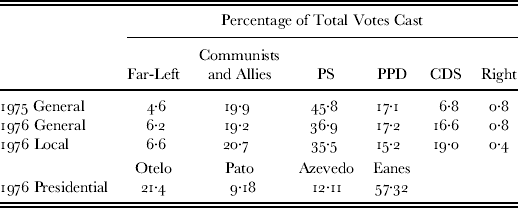
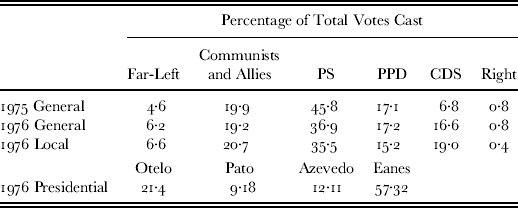
The voting patterns of the residents of the city can help clarify the causes of demobilization. These suggest that rather than going through a process of polarization and radicalization, the individual preferences of the ordinary citizens of Lisbon remained remarkably stable throughout the period. And these preferences, which had first been expressed in the constituent assembly elections of April 1975, gave a comfortable majority of votes to the parties that sided with the moderates and called for a pluralist democracy, as opposed to a popular democracy. Table 1 shows the results for the city of Lisbon in the four elections that took place between 1975 and 1976. Despite its claims to power and popular legitimacy, neither the far left nor the Communists made any significant inroads throughout the two-year period, even in the city's poorest wards, where the Socialists also led comfortably. Also, the share held by the moderate parties remained constant, notwithstanding a rearrangement of the votes between them following tactical voting in the PS at the first elections.
Voting Patterns in Lisbon, 1975–1976
Source: Comissão Nacional de Eleições, Portugal.
The only result that stands out is that obtained by Otelo Saraiva de Carvalho, former head of the COPCON, in the presidential elections of June 1976. The support gained by his bid for the presidency took many by surprise, not least the Communists, whose supporters snubbed the party candidate Octávio Pato. Otelo's populist campaign emphasized the importance of the role of grassroots organizations, and received the support of a number of residents' commissions and CRAMOs from Lisbon.Footnote 76 Nevertheless, the candidate supported by the PS, PPD, and CDS, Ramalho Eanes, topped the polls in all but two Lisbon wards. The success of Otelo's campaign is not easily explained, but the impression that it had more to do with the individual charisma and prestige of Otelo than with his political programme is strengthened by the results in the local elections six months later. Several of the radical parties that had supported Otelo's campaign attempted to take advantage of the momentum of the presidential election by putting forward local candidates on a pro-Popular Power platform. This was a failure, achieving less than 5 per cent of the vote in Lisbon, failing even to make an impression in the wards which Otelo had previously won. When presented with revolutionary political programmes that implied the relegation of representative bodies in relation to organic, ‘popular democracy’, the people who had supported the urban movement consistently voted against it.
V
Leading accounts of the impacts of social movements in processes of transition have argued that democratization requires the demobilization of civil society, as part of the bargaining process between former regime supporters and reformers. While stability is certainly a requisite for democracy, the manner of demobilization is important too. Theories of democratization have tended to see popular protest as an instrument of the politics of elites, assuming a top-down relationship within social movements. Robert Fishman has argued that the Spanish labour movement's growing strike activity in the final years of the dictatorship, followed by acquiescence and acceptance of the Moncloa Pact, was linked to the strategic choices made by pro-democracy opposition leaderships. Similar arguments have been made about the mobilization of neighbourhood associations in Spanish cities during 1976 and 1977, and in Chilean shantytowns in the 1980s.Footnote 77 In these accounts grassroots mobilization is just another resource at the disposal of political elites, which can be turned on or off at will in response to tactical needs.
This article has shown that events in Portugal followed a different dynamic, where elites were much more constrained by autonomous popular protest, and where collective actors certainly had a great deal of independent agency, and were a critical part of the political process. The conditions in Portugal were different: the political game was played out not between supporters of the dictatorship and the opposition, but between different strands of the latter. In this environment it was easier for independent grassroots movements to play off the competition between elite groups. Yet, in the end, their choices were critical: the demobilization of the movement was both a rejection of radicalization and an acceptance of democratization – an active choice by the rank and file, not an instruction from above.
The process described in this article fits Nancy Bermeo's distinction between public and private polarization, which asserts the difference between a polarized political arena – achieved by minorities with a monopoly on media and resources – and the individual preferences of the majority of citizens.Footnote 78 The evidence presented here supports this model by showing that despite public polarization, democratization in Portugal was still possible since private attitudes did not follow the political environment towards more radical extremes. With the supporters of the urban movement remaining staunchly moderate, the effect of public polarization was the reverse of the disaggregation predicted by Sartori: it helped pro-democracy forces through what Tilly and his colleagues have called a ‘radical flank effect’, encouraging the unity of moderate forces and their supporters.Footnote 79 At the elite level this resulted in the tactical alliance between the MFA moderates, the Socialists, and the PPD. At the street level this meant the refusal to support the radicalization of the movement's leadership. The Portuguese case suggests that collective actors can, and do, make positive contributions to democratization. In fact, in this case at least, democratization would have been made very difficult (if not impossible), had the ‘street’ not chosen a path of moderation which undermined revolutionary programmes.
The evidence presented here also raises a further question regarding the moderation of movement supporters, which is relevant not just to the Portuguese case, but also to different types of transitions, involving negotiation between previous regime supporters and democratizing forces. As Sidney Tarrow observed, the political preferences of the supporters of social movements are not necessarily pro-democratic.Footnote 80 It remains to be explored why, given half a century of dictatorship, the influence of revolutionary thought in leading intellectual and political circles, and the domination of the media by opponents of ‘bourgeois democracy’, the citizens of Lisbon (and Portugal) expressed such consistently moderate convictions, both on the street and at the ballot box.