INTRODUCTION
The importance of ascidians as an invasive species is increasing worldwide as the rise of several factors increase the likelihood of its spread. Such factors include eutrophication (Marins et al., Reference Marins, Novaes, Rocha and Junqueira2010), aquaculture (McKindsey et al., Reference McKindsey, Landry, O'Beirn and Davies2007; Rocha et al., Reference Rocha, Kremer, Baptista and Metri2009) and harbour and shipping operations (Darbyson et al., Reference Darbyson, Hanson, Locke and Willison2009; Grey, Reference Grey2009; Marins et al., Reference Marins, Oliveira, Maciel and Skinner2009). These introductions could impact natural environments in several ways as ascidians outperform native species (Kremer & Rocha, Reference Kremer and Rocha2011) or compete for food or space (Lutz-Collins et al., Reference Lutz-Collins, Ramsay, Quijón and Davidson2009). The number of studies on ascidians has increased in recent years, and the most studied species are Didemnum vexillum, Botrylloides violaceus, Botryllus schlosseri, Styela clava and Ciona intestinalis due to the extent of damage these species cause to aquaculture and to benthic biological diversity (Locke & Hanson, Reference Locke and Hanson2011).
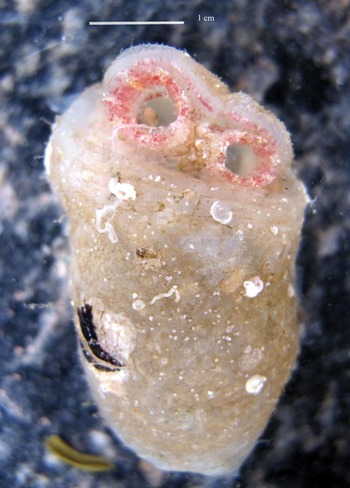
The genus Rhodosoma is in the family Corellidae, and includes two species: R. turcicum (Savigny, 1816) and R. callense (Lacaze-Duthiers, 1865) (Kott, Reference Kott2005; Sanamyan, Reference Sanamyan, Shenkar, Gittenberger, Lambert, Rius, Rocha and Swalla2010; Sanamyan & Monniot, Reference Sanamyan and Monniot2010). The most common species is R. turcicum (Millar, Reference Millar1988) (Figure 1). This species is described as widely distributed in tropical and some temperate seas (Millar, Reference Millar1988; Kott, Reference Kott2005; Izquierdo-Muñoz et al., Reference Izquierdo-Muñoz, Díaz-Valdés and Ramos-Esplá2009; Bonnet, Reference Bonnet2010; Sanamyan & Monniot, Reference Sanamyan and Monniot2010). Distribution includes the Indo-Pacific (Australia, New Caledonia, Indonesia, Phillipines, China, Japan, Mozambique, Somalia, Red Sea and India), East Pacific (California) and the Caribbean region in the West Atlantic (Florida, Jamaica, Puerto Rico, Guadeloupe, Curaçao, Bonaire, Panama and Venezuela) (Kott, Reference Kott1952; Millar, Reference Millar1988; Meenakshi & Renganathan, Reference Meenakshi and Renganathan1997; Rocha et al., Reference Rocha, Faria and Moreno2005a, Reference Rocha, Guerra-Castro, Lira, Paul, Hernández, Pérez, Sardi, Pérez, Herrera, Carbonini, Caraballo, Salazar, Diaz and Cruz-Motta2010; Bonnet, Reference Bonnet2010). Shenkar & Loya (Reference Shenkar and Loya2009) found this species in Israel, on both natural and artificial substrates. In Israel, it is considered a rare species living in cryptic environments. In other places, such as Panama, R. turcicum are found living among mangrove roots and coral reefs (Bonnet, Reference Bonnet2010). According to Faria (Reference Faria2006) this species' latitudinal distribution in the Atlantic Ocean ranges from 15oN to 30oN. There was no record of the species in the southern Atlantic and along the Brazilian coast until 1999, when Lotufo (Reference Lotufo2002) first recorded its presence on the north-east Brazilian coast, in Bahia State, attached to a submerged tug. Rocha et al. (Reference Rocha, Bonnet, Baptista and Beltramin2012a) indicated the presence of this species inside a marina, also at Bahia State.
Rhodosoma turcicum individual. Note the opened protective lid and both siphons. There are some fouling species (oyster, barnacles and polychaete) over its tunic. Scale bar = 1 cm.

This species is designated as a non-indigenous species (NIS) in Florida and the eastern Mediterranean Sea (Shenkar & Swalla, Reference Shenkar and Swalla2011). The first Mediterranean record of this species was in Lebanon in 1999 (Bittar & Kouli-Bitar, Reference Bitar and Kouli-Bitar2001). Later, it was recorded in Israel (Shenkar et al., Reference Shenkar, Zeldman and Loya2008; Izquierdo-Muñoz et al., Reference Izquierdo-Muñoz, Díaz-Valdés and Ramos-Esplá2009; Shenkar & Loya, Reference Shenkar and Loya2009) and Greece (Koukouras, Reference Koukouras2010).
The aim of this work is to report the occurrence of Rhodosoma turcicum in the south-west Atlantic (south-east Brazil) and discuss some factors that could be related to its introduction and detection.
MATERIALS AND METHODS
Study site
This study was conducted in the Cabo Frio region from January 2009 to December 2011. In 2009, we performed experiments at three sites: Forno Harbour (FH) (22°58′22.39″S 42°0′49.44″W); Forno Beach (FB) (22°58′6.64″S 42° 0′21.05″W) inside a shell farm; and at Cabo Frio Island (CFI) (23°0′4.84″S 42° 0′20.03″W). The Cabo Frio region is inside the Marine Protected Area of Arraial do Cabo (RESEX-AC). In 2010 and 2011, experiments were performed only at FH. Although this region is influenced by upwelling, the study site is under tropical influence, with sea surface temperatures (SST) ranging from 19oC to 26oC, with a mean ~22.5oC (Guimaraens & Coutinho, Reference Guimaraens and Coutinho2000; Skinner et al., Reference Skinner, Siviero and Coutinho2007, Reference Skinner, Macharet and Coutinho2011).
In this region, there is a harbour that previously received salt from Rio Grande do Norte (RN) State, on the north-east coast of Brazil, to Rio de Janeiro (RJ). Starting in the late 1990s, support activities to the oil industry have increased as has ship and platform traffic to this region. Many exotic species have been detected since the early 2000s including sponges Paraleucilla magna (Klautau et al., 2004), soft coral Chromonephthea braziliensis (Ofwegen, Reference Ofwegen van2005) and azooxanthellate coral Tubastrea coccinea (Fleury et al., 2005), bivalvia Isognomon bicolor (López et al., 2010), Didemnidae ascidians (Rocha & Costa, Reference Rocha and Costa2005), the polychaete Branchiomma luctuosum (Costa-Paiva et al., Reference Costa-Paiva, Paiva and Klautau2007) and Spirobranchus giganteus (Skinner et al., Reference Skinner, Tenório, Soares and Penha2012), among others (Lopes, Reference Lopes2009). Many of these introductions have been associated with this increase in ship traffic.
Sampling of individuals
Rhodosoma turcicum individuals were collected from the internal side of black plastic boxes (30 × 15 × 10 cm) used in predator exclusion experiments. These structures were immersed and kept suspended 1 m below the surface, with their openings turned to the bottom to create a cryptic environment. Granite plates (23 × 11 cm) were fixed inside these boxes. Some of the boxes had a mesh (1.0 cm) closing their openings while others were kept open to permit access of predators such as fishes and turtles. The use of floating structures prevents predation by benthic invertebrates such as crabs, molluscs and echinoderms. This methodology is the same as used by Marins et al. (Reference Marins, Oliveira, Maciel and Skinner2009), who collected Ciona intestinalis in Brazil. The number of structures ranged from 10 boxes at each site (FH, FB and CFI) in 2009 to 16 and 20 boxes at FH in 2010 and 2011, respectively. The difference in the number of boxes used is due to several treatments employed in different predator exclusion experiments; these experiments are still in course. To adjust sampling effort at different times, we divided the number of R. turcicum individuals by the number of structures employed in each experiment.
We performed monthly observations and maintenance (cleaning) of the structures, changing plates every two (in 2009) or four months (2010–2011). Counts of individuals were performed the first time they were registered on cages/plates. All individuals of R. turcicum on the inner cages' wall (at least 1 month old) or plates (maximum 4 months old) were collected, narcotized with menthol and fixed in 95% alcohol or 4% formalin. In the laboratory, they were dissected and identified under stereoscopic microscope using the available literature (Kott, Reference Kott1985, Reference Kott2005; Bonnet, Reference Bonnet2010; Rocha et al., Reference Rocha, Zanata and Moreno2012b).
RESULTS
Species identification
Corellidae ascidians from Rhodosoma attach to substrates using the right side of the body. On the tunic, we found some small papillae, mainly close to the anterior region of the body. In this region exists a lid, which can be moved by internal muscles to close the anterior region of the body, protecting both oral and atrial siphons. It is easiest to identify individuals when the lid is open; identification is markedly more difficult with the lid retracted. Dissected individuals show short and simple oral tentacles. Muscles are visible close to siphons and extending on the hinge of lid. The dorsal tuberculae have a horseshoe shape. There is a branchial sac without folds, straight stigmata with visible papillae. A complete description can be found in Van Name (Reference Van Name1945), Kott (Reference Kott1985, Reference Kott2005) and Rocha et al. (Reference Rocha, Bonnet, Baptista and Beltramin2012a, Reference Rocha, Zanata and Morenob).
Density
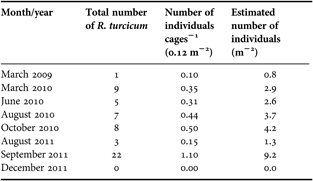
From March 2009 until December 2011, we collected 55 individuals of R. turcicum (Table 1) exclusively from protected cages. They were found attached directly to the plates or the cage wall, not forming clusters. Our first record was for samples from March 2009 (1 individual) collected two months after the beginning of the experiments in the region. However, the sample has since been identified as Ascidia sp. From March 2009 to January 2010, R. turcicum was not observed either in the harbour, the shell farm or CFI. It was recorded again in March 2010 through to December 2011.
Total and relative number of individuals of Rhodosoma turcicum collected from January 2009 up to December 2011 at Forno Harbour, Rio de Janeiro, Brazil.

The number of individuals had increased from 2009 to 2011. In the first year, only one individual was collected, but in 2010 and 2011, 17 and 25 individuals were collected, respectively. The higher number of structures used increased the number of individuals recorded, but the number of individuals relative to sampling effort resulted in a similar sampling rate, except for the recruitment high of September 2011. Individuals of R. turcicum were recorded in all seasons, with higher relative abundance in August and October 2010 and in September 2011 (late winter/early spring).
Records of R. turcicum were not dependent on the age of plates; the species was found on plates/structures ranging from one up to four months old. The minimum size for detection was approximately 1.0 cm.
DISCUSSION
Rhodosoma turcicum (Figure 1) is the most common species in the genus Rhodosoma, which contains only two species. The worldwide distribution of R. turcicum includes the Caribbean Sea, Red Sea, Indo-Pacific and Mediterranean Sea (Izquierdo-Muñoz et al., Reference Izquierdo-Muñoz, Díaz-Valdés and Ramos-Esplá2009; Shenkar & Loya, Reference Shenkar and Loya2009; Rocha et al., Reference Rocha, Bonnet, Baptista and Beltramin2012a). Records of this species in the Western Atlantic are mainly in the northern hemisphere (Rocha et al., Reference Rocha, Faria and Moreno2005a, Reference Rocha, Moreno and Metrib for the Caribbean; Faria, Reference Faria2006: in a review, from 15 to 30oN; Rocha et al., Reference Rocha, Guerra-Castro, Lira, Paul, Hernández, Pérez, Sardi, Pérez, Herrera, Carbonini, Caraballo, Salazar, Diaz and Cruz-Motta2010 for Venezuela; and Shenkar & Swalla, Reference Shenkar and Swalla2011, in a review) with only one very recent record on the Brazilian coast (Rocha et al., Reference Rocha, Bonnet, Baptista and Beltramin2012a).
Our records of R. turcicum represent the third finding of the species in Brazilian waters. The first was in the south-west Atlantic in 1999 by Lotufo (Reference Lotufo2002), followed by a finding in 2007 by Rocha et al. (Reference Rocha, Bonnet, Baptista and Beltramin2012a). The Brazilian record at the Cabo Frio region is the southernmost site of occurrence and, as indicated in Table 1, there are records all year and during all seasons.
The detection of R. turcicum was correlated with two conditions. The first one is that all individuals were collected inside the harbour area (FH). The second is that all individuals were collected exclusively inside cages, protected from predators including fish. That this species was found at the start of predator exclusion experiments in 2009 could indicate its presence on natural or artificial substrata in the harbour area. In 2012, during one monitoring dive, we recorded one individual attached to a breakwater. We do not know if this species has since spread into other areas of Anjos Bay. In 2009, we did not detect any individuals outside the harbour, but studies including predator exclusion outside of the harbour were only performed during this year. During dives outside of the harbour, we did not record any individuals attached on natural or artificial substrata, but the sampling effort during these dives was much lower than in the use of artificial substrates in experiments. This question of how artificial versus natural substrate affect species colonization is now under new investigation in the region. It is possible that established populations could be located in cryptic environments, where light and predation is attenuated, but this observation is difficult to confirm. Shenkar & Loya (Reference Shenkar and Loya2009) have found R. turcicum living in cryptic environments, and according to Shenkar & Swalla (Reference Shenkar and Swalla2011), light attenuation is one of the factors that influence ascidian recruitment. Some species are more sensitive to predation, and this factor could control their distribution or persistence within the environment (Osman & Whitlatch, Reference Osman and Whitlatch1995, Reference Osman and Whitlatch1996, Reference Osman and Whitlatch1998, Reference Osman and Whitlatch2004; Marins et al., Reference Marins, Oliveira, Maciel and Skinner2009; Whitlatch & Osman, Reference Whitlatch and Osman2009; Freestone et al., Reference Freestone, Osman, Ruiz and Torchin2011). Ferreira et al. (Reference Ferreira, Gonçalves and Coutinho2001) investigated the fish community structure in a site located 500 m from the harbour, where the proportion of invertivorous fishes (that feed mainly on invertebrates) is one of the highest in the region with 27 species recorded. Other natural or artificial substrates are located at further distances on the east side of the bay. This could explain why R. turcicum has not expanded to areas outside of the harbour because ascidians usually disperse at short distances (Olson, Reference Olson1985; Manríquez & Castilla, Reference Manríquez and Castilla2007).
Rocha et al. (Reference Rocha, Bonnet, Baptista and Beltramin2012a) have assigned the status of cryptogenic to R. turcicum in Bahia due to the tropical distribution of this species and its presence on a breakwater close to the harbour area. The Cabo Frio region, 1200 km away from Todos os Santos harbour, is recognized as a transitional area between tropical and temperate bioregions (Floeter & Soares-Gomes, Reference Floeter and Soares-Gomes1999; Spalding et al., Reference Spalding, Fox, Allen, Davidson, Ferdaña, Finlayson, Halpern, Jorge, Lombana, Lourie, Martin, Mcmanus, Molnar, Recchia and Robertson2007).
The presence of R. turcicum exclusively inside the Forno Harbour, fulfils three of four criteria proposed by Boudouresque & Verlaque (Reference Boudouresque and Verlaque2002) for the species to be considered an introduced NIS: (i) the species must be present in a new area not previously reported; (ii) the extension of its range is linked to human activity, in this case harbour operation; and (iii) new generations of the species are born in situ without human assistance, thus constituting self-sustaining populations (i.e. naturalized species). Despite the differences in sampling effort between years (2009 and 2010–2011), in the first year, the species was found in similar numbers among sites, and we detected R. turcicum only inside of the harbour. Thus, the inclusion of R. turcicum as an NIS is very plausible.
For over 30 years, regular ship operations between the north-east and south-east Brazilian coast have introduced bivalves (Perna perna and Modiolus carvalhoi) and crustaceans (Megabalanus coccopoma) to Areia Branca harbour (04o49′06′′S/037o02′43′′W, Rio Grande do Norte) (Silveira et al., Reference Silveira, Souza, Fernandes and Silva2006). However, we did not detect any introduction of species from the north-east to the south-east. Although this region has been intensively studied (Klautau et al., Reference Klautau, Monteiro and Borojevic2004; Fleury et al., Reference Fleury, Lages, Pereira and Ferreira2005; Rocha & Costa, Reference Rocha and Costa2005; Ferreira et al., Reference Ferreira, Gonçalves and Coutinho2006; Jara et al., Reference Jara, Miyamoto, Gama, Molis, Wahl and Pereira2006; López et al., Reference López, Coutinho, Ferreira and Rilov2010), only one of these studies has focused on ascidia diversity (Rocha & Costa, Reference Rocha and Costa2005). Currently, harbour operations mainly support oil exploration activities in the Campos basin, and ships regularly operate along the Brazilian coast, which includes Bahia and other states of the north-east coast. It is possible to identify several introductions in one area; however, verification is difficult, and we did not identify several introductions in our work. Species translocation among biogeographical regions has been associated with ship hulls, oil platforms, ballast water and aquaculture (Hayes, Reference Hayes2002; Orensanz et al., Reference Orensanz, Schwindt, Pastorino, Bortolus, Casas, Darrigan, Elías, Gappa, Obenat, Pascual, Penchaszadeh, Piriz, Scarabino, Spivak and Vallarino2002; Ferreira et al., Reference Ferreira, Gonçalves and Coutinho2006; Farrapeira et al. Reference Farrapeira, Melo, Barbosa and Silva2007; Wanless et al., Reference Wanless, Scott, Sauer, Andrew, Glass, Godfrey, Griffiths and Yeld2009); with ship hulls now recognized as a very important, actual and continuous translocation vector of species (Gollasch, Reference Gollasch2002; Lewis et al., Reference Lewis, Watson and Ten Hove2006).
There is no information in the literature concerning the R. turcicum reproductive cycle, reproductive effort or larval survival and behaviour, so we do not know the potential for the species to spread after its introduction. However, R. turcicum's first detection in Lebanon (Bittar & Kouli-Bitar, Reference Bitar and Kouli-Bitar2001) and its actual distribution (Shenkar & Loya, Reference Shenkar, Loya and Por2008; Izquierdo-Muñoz et al., Reference Izquierdo-Muñoz, Díaz-Valdés and Ramos-Esplá2009) is likely due to using ship hulls as a transportation vector as well as the favourable tropicalization of Mediterranean waters (Izquierdo-Muñoz et al., 2009). We believe that the potential of R. turcicum to be introduced to other regions of the Brazilian coast is high. This is due to ship traffic and the increasing transfer of structures among regions, both between Brazilian ports and between Brazilian and international ports.
The total area of cages and the density of animals per cage were low; however, R. turcicum seems to be abundant, and it is possible that they are recruiting on other structures or sites inside of the harbour. This could include ships which have a much greater surface area or other suitable habitats protected from predators. Locke (Reference Locke2009) conducted a screening for potential invading tunicates to Atlantic Canada and found R. turcicum to not be a threat to Canadian waters due to the temperate to cold waters found there. However, for the Brazilian coast, mainly on the north-east where we found suitable habitats, the heavy ship traffic from many bioregions where R. turcicum is found could facilitate its introduction or spread.
Further studies on reproduction, larval behaviour and dispersal potential could help to further understand and estimate the potential of this species to spread and colonize new areas. Genetic analysis among populations could further elucidate its means of spreading around the globe and its centre of origin.
Conclusions
Rhodosoma turcicum could be designated as a NIS in the Cabo Frio region. The species was most likely introduced to the area using a ship hull as its vector and the harbour area as its refuge. The detection and occurrence of the species is probably controlled by unknown fish predators.
ACKNOWLEDGEMENTS
The authors thank the Porto do Forno Authority for permitting free access to its installation and allowing the immersion of experimental structures. Thanks also to ICMBio for the authorization of the study inside the Marine Reserve Area (Proc. #25024-1). This work was supported by grants from FAPERJ to Michelle Klautau (E-26/111.541/2008) and L.F.S. (E-26/110.250/2010; E-26/111.454/2011), and by scholarships to L.F.S. (PROCIENCIA) and GCMO(E-26/100.541/2010), from UERJ to D.F.B. (PROATEC) and D.C.S. (EIC) and from UERJ-CNPq (PIBIC) to A.A.T. We also thank the anonymous referees whose suggestions have improved this manuscript.