Background to the study
In recent years, the impacts of economic and cultural globalisation have become prevalent throughout the Alaska native bush, greatly accelerating the degree and rapidity of change within these communities in only a few decades. While the subjective aspects of this change are widely apparent in terms of changing tastes in clothing, food, music, consumption of electronic goods, and other aspects of native cultural life, reports of the ‘death’ of Alaska native lifeways are, to paraphrase Mark Twain, at best premature.
Indeed, it has become common, especially since passage of the Alaska Native Claims Settlement Act (ANCSA) in the early 1970s and the building of the oil pipeline soon thereafter, to suggest that the ‘traditional’ Alaska native is on the verge of extinction, about to be replaced by the business-savvy, ‘oil-age’, materially-oriented capitalist (for an alternative perspective see Haycox Reference Haycox2002: 283). This sentiment has been suggested in such popular literature as John McPhee's Coming into the country (McPhee Reference McPhee1977) in the form of the ‘Brooks Brothers’ native (see Kollin Reference Kollin2001: 168–169), and has been reinforced by academics who suggest that with the creation of ANCSA, if not before, capitalism began taking hold in Alaska native communities, fostering an achievement orientation which is supplanting an ascriptive culture, facilitating the development of a new class structure which includes the creation of an ‘Alaska native bourgeoisie' (Mason Reference Mason2002).
The author would contend that the effects of globalisation upon native Alaska are incontrovertible. Increasingly, ‘native space’ may be defined in 21st century Alaska as a milieu dominated by the simultaneous contestation and hybridisation of pre-colonial, colonial, and post-colonial social patterns and behaviours, economic activities and political agendas enmeshed within and across a single geographic territory.
Previous research initiated in one interior Gwich'in Athabascan indian community, Vashraii K'oo/Arctic Village, in 1999 (Dinero 2004a, 2005) found that while change brought on by contact with European/white America is considerable, subsistence activities, the heart of Alaska native culture going back millennia, were still central to Gwich'in communal life. At the same time, however, numerous new behaviours and activities were also to be found in the village that now play a significant role in this evolving, globalising environment.
Summary of Vashraii K'oo/Arctic Village research findings, 1999–2006
Founded in approximately 1908 according to most sources (see Dinero Reference Dinero2005), Vashraii K'oo/Arctic Village is located some 250 miles (400 km) northeast of Fairbanks, and 150 miles (240 km) north of the Arctic circle. It is accessible only by small bush plane or boat. The village was developed for the very purpose of facilitating subsistence hunting and especially fishing among the Nets'aii Gwich'in of the lower Brooks Range region of the Yukon Flats in northeastern Alaska. As Shitzuh [Grandma] Sarah Frank once explained in describing the creation of the village (in Mishler Reference Mishler2001: 457, 467):
[T]here was no village [back then], but they all gathered there until [river ice] break-up . . . [T]hey said ‘Let's all live in one place and vote to have one leader, and we will see what happens.’ So from around Arctic Village we went down to where the trail meets from Fort Yukon [and] that's where we stayed . . . So everybody got together. In those days there was hardly any money. Our main thing was getting food to eat. So they elected Chief Christian for their leader at Arctic Village. People all helped one another. They helped one another with wood, food, and other things. They all worked hard to do this. So that's how we became a village . . . They picked that spot because of the animals and because there were plenty of fish there. The village started because of that . . . There were plenty of fish and ducks there.
The history and development of the village between 1910 and 1990 will not be repeated here, as it has been discussed elsewhere (see, for example, Mishler Reference Mishler2001; Campbell and others Reference Campbell, Parrott, Desrochers, Hewko and Schmetzer2005; Dinero Reference Dinero2003, Reference Dinero2004a, Reference Dinero2005). What is notable, however, is that the population of the village fluctuated considerably during this period (Dinero, Reference Dinero2004a: 145), and to a great extent the Gwich'in only began to settle in the truest sense of the word around the year 1950. Between the two world wars the population of the village occasionally dropped to single digits. Only after World War II and the creation of the Venetie Reservation in 1943 did the village begin to take on a sense of true permanence (between the world wars the village population dropped down to single digits).
Its growth was also impacted to a great extent by the role of the Episcopal chapel that had again been rebuilt in the village in the early 1940s (see Dinero Reference Dinero2003). Historically, the Gwich'in had followed shamanistic beliefs centered most especially upon one key animal, the caribou. But early in the 1910s Albert E. Tritt, a village resident, came into contact with Episcopalian missionaries, and began to convert his fellow villagers. In 1917, he and his followers, initially comprising members of his immediate family but, later on, others as well, built a log chapel at Arctic Village of local materials and with their own labour. The wood was cut from trees near the village, and then floated down river to the village site. The Rev. Tritt preached in this, the Bishop Rowe Chapel, for nearly 50 years, rebuilding and repairing it as needed. In the late 1960s a larger church was built in the village to accommodate the growing population, and the old log chapel was finally vacated, though in 1975 it was listed on the U. S. National Registry of Historic Places.
Thus, the expansion of the village continues to the present day. Given the considerable development and change which the village experienced especially over the past 50 years (the population has risen 72% since 1970; Campbell and others Reference Campbell, Parrott, Desrochers, Hewko and Schmetzer2005: 38), the author visited it in 1999 with the aim of tracking and measuring the transition that the Gwich'in of Vashraii K'oo/Arctic Village were making as they pursued formal education and wage labour in a post-nomadic, monetised, globalising environment. Also investigated was the degree to which the villagers had completed the transition from a self-reliant lifestyle comprised of family-based groupings with divergent ideas, goals and interests to a true ‘village’, with a governing Local Council bound by a sense of shared identity, sense of community, and destiny (Dinero Reference Dinero2005). This was measured by analysing the extent to which community members and Local Council representatives were satisfied with village planning structures, how they saw their community developing and changing, and the criticisms they had of their community and its governance.
The previous research revealed that formal education and wage labour have not replaced or supplanted the Gwich'in subsistence economy in the village; rather, it suggested that those who were better able to access the benefits of education and economic wealth were also more likely to pursue subsistence activities as well. This need for cash (a relatively new indicator) in particular in helping to perpetuate subsistence in Alaska native communities is well known (see, for example, Agricultural Experiment 1978: 5–7; Nuttall Reference Nuttall2005: 668).
As for the consumption of imported consumer products, the 1999 findings suggested that in many instances, the ownership of certain goods (such as the 4-wheel ATV and snowmachine) proved essential to the continuation of subsistence activities in the new economy. Like other communities (Morseth Reference Morseth1997: 251) new technologies have been incorporated into bush communities for hunting purposes with mixed results; the caribou hunt, for example, is now easier to carry out (Nuttall Reference Nuttall2005: 694), but the practical dynamics involved in hunting and gathering have changed considerably as a result. Although new technologies facilitate the hunt, those who can access them often work in wage labour as well, placing constraints on the extent to which they can spend time out in the field. At the same time, the consumption of new recreational products, such as satellite dish television and the personal computer, suggested the early beginnings of a trend towards greater interest in pursuing connectivity with the rest of the world.
In analysing the role of community planning in the development of the village and the self-conscious shift from individual to group effort and action, it was determined that the planning process initiated in 1991 was surprisingly sophisticated and well considered (Dinero Reference Dinero2005). However, as one might expect, government-initiated planning was new to the Gwich'in, and the ‘dysfunctionality’ of the Local Council was a subject of widespread discussion and was noted as the greatest problem facing the village during the time that the study was implemented (Dinero Reference Dinero2005: 152).
In part, this is probably explained by the fact that most villagers are blood relatives and members a small group of related families, and that governance in the town is often influenced by familial allegiances and alliances. While it is not necessary here to enter the details of some of the conflicts that arise as a result, it can be said that disagreement within, between, and among the villagers, the First Chief, and the Local Council is not uncommon. Annual elections only further incapacitate the ability of the elected officials to get much done; from the perspective of some villagers, annual elections preclude the Council's ability to have much time to ‘do much damage.’ As a result, the level of satisfaction with village services was highest in 1999 for those in which the Council is least involved and where households are required to play the most active role, namely water provision (which is self-service) and air transportation (supplied by an outside private vendor).
The author revisited the village in 2006 in order to implement a follow-up survey and analysis of the growth and development of the community since 1999. This was a household survey undertaken from 29 June–5 July 2006, in which virtually the same questions as those posed in 1999 were asked. However, some questions were modified, added or improved as a result of the 1999 research. In 1999, there were approximately 40 households in the village and 35 were surveyed. In 2006 there were approximately 45 households in the village and 39 were surveyed.
In this context it should be noted that as discussed by Craver (Reference Craver2001) at length, the concept of ‘household’, is an inadequate and subjective concept in a community such as Arctic Village. The object of measurement that was considered to be a ‘household’ for the survey is both a geographic/physical and socioeconomic unit. It consists of a cabin, house or comparable structure within which resided full time during the period that the survey was implemented at least one adult (age 18 or above). The structure may be home to one or more additional adults who are likely (though not certainly) to be blood relatives or in a committed relationship of some sort to the interviewee, as well as children (age 17 and younger) being reared by at least one of the adults within the dwelling on a full-time basis who are dependents by dint of a blood or adoptive relationship to that adult.
As required for statistical analysis, all household representatives were sampled randomly and those not surveyed were, in most instances, out of the village during the period in question. The households included in the survey represent a total of 73 adults and 35 children under age 18, a total of 108 (the population of the village according to the 2000 U. S. Census being 152). Of those surveyed, 92% were Gwich'in, 5% Inupiat Eskimo, and 3% were white.
In 1999, participants were paid $10.00 for their time (anywhere from a half hour to 2 hours per questionnaire). Following precedent, the respondents were again paid, although the payment in 2006 was raised to $15.00 per participating household. Because of the very small sample size for the study, the chi-square statistic has been used, in which p < or = 0.05. For all quantitative findings, N = 39 and for verbal questions N = 38.
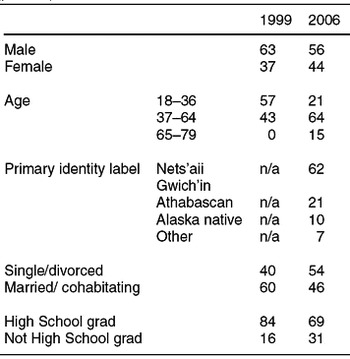
The 2006 survey sample was comparable to the 1999 sample in nearly every aspect (Table 1). A better gender balance was achieved in the second survey, although the particularly high number of single-male households continued to skew this figure substantially. The 2006 sample was somewhat older than the first sample, and thus less educated in a formal sense. Also, a new question concerning identity was added to the 2006 questionnaire.
Survey respondents descriptive statistics (percent).

Sources: 1999 Statistics, Dinero, Reference Dinero2005: 144; 2006 Statistics from the 2006 Arctic Village household survey.
Some significant results were found among the survey sample participants. For example, women were more likely to identify as ‘Nets'aii Gwich'in’ (by far the most preferred identity label) than men (.00). This was especially true of those women coming from households with higher incomes (.02). The ‘Nets'aii Gwich'in’ identity label was also chosen by younger respondents in the survey (.03). This finding is returned to below, because the role of gender, identity, and development are at the heart of the changes now manifest in the village today.
Gender and marital status also correlated, that is, males were more likely to be single than women (.04) and many of the households in the survey comprised single males with no children (although they may have fathered children being raised in another household in the village or elsewhere). Lastly, it was found that villager education levels correlated positively with the respondent's mother's educational level, though not the father's (.05).
The ‘mixed’ village economy
As is the case in much of bush native Alaska, the economy of Vashraii K'oo/Arctic Village is a mixture of wage labour, transfer payments and subsidies, and subsistence (Dinero 2004a). Although Arctic communities now have mixed economies, in which half of household income is from wage labour and/or transfers (Nuttall Reference Nuttall2005: 668), ‘their basic need for social-ecological resilience has not changed’ (Robards and Alessa Reference Robards and Alessa2004: 418). Such community economies are typically very weak and vulnerable. Scarcity of resources forces communities to turn to wage labour, but it also forces them to continue subsistence; pursuit of a pure hunter/gatherer lifestyle would be economically irrational and unstable (Robards and Alessa Reference Robards and Alessa2004: 420). Given that one caribou was valued at approximately $187.50 worth of store-bought meat in 2005 (Nuttall Reference Nuttall2005: 692), for example, the rationality of maintaining the hunt in a capitalist economy comes into sharper focus.
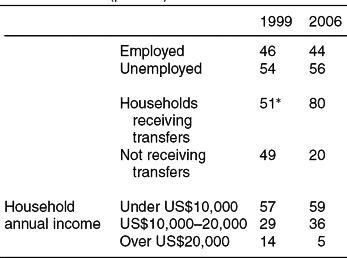
In order to understand a mixed economy, however, it is necessary to evaluate all three parts of that economy (Table 2). A final index, the consumption of material goods, is an additional barometer in this regard. What makes these determinations somewhat difficult to parse, however, is that they are intertwined.
Economic standing of survey respondents and their households (percent).

* This substantial difference is due to two probable explanations: 1) under-reporting in 1999, 2) the older ages of some respondents in 2006 who are receiving Medicaid or other benefits. That said, it appears that overall economic standing in the village has dropped as prices have risen, which also would contribute to a higher reliance upon outsider assistance.
Sources: 1999 Statistics, Dinero, Reference Dinero2005: 145; 2006 Statistics from the 2006 Arctic Village household survey.
For example, it is most typically those in the village who are better educated, who are in a stable partner relationship, who have a wage-labour position, who have some sort of additional transfer income, and therefore are more able to purchase material goods (most especially 4 wheel ATVs, snowmachines, and refrigerators/freezers) who are also the most likely to be conducting subsistence activities. This further contributes to the economic stability of their own personal households, and also contributes to the village as a whole as they serve as the primary providers of meat, fish and wood to others who, for various reasons, do not fit into these categories, and are therefore dependent upon them.
The statistics gathered from the 2006 survey substantiate this contention. Predictably, those engaged in wage labour employment had wealthier households (.05). Those in committed relationships (whether married or cohabitating) were also more likely to be employed in wage labour (.01); in turn, higher incomes were found among married/cohabitating households (.04).
While engagement in wage labour reveals a part of the economic situation, transfer payments such as food stamps (received by 56% of those surveyed), Medicare, Medicaid, and the like play a crucial role in the village economy. According to the previous study, for example, those who received transfer payments were more likely to carry out certain types of subsistence in the village (Dinero 2004a: 139). For example, transfer income helped to facilitate caribou hunting (Dinero 2004a: 155). As nearly half of villager households are below the U.S. Federal poverty line (Campbell and others Reference Campbell, Parrott, Desrochers, Hewko and Schmetzer2005: 22), the 2006 data reveal that receipt of transfer payments continues to play a significant role.
Subsistence activities are the heart and soul of native bush villages. Indeed, the village does not exist today in order for hunting, fishing, and gathering to occur but rather, it exists despite these activities, which by definition take place over large expanses of land and in pursuit of highly mobile game. Sedentary native life in small, geographically fixed sites is, to a certain extent, an affront to subsistence activity and, in the present case, to ‘Gwich'inness’, or at least it was until recent days. But with globalisation, changes are now occurring in how subsistence is being carried out, the extent to which it is being carried out, and by whom, that have major ramifications for the future of the Nets'aii Gwich'in, and the village that they call ‘home’. It is this shift, and the potential consequences of these apparent changes, which are addressed below.
Subsistence
Subsistence activities are conducted throughout the year, although they are dictated by seasonal changes. The consumption of native (traditional) foods acquired through these activities has both nutritional and cultural/social importance (Nuttall Reference Nuttall2005: 662). One can easily distinguish those households that are actively involved in various harvesting activities from those that are not by the ways in which the rhythm of their members’ lives are dictated (or not) by even minor alterations in weather cycles.
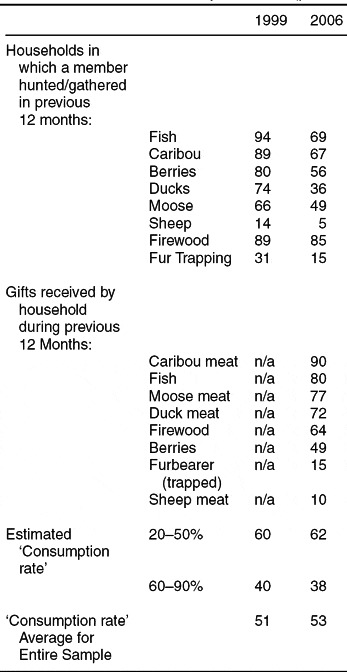
In the previous research, it was found that those households in which members were involved in one form of harvesting typically were also involved in others (Dinero 2004a: 154). This was again found to be true in 2006. For example, correlations were found between those households involved over the previous 12 months in caribou hunting and moose hunting (.00), caribou hunting and fishing (.03), (this correlation was strongest among those with more formal education (.02)), moose hunting and duck hunting (.02), and moose hunting and fishing (.05). A weak association was found between those households participating in fishing and berry picking (.05), (Table 3).
Subsistence activities by household (percent).

Sources: 1999 Statistics, Dinero, Reference Dinero2005: 146; Dinero, Reference Dinero2004a: 152; 2006 Statistics from the 2006 Arctic Village household survey.
Three other interrelated indicators also play a role in subsistence activity, namely household monetary wealth, the educational level of the household head, and the ownership of certain consumer goods found in the home, with wealth being a particularly determinant factor. It has been known for some time that as household wealth increases, the diversity of subsistence activities may also increase (The Agricultural Experiment 1978: 5–7). Moreover, as noted previously (Dinero 2004a), subsistence activities have become increasingly costly. As one 76 year old male villager relates:
Once I went moose hunting by boat. I figured the cost of gas, the shells, everything – I got no moose. And it cost $540! For nothing! That was 3 or 4 years ago. Hunting is pretty expensive by boat, or even with a snowgo. Sometimes we burn up three cans of gas for nothing. So every time we go out we have to make sure we get something. We aren't sports people here-we fight for our lives here in Arctic Village, we don't play around. Money isn't important to us, but we need it.
It is notable that prices for store-bought food are exceptionally high. A gallon of fuel for a 4-wheeler was $6.00/gallon in the summer of 2006 (at a time when gasoline in Fairbanks was just under $3.00/gallon), and a quart of Parmalat milk in the village grocery cost $3.00 (the same quart in Fairbanks cost $1.90). Other basic foodstuffs, flown into the village from Fairbanks, were equally expensive; a box of Sunshine brand cheese crackers, for example, cost $7.00 ($3.00 in Fairbanks). So while the cost of subsistence continues to rise, the alternative, store-bought food, is no cheaper, and is, in any case, seen by very few as an acceptable replacement (Fast Reference Fast2002: 113).
It was found in the 2006 survey that those with higher incomes are more likely to carry out certain subsistence activities, such as picking berries (.05). Perhaps this is explained in part by the fact that households that included berry pickers were also more likely to own goods such as a 4 wheeler (which makes berry picking easier; (.01)), and the snowmachine (.01). Those households participating in duck hunting were also less likely to receive non-wage labour income supplements or other transfers (.02).
Similarly, it was found previously that fur trapping had been carried out mostly by more wealthy villagers (Dinero 2004a: 153). According to the new data, trapping is far less common than in the past; those who continue to undertake this activity in 2006 are primarily older villagers (.03).
Previously, it was found that more educated villagers were involved in several subsistence activities (Dinero 2004a: 153). Some of the 2006 results also suggest this. For example, more highly educated, lower income residents were more likely to come from households engaging in duck hunting than the less educated villagers responding to the survey (.04).
Strong correlations were found in the 1999 data between ATV and snowmachine ownership and subsistence activities (Dinero 2004a: 156). In 2006, income also played a factor in the ownership of these two vehicles, both of which are key to harvesting activity. Among those with less education in the village, the lack of a snowmachine resulted in less likelihood of hunting for caribou over the previous 12 months (.01). Ownership of another consumer good, the refrigerator/freezer, also played a role in fishing activity. Among the more educated, ownership of one of these increased the likelihood of household fishing activity (.04).
Gifts, responsibility and inter-dependency
A cursory glance at the 1999 and 2006 statistics with regard to the percentage of households involved in hunting, gathering, and trapping in Vashraii K'oo/Arctic Village reveals a significant decline in every category (except perhaps firewood) over the seven year period in question (Table 3). While a generalised concern about the bird flu is a likely contributor to the decline in duck hunting (this was the stated explanation among many of those surveyed), the statistics reveal reduced household harvesting activity overall. In part, population pressure upon the land over time since the Gwich'in settled may be taking its toll in the region (Wein and Freeman Reference Wein and Freeman1995: 168); elders contend that there are simply fewer animals and birds on the land than when they were young (S. James, personal communication, 8 August 1999; 76-year old male interviewee, 2006 survey). Similarly, several regional lakes are empty of fish, and village hunters repeatedly bemoan having to travel longer and further each year in search of game.
And yet, looking at the village as a whole, estimated rates of food consumed off the land are virtually unchanged over the period in question. This may be explained by examining the substantial role played by the gifts of meat, fish and berries received by each household.
The subsistence economy is founded upon principles of the sharing and distribution of the harvest of meat and fish (Fast Reference Fast2002: 90). These sharing networks have built-in expectations of reciprocity (Fast Reference Fast2002: 101); the addition of cash to the system has complicated, though not eliminated its functioning, and in some ways cash may help to overcome some instances of awkwardness when immediate reciprocity is not possible. It is typical in Alaska that 30% of native bush households account for 70% of the harvest by weight (Robards and Alessa Reference Robards and Alessa2004: 422).
Sharing of the harvest, reciprocity, and networks of exchange usually are based upon kinship. Family networks help to reduce insecurity, unpredictability, and uncertainty. For example, whereas 50–60% of respondents were found to have hunted caribou in the western Arctic herd in an Alaska Department of Fish and Game study, just over 40% participated in the giving and/or receiving of caribou meat products (Nuttall Reference Nuttall2005: 694).
Similarly, there appear to be some patterns in the 2006 survey results in terms of who the givers are, as well as who the receivers are, of this shared wealth. As is the case with those participating in hunting and gathering activities, there is also a correlation between/among receiving gifts of traditional food from the land. Gifts of berries and fish (.03), moose meat and caribou meat (.03), moose meat and berries (.01), and caribou meat and fish (.02), each were shown to be correlates.
The patterns of giving and receiving food and wood off the land were not found exclusive; households actively involved in hunting and gathering also were recipients of gifts. For example, women who went out for berries were also more likely to receive berries as gifts (.04). Still, some sharing networks can be discerned in terms of who is carrying out much of the hunting and gathering activity in the village today.
For example, upon returning to the village from the hunt, an Arctic Village hunter gives parts of his quarry first to his elders and then to other immediate family members living nearby (‘neighbourhoods’ in the village tend to be family-based, several bearing households with a single last name), and thereafter to extended family. Often, family members who receive these gifts will then ‘re-gift’ some of the meat, further distributing the wealth so that eventually, depending upon the size and nature of the animal taken (a moose for example), virtually everyone in the village will share in at least a small part of the harvested animal. This is especially true in the summer months when fresh meat is less readily available than during the rest of the year.
As for other shared subsistence wealth, the survey results revealed that single male households are more likely to get their own firewood (.05) and not rely upon gifts. Recipients of firewood tended to be those who did not own a 4-wheeler (.01). Older women were less likely to cut their own wood (.02). Interestingly, those lower income residents who were the recipients of firewood as a gift (wood is also bought and sold in the village at $40/load), were more likely to identify as ‘Gwich'in’ (.01). This raises the question of how and in what ways an expressed sense of Gwich'inness is in part a sign of social and/or economic health, and a by-product of sustained values and shared ideals, felt most by those who are embraced within the community, and who feel the least alienated from the community as a whole. This question will be returned to below.
As it is usually a woman who receives the moose head for preparation upon return from the hunt (Fast Reference Fast2002: 91; moose-head stew or soup is an essential staple at any potlatch, birthday or holiday celebration), it was found that female-run households had a higher likelihood of being the recipients of the gift of moose products (.03). Those more likely to be the recipients of caribou products (.01), berries (.05), and fish (.02), however, were usually those villagers who owned a refrigerator or freezer.
One of the most interesting findings concerns those who noted receiving gifts of duck meat over the last twelve months. These residents were also likely to have received other gifts, such as fish, (.00), during the same period. These residents were found to be particularly affluent. They were more likely to have at least one employed adult in the household (.05). In and of itself this is not very significant and could be viewed as an anomaly, were it not that for the fact they were also found to be more likely to own a telephone (.05), and a snowmachine (.04), and a 4 wheeler (.05), and even a computer (.03). Although it is entirely speculative, it appears that duck meat is becoming a delicacy, as its consumers are developing into a class within the village, showing signs of greater wealth and education than the average Gwich'in villager.
Lastly, the use of estimating one's consumption of food from the land (referred to as the ‘consumption rate,’ as opposed to the act of harvesting natural resources) is an imprecise but useful measurement of a household's annual home economy (see Wein and Freeman Reference Wein and Freeman1995). In the mid-1970s, 54% of those in the Yukon Flats region, including Ft. Yukon, estimated their household ‘consumption rate’ to be at least 50% (The Agricultural Experiment 1978: 4–5). In Arctic Village in 2006, 72% of the households surveyed estimated that at least half of their food intake came from traditional food off the land. While these rates do not correlate with actual hunting and fishing activity, the estimated rate may indicate something about self-perception and identity, in the rapidly globalising village environment. For example, although the overall rate average was 53%, older villagers estimated higher rates of food consumption from the land (.02.), while those with lower incomes estimated lower rates of traditional food consumption (.04).
Lower rates correlated with the ownership of various consumer goods. Those claiming lower rates of traditional food consumption were more likely to own a refrigerator or freezer (.01). This was found particularly among men (.01), age 30–39 (.05), who are single (.01), with low incomes (.04), receiving transfer payments (.02), although they had completed high school degrees and were the most educated of village residents (.02). Those claiming lower rates were also more likely to own a 4-wheeler (.02).
Together, this all seems to suggest that those at the lower levels of the socio-economic ladder within the village are those who, despite owning the means to carry out subsistence (namely a 4-wheeler and a refrigerator) are in many instances no longer participating in subsistence. It is these single men, though higher on the social ladder in terms of education, who appear to be experiencing a decline in social status, a likely outcome of their inability (or unwillingness) to contribute to the community through hunting (Nuttall Reference Nuttall2005: 663).
Returning to questions of ‘Gwich'in’ identity (as opposed to stated expressions of other forms of native/non-native identity), those stating an identity of ‘Nets'aii Gwich'in’ were likely to state lower levels of consumption of traditional foods (.05) than others in the study. Those who identified in the study as ‘Gwich'in’ were less likely to own a 4-wheeler (.02); and yet those who identified as ‘Gwich'in’ but who had the lowest estimated levels of traditional food consumption were more likely to own a 4-wheeler (.03), and a snowmachine (.05), the two primary means through which the Gwich'in typically have conducted subsistence activities in recent years. However these are the two consumer products which are now becoming increasingly cost-prohibitive to own. In other words, those who own these vehicles appear to be using them mostly for transportation and recreation, not subsistence.
One might postulate then that increasingly, ‘Gwich'inness’ is being expressed in Vashraii K'oo/Arctic Village as a reflection of upward mobility and well-being, (that is in terms of what one owns, be it a 4-wheeler, snowmachine, etc.), and less about the extent to which one still carries out harvesting activities. When combined with the fact noted previously that a strong correlation was found between gender and the expressed preference for using the ‘Gwich'in’ identity label (.00), it appears that those in the village who are faring the best economically and socially, even if they themselves are not actively engaged in subsistence activities, feel the most ‘Gwich'in,’ while those with less positive outlooks or circumstances express alternative senses of identity.
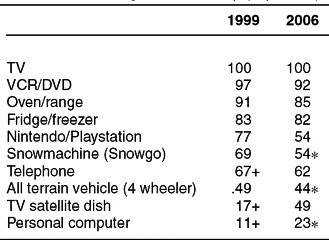
There are three key items in the village that tend to indicate wealth and wellbeing, the refrigerator/freezer, the telephone, and the oven (Table 4). These three items play significant roles as indicators of household development, both in terms of the degree to which a family is adapting to western modes of activity, as well as, to a certain degree, the maintaining of subsistence activity.
Consumer goods ownership (in percent).

+ ‘Luxury’ items in 1999, where ownership correlated with income.
* ‘Luxury’ items in 2006, where ownership correlated with income.
Sources: 1999 Statistics, Dinero, 2004a: 157; 2006 Statistics from the 2006 Arctic Village Household Survey.
Indeed, not only does ownership of these three items inter-correlate with one another (telephone with refrigerator/freezer (.01), with oven (.00), and refrigerator with oven (.01)) but ownership of each correlates in turn with ownership of DISH TV, a 4-wheeler, and a snowmachine. Successful couples in committed relationships were more likely to own these various high-end items including telephones (.01), DISH TV (.01), and 4-wheelers (.01). Much of this can be seen to play a role in village home life, as well as in subsistence activities (Table 4).
Thus far, it has been argued that the number of those households that are actively involved in various aspects of traditional food harvesting appears to be shrinking, but that the extent of sharing and support among villagers remains strong. What is also apparent from the survey is that those villagers who are involved in the subsistence economy do not limit their interests to that, but are also concerned with other civic and developmental aspects of the health of Vashraii K'oo/Arctic Village.
Households which continue to pursue caribou hunting, the most significant subsistence activity in the village today from a symbolic perspective (see Nuttall Reference Nuttall2005: 692; Dinero Reference Dinero2003; Wein and Freeman Reference Wein and Freeman1995), also were more likely to express criticisms of the Arctic Village schools, and to call for badly needed changes to the educational system in the village (.02) (see below). Though dropping in number, those involved in duck hunting are especially outspoken as well, and, as noted above, are somewhat more highly educated than other villagers. Perhaps this explains the fact that households involved in duck hunting were more critical of the cleanliness of the town than those who did not hunt ducks (.05). Although this correlation was not highly significant, these families were more critical of the health clinic in town than were non-duck hunters (.01).
Village community planning
In order for economic development to take hold in such a small community centralised planning mechanisms have been instituted, most especially since the early 1990s (see Dinero Reference Dinero2005, 141–143). This is in order to shift responsibility away from the individualised actions inherent in the nomadic hunter/gatherer lifestyle, and to place it squarely upon the shoulders of the First Chief and Local Council. It is they who are the central figures in facilitating the shift from a nomadic to a settled village lifestyle, and it is through community planning and service provision that this process is presently seen to be in process.
The primary manner in which the Arctic Village Local Council has sought in recent years to undertake planning in the village is through capital improvements, securing badly needed funding for the community by taking advantage of State, Federal and other grant opportunities. Indeed, from 2000 to mid-2006, the Council had submitted applications valued at over $13.5 million to various Federal and State agencies, and had funding of nearly $9 million for capital improvements to the village housing stock, roads, airport, and electric generator (Alaska Division of Community Advocacy 2006). In addition, over $100,000 was also raised through private and public funding for the reconstruction and historic preservation of the Bishop Rowe Chapel.
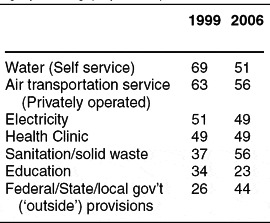
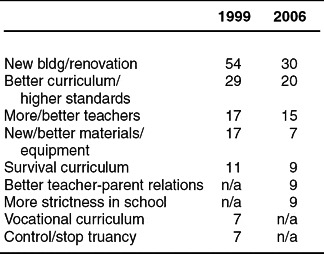
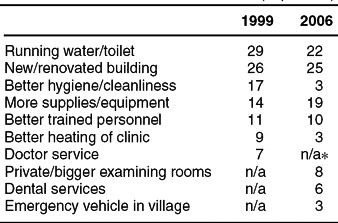
As in 1999, the 2006 survey respondents were asked to express their opinions about village service provisions in general (Table 5), and then offer specific ideas for improvement in two areas of greatest need and interest in the village, education and health (Table 6, 7). During the period when the survey was undertaken in the summer of 2006, the newly-elected First Chief and Council were experiencing a ‘honeymoon’ of sorts and were praised by virtually every respondent; many compared them to the previous leadership, which was widely found to be corrupt, and was forcibly removed from power before the end of its term the previous year. As a result, 29% of those surveyed noted that the present government was, if nothing else, ‘better than the last one’. When compared to the 1999 results, the criticism of the planning in the village was greatly muted, in part at least, a likely result of this sentiment.
Expressed satisfaction with village planning (in percent).

Sources: 1999 Statistics, Dinero, Reference Dinero2005: 154; 2006 Statistics from the 2006 Arctic Village 2007 Household Survey.
Stated school/educational needs (in percent).

Sources: 1999 Statistics, Dinero, Reference Dinero2005: 147; 2006 Statistics from the 2006 Arctic Village Household Survey. Open question; more than one answer is possible from each respondent.
No mention was made in the 2006 survey, for example, of previous concerns regarding the lack of running water in the village, the need for better rubbish removal, and the like. What did remain of primary concern however was the 24% of respondents who complained that there is still no wage labour work in town (compared to 26% in 1999), and that they saw the Council as responsible for helping to create year-round work in the village. Also, 24% mentioned alcohol and/or drugs as a problem in the village (26% in 1999), and 16% mentioned the loss of elders as a community-wide concern (7% in 1999; all 1999 statistics from Dinero Reference Dinero2005: 152).
One significant complaint (18%) not found in the 1999 results was a lack of communication in the village between villagers, and between the Council and the people. This issue, survey respondents suggested, lent to a sense of lost communal cohesion. One 37 year old female respondent summarized this sentiment well: ‘Yes, there's a better Council and Chief [now] than in the past, and a better Tribal Administrator to handle the finances. But it was better in the past. There was more communication, kids and adults did things together. There's too much gossip and hatred now.’
In part, the issue of cohesion may be explained by the increasing geographical size of the village over recent decades, especially since the introduction of the snowmachine and 4-wheel ATV. Use of these vehicles has allowed for and encouraged the dispersion of dwellings, which are being built increasingly further away from the original town core. As a result, the villagers have a tendency to interact less often and less directly with each other than in the past. When, for example, bingo is now played in the village, it takes place virtually from individual homes over walkie-talkies (even in the summer months), rather than in a single physical space such as the Youth Centre or Community Hall.
Overall, a movement from communalism towards individualism appears to be common throughout the community. As noted in Morseth (1997: 249), this may be a result of the introduction of new technologies that make subsistence activities easier, but also less communal in nature. In turn, the villagers have become more competitive rather than cooperative with each another (Mason Reference Mason2002), especially with regard to how they view ownership of various consumer products.
The 37% of respondents who had expressed dissatisfaction with the Local Council in 1999 (Dinero Reference Dinero2005: 152) had largely dissipated by 2006. From 1999 to 2006, a movement appeared to be under way in which the local government was gaining more villager trust, although with that trust was also coming a sense of dependency and expectation that, if something needed to be done, ‘the Council will do it.’
Testing for significant correlations, it was determined that women were more likely to express greater satisfaction with overall services granted by the Local, State and Federal governing bodies than men (.02), as were respondents in committed relationships (.04). It is noteworthy that the First Chief elected in January 2006 is a married woman, while her predecessor is a single man. In other words, single men were least likely to express satisfaction with overall village planning and development, but then, it appears that these are the very respondents who stand out throughout the study as possibly experiencing a greater sense of alienation in other aspects of community life than do the rest of the village households.
As criticism levelled against the Local Council has lessened, so too have satisfaction rates with most village services provided by the Council stayed constant or risen somewhat. Although once again, the top two services with the highest rates of satisfaction remain those supplied either by an outside operator (air transportation) or by the individual (water service), both showed signs of decline in satisfaction. Accessing water is far from convenient; villagers supply their own homes with water provided from a single village tap, usually using a 4-wheeler and a large plastic rubbish can to pack the water. The decline in satisfaction with the air transportation service is in large part due to the ever-increasing cost of air travel that, as of 2006, cost $340 per return trip to Fairbanks. As a result, 95% of the 2006 survey respondents rated the cost of the service as ‘high’ or ‘somewhat high’, up from 83% in 1999. In addition, only 33% of those surveyed stated that they travel out of the village by air with any degree of regularity, down from 46% in 1999 (Table 5).
The service receiving the lowest rating in the entire survey was education, provided by the Yukon Flats School District based in Ft. Yukon. Education in the native bush is a controversial issue with many difficult aspects at local and state levels (see, for example, Dinero Reference Dinero2004b). On the one hand, it is quite notable that as of 1970, only 4% of Athabascan Indians in the Yukon Flats region between ages 25 and 34 were high school graduates (The Agricultural Experiment 1978: 3–1). On this score at least, the Gwich'in have made incredible progress. Still, the community recognises the need for quality education; it is known that students in the two schools in the village have been tested and achieved levels ranking them among the worst nationally. As one survey respondent stated, ‘our kids have poor education; our high school graduates [really only] have a 7th grade education.’
Although the percentages dropped, a new school building, better curriculum and standards, and better teachers remain the top three concerns cited by the parents and other adults of the village. In the survey, 100% of those with children said that they do send their children to the village schools. However, some families occasionally send some of their children out to boarding schools or to live in Fairbanks where the children attend public school if they can afford the additional expenses. Incidentally this includes the children of the village school principal (Table 6).
As for the village health clinic, 90% of those surveyed stated that they consult a medical doctor for their healthcare needs, and 100% of these stated that they use the local clinic for this purpose. And yet, concerns expressed in 1999 remained virtually unchanged in the 2006 survey; the building remains old and dilapidated, stocked with inadequate supplies and equipment and staffed by personnel with limited training or medical expertise (Table 7).
Stated clinic/health care needs (in percent).

*In 2006, a physician, nurse or aide flew into the village on a weekly basis.
Sources: 1999 Statistics, Dinero, Reference Dinero2005: 150; 2006 Statistics from the 2006 Arctic Village Household Survey. Open question; more than one answer is possible from each respondent.
One major improvement is that a health care professional now visits the village once each week. But most respondents still noted that they seek local solutions to their needs, including having prescription drugs available in town, and emergency services available when needed. Many noted that the only reason that they go to the local clinic is that this is the first step toward getting the written approval they need to fly to Fairbanks at no cost (as long as the reason for travel is medically related) in order to secure the appropriate care they require.
Vashraii K'oo/Arctic Village development analyses
Looking back: the sense of loss
The statistics and correlations above provide only one part of the picture of the changes and developments taking place in Vashraii K'oo/Arctic Village as the village enters its second century of existence. It is necessary to consider the way in which the villagers themselves perceive the changes taking place in their community. While the material gathered for this section is verbal in response to open-ended questions at the end of the 2006 survey, the results provided were quite consistent.
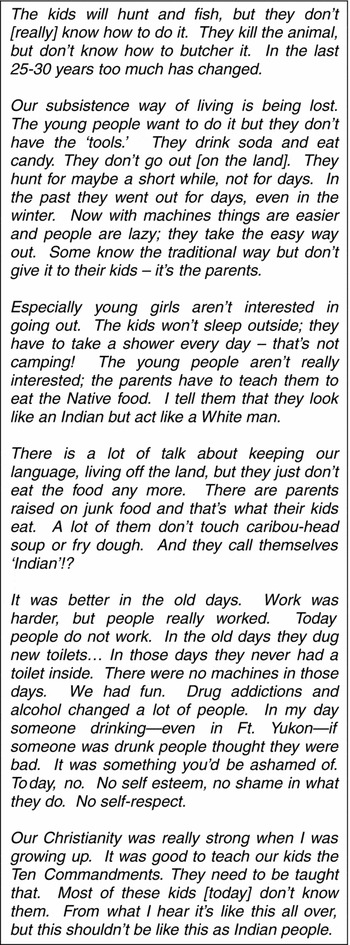
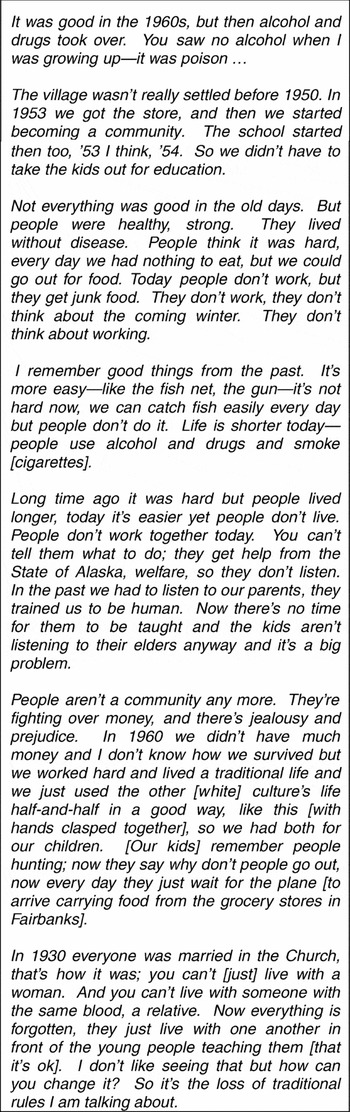
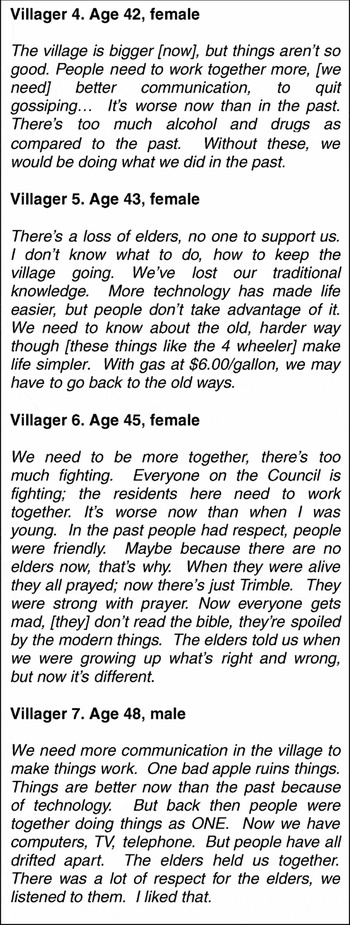
Villagers were asked how they believe that their community has changed, for better and/or for worse, since they were young. A time frame was offered as guidance (that is ‘compare the present with 10 years ago, 20 years ago, 30 years ago . . .’) depending upon the age of the respondent. Of the 38 responses for this point, the three villager respondents quoted here at length may be viewed as a representative sample of a prevailing viewpoint that the Gwich'in's best years are behind them. It should be noted that the responses are edited very lightly for consistency and understanding of meaning (Figs. 1, 2, 3).
Villager 1. Age 63, Male.

Villager 2. Age 65, female.

Villager 3. Age 71, male.

The three individuals quoted here are well-respected elders in the village. All have spent time outside the village and in fact outside Alaska, and are nearly as familiar with the white world as they are with the world of the Gwich'in. All grew up in the village, and all have served in the village government and have been active village leaders for many years.
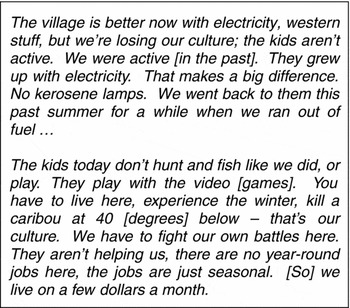
And yet as elders, it could be argued that these views may represent a generational perspective. It is enlightening to listen to the voices of the next generation, which grew up during the 1960s and 1970s, when the changes under discussion became manifest (Fig. 4).
Four villagers.

It is apparent from the responses to the open-ended part of the survey that a few basic points may be discerned in terms of views and perceptions of recent changes in the native community. They may be summarised as the following:
Life in the village has been made easier because of technology, particularly over the past 20–30 years;
Due to reliance upon these technologies, villagers are less likely to work hard and pursue subsistence (hunting/fishing/gathering) and other necessary community activities;
Wealth stratification has led to a competitive atmosphere between villagers leading to bickering, jealousy, arguing rather than cooperation. This in turn has led to a lost sense of community;
Drugs and alcohol have entered into the community as a result of these rapid changes, only serving to make matters that much worse.
While the villagers are generally better off today than in the past in terms of material wealth, this has come at great cost; there is a sense of loss that pervades the community (lost elders, lost language, lost hunting/fishing skills and activity, lost identity, lost culture).
As globalisation, new technological changes, and the imposition of outside influences and values each serve to help eliminate temporal/spatial differentiation, the Gwich'in today state not that they do not know who they are but rather, that they ‘don't know where we are.’
Looking forward: a prognosis
If Vashraii K'oo/Arctic Village and other bush villages like it are to evolve and grow in the rapidly changing era of globalisation that typifies the 21st century, then a more hybridised sense of meaning of who a Gwich'in Indian is, and what Gwich'in space is, may now be in order. Put simply, if the definition of what it means to be an ‘Indian’ is not broadened to include new ways of expression and identity (see Dinero and others Reference Dinero, McGee, Bhagat and Mariotz2006) which better accommodate the mixed, meshed, interconnected and at times, oppositional elements which now comprise the daily lives of people like the Gwich'in, then, to quote one 48-year old male villager, the Gwich'in are indeed ‘doomed to extinction-finished!’
The journalist Michael D'Orso captured this sentiment well in the introduction to his book Eagle blue, an in-depth work concerning high school basketball in the native bush and itself a study of the manifest ways in which globalisation now plays a role in the daily lives of the Gwich'in. For this reason, I quote D'Orso at length (Reference D'Orso2006: 2):
There are souls all around, say the Elders. There are Spirits. In the earth, in the air, in the blood that still runs through the veins of the People.
The boy wants so much to believe them, to know that it's true. But it's hard to hear tales of the ancients on foot, with their sleds and their spears and their tents on their backs, braving sixty-below in the dead of the winter, bringing down bears with their wits and their hands. It's hard for the boy to hear stories like those, then to look at the men of the village today. There are some who still run their traplines the time-honored way, tracing the trails of their fathers through silent white forests with trained teams of huskies and hand-fashioned sleds. But the rest of the tribe, those who still call themselves woodsmen, saddle sleek snow-machines powered by NASCAR-grade engines, fiberglass beasts that blast over the ice at the speed of a Lexus.
The boy thinks of the stars and the wind that showed the way home when the Elders were young, then he looks at these men – the friends of his father – with their GPS bearings and satellite cell phones with signals that slice through the worst winter storm, and he asks himself: Where are the Spirits in any of this? He asks it while watching the men in the village who no longer run traplines at all, who no longer hunt moose in the fall or net salmon come summer. He looks at the husbands and fathers and brothers with pints in their pockets and dope on their breath, slumped on the stoops of their worn, weathered shacks. He can feel their surrender, soaked in whiskey and weed. He can feel their confusion, one foot in the old world, the world of the Elders, and one foot in the new, the world of the white man, with food wrapped in plastic, and color TV's, and lawyers and judges and government checks . . .
The nature of this description is bleak at best, and again suggests loss, and the immobility that such loss seems to entail.
But from the Gwich'in perspective, if one is to find answers to the question of how to resolve the apparent challenges between the innovations of the present with the fears that culture is being ‘lost’, one must simply look to the tradition to find that ‘it's never been lost. It's still right there . . . All we've got to do is just uncover it, and just start to work with it’ (Frank Reference Frank2003: 57). Suggests one 62-year old female Arctic Villager:
People say we're doing better today than the past but I think sometime between then and now life was good whenever the caribou would come and make us strong. I can't say let's go back [to the past]-it was good before [the White people] came; we were nomadic, we didn't have dogs, no snowmachine, we just had canoes, but we were healthy, there were lots of us, and we were organised and strong in those days. People only died of old age-THOSE are the ‘good old days’ – before Columbus.
But then the whalers and the trappers all came and we're the last ones to be affected; it's in our hearts, it can't be changed, this is who we are today . . . [So it's best if] we use the tools of both worlds, the western and ours, combine them together, like the way we use the parts of the caribou . . .
Or, to put it as a 46 year old female respondent put it:
In the past 10 years we hardly know where we are standing. The changes in our lifestyle, education, schooling, training, a modern life, everything is technology. Nowadays, I see a lot of differences between the past and now. I guess it's good-we do need these things. They do need the computer and all that I guess, but changing is hard, and you really can't depend on it. But we're stuck with it. . .
If ‘Villager 2’ cited above and the other doomsayers are correct, if the definition of what is ‘Indian’ today in northeast Alaska is one who eats fry dough and speaks Gwich'in, then perhaps the Gwich'in people will soon cease to exist. But in the globalising environment of Vashraii K'oo/Arctic Village, Indianness, it is argued here, must be seen as more than this.
If Indianness can be seen as having a breadth and depth that extends through time and space, beyond the constraints of a specific food or clothing or word choice, then Gwich'inness lives. Or put a different way, so long as there are those who stand up and say ‘I am Gwich'in, this is my Land, and I am proud of it!’ the Gwich'in will live on.
Indeed, it is this sort of rhetoric which in part has supported and sustained the Gwich'in in recent decades. In the early 1970s, it was this very attitude that led to their opting out of the ANCSA agreements; as a result, Arctic Village residents today are not Doyon Corporation shareholders, a choice that remains controversial among some villagers but well exemplifies Gwich'in values of independence and self-reliance (Dinero Reference Dinero2005). Such attitudes similarly inform Gwich'in resolve to protect their lands from development, particularly against the continuing interests of the oil industry and of some quarters in Washington to conduct exploratory drilling in the Arctic National Wildlife Refuge (ANWR). Though perhaps simplistic at its core, this recent resurgence of ‘Gwich'in pride’ has infused a small but notable sense of well-being into the community as it continually battles against the pro-drilling forces in order permanently to protect and preserve the calving grounds of the Porcupine caribou herd (S. James, personal communication, 8 August 1999).
Gwich'inness, and indeed Indianness in general, requires redefinition in the globalised economy and evolving monoculture of the 21st century. The suggestion that such ‘traditional’ cultures and identities are fixed and static has lost currency long ago. Castells (Reference Castells1997: 59) suggests that in such ‘cultural communes’ that is spaces in which ‘ethnic materials’ have been powerfully interwoven over time but which are now being torn away from their historical contexts by these new forces, ‘ethnic roots are twisted, divided, reprocessed, mixed, differentially stigmatized or rewarded, according to a new logic of informationalization/globalization of cultures and economies that makes symbolic composites out of blurred identities. Race matters, but it hardly constructs meaning any longer.’
Or, put another way, the literature has referred to the theoretical idea of places being ‘thick’ with meaning, where certain behaviours and activities have taken place over time. But a ‘thinning’ of meaning begins to occur as globalisation takes hold, serving as a process of decontextualisation (Stewart and others Reference Stewart, Keith and Scottie2004: 184). Still, so long as a place retains its name(s) and referents to certain times or events, a triangular relationship between the people, the place, and things (in this case primarily animals) will continue to inform and underpin a sense of meaning for that place (Stewart and others Reference Stewart, Keith and Scottie2004: 191). It is this meaning, or sets of meanings, that further inform and facilitate cultural development, even in an age of globalisation. As archaeologists working in the Arctic have shown, native cultures continue to develop out of cyclical processes of human activity over time (Stewart and others Reference Stewart, Keith and Scottie2004: 202). Rather than thinking of spaces as ‘flat’ they can be seen to have ‘layers’ of meaning informed by and embedded with historical narratives of events punctuated by innovations.
Within such a framework, native identities and cultures, like all cultures, can and must change. What remains constant in the present case, however, is the Gwich'in connection to various markers and locations of embedding meanings (Snyder and others Reference Snyder, Williams, Peterson, Jentoft, Minde and Nilsen2003) throughout the Yukon Flats/Lower Brooks region: the Vashraii K'oo creek that runs through the village and that gives it its Gwich'in name; the Dan-cha-lee mountain behind the village where much of the caribou hunting takes place each year and which is central to Gwich'in history, heritage and identity; nearby Old John Lake where a great deal of fishing takes place; the Chandalar River which runs past the village and the Junjik River which branches off to the north, providing ideal moose and duck hunting opportunities, and certainly, Arctic Village itself. These, among others, are the Gwich'in spaces, the lands and waters upon which and within which Gwich'inness is embedded with multiple levels of evolving meanings and significance.
These spaces have long made the Gwich'in who and what they are (just as the Gwich'in play a role in making the spaces what they are), and the Gwich'in were continuing to do so in 2006. That this is accomplished in part using imported technologies, foods, clothing and the like is not insignificant. But the above data suggest that these are merely new tools, as was the rifle when it replaced the bow and arrow, or the log cabin when it replaced the caribou-skin tent, to be used to support, sustain and perpetuate new forms of Gwich'inness upon the lands and waters that have been used by their ancestors for millennia.
The future for Vashraii K'oo/Arctic Village, and indeed, for villages throughout the native bush, will be dictated not by if/when globalisation will impact the community, for indeed, that genie is long ago out of the bottle, but how the villagers of the community and most especially, the village leadership and community planners, will respond to these inevitable changes, while anticipating and embracing new developments and opportunities as they arise. There will be those who bemoan the losses the community has incurred, and those who embrace what innovations and new opportunities have to offer. And they may sometimes be the very same people. But to quote a Local Council member interviewed during the 1999 village study, ‘we can't go back to the bow and arrow – we can only move forward.’
Council planning efforts are in fact reasonably forward-looking. In addition to the capital investments noted above, virtually every Chief and Council elected in recent years has made an effort to increase tourist numbers coming into town in order both to boost local economic development, and as a way of celebrating communal heritage, identity and pride. A continuing discussion includes the possibility of building a small lodging/restaurant facility in the village while also creating more eco-tourism opportunities. Indeed, 63% of 1999 survey respondents supported these efforts: this statistic remained virtually unchanged at 62% in 2006. Younger survey respondents were found to be more open to marketing tourism to outsiders than older respondents (.05). In 1999, male respondents were much more likely to support these efforts than women (.00).
And yet, such plans also open the door to additional outside ideas, influences, and interests which some see as potential threats to the community's internal health. As a result, many have voiced opposition to this planning agenda. Interestingly, those 2006 survey respondents who travel outside the village by plane with the greatest regularity (to Fairbanks and beyond) were more likely to voice greater opposition to increasing tourism than more homebound residents (.04). In addition, opposition came from two groups of hunting households, those who hunt caribou (.04) and those who hunt duck (.05). It was seen in both cases that less educated respondents expressed opposition to marketing tourism. Still, while one can imagine that sport hunting could bring greatly needed cash into the Arctic Village economy, it is not unreasonable to appreciate the ambivalence that hunting families might feel with the idea of having to compete for increasingly scarce game with white trophy hunters in order to put food on their tables.
In conclusion, it is contradictory and counterproductive to speak of the ‘death’ of the Alaska native bush. It is not inappropriate or ill-advised for chiefs, mayors, Local and Tribal Councils, and other native community leaders to continue the difficult work needed to help foster a sense of community, identity and pride in response to the sense of loss and despondency described above and felt by so many throughout this and other similar Alaska native villages. Globalisation, and, for that matter, the changes that have occurred in native Alaska since the first white settler arrived, have in fact brought loss to the bush, even while bringing with it new technologies, new opportunities, and new hopes (see Dinero and others Reference Dinero, Mariotz and Bhagat2007). A failure to appreciate and acknowledge this sense of loss not only invalidates native pride, but potentially jeopardises the ability of residents of villages like Vashraii K'oo/Arctic Village to adapt to the new challenges of globalisation manifest throughout their communities.
Acknowledgements
Funding for this study was provided by the National Science Foundation, Award No. EEC-0332608. I am indebted to two anonymous referees for their invaluable input and advice on an earlier version of the paper. I also owe a debt of gratitude to the people of Arctic Village, who have generously opened up their homes and hearts to me, my wife Penina, and my family over the past years.