Mangrove trees are not immune to herbivory. They are affected mainly by folivores, which may influence litter production and nutrient cycling within the system (Choudhury Reference CHOUDHURY1988). The amount of leaf material lost to herbivory is also related to the characteristics of the trees and local environmental conditions (Feller Reference FELLER1995), which result in widely varying rates of leaf consumption (Anderson & Lee Reference ANDERSON and LEE1995). According to Cannicci et al. (Reference CANNICCI, BURROWS, FRATINI, SMITH, OFFENBERG and DAHDOUH-GUEBAS2008), the true ecological role played by insect herbivores is not simply the amount of plant material lost to herbivory, but also involves effects at the scale of whole plant performance and ecosystem functioning. Thus, the activities of insect herbivores may also be viewed as a positive impact on mangroves, influencing, for example, energy transfer in the system.
Mass defoliation of the mangrove tree Avicennia germinans (L.) Stearn has been observed in lepidopteran larvae such as Hyblaea puera (Cramer, 1777) (Hyblaeidae) (Bouchon et al. Reference BOUCHON, BOUCHON-NAVARO, IMBERT and LOUIS1991, Mehlig & Menezes Reference MEHLIG and MENEZES2005, Menezes & Mehlig Reference MENEZES and MEHLIG2005) and Junonia evarete (Stoll) (Nymphalidae) (Elster et al. Reference ELSTER, PERDOMO, POLANÍA and SCHNETTER1999, Saur et al. Reference SAUR, IMBERT, ETIENNE and MIAN1999). However, only a few reports on mangrove herbivory have provided detailed information on the resulting loss of defoliation events (Anderson & Lee Reference ANDERSON and LEE1995, Burrows Reference BURROWS2003, Duke Reference DUKE2002, Gara et al. Reference GARA, SARANGO and CANNON1990, Tong et al. Reference TONG, LEE and MORTON2006).
On the Ajuruteua Peninsula, on Brazil's Amazon coast, this phenomenon is observed every 2 y for approximately 1 mo, when the leaves of A. germinans are consumed completely by H. puera. The present study is part of a larger investigation on mangrove productivity over a 4-y period. Thus, we evaluated the impact (per cent reduction) on litterfall production due to leaf consumption on Amazonian mangrove stands in the north-eastern coast of Pará, Brazil.
The site of the present study is located at Furo Grande, Ajuruteua Peninsula (00°50′19.5″S, 46°38′14.9″W) in the municipality of Bragança, in the Brazilian state of Pará. This region presents a distinct wet season from January to June, when rainfall averages c. 430 mm mo−1. According to Pool et al. (Reference POOL, LUGO, SNEDAKER, Walsh, Snedaker and Teas1975), litterfall production in mangrove forests is related primarily to the availability of freshwater. In fact, peaks of litterfall tend to coincide with those of rainfall, typically during the wet season, leading to the exportation of organic matter from the mangrove forest to adjacent aquatic systems, increasing their productivity (Day et al. Reference DAY, CONNER, LEY-LOU, DAY and NAVARRO1987).
An almost pure stand of A. germinans was monitored at Furo Grande from August 2000 to July 2004. This species predominates in the local mangrove forest, which includes two other tree species, Rhizophora mangle L. and Laguncularia racemosa (L.) Gaertn.f. The study site is dominated by A. germinans trees > 20 m tall interspersed with a few individuals of R. mangle. Laguncularia racemosa is only found along the edge of the main channel. The soil is silty clay and the interstitial water averaged value of 33 ppt in salinity over an annual cycle (Fernandes et al. Reference FERNANDES, SILVA, LIMA, VARELA, HERCOS, FERNANDES, ARRUDA, GOMES, SANTOS, SOARES and SARAIVA2005).
Litterfall was estimated using litter traps consisting of a 1-m2 wood frame encompassing a 1-mm2 drainage mesh. Traps were set 1 m above the ground to avoid tidal inundation, at 20-m intervals, along a 140-m transect. Litter was collected monthly and sorted into six categories: leaves, flowers, fruits, twigs, stipules and miscellaneous (frass, dead larvae of H. puera). The material collected was dried to a constant weight at 70 °C. Variation within years was assessed by the Kruskal–Wallis (H) test and among years by Friedman's U (Ayres et al. Reference AYRES, AYRES, AYRES and SANTOS2007).
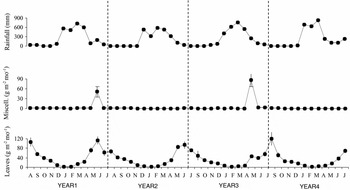
Litter yield ranged from 511–707 g m−2 mo−1 over the 4-y study period, averaging 583 g m−2 mo−1 (Table 1). Leaves represented a major proportion of litterfall (71%), averaging around 415 g m−2 mo−1 overall. The relative contribution of each category to total litter yield differed significantly over the four years of the study (Table 1), although, except for miscellaneous material (U = 11.9; df = 3; P = 0.01), the amount of material produced in each category did not vary significantly among years. Production of miscellaneous material increased substantially in the first and third years, at 65 and 99 g m−2 mo−1, respectively (Table 1), in comparison with 10 g m−2 mo−1 or less in years 2 and 4. While negligible in most months, production of miscellaneous material peaked in June of YEAR 1 and May of YEAR 3 (Figure 1). Leaf litter production decreased about 45% and 15% in the subsequent months of July 2001 and June 2003, respectively (Figure 1), reflecting the amount of leaf material lost to herbivory by H. puera, i.e. the replacement of leaves by frass, the end result of herbivory. Thus, the amount of frass produced in the first and third years (Table 1) represented 9% and 17% of the total litterfall, respectively, while the other two years provided a very different picture of herbivory damage (< 2%).
Average (mean ± SD) of the annual litterfall at Furo Grande, Ajuruteua Peninsula, Brazil, by category of litter, with Kruskal–Wallis H values for variation within each year and Friedman U values for variation among years.

Monthly mean (± SE) dry weight of leaf and miscellaneous litter in the Avicennia germinans mangrove forest in relation to local rainfall at Furo Grande, Ajuruteua Peninsula, Brazil.

Hyblaea puera larvae feed exclusively on A. germinans in the mangroves of the Brazilian Amazon, depleting both young and senescent leaves within a short period of time. This appears to account for the reduction in litterfall, which has important consequences for the input of nutrients on the forest floor, although, for some reason, this is not an annual phenomenon. The amount of frass in the traps suggests that the quantity of nutrients falling to the forest floor may not change very much, but it may influence the mineralization process by accelerating leaf decomposition in the sediment. In addition, herbivory by H. puera larvae may play an important role in the regulation of the leaf dynamics of A. germinans in the Amazonian mangrove.
Other studies found that insect herbivory plays a minor role in the leaf dynamics of mangrove tree species. For example, Lee (Reference LEE1991) found that less than 5% of the leaves of Kandelia candel in Hong Kong, China, suffered > 40% area loss under natural grazing pressure. By contrast, Burrows (Reference BURROWS2003) showed that up to 13% of Rhizophora stylosa and 36% of Avicennia marina leaf material can be lost to herbivores. In the present study, leaf loss averaged 13% (in the first and third years), a higher percentage than in other studies, considering that total consumption by herbivores seldom reaches 10% of the foliage (Schowalter et al. Reference SCHOWALTER, HARGROVE and CROSSLEY1986, Tong et al. Reference TONG, LEE and MORTON2006).
Some authors have shown that the loss of leaf material, such as the apical buds, can reduce leaf production rates and negatively impact individual tree performance (Anderson & Lee Reference ANDERSON and LEE1995, Burrows Reference BURROWS2003, Murphy Reference MURPHY1990). In addition, the structure of the forest may also be negatively influenced by such a severe defoliation process (Anderson & Lee Reference ANDERSON and LEE1995). In the present study, however, the herbivore attack occurred once every 2 y, converting A. germinans leaves into frass, favouring nutrient cycling in the mangrove itself and providing a nutrient supply for neighbouring aquatic systems over a short period of time.
ACKNOWLEDGEMENTS
We gratefully acknowledge the funding provided by the National Council of Technological and Scientific Development – CNPq – Brazil, ITI-Proc. n° 190104/2004-0 e DTI -Proc. n° 390035/04-1X.