1 Introduction
Multi-agent systems comprise intelligent agents that interact with each other (Wooldridge, Reference Wooldridge2009). Trust and reputation are tools that enable agents to decide whether or not to interact with other agents and to select interaction partners (Yu et al., Reference Yu, Shen, Leung, Miao and Lesser2013; Hendrikx et al., Reference Hendrikx, Bubendorfer and Chard2015). Trust is the subjective belief, from the perspective of a trustor agent, that a trustee agent will act as they say they will do in a given context (Artz & Gil, Reference Artz and Gil2007; Jøsang et al., Reference Jøsang, Ismail and Boyd2007). A trustor agent that has a high level of trust in a trustee is confident that an interaction will be successful with good outcomes. Likewise, a low level of trust in a trustee implies that the trustor agent expects an unsuccessful interaction. Whereas trust is assessed using information collected by the trustor, the reputation of a trustee is based on the opinions of several agents in a network.
Trust and reputation systems generally consist of the collection, dissemination, and aggregation of agent experiences (Hoelz & Ralha, Reference Hoelz and Ralha2015). As agents interact with one another they record details of the interaction along with a rating. In centralized systems these records are reported to a central authority which aggregates them and provides reputation assessments of trustees to trustors (Jøsang et al., Reference Jøsang, Ismail and Boyd2007). In decentralized systems, agents report their experiences and opinions to each other and aggregate them along with their own (Teacy et al., Reference Teacy, Luck, Rogers and Jennings2012). In both centralized and decentralized systems several factors affecting reputation assessments must be considered, including lack of experience with a trustee, dishonesty, subjective preferences, and context (Yu et al., Reference Yu, Shen, Leung, Miao and Lesser2013; Hendrikx et al., Reference Hendrikx, Bubendorfer and Chard2015; Hoelz & Ralha, Reference Hoelz and Ralha2015).
In this paper, we distil trust and reputation into two kinds of aggregation, namely aggregating interaction records to form trust opinions, and aggregating opinions to produce overall reputation assessments. To this end, the way trust and reputation information is represented is discussed in detail, followed by how it is disseminated while considering dishonesty and preferences. In particular, this paper makes the following contributions:
1. we present a unifying abstraction for the different kinds of trust and reputation system found in the literature,
2. we show for each abstraction how a function of the same form and capabilities can be learned using machine learning over gathered experiences, and
3. we present a machine learning framework to learn trust and reputation models that exhibit the capabilities of existing systems in the literature.
Finally, we propose the Machine Learning Reputation System (MLRS) to combine the capabilities of the different abstractions. The MLRS is then evaluated in a simulated marketplace, against trust, and reputation systems that are analogous to those found in the literature.
The paper is structured as follows. First, in Section 2 we review the literature on trust and reputation systems with a focus on how trust and reputation information is represented and disseminated. A unifying abstraction for trust and reputation systems is presented in Section 3, followed by a discussion of its limitations and the corresponding limitations of existing trust and reputation systems in Section 4. Next, Section 5 presents a machine learning framework for building trust and reputation models and introduces the MLRS. Finally, an evaluation of several strategies in a simulated martketplace is presented in Section 6, and Section 7 concludes the paper.
2 Research landscape
Trust and reputation systems can be divided in many ways, such as whether they are centralized or decentralized, whether they process continuous or discrete ratings, or if they are suitable for dynamic environments or not. Kinateder et al. (Reference Kinateder, Baschny and Rothermel2005) identify the common components of trust and reputation models, including trust and certainty measures and whether the trust information is direct or indirect. They then propose a general model comprised of these components, and adapt existing trust and reputation models to fit with their framework. Similarly, Hoelz and Ralha (Reference Hoelz and Ralha2015) provide a meta-model for trust and reputation, considering trust, reputation, the environment, and its exploration. They map components of existing trust models, including direct trust, reputation weighting, and information sources, onto the components of their meta-model. Their meta-model does not consider the form or combination of trust and reputation information sources, however, as we do in this paper. We consider the components of trust and reputation, and in particular we consider the representation and dissemination of trust and reputation information. When presenting abstractions for trust and reputation assessment models in Section 3, trust information is generalised to opinions, and dissemination is further divided into gathering and aggregating opinions.
2.1 Representation of trust information
A trust or reputation score is typically given to the user as a single number, representing the trustworthiness of a trustee agent. To compute a trust or reputation score, ratings of past interactions are typically aggregated to produce a set of parameters that form an opinion. In the most simple cases the aggregation computes the mean rating, which is then used as the measure of trustworthiness (Sabater & Sierra, Reference Sabater and Sierra2001a, Reference Sabater and Sierra2001b; Huynh et al., Reference Huynh, Jennings and Shadbolt2004, Reference Huynh, Jennings and Shadbolt2006). Other aggregations produce opinions with the parameters of probability density functions (PDF), such as the Gaussian (Teacy et al., Reference Teacy, Luck, Rogers and Jennings2012), Beta (Jøsang & Ismail, Reference Jøsang and Ismail2002), or Dirichlet PDFs (Regan et al., Reference Regan, Poupart and Cohen2006; Teacy et al., Reference Teacy, Luck, Rogers and Jennings2012). In these cases, the measure of trustworthiness is typically computed as the expected value of the PDF.
The representation of trustworthiness depends on the domain, as does the kind of ratings that are assigned to interactions. In FIRE (Huynh et al., Reference Huynh, Jennings and Shadbolt2004, Reference Huynh, Jennings and Shadbolt2006), for example, ratings are assigned as real numbers in the range [−1, 1]. This means that the most suitable opinion representation is one with continuous parameters. In FIRE, the mean rating is used as the opinion, which is in fact equivalent to a Gaussian representation where the standard deviation is ignored. In BRS (Jøsang & Ismail, Reference Jøsang and Ismail2002), ratings are given as binary (i.e. {0, 1}) to represent a successful or unsuccessful interaction. In this reputation system, therefore, a Beta PDF is most appropriate with α being the number of successful interactions and β the number of unsuccessful interactions. Regan et al. (Reference Regan, Poupart and Cohen2006) extend this binary rating system to include more values, such as {Very bad, Poor, OK, Good, Very good}, and use a Dirichlet PDF as the opinion.
In a stable environment, where the behaviour of agents does not change over time, simple aggregations of historical interaction ratings can be used in assessing trust and reputation. If there are dynamic properties to the environment and its members, however, some historical interactions may be more relevant than others. If the performance of a trustee drifts over time, for example, the ratings given by trustors for its interactions may decrease. Here, an old interaction rating is less relevant to the performance of the trustee after the drift, than a more recent one. In several reputation systems, including REGRET (Sabater & Sierra, Reference Sabater and Sierra2001a), FIRE (Huynh et al., Reference Huynh, Jennings and Shadbolt2004, Reference Huynh, Jennings and Shadbolt2006), and BRS (Jøsang & Ismail, Reference Jøsang and Ismail2002), this recency is considered by weighting the interaction records in the aggregation, giving more weight to more recent interactions. In other systems, such as TRAVOS (Teacy et al., Reference Teacy, Patel, Jennings and Luck2005) and HABIT (Teacy et al., Reference Teacy, Luck, Rogers and Jennings2012), interaction ratings older than a threshold are ignored.
Weighting or ignoring interaction ratings by their recency is appropriate when older interactions are always less relevant than more recent ones, but this is not always the case. If there is context associated with interactions, it may be more useful to use this to determine their relevance to the assessment. This notion of contextual trust has been investigated in even the first computational trust models. Marsh (Reference Marsh1994), for example, considered the general trust of an agent separately from situational trust of a trustee in a particular situation. The POYRAZ (Şensoy et al., Reference Şensoy, Zhang, Yolum and Cohen2009) reputation system uses an ontology to describe and compare contexts, and uses only those ratings from relevant interactions in the assessment. If an old interaction occurred under the same context as the one being evaluated, it is highly relevant to the assessment. If the interaction occurred under a completely different context, no matter how recent, is unlikely to be relevant in the trust or reputation assessment. Similarly, Urbano et al. (Reference Urbano, Rocha and Oliveira2010) compare the current context to the context extracted from negative experiences with the trustee. If there is a match above a threshold, the trust score is 0 and otherwise another trust aggregation is used over all interaction records involving the trustee. Both these context aware assessments may be extended to provide a measure of context similarity, which can replace the recency weighting.
An alternative to simple aggregation is to apply machine learning over features extracted from interaction records, to produce models that predict the ratings (Liu et al., Reference Liu, Tredan and Datta2014). In general, a machine learning algorithm operates over a set of training samples, each with input values and an output target value. The algorithm then learns a model that can accept inputs of the same form, and produce estimates of the target. In the context of trust and reputation, the input values are a vector of features describing the interaction (i.e. features describing the trustee and interaction context, etc.), and the output target value is the rating. Once a learning algorithm has been applied to training samples extracted from interaction records, the learned model can then be used to make predictions about potential future interactions. The most common application of machine learning for trust and reputation is in deriving stereotype trust and reputation (Burnett et al., Reference Burnett, Norman and Sycara2010, Reference Burnett, Norman and Sycara2013).
Stereotype trust and reputation relies on agents exhibiting traits prior to an interaction, where those traits are indicative of their behaviour during an interaction. For example, a taxi service may be an airport transfer service or a local taxi, which exhibit different traits that are observable prior to using their services. The airport transfer taxi may have a large storage space, whereas the local taxi may be able to carry more passengers. Other traits include those extracted from the organizational structure in which a trustee is situated or their relationships with other trustees (Ashri et al., Reference Ashri, Ramchurn, Sabater, Luck and Jennings2005). If several trustee agents with similar behaviours exhibit similar traits, a stereotype can be formed to bootstrap or enhance the reputation assessment process.
Stereotype information is useful in highly dynamic environments where agents join and leave with high frequencies, meaning that trustor agents may have too few direct experiences with trustees to make reliable trust assessments. As with interaction context, one method for considering stereotype information is to use ratings from historical interaction records where similar traits were observed. This is akin to the clustering approach that Liu et al. (Reference Liu, Datta and Rzadca2009, Reference Liu, Datta, Rzadca and Lim2010, Reference Liu, Kaszuba, Nielek, Datta and Wierzbicki2013) proposed in StereoTrust, where interactions are separated into groups defined by observed traits. The interactions in groups that match the current trustee traits are then aggregated to produce an overall trust value.
In using stereotype information alongside BRS, Burnett et al. (Reference Burnett, Norman and Sycara2010, Reference Burnett, Norman and Sycara2013) propose a model that learns a mapping from stereotype traits to a trust value. The output of the stereotype model is then used to shift the Beta PDF, also considering how many direct experiences the trustor has had with the trustee. If the trustor has directly interacted with the trustee only a small number of times, the distribution is shifted to have a mean close to the output of the stereotype model. When the trustor has an abundance of experience with the trustee, the stereotype model output has little impact on the overall assessment in comparison to the direct experience.
When a trustor has not observed a trustee directly nor any of its traits, it has no information with which to make a trust assessment. To overcome this lack of information it is typical to request reputation information from witnesses, which is discussed in detail in Section 2.2. An alternative to this is to generalize stereotype traits so that a stereotype model can be built with even small numbers of interaction records. Fang et al. (Reference Fang, Zhang, Şensoy and Thalmann2012) present a fuzzy decision tree that learns from a semantic ontology of stereotypes that is able to generalize traits when making assessments of stereotype trust. For instance, if the trustor has experience with trustees that have the trait of their location being China, this can be generalized to Asia in the ontology. With this generalization, the decision tree is then able to make an assessment of stereotype trust for a trustee in Japan even when there is no experience of trustees in this location.
Some representations of trust and reputation, in particular those that are based on PDFs, also provide an accessible measure of confidence for the trust score. Teacy et al. (Reference Teacy, Patel, Jennings and Luck2005) define confidence in a Beta PDF as the integral of a range around the expected value, which increases as more evidence is gathered and α+β increases. This confidence measure can be used to evaluate how reliable the trust score is, in particular when deciding whether or not to use other sources of information (see Section 2.2). Rather than confidence, Jøsang and Ismail (Reference Jøsang and Ismail2002) propose a measure of uncertainty for the Beta PDF, which decreases as more evidence is gathered. Other measures of confidence may be based on the variance of the distribution, particularly if the representation used is a Gaussian PDF. In general, a PDF that has a high variance is considered to be less reliable than a PDF with low variance, which should be reflected in the confidence measure.
For opinions produced by machine learning, Liu et al. (Reference Liu, Tredan and Datta2014) discuss using the estimated performance of the model along with characteristics of the input to provide a measure of confidence in the trustworthiness score. In particular, confidence in assessments should be low for models that are known to perform poorly in evaluation. A learned model can be evaluated using either k-folds cross-validation, or by using testing samples that are distinct from the training samples (Witten et al., Reference Witten, Frank and Hall2011). Furthermore, several machine-learned models, including decision trees and naïve Bayes, can provide a measure of confidence alongside their predictions.
Finally, trustworthiness is sometimes considered to have multiple dimensions, such as when interactions are rated using multiple terms. In a logistics scenario, for example, there may be two-term dimensions, such as timeliness of delivery and politeness. If a trustor does not mind whether the trustee is polite or not, then it can look at timeliness only, but if both timeliness and politeness matter then both should be considered. In this paper, we make the simplifying assumption that ratings, trust, and reputation have only one dimension. Furthermore, a multi-dimensional rating can be converted to have a single dimension by taking a weighted average, or multiple reputation models can be created for each dimension and their outputs averaged (Griffiths, Reference Griffiths2006).
2.2 Dissemination of reputation information
In most trust and reputation systems the main source of information is the direct experience of the trustor agent. When a trustor has too little direct experience, they can gather information from other sources. Typically, these other sources are witness agents, or advisors, who report on their experiences to help the trustor assess reputation. Another source of reputation information is from reference agents selected by the trustee (Huynh et al., Reference Huynh, Jennings and Shadbolt2004, Reference Huynh, Jennings and Shadbolt2006). There are two main considerations when disseminating reputation information, first is how reputation is communicated from witnesses to the trustor, and second is how to handle dishonesty of witnesses, their personal preferences, and different perspectives.
Reputation systems generally fit into one of two broad categories, either centralized or distributed. In centralized systems, reputation information, typically in the form of raw ratings, is transmitted to a central authority for processing. In the SPORAS reputation system (Zacharia & Maes, Reference Zacharia and Maes2000), trustor agents provide ratings to a central authority, which then updates the reputation score for the trustee accordingly. Once processed, trustor agents can request this reputation information to inform their decisions of whether or not to interact with a trustee. The processing can be simply collating witness ratings for the trustor to aggregate, or it can be an aggregation in itself with the result provided to the trustor.
Whereas centralized systems require a central authority to be maintained, reputation information in decentralized systems is communicated directly between agents in the network. A trustor typically requests information from witnesses, who then report their opinions to the trustor for combination with their own direct evidence. To make requests the trustor must first discover witnesses, which can be found either via a public directory, if one exists, or by asking agents the trustor has knowledge of (such as those they have previously interacted with). This is the basis of TrustNet (Schillo et al., Reference Schillo, Funk and Rovatsos2000), in which a request for reputation information is sent to agents the trustor has previously interacted with. These witnesses are then able to make requests on behalf of the trustor within their neighbourhood, creating a network of trust to be combined into a single reputation assessment.
The FIRE (Huynh et al., Reference Huynh, Jennings and Shadbolt2004, Reference Huynh, Jennings and Shadbolt2006) reputation system has a similar reputation dissemination mechanism, where agents within a local radius on a map are to be considered neighbours. Requests are then made to neighbours of the trustor, who pass them onto their neighbours recursively until sufficient reputation information is gathered to make an assessment. Likewise, in DTMAS (Aref & Tran, Reference Aref and Tran2015) a breadth-first search of the agent network is performed, up to a given depth decided by the trustor.
When reputation information is gathered, it must be combined along with any direct information the trustor has. If witnesses are known to be honest and to rate interactions in the same way as the trustor, the opinions can be combined using either a sum of functions or sum of parameters approach (Liu & Datta, Reference Liu and Datta2012). In a sum of functions, the expected value of each of the gathered opinions is computed and the results combined to produce an overall reputation score. When opinions all have the same representation (such as Beta or Dirichlet PDFs) a sum of parameters can be used, to produce an overall opinion.
Reports provided by witnesses that are dishonest or otherwise rate interactions differently to the trustor can be detrimental to reputation assessment if they are trusted blindly. The FIRE reputation system is able to control the impact that witness reputation has on the overall reputation assessment, but this can lead to reliable opinions being ignored unfairly. Building on BRS and using Beta PDFs, Whitby et al. (Reference Whitby, Jøsang and Indulska2004) iteratively remove witness opinions that have expected values that are outliers when compared to all the opinions combined. Teacy et al. (Reference Teacy, Patel, Jennings and Luck2005) developed TRAVOS to discount individual opinions based on the perceived accuracy of the witness. If a witness has previously provided reports that differed significantly from the subsequent interaction ratings, they are deemed to be unreliable. Reports provided by unreliable witnesses are given a low weight so that they affect the overall reputation assessment less than those from reliable witnesses. In STAGE, Şensoy et al. (Reference Şensoy, Yilmaz and Norman2016) filter unreliable opinions, while using stereotypes extracted from witnesses to determine their reliability.
Discounting reports from witnesses who have previously provided poor information means that they do not negatively affect the reputation assessment. In some cases, where agents rate interactions differently and in a consistent way, however, their ratings may be useful. Reports provided by a witness that always rates interactions inversely from the trustor are useful in reputation assessment once this difference in ratings is understood. Koster et al. (Reference Koster, Sabater-Mir and Schorlemmer2012) provide an argumentation framework for agents to discuss and translate their opinions from one perspective to another. Using Bayesian networks, BLADE (Regan et al., Reference Regan, Poupart and Cohen2006) and HABIT (Teacy et al., Reference Teacy, Luck, Rogers and Jennings2012) both aim to reinterpret ratings from such witnesses, and maximize the useful information that is input into reputation computation. BLADE and HABIT both learn the rating function used by witnesses from their ratings of several trustees, comparing them to those of the trustor. Similarly, Koster et al. (Reference Koster, Schorlemmer and Sabater-Mir2012) use shared experiences to learn an alignment for trust models in different perspectives.
3 Model abstractions
In this section, we provide abstractions of the different kinds of reputation system proposed in the literature. First, we discuss the sources of information used in reputation assessments, namely the experience of the trustor and that of witness agents. Second, given these sources of information, we detail a set of trust functions that aggregate interaction records to provide an opinion, and finally we detail mechanisms for combining opinions provided by different agents. The abstractions we describe are to be combined in different permutations, to produce reputation systems that are robust to different kinds of environment with different requirements. For example, in highly dynamic environments where agents exhibit traits indicative of their behaviour during an interaction, stereotype information may be combined with direct and witness information for more accurate reputation assessments (Burnett et al., Reference Burnett, Norman and Sycara2013; Şensoy et al., Reference Şensoy, Yilmaz and Norman2016).
Reputation models aim in general to compute the trustworthiness of an agent using information gathered from the environment. Typically, trust and reputation systems process experiences and situation information in parameterized functions that output the reputation based on the inputs (Vogiatzis et al., Reference Vogiatzis, MacGillivray and Chli2010; Koster et al., Reference Koster, Schorlemmer and Sabater-Mir2012). Reputation is often an estimate of the utility that will be gained if an interaction took place between the trustor agent, tr (who is performing the reputation assessment) and the trustee agent, te (whose reputation is being assessed) (Huynh et al., Reference Huynh, Jennings and Shadbolt2006). In other cases, the reputation is the likelihood that the interaction will be successful, or have an outcome above some threshold (Burnett et al., Reference Burnett, Norman and Sycara2013). The information gathered is often collected as descriptions of interactions that have taken place, involving a trustee, te, and a trustor, tr, or some other witness agent. These descriptions are in the form of tuples, describing the agents that interacted, details of the interaction, and any ratings assigned by tr to the interaction. The ratings represent how good the trustor agent considered that the interaction was, and usually are either the utility gained during the interaction or whether or not it was successful.
In general, the reputation,
 $${\scr R}(S)$$
, of a situation, S, is the expected utility,
 $${\scr R}(S){\equals}E\left[ {u(S)\!\mid\! D} \right],$$
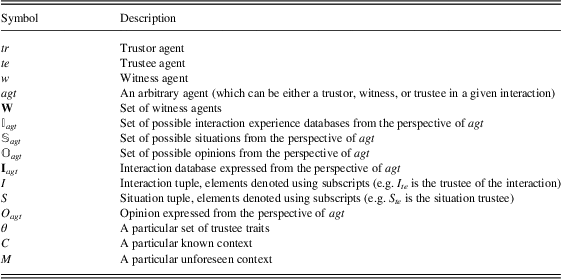
where u(S) is a random variable representing the utility of S, and D the set of information sources used in the evaluation. A situation is a set of parameters describing a prospective interaction to be assessed by a reputation system. For example, a situation may describe an interaction with a trustee, te, under known context, C. The reputation system then analyses this against the data it has gathered from the environment, which is typically a set of interaction records, I . Throughout this section, and subsequently in this paper, we will use the notation defined in Table 1.
Notation used for reputation system abstractions

3.1 Gathering opinions
In this section, we discuss the sources of information that reputation assessment is based on. In particular, direct information, which is derived from the experiences of the trustor agent, and witness information, which is provided by agents other than the trustor. In the literature, witnesses are often considered as acquaintances of the trustor, and are typically other trustor agents not involved in the current reputation assessment. Here, we consider a witness as any agent able to provide information that is relevant to the reputation assessment. This may be a central authority, such as a regulatory body, or other competing providers, such as other trustees.
3.1.1 Direct information
Almost all reputation systems use some form of direct information, collected through the trustor agent’s own experience. In general, the direct-trust of a trustee in a particular situation is,
 $${\scr R}(S){\equals}E\left[ {u(S)\!\mid\! {\bf I}_{{tr}} } \right],$$
which estimates the utility of the prospective situation, given the interaction history of the trustor, I tr . Our abstraction for this reputation computation is a function that maps a situation and a set of interaction records to an opinion representation,
 $$f_{{tr}} \,\colon\,{\Bbb S}_{{tr}} {\times}{\Bbb I}_{{tr}} \to{\Bbb O}_{{tr}} .$$
For example, a situation may be described simply as a potential interaction between the trustor and the trustee (i.e. S=〈tr,te〉), with interaction records consisting of this information along with a rating (i.e. I∈ I tr =〈tr,te,r〉). The direct-trust function then processes the interaction records with respect to the situation to output an opinion, O tr .
In general, in this paper, we consider a situation tuple, S=〈tr, te, τ, θ, C〉, to contain all information known during a reputation assessment prior to an interaction. This includes the interacting parties, tr and te, the current timestamp, τ, the trustee stereotype traits observed by the trustor, θ, and the known context, C. Interaction records, I=〈tr, te, τ, θ, C, M, r〉, contain the situation definition along with unforeseen context information, M, and the rating given by the trustor, r, which are only known after the interaction has taken place. Elements in both situation and interaction tuples are indexed using subscripts. For example, the trustee agent of a situation tuple is I te , and the interaction rating is I r .
In a typical reputation system, such as FIRE or BRS, this function searches through interaction records to find those that match the current situation (i.e. those with the same te). These records are then aggregated to produce an opinion, which in FIRE is a real number in the range [−1, 1], and in BRS is a Beta PDF represented by α and β parameters. In the general case, a second function,
 $$f_{{tr}}^{{rep}} \,\colon\,{\Bbb O}_{{tr}} \to{\Bbb R},$$
is applied to convert the opinion to a real-valued trust score. In FIRE, this function may simply output the opinion, whereas in BRS this function queries the Beta PDF for its expected value.
3.1.2 Witness information
In assessing reputation, the trustor may have little or no direct information to make a direct-trust assessment and must acquire information from other sources, such as witnesses. When combined with direct information, the reputation of a trustee in a particular situation is,
 $${\scr R}(S){\equals}E[u(S) \!\mid\! {\bf I}_{{tr}} ,{\bf I}_{w} \forall w\in{\bf W}],$$
where W is the set of all witness agents that provide information for use in the reputation assessment.
We define a witness as any agent that is not the trustor providing information for use in the reputation assessment. Typically, witnesses are synonymous with advisor agents who are acquaintances or neighbours of the trustor, but this can be extended to those gathered through a recursive search of the trustor’s social network. In FIRE, another kind of witness is introduced, selected by the trustee as a referee, to provide information for certified reputation. Although the information provided by these referee witnesses cannot be tampered with by the trustee, it is likely that only referees with positive opinions will be selected. This is therefore likely to result in certified reputation being optimistic with respect to the true reputation score, which should be handled appropriately by the aggregation.
As with direct-trust, each witness has their own individual trust function,
 $$f_{w} \,\colon\,{\Bbb S}_{w} {\times}{\Bbb I}_{w} \to{\Bbb O}_{w} ,$$
which maps situations and interaction records to opinions, all from their own perspective and in their own representations. It should be noted that the outputs of this function may be dependent on the trustor requesting the opinion, which is an element of S. After applying this function, the witnesses then provide their opinions to the trustor to combine them along with their direct-trust score. Such a combination function has the form,
 $$f^{{agg}} \,\colon\,{\Bbb O}_{{tr}} {\times}\prod\limits_{w\in{\bf W}} {\Bbb O}_{w} \to{\Bbb O}_{{tr}} ,$$
mapping all gathered opinions onto an opinion in the representation used by the trustor. Finally, the opinion is processed in the same way as in Equation (4) to produce a single reputation score,
 $${\scr R}(S)$$
.
3.2 Opinion representation
This section outlines a representative selection of opinion representations. First, a simple aggregation of ratings is considered, which is then built upon to incorporate more complex facets of reputation assessment, including stereotypes and contexts. Each element of the situation and interaction tuples may be irrelevant for a particular environment or opinion representation, and may be omitted when appropriate.
3.2.1 Basic trust
A simple method, used in FIRE, for computing an opinion is to take a weighted mean overall ratings from interactions that match the prospective situation,
 $$O_{{tr}} {\equals}f_{{tr}} (S,{\bf I}){\equals}{{\mathop{\sum}\nolimits_{I\in{\bf I}} {\Psi (S,I) \cdot I_{r} } } \over {\mathop{\sum}\nolimits_{I\in{\bf I}} {\Psi (S,I)} }},$$
where I r is the rating of interaction, I, and the interaction weight is defined as,
 $$\Psi (S,I){\equals}\left\{ {\matrix{ 1 \hfill & {{\rm if}\,S_{{te}} {\equals}I_{{te}} } \hfill \cr 0 \hfill & {{\rm otherwise}} \hfill \cr } .} \right.$$
This provides an all-or-nothing weighting system, with a weight of 1 if the situation trustee, S
te
, and interaction trustee, I
te
, matches. As this aggregation represents opinions as a single real number, it is appropriate to also use this as the trust score, that is
 $${\scr R}(S){\equals}O_{{tr}} $$
.
When ratings are binary, as in BRS, the parameters of a Beta PDF can be used to form the opinion,
 $$O_{{tr}} {\equals}f_{{tr}} (S,{\bf I}){\equals}\langle \alpha ,\beta \rangle ,$$
where,
 $$\alpha {\equals}\mathop{\sum}\limits_{I\in{\bf I}} \left\{ {\matrix{ {\Psi (S,I)} \hfill & {{\rm if}\,I_{r} {\equals}1} \hfill \cr 0 \hfill & {{\rm otherwise}} \hfill \cr } } \right.,\,{\rm and}\quad \beta {\equals}\mathop{\sum}\limits_{I\in{\bf I}} \left\{ {\matrix{ {\Psi (S,I)} \hfill & {{\rm if}\,I_{r} {\equals}0} \hfill \cr 0 \hfill & {{\rm otherwise}} \hfill \cr } } \right.,$$
represent the number of matching positive and negative ratings, respectively. While there are more concise ways of defining α and β (e.g. using set cardinality), the summations of interaction weights enable BRS to be sensitive to recency, stereotype, and context information, as discussed later in this section. This representation is used by all reputation systems that are based on BRS, including TRAVOS (Teacy et al. Reference Teacy, Patel, Jennings and Luck2005) and STAGE (Şensoy et al. Reference Şensoy, Yilmaz and Norman2016). As previously stated, where opinions are represented as a set of parameters, a second trust function is required,
 $$f_{{tr}}^{{rep}} (O_{{tr}} ){\equals}{{\alpha {\plus}1} \over {\alpha {\plus}\beta {\plus}2}},$$
which calculates the expected value of the Beta PDF and transforms the opinion into a trust or reputation score.
Opinions can be represented using different sets of parameters, including those for Dirichlet PDFs (Regan et al., Reference Regan, Poupart and Cohen2006; Teacy et al., Reference Teacy, Luck, Rogers and Jennings2012) or Gaussian distributions (Teacy et al., Reference Teacy, Luck, Rogers and Jennings2012). Due to space constraints we do not provide a comprehensive set of opinion representations, but the abstraction presented is able to accommodate any opinion representation that can be queried for a trust value (such as the expected value of the distribution they represent). As an example, the parameters of a Dirichlet PDF may represent the number of times a particular rating out of a set of discrete values (e.g. {Very poor, Poor, Good, Excellent}) has been given in previous interactions. The expected value and reputation or trust score is then computed as the most common rating. It is also possible to represent trust in multiple dimensions by using multiple sets of parameters in an opinion. For example, both the quality and timeliness of a service may be represented as two Beta PDFs in one opinion, that is O tr =〈α quality, β quality, α timeliness, β timeliness〉. Our abstraction only assumes that the final reputation score is represented as a single value.
3.2.2 Weighting for recency
Many reputation systems consider recent information to be more important than old information. This is typically achieved through applying weights to ratings in the aggregation proportionally to their age, which can be incorporated into the abstraction’s interaction weighting function,
 $$\Psi _{{rec}} (S,I){\equals}\left\{ {\matrix{ {\lambda _{{rec}} (S,I)} \hfill & {{\rm if}\,S_{{te}} {\equals}I_{{te}} } \hfill \cr 0 \hfill & {{\rm otherwise}} \hfill \cr } ,} \right.$$
where λ rec (S,I) is a recency function that outputs a larger value for more recent interactions. The FIRE reputation system (Huynh et al., Reference Huynh, Jennings and Shadbolt2006) uses a recency function that gives logarithmic weights based on the age of the interaction,
 $$\lambda _{{rec}} (S,I){\equals}e^{{{\minus}{{\Delta (S_{\tau } ,\, I_{\tau } )} \over {\lambda _{d} }}}} ,$$
where Δ(S τ , I τ ) is the time since interaction I, and λ d is a constant defining the amount of decay (Huynh et al., Reference Huynh, Jennings and Shadbolt2006). Of course, this weighing mechanism can also be used when aggregating the α and β parameters of BRS.
In some reputation systems, such as TRAVOS (Teacy et al., Reference Teacy, Patel, Jennings and Luck2005), old information is simply ignored, giving a interaction weighting of,
 $$\Psi _{{rec}} (S,I){\equals}\left\{ {\matrix{ 1 \hfill & {{\rm if}\,(S_{{te}} {\equals}I_{{te}} )\wedge(\Delta (S_{\tau } ,I_{\tau } )\geq \lambda _{\tau } )} \hfill \cr 0 \hfill & {{\rm otherwise}} \hfill \cr } .} \right.$$
Here, λ τ is a cut-off for ignoring interaction ratings, where interactions older than the cut-off are given a weight of 0 and not considered when forming the opinion.
3.2.3 Stereotypes
In many domains, agents exhibit traits that are indicative of their behaviour during an interaction, and are observable during reputation assessment. If several trustee agents with similar behaviours exhibit similar traits, a stereotype can be formed to bootstrap or enhance the reputation assessment process. In general there are two techniques to incorporate stereotype information into the trust functions, namely to adapt the match function to output stereotype similarity, or to use machine learning in the trust function.
The interaction weight when taking stereotype information into account should not depend on whether the trustees are the same or not, but rather on the similarity of their stereotype features. For example, the Jaccard index may be used to measure the similarity situation trait observations, S θ , and the interaction trait observations, I θ ,
 $$\Psi _{{st}} (S,I){\equals}{{S_{\theta } {\cap}I_{\theta } } \over {S_{\theta } {\cup}I_{\theta } }}.$$
As with recency, a threshold may also be used alongside a similarity measure such as the Jaccard index, where the interaction weight is 1 when the similarity is above the threshold and 0 otherwise. This thresholding method is akin to the clustering approach that Liu et al. (Reference Liu, Kaszuba, Nielek, Datta and Wierzbicki2013) proposed in StereoTrust, where interactions are separated into groups defined by observed traits. The interactions in groups that match the current trustee traits are then aggregated to produce an overall trust value.
An alternative technique is to apply machine learning to build a predictive model, taking observed traits as the inputs and outputting an estimate of trust (Burnett et al., Reference Burnett, Norman and Sycara2010, Reference Burnett, Norman and Sycara2013). A stereotype function, f st (⋅), is built using learning algorithms such as naïve Bayes or the MD5 decision tree (Quinlan, Reference Quinlan1992). A training set can be generated from interaction records, with the stereotype traits as inputs and the ratings as outputs. In particular, Burnett et al. (Reference Burnett, Norman and Sycara2010, Reference Burnett, Norman and Sycara2013) use the MD5 learning algorithm and generate one training sample per trustee, with the traits as inputs, and the output variable is the direct trust computed using Equation (12). This gives a small training set to learn from efficiently, but assumes that trustee traits do not change over time. An alternative to this is to generate a sample for each interaction, but this may bias the trust value of a stereotype to a popular trustee with numerous interactions. Once learned, observed traits, S θ , are used as the input to estimate the stereotype trust, f st (S θ ), of a trustee.
This output can then be combined with more simple aggregations, as in Burnett et al. (Reference Burnett, Norman and Sycara2010, Reference Burnett, Norman and Sycara2013), Şensoy et al. (Reference Şensoy, Yilmaz and Norman2016), and Taylor et al. (Reference Taylor, Griffiths, Barakat and Miles2017a, Reference Taylor, Griffiths, Barakat and Miles2017b), or the model used directly as the opinion. Burnett et al. (Reference Burnett, Norman and Sycara2010, Reference Burnett, Norman and Sycara2013) extend BRS to include stereotypes, and produce an opinion,
 $$O_{{tr}} {\equals}f_{{tr}} (S,{\bf I}){\equals}\langle \alpha ,\beta ,f^{{st}} (S_{\theta } )\rangle ,$$
where the stereotype trust, f st (S θ ), is the likelihood of a successful interaction after observing the trustee traits, S θ . An overall trust value is then computed as,
 $$f_{{tr}}^{{rep}} (O_{{tr}} ){\equals}{{\alpha {\plus}2f^{{st}} (S_{\theta } )} \over {\alpha {\plus}\beta {\plus}2}},$$
when
 $$n\alpha {\plus}\beta \,{\approx}\,0$$
, this prior provides the trust function with a default value for trust, based on the observed traits of the trustee. To combine this opinion with witness opinions, the mean value of each of the parameters can be taken to form a new opinion. With no stereotype information, this equation becomes equivalent to BRS in Equation (12) (i.e. when f
st
(S
θ
)=0.5).
3.2.4 Known context
When the context of a prospective interaction is known and is part of the situation tuple, this information should be used in the reputation assessment. Teacy et al. (Reference Teacy, Luck, Rogers and Jennings2012) suggest that a separate model can be built for each context,
 $$O_{{tr}} {\equals}f_{{tr}} (S,{\bf I}){\equals}\langle S_{C} ,O_{{tr}}^{{C_{1} }} ,O_{{tr}}^{{C_{2} }} ,\,\ldots\,O_{{tr}}^{{C_{n} }} \rangle ,$$
where
 $$O_{{tr}}^{{C_{1} }} ,O_{{tr}}^{{C_{2} }} ,\,\ldots\,,O_{{tr}}^{{C_{n} }} $$
are contextual opinions for contexts, C
1, C
2, … , C
n
, each produced using aggregations over interaction records with a context-sensitive interaction weighting. A trust score can then be computed using the most appropriate contextual opinion, or an aggregation of contextual opinions when there are multiple relevant contexts.
To formalise this in a single weighted aggregation, the interaction weighting function can be adapted so that it reflects the similarity of the interaction record to the current context,
 $$\Psi _{{ctx}} (S,I){\equals}\left\{ {\matrix{ {\lambda _{{ctx}} (S,I)} \hfill & {{\rm if}\,S_{{te}} {\equals}I_{{te}} } \hfill \cr 0 \hfill & {{\rm otherwise}} \hfill \cr } ,} \right.$$
where the Jaccard index can again be used to measure context similarity,
 $$\lambda _{{ctx}} (S,I){\equals}{{S_{C} {\cap}I_{C} } \over {S_{C} {\cup}I_{C} }},$$
where S C and I C are recorded as sets of traits. As with stereotype and recency weighting, a threshold can be applied, where the interaction weight is 1 when the similarity is above the threshold and 0 otherwise.
As with stereotype trust, a third approach to incorporate known context is to apply machine learning and to use the context features as inputs to a context model. The output of this model can then be either used directly as the opinion or as a parameter in the trust function. This is discussed further in Section 5.
3.2.5 Unforeseen context
When the context is only known after an interaction has taken place, and not during the assessment of a situation, it cannot be considered directly. Instead, the impact of unforeseen contexts on previous interactions must be considered when inspecting their ratings. We consider two kinds of unforeseen context, namely those that were caused by the trustee and those that were caused by external factors. If the unforeseen context is caused by the trustee, then the interaction ratings are relevant when performing reputation assessment. For instance, if a logistics company is delayed after taking on a second contract, a poor rating for timeliness may be relevant and should be considered. If an external factor is the root cause of the unforeseen context, such as an unexpected storm causing the delay, it may be more reasonable to ignore a poor rating. Similarly, a good rating caused by an external factor should also be ignored.
To consider these unforeseen contexts that should be ignored in reputation assessment, Miles and Griffiths (Reference Miles and Griffiths2015a, Reference Miles and Griffiths2015b) adapted the recency weighting of FIRE to reflect the impact of an unforeseen context on an interaction. An example interaction weighting function for the abstraction is,
 $$\Psi _{{mit}} (S,I){\equals}\left\{ {\matrix{ 1 \hfill & {{\rm if}(S_{{te}} {\equals}I_{{te}} )\wedge(I_{M} {\equals}{\rm normal})} \hfill \cr {\lambda _{{mit}} } \hfill & {{\rm if}(S_{{te}} {\equals}I_{{te}} )\wedge(I_{M} \,\ne\,{\rm normal})} \hfill \cr 0 \hfill & {{\rm otherwise}} \hfill \cr } } \right.,$$
where an interaction unforeseen context, I M , is normal when the unforeseen context was under the control of I te , and λ mit is a weight to discount ratings from abnormal circumstances.
3.3 Opinion aggregation
To combine direct and witness information the opinions must be aggregated. One simple aggregation used in BRS (Regan et al., Reference Regan, Poupart and Cohen2006) is the sum of parameters approach (Liu & Datta, Reference Liu and Datta2012),
 $$f^{{agg}} \left( {\left\{ {O_{{tr}} } \right\}{\cup}\left\{ {O_{w} \,\colon\,\forall w\in{\bf W}} \right\}} \right){\equals}{1 \over { \!\mid\! {\bf W} \!\mid\! {\plus}1}}\left[ {O_{{tr}} {\plus}\mathop{\sum}\limits_{w\in{\bf W}} O_{w} } \right],$$
where the addition of two opinions is the addition of their parameters. For example, the addition of two BRS opinions, O a =〈α a , β a 〉 and O b =〈α b , β b 〉, is O a +O b =〈α a +α b , β a +β b 〉. When combining opinions in this way it is necessary that the same representation is used by all witnesses. To relax this requirement, the sum of functions (Liu & Datta, Reference Liu and Datta2012) approach can be used, where the mean trust score represented by the opinions is taken instead,
 $$f^{{agg}} \left( {\left\{ {O_{{tr}} } \right\}{\cup}\left\{ {O_{w} \,\colon\,\forall w\in{\bf W}} \right\}} \right){\equals}{1 \over { \!\mid\! {\bf W} \!\mid\! {\plus}1}}\left[ {f_{{tr}}^{{rep}} \left( {O_{{tr}} } \right){\plus}\mathop{\sum}\limits_{w\in{\bf W}} f_{w}^{{rep}} \left( {O_{w} } \right)} \right].$$
For the remainder of this paper we assume that opinions of witnesses have the same representations, enabling the use of the sum of parameters aggregations.
A trustor may wish to give more importance to their own direct information compared to witness information, and so this aggregation may be weighted to reflect this,
 $$f^{{agg}} \left( {\left\{ {O_{{tr}} } \right\}{\cup}\left\{ {O_{w} \,\colon\,\forall w\in{\bf W}} \right\}} \right){\equals}\omega _{{tr}} O_{{tr}} {\plus}{{\omega _{{wit}} } \over { \!\mid\! {\bf W} \!\mid\! }}\mathop{\sum}\limits_{w\in{\bf W}} O_{w} ,$$
where ω tr and ω wit are weights for the direct and witness information respectively. Similarly to addition, multiplication of an opinion by a scalar is applied to each of the opinion parameters, that is ωO a =〈ωα a , ωβ a 〉. This weighted aggregation is similar to that used in FIRE, where the trustor defines the weights as parameters.
In general, it is unreasonable to assume that all witnesses will be benevolent and provide opinions from the same perspective as the trustor. To combat this, many reputation systems, such as TRAVOS (Teacy et al., Reference Teacy, Patel, Jennings and Luck2005) and STAGE (Şensoy et al., Reference Şensoy, Yilmaz and Norman2016), discount witness opinions to limit their impact on the overall reputation assessment, particularly if they differ subjectively. Other reputation systems, including BLADE (Regan et al., Reference Regan, Poupart and Cohen2006) and HABIT (Teacy et al., Reference Teacy, Luck, Rogers and Jennings2012), map opinions from the witness perspective to the perspective of the trustor, accounting for differing opinion representations and preferences.
3.3.1 Discounting witness information
If witnesses are known to be unreliable, it is possible to ignore their information in Equation (25) by setting the witness weight to 0, ω wit =0. Universally discounting all witnesses ignores some potentially reliable information, however, and so TRAVOS (Teacy et al. Reference Teacy, Patel, Jennings and Luck2005) uses an individual weighting for each witness,
 $$f^{{agg}} \left( {\left\{ {O_{{tr}} } \right\}{\cup}\left\{ {O_{w} \,\colon\,\forall w\in{\bf W}} \right\}} \right){\equals}{1 \over { \!\mid\! {\bf W} \!\mid\! {\plus}1}}\left[ {\omega _{{tr}} O_{{tr}} {\plus}\mathop{\sum}\limits_{w\in{\bf W}} \omega _{w} O_{w} } \right],$$
based on the opinions they have previously provided. The individual weights again sum to one, and are derived by comparing the opinions of trustees provided by the witnesses to what happened during subsequent interactions with the same trustees. Specifically, the witness weights in TRAVOS (Teacy et al., Reference Teacy, Patel, Jennings and Luck2005) shift the Beta PDF toward the uniform distribution with α=β=1 in proportion with the disagreement between the witness and trustor opinions.
3.3.2 Reinterpreting witness information
When witnesses disagree with the trustor in a consistent way, then discounting or ignoring their opinions may be detrimental to reputation assessment. For example, if a witness is observed to consistently have the opposite opinion to the trustor, this knowledge can be used to reinterpret or flip future opinions provided by the witness. Similarly, opinions of a witness that are consistently optimistic about the performance of trustees can be mapped to be more realistic. The opinion aggregation function for a reputation system with this reinterpretation capability is,
 $$f^{{agg}} (\{ O_{{tr}} \} {\cup}\{ O_{w} \,\colon\,\forall w\in{\bf W}\} ){\equals}{1 \over { \!\mid\! {\bf W} \!\mid\! {\plus}1}}\left[ {\omega _{{tr}} O_{{tr}} {\plus}\mathop{\sum}\limits_{w\in{\bf W}} \omega _{w} \rho \left( {O_{w} } \right)} \right],$$
where ρ(⋅) is a mapping function that reinterprets the witness opinion. The weighting, ω w , remains in this definition for witnesses that are unreliable in an unpredictable way.
The mapping function, ρ(⋅), can be learned by inspecting the opinions provided by a witness against those of the trustor. For example, if the witness has provided opinions for several different situations for which the trustor also has sufficient information from which to form an opinion, a mapping between the two perspectives can be built. Existing reputation systems that have this reinterpretation capability include BLADE (Regan et al., Reference Regan, Poupart and Cohen2006) and HABIT (Teacy et al., Reference Teacy, Luck, Rogers and Jennings2012), which are based on Bayesian networks that model the rating functions of witnesses and map their opinions to the trustor’s perspective.
4 Limitations
Trust and reputation is a multi-faceted problem, of which most trust and reputation systems target one particular aspect. As a result, most reputation systems in the literature are limited as they do not easily generalize to new environments with new information types or sources. In our abstraction, we have provided a mechanisms for including different types of information in aggregation models. The FIRE and BRS models, for example, were extended to use context information by altering the interaction weighting function, as in Equation (20).
While including information using weighting functions works in isolation, it is unclear how multiple types of information should be combined using aggregation models. One approach may be to aggregate the weights using a multiplication, such as Ψ st ×Ψ ctx to combine stereotype and known context weightings in Equation (8). To combine all four interaction weightings, namely recency, stereotype, known context, and unforeseen context, all the weights can be multiplied,
 $$\Psi _{{rec{\plus}st{\plus}ctx{\plus}mit}} {\equals}\Psi _{{rec}} {\times}\Psi _{{st}} {\times}\Psi _{{ctx}} {\times}\Psi _{{mit}} .$$
If the weights are in the range [0, 1], their product may produce very small values for overall weights that ignore all but the most relevant interactions, which may be undesirable in some domains. This issue could be solved by separating the filtering and weighting of interactions, but this adds unnecessary complexities into the abstraction that may limit its applicability in other ways.
Another limitation of many reputation systems is that they use endogenous discounting, causing a feedback loop where useful witness information is discounted because it disagrees with unreliable direct information (Muller et al., Reference Muller, Liu and Zhang2015). This is not accounted for in our abstraction, as it relates to the computation of opinion weights and formation for reinterpretation functions, rather than their application.
5 Machine learning of trust functions
In this section, we view reputation assessment as a machine learning problem, and discuss how a trust function can be learned algorithmically to form opinions. Although several existing reputation systems can be considered a machine learning approach, including BRS, BLADE, and HABIT, these models use interaction records to fit a fixed set of parameters that is difficult to expand to include new kinds of information, such as context and stereotypes. For example, different contexts in HABIT can be modelled in separate trust models and combined as though each contextual trust model were from the perspective of a different witness (Teacy et al., Reference Teacy, Patel, Jennings and Luck2005). Also, Burnett et al. (Reference Burnett, Norman and Sycara2013) introduce stereotypes to BRS using a separate stereotype model to alter the prior of the Beta distribution. These kinds of adaptation are often dependent on the model and domain, and typically they increase the complexity of trust and reputation models.
Using machine learning, descriptions of interactions, their context, and the environment, can easily be incorporated in assessing reputation by appending features to the samples. In addition, viewing reputation assessment as a machine learning problem enables the use of established and well-understood techniques to enhance the learning process, including feature selection, cross-validation, and ensemble learning (Witten et al., Reference Witten, Frank and Hall2011). If context features extracted from interaction tuples are not relevant to the ratings then they can be ignored by the machine learning process, especially if feature selection techniques are applied.
In general, a supervised learning algorithm, F(⋅), builds a function, f
ml
(⋅), that maps m input features to a target variable. The algorithm learns this function by processing training data with n samples, that each have m features and a target variable. In the case of reputation assessment, the training data is generated from interaction records, with m features extracted to describe an interaction and a target variable of the rating. The training data for the basic trust function using direct information, comprises samples extracted from all interactions tr has taken part in, I
tr
. Each interaction record produces one sample with values,
 $$\langle te;\!r\rangle $$
, where te is an input feature signifying the trustee in the interaction, and r is the target value representing the interaction rating. A learning algorithm is applied to the training samples, F(∀〈te;r〉∈I
tr
), to produce the mapping function,
 $$f_{{tr}}^{{ml}} ( \cdot )$$
. The reputation of different trustee agents is then assessed by inputting to the learned function samples of the form 〈te;?〉, extracted from situation tuples describing the potential interactions between tr and the different trustees. The estimated utility for the situation,
 $$E[u(S) \!\mid\! {\bf I}_{{tr}} ]{\equals}f_{{tr}}^{{ml}} (\langle te\rangle \inS)$$
, is then the trust score for te in the prospective interaction.
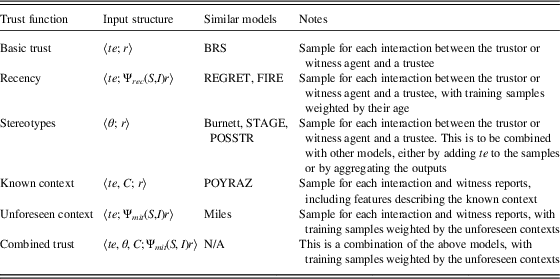
Table 2 lists each of the trust functions discussed in Section 3.2, presenting the structures of input data for their corresponding machine learning models. For clarity, input features are each separated by ‘,’, which are separated from the target value by ‘;’. For recency and unforeseen context the training samples are weighted prior to applying the learning algorithm. In general, an all-or-nothing weighting function can be used to filter out those training samples that are too old (as in Equation (15)) or where an unforeseen context occurred. Alternatively, several machine learning algorithms are able to account for training weights, by learning more from training samples with high weights and less from those with low weights.
Sample structures extracted from interaction records that can be used in a supervised machine learning algorithm

The input features and target value of the sample structures are separated by ‘;’.
Hereafter, we do not repeat the input features when referring to a learning function or the learned models. This is both for clarity and to abstract the input structures of the models, which are independent of the learning algorithm and combining opinions. A opinion learned using direct information, I tr , is therefore,
 $$O_{{tr}} {\equals}\langle f_{{tr}}^{{ml}} (S)\rangle ,$$
which can be defined using a partial function application,
 $$f_{{tr}}^{{ml}} (S){\equals}F({\bf I}_{{tr}} )(S).$$
Similarly, an opinion learned by a witness, w, is,
 $$O_{w} {\equals}\langle f_{w}^{{ml}} (S)\rangle {\equals}\langle F({\bf I}_{w} )(S)\rangle .$$
5.1 Opinion aggregation
To combine direct and witness information with trust functions of this kind, there are two possibilities. First, the learned functions can be stored in the opinion tuple and then combined in the opinion aggregation, either by collating the interaction records or by combining the model parameters. Second, the outputs of the learned functions comprise the opinions and these can be aggregated to produce an overall reputation score. For simplicity, in this paper we mainly consider aggregating the model outputs, as this is more amenable to discounting and reinterpretation of opinions. Specifically, the overall reputation score is the mean output of the direct and witness models,
 $$f^{{agg}} \left( {\left\{ {O_{{tr}} } \right\}{\cup}\left\{ {O_{w} \,\colon\,\forall w\in{\bf W}} \right\}} \right){\equals}{1 \over { \!\mid\! {\bf W} \!\mid\! {\plus}1}}\left[ {f_{{tr}}^{{ml}} (S){\plus}\mathop{\sum}\limits_{w\in{\bf W}} f_{w}^{{ml}} (S)} \right].$$
5.2 Discounting witness opinions
To discount unreliable witness opinions we use,
 $$f^{{agg}} \left( {\left\{ {O_{{tr}} } \right\}{\cup}\left\{ {O_{w} \,\colon\,\forall w\in{\bf W}} \right\}} \right){\equals}{1 \over { \!\mid\! {\bf W} \!\mid\! {\plus}1}}\left[ {\omega _{{tr}} f_{{tr}}^{{ml}} {\plus}\mathop{\sum}\limits_{w\in{\bf W}} \omega _{w} f_{w}^{{ml}} (S)} \right],$$
where ω tr and ω w are weights that reflect the performance of the respective learned models. The performance can be measured in accuracy, true positive or true negative rates, precision, or recall, etc., and can be estimated using a k-folds cross-validation or another evaluation procedure (Witten et al., Reference Witten, Frank and Hall2011). In keeping with the TRAVOS discounting mechanism, the weights in this paper represent the ability of the learned model to predict ratings given by trustor. Specifically, ω tr =1, and each witness weight is the accuracy of the witness model estimated using the direct interactions where trustor has previously given a rating. For discrete rating systems this is the number of true positives when predicting the rating divided by the number of direct interaction records. With continuous ratings, the accuracy may be derived from the root mean squared error.
5.3 Reinterpreting witness opinions
To reinterpret witness opinions, an individual reinterpretation model, ρ
w
(⋅), is learned for each witness, w∈
W
, to reinterpret the outputs of the witness models to the perspective of tr. The training samples for a reinterpretation model are generated from both the interaction records and witness reports, I
tr
∪I
w
. Each of these records is used to generate a reinterpretation training sample,
 $$\langle f_{w}^{{ml}} (I)\,\semi-colon\,f_{{tr}}^{{ml}} (I)\rangle $$
, with an input of the witness opinion and a target of the trustor opinion. The reinterpretation model learned,
 $$\rho _{w} ( \cdot )\,{\equals}\,F\left( {\forall \left\langle {f_{w}^{{ml}} (I); \,f_{{tr}}^{{ml}} (I)} \right\rangle \in{\bf I}_{{tr}} {\cup}{\bf I}w} \right)$$
is then able to convert an input rating from the perspective of the witness, O w , to the perspective of the trustor, O tr .
It is also possible to include the trustee, stereotype, and context features in this reinterpretation model,
 $$\rho _{w} ( \cdot )\,{\equals}\,F\left( {\forall \left\langle {te,\, \theta _{{te}} ,\,C,\,M,\,f_{w}^{{ml}} (I); \,f_{{tr}}^{{ml}} (I)} \right\rangle \in{\bf I}_{{tr}} {\cup}{\bf I}w} \right),$$
for when differences in agent perspectives are dependent on the situation. This can then be applied as,
 $$\rho \left( {\left\langle {te,\,\theta _{{te}} ,\,C,\,M,\,f_{w}^{{ml}} \left( {\langle te,\,\theta _{{te}} ,\,C,\,M\rangle } \right)} \right \rangle \in S} \right){\equals}\rho \left( {S,\, f_{w}^{{ml}} (S)} \right).$$
The final reputation value output is an aggregate of the direct interaction trust model, f tr (⋅), and reinterpreted outputs of the witness function, f w (⋅). Many different aggregation functions can be used, but in this work we use a weighted mean of model outputs. Reputation is then computed as,
 $${\scr R}(S){\equals}{1 \over { \!\mid\! {\bf W} \!\mid\! {\plus}1}}\left[ {\omega _{{tr}} f_{{tr}}^{{ml}} (S){\plus}\mathop{\sum}\limits_{w\in{\bf W}} \omega _{w} \rho _{w} (S,\,f_{w}^{{ml}} (S))} \right],$$
and is referred to as the MLRS strategy.
Although MLRS requires 1+2|W| models to be learned in total, each of the individual models can be relatively simple and are often able to be learned from small sample sizes. Naïve Bayes has a computational complexity of O(nm), for example, which means that models can be learned quickly. The interactions used to learn each trustor and witness model are also only those interactions recorded by the trustor and provided by the individual witnesses, meaning that n is often not large. If the sample is too large, subsampling techniques can be applied to reduce its size, and many machine learning algorithms, including Naïve Bayes, can be updated with new samples to avoid a full re-learning of the model. Also, features may be selected using feature selection techniques such as Mutual Information and Principal Components Analysis, to limit m and reduce learning time further (Witten et al., Reference Witten, Frank and Hall2011).
6 Evaluation
To evaluate models in our abstraction we use a simulated marketplace based on that presented by Burnett et al. (Reference Burnett, Norman and Sycara2010, Reference Burnett, Norman and Sycara2013), and subsequently adopted by Şensoy et al. (Reference Şensoy, Yilmaz and Norman2016) and Taylor et al. (Reference Taylor, Griffiths, Barakat and Miles2017a, Reference Taylor, Griffiths, Barakat and Miles2017b). The simulation and models discussed in this evaluation are available for download as open source softwareFootnote 1 . The simulation consists of trustor agents that assess the reputation of, and interact with, trustee agents over 250 rounds. At the beginning of the simulation each trustee is assigned a base capability, μ te , in the range [0.0,0.1, … , 1.0], and a base STD, σ te , in the range [0.1,0.2, … , 0.5]. Similarly, each interaction context is assigned a base mean, μ C , in the range [−0.5,−0.4, … , 0.5] and a STD of σ C =1. These are combined to give the mean capability of a trustee, te, for each known context, C, which is defined as,
 $$\mu _{{te,C}} {\equals}\mu _{{te}} {\plus}sample\,(\mu _{C} ,\sigma _{C} ),$$
where sample(μ C , σ C ) is a random sample drawn from the Gaussian distribution defined by μ C and σ C .
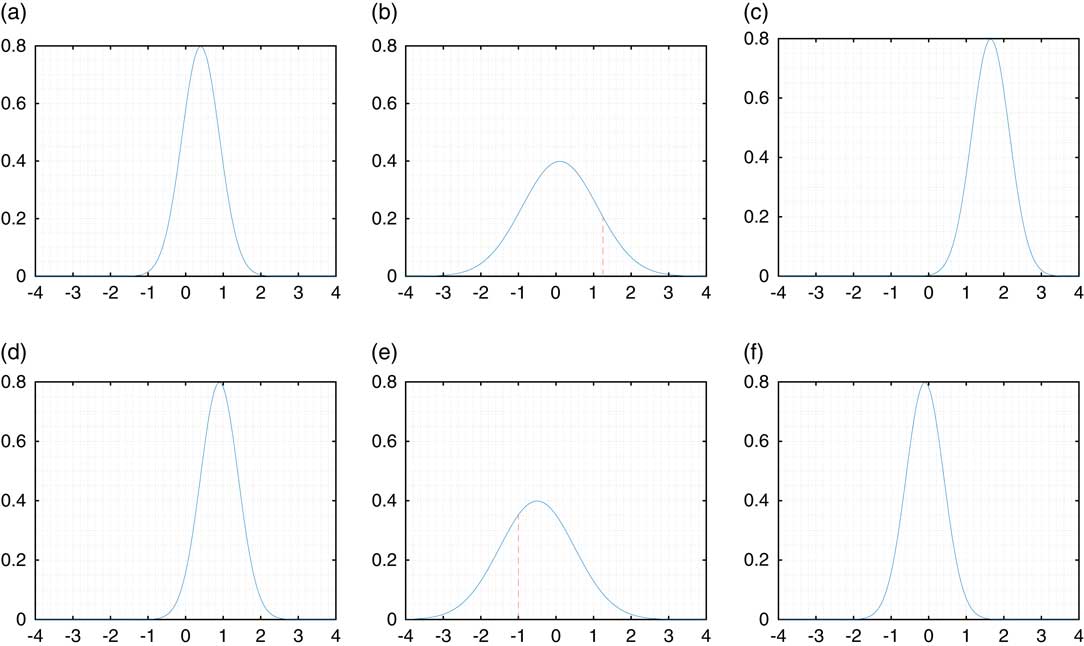
Two example combinations are shown in Figure 1. Figure 1(a) displays trustee profile 4, where μ te =0.4, with a standard deviation of σ te =0.5, and Figure 1(b) shows context profile G. Their combination, having sampled μ C =1.25 from the context profile distribution (indicated by the vertical dashed line on the context profile), is displayed in Figure 1(c). The mean of this combined trustee–context profile is μ te,C =1.65, which is higher than the base trustee profile mean and represents that this trustee is more proficient in this context than on average. A second trustee profile, with μ te =0.9 and σ te =0.5, is shown in Figure 1(d), and is combined with the context profile, with μ C =−0.5, shown in Figure 1(e). The sample taken from the context profile is −1, meaning that the trustee–context profile in Figure 1(e) has a mean of −0.1, representing that this trustee does not perform well in this context compared to the base trustee profile.
Two example combinations of trustee and context profiles. (a) Trustee profile (μ=0.4, σ=0.5); (b) context profile (μ=0.1, σ=1); (c) trustee–context profile ((a)+(b)); (d) trustee profile (μ=0.9, σ=0.5); (e) context profile (μ=0.5, σ=1); (f) trustee–context profile ((d)+(e)).

The mean capability, μ te,C , and STD, σ te , then define the Gaussian from which interaction outcomes with a trustee in a context are drawn, sample(σ te,C , σ te ). After each interaction with a trustee, the trustor then rates that interaction based on their preference threshold, which is assigned randomly at the beginning of the simulation in the range [0.0,0.1, … ,1.0]. An interaction with an outcome greater than their preference threshold is deemed successful and given a rating of 1 by the trustor, otherwise it is rated as 0. This means that a preference threshold of 0.5 leads to a random strategy having a successful interaction 50% of the time.
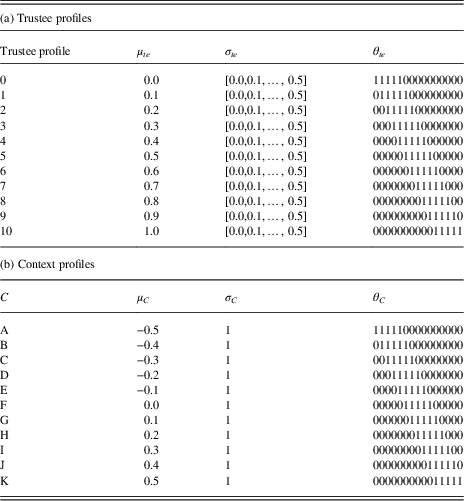
Each trustee profile is associated with a set of observable stereotype traits, which are indicative of their base capability, as outlined in Table 3(a). The observable traits distinguish each of the profiles, to be used in stereotype assessments of trustees. Each element in these feature vectors can be interpreted as the trustee exhibiting a trait or not, for example the first trait may represent ‘airport transfer’. Similarly, each interaction context is associated with a set of traits (outlined in Table 3(b)) for use in contextual reputation assessments. To introduce noise into stereotype and context traits, each of the binary values are flipped (i.e. 0→1 and 1→0) with a probability of 0.25. For stereotype traits the noise is applied when assigning them to a trustee when they join the simulation. With context traits, the noise is applied separately for each trustor at the beginning of each round. The traits observed by the trustor in a round are used in their reputation assessment and stored in the subsequent interaction record.
List of (a) trustee and (b) known context profiles, their base means and STDs, and their features

Each trustor and trustee agent leaves the simulation in each round with a probability of 0.05, to be replaced by another agent. New trustees are assigned a base capability, context capabilities, and stereotype traits using the same process as described above. The number of agents in the simulation is static, therefore, and in all of our simulations there were 100 trustee agents and 20 trustor agents. In each round, each trustor agent is given a random 10 available trustees from which they select the one with highest reputation as an interaction partner. Similarly, in each reputation assessment, each trustor requests reputation information from 10 random witnesses.
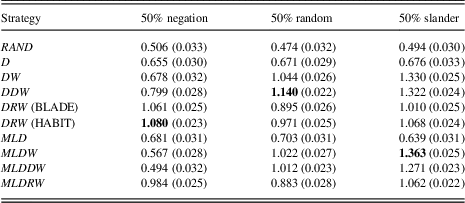
Each trustor is either an honest, negative, random, or slanderous witness (which is determined when they join the simulation). Honest witnesses report all their reputation information truthfully, whereas negative witnesses report an opinion computed using the negation of all their ratings. For example, if they gave a rating of 0.4 for an interaction, they will use −0.4 as the rating when computing an opinion to be communicated to the requesting trustor. A slanderous witness reports true assessment of half of the trustees, and for the remainder they report an opinion computed using decreased ratings, specifically 0.5(r−1). Finally, a random witness computes their opinions using random ratings for all their interactions, before communicating that opinion.
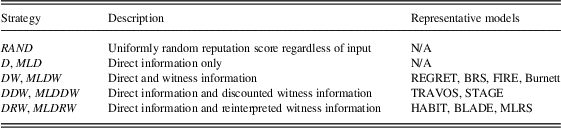
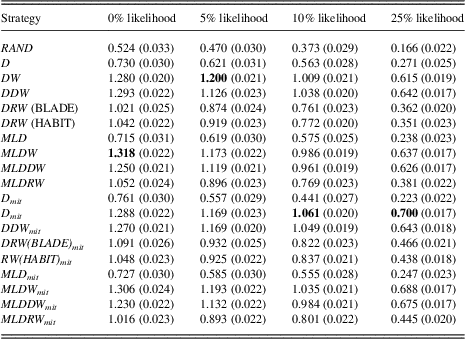
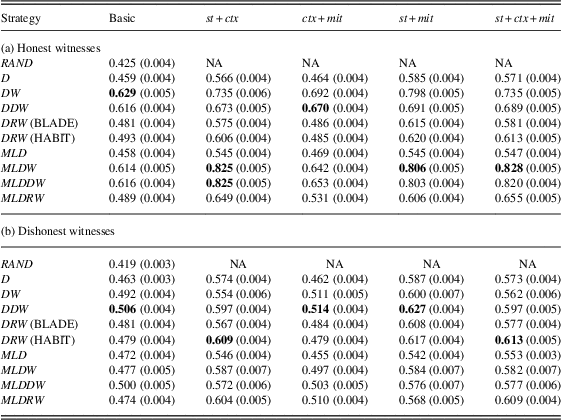
The evaluation is separated by the information used by the strategies. We first investigate basic trust, where only the trustee identifier is used by the strategy, and then introduce known context, stereotype, and unforeseen context features. Two instantiations are considered for each kind of strategy, namely one using an aggregation (as described in Section 3) and another based in machine learning (as described in Section 5).
The strategies based on aggregations are instantiated using probabilistic reputation models, namely BRS, TRAVOS, BLADE, and HABIT. The opinion representation used was therefore a Beta PDF, as in Equation (10), and the trust function computes its expected value, as in Equation (12). These models are used because of their probabilistic nature in predicting whether an interaction will be successful or not, which can be implemented using machine learning as a binary classification task. For the machine-learned reputation strategies, a random forest (Breiman, Reference Breiman2001) was learned using the trustor’s direct interaction records. A random forest model is made up of several decision trees, each learned using a random subset of samples (via bootstrap aggregating (Breiman, Reference Breiman1996)) and a random subset of features (via random subspace learning (Ho, Reference Ho1998)). Typically, a majority vote over the decision trees is used, where the modal prediction is taken as the overall output. In this paper, we aggregate the likelihood outputs of each of the decision trees and take the mean likelihood of success as the trust score. This is then a probabilistic estimate of the rating, akin to that provided a Beta PDF.
The opinion aggregations investigated are outlined in Table 4. The aggregation strategy using direct information only, D, and the machine learning variant, MLD, both use the trustor’s opinion only in computing the trust score. To combine direct and witness information, DW aggregates the opinions as in Equation (23), and MLDW aggregates the opinions using Equation (32). The discounting of unreliable witness information in DDW is as in Equation (26), and uses computes the witness weights as in TRAVOS (Teacy et al., Reference Teacy, Patel, Jennings and Luck2005). MLDDW discounts unreliable witness information using Equation (33), for which the respective model accuracies, estimated using the direct interaction records, are the weights. To reinterpret witness information (DRW), we use both BLADE (Regan et al., Reference Regan, Poupart and Cohen2006) (denoted DRW (BLADE)) and HABIT (Teacy et al., Reference Teacy, Luck, Rogers and Jennings2012) (denoted DRW (HABIT)). In the machine learning case, MLRS is used, as in Equation (37).
List of opinion aggregations investigated

Machine learning variants of the strategies are prefixed with ML.
All results presented are the mean utility gained by agents over the 250 simulation rounds, averaged over 100 simulations. To analyze the results we have performed pair-wise t-tests and corrected for multiple-comparisons using the Bonferroni correction. Each conclusion discussed is significant at the p<0.01 level, unless otherwise stated.
6.1 Basic reputation
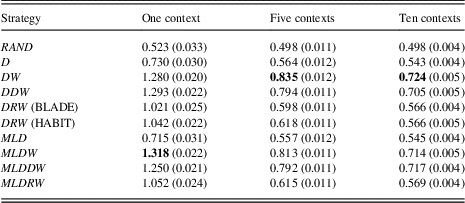
With basic reputation information, strategies do not account for any context or stereotype features. The aggregations used an interaction weighting as in Equation (9) and the machine learning models used only the trustee 〈te〉 as an input feature. Table 5 shows the mean interaction utilities gained over 250 rounds in simulations where all witness agents were honest and with one, five, and ten interaction contexts selected at random from the contexts outlined in Table 3(b). The random strategy, RAND, gained a mean utility of around 0.5 as expected, which was significantly worse than all other strategies in all cases. This indicates that assessing reputation with information from previous interactions is beneficial, even if only direct interactions are used (as in D and MLD). In all cases, lower utilities were gained in simulations with more contexts.
Utilities for strategies using basic trust information only, with one, five, and ten contexts, and honest witnesses

The standard error is displayed in braces after the mean utility and bold signifies the highest mean utility gained by a strategy in the environment
Using witness information provided significantly higher utilities than using direct information only. Discounting witness information, in DDW and MLDDW, gained similar utilities to using witness information directly, in DW and MLDW. However, reinterpreting witness reports in DRW (BLADE), DRW (HABIT), and MLDRW, provided significantly worse utilities than these strategies. This indicates that when witnesses are known to be honest there is no benefit to discounting their reports, and it is detrimental to attempt to translate them to the perspective of the trustor.
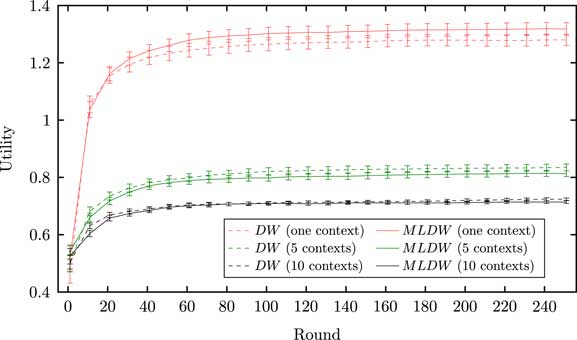
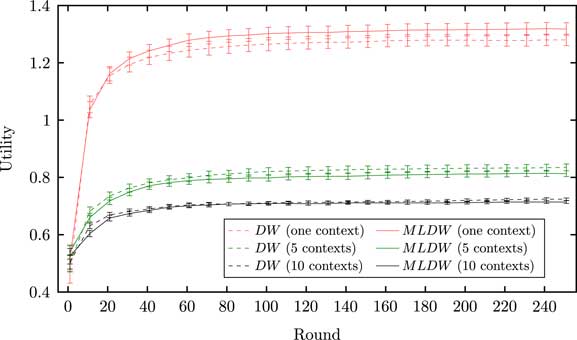
In general, the utilities gained by the machine-learned strategies were not significantly different to the respective aggregation strategy. For instance, there was no significant difference between the utilities gained by MLDW and DW for any number of contexts. This is further displayed in Figure 2, which shows the utilities gained by the DW and MLDW strategies over the course of simulations with one, five, and ten contexts. In the early rounds of the simulations, there was insufficient data to form useful opinions with either strategy, and so their performances were poor. In particular, in the first round of the simulations all strategies had the same performance as the RAND strategy. As agent interactions took place, and evidence was gathered to use in forming opinions, the performance of the DW and MLDW strategies increased at a similar rates in both the single and multiple context simulations. This pattern was also observed for the all other strategies, showing that machine learning can be used to replicate aggregation strategies.
Utilities over rounds of a simulation for the DW and MLDW and strategies, using basic trust information only in simulations with one, five, and ten contexts, and honest witnesses. The error bars show the standard error.
6.2 Stereotypes
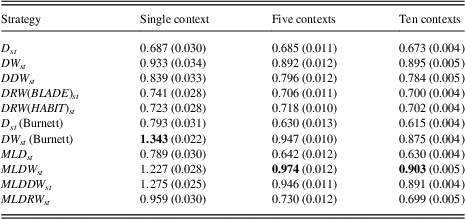
Stereotype information was included in the aggregation models using the interaction weighting function in Equation (16). The utilities in Table 6 show that such aggregation strategies performed very poorly compared to the machine learning models, which used stereotype traits as binary input features. In simulations with a single context, all aggregation models gained lower utilities when using stereotype information than when using basic information only. With multiple contexts their performances were better with stereotype information, but in most cases were still worse than the performances of the machine learning strategies in all cases. Another kind of stereotype reputation, proposed by Burnett et al. (Reference Burnett, Norman and Sycara2010, Reference Burnett, Norman and Sycara2013) and defined by Equation (18), is therefore included in this table. Although the Burnett model used machine learning for the stereotype model, it represents opinions using Beta PDFs and uses direct and witness information in the same way as DW and MLDW.
Utilities for strategies using stereotype information, with different numbers of contexts and honest witnesses

The standard error is displayed in braces after the mean utility and bold signifies the highest mean utility gained by a strategy in the environment.
Using direct information only, as with basic trust, generally gave significantly lower utilities than using both direct and witness information. One exception was the reinterpretation strategies, DRW (BLADE) and DRW (HABIT), which gained slightly lower utilities than D. Furthermore, the utilities gained by these strategies in simulations with single contexts was not significantly different to those gained when using basic information. In multi-context simulations, utilities when using stereotype information were generally higher compared to not using stereotypes.
The highest utilities were gained by strategies that used machine learning with both direct and witness information. With any number of contexts in the simulation, Burnett’s strategy, MLDW, and MLDDW, and gained significantly the highest utilities. Although there was no statistically significant difference between the three strategies in any case, Burnett’s strategy did gain the highest utility in simulations with a single context. With ten contexts in the simulation, MLDW and MLDDW and outperformed Burnett’s strategy by a slight margin, as did DW.
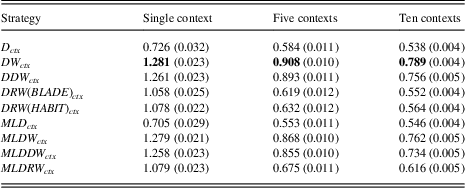
6.3 Known context
To incorporate context information into the aggregation strategies, the interaction weighting in Equation (20) was used, using Jaccard similarity between the context traits. For the machine learning approaches, the binary feature vector indicating which context traits were observed was used as inputs to the learned models. It is assumed that all agents represent context in the same way, but this does not need to be true in general (Taylor et al., Reference Taylor, Griffiths, Barakat and Miles2017a). The results for using known context information are shown in Table 7.
Utilities for strategies using known context information, with different numbers of contexts and honest witnesses

The standard error is displayed in braces after the mean utility and bold signifies the highest mean utility gained by a strategy in the environment.
As with basic trust, the strategies using direct information only tended to gain significantly lower utilities than those that used both direct and witness information. One exception to this was DRW (BLADE) and DRW (HABIT), which gained similar utilities to D and MLD when there were multiple contexts in the simulation. MLDRW, while gaining lower utilities than strategies that did not reinterpret witness opinions, did gain higher utilities than DRW strategies. Furthermore, D, MLD, DRW (BLADE), and DRW (HABIT), did not improve on their performances compared to when context information was not used, and MLDRW gained only slightly more utility in simulations with multiple contexts. One explanation for this is that trustor agents were unable to individually collect enough interaction records to discriminate between contexts themselves, and as a result could not reinterpret contextual opinions from witnesses.
For any number of simulation contexts, no strategy gained significantly lower utilities when using context information than when using basic information only. Furthermore, strategies using context information did not achieve significantly higher utilities than strategies using basic information. This means that, for an unknown number of contexts, there is no cost in utility to using context information when assessing trust and reputation, but also that context information has no benefit when there is only one context. In simulations with multiple contexts, all strategies gained lower utilities. However, strategies that used witness information without reinterpretation, namely DW, MLDW, DDW, and MLDDW, gained significantly more utility when using context information compared to using basic information.
Of the four best performing strategies, DW gained the most utility by a small but statistically significant margin in simulations with ten contexts, outperforming MLDW by around 0.027. Similarly, DDW gained about 0.022 more in utility than MLDDW. These differences are possibly due to the difference in the two aggregation approaches, and the limited number of samples available for the learning algorithm to discriminate between the contexts. An alternative learning approach that improves on this performance is discussed in Section 6.7, where a single model is learned using both direct and witness interaction records.
6.4 Unforeseen context
Table 8 shows utilities gained in simulations where interactions encountered unforeseen contexts with different likelihoods, for a single known context. The utility of interactions with unforeseen contexts was always −1. As a result, with higher likelihoods of unforeseen contexts the utilities gained by all strategies decreased as the likelihood of unforeseen context increased. To mitigate for ratings made after an interaction with an unforeseen context, strategies used the interaction weighting function defined in Equation (22). In the machine learning strategies this weighting was applied to the training samples prior to learning. In both cases the weight given to interactions with abnormal unforeseen context was λ mit =0.1.
Utilities for strategies using unforeseen context information, with different likelihoods of unforeseen contexts and honest witnesses

The standard error is displayed in braces after the mean utility and bold signifies the highest mean utility gained by a strategy in the environment.
Without unforeseen contexts, there was no significant difference between the utilities gained by strategies that considered mitigation and those that did not. With higher likelihoods of unforeseen contexts, the strategies that used mitigation had higher utilities in general than those that did not. One exception was the D mit strategy, which gained less utility than the D strategy in the presence of unforeseen context. In particular, using witness information directly, such as DW and MLDW had the highest utilities when mitigation information was used in simulations with unforeseen contexts. Finally, the machine learning strategies again did not perform significantly differently to their aggregation counterparts in general.
6.5 Dishonesty
Table 9 shows utilities gained by strategies when 50% of witness agents either negate their ratings when reporting opinions, use random ratings, or slander trustees. In each case, only basic trust information is used, there is only one known context, and there are no unforeseen contexts in the simulation. When direct information is used in D and MLD there was no significant difference in utilities from when all witnesses were reliable. Using witness information directly, in DW and MLDW, the utility was significantly lower when there were either negation or random witnesses, compared to with all honest witnesses. They were not, however, significantly different with slander witnesses.
Utilities for strategies using basic trust information, when half of all witnesses are either negation, random, or slander

The standard error is displayed in braces after the mean utility and bold signifies the highest mean utility gained by a strategy in the environment.
With negation witnesses, DRW (BLADE), DRW (HABIT), and MLDRW gained significantly highest utilities, as they were able to reinterpret the witness opinions properly. These utilities were also not significantly different to those that the reinterpretation strategies gained with no unreliable witnesses. MLDDW performed particularly poorly in this case, compared to DDW. DDW also gained the highest utilities with random witnesses, but was not statistically significantly better than MLDW or MLDDW. With slander witnesses there were no significant differences in utility gained by any of the strategies when compared to when all witnesses were reliable.
6.6 Putting it all together
When combining multiple kinds of trust information, such as stereotype and context, in one model, aggregation approaches must resort to combining the respective interaction weights. In these results we combine weights by taking their product, for example stereotype and known context information is combined by multiplying their respective interaction weights, Ψ st+ctx (S,I)=Ψ st (S,I)×Ψ ctx (S,I). For machine learning strategies, the features are simply appended together and all of them are used in the learned model.
Utilities gained by strategies using different combinations of stereotype, known context and unforeseen context, information are shown in Table 10. The simulations all contained ten contexts and unforeseen context occurred in 5% of interactions. Witnesses for results in Table 10(a) were all honest, and results in Table 10(b) were from simulations with dishonest witnesses that were each 25% likely to be either random, slander, or negation.
Utilities for strategies using different combinations of trust information with (a) honest witnesses and (b) witnesses that are each 25% likely to be either random, slander, or negation

In each simulation there were ten contexts and an unforeseen context occurred in 5% of interactions. The standard error is displayed in braces after the mean utility and bold signifies the highest mean utility gained by a strategy in the environment.
Using basic information only, machine learning strategies had similar performance to the aggregation strategies. With honest witnesses, all strategies except those that reinterpreted witness reports gained similar higher utilities, whereas DRW (BLADE), DRW (HABIT), and MLDRW, gained utilities close to that of RAND. In the presence of dishonest witnesses, all strategies using basic information only performed poorly.
Using stereotype and known context information (st+ctx) increased performance in all cases with honest witnesses. In this environment the machine learning strategies gained significantly higher utilities than did their aggregation counterparts. This was also the case when stereotype and unforeseen context information was combined (st+mit), and also when all three kinds of information were combined (st+ctx+mit). This is displayed further in Figure 3(a), which shows the utilities for the DW and MLDW strategies over the rounds in these simulations with honest witnesses. In particular, when all the kinds of information were used by the strategies, MLDW outperformed DW throughout the simulation. When the strategies used basic information only their, performances were similar in all rounds of the simulation.
Utilities over rounds of simulations with ten contexts and an unforeseen context occurred in 5% of interactions, for (a) the DW and MLDW and (b) the DRW (HABIT) and MLDRW strategies, using either basic trust information only or combined stereotype, known context, and unforeseen context information. In (a) all witnesses in the simulation were honest, and in (b) the witnesses were each 25% likely to be either random, slander, or negation. The error bars show the standard errors.

When known context and unforeseen context information (ctx+mit) were combined, the aggregation strategies gained slightly higher utilities than the machine learning strategies. Overall, this shows that machine learning methods are more equipped to use these different combinations of features. Further, the combination of stereotype and known context information (st+ctx) gained the highest utilities, when used in the MLDW and MLDDW strategies. The addition of unforeseen context information to these models did not improve performance significantly.
With dishonest witnesses there was generally no significant difference between the machine learning and aggregation strategies. Some exceptions to this are with stereotype and unforeseen context information (st+mit), where DDW significantly outperformed MLDDW, and with known context and unforeseen context information (ctx+mit) where MLDRW outperformed both DRW (BLADE) and DRW (HABIT). These observations may indicate that, in general, dishonest witnesses cancel out the benefits of applying machine learning to combinations of features. When using dishonest witnesses as information sources, the inclusion of stereotype information in any model provided the highest utilities, regardless of what it was combined with. For instance, st+ctx had similar results to st+mit and st+ctx+mit, indicating that stereotypes are the most important information to use in models in the presence of dishonesty. Figure 3(b) shows the utilities gained for the DRW (HABIT) and MLDRW strategies in these simulations with dishonest witnesses. When the strategies both used basic information only, their performances were similar throughout the simulation. When using all kinds of information (i.e. st+ctx+mit), however, DRW (HABIT) gained more utility than MLDRW during the initial stages of the simulation.
6.7 Single learned model
In this section, we use an alternative aggregation for machine-learned opinions, where the models were combined rather than the outputs. This is done in a simple way, by concatenating the training samples and learning a single random forest model. Using this approach it is difficult to discount or reinterpret the opinions, and so only results for MLDW using combinations of stereotype and context information are presented. Alternative methods may exist where model parameters are combined, weighted, or reinterpreted, but this is left as future work.
Table 11 shows utilities in simulations with one, five, and ten contexts, for the MLDW strategies when using different combinations of context and stereotype information. In these simulations there were no unforeseen contexts and all witnesses were honest. With basic information only, the utilities in this combination were slightly lower than those gained by aggregating model outputs (in Table 5). The use of context information in this aggregation of models provided significantly higher utilities in simulations with multiple contexts when compared to aggregating their outputs (in Table 7). Stereotype information, however, was better processed by combining model outputs (in Table 6) than with this alternative opinion aggregation. Finally, the combination of stereotype and context information had highest utilities.
Utilities for MLDW (using an alternative opinion aggregation) with different combinations of context and stereotype information, and in simulations with different numbers of contexts and honest witnesses

The standard error is displayed in braces after the mean utility and bold signifies the highest mean utility gained by a strategy in the environment.
6.8 Continuous ratings
In all the results presented thus far, interaction ratings have been binary and reputation has been probabilistic. Specifically, ratings of interactions have been positive where the outcome was above the trustor’s preference threshold, and negative otherwise. Higher utilities can be gained by reputation strategies that use continuous ratings, in particular ratings that are computed as the difference between the interaction utility and preference threshold. The FIRE reputation system uses the interaction aggregation defined in Equation (8), and uses continuous ratings to output a continuous trust and reputation scores.
To mirror this in machine learning reputation, either a regression learning algorithm or multi-label classifier can be used. In this paper, we simply increase the dimensionality of the target variable in the random forest algorithm, to make a multi-label classifier. In particular, rather than mapping input features to two values, the target can now take one of five values that span the intervals (−∞:−1.5), [−1.5:−0.5), [−0.5:0.5), [0.5:1.5), [1.5:∞).
Table 12 shows results for these variants of the DW and MLDW reputation systems in simulations with one, five, and ten contexts. In these simulations there were no unforeseen contexts and all witnesses were honest. The first MLDW is based on the aggregation of outputs, and is the same reputation system as outlined in Sections 3.2.1 and 3.2.4. The second MLDW uses the aggregation presented in Section 6.7, and concatenates the training samples prior to learning. With any number of contexts in the simulation, the utilities gained by these strategies were significantly higher than the binary strategies using the same information. When using basic trust information only, there was no significant difference between the utilities gained between DW and MLDW. With context information, however, MLDW had significantly higher performance in simulations with multiple contexts than did DW. This again highlights the power of using machine learning as the basis of trust and reputation assessment.
Utilities for DW using continuous ratings and MLDW using a multi-dimensional learning algorithm, both with and without context information

The simulations had different numbers of contexts and honest witnesses. The standard error is displayed in braces after the mean utility and bold signifies the highest mean utility gained by a strategy in the environment.
6.9 Summary
In general, machine learning strategies had similar performances to the aggregation models using the same information sources. There were some situations where machine learning was better able to model features, in particular when stereotype information was used. When using context information, the aggregation strategies gained higher utilities than did the machine learning strategies that learned a model for each witness. This highlights one limitation of using machine learning to assess trust and reputation, namely the availability of data. In domains where interactions are scarce it may be more appropriate to use an aggregation based strategy such as FIRE or BRS, as the number of parameters that these models use is small in comparison to most machine learning algorithms, and can therefore fit more effectively to the data. The same is also true for highly dynamic environments where data rapidly becomes outdated. Where there is a vast amount of data generated from many interactions, machine learning based strategies may be preferable due to their flexibility in modelling different kinds of information such as context and stereotypes.
When a single machine learning model was learned, by combining the data from all witnesses, however, the utility gained was significantly higher than for other strategies investigated. This indicates that combining direct and witness information into a single model somewhat overcomes the issues that arise with limited data, and is a result of using all available samples to learn a single model rather than dividing them up by witness to learn several models. Methods for weighting training samples by the reliability of the witness, or reinterpreting them for different perspectives, should therefore be investigated to maximize the utility gained by single model variants of the MLDDW and MLDRW strategies.
7 Conclusion
In this paper, we have distilled trust and reputation into its representation and dissemination. In analyzing the representation we found that trust opinions are often represented as using PDFs formed via aggregations of previous ratings. Other trust and reputation systems represent trust information in models learned using machine learning over interaction tuples. Typically, reputation information is disseminated through a central authority or to acquaintances in a trust network. In either case, dishonesty of witness agents can be handled by discounting their opinions before combining them with the trustor’s own. In cases where witness agents may have opinions that are different to those of the trustor in a consistent way, reinterpretations can be learned.
Following this review, a unifying abstraction of reputation systems for reputation systems was presented as opinion gathering, representation, and aggregation. As well as creating instantiations of the abstraction to represent several existing reputation systems, we also presented instantiations based on machine learning over interaction tuples. A machine learning model was presented for each kind of reputation system found in the literature, to use the same kind of information in forming an opinion and aggregating opinions in a similar way. In culmination, the MLRS was presented to combine these capabilities in one reputation system, including contextual reputation, stereotypes, and opinion reinterpretation.
Finally, an evaluation of the models discussed throughout the paper was performed using a simulated marketplace. The main findings from the evaluation were that the machine learning based strategies perform equally well to the aggregation based strategies using the same information sources. It was also clear that combining multiple information sources was more beneficial when using machine learning than weighted aggregations. For both the machine learning and aggregation models, however, using information relevant to the environment produced higher reputation assessments. For example, in an environment with multiple contexts it was beneficial to use context information, and in dynamic environments stereotype information was useful. The code for the simulations can be found as open source softwareFootnote 2 .
As future work we intend to investigate combining model parameters, rather than their outputs, in combining opinions. This will enable more detailed reinterpretations of witness opinions, and possibly allow detection of dishonesty by inspecting the model for inconsistencies. Another avenue for research is to determine the usefulness of continuous, over discrete or binary, ratings in different kinds of environment.
Acknowledgements
This work was part funded by the UK Engineering and Physical Sciences Research Council as part of the Justified Assessments of Service Provider Reputation project, ref. EP/M012654/1 and EP/M012662/1.