INTRODUCTION
Reviews of material culture and burial practice in Roman Britain have yielded a number of consistent patterns in relation to the north and west – that inhumation burials are ‘essentially absent’Footnote 2 and those that are present are linked to military sites,Footnote 3 and that ‘Roman’ material culture is rare outside forts and other military structures.Footnote 4 Indeed, Tom Brindle recently noted that the few Roman artefacts in rural settlements from northern England suggest ‘only limited interaction between the occupants of most farmsteads and the military.’Footnote 5 These patterns match a broader, widely discussed, distribution of more visible aspects of Roman culture – such as villas and temples – that are concentrated in the south and east of the country.Footnote 6 While some of this patterning is undoubtedly due to taphonomic processes (for example, the soils in the north-west are very bad for bone preservation), this cannot be the sole reason that Roman material culture is effectively missing from the rural sites in the region. Little is also known of Romano-British rural burial practice in north-west England, as few burials have been excavated. Only a limited number of graves of the later Roman period in the Roman cemeteries at Carlisle have been subject to adequate recording and investigation, while Brougham in the Eden valley is largely a cremation cemetery.Footnote 7
Here we report on the rural site of Dog Hole Cave (hereafter Dog Hole), in Haverbrack, southern Cumbria, which departs from some of these well-established north-west versus south-east generalisations. The cave contains a unique assemblage of Romano-British human and non-human remains and artefacts. These include a late Iron Age to early Roman concentration of foetal and neonatal remains associated with a horse burial and later adult and non-adult human burials with artefact types most closely paralleled at southern urban or military sites. To examine the question of the origins of the people at Dog Hole we have undertaken stable and radiogenic isotope analysis, an approach that has been highlighted as lacking for rural Romano-British populations.Footnote 8 The assemblage from Dog Hole has previously been classified as indicative of a burial chamber and later dog den,Footnote 9 a votive deposit,Footnote 10 a burial siteFootnote 11 and, most recently, a potential shrine.Footnote 12 Using data from excavations undertaken in 2010–11 and incorporating material from earlier excavations where appropriate, we examine these interpretations and discuss the material culture and human remains from Dog Hole and what they can tell us about ‘Roman’ culture in a rural setting.
DOG HOLE
Dog Hole, Haverbrack (SD482801) is situated in carboniferous limestones near the Kent estuary close to the villages of Storth and Sandside in the north-eastern corner of Morecombe Bay (fig. 1). The cave has a vertical entrance hole (approximately 1.5 by 1 m) and lies in a small valley between limestone pavements just below the brow of Haverbrack Hill. Below the cave entrance is a vertical shaft extending for 3 m, followed by a steep (35–40 degree) slope 4 m long trending in a westerly direction, with a further 2.5 m vertical section leading down to a chamber (9 m long by 3 m wide), on a north–south orientation, with a narrow shaft dug through the deposits at the northern end (fig. 2).
Map showing the location of Dog Hole (black star) and other key Roman sites mentioned in the text. (UK basemap © EuroGeographics for the administrative boundaries)

Cross sections of Dog Hole Cave. Left: south–north cross section showing areas excavated during earlier excavations: light-grey area excavated by Jackson (Reference Jackson1913), mid-grey by Benson and Bland (Reference Benson and Bland1963), darker grey by unknown cavers (1960s to 1980s), darkest grey excavated by O'Regan and team in 2010–11 (see Wilkinson et al. Reference Wilkinson, O'Regan and Thorp2011 for more information). Right: east–west cross section of the entrance shaft, descending to the northern shaft, showing the narrow squeeze into the dead-end passage at the base. In both images the black dot denotes the site datum used during the 2010–11 excavation.

Dog Hole was first excavated by Wilfred Jackson in 1912.Footnote 13 Donald Benson and Keith Bland (along with other members of the 1st Milnthorpe Scouts) subsequently excavated the site from 1956 onwards, publishing their results in 1963.Footnote 14 Their excavations uncovered the main chamber in which a considerable number of human remains, bones of a variety of other species and a number of artefacts were found. Later caving activity created a shaft through the remaining sediment on the northern side of the chamber, and we excavated a small portion of this area in order to undertake conservation work in 2010–11.Footnote 15 A small additional chamber was also uncovered through a very narrow passage (a ‘squeeze’ in caving terms), at the base of the northern shaft, and slightly lower than the base of our excavations (fig. 2). The site entrance is located amongst limestone pavement that is currently covered by woodland. The topography makes it highly unlikely that the human and larger non-human remains were washed in or fell in by accident. There is no known nearby or contemporaneous settlement, so the source of the people and non-human animal remains is unknown. However, Sandside Quarry has removed over two-thirds of the hill in which Dog Hole is located, so any evidence for settlement that was there will have been lost.
THE 2010–11 EXCAVATIONS
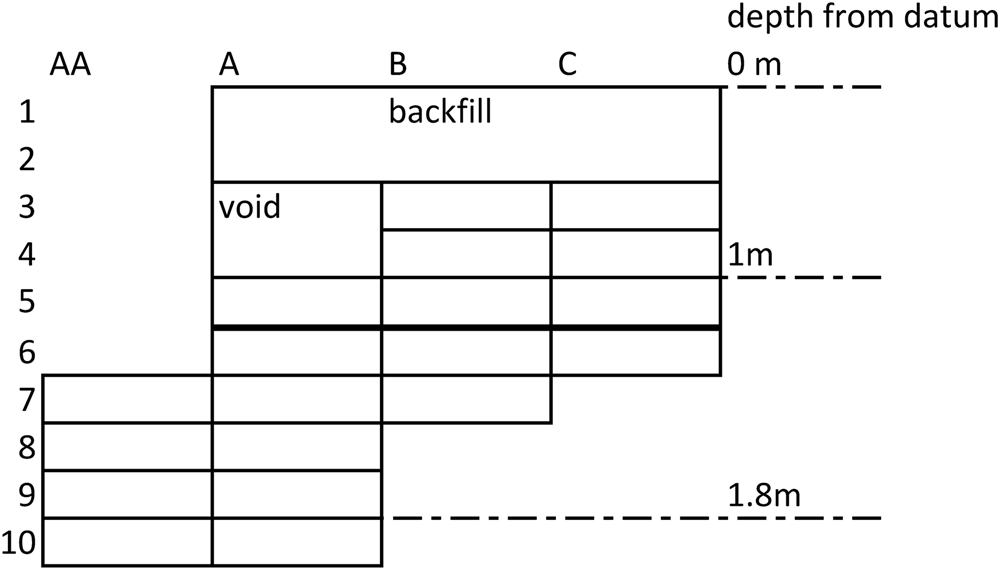
The excavations in 2010–11 focused on a small area to the north of the main chamber (fig. 2) where past caving activity had occurred. Here, corrugated-iron shoring that had been used when the northern shaft was dug through the archaeological deposits was in very poor condition and would have endangered the archaeology if it had collapsed. We excavated a small vertical section of sediment, replacing the shoring as we dug. This excavation also allowed us to address research questions that had been raised by the 1950s excavation. Such as, were the remains placed in the cave or thrown in from the top? Were the human remains deposited as articulated skeletons? The site has a heavily clast (rock) dominated matrix, with clast sizes ranging from boulder (>0.25 m) to pebble (0.004–0.064 m) on the Wentworth Scale.Footnote 16 The sediment containing human and non-human animal remains, artefacts and finer gravel sat between these clasts. The sediment was very wet and sticky with occasional voids (see the online supplementary material section 1), and this, combined with the limited space, meant it soon became apparent that it would not be possible to excavate using standard archaeological techniques (i.e. trowelling and single-context recording). We therefore divided the area to be excavated into three columns, A, B, C, and the excavation proceeded in ~20 cm-deep spits (fig. 3). The site datum was placed as a bolt in the cave wall, level with the top of layer 1, and all depths were recorded from this (figs 2 and 3). Owing to the difficulties of excavating the matrix, all sediment was wet sieved to 1 mm at the surface to recover small bones and artefacts. During the excavation, sections B and C petered out, and section AA was added to the left of A, as the cave wall expanded to the west as the section became deeper (figs 2 and 3).Footnote 17 With the exception of a charcoal-rich layer (hereafter CRL), no single contexts were identified, despite a total sediment depth of 2 m being removed. However, careful analysis of the bones and artefacts within the spits has demonstrated that there was spatial integrity to the material, particularly, but not exclusively, from beneath the CRL.
Schematic representation of the excavated deposits, showing the spits and columns, with associated depths below the site datum. The thicker black line between layers 5 and 6 denotes the charcoal-rich layer.

RESULTS
OSTEOLOGY
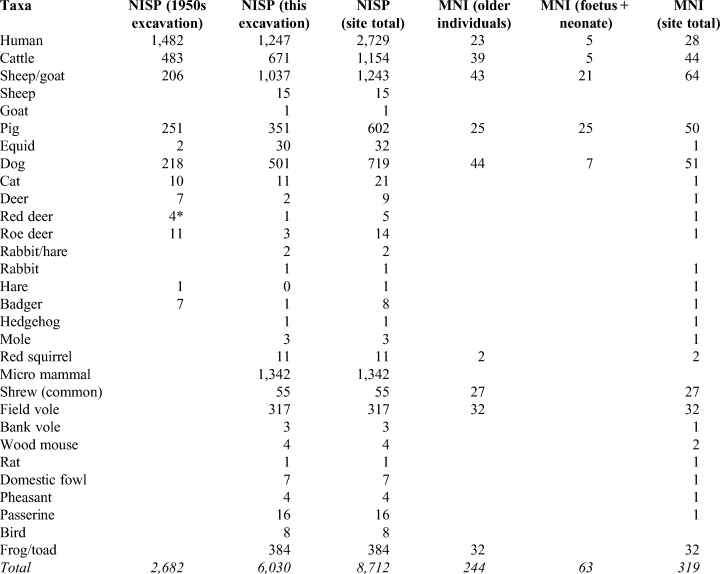
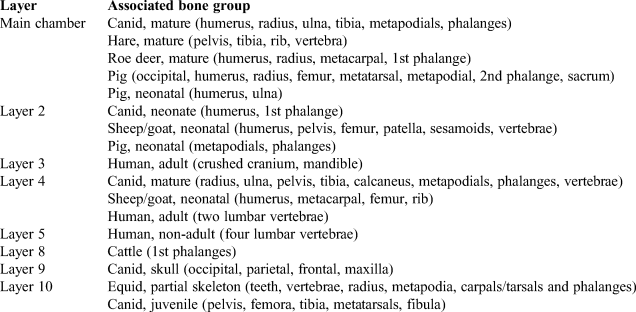
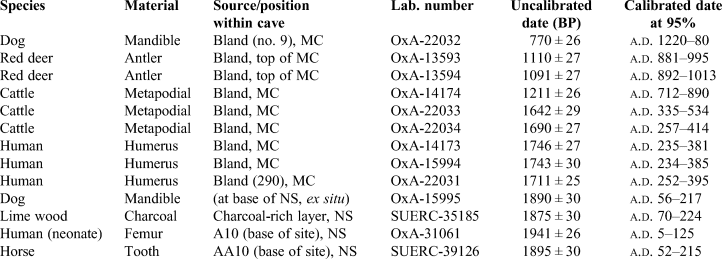
The majority of finds from Dog Hole were human and non-human bones (Number of Identifiable Specimens (NISP) = 8,689 (including micromammals); table 1). For full details of the osteological analyses and the methodologies employed, see supplementary material sections 3 and 4. The remains were almost all disarticulated, although some human and non-human Associated Bone Groups (ABGs) were identified (table 2). The disarticulation is likely to be the result of both the excavation methods used in the 1950s and taphonomic processes within the cave, where specimens moved between clasts over time (see supplementary material section 5 for further discussion). All human remains that have been radiocarbon dated are from the latest Iron Age to Romano-British periods, while the non-human remains date from the latest Iron Age to medieval periods (table 3 and fig. 4). The combined results from the 1950s and 2010–11 excavations provide a Minimum Number of Individuals (MNI) of 28 humans (table 1), making the burials at Dog Hole the largest collection of Romano-British inhumations in north-west England. There are also considerable numbers of sheep (MNI = 34), cattle (MNI = 33) and dogs (MNI = 32). One of the most striking features of the Dog Hole assemblage is the age profile of the human and non-human animals, particularly from below the CRL, and the body-part representation of the different species. To explore these more fully we describe below the assemblages in stratigraphic order from the base of the 2010–11 excavations upwards.
All calibrated radiocarbon dates from the site, demonstrating that the dates fall into three approximate phases. Calibrated using Oxcal v.4.3.2 Bronk Ramsey (Reference Bronk Ramsey2009/2017), r:5 IntCal 13 atmospheric curve (Reimer et al. Reference Reimer, Bard, Bayliss, Beck, Blackwell, Bronk Ramsey, Grootes, Guilderson, Haflidason, Hajdas, Hatté, Heaton, Hoffmann, Hogg, Hughen, Kaiser, Kromer, Manning, Niu, Reimer, Richards, Scott, Southon, Staff, Turney and van der Plicht2013).

NISP AND MNI FOR ALL TAXA FROM EACH EXCAVATION AND AN AMALGAMATED TOTAL FOR THE SITE OF DOG HOLE CAVE AS A WHOLE
(*An additional 151 red-deer antler fragments were identified from the 1950s excavations; they have not been included here as they are likely to be early medieval: see table 3)

ASSOCIATED BONE GROUPS (ABGS) IDENTIFIED AT DOG HOLE CAVE
(See supplementary material section 4 for discussion of neonatal human remains)

ALL RADIOCARBON DATES FOR DOG HOLE CAVE
(Calibrated using Oxcal v.4.3.2 Bronk Ramsey (Reference Bronk Ramsey2009/2017), r:5 IntCal 13 atmospheric curve (Reimer et al. Reference Reimer, Bard, Bayliss, Beck, Blackwell, Bronk Ramsey, Grootes, Guilderson, Haflidason, Hajdas, Hatté, Heaton, Hoffmann, Hogg, Hughen, Kaiser, Kromer, Manning, Niu, Reimer, Richards, Scott, Southon, Staff, Turney and van der Plicht2013); MC = main chamber; NS = northern shaft (site of 2010–11 excavation))

Horse and neonatal infants
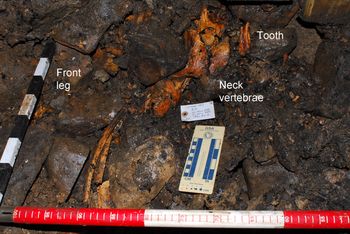
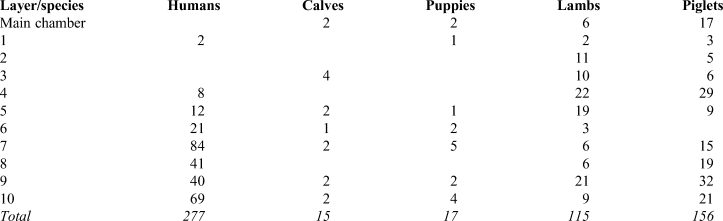
In layer 10 at the very base of our excavationsFootnote 18 part of an articulated horse was discovered, comprising the distal portion of a right forelimb, including radius, carpals, metacarpal, lateral metapodia, 2nd phalange, and neck (atlas, axis and cervical vertebrae) (fig. 5). The neck of the animal disappeared into the section, suggesting that more of the skeleton (and potentially the entire horse) was originally buried. In close association were the fragmentary remains of two neonatal humans, one of which was radiocarbon dated to cal. a.d. 5–125, while the horse was dated to cal. a.d. 52–215 (table 3). Two further neonatal humans were found in the layers above the horse but below the CRL, and an additional neonatal human and a foetus of approximately 30 weeks lay above the CRL in layers A5 and B4, respectively (table 4). A considerable number of foetal and neonatal non-human remains, particularly of puppies, lambs, calves and piglets, were recovered from the same layers below the CRL (table 4) and a juvenile canid ABG was recovered from the same level as the horse (layer 10). While bitches can produce young throughout the year, pigs and sheep have a birthing season lasting from late winter to early summer, peaking in spring. The deposit at Dog Hole must therefore coincide with this time of year. Adult human remains were also recovered from these layers, but tended to be isolated teeth and phalanges, which may have originated from higher in the cave (see discussion). No articulated adult human remains, or larger bones, were recovered from these layers. Adult non-human remains present consisted of cattle cranial fragments and phalanges, pig metapodia and all body parts of sheep/goat and dogs. Other associated bone groups were also recovered: a canid skull in layer 9 and cattle first phalanges in layer 8 (table 2).
Annotated photograph of the articulated horse in layer AA10, at the base of the northern shaft.

NUMBER OF IDENTIFIED SPECIMENS (NISP) FOR FOETAL AND NEONATAL HUMAN AND NON-HUMAN REMAINS THROUGHOUT THE SITE OF DOG HOLE CAVE

The charcoal-rich layer
The charcoal-rich layer (CRL, context 4) was a distinctive black horizon covering almost the entire surface of the excavation between layers 5 and 6. It contained small quantities of highly fragmented burned bones and several large pieces of charcoal, identified by Alan Clapham as lime (Tilia sp.) and birch (Betula sp.). The burned bones were very black in colour, which appeared to be the result of a highly reducing fire or, perhaps more likely, a fire made of wet wood that was repeatedly going out (Kirsty Squires, pers. comm.). All identifiable bones from this layer were from sheep/goat or medium mammals (n = 10). Burned bones were also present in layers above and below the CRL, but not in such dense quantities (i.e. 108 identifiable bones were found in the five spits below the CRL and 50 specimens in the five spits above). Nearly all of these burned remains were sheep/goat, although isolated cattle, pig, dog and amphibian bones were also recovered. Large pieces of charcoal from immediately below the CRL were identified as lime (A6, B6) and hazel (Corylus sp., B6), while those above were lime (B5), hazel (C5) and oak (Quercus sp., C4).
Above the CRL
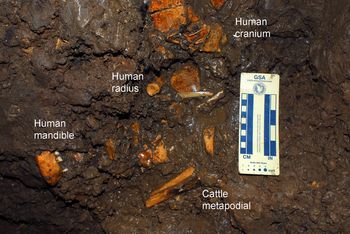
The pattern of the remains above the CRL shows an increase in complete or semi-complete large human and non-human bones (e.g. fig. 6). All body parts of adult sheep/goat and adult cattle crania, metapodia and phalanges were well represented, and remains of neonatal lambs were also found throughout. Several large pieces of charcoal were recovered from this area, again identified as lime. Two sections were different from the main types of deposition. The first, section A3 and A4, was largely a void towards the side of the cave wall, while layers 1 and 2 across the site (i.e. A1, B1, C1 and A2, B2 and C2) were behind the original shoring (see supplementary material section 1) and appeared to be the spoil of previous excavations; bones were fragmented and mixed with occasional modern debris such as a crisp packet and aluminium buttons.
Annotated photograph of layer B3 showing close association of human and non-human remains, and the density of the sediments and clasts in the northern shaft.

Main chamber
The material excavated in the 1950s is here designated as ‘main chamber’ material. This contained the majority of the long bones from all species, including the adult human remains. A particular feature is the dominance of cattle teeth and lower limbs (metapodials, sesamoids and phalanges) in the assemblage (supplementary material section 3). The pattern is not so marked for the other domesticates (sheep/goat and pig), but the assemblages of all appear to be lacking meat-bearing limb bones such as the femur. There is very limited evidence of butchery on all species, with a maximum of 3 per cent butchery and 2 per cent gnawing on bones from the main chamber, indicating that they were quickly buried and not accessible to scavengers (supplementary material section 3). Radiocarbon dating has shown that there were multiple phases of deposition in the main chamber, with two cattle bones dated to the Romano-British period and cattle, red deer and dog specimens that are early and later medieval (table 3). While some of the non-human remains are likely to be related to these medieval deposits, others appear to have a more clearly Romano-British stamp, such as a small toy-dog skull and two bandy legged (terrier-type) long bones.
The human remains from the 1950s excavation comprised at least 23 individuals, based on the presence of 23 right distal humerii. Disarticulated innominates (hip bones; both left and right) that preserved the auricular surface were aged using seriation, resulting in age estimations for 13 individuals (one adolescent, three young adults, six middle adults and three old adults) and a minimum number of six children based on the presence of left and right ilia.Footnote 19 Sexing the adult innominates resulted in an estimate of five males, five females, two probable males and two probable females, with four that could not be sexed (table 5).
SEXING LATE ADOLESCENT AND ADULT INNOMINATES FROM THE MAIN CHAMBER OF DOG HOLE CAVE
(Sexes based on both right and left innominates; where both left and right innominates were in the same age category, they have been counted as one. Inclusion of sex estimates gives a higher minimum number of individuals than those represented by age categories alone: i.e. an MNI of 17 versus 13)

While the majority of human long bones excavated in the 1950s were complete, the complete bones from the 2010–11 excavations tended to be small compact bones such as phalanges, carpals, tarsals and isolated teeth; long bones were highly fragmented (supplementary material section 4). This suggests that many of the isolated adult teeth and phalanges found in the 2010–11 excavation had come from the corpses above and had been washed through the sediment over time. We have not, therefore, increased the MNI for age categories of children and above following our excavation.
Relatively few pathologies were noted in the human remains from both the 1950s and 2010–11 excavations. They are described in full in the supplementary material (section 4.4) and are briefly summarised here. Eight caries, 120 teeth with calculus and six teeth with dental enamel hypoplasia were identified from a total sample of 434 teeth. Eburnation indicative of osteoarthritis was seen on a humerus and a hand phalange. Fifty vertebrae had evidence of spinal degenerative joint disease and 28 vertebrae had schmorl's nodes, out of a total sample of 295 vertebrae. The crania were highly fragmented, and ten orbits from a total of 41 orbits showed evidence of cribra orbitalia, while porotic hyperostosis was observed on one occipital fragment. Osteochondritis dissecans was present on a single thumb phalanx, and a femur and tibia shaft showed evidence of periostitis. Harris lines were present in eight out of 61 tibial and femoral samples (proximal and distal ends counted separately). Two bones showed evidence of fracture: a radius and a proximal hand phalanx. Finally, trauma in the form of cutmarks was observed on three specimens: two rib fragments published by BlandFootnote 20 and a right clavicle.
Discussion
Whatever explanation is provided for the deposition of the non-human remains, they do not represent a typical assemblage reflecting accumulations of general refuse from a nearby settlement. A more varied range of elements might be expected for the main food domesticates at such a site, representing the meat-bearing limb bones of food waste. A greater proportion of butchery marks might also be expected; no layer contains more than 3 per cent of bones with butchery marks (supplementary material section 3), whereas contemporary settlement sites with similar preservation can easily comprise 15–20 per cent butchered bones.
Functional explanations for the use of the cave based on osteology include the possible dumping of butchery waste and birthing casualties. The presence of large numbers of lower legs and heads of cattle, sheep/goat and pigs in the main chamber is typical of primary butchery waste involving the removal of skins and disarticulation of the extremities. The pattern for cattle at least seems to have been established in the earliest phases. Furthermore, the presence of a horse in the lowest level could also be interpreted as the opportune disposal of the carcass of a large animal not commonly consumed in Roman Britain.Footnote 21 The neonatal remains could represent the disposal of animals that died natural deaths and were also not fit to be eaten. While such functional explanations must be considered, the presence of deliberate human burials throughout the cave from foetal to old individuals implies a more ritualised context, with at least some animals used to accompany the dead or symbolise a particular deity. The predominance of neonatal human remains in the lowest layers below the CRL indicates the deliberate accompaniment of foetuses and infants with lambs, piglets and puppies.
MATERIAL CULTURE
The majority of the finds assemblage is Roman in date and falls into a narrow range of categories: personal ornaments (beads, bracelets, an earring and a finger-ring), footwear (hobnails) and pottery. A few additional items from the 1950s excavations, such as an iron axe-head and whetstones, are unlikely to be grave furniture, but the vast majority of the finds appear to be related to the interments. There are several 20th-century finds, which in part result from documented activity in recent times, such as the 1957 excavations and digging in the mid-1980s in an attempt to extend the cave system.Footnote 22 A full description and catalogue of all finds can be found in section 2 of the supplementary material. Some finds, particularly incomplete and corroded iron objects, are most likely to be modern debris and are not discussed further.
Personal ornaments: beads
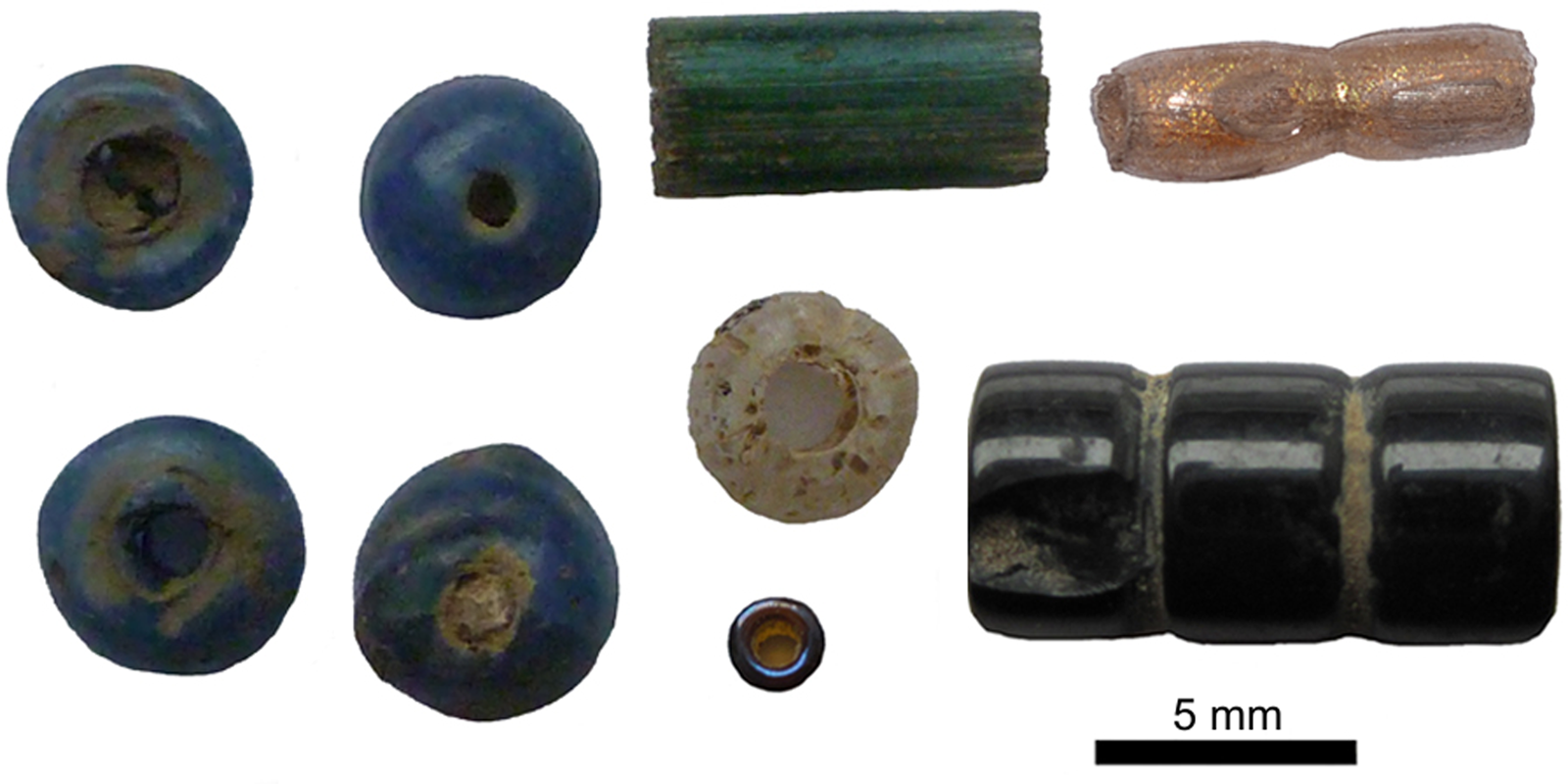
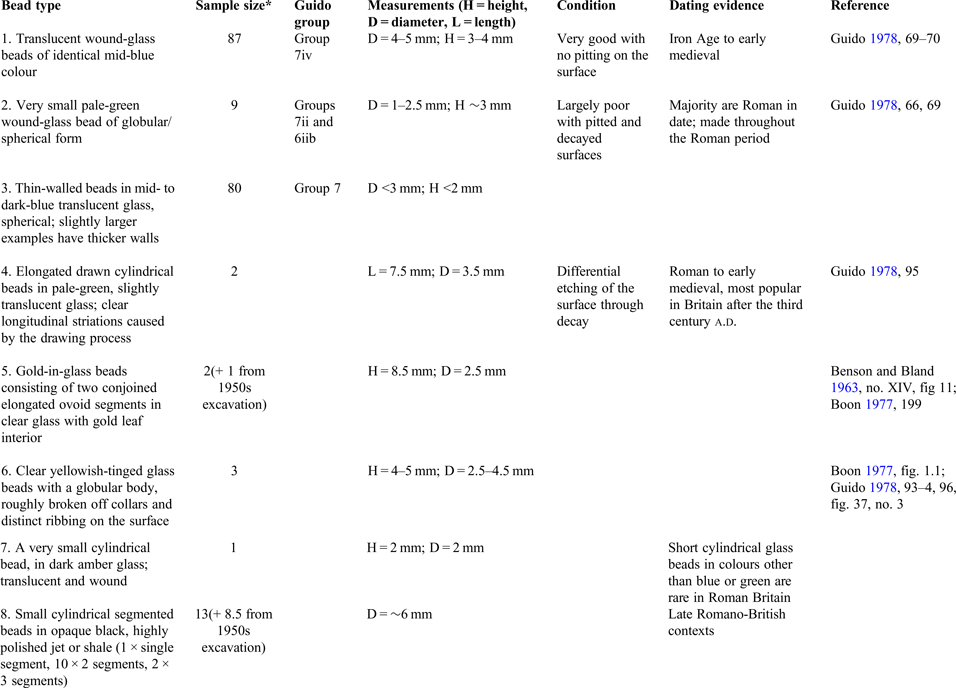
There are up to 192 complete or fragmentary beads; the uncertainty arises from the fact that some bead fragments may belong to the same bead. The beads fall into eight types, which are described in table 6 and shown in fig. 7. The majority of specimens are small blue beads (n = 167), but gold-in-glass and cylindrical jet/shale beads are also present. There are five gold-in-glass beads, of two different types (fig. 7), with one additional specimen recovered from the 1950s excavation.Footnote 23 They are known elsewhere in the north of England, occurring, for instance, at Hartlepool, Cleveland, where a necklace worn around the neck of a skeleton contained 12 jet beads and 26 glass, of which 13 were gold-in-glass.Footnote 24 At the cemetery of Low Borrowbridge, Tebay, Cumbria, 12 out of 67 beads from a necklace found in a possible inhumation burial (pit 301, third century) are of the gold-in-glass type; others are of blue, black and green glass, jet and shale.Footnote 25 At Brougham, five cremations have examples of this type, dating to the third century a.d.Footnote 26
Romano-British beads from Dog Hole Cave. From left: blue beads = Type 1 (SF10-13), long green bead = Type 4 (SF142), elongated gold-in-glass bead = Type 5 (SF113), round gold-in-glass bead = Type 6 (SF158), small amber/rainbow bead = Type 7 (SF150) and three-part jet bead = Type 8 (SF97). See table 6, and section 2 of the supplementary material for more information.

SUMMARY BEAD DESCRIPTIONS AND CATALOGUE FROM THE 2010–11 EXCAVATIONS AT DOG HOLE CAVE
(* > 40 beads were recovered from the 1950s excavation (Benson and Bland Reference Benson and Bland1963) and only the jet/shale and gold-in-glass beads have been included in the totals presented here; for full details of the assemblage, see supplementary material section 2)

Thirteen cylindrical jet or shale beads were also recovered, with an additional 8.5 from the 1950s excavation.Footnote 27 These are commonly found in late Roman contexts. Jet or shale beads are represented by burials of third- to fourth-century date in York, notably at the Railway Cemetery.Footnote 28 They are found in other major towns, such as Southwark in London, at Poundbury, Dorset, and Colchester, as well as in military and rural contexts. A large collection of segmented beads was found in South Shields, though all are longer than the examples from Dog Hole Cave.Footnote 29
Personal ornaments: metalwork
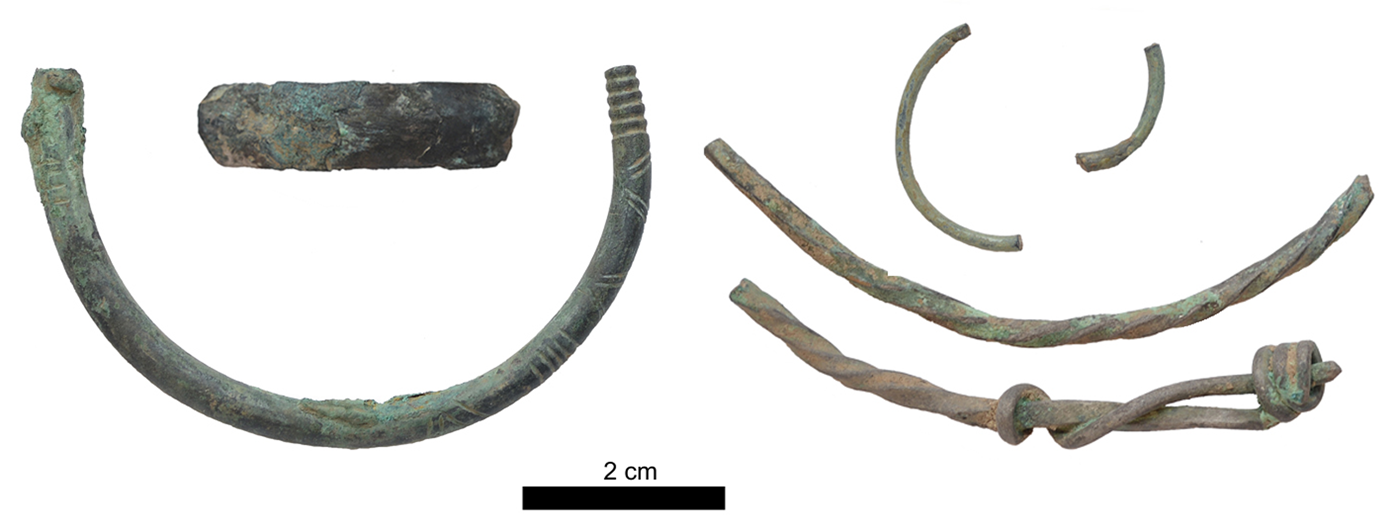
There are fragments of three bracelets from the 2010–11 excavations (fig. 8), to which can be added five whole or fragmentary bracelets recovered in 1957.Footnote 30 A curved fragment of iron of circular section (SF256) may be part of a bracelet, but the lack of surviving terminals makes this uncertain.
Metal jewellery from Dog Hole Cave. Top left: fragment of silver-alloy bangle (SF225); bottom left: copper-alloy penannular bracelet with incised chevron decoration (SF259); bottom right: two pieces of a copper-alloy torc-twisted bracelet (SF260, SF261); top right: two refitting pieces of a probable earring (SF215, SF236).

Two fragments of an undecorated broad silver-alloy bracelet (SF263 and SF225) do not join, but almost certainly belong to the same item. The absence of terminals makes classification impossible, but the broad band and slight rib are found on Romano-British bracelets, including some with snake-head terminals.Footnote 31 SEM EDX analysis indicates a strong presence of silver, together with copper.Footnote 32
A copper-alloy penannular bracelet with grooved terminals belongs to Hilary Cool's Group VI, a type that runs through the Roman period.Footnote 33 This example with grooved terminals of circular section (SF259) has an almost identical, but in this case complete, parallel found in 1957.Footnote 34 They share the same incised chevron decoration, the only difference being that the grooves at the terminals of the 1957 find do not run all the way round the bracelet. There is little doubt that they represent a pair. Other parallels for the bracelet (SF259) include one from a mid-fourth-century inhumation at Kelvedon, Essex (G19),Footnote 35 which was found with two other bracelets. This example lacks the oblique and vertical incised lines of the find from Dog Hole, as does a broken, undated bracelet from Lansdown, Bath, Avon.Footnote 36
There are two fragments of a torc-twisted bracelet with an expanding loop in square-section wire (SF260, SF261), the surface of which appears to have been tinned (fig. 8). There are also two more corroded fragments of torc-twisted, copper-alloy, square-sectioned wire (SF214, SF228) that may belong to the same object but were buried in different conditions. The bracelet with expanding loop conforms to Cool's Group III, subgroup A, with simple terminals.Footnote 37 The type is overwhelmingly of later Roman date, of the late third to fourth century. An example from Fox Hole Cave in the Peak District not only closely parallels the Dog Hole object in form, but also comes from a cave deposit. Fox Hole Cave is identified as a possible burial site and the bracelet from there may have been an object buried with the dead.Footnote 38 An identical bracelet was found at Brougham, Cumbria, in a Phase 2 cremation burial, dated to the late third to fourth century.Footnote 39 The bracelet (SF260, SF261) also closely resembles an example found at Dog Hole Cave in 1957; this has a square section but is not twisted.Footnote 40
There is a fourth possible bracelet in iron; the object is curved with a circular section (SF256), but lacks the diagnostic terminals to determine identification as a bracelet. Undecorated iron bracelets of simple circular section are known from late Roman contexts, such as the Lankhills cemetery, Winchester.Footnote 41
Two joining fragments of thin copper-alloy wire of circular section, and split to half width at one surviving end, probably belong to a loop earring (SF215, SF236). The lack of terminals makes it difficult to assign this object to any particular type. It could belong to one of several forms of plain, looped earring in Lindsay Allason-Jones's typology, particularly the long-lived Types 1–3 or, less likely, her rarer Type 12.Footnote 42
There is a single example of a copper-alloy finger-ring (SF267) with a plain band of shallow D-shaped profile. This simple form is not closely datable. Two additional finger-rings are reported by Benson and Bland.Footnote 43
Footwear
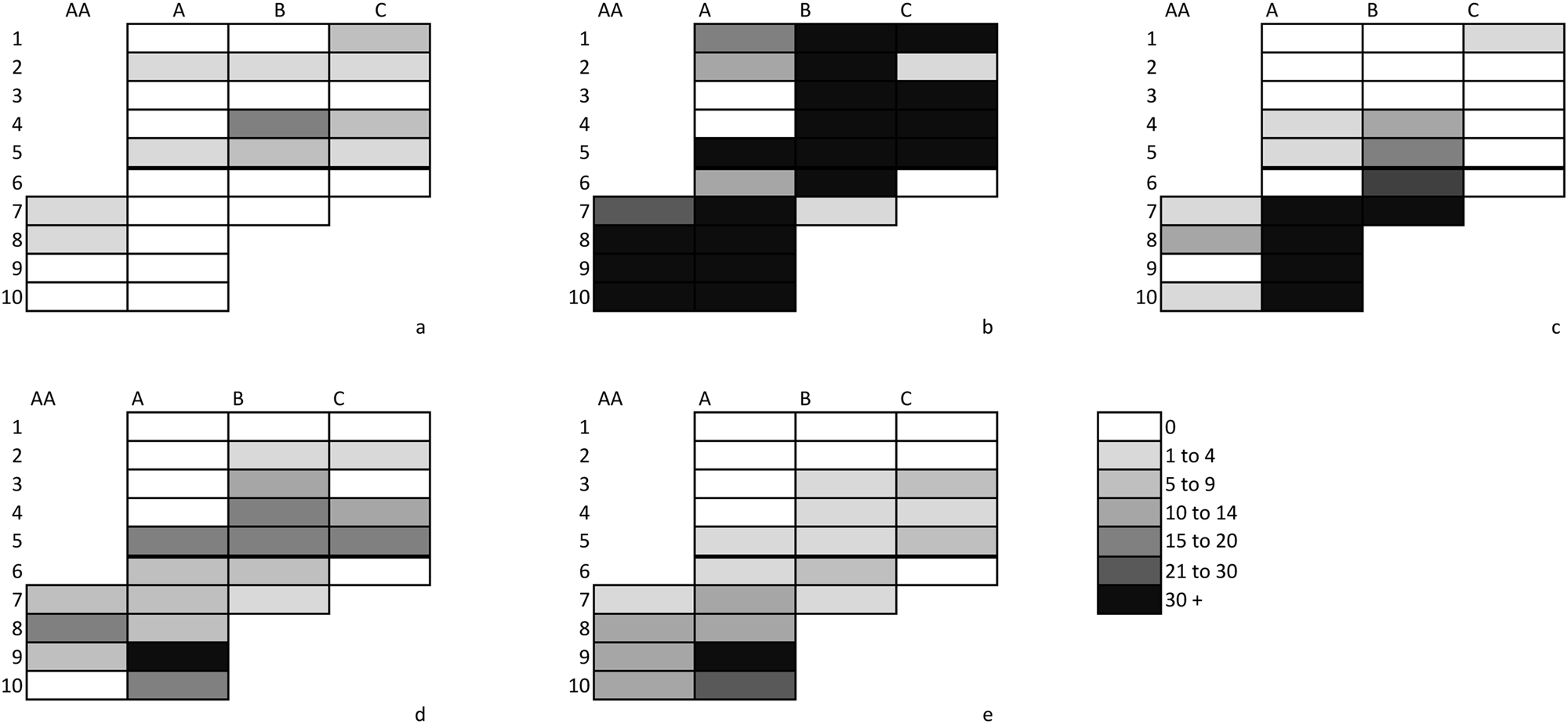
In total, up to 44 hobnails were recovered in 2010–11, while an unquantified number of ‘miscellaneous iron studs’, presumably hobnails, was found during earlier investigations.Footnote 44 Hobnails were used in the soles of leather shoes or sandals, and once the leather sole of the shoe had decayed, the nails, which are small and relatively dense, were easily dispersed from their original position. The 44 hobnails from Dog Hole Cave and the unspecified number of additional examples found in 1957 may therefore represent no more than the hobnails from a single pair of shoes. It is notable that all but two were found above the CRL (fig. 9a), indicating their association with the later phases of the site.
Schematic diagram of the northern shaft excavations showing the distribution of (a) hobnails, (b) microfauna, (c) foetal remains, (d) adult teeth and (e) beads through the layers. The greyscale key indicates the density of finds in each spit.

Pottery
Finds of Roman pottery are confined to two sherds: a small body sherd of black burnished ware (BB1) (SF202) and a flake of buff pottery, probably from a mortarium, with sub-rounded black mineral inclusions (SF38). BB1 began to appear in northern Britain in the a.d. 120s as a result of expanded marketing, perhaps military contracts, from its place of origin in south-eastern Dorset.Footnote 45 While this small fragment is not closely diagnostic of date, BB1 is present in both military and civil contexts in Cumbria and northern Lancashire from c. 120 to c. 350/70.Footnote 46 A single fragment of potential prehistoric pot was also found (SF197), although it may have formed part of a daub. If it is indeed pottery, this small fragment would be the only evidence of prehistoric activity at the site.
Discussion
The majority of the material culture recovered from Dog Hole is from the later Romano-British period (mid-third to fourth century), matching the radiocarbon dates from the adult and non-adult human remains. Necklaces as a type of personal ornament became more popular in the later Roman period,Footnote 47 and analysis of the deposition of beads, whether as components of bracelets or necklaces, shows a consistent association with female graves. For example, in the cremation cemetery at Brougham, deposits with glass beads were found exclusively in female graves or those with children, and were entirely absent from male graves.Footnote 48
Gold-in-glass beads have been extensively discussed,Footnote 49 and they occur in Britain at a range of sites, including villas and rural burial sites, temples and urban contexts.Footnote 50 They are known to have been first manufactured in Egypt and on Rhodes, but by the Roman period they were made in various places including Dacia. Their distribution on the continent shows that they were present on the Rhine-Danube frontier and in southern Russia, but were absent from Spain, Italy, Gaul and Germany before the fourth century.Footnote 51 George Boon suggests that gold-in-glass beads were introduced to Britain by military personnel,Footnote 52 with the Sarmatians (Iazyges) the favoured candidates, given their attested movement to Britain under Marcus Aurelius c. a.d. 175.Footnote 53 Hella Eckardt's review of the evidence confirms that this type of bead arrived in Britain with immigrants, although not specifically with the Sarmatians.Footnote 54 They are predominantly a female ornament, suggesting that they were perhaps brought by women following soldiers on detachment.Footnote 55 Their subsequent distribution argues for absorption of immigrant military personnel and their families into civilian contexts. However, the dispersal of some of these distinctive beads through trade or exchange may account for small numbers present on necklaces not associated with incomers. Cool has argued that overall composition should be taken into account when considering the possible origin or associations of a necklace.Footnote 56 Those composed entirely of gold-in-glass beads are considered more likely to indicate a foreign origin, while those in necklaces with only one or two may have been traded or exchanged after restringing, thereby losing their ethnic affinities. In some cases, however, necklaces with a few gold-in-glass beads, when found in association with other unusual beads, may retain their integrity as indicators of foreign origin.Footnote 57
The two probable pairs of bracelets found across the 1957 and 2010–11 excavations suggest that the deposits into which the bracelets had been placed were only partially removed in the 1950s. From the first to the third century, precious-metal bracelets were worn by high-status individuals in Roman Britain. Cool notes that the practice of wearing copper-alloy bracelets, often in groups of six or more, only became fashionable in the fourth century.Footnote 58 Bracelets were worn almost exclusively by women, and occur in a minority of late Roman burials, either worn on the body at burial or placed singly or in small groups with the deceased.Footnote 59
Hobnails, representing nailed footwear buried with the dead, are frequent finds in both cremation and inhumation burials in Roman Britain.Footnote 60 They are most commonly found, where datable, in fourth-century graves.
Finger-rings are frequent grave finds in Britain and may represent items simply left on the body at burial.Footnote 61 In contrast, earrings are rare finds in graves, although they may be misidentified in early reports. Only 12 are recorded in inhumations excavated up to 1990,Footnote 62 although a further six have been recorded in the Brougham cemetery alone.Footnote 63
From the 2010–11 excavations, 13 human bones had green staining, indicating proximity to the copper-alloy jewellery; there are an additional 30 green-stained bones from the 1950s excavation. These bones were largely from the neck, wrist/hand and ankle regions (supplementary material section 4). Copper staining was found on metacarpals from the thumb (n = 1) and third finger (n = 2), as well as on three proximal hand phalanges, suggesting that jewellery was worn on the thumb and central finger. Of those copper-stained specimens that could be aged (32 out of 43), ten were from individuals <18 years of age (representing at least two individuals, as two left metacarpals and two left radii were present). The position of the staining suggests that at least some of the jewellery was worn or placed on the neck, hands and ankles of the bodies when they were buried.
ISOTOPE ANALYSIS
Isotope analysis was performed on seven adult humans. Six lower second molars from the 1950s excavation and an upper second molar from the 2010–11 excavation were sampled for strontium (Sr), oxygen (O), carbon (C) and lead (Pb) isotopes and lead concentrations (Pb ppm). Three cattle lower third molars from the main chamber were sampled for Sr and Pb isotopes, and a lower molar from the articulated horse was sampled for Sr only. Crown development of the human second molar begins at two and a half years and ends at seven and a half years,Footnote 64 allowing us to see if an individual is likely to have moved between their childhood location and where they were finally buried. It is important to note that isotope analysis does not allow us to determine where someone grew up, but it does allow us to exclude specific regions that are not compatible with the isotope values of an individual. Such analyses have been performed on a number of Roman sites, from urban centres such as London,Footnote 65 WinchesterFootnote 66 and York,Footnote 67 to smaller military forts and associated settlements such as CatterickFootnote 68 and Scorton.Footnote 69 However, there have been far fewer isotope analyses conducted on inhabitants of rural settlements in Roman Britain, and none from north-west England. Full details of the methods employed are given in section 7 of the supplementary material.
The results of the isotope analyses are shown in table 7. The 87Sr/86Sr values range from 0.7097 to 0.7121 (mean = 0.7105 ± 0.00196 (2SD)), while the δ18Ophos(SMOW) values range from 17.26‰ to 18.19‰ (mean = 17.87 ± 0.6188 (2SD)). Enamel carbon values range from δ13C -16.2‰ to -13.9‰ (mean = -14.6 ± 0.76‰ (2SD)). For Pb we focus on the 207Pb/206Pb and 208Pb/206Pb results in the following discussion, as galena (lead ore) values are available for comparison with these ratios,Footnote 70 but all five lead ratios and Pb concentrations are reported in full in table 7. For 206Pb/204Pb the results range from 18.2888 to 18.4720 (mean = 18.3548 ± 0.1168 (2SD)) and 207Pb/204Pb range from 15.6199 to 15.6413 (mean = 15.6345 ± 0.01568 (2SD)). Pb concentrations range from 0.51–1.77 ppm (mean 1.01 ± 0.9596 (2SD)).
STABLE AND RADIOGENIC ISOTOPE RESULTS FOR HUMAN REMAINS FROM DOG HOLE CAVE
(See section 7 of the supplementary material for analytical methods, calibrations and Sr data for horse and cattle)

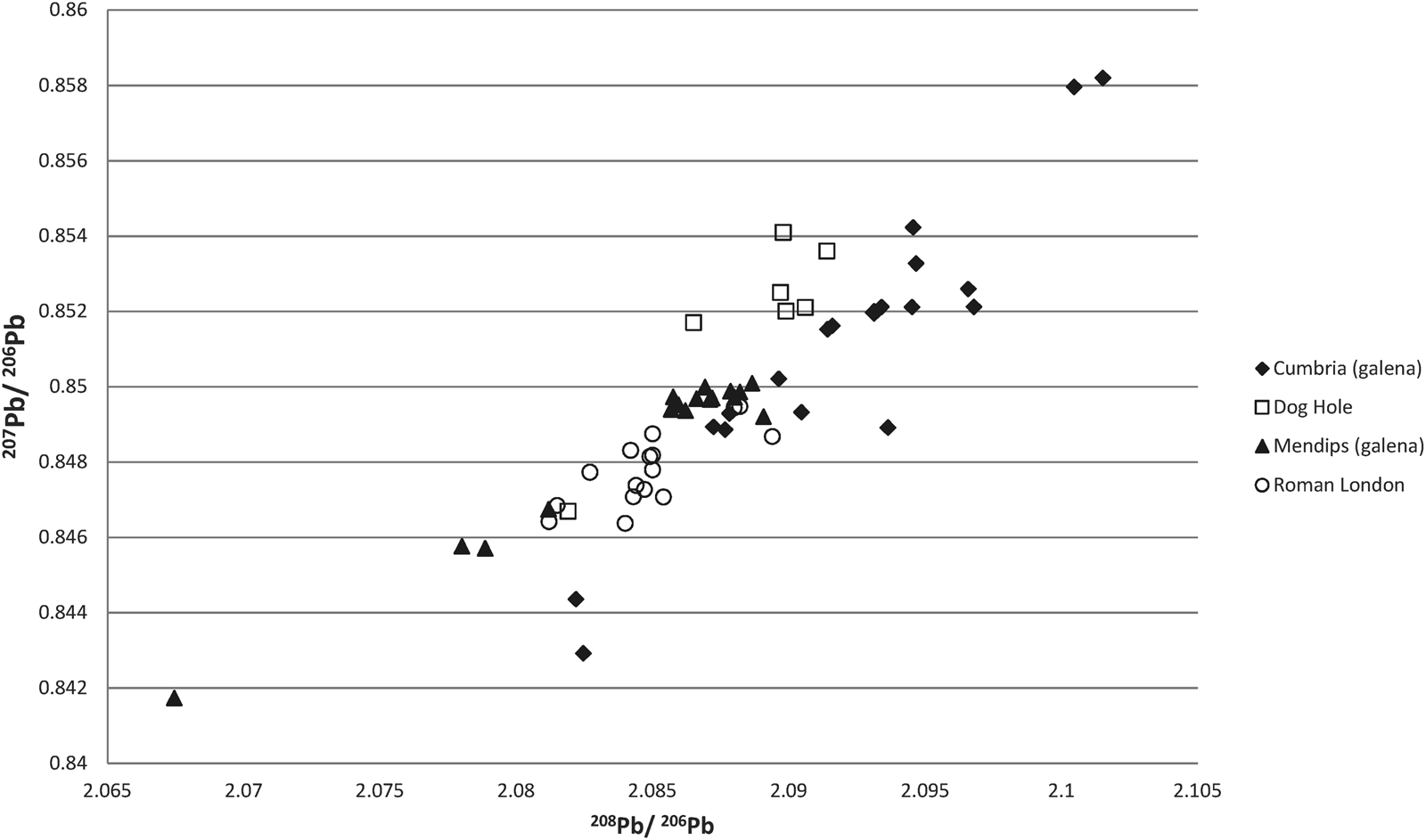
Comparison of the Dog Hole Sr and O data with the Biosphere Isotope Domains MapFootnote 71 demonstrates that the δ18Ophos(SMOW) values are similar for all Dog Hole individuals and do not discriminate between regions in the UK. In contrast, five of the seven individuals have 87Sr/86Sr isotope values compatible with the region around Dog Hole and are therefore likely to be local to the area, while two others (DH 212 and DH 488) have slightly elevated 87Sr/86Sr values. The values of DH 222 and DH 488 are compatible with a number of geologies, including those of the southern Lake District, parts of Scotland, Wales and south-west England, and DH 222 is also compatible with the Pennines. Examination of the Pb isotopes allows us to investigate the origins of these people further. fig. 10 shows 208Pb/206Pb versus 207Pb/206Pb plotted in comparison with Cumbria and Mendips galena (lead ore)Footnote 72 and a sample of humans from Roman London.Footnote 73 This demonstrates that almost all the Dog Hole Pb values plot away from the Mendips ore and the urban Roman samples, but are encompassed within the variation of the Cumbria galena, indicating a local origin for these people. The outlier is DH 2010, which sits within the Mendips and Roman London samples; this may indicate that this individual spent their childhood away from Cumbria. Their Sr and O values suggest that they are likely to be from western or southern Britain, including Lowland Scotland, the southern Lakes, Wales, the Mendips, the South-West and Sussex. This individual (DH 2010) also had a lower δ13C value in comparison with all other samples (table 7), again suggesting that they grew up in a different location. Examination of Pb concentrations indicates that all individuals have a low level of lead incorporated into their tooth enamel (table 7). Two have Pb concentration values expected for an entirely background lead signature (<0.7 ppm), while the others are slightly elevated, but still sit at the bottom end of the distribution for Roman London.Footnote 74 These values indicate that the people buried at Dog Hole were not engaged in any major industrial activity such as lead mining or smelting, although most had some low-level contact with lead in their childhood. In conclusion, all but one of the individuals from Dog Hole have Pb isotope values that are consistent with the lead-ore fields of the Lake District. It is therefore most parsimonious to suggest, based on the Sr, O and Pb isotope results, that all these individuals, except DH 2010, grew up in the region of Dog Hole or the southern Lake District between the ages of two and a half and about eight.
Lead-isotope graph showing the similarity between Dog Hole and Cumbria galena, and individuals from Roman London and Mendips galena. Galena data from Rohl Reference Rohl1996; Roman London data from Shaw et al. Reference Shaw, Montgomery, Redfern, Gowland and Evans2016.

DISCUSSION
As described in the introduction, Dog Hole is an important site because it appears to run counter to many generalisations about Roman Britain, particularly for the north. Dog Hole clearly represents a multiple-phase deposit, and we propose at least three periods of deposition. The first is dated to the latest Iron Age to early Romano-British period, when foetal and neonatal humans and non-human animals were deposited near a horse burial (Phase 1). Deposits from this phase were overlain by the charcoal-rich layer (CRL) between layers 5 and 6, which has a radiocarbon date that is indistinguishable from the material below (fig. 4 and table 3). Subsequent to this, in the later third and fourth centuries, adults and older children were buried at the site and complete dogs and the heads and feet of cattle and other animals were also deposited (Phase 2). The early medieval period saw the deposition of further non-human remains in the cave,Footnote 75 culminating in the probable stashing of antlers which had had their tines sawn off between a.d. 881 and 1013 (Phase 3). These antlers were on the top of the sediment when the cave was first accessed in the 1950s.Footnote 76 Further animal remains in the entrance shaftFootnote 77 and the dating of a dog mandible to a.d. 1220–80 indicate that deposition of non-human remains continued at the site well into the medieval period. A particularly interesting aspect is the continuity of activity at the cave, with dogs being deposited there for at least 1,000 years, if not longer.
While some aspects of the assemblage therefore postdate the Roman period, there are numerous reasons to believe that the overall picture presented above is correct. Some items have clear potential to move around in a clast-rich cave sediment such as that found in Dog Hole, including the hobnails, microfauna, beads, neonatal remains and human teeth. We have plotted these in fig. 9, and it can be seen that all hobnails bar two were found above the CRL (fig. 9a). Plotting the microvertebrates does not reveal the concentration of remains that might be expected if they had been washed to the same levels within the deposit (fig. 9b), and a similar distribution is seen for the neonatal human remains (fig. 9c). The human teeth show a slightly different pattern (fig. 9d), and this may be because they are somewhat heavier/denser than those of the smaller/younger animals and have therefore been carried further. The only items that show considerable movement are the beads (fig. 9e), which, with many measuring <3 mm (table 6), is perhaps not surprising. It is also worth mentioning here that our comprehensive sieving regime (wet sieving to 1 mm for all deposits) accounts for such a large accumulation of beads and foetal remains having been recovered. Other reasons to suppose that the remains, particularly those below the CRL, were not greatly disturbed are the ABGs or partial skeletons that were discovered in the main chamber and in layers 2–10 of the 2010–11 excavation (table 2 and section 4 of the supplementary material). The radiocarbon dates are in order, with older specimens at the bottom and younger at the top. In no case (for those specimens for which we have stratigraphic information) has the order been reversed. Finally, artefact types found in our excavation match those found by Benson and Bland,Footnote 78 and all indicate a later Romano-British date.
PHASE 1
The bones of an adult horse, associated with the remains of one foetal and four neonatal humans, and the partial skeleton of a young dog in Phase 1 recall traditions of burial from the later Iron Age and also Romano-British deposits from pits and wells in southern England. To place a horse within the site would not have been an easy matter; either alive or dead it would have needed to be manoeuvred through the relatively small entrance hole and then lowered 11–12 m into the cave. It was lying horizontally at the bottom of the deposit with the lower leg and hoof tightly flexed beneath the radius and the neck outstretched, suggesting it had not moved much if at all since deposition (fig. 5). That the horse was kept until it was an old animal implies that it had some value in life, which may then have been transferred through its inclusion in the cave. For example, in the late Iron Age the ownership of a horse would have brought considerable status.Footnote 79 The revered and ritual nature of the burial of horse remains during the Iron Age is reflected in deposits from Danebury, Hampshire, although the majority of these were isolated bones or articulating limbs.Footnote 80 It has been suggested that at this time horses provided a link ‘between the earthly and otherworld existence’.Footnote 81
As noted above, the presence of the remains of new-born lambs in Dog Hole makes springtime the likely season of deposition for some of the neonatal remains, and this perhaps relates to a seasonally specific ritual. Furthermore, Eleanor Scott suggests that the burial of infants alongside animals is likely to be gender specific, and a ritual undertaken by women.Footnote 82 The quantities of neonatal pig and dog remains decline in the upper layers while the number of neonatal lamb remains increases, perhaps indicating a change in ritual focus towards the disposal of lambs over piglets and dogs from the early to the later Roman period.
Animal sacrifice played a considerable role in many Roman and Iron Age religious ceremonies, often in honour of specific deities.Footnote 83 This often coincided with the use of natural features, frequently watery places.Footnote 84 Such an occurrence in a cave has numerous parallels,Footnote 85 but Dog Hole appears to be on a unique scale. The large late Iron Age and early Roman temple sites elsewhere in Britain tend to be dominated by one or two domestic species.Footnote 86 The association between sheep and Roman temples is relatively common and can be observed at Snow's Farm, Haddenham,Footnote 87 Great Chesterford,Footnote 88 HarlowFootnote 89 and Uley.Footnote 90 Many of these remains represent animals that died as neonates and in their first year (culls in spring and autumn). These traits fall into Anthony King's Group A sites,Footnote 91 where seasonal culls of very young sheep/goats have been interpreted as the result of spring festivals or celebrations,Footnote 92 with animals provided from the local economy. Although there are some similarities in the presence of neonatal animals at temple sites, these rarely have such a variety of taxa present, and dog and human remains are generally absent. The Dog Hole assemblage is therefore not typical of a traditional Roman temple or place of worship. In a Roman context dogs have been linked to ideas of ‘healing/birth/fertility and to death and the afterlife’.Footnote 93 In addition, dogs were commonly associated with the underworld;Footnote 94 in the context of human burials in a cave this appears potentially relevant, although it should be noted that many of the other animal species present have no such chthonic associations. A potential parallel to the earliest activity at Dog Hole is seen at North End Pot, North Yorkshire, where Iron Age human remains have been found along with dog and horse bones (although the remains of the latter species have not been radiocarbon dated).Footnote 95
There are potential parallels for the burial of very young human and non-human remains at a number of other Romano-British sites across Britain: for example, the Springhead ritual shaft in Kent from where a number of human infant burials were recovered alongside mature and neonatal dog remains.Footnote 96 The deposition of at least 30 lambs, piglets and puppies in a plunge pool/tank at Cuddington, Buckinghamshire, is also similar, although there were no associated human remains.Footnote 97 At Dunstable, Bedfordshire, a cesspit was filled and abandoned prior to a.d. 150.Footnote 98 This cesspit was 9.15 m deep, and, at a depth of between 3.6 and 7.0 m, the remains of a human infant (<6 months in age) and bones from neonatal sheep (MNI = 6), cattle (MNI = 2) and dogs (MNI = 14 including 12 neonate skeletons) were found, as well as those of adult cattle, horse, sheep and dogs.Footnote 99 Cattle and horse were represented by lower limbs, while the majority of the skeletons of the adult sheep (MNI = 2) and dog (MNI = 3) were present. The remains of a white-tailed sea eagle and a raven were also recovered from this level. It has been suggested that the pit had originally been intended to be a well, but was used as a cesspit instead.Footnote 100 Three pits at Silchester, Hampshire, contained foetal and neonatal human remains and bones of dogs, and, in one case (pit 3251), a blue-glass bead and a neonatal pig.Footnote 101 One of the best examples of a Roman well is that at Oakridge, Hampshire. Filled between the second and fourth centuries a.d., it contained primary butchery waste, human remains and the remains of puppies, dogs, calves, lambs and piglets.Footnote 102 Closer to Dog Hole, the well at Heslington East, York, included the skeletons of a puppy and a calf, and primary butchery waste.Footnote 103 A well at Rudston Villa, Yorkshire, was filled between the fourth and sixth centuries a.d., and contained human infant burials and the remains of lambs and sheep/goat lower legs.Footnote 104 Other examples are Dalton Parlours, West Yorkshire, where a few remains of neonatal sheep/goat, cattle and pigs were recovered alongside the bones of sheep/goat, cattle and pigs, primary butchery waste and a few human remains,Footnote 105 and Shiptonthorpe, East Yorkshire, where a water hole was used for inhumations of neonatal infants alongside dog skulls.Footnote 106 At Burnby Lane, Hayton, East Yorkshire, a minimum of 33 human foetuses and neonates (of 43 gestational weeks or younger) were found in and around a range of domestic buildings, one of which was buried with a lamb of ~ten months old.Footnote 107 The practice of the careful burial of infants at Burnby Lane was a continuation from the Iron Age into the Roman period.Footnote 108 Interestingly, and in contrast to Dog Hole, it has been concluded from the burial of non-human ABGs (especially sheep) that there was no seasonal pattern in the deposition at Burnby Lane.Footnote 109 Similar examples are known from across the wider Roman Empire, such as an association between the buried remains of puppies and human infants at a mid-fifth-century villa in Umbria.Footnote 110 The deposition of humans and animals in disused wells has been described as a symbolic closure ceremony.Footnote 111 However, it is also possible that wells were conceived of as providing a convenient opening to the underworld, a role that could also have been fulfilled by Dog Hole.
PHASE 2
The adult human and cattle remains of Phase 2 were mainly located in the main chamber. The cattle bones were largely those from the head and feet of the animal, particularly the metapodia, which exhibited cut marks from skinning. The restriction of elements to the head, lower leg and feet of cattle is unusual outside a primary butchery context. The legs were deposited fresh, as implied by the recovery of numerous accessory bones, though it is not clear whether they were attached to skins. It could be that they represent a token offering from the killing and consumption of cattle at a nearby settlement, the meat being too valuable to dispose of in the cave. This would also explain both the very low MNI of neonatal cattle and the higher age range of these animals compared to the other domesticates. In addition, their use for ploughing and transport made older cattle valuable, so it may be expected that they would not be culled early. However, the situation at Dog Hole is also reminiscent of ‘head-and-hoof’ finds that have been identified in Neolithic and Bronze Age Europe,Footnote 112 where the skins of animals, with the crania and feet attached, accompanied human burials. Furthermore, throughout Europe, the heads, hooves and skins of cattle, sheep and horses have been recovered from areas indicative of their display in prominent places, such as outside a tomb, at the house of the animal's owner or at a sacred site such as a bog or watery place.Footnote 113 Possible examples of ‘head-and-hoof’ burials closer to Dog Hole are evidenced by two early medieval cattle found in Solway Moss, Cumbria,Footnote 114 and horse remains from Kinsey Cave, North Yorkshire, where Romano-British artefacts and horse bones radiocarbon dated to the early to mid-Romano-British period were found in a scree slope outside the cave.Footnote 115 The head and hooves of cattle and sheep/goats are frequently recorded as butchery waste from wells, which were often used as ritual features, and present in considerable quantities at the sites of Springhead in Kent, Oakridge in Hampshire and Dalton Parlours, Rudston Villa and Heslington East in Yorkshire, which have already been discussed. Such deposits may therefore not simply be a product of the functional deposition of butchery waste following the skinning and early dismemberment of a carcass, but have greater symbolic value. They may represent the sacrifice and consumption of a whole animal, with the meat-bearing elements being disposed of elsewhere following consumption. Alternatively, they may have included the skins of the animals, and so represent the offering of a valuable raw material.
It is possible that there is also a practical explanation for the high level of cattle metapodia, as several are of similar date to the human remains. The human bodies would need to have been transported to the site and then lowered into the cave, and they could have been wrapped in cattle skins for ease of transport. While this explanation would account for the high number of metapodia present (as they are often left in place for ease of handling during the tanning processFootnote 116), it is harder to account for the skulls, as the extra weight of a cattle skull attached to the skin would make a wrapped body much more unwieldy.
Finally in this section, it should be noted that the cave is filled with fist-sized clasts; the majority are limestone, but greywacke and (rarely) tuff also occur. Their presence is not the result of roof-fall or flood events and they must have been deliberately placed within the cave. It is likely that the human bodies were covered with these clasts once they had been deposited. There is a considerable depth of them within the site; over 4 m of deposits must have been present originally, with some 2–3 m of sediment between the horse burial and the later human burials in the main chamber (fig. 2). This demonstrates that the placement of the clasts was a substantial undertaking and may have formed a deliberate part of burial or perhaps later mourning rituals.
ADOPTING ROMAN WAYS?
The burial practice seen within Phase 1 at the site is perhaps most consistent with the continuation of an Iron Age tradition. With such a dearth of burials in Cumbria it is difficult to envisage what the local Iron Age tradition might be, but the burial of people in caves is known from other locations elsewhere in northern England,Footnote 117 and would therefore predate Roman influence.
In contrast, the finds from Phase 2 are consistent with Romano-British burial practice as it had developed by the fourth century. In most instances, late Roman practice consisted of extended inhumation, often without durable grave furniture, although a minority of young women and girls were buried with personal ornaments, notably necklaces and bracelets (both types of jewellery that became popular in the fourth century). This narrow, gender-specific rite shows that in particular circumstances it was desirable to deposit jewellery, whether worn or unworn, with the deceased. Although these practices are best known from large cemetery excavations in the towns of southern and eastern England, smaller samples of burials show the same rites in civil settlements such as York and Carlisle. The practice has been interpreted as the provision of jewellery as a symbolic dowry for unmarried women and girls who died young or as gifts for the underworld gods.Footnote 118 The burial of a small number of the dead with necklaces, employing exotic gold-in-glass beads and jet or shale beads, the use of multiple bracelets and burial with hobnailed footwear suggest an awareness of burial practices drawn from late Romano-British culture as found in major Roman towns and urban/military communities. It is perhaps surprising that a rite most commonly associated with towns and large cemeteries has been identified at a rural site in Cumbria. Therefore the nature of what appears to be formal grave furniture poses questions about the character and cultural affiliations of the local rural population.
By the late Roman period the countryside of north-west England had seen more than two centuries of military occupation and administration. The landscape was no longer solely the preserve of people of local descent farming on their ancestral lands. Military control of land and settlement by incomers and their descendants, in particular retired soldiers and their families, created a more heterogeneous rural population. Land grants were made to legionary veterans on completion of their service, and, although these have not been recorded for auxiliary veterans on retirement,Footnote 119 David Shotter considers that military land allotments, or purchases, would have been situated on good-quality land in river valleys or near the coast.Footnote 120 Occasional finds in the countryside of the north-west point to the location of the landholdings of former soldiers. For example, Julius Januarius, a retired decurio probably formerly serving in Lancaster, set up an altar at Bolton-le-Sands in the Lune Valley.Footnote 121 In Cheshire, the diploma of a Spaniard, Reburrus, dated a.d. 103 and found near Malpas is very likely another example.Footnote 122 Auxiliary veteran settlement has been postulated for the vicinity of the fort at Ribchester, implied by the Roman name Bremetenacum veteranorum, probably by Sarmatians after a.d. 175.Footnote 123 A find from north Wales also warns against the assumption that these settlers’ farms would have been architecturally or morphologically distinctive. A Roman will on a writing tablet, found near Trawsfynydd, 5 km from the nearest fort at Tomen y Mur, implies the presence of a literate citizen yet it appears to emanate from a rural settlement of wholly native type, interpreted as the farm of an auxiliary veteran.Footnote 124 These, and no doubt many other undocumented examples, indicate the presence of a resident rural population, some of whose origins may have lain in the Empire outside Britain and who were familiar with Roman military structures and cultural practices, even if their farms remained resolutely native in style.
A hint that some of those using caves in Roman Britain were of immigrant origin has come from work on the limestone caves in Yorkshire. Tom Lord and John Howard suggest that those who made use of the Yorkshire caves may have had a link with immigrant military personnel and their families due to the discovery of military accoutrements in the caves.Footnote 125 At Victoria Cave, the presence of a Norican name, Annamus (as graffiti on a pottery vessel), suggests a connection with Noricum (in modern-day Austria and Slovenia), where such a limestone environment used for the exploitation of lead would have been familiar.Footnote 126 The presence of burial practices that appear to be more urban or military than might be expected for a rural site, brings with it the possibility that the people buried at Dog Hole were not local to the area. This possibility prompted our isotope analyses of the adult remains, but they did not reveal any evidence for long-distance immigrants amongst the sample, although one individual does appear to have moved into the area from elsewhere in Britain after the age of eight.
The data presented above provide evidence for a cave that has been used in multiple ways from the latest Iron Age into the medieval period, with a particular focus on the Romano-British period. Similar to other late Iron Age and Romano-British cave, well or shaft deposits, there is a dominance of human and non-human foetuses and neonates, in our case at the base of the site and in association with a horse burial. This is the first time such an association has been documented in north-west England, but it is interesting to note that the military-associated cremation cemetery at Brougham near Penrith also had horse-related activity only 100–200 years later than the placement of the horse at Dog Hole. At Brougham, ten cremation and pyre sites included horse remains; most notably three had evidence for the cremation of whole horses,Footnote 127 one of which was buried with a male and is dated to Phase 2 (~a.d. 240–70), while partial horse remains buried with a female are dated to Phase 1 (~a.d. 200–40). Cremation of horses is an unusual rite, and is unparalleled elsewhere in Roman Britain.Footnote 128 Brougham also has an unusual number of funerary inscriptions for people with local Celtic rather than Germanic or Latin names,Footnote 129 perhaps suggesting that horses had some significance for the local population. In which case, the lowest level at Dog Hole may be the earliest identification of this in the region. Goddesses associated with horses, such as Epona (who also seems to have a countryside association), are attested in northern Britain, with inscriptions to Epona having been found on both the Antonine Wall and Hadrian's Wall.Footnote 130 Interestingly, Brougham also has the only known occurrence of bucket pendants in Roman Britain; these are thought to indicate an overseas origin.Footnote 131 However, there is increasing evidence from isotope analyses that the use of the presence of particular grave goods to identify immigrants can be flawed.Footnote 132 The mid- to late Roman individuals at Dog Hole underwent burial practices that appear at first glance to be those of urban Britain, with the presence of beads, hobnails and copper-alloy bangles within the cave. The isotope analysis demonstrates that most of the people buried at Dog Hole are likely to have been from the local region, with the southern/central Lake District the furthest likely area for two individuals, based on the combination of Sr, O and Pb isotopes, and one individual exposed to Mendips ore based on Pb alone. The closest substantial Roman sites to Haverbrack are the forts at Lancaster (18 km to the south), Burrow in Lonsdale (14 km to the east) and Watercrook (11 km to the north), all of which remained in use into the fourth century.Footnote 133 Each fort, with its associated vicus, had its own cemetery close by,Footnote 134 and its inhabitants are unlikely to have transported people to Dog Hole for burial.
CONCLUSION
Considering the various suggestions for the use of Dog Hole, from ritual or shrineFootnote 135 to a burial place,Footnote 136 we view it as a burial place. While there are undeniable ritual aspects to burial, the site does not appear to match sites identified as temples or shrines in Roman Britain. Rather, it appears to have been the burial place of a local population, who perhaps performed rites which continued from the late Iron Age into the early Roman period, before switching to a more recognisably ‘Romano-British’ burial practice in the mid- to late Roman period. The combination of the isotope results with the artefact studies suggests a level of acculturation or adoption of more urban burial practices by the rural population. Whether, as we suggest, this relates to military retirees moving into the area and introducing their practices or the observation and subsequent adoption of urban practices by a rural population, we cannot say for sure. As discussed by Eckardt and colleagues, the adoption of overseas practices in the Roman period could relate to the fact that many of the incomers were of high status and therefore their activities were seen as desirable.Footnote 137 In the same way, urban Romano-British burial rites could have been attractive, prompting a desire for emulation, for those who lived in more rural areas.
SUPPLEMENTARY MATERIAL
For supplementary material for this article, please visit https://doi.org/10.1017/S0068113X20000136. The supplementary material comprises the following sections: 1. General site and excavation information; 2. Small finds; 3. Zooarchaeology; 4. Human osteology; 5. Site taphonomy; 6. Palaeoenvironment; 7. Isotope methods and analysis; 8. Finds listed in Benson and Bland Reference Benson and Bland1963; 9. References
ACKNOWLEDGEMENTS
Many people have contributed to this study without whom the excavation and subsequent analyses would not have been possible. We particularly would like to thank Susie Villiers-Smith and Dallam Estate for permission to excavate the site, and their interest in our results. Many cavers helped in our excavation, and we would like to thank Alan Speight and Andy Walsh in particular, for their expertise and good humour in the field. Thank you to Peter Standing for providing us with a site hut and endless enthusiasm, Jim Ohman for advice on ageing innominates by seriation, Alan Clapham for identifying charcoal and Kirsty Squires for discussion of the state of the burned remains from the CRL. We also thank Tom Clare, Richard Newman, Lionel Rice and Jim Newton for encouraging investigation of the site. Steve Newman and Siobhan Watts undertook the conservation and materials analysis of the small finds, and Simon Chenery performed the trace-element analysis. Funding was provided by: Arnside and Silverdale AONB for excavation in 2010 and for radiocarbon dates; Cumbria County Council for radiocarbon dates; Liverpool John Moores University for radiocarbon dates; The Roman Research Trust and the Roman Society for post-excavation analysis of the small finds and zooarchaeological remains; and, finally, the University of Nottingham for isotope and trace-element analyses (a Research Priority Area Grant to Hannah J. O'Regan, ‘Migration narratives: an archaeological perspective’) performed under the auspices of the Centre for Environmental Geochemistry (UoN-BGS) collaboration.