INTRODUCTION
Theory of mind (ToM) describes children's understanding of others as mindful beings whose actions reflect their true and false beliefs and other cognitive mental states. This understanding is prototypically assessed using false-belief tasks that require children to make explicit predictions about the actions, speech, or thinking of people with erroneous beliefs. Performance on these tests exhibits a major developmental shift during early childhood (Wellman, Cross & Watson, Reference Wellman, Cross and Watson2001). Most three-year-olds fail false-belief tasks whereas most five- to six-year-olds succeed readily. Consequently, false-belief test success is widely recognized as a significant cognitive and social milestone. Nevertheless, how these aspects of ToM understanding interconnect with children's conversational and social interaction is imperfectly understood (Hughes & Leekam, Reference Hughes and Leekam2004).
Social conversation is an everyday domain where false-belief understanding and real-world behavior could plausibly be mutually enhancing. When children exchange ideas with adults or peers via dialogue, they gain access to other people's points of view (de Rosnay & Hughes, Reference de Rosnay and Hughes2006). Frequent and skilled conversational exchange can teach them the meaning of mental state terms as well as alerting them to what their conversational partners are thinking about. This may boost understanding of mind. Conversely, children with especially advanced ToM understanding are apt to pick up subtle cues about their conversational partners' mental states (e.g. disinterest, misunderstanding) that could prompt their mastery of greater conversational skill. Perhaps for these reasons, empirical evidence reveals reliable links between individual differences in children's ToM test scores and their exposure to rich and varied conversation about thoughts and feelings with family members and friends (e.g. Dunn, Reference Dunn, Bernstein and Brannen1996; Harris, Reference Harris, Astington and Baird2005). Links may well be bi-directional. Cross-sectional studies show that mothers' frequent talk about mental states correlates with children's greater ToM understanding (e.g. Dunn, Reference Dunn, Bernstein and Brannen1996; Slaughter, Peterson & Mackintosh, Reference Slaughter, Peterson and Macintosh2007). Furthermore, there is longitudinal support (e.g. Ruffman, Slade & Crowe, Reference Ruffman, Slade and Crowe2002) for earlier maternal conversational input as a developmental precursor to the child's subsequent gains in ToM performance. Evidence from young children with severely restricted access to family conversations about mental states (e.g. deaf children growing up in hearing families) reveals that they are often unusually delayed in ToM development (e.g. Peterson & Siegal, Reference Peterson and Siegal1995, Reference Peterson and Siegal1999; see Peterson, Reference Peterson2009, for a review).
Yet, by the same token, the later growth of pragmatic conversational skills is apt also to be prompted by a child's earlier successes in the ToM domain. Hughes & Leekam (Reference Hughes and Leekam2004) suggest that ‘developments in theory of mind transform children's close relationships' (p. 596). They argue that once preschoolers can pass false-belief tests they strive to influence others' belief states in conversation ‘via new and advanced forms of social interaction including tricks, jokes and deception’ (p. 595), as well as through the sarcastic conversation which has been shown in scaling research to require a more developmentally advanced level of ToM understanding than false belief (Peterson, Wellman & Slaughter, Reference Peterson, Wellman and Slaughter2012).
Developmentally, then, the links between conversational practice and the cognitive understanding of others' minds may well be both fundamental and bi-directional. These links are likewise likely to continue well beyond preschool. Indeed the skilled conversationalist's ability to take account of what is on a listener's mind is a sophisticated everyday socio-cognitive skill that undergoes important developmental change from early childhood well into the later teens (Dorval, Eckerman & Ervin-Tripp, Reference Dorval, Eckerman and Ervin-Tripp1984). Furthermore, even mature adults may often find it challenging to effectively ‘read’ minds in casual conversation. Interlocutors of any age may undermine the conversational exchange by using pragmatic tactics that fail to adequately account for others' knowledge states, interests, and mental perspectives. We may forget that others outside our specialty fields have no basis for knowing the meanings of abbreviations, acronyms, and technical terms. This betrays failure to deploy the ToM concept known as knowledge access (Wellman & Liu, Reference Wellman and Liu2004). Other adult insensitivities to conversational norms and expectations, such as undue terseness, mind-numbing verbosity, irrelevance, obscurity, and a host of other failures to take account of the listener's viewpoint, can all undermine the shared conversational purpose. Listeners may also lapse as conversational mindreaders via inattentive misunderstanding or through inability or unwillingness to process non-verbal contextual or meta-linguistic cues.
Research shows there are important individual differences in children's levels of skill as conversationalists at any given age (Sehley & Snow, Reference Sehley and Snow1992). Yet there is also a consistent developmental trend (Brinton & Fujiki, Reference Brinton and Fujiki1984; Dorval et al., Reference Dorval, Eckerman and Ervin-Tripp1984). Piaget (Reference Piaget1926) pioneered the analysis of children's peer–peer dialogues and discovered a reliable developmental change between the ages of two and seven years. Young preschoolers often practiced ‘egocentric speech’ and ‘collective monologue’. While adhering superficially to the conversational format of speaker-to-listener turn-taking, they failed to take account of the other's state of mind, seeming neither to realize that communication about a topic of mutual interest is conversation's underlying goal nor that people without knowledge access would not know what they were talking about. They neither listened nor bothered to make their remarks relevant or comprehensible when they spoke.
However, by the age of six or seven, Piaget concluded that skilled conversational perspective-taking via ‘socialized speech’ had largely taken over from these immature forms. He highlighted older children's collaborative abilities to interest, inform, amuse, debate, and persuade. More recently, a comprehensive and carefully controlled investigation of developmental changes in peers' spontaneous conversations from age seven to age twenty (Dorval et al., Reference Dorval, Eckerman and Ervin-Tripp1984) has supported these Piagetian findings while also revealing further increases in everyday conversational skill (e.g. fewer tangents and more sharing of cognitive perspective) from middle childhood through late adolescence.
This developmental trend, together with individual differences within age groups in sensitivity to conversational norms and expectations, raises intriguing questions. How might children's socially skilled conversation relate to their development of ToM understanding? Do children who stand out from their peers as exceptionally adept at reading minds in their ‘real-world’ conversations also score higher on laboratory false-belief tests? If so, is the association a direct one? Or might any observed links merely be accidental by-products of concurrent developmental timing or the operation of some third variable influencing them both, such as: (a) structural language (syntactic/lexical) maturity (Astington & Baird, Reference Astington and Baird2005) or (b) emotion understanding (Pons, Harris & de Rosnay, Reference Pons, Harris and de Rosnay2004) or (c) the child's personality on a continuum from shyness to outgoing sociability?
Indeed, shyness deserves special attention as a likely ToM correlate that, while less often studied than structural language or emotion understanding, has revealed somewhat paradoxical links to ToM. For example, Walker (Reference Walker2005) found a significant negative correlation between teacher-rated shyness and false-belief test scores in four- and five-year-old boys. Shyness also declined from age four to five, so she suggested, plausibly, that as children gain peer interaction experience in preschool they not only learn about others' minds but also become more confident and less withdrawn in their temperament style. Studying older children aged six to eleven, Banerjee and Henderson (Reference Banerjee and Henderson2001) similarly found that higher shyness predicted lower scores on advanced ToM tests involving understanding of faux pas and of the links between emotions, intentions, and beliefs. However, a longitudinal study of three-year-olds (Wellman, Lane, LaBounty & Olson, Reference Wellman, Lane, LaBounty and Olson2011) revealed an opposite pattern. High shyness at age three was linked with higher false-belief scores two years later at age five. Yet when Lane et al. (Reference Lane, Wellman, Olson, Miller, Wang and Tardif2013) looked at physiological reactivity to stress (salivary cortisol) cross-sectionally along with parent-reported shy temperament, they found that the lowest false-belief scores were earned by highly shy four- and five-year-old children with high cortisol reactivity. The same high cortisol when coupled with very low shyness ratings resulted in some of the highest ToM scores in the sample. Thus they speculated that physiological reactivity may promote social interaction provided the child is not too shy, with social engagement in its turn promoting the growth of ToM understanding. Nevertheless, the pattern is clearly complex and far from fully understood, warranting our addressing of shyness along with ToM and conversational skill in the present study.
For typically developing children (in contrast to groups with autism), there has been very little previous investigation of possible direct or indirect links of conversational skills with ToM understanding. Nor is the evidence from the few studies that have been conducted to date fully consistent or convincing. In a pioneering study, Lalonde & Chandler (Reference Lalonde and Chandler1995) observed several marginally statistically significant correlations between three-year-olds' scores on false-belief tests and their teachers' reports that they spontaneously engaged in certain conversational behaviors like ‘ends conversations appropriately’ and ‘converses on topics of mutual interest’. Yet, paradoxically, there were no correlations between ToM and teachers' reports of other seemingly similar conversational skills (e.g. ‘participates in a conversation with adults and peers without monopolizing it’). Furthermore, no controls for verbal ability were included. Frith, Happé & Siddons (Reference Frith, Happé and Siddons1994) likewise asked preschool teachers to rate a group of typically developing four-year-olds on an eight-item teacher-report ‘interactive sociability’ scale consisting predominantly of conversational skills (e.g. ‘initiates flexible small talk’, ‘initiates conversation of interest to others'). No significant link with false-belief test scores emerged in their study although, more recently, Banerjee & Henderson (Reference Banerjee and Henderson2001) did find that higher scores on this scale correlated positively with advanced ToM and negatively with shyness in typically developing six- to eleven-year-olds. Nonetheless, using a different eight-item scale of everyday conversational skills, Peterson, Garnett, Kelly & Attwood (Reference Peterson, Garnett, Kelly and Attwood2009) found no link with ToM scores among typically developing preschoolers, even though the association was significant for older groups with high-functioning autism.
Clearly, further study would be useful to help reconcile these very mixed results, especially since many of the studies reviewed above were hampered methodologically by relatively small sample sizes and lack of data on verbal ability and other important control variables. Thus we aim to further explore the relation of ToM to conversational competence in typically developing children. Theoretically, there should be such a correlational connection, and one that is likely to be bi-directional. During conversational exchanges with peers and adults, speakers' ToM understanding is likely to help them take account of their listeners' views, interests, and comprehension, whereas listeners' ToM skills should assist inference of pragmatic communicative intent and subtle nuances of message meaning. Conversely, children who start off with relatively good conversational skills may, on this basis, enter into more varied and sophisticated conversational interactions that help to build their ToM-based understanding of their conversational partners' minds. In the current study therefore we directly investigate (a) whether typically developing children's everyday conversational skill correlates with their cognitive ToM understanding on laboratory false-belief tests and (b) the relative importance of ToM as compared with other potential correlates of conversational competence (age, language ability, emotion understanding, and shy temperament).
METHOD
Participants
One hundred and forty-five children were recruited from kindergarten (n = 54), first grade (n = 45), and second grade (n = 46) classrooms of four inner-suburban public schools in Sydney (Australia's largest city) serving a mixed community of working- and middle-class families. Because of the pervasive influence of linguistic ability on ToM (e.g. Milligan, Astington & Dack, Reference Milligan, Astington and Dack2007), and the central position of ToM for this study, we excluded all non-native English speakers (n = 14), plus two who failed to complete any ToM tests. Thus the final sample comprised 129 children (67 boys) aged 60 to 101 months (mean = 78·8). All had written parental consent and none had developmental disabilities.
Materials and testing procedure
Each child was tested individually by an experienced researcher in a quiet school area on: (a) a ToM battery of ten false-belief tasks, (b) an eight-component emotion-understanding scale, and (c) a standardized, norm-referenced language ability measure. Late in the school year, after at least six months of daily classroom and playground observation, classroom teachers rated children's conversational competence and shy temperament on published scales. Measures are described below. Summary statis Otics appear in Table 2.
Theory of mind (ToM) battery
The ten-item ToM battery consisted of standard false-belief understanding tasks (see Wellman et al., Reference Wellman, Cross and Watson2001, for a review of such tasks). There were four stand-alone first-order false-belief tasks (two involved containers with unexpected contents and two depicted unexpected transfer) plus three tests of second-order (recursive) false belief (FB). Each of the four first-order tasks had a test question (e.g. ‘What will [naive] X think is in this [potato chip tube] before he/she opens it?’) plus a control question (e.g. ‘What is really in it?’). Children had to pass control as well as test questions to pass (with a score of 1) any given task, otherwise they scored zero. The three second-order FB tasks involved stories modeled on Perner & Wimmer's (Reference Perner and Wimmer1985) seminal task. Each test had a second-order test question (e.g. ‘Where does X think that Y thinks the marble is?’), plus an embedded first-order false-belief question (e.g. ‘Where does Y think the marble is?’), and one or more control questions. Children who passed control questions earned one point for each correct first-order (maximum = 3) and each correct second-order (maximum = 3) false-belief attribution. We summed scores on the embedded first-order items with those on the four stand-alone first-order tasks so that, overall, children received a score between 0 and 7 for first-order false-belief understanding. Similarly, second-order false-belief scores could range from 0 to 3. Finally first- and second-order subtotals were added together to create an overall total for ToM (ToM/10) that ranged from 0 to 10. A reliability analysis on this ten-item total revealed it had sound internal consistency (α = .74). All children completed the first-order tasks but six (5%) had missing second-order data. They received pro-rated scores for inclusion in analyses involving first-order false belief but were omitted from those involving second-order and ToM/10.
Emotion understanding (EU)
EU was assessed using the first eight components of the Test of Emotion Comprehension (TEC: Pons et al., Reference Pons, Harris and de Rosnay2004), each examining a unique conceptual domain (component) of thinking about feelings. Specifically, items tested (a) labeling of emotional expressions, the understanding that (b) situations, (c) desires, (d) memories, and (e) false beliefs can each cause different emotions, (f) emotion concealment, (g) mixed emotions, and (h) voluntary emotional control. Children earned one point for each component on which they demonstrated competence. EU scores in this sample ranged from 2 to 8. A Cronbach's alpha of .42 indicated only modest internal consistency. However, TEC scores have been shown to scale hierarchically (Pons et al., Reference Pons, Harris and de Rosnay2004) and individual differences display robust longitudinal stability (Pons & Harris, Reference Pons and Harris2005). Thus, as low internal consistency may have reflected, at least in part, the diversity of the emotion constructs considered and the varying ages at which different children master these, we elected to retain the EU total, with appropriate caution, as a summary of children's varying patterns of aptitude across a broad of developmentally distinctive emotion cognitions. One child had missing EU data.
Language ability
Verbal mental age was measured with a widely used receptive vocabulary test, Peabody Picture Vocabulary Test (PPVT 4th Ed.; Dunn & Dunn, Reference Dunn and Dunn2007). Raw (unstandardized) verbal ability scores ranged from 46 to 163. We chose to use unstandardized language scores rather than verbal mental age estimates both to avoid the statistical complications from using both age and age-derivative scores in the same regression analyses, and also out of theoretical interest in how absolute linguistic skill (rather than linguistic maturity) related to ToM, conversation, and other variables. Eight children (6%) were unavailable to take the PPVT.
Mindful conversational competence (MConvComp)
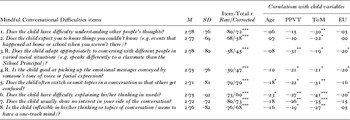
We measured conversational competence using Peterson, Garnett et al.'s (Reference Peterson, Garnett, Kelly and Attwood2009) eight-item Mindful Conversational Difficulties Scale. Administered exactly as originally described, it lists a set of familiar conversational situations calling for ToM (e.g. ‘Does the child frequently switch or omit topics in a conversation so that others become confused?’). Teachers responded on 5-point scales from ‘very much less difficulty/[skill]’ ( = 1) … to ‘very much more difficulty/[skill]’ ( = 5) ‘than a typical child this age’. (See Table 1 for the full item set, verbatim.) Peterson et al. (Reference Peterson, Garnett, Kelly and Attwood2009) designed the test for children with autism and framed most items as difficulties children might have on the grounds that it is easier for teachers to notice and recall familiar problems when conversations break down than it is to abstractly rate ability in terms of higher levels of skilled performance, especially since no child is likely to be as conversationally adept as even a mediocre adult. Agreeing with this logic, we used Peterson et al.'s item wording and response formats for similar reasons for the teachers' ratings and in the raw data reported in Table 1. Higher raw total scores (8 to 40) in Table 1 therefore reflect ever-greater difficulty with conversational mindreading. (Note: On the original test, as in ours, two items were framed positively then reverse-scored to prevent response perseveration.)
Means, standard deviations, and correlations for individual items on the teacher-rated Mindful Conversational Difficulties Scale

notes: All items (except 3 and 4) were phrased in the negative (as difficulties) to facilitate accurate rating (see Method). Scoring for Table 1 is uniformly in this direction. Thus higher scores here denote greater difficulty with conversation, in contrast to the ConvComp score (e.g. Table 2), where higher skill scores higher; * p < ·05; ** p < ·01; *** p < ·001.
However, for ease of conceptual interpretation, we subsequently derived a positively framed Mindful Conversational Competence (MConvComp) summary score by transposing each child's rating on each item and then averaging over items. Thus the final MConvComp score that we report in Tables 2 and 3 could (and did) range from a low of 1 (‘much less skilled …’) to a high of 5 (‘very much more skilled …’).
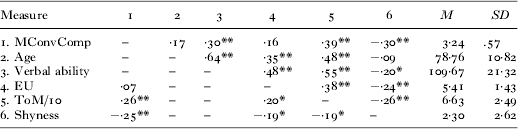
Summary of intercorrelations, means, and standard deviations for scores on the new Mindful Conversational Competence (MConvComp) Scale, plus age, verbal ability, emotion understanding (EU), theory of mind, and shyness
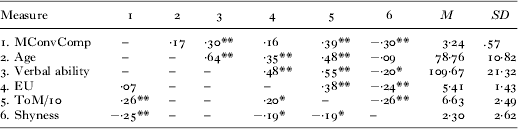
notes: Product moment correlations are presented above the diagonal and partial correlations (controlling for age and verbal ability) are presented below the diagonal; * p < .05; ** p < .01.
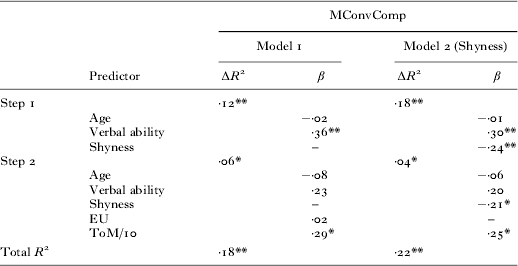
Hierarchical multiple regression models predicting mindful conversational competence from age, verbal ability, emotion understanding, theory of mind, and shyness
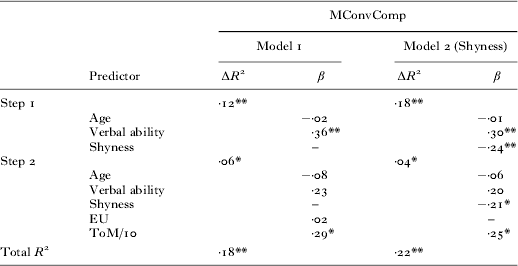
note: * p < .05; ** p < .01.
Shy temperament
We used Gresham and Elliott's (Reference Gresham and Elliott1990) widely used teacher-report scale of shy temperament (originally dubbed ‘internalizing problems’) to measure the child's level of shyness. The measure consists of six items, including: ‘shows anxiety about being with a group of children’ and ‘likes to be alone’, similar to the measures of shy temperament shown previously (e.g. Walker, Reference Walker2005; Wellman et al., Reference Wellman, Lane, LaBounty and Olson2011) to correlate with ToM. Ratings were on a three-point scale (‘0’ = 'never’, ‘1’ = 'sometimes’, ‘2’ = 'often’). Higher scores indicated greater shyness. Five children (4%) had missing shyness ratings.
RESULTS
Preliminary analyses
Psychometric properties of the MConvComp Scale were sound (Table 1). Across the sample, teachers utilized the full response range on each item. All inter-item correlations were significant and Cronbach's α was .87, indicating sound internal consistency, replicating Peterson et al. (Reference Peterson, Garnett, Kelly and Attwood2009). There was no gender difference in mindful conversational skill (t(127) = 1·76, p = .081). Nor did boys and girls differ on any of the other measured variables (all ts< 1·15, all ps> .25). Thus, we did not analyze gender further.
Bivariate relations
Table 2 shows means for MConvComp (with high scores reflecting greater skill) together with means on other key variables. Raw and partial correlations (age and language skill controlled) among the variables are also shown. (Table 1 supplements this with correlations for each conversational difficulty item separately.) As we had predicted, children's total scores on our tests of false belief (ToM/10) were strongly positively linked with conversational competence, not only initially but even after age and language ability were statistically controlled (see Table 2). This relation pertained to the first-order false-belief total (out of 7) and also the second-order false-belief total (out of 3) separately. Scores on the EU tests, despite similarities in format to the ToM tests, showed a more modest relation with MConvComp that fell to non-significance in the partial correlations with age and verbal ability controlled.
Thus test scores for false belief (but not emotion understanding) display consistent links with children's everyday pragmatic interactive behavior in taking account of their conversational partners' mental perspectives during dialogue. In terms of temperament, shyness was a significant negative correlate of mindful conversational skill, similar to Banerjee and Henderson's (Reference Banerjee and Henderson2001) finding with older children and a different conversation measure. Shyness likewise correlated negatively with ToM in both the raw and the partial correlations, similar to other cross-sectional findings by Banerjee & Henderson (Reference Banerjee and Henderson2001) and Walker (Reference Walker2005) but in contrast to the positive longitudinal link from age three to five reported by Wellman et al. (Reference Wellman, Lane, LaBounty and Olson2011).
Regression analyses
Two hierarchical multiple regression analyses were conducted, both with MConvComp as the dependent variable. Model 1 examined whether children's understanding of mind was uniquely important for conversational competence over and above age, structural language, and emotion understanding, while Model 2 also included shyness as a possible predictor of conversational competence.
To test Model 1, age and language ability were entered first, followed by entry of EU and ToM/10 scores together at the second step. At Step 1, the model was significant (F(2,106) = 7·44, p < .001), but only verbal ability significantly contributed to MConvComp. The addition of EU and ToM/10 at Step 2 significantly improved the overall model (∆F(2,104) = 3·64, p = .030), but only ToM/10 emerged as a significant independent predictor of MConvComp in the final equation (see Table 3). In other words, false-belief understanding significantly predicted children's everyday conversational competence as mindreaders independently of age, language, and emotion understanding.
In Model 2, age, language ability, and shyness were entered as control variables at Step 1, and ToM/10 was entered alone at Step 2. At Step 1, the model was significant (F(3,105) = 7·64, p < .001), and both verbal ability and shyness uniquely contributed to MConvComp. The addition of ToM/10 at Step 2 significantly improved the overall model (∆F(1,104) = 5·23, p = .024), and at this final step both shyness and ToM/10 emerged as a significant independent predictors of MConvComp (see Table 3). The former predicted negatively (high shyness was linked with poor conversation skill), while the association between ToM and conversational skill was positive, suggesting that even after allowing for other key influences on conversational mindreading, higher false-belief understanding still independently predicted children's better MConvComp scores.
DISCUSSION
These findings show that children's cognitive ToM understanding (as assessed with laboratory false-belief tests) is significantly correlated with their everyday deployment of mindful conversational skills in real-world social interaction as reported by their teachers. Furthermore, the link appears direct, rather than an accidental by-product of mutual correlations with other variables like age, language ability, emotion understanding, or shy temperament. In other words, those children with clearest cognitive awareness of how ignorance and false beliefs shape the behaviors of hypothetical protagonists in laboratory tests were also the ones who stood out in their teachers' estimation as displaying the highest levels of skill in everyday conversations requiring recognition of their conversational partners' mental perspectives. In this way, social conversation joins a group of other everyday behaviors with clear links to false-belief understanding, including hiding and keeping secrets (Peskin & Ardino, Reference Peskin and Ardino2003), telling lies (Talwar & Lee, Reference Talwar and Lee2008), negotiating imaginary roles in pretend play (Astington & Jenkins, Reference Astington and Jenkins1999), and persuading someone to do something undesirable (Slaughter, Peterson & Moore, 2012).
Of course, simple correlation does not imply causation and two distinct directions of association could, in theory, provide equally plausible interpretations for these findings, possibly both operating in conjunction with one another. The child's cognitive mastery of false-belief understanding could conceivably, ‘transform children's social relations’ (Hughes & Leekam, Reference Hughes and Leekam2004, p. 590) by supplying the insight that people's behavior is not always what reality might dictate. Thus, children with an astute grasp of ToM might come to realize, during conversation, that their own failure to take account of their conversational partners' perspectives can undermine communication and interrupt the smooth flow of shared discourse. This could prompt more sophisticated conversational performance, including the taking account of listeners' ignorance or false beliefs, in everyday interaction. Conversely, children who start out as particularly skilled and astute conversationalists might thereby attract a broader range of conversational partners than their peers. These rich and varied conversational encounters could expose them to different people's points of view and, over time, culminate in better ToM skills on standard tests. This latter perspective is consistent with Deleau's (Reference Deleau2012) conclusion that ‘conversational practices play an important role in the development of cognitive skills [including ToM]’ (p. 309). He came to this conclusion based on results of a short-term longitudinal study in which three- and four-year-old preschoolers were tested three times over six months for their understanding of (a) ToM (false belief) and (b) selected pragmatic conversational rules like formal address (e.g. via a picture book task requiring choice of an adult, not a peer, as the target of an utterance prefaced by ‘sir’). Cross-lagged correlational analyses suggested conversational awareness scores as longitudinal antecedents to ToM scores in this instance. Overall, however, Deleau concluded that influences of pragmatics on ToM and vice versa are ultimately ‘complex and multidimensional’ (p. 309). Future longitudinal and training studies might assist in further unraveling these intriguing possibilities (Harris, Reference Harris, Astington and Baird2005).
While not a central focus of our study, the present findings regarding shyness, particularly the significant raw and partial correlations (with age and language ability controlled) between high shyness and lower false-belief understanding, warrant brief speculative comment. In line with several previous studies of children aged five and older (e.g. Banerjee & Henderson, Reference Banerjee and Henderson2001; Walker, Reference Walker2005), shy children in our study did worse than their more outgoing peers on ToM tests. Conceivably, a shy temperament might limit everyday conversational and playful interaction with other children and thus reduce a child's opportunities for learning about other people's minds. However, such a possibility needs to be reconciled with Wellman et al.'s (Reference Wellman, Lane, LaBounty and Olson2011) finding that shy, observant three-year-olds were the ones who were most advanced in ToM understanding when tested at age five. Perhaps developmental timing matters here. During their very earliest encounters with groups of peers at the young age of three, remaining on the sidelines to watch might be useful for ToM learning. Yet, a few years later, once peer interaction becomes a familiar and major element of daily school life (e.g. after age five), active social engagement with peers may supply new ToM-relevant insights that shy watching from the sidelines can no longer provide. Alternatively, as Lane et al. (Reference Lane, Wellman, Olson, Miller, Wang and Tardif2013) found, in any given sample of children there may be different types of shy temperament such that ‘children who exhibit different forms of social withdrawal may evidence quite different socio-cognitive skills' (p. 832). Clearly more research is needed on mutual associations among ToM, conversation, and temperament in typically developing children across a wide age range, ideally including ToM scales (Peterson, Wellman & Liu, Reference Peterson, Wellman and Liu2005) suited to groups aged two through ten years (e.g. Peterson et al., Reference Peterson, Wellman and Slaughter2012), together with additional measures of temperament and temperament-linked physiology, in order to amplify and evaluate these intriguing yet speculative possibilities.
Meanwhile, methodologically, the new conversational competence scale we used appears promising as a simple tool that classroom teachers are able to validly and reliably apply. As well as stimulating future research efforts, it is hoped this tool might ultimately assist teachers of typically and atypically developing groups to plan, implement, and evaluate classroom activities and interventions to support children's competencies with, and opportunities to learn from, their everyday dialogues with varied conversational partners.