Introduction
Consanguinity is the union of individuals having at least one common ancestor. Consanguineous marriage is influenced by several factors, including demographic, religious, cultural and socioeconomic factors (Bittles, Reference Bittles2001; Saadat, Reference Saadat2007a).
The main consequence of consanguineous marriages is the increased risk of autosomal recessive diseases. Several authors have reported a significant increase in sterility and in the rate of abortions, stillbirths, perinatal losses and neonatal deaths in consanguineous families. Several studies have shown that the rate of congenital malformations among the offspring of consanguineous marriages is higher than that among the offspring of unrelated parents (Al-Awadi et al., Reference Al-Awadi, Naguib, Moussa, Farag, Teebi and El-Khalifa1986; Bittles et al., Reference Bittles, Grant and Shami1993; Dawodu et al., Reference Dawodu, Abdulrazzaq, Bener, Kappel, Liddle and Varghese1996; Al-Abdulkareem & Ballal, Reference Al-Abdulkareem and Ballal1998; Ober et al., Reference Ober, Hyslop and Hauck1999; Al-Rifai & Woody, Reference Al-Rifai and Woody2007; Kerkeni et al., Reference Kerkeni, Monastiri, Saket, Guediche and Ben Cheikh2007).
One ecological study showed that it seems that countries with higher rates of consanguineous marriages have lower national IQ scores than countries with lower consanguinity rates (Saadat, Reference Saadat2008a). Also, it has been shown that consanguineous marriages may be a risk factor that influences the incidence of suicidal burns and child mortality at population level (Saadat, Reference Saadat2005, Reference Saadat2007b; Saadat & Zendeh-Boody, Reference Saadat and Zendeh-Boodi2006).
Although several studies on the prevalence of consanguinity in Arabian countries have been published (Hafez et al., Reference Hafez, El-Tahan, Awadalla, El-Khayat, Abdel-Gafar and Ghoneim1983; Benallegue & Kedji, Reference Benallegue and Kedji1984; Al-Hamamy et al., Reference Al-Hamamy, Al-Bayati and Al-Kubaisy1986; Khlat, Reference Khlat1988; Khoury & Massad, Reference Khoury and Massad1992; El-Hazmi et al., Reference El-Hazmi, Al-Swailem, Warsy, Al-Swailem, Sulaimani and Al-Meshari1995; Al-Gazali et al., Reference Al-Gazali, Bener, Abdulrazzaq, Micallef, Al-Khayat and Gaber1997; Al-Abdulkareem & Ballal, Reference Al-Abdulkareem and Ballal1998; Saha & El Sheikh, Reference Saha and El Sheikh1988; Rajab & Patton, Reference Rajab and Patton2000; Barbari et al., Reference Barbari, Stephan, Masri, Karam, Aoun, El Nahas and Bou Khalil2003; Gunaid et al., Reference Gunaid, Hummad and Tamim2004; Hamamy et al., Reference Hamamy, Jamhawi, Al-Darawsheh and Ajlouni2005; Bener & Alali, Reference Bener and Alali2006; COSIT, 2006; Kerkeni et al., Reference Kerkeni, Monastiri, Saket, Guediche and Ben Cheikh2007), there is only one report concerning consanguinity in Damascus (the capital of Syria) using a small sample size (Al-Rifai & Woody, Reference Al-Rifai and Woody2007). Therefore, the present study was done in order to illustrate the percentage and types of consanguineous marriages in the Syrian Arab Republic.
Methods
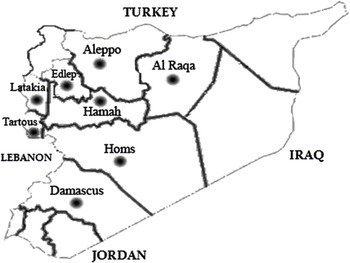
The Syrian Arab Republic is a country in the Middle East. The present cross-sectional study was carried out in eight provinces of Syria in 2008. For sampling a multistage design was used. Syria is divided into fourteen provinces. Eight provinces (Damascus, Hamah, Tartous, Latakia, Al Raqa, Homs, Edlep and Aleppo) were included in the survey (Fig. 1). The selected provinces (clusters) were stratified into urban and rural areas. Sampling according to the number of couples in each stratum was collected in proportion to the size of the population. A total of 67,958 couples (urban areas: 36,574 couples; rural areas: 31,384 couples) were included in the study. The main religion and ethnicity in Syria are Islam and Arab, respectively. In this study, non-Arab ethnic groups were not taken into consideration. Data on consanguineous marriages were collected using a simple questionnaire by interview. The questionnaires were completed by trained interviewers.
Geographical distribution of study provinces in the Syrian Arab Republic.

The coefficient of inbreeding (F) is the probability that an individual has received both alleles of a pair from an identical ancestral source, or the proportion of loci at which he is homozygous. Consanguineous marriages were classified by the degree of relationship between couples: double first cousins (F=1/8), first cousins (F=1/16), second cousins (F=1/64) and beyond second cousins (F<1/64). The F-value was calculated for each couple and the mean inbreeding coefficient (α) estimated for the population. The total percentage of consanguineous marriages and α-value for each province were calculated, stratified by rural and urban areas.
Chi-squared (χ2) tests were used to compare mating pattern frequencies between populations. A probability of less than 0.05 was considered as statistically significant.
Results
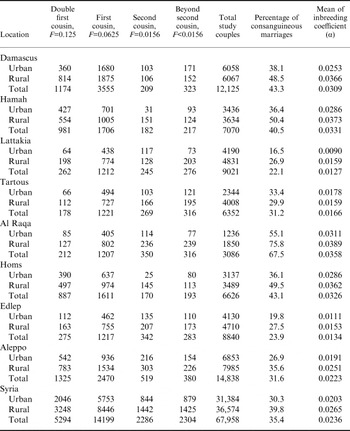
Table 1 shows the frequency of the various types of consanguineous marriages in urban and rural areas of the studied provinces. There were significant differences between provinces for frequencies of different types of marriages (χ2=6634, df=60, p<0.00001). Also there were significant differences between rural and urban areas for the types of marriages in all of the studied provinces (p<0.05).
Prevalence of various types of consanguineous marriages in Syria

The present data show that the overall frequency of consanguinity was 30.3% in urban and 39.8% in rural areas, and the total rate of consanguinity was found to be 35.4%. The equivalent mean inbreeding coefficient (α) was 0.0203 and 0.0265 in urban and rural areas, respectively. The overall α-value was estimated to be about 0.0236 for the studied populations.
The mean proportion of consanguineous marriages ranged from 67.5% in Al Raqa province to 22.1% in Latakia province. The mean inbreeding coefficient (α) ranged from 0.0358 to 0.0127 in these two provinces. The western and north-western provinces (including Tartous, Latakia and Edlep) recorded lower levels of inbreeding than the central, northern and southern provinces.
First cousin marriages (with 20.9%) were the most common type of consanguineous marriages, followed by double first cousin (with 7.8%), second cousin (with 3.3%) and beyond second cousin. First cousins may be either the children of two brothers (patrilateral parallel cousins), of two sisters (matrilateral parallel cousins) or of a brother and sister (cross-cousins). The cross-cousin marriages were divided into two types of marriages: cross-cousin type I (wife is daughter of husband's maternal uncle) and cross-cousin type II (wife is daughter of husband's paternal aunt). Of first cousin marriages, patrilateral parallel cousin marriages were the most common type of consanguineous marriages (39%), followed by matrilateral parallel cousin (23%), cross-cousin type I (19%) and cross-cousin type II marriages (19%). The observed difference was statistically significant (χ2=1540, df=4, p<0.00001).
Overall, these data indicate that double first cousin marriages accounted for 6.5% and 8.8% of marriages in urban and rural areas, respectively. This difference was statistically significant (χ2=131, df=1, p<0.00001). The frequency of double first cousin marriages ranged from 1.5% in urban areas of Latakia to 15.2% in rural areas of Hamah (Table 1). In all of the studied provinces, the frequency of double first cousin marriages was higher in rural areas compared with urban areas, except for Tartous and Al Raqa, which showed equal frequencies of double first cousin marriages in urban and rural areas.
Discussion
Consanguineous unions are strongly preferred in many Asian and African countries. The prevalence of consanguineous marriages in the Syrian Arab Republic is high and comparable to levels reported from other Arabic countries (Hafez et al., Reference Hafez, El-Tahan, Awadalla, El-Khayat, Abdel-Gafar and Ghoneim1983; Benallegue & Kedji, Reference Benallegue and Kedji1984; Al-Hamamy et al., Reference Al-Hamamy, Al-Bayati and Al-Kubaisy1986; Khlat, Reference Khlat1988; Saha & El Sheikh, Reference Saha and El Sheikh1988; Khoury & Massad, Reference Khoury and Massad1992; El-Hazmi et al., Reference El-Hazmi, Al-Swailem, Warsy, Al-Swailem, Sulaimani and Al-Meshari1995; Rajab & Patton, Reference Rajab and Patton2000; Barbari et al., Reference Barbari, Stephan, Masri, Karam, Aoun, El Nahas and Bou Khalil2003; Gunaid et al., Reference Gunaid, Hummad and Tamim2004; Hamamy et al., Reference Hamamy, Jamhawi, Al-Darawsheh and Ajlouni2005; Bener & Alali, Reference Bener and Alali2006; Bener & Hussain, Reference Bener and Hussain2006; COSIT, 2007; Kerkeni et al., Reference Kerkeni, Monastiri, Saket, Guediche and Ben Cheikh2007) and other Islamic countries (Bittles et al., Reference Bittles, Grant and Shami1993; Tuncbilek & Koc, Reference Tuncbilek and Koc1994; Alper et al., Reference Alper, Erengin, Manguoglu, Bilgen, Cetin, Dedeoglu and Luleci2004; Saadat et al., Reference Saadat, Ansari-Lari and Farhud2004; Wahab et al., Reference Wahab, Ahmad and Akram Shah2006).
Here, a geographic distribution was found for levels and types of consanguineous marriages between provinces of Syria. Differences between provinces for prevalence of consanguinity have been reported from several countries (Al-Awadi et al., Reference Al-Awadi, Naguib, Moussa, Farag, Teebi and El-Khalifa1986; Tuncbilek & Koc, Reference Tuncbilek and Koc1994; El-Hazmi et al., Reference El-Hazmi, Al-Swailem, Warsy, Al-Swailem, Sulaimani and Al-Meshari1995; Dawodu et al., Reference Dawodu, Abdulrazzaq, Bener, Kappel, Liddle and Varghese1996; Al-Gazali et al., Reference Al-Gazali, Bener, Abdulrazzaq, Micallef, Al-Khayat and Gaber1997; Al-Abdulkareem & Ballal, Reference Al-Abdulkareem and Ballal1998; Becker et al., Reference Becker, Al Alees, Molina and Paterson2001; Alper et al., Reference Alper, Erengin, Manguoglu, Bilgen, Cetin, Dedeoglu and Luleci2004; Saadat et al., Reference Saadat, Ansari-Lari and Farhud2004).
These results show that among Syrians, first cousin marriage is the favoured type of consanguinity. The specific types of consanguineous marriage that are favoured can vary quite widely between and within different countries, with religious, ethnic and local or tribal traditions playing a major role at local and national levels. Among Islamic countries (Arabs and non-Arab Muslims), the most common form of consanguineous marriage contracted is between first cousins (Hafez et al., Reference Hafez, El-Tahan, Awadalla, El-Khayat, Abdel-Gafar and Ghoneim1983; Benallegue & Kedji, Reference Benallegue and Kedji1984; Al-Hamamy et al., Reference Al-Hamamy, Al-Bayati and Al-Kubaisy1986; Khlat, Reference Khlat1988; Saha & El Sheikh, Reference Saha and El Sheikh1988; Khoury & Massad, Reference Khoury and Massad1992; Bittles et al., Reference Bittles, Grant and Shami1993; Tuncbilek & Koc, Reference Tuncbilek and Koc1994; El-Hazmi et al., Reference El-Hazmi, Al-Swailem, Warsy, Al-Swailem, Sulaimani and Al-Meshari1995; Rajab & Patton, Reference Rajab and Patton2000; Barbari et al., Reference Barbari, Stephan, Masri, Karam, Aoun, El Nahas and Bou Khalil2003; Alper et al., Reference Alper, Erengin, Manguoglu, Bilgen, Cetin, Dedeoglu and Luleci2004; Gunaid et al., Reference Gunaid, Hummad and Tamim2004; Saadat et al., Reference Saadat, Ansari-Lari and Farhud2004; Hamamy et al., Reference Hamamy, Jamhawi, Al-Darawsheh and Ajlouni2005; Bener & Alali, Reference Bener and Alali2006; Bener & Hussain, Reference Bener and Hussain2006; COSIT, 2007; Wahab et al., Reference Wahab, Ahmad and Akram Shah2006; Kerkeni et al., Reference Kerkeni, Monastiri, Saket, Guediche and Ben Cheikh2007).
The prevalence of double first cousin marriages (7.8%) in the present study was higher than that reported from some Muslim and other countries, except those from Saudi Arabia, United Arab Emirates and Kuwait (Al-Awadi et al., Reference Al-Awadi, Naguib, Moussa, Farag, Teebi and El-Khalifa1986; Khoury & Massad, Reference Khoury and Massad1992; El-Hazmi et al., Reference El-Hazmi, Al-Swailem, Warsy, Al-Swailem, Sulaimani and Al-Meshari1995; Al-Gazali et al., Reference Al-Gazali, Bener, Abdulrazzaq, Micallef, Al-Khayat and Gaber1997; Saadat et al., Reference Saadat, Ansari-Lari and Farhud2004; Bener & Alali, Reference Bener and Alali2006; Bener & Hussain, Reference Bener and Hussain2006).
Recently, a very high level of significant correlation was reported between estimated inbreeding coefficient for different Iranian populations using folktale records of marriages and the present α-values. Therefore, it is suggested that consanguinity has been a long-standing social habit among Iranian populations (Saadat, Reference Saadat2007a, Reference Saadat2008b). It is suggested that folktales represent the historical basis of knowledge, attitude and practice about different subjects, such as consanguinity (Saadat, Reference Saadat2007a). Interestingly, among sixteen records of marriages among Iranian Arabs, one of them was double first cousin, which is about 6.2% (Saadat, Reference Saadat2007a). Taken together, it might be suggested that a high frequency of double first cousin marriages appears to have a strong tradition, at least among some Arab populations.
The present data show that there is a statistically significant difference between rural and urban areas for prevalence of consanguineous marriages. The same result was reported by other investigators from Algeria (Benallegue & Kedji, Reference Benallegue and Kedji1984), Jordan (Khoury & Massad, Reference Khoury and Massad1992), Iraq (COSIT, 2006), Turkey (Alper et al., Reference Alper, Erengin, Manguoglu, Bilgen, Cetin, Dedeoglu and Luleci2004), Egypt (Hafez et al., Reference Hafez, El-Tahan, Awadalla, El-Khayat, Abdel-Gafar and Ghoneim1983), China (Du et al., Reference Du, Zhao, Xu, Wang, Cui and Mao1981) and India (Rao & Inbaraj, Reference Rao and Inbaraj1977).
It is recommended that a nation-wide study be conducted to determine accurately the association between consanguinity on the one hand and several aspects of health of offspring on the other hand. All health workers, professionals, as well as family members (especially younger girls and boys), should be aware of the dangers (consequence of consanguinity on health of offspring), and try to reduce the burden of consanguinity.
Acknowledgments
The authors are indebted to the participants for their close cooperation. They would like to acknowledge their trained interviewers (Abir Fahel, Ahmad Asaad, Ahmad Othman, Basel Saker, Tasnim Othman, Darin Moala, Lama Astour, Maher Nassour, Malake Hakim, Mona Jadid, Nada Hmeisho, Nasreen Saker, Omayma Ghazoul, Ruba Kahali, Safaa Dalla, Safaa Qerheli, Salma Ali, Somar Eisa and Yasmin Sygrei) for their assistance during the course of this study. Hasan Othman is supported by the Ministry of Higher Education of the Syrian Arab Republic. The authors are indebted to Dr Maryam Ansari-Lari for critical reading of the manuscript and for her contribution in discussion. This study was supported by Shiraz University.