Introduction
Research on dementia caregiving is robust in showing the negative impact that stressors have on caregivers’ mental health. The stress and coping model (Knight and Sayegh, Reference Knight and Sayegh2010) has been proposed as the main model to explain caregivers’ distress. This model considers that caregiver's stressors do not impact directly on caregivers’ morbidity, suggesting that other factors contribute significantly to the explanation of the individual differences in the degree to which caregiving generates negative outcomes in the caregivers. The main role that coping variables exerts on the impact of stressors has been consistently supported by research studies (e.g. Cooper et al., Reference Cooper, Katona, Orrell and Livingston2008).
Most of the existing literature regarding explanations of caregiver's psychological outcomes has been focused on analyzing which variables are predictors of caregiver depression or burden (e.g. Piercy et al., Reference Piercy2013). Caregivers’ anxiety, however, has received relatively little attention although it has been found that 25% of caregivers experience clinically significant anxiety (Cooper et al., Reference Cooper, Balamurali and Livingston2007). Research is consistent showing the negative impact that stressors have on caregivers’ anxiety symptoms (e.g. Cooper et al., Reference Cooper, Balamurali and Livingston2007). However, the mechanisms of this relationship remain unclear and more studies analyzing mediating variables of anxiety are needed (Cooper et al., Reference Cooper, Balamurali and Livingston2007).
Among the few existing studies focused on caregivers’ predictors of anxiety, Li et al. (Reference Li, Cooper and Livingston2014) conducted a systematic review and meta-analysis of the relationships between dementia caregivers’ coping strategies and caregivers’ anxiety, taking into account the effects of stressors. They classified coping strategies in three general categories: “solution focused,” “emotional support and acceptance based coping,” and “dysfunctional coping.” They found that, while dysfunctional coping had a moderate and positive relationship with caregivers’ anxiety, emotional support and acceptance coping strategies were negatively associated with caregivers’ anxiety. However, in this study, very different coping strategies were included in the same general category.
Regarding the role of mediating variables in the process through which stress exerts its influence on dementia caregivers’ anxiety, to our knowledge there are only two studies analyzing mediating effects of caregivers’ resources in the caregiving stress–anxiety pathway (García-Alberca et al., Reference García-Alberca2012; Orgeta and Sterzo, Reference Orgeta and Lo Sterzo2013). One of these studies found that engagement (problem solving, cognitive restructuring, express emotions, social support) and disengagement (problem avoidance, wishful thinking, self-criticism, social withdrawal) coping strategies mediate the relationship between stressors (burden) and anxiety (García-Alberca et al., Reference García-Alberca2012). However, this study used a generic instrument for measuring coping styles, and, as in Li et al. (Reference Li, Cooper and Livingston2014), different coping strategies are included in the same general category. In the other study, Ortega and Sterzo (Reference Orgeta and Lo Sterzo2013) found that dementia caregivers’ sense of coherence mediated the associations between caregivers’ burden and anxiety. In both studies, the authors conducted simple mediational analysis, using only one mediator variable in each case. However, as it has been suggested by Preacher and Hayes (Reference Preacher and Hayes2008), in most situations, it is unlikely that the effect of an independent variable on an outcome is transmitted by only one means, and it is more plausible there are different potential mediators exerting their influence simultaneously. To our knowledge, there are no studies testing a multiple mediation model analyzing anxiety symptomatology as an outcome variable. There are several theories about which are the mechanisms of action by which stressors are associated with anxiety.
Experiential avoidance and anxiety
One of the variables that have been shown to be associated with anxiety psychopathology in dementia caregiving is escape-avoidance coping (Cooper et al., Reference Cooper, Balamurali and Livingston2007). Specifically, it has been found that dysfunctional focused coping strategies, which include avoidance coping strategies, such as denial, self-distraction, and substance use, among others, were the most important predictor of caregivers’ anxiety (Cooper et al., Reference Cooper, Katona, Orrell and Livingston2006). Cross-sectional, longitudinal, and experimental studies (Kashdan et al., Reference Kashdan2014) have found significant associations between experiential avoidance and anxiety in non-caregiving populations.
It is plausible that the impact that stressors have on dementia caregivers’ anxiety may be mediated by experiential avoidance. This hypothesis has been supported in other populations. In a study with family caregivers of children with autism, Jones et al. (Reference Jones, Hastings, Totsika, Keane and Rhule2014) found that low psychological acceptance – the opposite side of experiential avoidance – in the parenting role mediated the relationship between stressors and parental anxiety. In dementia caregiving research, Cooper et al. (Reference Cooper, Katona, Orrell and Livingston2008) found that the use of fewer emotion focused strategies (including acceptance) and more problem-focused strategies mediated the relationship between caregivers’ stressors and anxiety a year later. Consistently with the previous study, García-Alberca et al. (Reference García-Alberca2012) found that caregivers with higher levels of burden also reported higher levels of disengagement coping strategies – including problem avoidance – and that this factor contributes to higher anxiety levels.
Rumination and anxiety
Another potential pathway by which stressors may influence caregiver anxiety is through rumination. Rumination involves repetitive and passive focus on the causes, consequences, and symptoms of current negative affect of one's symptoms of distress (Nolen-Hoeksema, Reference Nolen-Hoeksema2000).
Significant and positive associations between caregivers’ use of rumination and anxiety symptoms have been found in non-clinical adult populations (Nolen-Hoeksema, Reference Nolen-Hoeksema2000), and also in dementia caregivers (Romero-Moreno et al., Reference Romero-Moreno, Márquez-González, Losada and López2011). It has been proposed that chronic stressors may lead to rumination because they create discrepancies between the individual's current state and his or her goals or desired states that cannot be resolved (Watkins, Reference Watkins2008), which in turn may increase symptoms of anxiety. Therefore, it is theoretically plausible that the impact that stressors have on caregivers’ anxiety may be mediated by rumination. This hypothesis has been supported in non-caregivers samples. Specifically, it has been found that rumination mediated the longitudinal relationship between self-reported stressors and symptoms of anxiety in adolescent and adult samples, suggesting that rumination may constitute a mechanism underlying stress-related internalizing psychopathology (Michl et al., Reference Michl, McLaughlin, Shepherd and Nolen-Hoeksema2013).
Satisfaction with leisure and anxiety
Another means by which stressors may influence caregiver anxiety is through its impact on satisfaction with leisure. Cross-sectional studies show the negative association between satisfaction with leisure and anxiety in caregivers of people with spinal cord injury (Raj et al., Reference Raj, Manigandan and Jacob2006). Also, both cross-sectional and longitudinal support for the negative association between caregiving stress and satisfaction with leisure time has also been found in dementia caregivers (Mausbach et al., Reference Mausbach2012). The hypothesis of the mediating effect of pleasant events in the relationship between stressors and quality of life has been supported in parental caregivers of children with developmental disabilities (Hsieh, Reference Hsieh2012). To our knowledge, the hypothesis that satisfaction with leisure exerts a mediating role in the stress–anxiety pathway has not been tested in dementia caregiving research.
Considering this, and drawing upon the stress and coping model (Knight and Sayegh, Reference Knight and Sayegh2010), the aim of this study was to analyze simultaneously the mediation role of experiential avoidance, rumination, and satisfaction with leisure in the relationship between caregivers’ stressors and anxiety. We hypothesized that all these mediator variables would significantly mediate the association between stressors and anxiety.
Methods
Participants and procedure
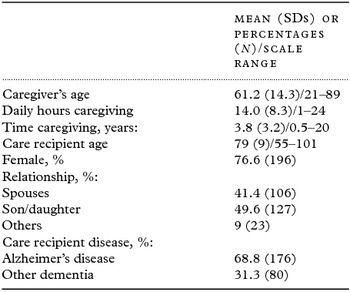
The sample consisted of 256 family dementia caregivers who were living in the community in Madrid (Spain). As can be seen in Table 1, the sample was composed primarily by female participants (76.6%) with a mean age of 61.2 (SD = 14.3) years old. Most of the caregivers were daughters or sons of the care-recipient (49.6 %) or spouses (41.4 %), and had been caring for a mean number of 3.8 years (SD = 3.2) devoting 14.0 (SD = 8.3) daily hours to caregiving tasks. A total of 77 % were living with the care-recipient and average educational level was 16.8 years of formal education received (SD = 3.1). A total of 68.8% of the care-recipients had Alzheimer's disease. They were recruited through social and health centers attending patients suffering cognitive impairment as well as by advertisements in the media. To participate in the study, they had to identify themselves as the primary caregivers of a person diagnosed with Alzheimer's disease or related disorders, be at least 18 years of age or over, and devote time to caregiving tasks for at least one daily hour during at least three consecutive months. A telephone screen was conducted prior to enrollment to determine if participants met the inclusion criteria. In order to participate in the study, caregivers signed an informed consent. This study was approved by the Spanish Ministry of Science and Innovation, the Spanish Ministry of Economy and Competitiveness, and the Ethics Committee at the Universidad Rey Juan Carlos (Madrid).
Characteristics of the sample (N = 256)

Variables and instruments
Stressors. Behavioral and psychological symptoms of dementia (BPSD). This variable was assessed using the Spanish version (Nogales et al., Reference Nogales-González, Losada and Romero-Moreno2015) of the disruptive subscale from the Revised Memory and Behavior Problems Checklist (Teri et al., Reference Teri, Truax, Logsdon, Uomoto, Zarit and Vitaliano1992). It is an eight-item scale that assesses the frequency of disruptive observable behavioral problems over the past week (e.g. “Arguing, irritability, and/or complaining”). The responses range from 0 = “not at all” to 4 = “extremely.” For this study, Cronbach's α was 0.67.
Potential mediators. Experiential avoidance. Experiential avoidance was measured with the Acceptance and Action Questionnaire (AAQ; Hayes et al., Reference Hayes2004), specifically with the Spanish version of Barraca (Reference Barraca2004). This scale is composed of nine items assessing a high need for emotional and cognitive control, avoidance of negative private events, inability to take needed action in the face of private events, and forms of cognitive entanglement, such as excessively negative evaluations of private experiences or negative self-references (e.g. “I'm not afraid of my feelings”) (Hayes et al., Reference Hayes2004). Responses range from 1 = “never true” to 7 = “always true.” In this study, internal consistency was 0.55; Rumination. It was measured through the Spanish version (Márquez-González, Izal, Montorio and Losada, Reference Márquez-González, Izal Fernández de Trocóniz, Montorio and Losada2008) of the short version of The Ruminative Responses Scale (RRS-reduced version; Nolen-Hoeksema and Jackson, Reference Nolen-Hoeksema and Jackson2001). It is a ten-item measure assessing self- and symptom-focused responses to sadness and distress (e.g. “I think about how sad I feel” or “think why I can't get going”) with item responses ranging from 0 “never” to 3 “always.” The internal consistency for this scale in this study was 0.89 (Cronbach's α); Satisfaction with leisure. The Leisure Time Satisfaction measure (Stevens et al., Reference Stevens2004), specifically the Spanish version by Romero-Moreno et al. (Reference Romero-Moreno, Losada, Márquez-González and Mausbach2014) was used to assess this variable. It is a six-item scale that measures the level of caregivers’ leisure time satisfaction regarding different pleasant events over the past month (e.g. “How satisfied are you with the amount of time you have been able to spend taking part in hobbies or other interests”). Item responses range from 0 “not at all” to 2 “a lot.” In this study, internal consistency of the scale was 0.78.
Outcome. Anxious symptoms were assessed using the Spanish version (Balager et al., Reference Balaguer, Fuentes, Meliá, Garcia-Merita and Pérez1993) of the tension–anxiety subscale from the Profile of Mood States (POMS; McNair et al., Reference McNair, Lorr and Droppleman1971), a scale consisting of nine items measuring anxiety levels during the previous week (i.e. “nervous”). Responses scores range from 0 “not at all” to 4 “very much.” The internal consistency (Cronbach's α) of the scale in the present study was 0.90.
Data analysis
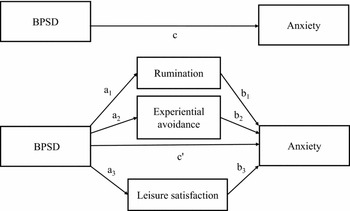
We tested a multiple mediator model in which three coping variables were proposed as mediators of the relationship between frequency of disruptive problems and anxiety. A parallel multiple mediation model was analyzed using the PROCESS method for SPSS script described by Hayes (Reference Hayes2013). The bias corrected and accelerated bootstrapping method was used to test confidence intervals (CI). The bias-corrected bootstrapping method does not assume symmetry or normality of the sampling distribution of the indirect effect and offers relatively greater power and better type I error rates when compared to other mediation approaches (Mackinnon et al., Reference MacKinnon, Lockwood and Williams2004). Also, the use of multiple mediation, as opposed to a simple mediation approach, allows to determine the relative magnitudes of the specific indirect effects associated with all mediators. As it is shown in Figure 1, our model consisted of the independent variable (BPSD), the dependent variable (anxiety), and three proposed mediators: (1) experiential avoidance, (2) rumination, and (3) satisfaction with leisure. Testing for mediation required multiple paths to be tested. In our model, the a path consisted of analyzing the effect of the independent variable (BPSD) on the mediators. The b path consisted of analyzing the effect of a mediator variable on the dependent variable (anxiety) controlling for the independent variable and the other mediator variables. The c path examined the total effect of the independent variable (BPSD) on the dependent variable (anxiety). Then, the indirect effect of BPSD on anxiety through our mediators was calculated regressing BPSD and all mediators (experiential avoidance, rumination, and satisfaction with leisure) onto anxiety (c´ path). For the indirect effects, 95% CI were used and, following suggestions by Preacher and Hayes (Reference Preacher and Hayes2008), 5,000 bootstrapping samples were generated.
A conceptual diagram of the parallel multiple mediation model.

Results
Sociodemographic characteristics of the sample are shown in Table 1. Descriptive data and correlation analysis of the assessed variables included in the model are shown in Table 2.
Descriptive information and bivariate correlations between the assessed variables

Note: *p < 0.05. **p < 0.001.
The column headings correspond to the variables listed in the row headings (1 = anxiety; 2 = frequency of behavioral problems; 3 = rumination; 4 = experiential avoidance).
Multiple mediator model of the relationship between BPSD and anxiety
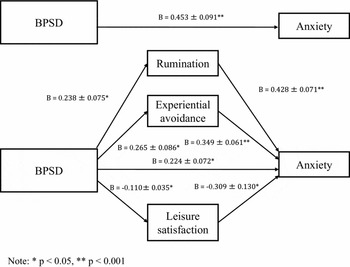
Figure 2 illustrates the model and a detailed description of the following analyses. First, our three proposed mediators were regressed onto BPSD (a path). Results showed that greater BPSD were significantly associated with increased rumination (B = 0.24; df = 254, p < 0.05; coefficient intervals = 0.095–0.385) and greater use of experiential avoidance (B = 0.26; df = 254, p < 0.05; coefficient intervals = 0.095–0.435). In addition, greater BPSD were associated with reduced satisfaction with leisure (B = −0.11; df = 254, p < 0.05; coefficient intervals = −0.180–0.040).
Multiple mediation model of relationships between frequency of behavioral problems, multiple mediators, and anxiety.

Next, we tested associations between all proposed mediators and anxiety. Results indicated that higher levels of rumination (B = 0.43; df = 251, p < 0.001; coefficient intervals = 0.288–0.567) and experiential avoidance (B = 0.35; df = 251, p < 0.001; coefficient intervals = 0.228–0.469) were significantly associated with higher levels of anxiety. In addition, results showed that lower levels of satisfaction with leisure (B = −0.31; df = 251, p < 0.05; coefficient intervals = −0.565–0.053) were significantly associated with higher levels of anxiety.
Results of c path, in which the total effect of BPSD on anxiety was analyzed, showed that higher levels of BPSD were associated with higher levels of anxiety (B = 0.45; df = 254, p < 0.001; coefficient intervals = 0.273–0.632).
Results of c’ path analyzed indirect effect of BPSD on anxiety after controlling for our three proposed mediators. The results showed a positive and significant association between these variables (B = 0.22; df = 254, p < 0.05; coefficient intervals = 0.083–0.367). As a set, BPSD and the three proposed mediating variables explained 47.09% of the variance in anxiety symptoms.
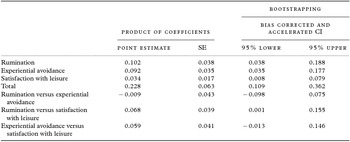
Table 3 shows the results of the multiple mediation analysis. Significance of mediators is determined when zero is not contained in the 95% CI. Results showed that, as a set, rumination, experiential avoidance, and satisfaction with leisure significantly mediated the relationship between BPSD and anxiety. In addition, each individual mediator, rumination, experiential avoidance, and satisfaction with leisure, significantly mediate the relationship between BPSD and anxiety.
Mediation of the effect of frequency of disruptive problems on anxiety through rumination, experiential avoidance, and satisfaction with leisure

CI: Confidence interval.
In order to test if one proposed mediator differed significantly from the other in terms of magnitude, pairwise contrasts of the indirect effects were conducted (see Table 3). Results showed that the only significant contrasts were between rumination and leisure satisfaction (p < 0.05), with rumination being a significantly stronger mediator.
Finally, following Preacher and Kelley criteria (2011), effect sizes of the mediation variables proposed in the model were calculated: for rumination, K 2 = 0.047 (explained variance; 4.7%); for use of avoidance coping, K 2 = 0.047 (explained variance; 4.70%); for satisfaction with leisure, K 2 = 0.045 (explained variance; 4.5%).
Discussion
The current study examined the multiple mediating role of different variables in the association between caregivers’ stressors and anxiety, in order to contribute to our understanding of the specific mechanisms by which stress may lead to anxiety symptoms in dementia caregivers, a psychological outcome that has been underexplored in dementia caregiving research (Cooper et al., Reference Cooper, Balamurali and Livingston2007; Li et al., Reference Li, Cooper and Livingston2014). Specifically, we analyzed the simultaneous mediational role of rumination, experiential avoidance, and satisfaction with leisure in the relationship between BPSD and anxiety. The multiple mediation model that has been analyzed in the study explained an important proportion of variance of anxiety (47.09%).
Consistent with previous research, our results suggest significant and positive associations between stressors (BPSD) and caregivers’ anxiety (Ferrara et al., Reference Ferrara, Langiano, Di Brango, De Vito, Di Cioccio and Bauco2008). In addition, according to our hypotheses, results suggest that experiential avoidance, rumination, and satisfaction with leisure were significant mediators of the relationship between stressors and anxiety in dementia caregivers. Hence, it is plausible that caregivers’ stressors may lead to anxiety by facilitating the use of these dysfunctional coping strategies (experiential avoidance and rumination), and by reducing satisfaction with leisure. In other words, the results suggest that caregivers who report more stressors also report more rumination and experiential avoidance, and less satisfaction with leisure, and these factors may jointly contribute to increase their levels of anxiety symptoms. The results of this study are consistent with those from García-Alberca et al. (Reference García-Alberca2012), which showed that engagement and disengagement coping strategies mediated the relationship between stressors (burden) and anxiety. However, in contrast to the cited study, in which the authors used a generic instrument for the detection of coping styles and applied single mediation analysis, the present study used multiple mediation analysis and addressed specific resources variables, including coping strategies that may be potential targets for interventions to reduce anxiety symptoms in dementia caregivers: rumination, experiential avoidance, and satisfaction with leisure. The simultaneous consideration of multiple mediators instead of single analyses to explain the impact that behavioral problems has on anxiety is a significant contribution to caregiving research. Multiple mediation analysis has been recommended as a more powerful analytic strategy than single mediation analysis (Hayes, Reference Hayes2013), as it allows the measurement of the strength of each mediator in relation to the others. A strength of this study is that it helps to identify variables that significantly contribute to the explanation of the impact of stressors on caregivers anxiety, a dependent variable which has been understudied in dementia caregiving research (Li et al., Reference Li, Cooper and Livingston2014). Hence, to our knowledge, this is the first study to analyze a multiple mediation model – instead of a single one – considering specific resources variables as mediating variables as well as objective stressors (BPSD) – instead of burden – as an independent variable in dementia caregiving anxiety symptoms.
The results of this study have several relevant practical implications. In order to design effective psychological interventions to reduce the impact that stressors have on caregivers’ anxiety, it may be very useful to train caregivers to reduce their levels of rumination and experiential avoidance coping and increase their levels of leisure satisfaction. Reducing caregivers’ use of rumination has been found to be useful to decrease their level of anxiety (Michl et al., Reference Michl, McLaughlin, Shepherd and Nolen-Hoeksema2013). The importance of training caregivers on developing abilities to increase their acceptance of internal and external situations related to caregiving, such as negative feelings, thoughts, and physical sensations or care-recipient diagnosis has been already suggested (Losada et al., Reference Losada2015). In this line, mindfulness and acceptance techniques, such as those included in Acceptance and Commitment Therapy (ACT) may be useful tools for these objectives. Given that rumination may be a form of experiential avoidance, acceptance, and mindfulness techniques may be also useful for reducing caregivers’ tendency to ruminate. Significant effects of an ACT intervention in individual format compared to a control group have been found in a randomized controlled study for both anxiety and depression (Losada et al., Reference Losada2015).
Additionally, satisfaction with leisure was a significant individual mediator of the stress to anxiety pathway, thus being another potential target of intervention. Training caregivers to increase their levels of behavioral activation, this is, their involvement in significant and pleasant activities and, consequently, their levels of satisfaction with leisure, may be useful not only for reducing their levels of depression (Losada et al. Reference Losada, Márquez-González and Romero-Moreno2011), but also for anxiety.
In addition, it would be very interesting to test in future studies if changing one mediator also contributes to changes in other mediators. The results of this study show that the three assessed coping variables interplay in the relationship between BPSD and anxiety in caregivers. It has been suggested that avoidance of emotionally arousing material through rumination may provide a false, and reinforcing, sense of control over emotions, which ultimately would prevent the individual from effectively processing their negative emotion (Giorgio et al., Reference Giorgio2010). In this sense, it is plausible that training caregivers on reducing experiential avoidance may also decrease their levels of rumination and vice versa. Likewise, a lower involvement in leisure activities may be a consequence of caregivers’ tendency to experiential avoidance: not performing pleasant activities in order to prevent pleasant experiences and guilt feelings derived from them.
In sum, considering that most intervention studies with dementia caregivers analyzed depression as the main dependent variable and little is known about anxiety (Li et al., Reference Li, Cooper and Livingston2014), this study may contribute to detect some intervention targets for reducing anxiety symptoms.
This study presents some limitations. First, the cross-sectional nature of the study does not allow us to do any causal inferences. The hypothesized directions of the associations between variables in this study may be different, such as caregivers with high levels of anxiety find it more difficult to face the problems associated with caregiving directly and so using more dysfunctional coping strategies (García-Alberca et al., Reference García-Alberca2012). Although we proposed a mediation model and mediation consists of causal processes that unfold over time, an important limitation of the study is the cross-sectional nature of data. As it has been suggested (Maxwell and Cole, Reference Maxwell and Cole2007), cross-sectional examination of mediation will typically generate biased estimates of longitudinal mediation parameters and stems from its inability to model stable relations between variables over time (p. 39). So, the cross-sectional nature of this study prevent us “to determine the extent to which correlations between measures reflect an influence of one measure on one measure on another over time” (Maxwell and Cole, Reference Maxwell and Cole2007; p. 39),” as cross-sectional estimates are often highly misleading. Longitudinal and experimental studies are needed in order to address this issue. The Cronbach's α of the AAQ constitutes a limitation of the study. Problems with the internal consistency of the AAQ have been also reported (Bond et al., Reference Bond2011) suggesting that the internal consistency of the AAQ often constitutes a limitation, especially in community samples and less educated populations, with values occasionally lower than 0.70. This may be due to the fact that the AAQ measures a wide range of constructs (e.g. beliefs about emotions, avoidant behaviors, fears about the consequences of emotions, etc.) (Giorgio et al., Reference Giorgio2010) and other measures of experiential avoidance with better psychometric properties, such as the recently developed Experiential Avoidance in Caregiving Questionnaire (Losada et al., Reference Losada, Márquez-González, Romero-Moreno and López2014) could be used in future studies. In addition, although the results of this study support the proposed multiple mediator model, the effect sizes of different mediator variables are small (Preacher and Kelley, Reference Preacher and Kelley2011). In this sense, future studies should identify additional potential mediators in the pathway stressors and caregivers’ anxiety that have not been considered in this study and may be influencing this process. Finally, the caregiver sample consisted of volunteers who were recruited by social and health centers, and results may be not generalizable to all caregiver population.
In spite of the mentioned limitations, this study provides additional support to the stress and coping model (Knight and Sayegh, Reference Knight and Sayegh2010), suggesting that coping variables play an important role on explaining the impact that stressors exerts on caregivers’ anxiety. Although most of dementia caregiving research has been focused on explaining the impact of stressors on caregivers’ depressive symptoms, there is a lack of studies analyzing its impact on anxiety symptoms.
In sum, the findings show that rumination, experiential avoidance, and leisure satisfaction significantly mediated the association between stressors – frequency of disruptive behaviors problems – and anxiety symptoms in a sample of dementia caregivers. Results suggest a potential pathway by which caregivers’ stressors influences on increases on rumination and experiential avoidance, and decreases on leisure satisfaction, and these changes result in increased anxiety symptoms. These results have important clinical implications for designing psychological interventions aimed at reducing caregivers’ anxiety symptoms.
Conflict of interest
None.
Description of authors’ roles
Rosa Romero-Moreno worked on the study implementation, the data analysis, and the writing of the paper. Andres Losada designed the study, supervised the data collection, and assisted with writing the paper. Maria Márquez-González designed the study and assisted with writing the paper. Brent Mausbach helped on the statistical design of the study, on carrying out the statistical analysis and helped write the paper.
Acknowledgments
This work was supported by grants from the Spanish Ministry of Science and Innovation and the Spanish Ministry of Economy and Competitiveness (Grant numbers PSI2009-08132/PSIC, PSI2012-31293).