


While most people recover fully from an acute infection within weeks, a substantial minority do not. Prospective cohorts that enrol participants at the point of a documented acute infection have shown that a postinfective fatigue syndrome (PIFS) emerges in approximately 9−19% of patients at 6 months, with a symptom profile of disabling fatigue, musculoskeletal pain, neurocognitive difficulty, and mood disturbance (Hickie et al., Reference Hickie, Davenport, Wakefield, Vollmer-Conna, Cameron, Vernon, Reeves and Lloyd2006). PIFS is indistinguishable from chronic fatigue syndrome (CFS), and the rate and symptom profile are broadly similar whether the trigger be Epstein-Barr virus, Ross River virus (RRV) or Coxiella burnetii (Q fever). This convergence across biologically distinct pathogens — a DNA virus, an RNA virus, and an intracellular bacterium — implicates the host response, rather than any property of the pathogen, as the principal determinant of who develops PIFS.
The Dubbo Infection Outcomes Study (DIOS) was established to better understand this host response (Hickie et al., Reference Hickie, Davenport, Wakefield, Vollmer-Conna, Cameron, Vernon, Reeves and Lloyd2006). Its most consistent finding is that the severity of the acute illness predicts who goes on to develop PIFS, with the odds rising roughly two-fold per standard deviation of baseline severity (OR ≈ 2.24; Sandler et al., Reference Sandler, Cvejic, Valencia, Li, Hickie and Lloyd2022). This acute phase symptom burden reflects the cytokine-mediated ‘sickness response’, yet ongoing cytokine production does not differ between cases and controls (Vollmer-Conna et al., Reference Vollmer-Conna, Cameron, Hadzi-Pavlovic, Singletary, Davenport, Vernon, Reeves, Hickie, Wakefield, Lloyd and Group2007), suggesting that infection acts as a trigger rather than an ongoing driver. If prolonged illness is not sustained by continuing inflammation, then susceptibility may lie in other host characteristics, including genetic liability.
Individual variation in this host response is substantially heritable (Smatti et al., Reference Smatti, Yassine, Mbarek and Boomsma2025). Twin and family studies estimate that over half, and as much as 86% for some proinflammatory cytokines, of the variance in stimulated cytokine production is genetic (de Craen et al., Reference de Craen, Posthuma, Remarque, van den Biggelaar, Westendorp and Boomsma2005), and CFS itself shows familial aggregation consistent with a heritable predisposition (Albright et al., Reference Albright, Light, Light, Bateman and Cannon-Albright2011). Within DIOS, polymorphisms in immunological genes, including the proinflammatory cytokines IL-1β, IL-6, TNF-α and IFN-γ, the anti-inflammatory cytokine IL-10, and the NLRP3 inflammasome, and in the neurologically expressed purinergic receptor P2X7 have been associated with the severity of the sickness response (Li et al., Reference Li, Cvejic, Gu, Vollmer-Conna, Hickie, Wakefield, Davenport, Wiley and Lloyd2021; Piraino et al., Reference Piraino, Vollmer-Conna and Lloyd2012; Valencia et al., Reference Valencia, Cvejic, Vollmer-Conna, Hickie, Wakefield, Li, Pedergnana, Rodrigo and Lloyd2021; Vollmer-Conna et al., Reference Vollmer-Conna, Cameron, Hadzi-Pavlovic, Singletary, Davenport, Vernon, Reeves, Hickie, Wakefield, Lloyd and Group2007). These findings establish a genetic contribution to postinfective outcomes, but they derive from a small number of candidate genes selected for their role in inflammation. Whether there is genomewide liability to other psychiatric and fatigue phenotypes with which PIFS overlaps has not been examined.
Mood disturbance is an intrinsic component of PIFS, and stable affective traits shape the course of illness: higher trait neuroticism predicts greater symptom severity across all domains and a reduced likelihood of recovery (Cvejic et al., Reference Cvejic, Li, Hickie, Wakefield, Lloyd and Vollmer-Conna2019). At the level of co-occurrence, 50−75% of patients with defined fatigue syndromes have a comorbid mood or anxiety disorder (Roy-Byrne et al., Reference Roy-Byrne, Afari, Ashton, Fischer, Goldberg and Buchwald2002), and several prospective cohorts report that psychiatric disorder measured before fatigue onset raises the risk of later CFS (Clark et al., Reference Clark, Goodwin, Stansfeld, Hotopf and White2011; Goodwin et al., Reference Goodwin, White, Hotopf, Stansfeld and Clark2011; Harvey et al., Reference Harvey, Wadsworth, Wessely and Hotopf2008). However, this association is not consistently observed. Where premorbid traits have been examined within genetically informative designs, their association with later fatigue has been substantially attenuated by shared familial factors: in a Swedish twin study, the effect of premorbid emotional instability fell from an odds ratio of 1.72 in case-control analysis to a within-pair relative risk of 1.02 (Kato et al., Reference Kato, Sullivan, Evengård and Pedersen2006), implying that part of the apparent premorbid mood signal reflects genetic confounding rather than a causal pathway. A prospective cohort that collected data before the illness found that premorbid mental health did not predict postinfective fatigue (Jason et al., Reference Jason, Cotler, Islam, Sunnquist and Katz2021). Similarly, within DIOS, which ascertains fatigue after infection, neither premorbid nor intercurrent psychiatric disorder predicted postinfective fatigue, even though they predicted postinfective depression, with acute illness severity being the main determinant (Hickie et al., Reference Hickie, Davenport, Wakefield, Vollmer-Conna, Cameron, Vernon, Reeves and Lloyd2006; Sandler et al., Reference Sandler, Cvejic, Valencia, Li, Hickie and Lloyd2022).
At the genetic level, depression and fatigue are far from independent. Classical twin studies indicate that chronic fatigue and depressive symptoms share common genetic influences, while also retaining disorder-specific genetic effects (Hickie et al., Reference Hickie, Bennett, Lloyd, Heath and Martin1999), with some studies finding gender-specific variance decompositions (Schur et al., Reference Schur, Afari, Goldberg, Buchwald and Sullivan2007) while others do not (Sullivan et al., Reference Sullivan, Evengård, Jacks and Pedersen2005). Later analyses estimate a genetic correlation of roughly r ∼ .7 between fatigue and depression (Corfield et al., Reference Corfield, Martin and Nyholt2016), and a genomewide study of self-reported tiredness reported significant genetic correlations with major depressive disorder of r ∼ .6 (Deary et al., Reference Deary, Hagenaars, Harris, Hill, Davies, Liewald, McIntosh, Gale and Deary2018). However, the largest CFS genomewide study to date implicates genes acting in the immune and nervous systems and in pain rather than mood pathways (DecodeME Collaboration, 2025).
This raises a hypothesis: that inherited liability to affective disorders could capture part of the liability to fatigue and might therefore identify individuals at greater risk of developing PIFS. Similarly, because PIFS is diagnostically indistinguishable from CFS and CFS is itself heritable, inherited liability to CFS might predispose to the postinfective syndrome. We therefore examined whether polygenic scores for MDD (MDD-PGS) and for CFS (CFS-PGS) predict PIFS diagnosis at 6 months post-infection. Two hypotheses were prespecified: that PIFS cases would have higher MDD-PGS than recovered controls (H1) and would also have higher CFS-PGS (H2). We further explored whether these associations differed by sex. To our knowledge, no prior study has examined polygenic liability to depression or to chronic fatigue syndrome as a predictor of PIFS diagnosis in a prospectively followed postinfective cohort of this kind.
Methods
Participants
Participants were drawn from the DIOS, a prospective cohort conducted in the region surrounding the township of Dubbo in northwestern New South Wales, Australia. Adults presenting to local general practitioners with an acute illness were enrolled when infection with Epstein-Barr virus, Ross River virus (RRV) or Coxiella burnetii (Q fever) was confirmed serologically. A detailed description of the study design is reported elsewhere (Hickie et al., Reference Hickie, Davenport, Wakefield, Vollmer-Conna, Cameron, Vernon, Reeves and Lloyd2006). Participants were assessed at baseline and at approximately 2−3 weeks, 4−6 weeks, 3 months and 6 months, at which point caseness for PIFS was determined by a medical interview, physical examination and laboratory investigations to exclude alternative explanations for ongoing symptoms (e.g., hypothyroidism or a primary sleep disorder), and a psychiatric assessment to identify any exclusionary diagnosis and to record DSM-IV comorbidities. PIFS was then diagnosed against standardized CFS criteria (Fukuda et al., Reference Fukuda, Straus, Hickie, Sharpe, Dobbins and Komaroff1994). Participants meeting these criteria were classified as cases and those who had recovered as controls. Of 484 phenotyped participants, 464 individuals were successfully genotyped on Illumina GSA v.3 single nucleotide polymorphism (SNP) arrays (89 cases, 375 controls), all of European ancestry. All participants gave written informed consent, and the study was approved by the QIMRB Human Research Ethics Committee.
Genotyping, Quality Control, and Imputation
Standard preimputation quality control excluded individuals on the basis of call rate (<.97) and unresolved sex differences; and variants based on call rate (<.95); GenTrain score <.6; failure to uniquely map to the hg19 reference in a BLAST search of the primer sequences; membership of a list of poorer performing duplicate assays; deviation from Hardy-Weinberg equilibrium (p < 1 × 10⁻⁶); MAF <.01 (as an imputation filter); and/or high chr X heterozygosity for males (>.01). Genotypes were imputed to the Haplotype Reference Consortium reference panel (HRCr1.1) using the Michigan Imputation Server. Ancestry principal components were derived by combining with genotypes from the 1000 Genomes Phase 3v5 reference panel (1000G), and projecting onto a set of 20 PC axes fitted to the 1000G populations using smartpca (in EigenSoft 7.2.1; original version described in Price et al., Reference Price, Patterson, Plenge, Weinblatt, Shadick and Reich2006). A bounding box in PC1, PC2 (fixed at mean ± 6 SD for the 1000G European populations) was used to exclude non-European individuals, to match the discovery GWAS. The first 10 components were retained as covariates.
Polygenic Scores
Two polygenic scores (PGS) were constructed from the most recent and highly powered studies. The major depressive disorder score (MDD-PGS) was derived from the most recent genomewide association study (GWAS; Adams et al, Reference Adams, Streit, Meng, Awasthi, Adey, Choi, Chundru, Coleman, Ferwerda, Foo, Gerring, Giannakopoulou, Gupta, Hall, Harder, Howard, Hübel, Kwong, Levey and McIntosh2025) with 688,808 individuals with major depression (MD) and 4,364,225 controls. The chronic fatigue syndrome score (CFS-PGS) was derived from the DecodeME GWAS (15,579 cases and 259,909 controls; DecodeME Collaboration, 2025), in which cases were ascertained by self-reported diagnosis, in contrast to the physician- and psychiatrist-confirmed diagnosis used in DIOS. Neither discovery sample included DIOS participants. Posterior-mean SNP effect sizes were estimated from the summary statistics using SBayesRC (Zheng et al., Reference Zheng, Liu, Sidorenko, Wang, Lin, Yengo, Turley, Ani, Wang, Nolte, Snieder, Yang, Wray, Goddard, Visscher and Zeng2024) and individual scores were computed in PLINK as the sum of effect-size-weighted allele dosages across variants. Both scores were standardized to a mean of zero and a standard deviation of 1 within the analytic sample so that effect sizes are interpretable per standard deviation of liability.
Genetic Correlation
To quantify the shared genetic basis of the two discovery phenotypes, we estimated the genetic correlation between MDD and CFS using cross-trait LD score regression (Bulik-Sullivan et al., Reference Bulik-Sullivan, Finucane, Anttila, Gusev, Day, Loh, Duncan, Perry, Patterson, Robinson, Daly, Price and Neale2015). The summary statistics used to construct the polygenic scores were restricted to HapMap3 variants, and the cross-trait test statistics were regressed on LD scores from the 1000 Genomes reference panel.
Statistical Analysis
Each PGS was tested as a predictor of PIFS diagnosis using logistic regression, both unadjusted and adjusted for sex, age, and the first 10 ancestry principal components; associations are reported as odds ratios per standard deviation of the PGS with 95% confidence intervals. Standardized case-control mean differences were summarized as Cohen’s d. Variance explained was quantified as the incremental Nagelkerke R 2 of the score over the covariate-only model and converted to the liability scale assuming a population prevalence of 11% (Lee et al., Reference Lee, Goddard, Wray and Visscher2012). With 89 cases and 375 controls, the study had 80% power (two-sided α = .05) to detect a standardized mean difference of approximately .33. Since the effects of MDD and CFS are separate hypotheses, we do not adjust the power calculation for multiple testing.
Tests of the two prespecified hypotheses constituted the primary analysis. As a further exploratory analysis, effect modification by sex was tested by adding a PGS × sex interaction term to the adjusted logistic model, with significance assessed by both Wald and likelihood-ratio tests. As the number of cases within each sex stratum was small, the interaction was additionally evaluated using Firth’s penalized-likelihood logistic regression (Firth, Reference Firth1993) which reduces the small-sample bias that can inflate logistic-regression estimates when events are sparse. Sex-stratified effect sizes were summarized as Cohen’s d within men and women separately. These analyses were descriptive only. All analyses were conducted in R.
Results
Sample Characteristics
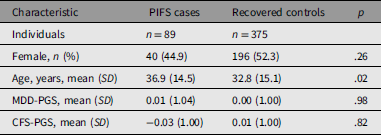
Of 464 participants with serologically confirmed postviral infection and complete genotype, polygenic-score and covariate data, 89 (19.2%) met criteria for postinfective fatigue syndrome at 6 months and 375 had recovered (controls). Cases were significantly older than controls (36.9 vs 32.8 years; Welch t test p = .02) but did not differ in sex distribution (44.9% vs. 52.3% female; χ2 p = .26). Means of standardized MDD-PGS and CFS-PGS were near zero in both groups (Table 1). In the DIOS sample the MDD and CFS polygenic scores were modestly positively correlated (r = .19, 95% CI [0.10, 0.28]). Cross-trait LD score regression further confirmed a substantial genetic correlation between major depression and chronic fatigue syndrome (r g = .59, SE = 0.02, p = 4.6 × 10−146), with well-estimated SNP-heritabilities for both traits (MDD, 0.052 [SE 0.002]; CFS, 0.043 [SE 0.003], observed scale).
Baseline characteristics (mean, SD) of participants by 6-month outcome

Table 1. Long description
A table comparing baseline characteristics of participants by 6-month outcome. The table has 6 rows and 5 columns. Column headers are Characteristic, PIFS cases, Recovered controls, and p. Row labels are Individuals, Female, Age, MDD-PGS, and CFS-PGS. Row 1: Individuals, PIFS cases, n = 89; Recovered controls, n = 375. Row 2: Female, n (%), PIFS cases, 40 (44.9); Recovered controls, 196 (52.3). Row 3: Age, years, mean (SD), PIFS cases, 36.9 (14.5); Recovered controls, 32.8 (15.1). Row 4: MDD-PGS, mean (SD), PIFS cases, 0.01 (1.04); Recovered controls, 0.00 (1.00). Row 5: CFS-PGS, mean (SD), PIFS cases, -0.03 (1.00); Recovered controls, 0.01 (1.00).
Note: Age compared by Welch’s t test, sex by Pearson’s χ2; PGS p values are adjusted for sex, age, and 10 principal components. MDD, major depressive disorder; PGS, polygenic score; CFS, chronic fatigue syndrome.
Polygenic Risk and PIFS
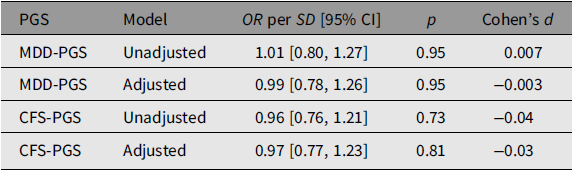
Contrary to the first hypothesis, the polygenic score for MDD did not predict PIFS diagnosis and the case and control distributions were near-identical (Figure 1). In logistic regression adjusted for sex, age, and 10 ancestry principal components, the odds of caseness were essentially unchanged per standard deviation of MDD-PGS (OR = 0.99, 95% CI [0.78, 1.26], p = .95), and the result was materially identical when unadjusted (Table 2); standardized scores were near zero in both groups (0.01 in cases, 0.00 in controls; Cohen’s d = −0.003). Contrary to the second hypothesis, the CFS polygenic score was likewise unassociated with PIFS diagnosis (adjusted OR = 0.97, 95% CI [0.77, 1.23], p = .81). Both scores explained negligible variance in liability to PIFS (liability-scale R2 < .001). In a joint model containing both scores and covariates, neither was associated with PIFS diagnosis, indicating no independent contribution of either polygenic liability.
Distributions of standardized MDD and CFS polygenic scores in PIFS cases versus recovered controls, with dashed lines marking group means.
Note: MDD, major depressive disorder; CFS, chronic fatigue syndrome; PIFS, postinfective fatigue syndrome.

Associations of MDD and CFS polygenic scores with PIFS diagnosis

Table 2. Long description
A table comparing polygenic scores for MDD and CFS with PIFS diagnosis. The table has four rows and five columns. Column headers are PGS, Model, OR per SD [95% CI], p, and Cohenʼs d. Row labels are MDD-PGS Unadjusted, MDD-PGS Adjusted, CFS-PGS Unadjusted, and CFS-PGS Adjusted. Row 1: MDD-PGS, Unadjusted, 1.01 [0.80, 1.27], 0.95, 0.007. Row 2: MDD-PGS, Adjusted, 0.99 [0.78, 1.26], 0.95, -0.003. Row 3: CFS-PGS, Unadjusted, 0.96 [0.76, 1.21], 0.73, -0.04. Row 4: CFS-PGS, Adjusted, 0.97 [0.77, 1.23], 0.81, -0.03.
Note: N = 464 (89 cases, 375 controls). Adjusted models include sex, age and ten ancestry principal components. OR per SD = odds ratio per standard deviation of standardized PGS. p values based on Wald test. Cohen’s d > 0 indicates higher PGS in cases. MDD, major depressive disorder; PGS, polygenic score; CFS, chronic fatigue syndrome; PIFS, postinfective fatigue syndrome.
Effect Modification By Sex
Although the pooled associations were null, the direction of the MDD-PGS effect differed between the sexes (Figure 2). Among men, higher MDD-PGS was associated with lower odds of PIFS (Cohen’s d = −0.22); among women, with higher odds (d = 0.28; Table 3). In a logistic model including a PGS × sex term (adjusted for age and ancestry principal components), the MDD-PGS × sex interaction approached significance (β = 0.46; OR = 1.59 per SD; Wald p = .06; likelihood-ratio p = .06) and remained so under Firth’s penalized-likelihood correction for small-sample bias (age-adjusted OR = 1.60, penalized p = .04). The interaction was robust to exclusion of the most extreme PGS values. Across deciles of MDD polygenic score within each sex, the case proportion tended to decline with increasing MDD-PGS in men but to rise in women (Supplementary information, Figure S1), consistent with the sex-stratified effect sizes. Confidence intervals were wide and overlapped at all deciles, and no decile contrast was significant; with roughly four to five cases per decile after stratification by sex, these estimates are descriptive only and require replication in larger samples. The corresponding CFS-PGS × sex interaction was weaker, in the opposite direction, and nonsignificant (β = −0.31; OR = 0.74; p = .20; Firth penalized p = .22).
Sex-stratified distributions of the MDD and CFS polygenic score in cases versus controls.
Note: MDD, major depressive disorder; CFS, chronic fatigue syndrome.

Exploratory sex differences in the PGS association with PIFS

Table 3. Long description
A table with two rows and six columns comparing the associations of MDD-PGS and CFS-PGS with PIFS across sexes. The columns are labeled PGS, d (men), d (women), Interaction OR, Wald p, LRT p, and Firth p. The first row represents MDD-PGS with values -0.22, 0.28, 1.59, 0.06, 0.06, and 0.046 respectively. The second row represents CFS-PGS with values 0.10, -0.19, 0.74, 0.20, 0.20, and 0.22 respectively.
Note: Men: 49 cases/179 controls; women: 40 cases/196 controls. d, Cohen’s d (cases vs. controls within sex; positive indicates higher PGS in cases). Interaction OR = exp(β) of the PGS × female-sex term from logistic regression (case ∼ PGS × sex + age + 10 PCs). PGS, polygenic score; MDD, major depressive disorder; CFS, chronic fatigue syndrome; PIFS, postinfective fatigue syndrome; LRT, likelihood-ratio test; Firth, penalized-likelihood logistic regression.
Discussion
In a prospective postinfective cohort, polygenic liability to MDD and to CFS did not distinguish participants who developed a PIFS diagnosis from those who recovered, with both primary effects essentially zero.
Our findings sit within a cohort in which acute illness severity, rather than premorbid psychiatric or personality characteristics, has been the consistent predictor of PIFS diagnosis (Hickie et al., Reference Hickie, Davenport, Wakefield, Vollmer-Conna, Cameron, Vernon, Reeves and Lloyd2006; Sandler et al., Reference Sandler, Cvejic, Valencia, Li, Hickie and Lloyd2022), and in which prior genetic signals have implicated immune and neuro-immune rather than mood pathways (Piraino et al., Reference Piraino, Vollmer-Conna and Lloyd2012; Vollmer-Conna et al., Reference Vollmer-Conna, Cameron, Hadzi-Pavlovic, Singletary, Davenport, Vernon, Reeves, Hickie, Wakefield, Lloyd and Group2007). The present results extend that picture from candidate genes to genomewide common-variant liability: inherited major depression risk does not predict who develops a PIFS diagnosis.
This null result cannot be attributed to an absence of shared genetics between the two traits. Using cross-trait LD score regression on the discovery summary statistics, we estimated a substantial genetic correlation between major depression and chronic fatigue syndrome (rg = 0.59, SE = 0.02), consistent with the modest positive correlation between the two polygenic scores in DIOS (r = 0.19, SE = 0.05) and with the established genetic overlap between depression and fatigue (Corfield et al., Reference Corfield, Martin and Nyholt2016; Deary et al., Reference Deary, Hagenaars, Harris, Hill, Davies, Liewald, McIntosh, Gale and Deary2018). While MDD and CFS share a large fraction of their common-variant architecture, neither score predicted PIFS. Although CFS and PIFS can be symptomatically very similar, PIFS is defined by an environmental trigger, whereas the liability of CFS, without reference to a precipitating infection, may reflect partly distinct pathophysiology.
This shared genetic liability does not imply a shared mood-based origin because a genetic correlation quantifies overlap in liability while remaining agnostic as to the mechanisms: the same variants may instead influence a common upstream process that gives rise to both conditions, and part of the correlation may be definitional, since depression is diagnosed in part on somatic features, such as anergia and disturbed sleep, which overlap with the symptoms of CFS. Consistent with this, the largest genetic study of CFS to date localizes its signals to immune, neurological and pain pathways rather than mood, and reports no shared genomewide-significant loci with depression despite the polygenic overlap (DecodeME Collaboration, 2025). A high genetic correlation and locus-level independence are not contradictory: the overlap is distributed across many variants of small effect, whereas the strongest signals of each trait may diverge. The genetic relationship between depression and chronic fatigue is therefore real but does not in itself identify the pathways that mediate it. Whatever they are, they do not appear to drive the postinfective phenotype.
Beyond this etiological interpretation, several nonexclusive explanations that may contribute to the CFS-PGS null exist: the still-early-stage CFS discovery GWAS (15,579 cases; 259,909 controls); a difference in phenotypic rigor between the discovery and target samples, since DecodeME cases were ascertained by self-report whereas PIFS in DIOS was confirmed by physician and psychiatrist assessment, in which case any heterogeneity between phenotypes would further attenuate the score’s power to predict PIFS; reduced cross-cohort portability of the polygenic score; and limited statistical power. The gap between the LDSC genetic correlation (r g = .59) and the weaker correlation between the polygenic scores in our sample (r = .19) reflects both the attenuation expected when correlating polygenic scores, as they are imperfect proxies that capture only part of trait liability, and the sampling variability of a correlation estimated in a modest sample (464 people). The LDSC genetic correlation, estimated from the full discovery summary statistics, is subject to neither. We also note that polygenic scores capture only common-variant liability, and rare variants not included in these scores could still contribute.
The effect of depression polygenic risk on PIFS appeared to differ by sex, being risk-increasing in women and apparently risk-reducing in men, with a near-significant interaction (Wald p = .06; Firth penalized p = .04). This is of interest because DIOS has previously described a sex dimension to the affective response to infection, with women overrepresented among those with more severe and more prolonged mood disturbance (Cvejic et al., Reference Cvejic, Li, Hickie, Wakefield, Lloyd and Vollmer-Conna2019; Sandler et al., Reference Sandler, Cvejic, Valencia, Li, Hickie and Lloyd2022) and a depression-polygenic effect expressed specifically in women would be consistent with that observation. We nonetheless interpret the finding cautiously. The interaction did not reach conventional significance in the primary model and the per-sex case counts were small (49 men, 40 women). The analysis was exploratory and not prespecified, so the possibility of a chance finding cannot be excluded. Nevertheless, the finding is intriguing and worth trying to replicate.
The study has several strengths. Its prospective design anchored at a serologically confirmed infection, the physician- and psychiatrist-assessed outcome, and controls drawn from the same exposure together mitigate the reverse-causation and ascertainment problems of cross-sectional studies. The main limitation is statistical power: with 89 cases and 375 controls, the study had 80% power to detect standardized mean differences of approximately .33, so smaller main effects cannot be excluded, and the sex-stratified analyses are more weakly powered still.
Conclusion
In a prospective cohort, common-variant polygenic liability to major depression and to CFS did not predict the development of PIFS. However, a sex-dependent association between depression polygenic risk and PIFS, where risk increases in women and reduces in men, emerged as an exploratory signal that requires investigation in adequately powered, prespecified replication.
Supplementary material
To view supplementary material for this article, please visit https://doi.org/10.1017/thg.2026.10098.
Data
The MDD and CFS GWAS summary statistics are publicly available. Individual-level DIOS data may be available from the corresponding author on request.
Acknowledgments
We thank Richard Parker and Simone Cross at QIMR for administrative assistance in bringing this project to fruition. We gratefully acknowledge the support of the general practitioners and the diagnostic pathology services in the Dubbo region, the enduring cooperation of the participants in the research, and the other members of the Dubbo Infection Outcomes Study Group, including Tracey Davenport, Denis Wakefield, Ute Vollmer-Conna, Barbara Cameron, Suzanne D Vernon, William C. Reeves. We thank the DecodeME Collaboration and the Psychiatric Genomics Consortium Major Depressive Disorder Working Group for making the summary statistics from their genome-wide association studies publicly available.
Funding
This work was supported by the National Health and Medical Research Council of Australia (NHMRC) Project Grants 157052 and 157092, the Judith Jane Mason and Harold Stannett Williams Memorial Foundation (The Mason Foundation), and a Cooperative Research Agreement with the US Centers for Disease Control and Prevention (U50/CCU019851-01).
Ethics approval
The Dubbo Infection Outcomes Study was approved by Human Research Ethics Committee at University of New South Wales (HC190102, HC04257). The participants provided their written informed consent to participate in this study.
Competing interests
The authors declare no competing interests.