M. S. Pole comments: In a recent paper Landis et al. (Reference Landis, Campbell, Begg, Mildenhall, Paterson and Trewick2008) propose that New Zealand was completely submerged in the Late Oligocene–earliest Miocene and therefore, its distinctive terrestrial biota must date from after that time. They propose this based on an analysis of the sedimentological, geomorphological and palaeontological record.
There has been a long history of debate on the origins of New Zealand's terrestrial biota, with Fleming (Reference Fleming1979), for example, being an advocate of extensive long-distance dispersal, but until Pole (Reference Pole1994) argued that perhaps all of the flora may have been of long-distance dispersal origin, the overwhelming opinion was that most, and particularly the distinctive elements (for instance Nothofagus and its conifers), were of vicariant origin, likely dating back to the late Mesozoic when New Zealand was attached to Gondwana (e.g. Enting & Molloy, Reference Enting and Molloy1982; Dawson, Reference Dawson1986; Thorne, Reference Thorne1986; Bellamy, Reference Bellamy1990). The hypothesis of dominant long-distance dispersal for the origin of New Zealand's biota seems to be generally accepted now (De Queiroz, Reference De Queiroz2005; McGlone, Reference McGlone2005), although certainly not universal (e.g. Heads, Reference Heads2006).
Landis et al. (Reference Landis, Campbell, Begg, Mildenhall, Paterson and Trewick2008) document the evidence that almost everywhere where New Zealand has some form of geological evidence from the Late Oligocene–earliest Miocene (equivalent to the local Waitakian Stage, or latest Landon Series), there appear to have been marine conditions. Sediments from this time are often very pure limestones and greensands, bolstering the case for little or no land in the vicinity. In the interior part of the country, sediments of this age are typically missing, but there is a widespread prominent planar landsurface, which has often been referred to as a ‘peneplain’. Landis et al. (Reference Landis, Campbell, Begg, Mildenhall, Paterson and Trewick2008) (see also LeMasurier & Landis, Reference LeMasurier and Landis1996) argue this is a wave-cut platform and they term it the Waipounamu Erosion Surface. This surface extends below the limestones and other indicators of a marine transgression. They combine these two lines of evidence to provide a compelling geological argument that New Zealand may have been completely submerged for a period around the Late Oligocene–earliest Miocene.
It follows from this that New Zealand's terrestrial biota must only date to the Early Miocene. While allowance can be made for a few species persisting on transient volcanic islands, what Landis et al. (Reference Landis, Campbell, Begg, Mildenhall, Paterson and Trewick2008) clearly have in mind is New Zealand as a ‘clean slate’ which was then recolonized by long-distance dispersal. They also incorrectly referenced Pole (Reference Pole1994) as arguing for a complete turnover in flora since the Oligocene. In fact, Pole (Reference Pole1994) suggested the longest plant lineage in New Zealand may have been Libocedrus, extending to the Paleocene.
What remains as the best case for a persisting emergent area, the Gore Lignite Measures, is dismissed rather glibly (Landis et al. Reference Landis, Campbell, Begg, Mildenhall, Paterson and Trewick2008, p. 184) on the grounds that ‘no case has been made for continuous terrestrial sedimentation’ and that ‘middle Cenozoic marine beds are well known in the area’. This is not surprising, as the area has been interpreted as a marine delta with interdigitating marine and terrestrial sediments (Isaac & Lindqvist, Reference Isaac and Lindqvist1990), perhaps not continuous terrestrial sedimentation in any one point, but continuous deltaic sedimentation all the same. However, what concerns me most is the palaeontological evidence, which was virtually ignored. Plainly said, if New Zealand ever suffered total submergence, the effects of this ought to be clear in the palaeontological record of the vegetation. As the authors claim, New Zealand has one of the best-documented palynological records in the world.
Landis et al. (Reference Landis, Campbell, Begg, Mildenhall, Paterson and Trewick2008, p. 184) claim that the effects of submergence are visible in the palynological record. They state that ‘New Zealand palynologists have long been aware of a terrestrial floral turnover in the vicinity of the Oligocene/Miocene boundary. The spore/pollen range chart of Couper (Reference Couper1960) shows this clearly, even within the limits of accurate dating at the time.’
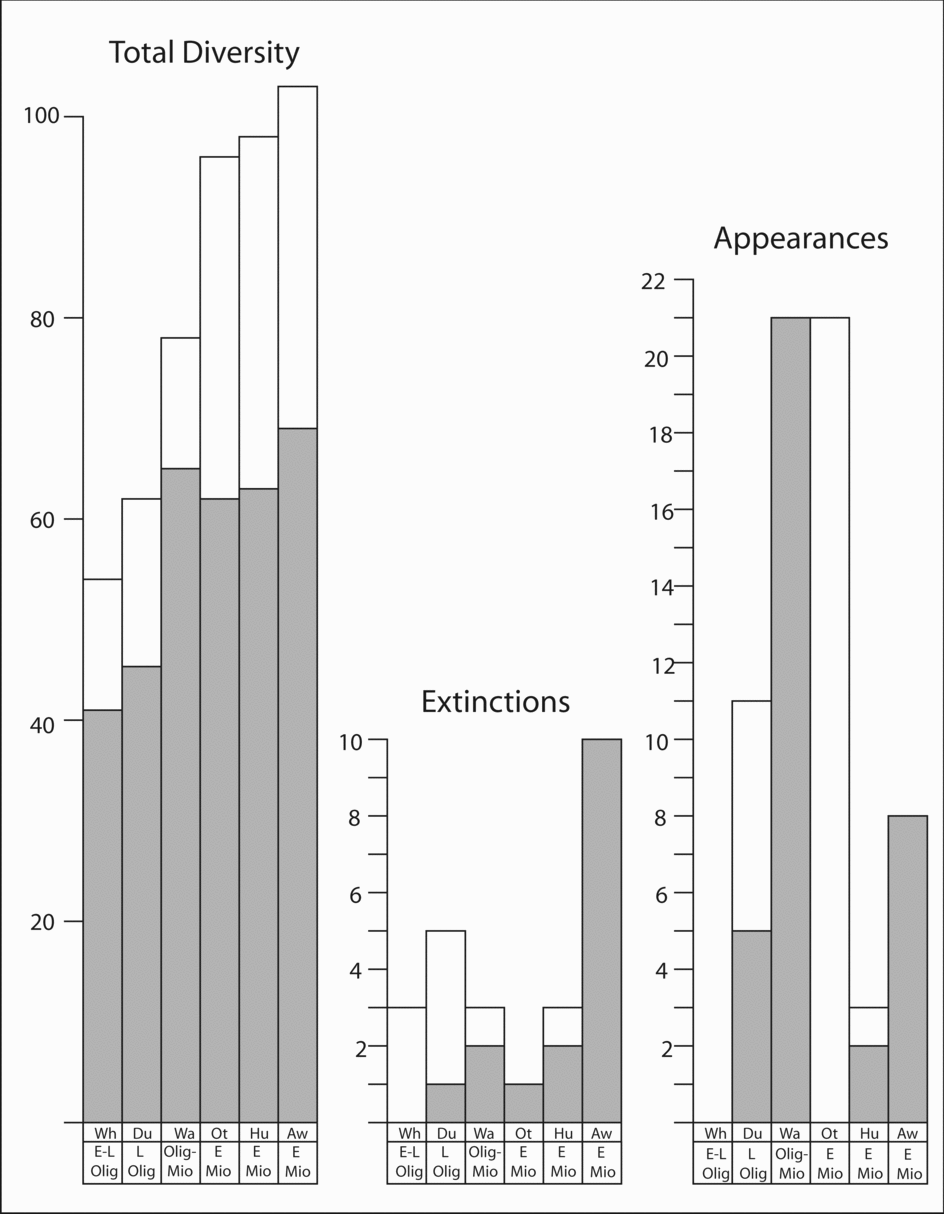
But if New Zealand palynologists have been aware of this turnover, they haven't mentioned it. The supposed turnover was not enough for Couper (Reference Couper1953, Reference Couper1960) himself to remark upon. His spore/pollen range chart, which is claimed to show this, is restricted to what he regarded as ‘index’ taxa and therefore a biased sample. If Couper's (Reference Couper1953, Reference Couper1954, Reference Couper1960) range data are compiled (Fig. 1), it shows that at most 2–3% of taxa became extinct across the Waitakian–Otaian, or 1% across the Otaian–Hutchinsonian. These numbers are not exceptional.
Figure 1.New Zealand palynological data for the Oligocene and Early Miocene taken from Couper (Reference Couper1953, Reference Couper1954, Reference Couper1960). The shaded bars are just Couper's (Reference Couper1960, table 2) ‘index microfossils’. The unshaded portions above represent Couper's entire dataset. ‘Appearances’ totals the number of taxa which appear at the start of or within the time unit. ‘Extinctions’ totals the taxa which disappear within or at the end of the time unit. New Zealand stages are abbreviated as follows: Wh – Whaingaroan; Du – Duntroonian; Wa – Waitakian; Ot – Otaian; Hu – Hutchinsonian; Aw – Awamoan. Not all of these stages are in current use; see Morgans (Reference Morgans and Cooper2004) and Crundwell (Reference Crundwell and Cooper2004) for an update. The large number of appearances in the Otaian when Couper's whole dataset is used is likely an artifact of poor dating. Couper listed the range of many non-index taxa as simply ‘Southlandian’, as this is taken as covering the entire range here. L Olig – Late Oligocene; E Mio – Early Miocene.
Landis et al. (Reference Landis, Campbell, Begg, Mildenhall, Paterson and Trewick2008, p. 184) claimed that ‘Immediately after the demise of many Palaeogene taxa there was a sudden and dramatic influx of new Neogene taxa, ancestral to the present New Zealand flora. There was also a rapid increase in diversity as new ecological niches opened up.’
A ‘dramatic influx’ and ‘rapid increase in diversity’ of new plant species would be expected on a new landmass, but there is no reason for significantly higher biodiversity after submergence than before the submergence in the absence of climate change, specifically an increase in warmth. The palaeontological evidence for total submergence claimed by Landis et al. therefore comes down to a sudden increase in biodiversity. This is hardly what first comes to mind when looking for evidence of total submergence.
Landis et al. (Reference Landis, Campbell, Begg, Mildenhall, Paterson and Trewick2008, p. 184) reference McGlone, Mildenhall & Pole (Reference McGlone, Mildenhall, Pole, Veblen, Hill and Read1996) as looking ‘in detail at the distribution of fossil Nothofagus pollen in the New Zealand Cenozoic. They show a sudden change in the types of Nothofagus pollen in the vicinity of the Oligocene/Miocene boundary, specifically the demise of Nothofagidites matauraensis, N. flemingii and N. waipawaensis and the rise of N. cranwelliae, N. falcatus and N. spinosus.’
In fact, the McGlone, Mildenhall & Pole reference cited showed that five of these species were present both before and after the ‘sudden change’, continuing into the Miocene. Only Nothofagidites waipawaensis does not cross the Oligocene–Miocene boundary. There is little published information on this species, which may have become extinct before the Waitakian. This ‘sudden change’ was quantitative, hardly convincing evidence for compete submergence of a landmass. Although there is growing evidence for rare long-distance dispersal of Nothofagus (e.g. Mildenhall, Reference Mildenhall1980; Knapp et al. Reference Knapp, Stöckler, Havell, Delsuc, Sebastiani and Lockhart2005), it stretches credulity to suggest that several species of this genus suffered New Zealand-wide extinction during submergence, then all dispersed back again soon after.
Landis et al. (Reference Landis, Campbell, Begg, Mildenhall, Paterson and Trewick2008, p. 184) claimed that ‘The available Cenozoic floral record for New Zealand reflects constant change (Mildenhall, Reference Mildenhall1980; Macphail, Reference MacPhail1997) with continuous arrival of immigrant species, particularly from Australia. Most significant is a dramatic change in flora from Oligocene to Miocene time with almost total turnover bar a few exceptions (Couper, Reference Couper1960; Mildenhall, Reference Mildenhall1980; Macphail, Reference MacPhail1997).’
Once again, the problem is that none of these authors talks about this. Not one of these authors makes any mention of abrupt change in vegetation that would accompany submergence (Macphail, Reference MacPhail1997 only lists some first appearances). Even Pocknall (Reference Pocknall1989), who specifically reviewed the Late Eocene to Early Miocene vegetation in New Zealand (and was not referenced by Landis et al. Reference Landis, Campbell, Begg, Mildenhall, Paterson and Trewick2008), makes no remark about any change which might be large enough to result from complete submergence of the landmass. In a review of the New Zealand time scale, Morgans (Reference Morgans and Cooper2004) remarks on the distinct increase in species diversity within the Waitakian. Thus the evidence for total submergence as seen in the extensive plant fossil record is practically nil.
The only paper to my knowledge that quantified the New Zealand palynological record, and specifically used it to try and answer the question as to where New Zealand had been totally submerged in the Oligocene, was Pole (Reference Pole2001). The paper proposed that submergence ought to be associated with a sharp drop in the level of endemism (the new biota would have been formed of colonists from elsewhere), but no such drop was noted. Landis et al. (Reference Landis, Campbell, Begg, Mildenhall, Paterson and Trewick2008) ignored these data.
Despite the impressive evidence for widespread marine sedimentation or wave erosion in the Oligocene, the floral record does not support total submergence. In that case, where was the land? If King's (Reference King2000) reconstructions of the New Zealand area throughout the Cenozoic are accepted, one can see that in the Oligocene it is still possible to have all of the current New Zealand landmass submerged, but still retain a large area, which has been completely tectonically eroded since. This may have remained emergent. As for the floral changes, as Landis et al. (Reference Landis, Campbell, Begg, Mildenhall, Paterson and Trewick2008) state, there has been continuous change in the New Zealand flora, but they emphasize the influx of new taxa and increase in diversity following their supposed submergence. An increase in diversity above what is was before a possible submergence is hard to understand without the additional effects of climate change, almost certainly an increase in temperature (see Francis & Currie, Reference Francis and Currie2003, for a recent correlation between angiosperm diversity and climate). To paraphrase Landis et al. (Reference Landis, Campbell, Begg, Mildenhall, Paterson and Trewick2008), New Zealand palaeontologists have long been aware of a warming climate around the Waitakian. Couper (Reference Couper1960), for example, noted that the tropical family Bombacaceae arrived at this time. In the marine world, the evidence of echinoderms (Fell, Reference Fell1954) and corals (Squires, Reference Squires1958) were used to suggest subtropical or tropical waters. Hornibrook's (Reference Hornibrook, Tsuchi and Ingle1992) review concluded that ‘climate warmed in the Late Oligocene and larger foraminifera and Cocos and reef corals began to appear in the far north’ of New Zealand. The changes in the ranges and abundance of New Zealand's flora are likely to be due to something that is not mentioned at all in the Landis et al. (Reference Landis, Campbell, Begg, Mildenhall, Paterson and Trewick2008) paper: climate.
C. A. Landis, H. J. Campbell, J. G. Begg, D. C. Mildenhall, A. M. Paterson & S. A. Trewick reply: Contrary to Pole's assertion, Landis et al. (Reference Landis, Campbell, Begg, Mildenhall, Paterson and Trewick2008) did not state that ‘New Zealand was completely submerged [in the Late Oligocene]’ but concluded that the geological evidence for the continuous presence of land during Late Oligocene to earliest Miocene time (about 23 million years ago) in the New Zealand region is weak and allows the possibility of complete submergence.
The fact that evidence for New Zealand's continued emergence is equivocal demands further study and thus we welcome new evidence and considered well-informed scientific opinion on the matter.
Mike Pole has provided a critical perspective of the palaeontological and in particular the palynological ‘evidence’ cited by Landis et al. (Reference Landis, Campbell, Begg, Mildenhall, Paterson and Trewick2008). Pole highlights some of the uncertainties and apparent conflicts in scientific opinion that relate to interpretation of the fossil record of terrestrial life in New Zealand during mid-Cenozoic time. We note that most of his critique relates to interpretation of palynological evidence.
In his introduction, Pole expresses apparent agreement with the central thesis of Landis et al. (Reference Landis, Campbell, Begg, Mildenhall, Paterson and Trewick2008). However, in conclusion he states: ‘Despite the impressive evidence for widespread marine sedimentation or wave erosion in the Oligocene, the floral record does not support total submergence.’ This is, in our opinion, an assertion that is too strongly worded.
As stated in Landis et al. (Reference Landis, Campbell, Begg, Mildenhall, Paterson and Trewick2008) and maintained herein, there remain significant uncertainties in our knowledge of the New Zealand fossil floral record for Late Oligocene–earliest Miocene time. New research is necessary and we note that a three-year research project addressing this very topic is currently underway (‘New Zealand's floral origins and the Oligocene land crisis’; a Marsden Fund project, 2009–2011).
Six specific criticisms of Landis et al. (Reference Landis, Campbell, Begg, Mildenhall, Paterson and Trewick2008) made by Pole demand a response and are addressed below.
(1) Pole claims that: ‘[Landis et al. (Reference Landis, Campbell, Begg, Mildenhall, Paterson and Trewick2008)]. . . incorrectly referenced Pole (Reference Pole1994) as arguing for a complete turnover in flora since the Oligocene. In fact Pole (Reference Pole1994) suggested the longest plant lineage in New Zealand may have been Libocedrus, ‘extending to the Paleocene’.
In the abstract (Pole, Reference Pole1994), which surely is a conclusion, the last sentence states: ‘It is probable that the entire forest-flora of New Zealand arrived by long-distance dispersal.’
(2) Pole claims that the Gore Lignite Measures represent ‘continuous deltaic sedimentation’ and that Landis et al. (Reference Landis, Campbell, Begg, Mildenhall, Paterson and Trewick2008) have dismissed the significance of this formation as ‘the best case for a persisting emergent area. . .rather glibly. . .’.
The age of this deltaic sequence is determined by fossil pollen only and we maintain that these ages are very poorly correlated with the much better constrained marine chronostratigraphy for Late Oligocene to Early Miocene time in New Zealand sequences. Pole chooses to ignore this fact. As in other deltaic environments, it is extremely difficult to demonstrate continuous sedimentation in the Gore Lignite Measures. Furthermore, it is not possible to distinguish between Late Oligocene and Early Miocene palynofloras. With this imprecision it is therefore entirely possible that the Gore Lignite Measures post-date maximum submergence.
(3) Pole is surprised by the claim by Landis et al. (Reference Landis, Campbell, Begg, Mildenhall, Paterson and Trewick2008) that ‘New Zealand palynologists have long been aware of a terrestrial floral turnover in the vicinity of the Oligocene/Miocene boundary.’ Pole asserts: ‘But if New Zealand palynologists have been aware of this turnover, they haven't mentioned it.’
In fact, New Zealand palynologists identified a floral turnover between the Late Eocene and Early Miocene but their main focus was on the distribution of plant fossils from a purely stratigraphic point of view (Couper, Reference Couper1960). This floral turnover is outstripped only by Pliocene–Pleistocene events. There is a caution here in that pollen is conservative and often represents genera or even families rather than species in the modern taxonomic sense and the species before and after this period may be quite different. While the data indicated a dramatic event during Oligocene time they did not indicate what or when, but were not inconsistent with a combination of events as is usually the case with climate change and/or sea level change.
(4) With respect to Nothofagus species ranges and ‘turnover’, Pole claims that ‘In fact, McGlone et al. (Reference McGlone, Mildenhall, Pole, Veblen, Hill and Read1996) showed that five of these species were present both before and after the ‘sudden change’, continuing into the Miocene.’
McGlone et al. (Reference McGlone, Mildenhall, Pole, Veblen, Hill and Read1996) illustrate a marked change in Nothofagus pollen through the Oligocene with lineages present before and after the event. Pollen for Nothofagus is of low taxonomic resolution and likely represents a number of species (e.g. Macphail, Reference MacPhail1997; Truswell & Macphail, Reference Truswell and MacPhail2009). Some pollen types that were relatively rare prior to the event dominated after the event, and those that were common before decreased significantly after. Pole (Reference Pole2001) shows the same effect with conifers for the same period. Pocknall (Reference Pocknall1982) also considered the idea of Late Oligocene–Early Miocene floral ‘turnover’ as represented by the change from Nothofagidites matauraensis to N. cranwelliae. He concluded that it could not have been caused by climate change but was an evolutionary succession. He did not consider changes in land area as a possible cause although he subsequently mentioned an increase in terrestrial habitats as a possible reason for the change and increasing floral diversity (Pocknall, Reference Pocknall1989, Reference Pocknall, Isaac and Lindqvist1990).
(5) Pole points out that Landis et al. (Reference Landis, Campbell, Begg, Mildenhall, Paterson and Trewick2008) refer to ‘dramatic change’ and ‘almost total turnover’ of flora from Oligocene to Miocene time, yet he claims that Couper (Reference Couper1960), Mildenhall (Reference Mildenhall1980) and Macphail (Reference MacPhail1997) do not: ‘Not one of these authors makes any mention of abrupt change in vegetation. . .’.
It is correct that these three articles focus on Oligocene to Miocene time mentioning changes in the pollen flora but do not specify its nature (dramatic, abrupt, complete, etc.). Mildenhall (Reference Mildenhall1980) mentions a ‘. . .sudden increase in new, mainly temperate, plant taxa appearing in the Late Oligocene and Early Miocene (Couper, Reference Couper1960) and in the disappearance of warm-temperate plants’. He considered turnover from a climatic point of view with respect to possible increase in westerly wind intensity and was aware of dating problems within this time interval. Macphail (Reference MacPhail1997) does not comment explicitly on the turnover but he does list the number of taxa that first appear in Australia and then appear in New Zealand during the Oligocene to Early Miocene time interval (along with later appearances of different taxa at other times).
Part of the confusion here is that Pole is using time more precisely than we do. We accept the imprecision of the dates we are working with and so some of the changes that are attributed to the Early Miocene (depending on the time scale in the paper quoted) are ignored by Pole, while we include them in the turnover because there is a reasonable probability that they are of Late Oligocene age.
(6) Pole asserts that Pole (Reference Pole2001) was not cited and that ‘Landis et al. (Reference Landis, Campbell, Begg, Mildenhall, Paterson and Trewick2008) ignored these data.’
We accept that Pole (Reference Pole2001) was not cited. Pole (Reference Pole2001) quantified the New Zealand palynological record on the basis of his interpretation of selected published material. We focused on using the primary literature. We were also cautious of Pole's analysis which featured a survey of endemicity using pollen with low taxonomic resolution.
In conclusion, Pole asserts that ‘the floral record does not support total submergence’. We maintain that it is too early to say one way or the other. For the reasons discussed above, the significance of the floral record remains uncertain and ambiguous but we agree that climate may have played a role. Further research is clearly necessary.
We stand by our conclusion as stated in Landis et al. (Reference Landis, Campbell, Begg, Mildenhall, Paterson and Trewick2008): ‘Although we cannot disprove the contention that land existed continuously in the New Zealand region throughout the Cenozoic, neither can we find evidence to support that hypothesis.’





 You have
Access
M. S. Pole comments: In a recent paper Landis et al. (Reference Landis, Campbell, Begg, Mildenhall, Paterson and Trewick2008) propose that New Zealand was completely submerged in the Late Oligocene–earliest Miocene and therefore, its distinctive terrestrial biota must date from after that time. They propose this based on an analysis of the sedimentological, geomorphological and palaeontological record.
There has been a long history of debate on the origins of New Zealand's terrestrial biota, with Fleming (Reference Fleming1979), for example, being an advocate of extensive long-distance dispersal, but until Pole (Reference Pole1994) argued that perhaps all of the flora may have been of long-distance dispersal origin, the overwhelming opinion was that most, and particularly the distinctive elements (for instance Nothofagus and its conifers), were of vicariant origin, likely dating back to the late Mesozoic when New Zealand was attached to Gondwana (e.g. Enting & Molloy, Reference Enting and Molloy1982; Dawson, Reference Dawson1986; Thorne, Reference Thorne1986; Bellamy, Reference Bellamy1990). The hypothesis of dominant long-distance dispersal for the origin of New Zealand's biota seems to be generally accepted now (De Queiroz, Reference De Queiroz2005; McGlone, Reference McGlone2005), although certainly not universal (e.g. Heads, Reference Heads2006).
Landis et al. (Reference Landis, Campbell, Begg, Mildenhall, Paterson and Trewick2008) document the evidence that almost everywhere where New Zealand has some form of geological evidence from the Late Oligocene–earliest Miocene (equivalent to the local Waitakian Stage, or latest Landon Series), there appear to have been marine conditions. Sediments from this time are often very pure limestones and greensands, bolstering the case for little or no land in the vicinity. In the interior part of the country, sediments of this age are typically missing, but there is a widespread prominent planar landsurface, which has often been referred to as a ‘peneplain’. Landis et al. (Reference Landis, Campbell, Begg, Mildenhall, Paterson and Trewick2008) (see also LeMasurier & Landis, Reference LeMasurier and Landis1996) argue this is a wave-cut platform and they term it the Waipounamu Erosion Surface. This surface extends below the limestones and other indicators of a marine transgression. They combine these two lines of evidence to provide a compelling geological argument that New Zealand may have been completely submerged for a period around the Late Oligocene–earliest Miocene.
It follows from this that New Zealand's terrestrial biota must only date to the Early Miocene. While allowance can be made for a few species persisting on transient volcanic islands, what Landis et al. (Reference Landis, Campbell, Begg, Mildenhall, Paterson and Trewick2008) clearly have in mind is New Zealand as a ‘clean slate’ which was then recolonized by long-distance dispersal. They also incorrectly referenced Pole (Reference Pole1994) as arguing for a complete turnover in flora since the Oligocene. In fact, Pole (Reference Pole1994) suggested the longest plant lineage in New Zealand may have been Libocedrus, extending to the Paleocene.
What remains as the best case for a persisting emergent area, the Gore Lignite Measures, is dismissed rather glibly (Landis et al. Reference Landis, Campbell, Begg, Mildenhall, Paterson and Trewick2008, p. 184) on the grounds that ‘no case has been made for continuous terrestrial sedimentation’ and that ‘middle Cenozoic marine beds are well known in the area’. This is not surprising, as the area has been interpreted as a marine delta with interdigitating marine and terrestrial sediments (Isaac & Lindqvist, Reference Isaac and Lindqvist1990), perhaps not continuous terrestrial sedimentation in any one point, but continuous deltaic sedimentation all the same. However, what concerns me most is the palaeontological evidence, which was virtually ignored. Plainly said, if New Zealand ever suffered total submergence, the effects of this ought to be clear in the palaeontological record of the vegetation. As the authors claim, New Zealand has one of the best-documented palynological records in the world.
Landis et al. (Reference Landis, Campbell, Begg, Mildenhall, Paterson and Trewick2008, p. 184) claim that the effects of submergence are visible in the palynological record. They state that ‘New Zealand palynologists have long been aware of a terrestrial floral turnover in the vicinity of the Oligocene/Miocene boundary. The spore/pollen range chart of Couper (Reference Couper1960) shows this clearly, even within the limits of accurate dating at the time.’
But if New Zealand palynologists have been aware of this turnover, they haven't mentioned it. The supposed turnover was not enough for Couper (Reference Couper1953, Reference Couper1960) himself to remark upon. His spore/pollen range chart, which is claimed to show this, is restricted to what he regarded as ‘index’ taxa and therefore a biased sample. If Couper's (Reference Couper1953, Reference Couper1954, Reference Couper1960) range data are compiled (Fig. 1), it shows that at most 2–3% of taxa became extinct across the Waitakian–Otaian, or 1% across the Otaian–Hutchinsonian. These numbers are not exceptional.
New Zealand palynological data for the Oligocene and Early Miocene taken from Couper (Reference Couper1953, Reference Couper1954, Reference Couper1960). The shaded bars are just Couper's (Reference Couper1960, table 2) ‘index microfossils’. The unshaded portions above represent Couper's entire dataset. ‘Appearances’ totals the number of taxa which appear at the start of or within the time unit. ‘Extinctions’ totals the taxa which disappear within or at the end of the time unit. New Zealand stages are abbreviated as follows: Wh – Whaingaroan; Du – Duntroonian; Wa – Waitakian; Ot – Otaian; Hu – Hutchinsonian; Aw – Awamoan. Not all of these stages are in current use; see Morgans (Reference Morgans and Cooper2004) and Crundwell (Reference Crundwell and Cooper2004) for an update. The large number of appearances in the Otaian when Couper's whole dataset is used is likely an artifact of poor dating. Couper listed the range of many non-index taxa as simply ‘Southlandian’, as this is taken as covering the entire range here. L Olig – Late Oligocene; E Mio – Early Miocene.
Landis et al. (Reference Landis, Campbell, Begg, Mildenhall, Paterson and Trewick2008, p. 184) claimed that ‘Immediately after the demise of many Palaeogene taxa there was a sudden and dramatic influx of new Neogene taxa, ancestral to the present New Zealand flora. There was also a rapid increase in diversity as new ecological niches opened up.’
A ‘dramatic influx’ and ‘rapid increase in diversity’ of new plant species would be expected on a new landmass, but there is no reason for significantly higher biodiversity after submergence than before the submergence in the absence of climate change, specifically an increase in warmth. The palaeontological evidence for total submergence claimed by Landis et al. therefore comes down to a sudden increase in biodiversity. This is hardly what first comes to mind when looking for evidence of total submergence.
Landis et al. (Reference Landis, Campbell, Begg, Mildenhall, Paterson and Trewick2008, p. 184) reference McGlone, Mildenhall & Pole (Reference McGlone, Mildenhall, Pole, Veblen, Hill and Read1996) as looking ‘in detail at the distribution of fossil Nothofagus pollen in the New Zealand Cenozoic. They show a sudden change in the types of Nothofagus pollen in the vicinity of the Oligocene/Miocene boundary, specifically the demise of Nothofagidites matauraensis, N. flemingii and N. waipawaensis and the rise of N. cranwelliae, N. falcatus and N. spinosus.’
In fact, the McGlone, Mildenhall & Pole reference cited showed that five of these species were present both before and after the ‘sudden change’, continuing into the Miocene. Only Nothofagidites waipawaensis does not cross the Oligocene–Miocene boundary. There is little published information on this species, which may have become extinct before the Waitakian. This ‘sudden change’ was quantitative, hardly convincing evidence for compete submergence of a landmass. Although there is growing evidence for rare long-distance dispersal of Nothofagus (e.g. Mildenhall, Reference Mildenhall1980; Knapp et al. Reference Knapp, Stöckler, Havell, Delsuc, Sebastiani and Lockhart2005), it stretches credulity to suggest that several species of this genus suffered New Zealand-wide extinction during submergence, then all dispersed back again soon after.
Landis et al. (Reference Landis, Campbell, Begg, Mildenhall, Paterson and Trewick2008, p. 184) claimed that ‘The available Cenozoic floral record for New Zealand reflects constant change (Mildenhall, Reference Mildenhall1980; Macphail, Reference MacPhail1997) with continuous arrival of immigrant species, particularly from Australia. Most significant is a dramatic change in flora from Oligocene to Miocene time with almost total turnover bar a few exceptions (Couper, Reference Couper1960; Mildenhall, Reference Mildenhall1980; Macphail, Reference MacPhail1997).’
Once again, the problem is that none of these authors talks about this. Not one of these authors makes any mention of abrupt change in vegetation that would accompany submergence (Macphail, Reference MacPhail1997 only lists some first appearances). Even Pocknall (Reference Pocknall1989), who specifically reviewed the Late Eocene to Early Miocene vegetation in New Zealand (and was not referenced by Landis et al. Reference Landis, Campbell, Begg, Mildenhall, Paterson and Trewick2008), makes no remark about any change which might be large enough to result from complete submergence of the landmass. In a review of the New Zealand time scale, Morgans (Reference Morgans and Cooper2004) remarks on the distinct increase in species diversity within the Waitakian. Thus the evidence for total submergence as seen in the extensive plant fossil record is practically nil.
The only paper to my knowledge that quantified the New Zealand palynological record, and specifically used it to try and answer the question as to where New Zealand had been totally submerged in the Oligocene, was Pole (Reference Pole2001). The paper proposed that submergence ought to be associated with a sharp drop in the level of endemism (the new biota would have been formed of colonists from elsewhere), but no such drop was noted. Landis et al. (Reference Landis, Campbell, Begg, Mildenhall, Paterson and Trewick2008) ignored these data.
Despite the impressive evidence for widespread marine sedimentation or wave erosion in the Oligocene, the floral record does not support total submergence. In that case, where was the land? If King's (Reference King2000) reconstructions of the New Zealand area throughout the Cenozoic are accepted, one can see that in the Oligocene it is still possible to have all of the current New Zealand landmass submerged, but still retain a large area, which has been completely tectonically eroded since. This may have remained emergent. As for the floral changes, as Landis et al. (Reference Landis, Campbell, Begg, Mildenhall, Paterson and Trewick2008) state, there has been continuous change in the New Zealand flora, but they emphasize the influx of new taxa and increase in diversity following their supposed submergence. An increase in diversity above what is was before a possible submergence is hard to understand without the additional effects of climate change, almost certainly an increase in temperature (see Francis & Currie, Reference Francis and Currie2003, for a recent correlation between angiosperm diversity and climate). To paraphrase Landis et al. (Reference Landis, Campbell, Begg, Mildenhall, Paterson and Trewick2008), New Zealand palaeontologists have long been aware of a warming climate around the Waitakian. Couper (Reference Couper1960), for example, noted that the tropical family Bombacaceae arrived at this time. In the marine world, the evidence of echinoderms (Fell, Reference Fell1954) and corals (Squires, Reference Squires1958) were used to suggest subtropical or tropical waters. Hornibrook's (Reference Hornibrook, Tsuchi and Ingle1992) review concluded that ‘climate warmed in the Late Oligocene and larger foraminifera and Cocos and reef corals began to appear in the far north’ of New Zealand. The changes in the ranges and abundance of New Zealand's flora are likely to be due to something that is not mentioned at all in the Landis et al. (Reference Landis, Campbell, Begg, Mildenhall, Paterson and Trewick2008) paper: climate.
C. A. Landis, H. J. Campbell, J. G. Begg, D. C. Mildenhall, A. M. Paterson & S. A. Trewick reply: Contrary to Pole's assertion, Landis et al. (Reference Landis, Campbell, Begg, Mildenhall, Paterson and Trewick2008) did not state that ‘New Zealand was completely submerged [in the Late Oligocene]’ but concluded that the geological evidence for the continuous presence of land during Late Oligocene to earliest Miocene time (about 23 million years ago) in the New Zealand region is weak and allows the possibility of complete submergence.
The fact that evidence for New Zealand's continued emergence is equivocal demands further study and thus we welcome new evidence and considered well-informed scientific opinion on the matter.
Mike Pole has provided a critical perspective of the palaeontological and in particular the palynological ‘evidence’ cited by Landis et al. (Reference Landis, Campbell, Begg, Mildenhall, Paterson and Trewick2008). Pole highlights some of the uncertainties and apparent conflicts in scientific opinion that relate to interpretation of the fossil record of terrestrial life in New Zealand during mid-Cenozoic time. We note that most of his critique relates to interpretation of palynological evidence.
In his introduction, Pole expresses apparent agreement with the central thesis of Landis et al. (Reference Landis, Campbell, Begg, Mildenhall, Paterson and Trewick2008). However, in conclusion he states: ‘Despite the impressive evidence for widespread marine sedimentation or wave erosion in the Oligocene, the floral record does not support total submergence.’ This is, in our opinion, an assertion that is too strongly worded.
As stated in Landis et al. (Reference Landis, Campbell, Begg, Mildenhall, Paterson and Trewick2008) and maintained herein, there remain significant uncertainties in our knowledge of the New Zealand fossil floral record for Late Oligocene–earliest Miocene time. New research is necessary and we note that a three-year research project addressing this very topic is currently underway (‘New Zealand's floral origins and the Oligocene land crisis’; a Marsden Fund project, 2009–2011).
Six specific criticisms of Landis et al. (Reference Landis, Campbell, Begg, Mildenhall, Paterson and Trewick2008) made by Pole demand a response and are addressed below.
(1) Pole claims that: ‘[Landis et al. (Reference Landis, Campbell, Begg, Mildenhall, Paterson and Trewick2008)]. . . incorrectly referenced Pole (Reference Pole1994) as arguing for a complete turnover in flora since the Oligocene. In fact Pole (Reference Pole1994) suggested the longest plant lineage in New Zealand may have been Libocedrus, ‘extending to the Paleocene’.
In the abstract (Pole, Reference Pole1994), which surely is a conclusion, the last sentence states: ‘It is probable that the entire forest-flora of New Zealand arrived by long-distance dispersal.’
(2) Pole claims that the Gore Lignite Measures represent ‘continuous deltaic sedimentation’ and that Landis et al. (Reference Landis, Campbell, Begg, Mildenhall, Paterson and Trewick2008) have dismissed the significance of this formation as ‘the best case for a persisting emergent area. . .rather glibly. . .’.
The age of this deltaic sequence is determined by fossil pollen only and we maintain that these ages are very poorly correlated with the much better constrained marine chronostratigraphy for Late Oligocene to Early Miocene time in New Zealand sequences. Pole chooses to ignore this fact. As in other deltaic environments, it is extremely difficult to demonstrate continuous sedimentation in the Gore Lignite Measures. Furthermore, it is not possible to distinguish between Late Oligocene and Early Miocene palynofloras. With this imprecision it is therefore entirely possible that the Gore Lignite Measures post-date maximum submergence.
(3) Pole is surprised by the claim by Landis et al. (Reference Landis, Campbell, Begg, Mildenhall, Paterson and Trewick2008) that ‘New Zealand palynologists have long been aware of a terrestrial floral turnover in the vicinity of the Oligocene/Miocene boundary.’ Pole asserts: ‘But if New Zealand palynologists have been aware of this turnover, they haven't mentioned it.’
In fact, New Zealand palynologists identified a floral turnover between the Late Eocene and Early Miocene but their main focus was on the distribution of plant fossils from a purely stratigraphic point of view (Couper, Reference Couper1960). This floral turnover is outstripped only by Pliocene–Pleistocene events. There is a caution here in that pollen is conservative and often represents genera or even families rather than species in the modern taxonomic sense and the species before and after this period may be quite different. While the data indicated a dramatic event during Oligocene time they did not indicate what or when, but were not inconsistent with a combination of events as is usually the case with climate change and/or sea level change.
(4) With respect to Nothofagus species ranges and ‘turnover’, Pole claims that ‘In fact, McGlone et al. (Reference McGlone, Mildenhall, Pole, Veblen, Hill and Read1996) showed that five of these species were present both before and after the ‘sudden change’, continuing into the Miocene.’
McGlone et al. (Reference McGlone, Mildenhall, Pole, Veblen, Hill and Read1996) illustrate a marked change in Nothofagus pollen through the Oligocene with lineages present before and after the event. Pollen for Nothofagus is of low taxonomic resolution and likely represents a number of species (e.g. Macphail, Reference MacPhail1997; Truswell & Macphail, Reference Truswell and MacPhail2009). Some pollen types that were relatively rare prior to the event dominated after the event, and those that were common before decreased significantly after. Pole (Reference Pole2001) shows the same effect with conifers for the same period. Pocknall (Reference Pocknall1982) also considered the idea of Late Oligocene–Early Miocene floral ‘turnover’ as represented by the change from Nothofagidites matauraensis to N. cranwelliae. He concluded that it could not have been caused by climate change but was an evolutionary succession. He did not consider changes in land area as a possible cause although he subsequently mentioned an increase in terrestrial habitats as a possible reason for the change and increasing floral diversity (Pocknall, Reference Pocknall1989, Reference Pocknall, Isaac and Lindqvist1990).
(5) Pole points out that Landis et al. (Reference Landis, Campbell, Begg, Mildenhall, Paterson and Trewick2008) refer to ‘dramatic change’ and ‘almost total turnover’ of flora from Oligocene to Miocene time, yet he claims that Couper (Reference Couper1960), Mildenhall (Reference Mildenhall1980) and Macphail (Reference MacPhail1997) do not: ‘Not one of these authors makes any mention of abrupt change in vegetation. . .’.
It is correct that these three articles focus on Oligocene to Miocene time mentioning changes in the pollen flora but do not specify its nature (dramatic, abrupt, complete, etc.). Mildenhall (Reference Mildenhall1980) mentions a ‘. . .sudden increase in new, mainly temperate, plant taxa appearing in the Late Oligocene and Early Miocene (Couper, Reference Couper1960) and in the disappearance of warm-temperate plants’. He considered turnover from a climatic point of view with respect to possible increase in westerly wind intensity and was aware of dating problems within this time interval. Macphail (Reference MacPhail1997) does not comment explicitly on the turnover but he does list the number of taxa that first appear in Australia and then appear in New Zealand during the Oligocene to Early Miocene time interval (along with later appearances of different taxa at other times).
Part of the confusion here is that Pole is using time more precisely than we do. We accept the imprecision of the dates we are working with and so some of the changes that are attributed to the Early Miocene (depending on the time scale in the paper quoted) are ignored by Pole, while we include them in the turnover because there is a reasonable probability that they are of Late Oligocene age.
(6) Pole asserts that Pole (Reference Pole2001) was not cited and that ‘Landis et al. (Reference Landis, Campbell, Begg, Mildenhall, Paterson and Trewick2008) ignored these data.’
We accept that Pole (Reference Pole2001) was not cited. Pole (Reference Pole2001) quantified the New Zealand palynological record on the basis of his interpretation of selected published material. We focused on using the primary literature. We were also cautious of Pole's analysis which featured a survey of endemicity using pollen with low taxonomic resolution.
In conclusion, Pole asserts that ‘the floral record does not support total submergence’. We maintain that it is too early to say one way or the other. For the reasons discussed above, the significance of the floral record remains uncertain and ambiguous but we agree that climate may have played a role. Further research is clearly necessary.
We stand by our conclusion as stated in Landis et al. (Reference Landis, Campbell, Begg, Mildenhall, Paterson and Trewick2008): ‘Although we cannot disprove the contention that land existed continuously in the New Zealand region throughout the Cenozoic, neither can we find evidence to support that hypothesis.’
Acknowledgements
M. S. Pole thanks A. Kemp and an anonymous reviewer for comments on the manuscript.