

The brilliance of gold, its colour and lustre alongside a resistance to tarnish, have afforded this metal a special role in societies, irrespective of time and place. It plays important roles in cosmologies and mythologies, it is seen to embody supernatural, magical, religious, or political power, and it is often employed as a symbol of wealth (Betz Reference Betz1995; Saunders Reference Saunders2003; La Niece Reference La Niece2009; Schoenberger Reference Schoenberger2011; Armbruster Reference Armbruster2013). Further value may also be derived when a material is rare or exotic, and those originating from distant sources are often associated with mythical forces. Deployment of these materials can augment the reputations of groups or individuals, whilst the ability to control them, whether at source, during artefact manufacture, or through exchange networks, is a potential mechanism for harnessing the embodied forces and to attain influence or status (Helms Reference Helms1988; Reference Helms1993; Beck & Shennan Reference Beck and Shennan1991; Harding Reference Harding2000; Needham Reference Needham2000a; Chapman Reference Chapman2008).
The Early Bronze Age (and, to a lesser extent, the Chalcolithic) of Britain and Ireland witnessed a marked growth in the deployment of rare and exotic materials. The first use of gold in these islands occurred during the third quarter of the 3rd millennium bc (Eogan Reference Eogan1994; Cahill Reference Cahill2006; Needham Reference Needham2011; Reference Needham2012a; Needham & Sheridan Reference Needham and Sheridan2014), and this was followed by a marked increase in the use of Whitby jet from the beginning of the Bronze Age during the 22nd century bc (Sheridan et al. Reference Sheridan, Davis, Clark and Redvers-Jones2002) and in the use of amber from the 20th century bc (Beck & Shennan Reference Beck and Shennan1991). Faience appeared as a wholly new material around the same time or shortly thereafter (Sheridan & Shortland Reference Sheridan and Shortland2003; Reference Sheridan and Shortland2004; cf. Brindley Reference Brindley2007). If the role these materials played in prehistoric societies is to be appreciated fully, an understanding of their procurement, trade, and exchange is required. This must begin with recognition of their source locations, and a consideration of how these changed over time. This contribution offers just such a study, focusing on gold.
Significant quantities of Chalcolithic and Bronze Age gold have been discovered in Ireland. However, acquisition of the raw material exploited by goldworkers is poorly understood, primarily due to the lack of archaeological evidence for gold extraction. As a result, scientific provenance studies are of critical importance (eg, Hartmann Reference Hartmann1970; Reference Hartmann1982; Taylor et al. Reference Taylor, Watling, Shell, Ixer, Chapman, Warner and Cahill1997; Watling et al. Reference Watling, Taylor, Shell, Chapman, Warner, Cahill and Leake1999), although in many cases methodological and technical issues have prevented reliable conclusions from being reached (Harbison Reference Harbison1971; Scott Reference Scott1976; Warner Reference Warner2004; Chapman et al. Reference Chapman, Leake, Warner, Cahill, Moles, Shell and Taylor2006; Warner & Cahill Reference Warner and Cahill2011). Nevertheless, the abundance of gold artefacts in Ireland compared to neighbouring regions has led many to hypothesise the exploitation of local Irish gold sources (eg, Kane Reference Kane1844; Taylor Reference Taylor1980; Eogan Reference Eogan1994; Armbruster Reference Armbruster2013), with the alluvial deposits of County Wicklow often cited as the most likely source (Armstrong Reference Armstrong1933; Cunliffe Reference Cunliffe2013) despite an absence of direct evidence, and recent evidence to the contrary (Chapman et al. Reference Chapman, Leake, Warner, Cahill, Moles, Shell and Taylor2006; Warner et al. Reference Warner, Chapman, Cahill and Moles2009).
The latest investigations on the major element composition (silver-copper-tin) of Early Bronze Age (EBA) Irish goldwork have highlighted the Mourne Mountains of County Down as the most likely Irish gold (Au) source (Chapman et al. Reference Chapman, Leake, Warner, Cahill, Moles, Shell and Taylor2006; Warner et al. Reference Warner, Chapman, Cahill and Moles2009; Reference Warner, Moles and Chapman2010a; Reference Warner, Moles, Chapman and Cahill2010b, although see Meighan Reference Meighan2011 for a critique of the Mourne Mountains hypothesis, and Chapman et al. Reference Chapman, Moles, Warner and Cahill2012 for a subsequent rebuttal). An interesting characteristic of the artefact alloys is that both the tin (Sn) and copper (Cu) contents are higher than that typical of most native Au in Ireland, including the large majority of natural gold grains from the Mourne Mountains. However a Mourne Mountains source can offer plausible explanations for both: alluvial Au populations include a number of particles, some relatively large in size, that contain Cu at levels above those observed in the artefacts; and Au-bearing alluvial deposits also contain cassiterite. Both could have been incorporated into the artefact alloys. Importantly, the Mourne Mountains is one of only two regions in Ireland where alluvial Au is found in association with cassiterite. It has also been recorded in low abundances in County Wicklow (Budd et al. Reference Budd, Gale, Ixer and Thomas1994); however, this region was ruled out as the potential Au source based on the low silver (Ag) concentrations of its Au alloys (Chapman et al. Reference Chapman, Leake, Warner, Cahill, Moles, Shell and Taylor2006). The key issue with the Mourne Mountains hypothesis is the present day low abundance of Au in the region, and it is unclear whether these deposits had the capability to account for the quantity of Au consumed by early Irish goldworking ‘industries’ (Chapman et al. Reference Chapman, Leake, Warner, Cahill, Moles, Shell and Taylor2006). As a result, after almost half a century of research, no study has resulted in a consensus regarding which Au deposits were exploited for the manufacture of Irish Chalcolithic and Bronze Age goldwork.
The application of a new provenance technique that is independent from elemental characterisation is therefore required. Lead (Pb) isotope analysis is frequently employed in archaeological provenance studies (Pollard & Heron Reference Pollard and Heron2008; Cattin et al. Reference Cattin, Guénette-Beck, Besse and Serneels2009; Stos-Gale & Gale Reference Stos-Gale and Gale2009). However, a number of factors, including the low abundance of Pb in Au and an isobaric interference from mercury, meant that applying this technique to the study of Au was a significant technical challenge (Standish et al. Reference Standish, Dhuime, Chapman, Coath, Hawkesworth and Pike2013; Pernicka Reference Pernicka2014a; Reference Pernicka2014b). Recent advances have now enabled this analytical technique to be successfully performed on samples of Au (Bendall et al. Reference Bendall, Wigg-Wolf, Lahaye, Von Kaenel and Brey2009; Standish et al. Reference Standish, Dhuime, Chapman, Coath, Hawkesworth and Pike2013), and here we employ Pb isotope analysis to improve our understanding of Irish Chalcolithic and EBA gold procurement, including the implications of compositional heterogeneity, the extent to which gold was reused, the source(s) of the gold, and the role the metal might have played in these early metal-working societies.
Archaeological Context
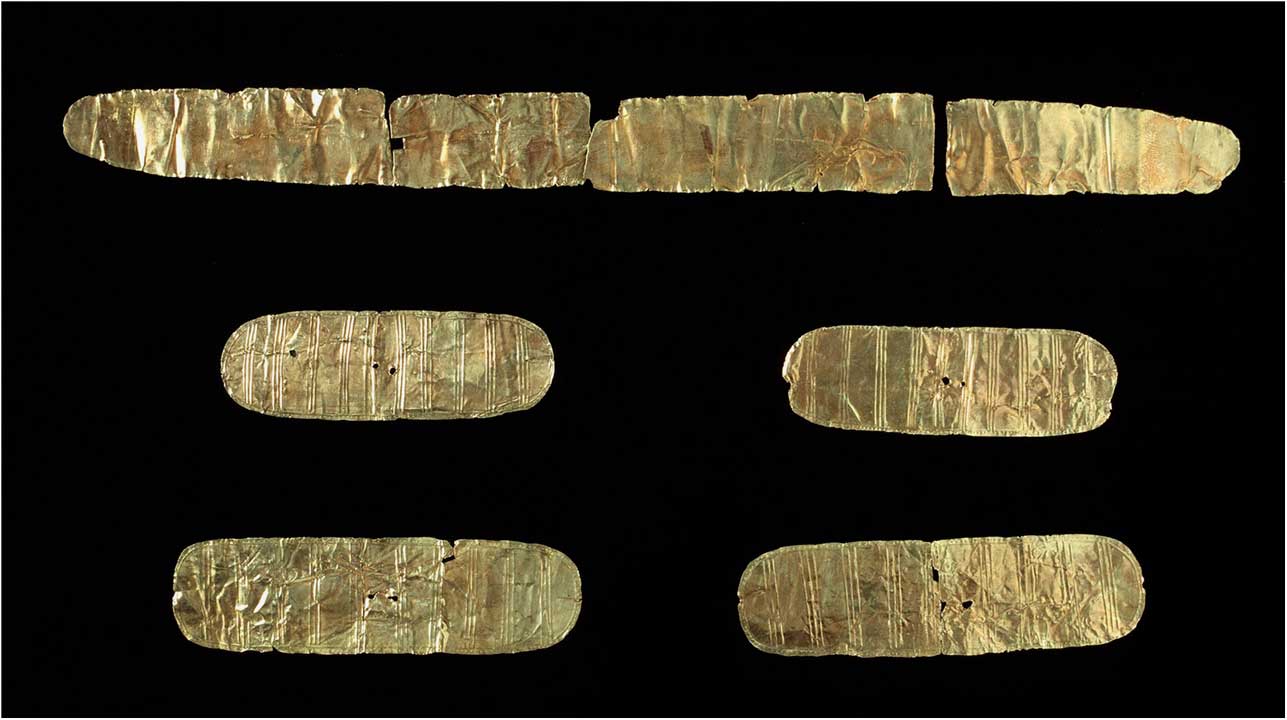
The earliest goldwork in Ireland dates from the Chalcolithic which commenced c. 2500 bc (O’Brien Reference O'Brien2012). These artefacts belong to the primary Beaker goldwork tradition, which consists of a small range of sheet forms including discs, basket ornaments, stud caps, rolled tubular beads, and bands/oval plaques (Eogan Reference Eogan1994; Needham Reference Needham2000b; Reference Needham2011; Reference Needham2012a; Needham & Sheridan Reference Needham and Sheridan2014). The distribution of basket ornaments is centred on Britain, and only three examples are known from Ireland: a pair of unprovenanced examples and the Benraw (formerly Deehommed or Dacomet) ornament, County Down (Eogan Reference Eogan1994; O'Connor Reference O'Connor2004; Needham Reference Needham2011). Over 20 ‘sun’ discs have also been found in Ireland, although this artefact type is not only restricted to the primary Beaker phase as demonstrated by the association of two discs and a lunula at Coggalbeg, County Roscommon (Kelly & Cahill Reference Kelly and Cahill2010). Nevertheless, a number of examples, such as the Knockadoon disc from Lough Gur and the possible pair from Corran, County Armagh, do fall into this early tradition (Case Reference Case1977; Eogan Reference Eogan1994; Cahill Reference Cahill2006), and in contrast to the basket ornaments, their distribution (when both early and late examples are considered) centres on Ireland. The oval plaques and possible diadem from County Cavan (Fig. 1) are also considered to be part of the primary goldworking phase (Case Reference Case1977; Eogan Reference Eogan1994; Cahill Reference Cahill2006). Links between these artefacts and continental goldwork have been discussed, including with artefacts from Iberia, France, and central and northern Europe (Taylor Reference Taylor1980; Reference Taylor1994; O'Connor Reference O'Connor2004; Needham Reference Needham2011; Needham & Sheridan Reference Needham and Sheridan2014); however, the key artefact forms, the basket ornaments and discs, are typically seen to be British developments (Taylor Reference Taylor1980; Eogan Reference Eogan1994; Needham Reference Needham2011).
Gold oval plaques from Co. Cavan. Photograph reproduced with the permission of the National Museum of Ireland, © National Museum of Ireland

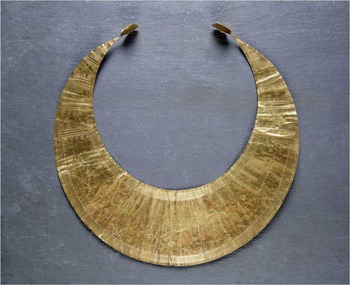
Whilst the production of discs continued into the EBA, new styles of sheetwork also appeared, the most notable of which were the lunulae (Fig. 2); crescent-shaped ornaments decorated with geometric designs (Taylor Reference Taylor1980; Reference Taylor1994; Eogan Reference Eogan1994; Cahill Reference Cahill2005; Reference Cahill2006). Over 80 lunulae – constituting approximately 75% of this artefact type – have been found in Ireland, with the remainder scattered along the Atlantic façade of north-west Europe, therefore suggesting that Ireland had become an important manufacturing centre of goldwork. A radiocarbon date for the alder box found containing a lunula at Crossdoney, County Cavan (3800±50 bp, GrA-13982, 2457–2050 cal bc at 95.4% probability: Cahill Reference Cahill2006, 277) and the association of two Cornish lunulae with an early bronze axehead belonging to the Brithdir metalwork stage (Clarke et al. Reference Clarke, Cowie and Foxon1985; Mattingly et al. Reference Mattingly, Marley and Jones2009) suggests the lunula tradition had emerged by c. 2200 bc, whilst it is likely their circulation continued into the early 2nd millennium (Needham & Sheridan Reference Needham and Sheridan2014).
Gold lunula from Rossmore Park, Co. Monaghan. Photograph reproduced with the permission of the National Museum of Ireland, © National Museum of Ireland

Other Irish gold artefacts dating to the EBA include: a corrugated hilt-band for a dagger from Topped Mountain, County Fermanagh (Eogan Reference Eogan1994), found in association with a cremation dated to 3570±40 bp (GrA-14761, 2029–1774 cal bc at 95.4% probability: Brindley Reference Brindley2007, 85); a gold pin found in association with a gold disc at Ballyvourney, County Cork (Case Reference Case1977; Cahill Reference Cahill2006); an embossed gold armlet from Lisnakill, County Waterford (Needham Reference Needham2000b); a bead cover from Mucklagh, County Offaly (Moloney Reference Moloney2011), found in association with a cremation dated to 3388±46 bp (UB-8025, 1872–1534 cal. bc at 95.4% probability: Sheridan et al. Reference Sheridan, Jay, Montgomery, Pellegrini and Cahill Wilson2013, 225); a trapezoidal plaque from Knockane, County Cork (Cahill Reference Cahill2006); and possibly also the gold foil plaques from Mushera, County Cork (Cahill Reference Cahill2006). These objects range in date from the late 3rd–early 2nd millennium, and a lack of goldwork from the closing stages of the EBA may indicate a decline in the deployment of gold (Eogan Reference Eogan1994). However, a radiocarbon age of 3310±50 bp (GrA-15376, 1736–1460 cal bc at 95.4% probability) for a sample of hide from the Derrinboy hoard (Cahill Reference Cahill2006, 275), and the continued use of embossed goldwork during the Middle Bronze Age (Eogan Reference Eogan1994; Needham Reference Needham2000b), suggest some form of continuity in Irish goldworking as the EBA came to a close.
Despite this apparent decline, there is no doubt that the quantity of Irish Chalcolithic and EBA goldwork, and particularly that dating to the second half of the 3rd millennium, represents a significant concentration. Understanding the procurement of gold used for Irish goldworking ‘industries’ would therefore greatly improve our understanding of the role this material played in early metal-working societies on a wider European scale.
The Lead Isotope Signature of Irish Gold Mineralisation
There are four stable isotopes of Pb: 204Pb is unradiogenic and its abundance on the Earth remains constant throughout time; 206Pb, 207Pb, and 208Pb are produced by radioactive decay of 238U, 235U, and 232Th respectively. Variations in the Pb isotope signatures of ore deposits relate to differences in the composition and the age of the source rock(s) of the Pb in the ores (for an overview of Pb-Pb systematics see Faure & Mensing Reference Faure and Mensing2005). As a result, by characterising the Pb isotope signatures of metallic artefacts and comparing them to those of potential ore deposits, it is possible to evaluate which sources of the metal may have been exploited for their manufacture, and which were not (Brill & Wampler Reference Brill and Wampler1965; Grögler et al. Reference Grögler, Geiss, Grünenfelder and Houtermans1966; Pollard & Heron Reference Pollard and Heron2008).
Recent studies stress the importance of understanding the geological context of the ore deposits under consideration and why ores are characterised by their particular isotopic signatures, employing 204Pb so that the more geologically informative ratios 206Pb/204Pb, 207Pb/204Pb, and 208Pb/204Pb can be utilised (Desaulty et al. Reference Desaulty, Telouk, Albalat and Albarède2011; Albarède et al. Reference Albarède, Desaulty and Blichert-Toft2012; Baron et al. Reference Baron, Tămaş and Le Carlier2014). A similar approach was developed here. A key criticism of provenance studies is that they cannot consider ore deposits that have not been analysed (eg, Harbison Reference Harbison1971). However by achieving a broad understanding as to why ore deposits in a study region are characterised by particular compositions, informed inferences regarding the exploitation of unanalysed ores can be made. Such an approach was also taken by Chapman et al. (Reference Chapman, Leake, Warner, Cahill, Moles, Shell and Taylor2006), who demonstrated a trend of increasing Ag contents in Irish Au from south to north.
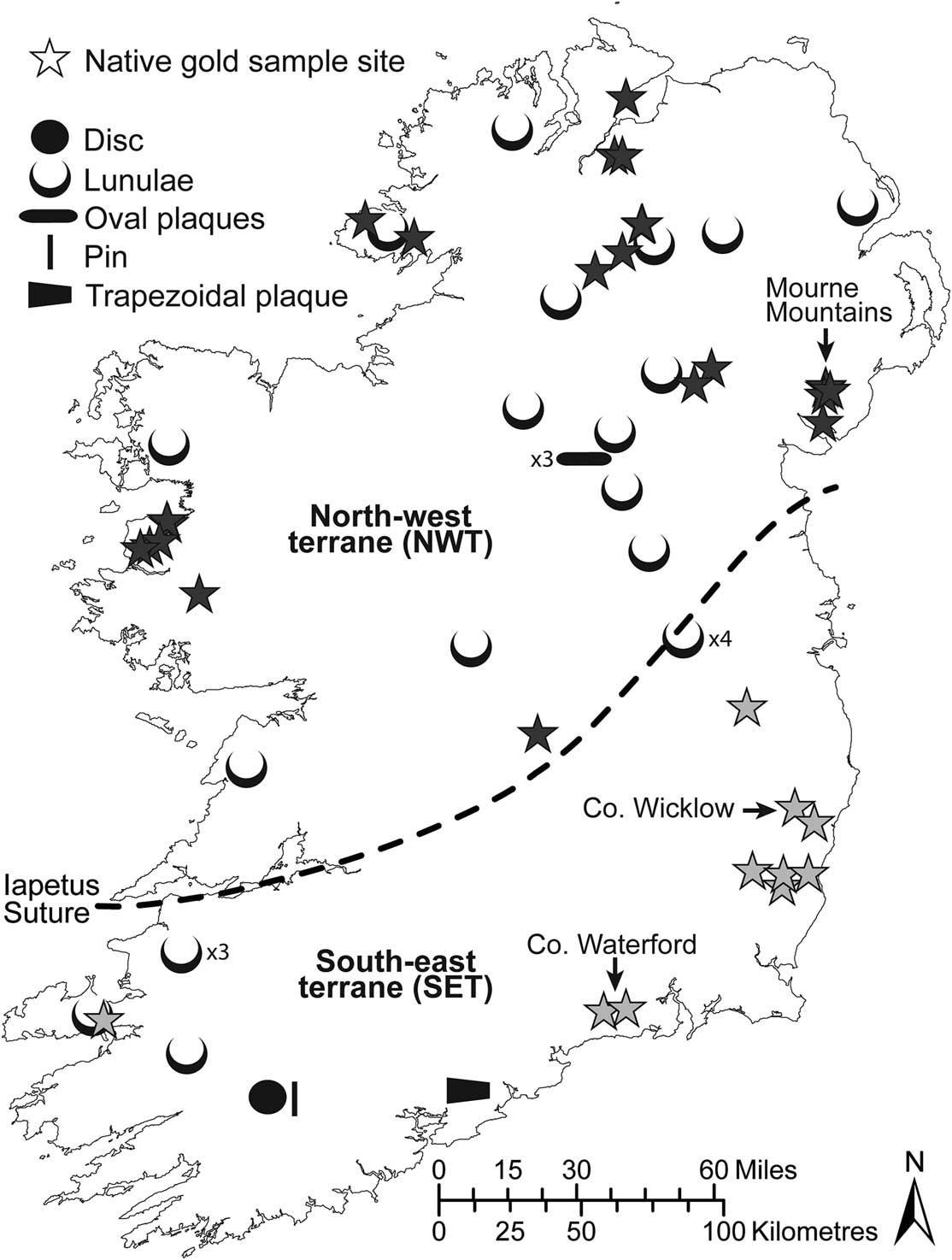
Due to the generally accepted opinion that an Irish Au source was exploited in the Bronze Age, and the current hypothesis regarding the Mourne Mountains of County Down, the principal aim of this study was to test the hypothesis of an Irish, and more specifically a Mourne Mountains, source for the Au. The characterisation of Irish Au deposits was a crucial first step before characterisation of artefact gold could proceed, and Standish et al. (Reference Standish, Dhuime, Chapman, Hawkesworth and Pike2014) present Pb isotope data for 109 Au and 23 sulphide samples from 34 Irish Au deposits (Fig. 3). These data provide the basis for the provenance study presented here.
Map showing locations of Irish Au deposits sampled as part of this study (see Standish et al. Reference Standish, Dhuime, Chapman, Hawkesworth and Pike2014 for full details) and find locations of artefacts analysed where known (see Appendices 2 & 3). Dark grey stars represent north-west terrane (NWT) Au deposits, ie those north-west of the Iapetus suture, which are typically characterised by higher wt% Ag and less radiogenic Pb isotope ratios. Light grey stars represent south-east terrane (SET) Au deposits, ie those south-east of the Iapetus suture, which are typically characterised by lower wt% Ag and more radiogenic Pb isotope ratios

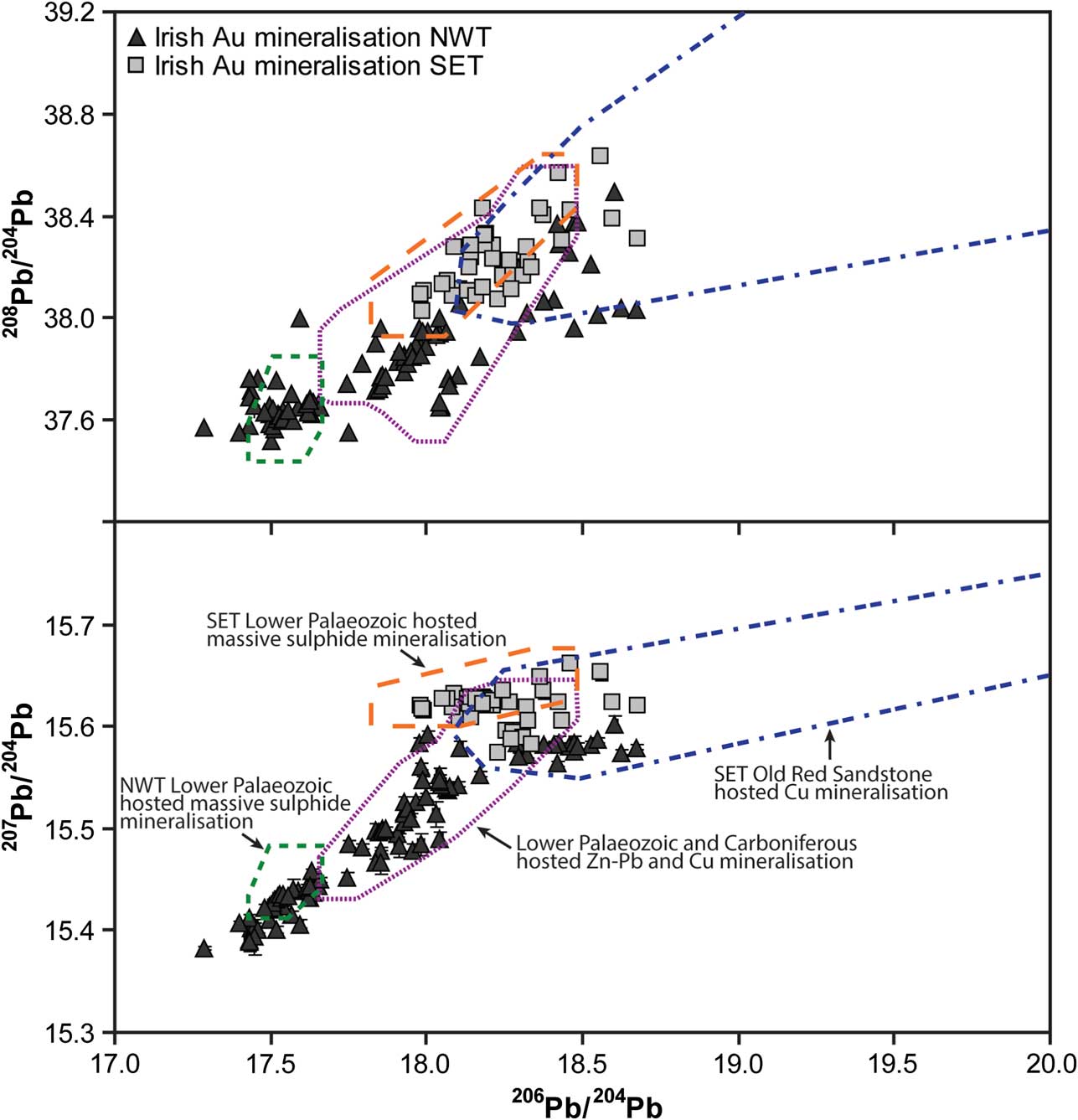
The Pb isotope signature of Irish Au mineralisation is very similar to that of other types of Irish mineral deposits (Fig. 4), highlighting that they had similar geological sources irrespective of metal type (Standish et al. Reference Standish, Dhuime, Chapman, Hawkesworth and Pike2014 and references therein). To summarise, the Pb isotope signature of Irish mineralisation varies due to the interaction of three principal Pb sources primarily during the Caledonian Orogeny (c. 475–380 Ma), Late Devonian to Mid-Carboniferous crustal extension (c. 380–320 Ma), and the Variscan Orogeny (c. 320–270 Ma).
Pb isotope composition of Irish Au mineralisation relative to data-fields for other Irish mineral deposit types (Standish et al. Reference Standish, Dhuime, Chapman, Hawkesworth and Pike2014 and references therein). Errors are ±2 standard errors (S.E.) of the mean of 50 integration cycles, and where not visible they are smaller than the data label

A major structural boundary known as the Iapetus Suture runs approximately from the Shannon estuary in the west of Ireland to Balbriggan in the east (Fig. 3), and creates two broad geological terranes: the north-west terrane (NWT) and the south-east terrane (SET). The vast majority of Irish Au mineralisation formed during the Caledonian Orogeny. Deposits of Early Caledonian age are characterised by Pb isotope signatures derived from one or other of two sources dominated by basement-derived Pb, and with discrete isotopic compositions defined approximately by the data-fields for NWT and SET massive sulphide mineralisation (Fig. 4, see Standish et al. Reference Standish, Dhuime, Chapman, Hawkesworth and Pike2014 for further details). North-west of the Iapetus Suture, mineralisation inherited basement-derived Pb relatively depleted in radiogenic Pb (lower 206Pb/204Pb, 207Pb/204Pb, and 208Pb/204Pb), whilst to the south-east mineralisation inherited basement derived Pb relatively enriched in radiogenic Pb (higher 206Pb/204Pb, 207Pb/204Pb, and 208Pb/204Pb).
Late Caledonian or younger deposits (for example Lower Palaeozoic and Carboniferous hosted Zn-Pb and Cu mineralisation and Au mineralisation with similar isotopic compositions) inherited variable mixtures of the two basement-dominated Pb sources. As a result, they plot intermediate between the aforementioned Early Caledonian NWT and SET data, yet with slightly more evolved isotopic signatures due to increased radiogenic Pb created through radioactive decay (higher 206Pb/204Pb and 208Pb/204Pb). In addition, there is evidence for a contribution of Pb from a third source. This source may include Pb with a magmatic origin (or at least distinctive Pb sampled through magmatic processes) and it is characterised by very radiogenic isotope ratios (ie higher 206Pb/204Pb, 207Pb/204Pb, and 208Pb/204Pb), for example the SET Old Red Sandstone hosted Cu mineralisation and Au mineralisation with similar isotopic compositions. Despite this complex mixing, a geographic distinction is still seen in the isotopic signature of the ore deposits due to the dominance of the respective local basement Pb sources (Fig. 4), and it is possible to correlate the isotopic signature of Irish ore deposits with geographic locations to the north-west or south-east of the Iapetus Suture.
It is important to reiterate that the Pb isotope composition of Au is consistent with that of other types of mineral deposits from throughout Ireland; the same Pb sources were involved and the variation between different deposits is associated with the factors outlined above. This is based on all Pb isotope analyses of Irish ore deposits to date, irrespective of metal type and totalling over 400 analyses. The Pb isotope composition of a metal ore (or associated artefact) can therefore be evaluated to determine whether it is: a) consistent with a north-western or south-eastern signature (relative to the Iapetus Suture), b) dominated by Early Caledonian or younger Pb, and c) characterised by a significant input from the third, very radiogenic Pb source. By achieving a broad understanding of the Pb isotope signature of mineral deposits within Ireland, the potential exploitation of Irish ores not analysed as part of this study can be considered.
Analytical Methods
Lead isotope analysis
The Pb isotope compositions of the artefact samples were determined on a Thermo Fisher Scientific Neptune multi-collector inductively-coupled plasma mass spectrometer (MC-ICP-MS) at the Bristol Isotope Group, School of Earth Sciences, University of Bristol. Sample introduction employed both solution and laser ablation techniques, with detailed methodologies presented in Standish et al. (Reference Standish, Dhuime, Chapman, Coath, Hawkesworth and Pike2013).
Artefact samples were small residual cuttings from samples previously taken for analysis by Hartmann in the 1960s (Hartmann Reference Hartmann1970; Reference Hartmann1982), and all were first analysed by laser ablation techniques. Samples were mounted in epoxy resin and polished using a series of graded sandpapers (P800, P1200, P4000) and a synthetic textile polishing cloth with 1 μm diamond paste. The mounted samples were then cleaned ultrasonically in acetone followed by 2% HNO3 and finally rinsed three times in ultrapure water. Samples were typically analysed three times, and the resulting data is the average of these multiple analyses, with the errors ±2 standard errors (S.E.) of the mean of the multiple analyses.
When employing laser ablation techniques, both accuracy and reproducibility are compromised because of the low abundance of 204Pb and the isobaric interference of mercury on this mass (Standish et al. Reference Standish, Dhuime, Chapman, Coath, Hawkesworth and Pike2013). As a result, 21 artefact samples were also analysed by solution MC-ICP-MS techniques in order to obtain accurate and precise 206Pb/204Pb, 207Pb/204Pb, and 208Pb/204Pb data, and those samples were selected to cover the full isotopic range of those analysed by laser ablation. Errors presented for solution analysis are ±2 S.E. of the mean of 50 integration cycles of 4.2 seconds each.
Major element composition
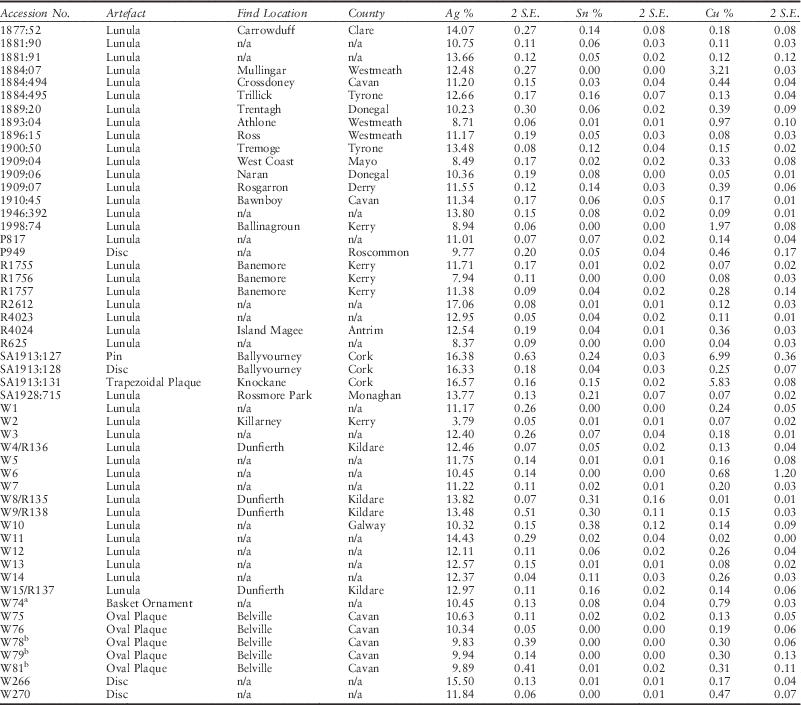
Quantitative major element analysis was also performed on all artefact samples using an Electron Probe Microanalyser (EPMA) to allow direct comparisons with previous studies (Warner Reference Warner2004; Chapman et al. Reference Chapman, Leake, Warner, Cahill, Moles, Shell and Taylor2006; Warner et al. Reference Warner, Chapman, Cahill and Moles2009). Appendix 1 presents the EPMA methodologies in more detail. The following elements were analysed: Ag, As, Cu, Fe, Hg, Pb, Pd, S, Sb, Si, and Sn. Only Ag, Cu, and Sn routinely fell above the limits of detection (0.074%, 0.029%, and 0.044% respectively), and so only these elements were used for artefact characterisation.
Results
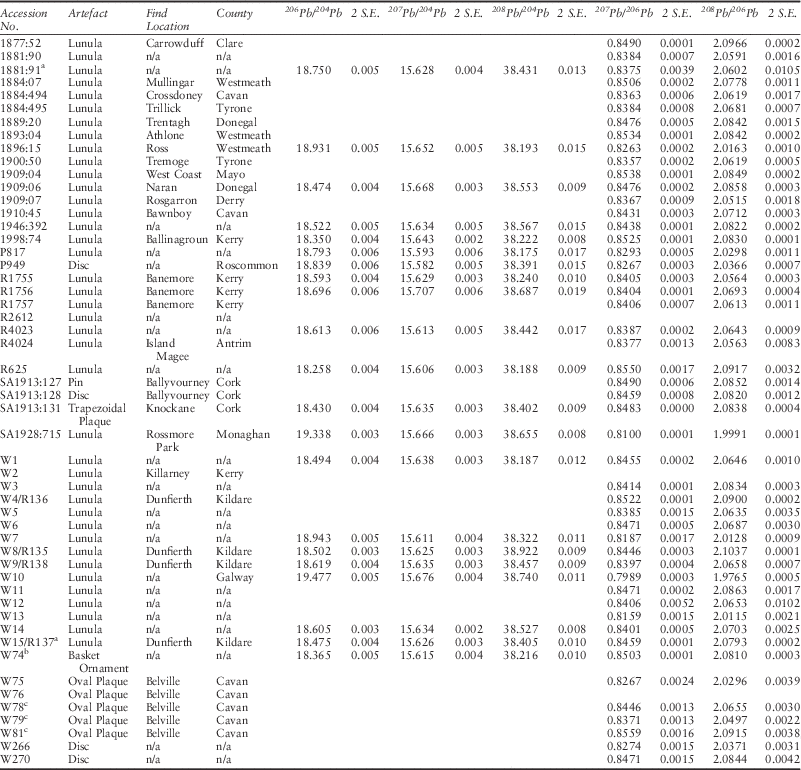
Fifty-two samples from 50 Chalcolithic and EBA artefacts have been analysed (Fig. 3 & Appendices 2 & 3). Of these, most of the samples are from lunulae (n=40; almost 50% of all the known Irish examples), whilst samples from discs (n=4), oval plaques (n=5; three samples are from the same artefact), a basket ornament, pin, and trapezoidal plaque were also analysed. One oval plaque and two lunulae samples failed Pb isotope analyses because of their low Pb concentrations.
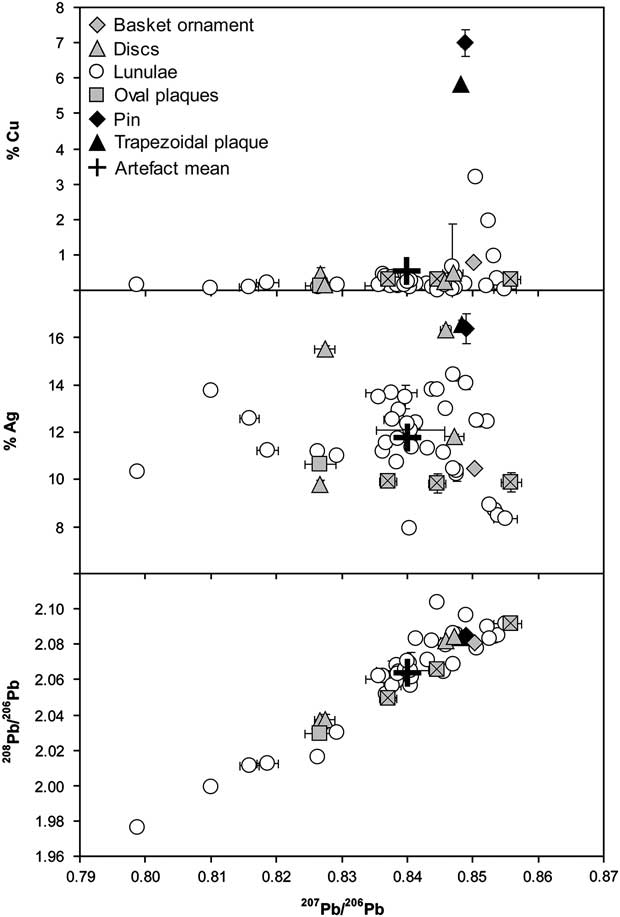
The elemental compositions are broadly consistent with previous provenance studies of the same material. Silver concentrations range from 3.79% to 17.06% (median of 11.63%), with the majority (n=41) forming a compositional group between 9.5% and 14.5% (Fig. 5). Copper values typically range from below the limit of detection (ie <0.029%) to 0.8% (median of 0.18%), with five samples falling above this range and up to a maximum of 6.99% (see Fig. 5 & Appendix 3 for details). Mean concentrations of natural Au grain populations rarely exceed 1% Cu (Chapman et al. Reference Chapman, Leake, Warner, Cahill, Moles, Shell and Taylor2006), therefore it is likely that any artefacts characterised by such high levels were the product of deliberate or accidental alloying. Tin values range from below the limit of detection (ie <0.044%) to 0.38% (median of 0.04%), and this signature is likely to be dependent upon the incorporation of alluvial cassiterite into the artefact alloys (Hartmann Reference Hartmann1970; Chapman et al. Reference Chapman, Leake, Warner, Cahill, Moles, Shell and Taylor2006).
208Pb/206Pb, Ag (%), and Cu (%) versus 207Pb/206Pb plots of Irish Chalcolithic and EBA gold artefacts. Oval plaque samples marked with a cross are from the same artefact

The Pb isotope ratios of the samples (laser ablation MC-ICP-MS analyses) range from 0.7989 to 0.8559 on the 207Pb/206Pb and 1.9765 to 2.1037 on the 208Pb/206Pb (Fig. 5).
Discussion
Gold-copper alloying
Artefacts manufactured from non-natural Au-Cu alloys should have an isotopic signature inherited from the mixture of both the Au and Cu sources. Five artefacts have been highlighted as potential products of alloying; however, in essence this is an arbitrary distinction and, because the Au source (and therefore its composition) is unknown, it is not clear what level of Cu would reflect this practice.
The five artefacts with Cu at >0.8% are characterised by distinct Pb isotope signatures: 0.8483–0.8534 on the 207Pb/206Pb and 2.0778–2.0852 on the 208Pb/206Pb. This is clearly demonstrated by Figure 5 where there is a strong spike in Cu concentrations at 207Pb/206Pb≈0.85. It is likely that the isotopic signatures of these five artefacts are significantly influenced by Cu-derived Pb, and that they give some indication of the isotopic composition of the Cu source(s) involved (although further discussion on this is beyond the scope of the current paper). Of the remaining artefacts, the two with the highest Cu concentrations (basket ornament W74 and lunula W6 with 0.79% and 0.68% Cu respectively) are characterised by similar Pb isotope signatures that could be interpreted as part of the same compositional spike. It is therefore likely that these were also the product of Au-Cu alloying. This spike is not present in the remaining data (where Cu is <0.5%), thus artefacts characterised by Cu concentrations below c. 0.5% are less likely to be the product of Au-Cu alloying.
If corrections for the Cu-derived Pb input were to be made (based on typical Pb concentrations of c. 20 ppm for the Au and a factor of ~25 higher for the Cu: Rohl & Needham Reference Rohl and Needham1998; Standish et al. Reference Standish, Dhuime, Chapman, Hawkesworth and Pike2014), the signature of the Au component will not differ significantly relative to the Chalcolithic/EBA artefact data-field due to: i) the high variability of the artefact data-field, ii) the low Cu concentration of the alloyed artefacts in question, and iii) contemporary Cu sources having similar Pb isotope ratios to the Irish goldwork (Northover et al. Reference Northover, O'Brien and Stos2001; see also Standish Reference Standish2012). Consequently the presence of Cu-derived Pb in some of the studied artefacts will not affect any general interpretations regarding the source of the Au.
Compositional variation
It is clear from Figure 5 that the isotopic variation between the artefacts is large. As this represents the best proxy for the overall compositional variation of the Au source(s) under exploitation, either multiple homogeneous sources or a smaller number of heterogeneous Au sources were exploited. Chapman et al. (Reference Chapman, Leake, Warner, Cahill, Moles, Shell and Taylor2006) favoured the exploitation of a single source characterised by a relatively narrow range of Ag compositions. In their study, the majority of the 33 artefact samples analysed fell between 9.7% and 12.7% Ag; in this study, however, the typical range of Ag values is slightly broader (9.5%–14.5%). This is a reflection of the higher number of artefacts studied here. Direct comparisons of the Pb isotope ratios with the Ag concentrations do not identify discrete populations of artefacts (Fig. 5), and the data-field is unlikely to represent simple linear mixing between two sources due to an absence of a feasible radiogenic end-member source, so the exploitation of heterogeneous ores is favoured. As a result, the following discussion on the source of the Au can only consider the principal source region, and will not be able to identify or rule out small scale inputs from additional minor sources.
Data points on Figure 5 represent single samples, although the three oval plaque data points marked with a cross are all derived from the same artefact (a possible diadem from County Cavan, see Fig. 1). This demonstrates that considerable variation may be found within a single artefact. The lack of homogenisation, both within a single artefact and within the overall metal pool, suggests that the Au was not well mixed. It may therefore be inferred that relatively simple manufacturing processes that did not involve prolonged periods of melting were employed, and perhaps also an absence of manufacturing centres where raw Au was collated, processed, and turned into ingot (or artefact) form en masse. The latter may in turn favour a lack of control of the Au at source, and instead trade or exchange could have been the principal mechanism for managing the flow of this metal.
Gold reuse
Repeated reuse of a closed-system metal pool (ie where Au from new sources is not added to the metal in circulation) is likely to create an increasingly homogenised compositional signature, as the metal pool becomes well mixed over time. The ability to recognise this signature is of considerable interest because it may not necessarily be consistent with a specific source deposit.
The mean isotopic ratios for the Chalcolithic and EBA gold artefacts (Fig. 5) are 0.8400 on the 207Pb/206Pb (median of 0.8406) and 2.0638 on the 208Pb/206Pb (median of 2.0681). This represents a potential isotopic composition of homogenised Chalcolithic and EBA Au, assuming that the artefacts analysed are a good proxy for the overall variation of the Au in circulation at this time. For the lunulae, approximately 50% of all known Irish examples have been analysed, so this is a reasonable assumption. Recycling works on a continuum and artefacts can be the product of varying degrees of mixing. Bearing this in mind, and with the average composition consistent with what could be termed the central artefact cluster, artefacts that plot nearer to this cluster have a higher likelihood of being the product of a greater degree of mixing. As a consequence, the isotopic signature of this cluster may not necessarily be consistent with that of the source of the Au. This also means that artefacts plotting further from this cluster have a higher likelihood of being the product of fewer (or no) degrees of mixing. With the latter being the majority (approximately two-thirds), this suggests that repeated reuse has not had a significant impact on the overall artefact data-field, and identification of Chalcolithic and EBA Au sources is more straightforward.
An Irish gold source?
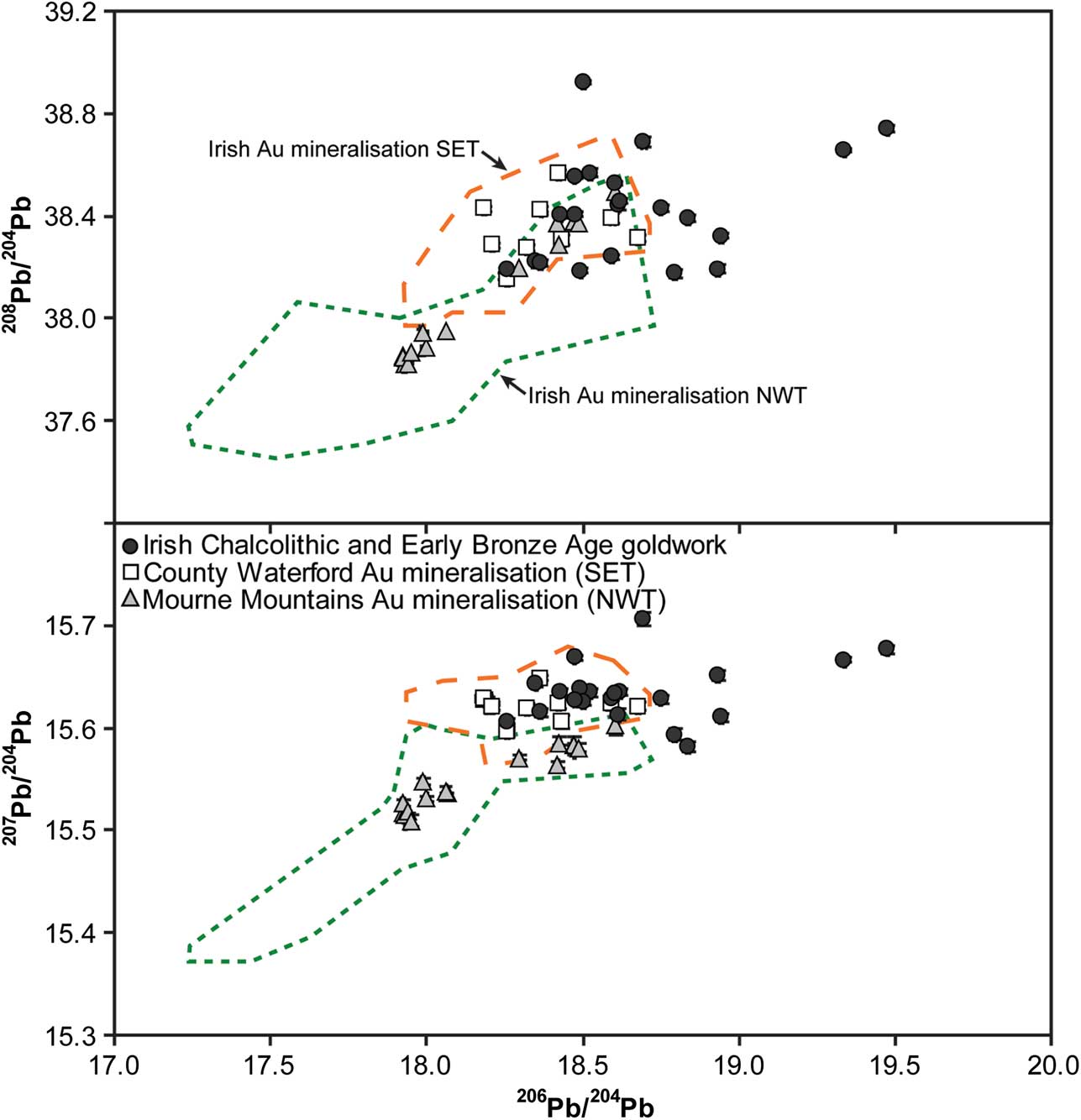
Figure 6 presents the Pb isotope signature of Irish Chalcolithic and EBA artefacts analysed through solution MC-ICP-MS relative to the Au deposits of Ireland (Standish et al. Reference Standish, Dhuime, Chapman, Hawkesworth and Pike2014). The majority of the artefacts have Pb isotope ratios consistent with an Irish source. However the Pb isotope ratios tend to be more similar to those from the south-eastern group of Au deposits characterised by higher 207Pb/204Pb and 208Pb/204Pb, and not with those located north-west of the Iapetus Suture. Alluvial Au from the Mourne Mountains forms part of the NWT sample set (Fig. 6), highlighting that the Pb isotope data do not support the Mourne Mountains hypothesis.
Pb isotope signature of Irish Chalcolithic and EBA gold artefacts relative to Irish Au deposits (Au mineralisation represented by two data-fields: one for NWT and one for SET deposits)

The Pb isotope signature of the artefacts favours a principal source in southern Ireland, with the Au deposits of County Waterford providing the closest match (Fig. 6). However these deposits were ruled out in previous studies because County Waterford Au has relatively low mean and median Ag contents of ≤6% (Chapman et al. Reference Chapman, Leake, Warner, Cahill, Moles, Shell and Taylor2006) and the artefacts are typically characterised by >9.5% Ag. Furthermore, no cassiterite was present at these locations to explain the Sn signature of the artefacts. Only two known deposits in southern Ireland display Ag concentrations that match those of the artefacts; the Goldmines River East and the Coolbawn Stream, both in County Wicklow (Chapman et al. Reference Chapman, Leake, Warner, Cahill, Moles, Shell and Taylor2006). However exploitation of these is unlikely because all analysed Au deposits from County Wicklow and neighbouring County Wexford, including the Goldmines River East, are characterised by Pb isotope signatures that do not match that of the artefact gold: 206Pb/204Pb and 208Pb/204Pb are typically too low relative to the artefacts (see Chapman et al. Reference Chapman, Leake, Warner, Cahill, Moles, Shell and Taylor2006 for further arguments against the exploitation of these two deposits).
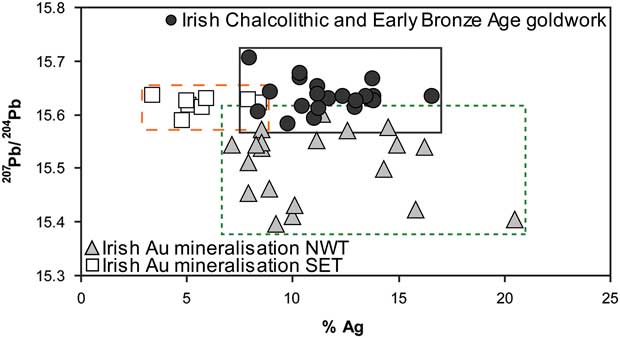
To summarise, when the Pb isotope and elemental characterisation approaches are combined, the Irish Chalcolithic and EBA gold artefacts are inconsistent with the analysed Irish Au deposits (Fig. 7).
207Pb/204Pb versus Ag (%) of Irish Chalcolithic and EBA gold artefacts and Irish Au deposits. For the Au deposits, Pb isotope ratios represent mean signatures whilst Ag concentrations represent medians (from Chapman et al. Reference Chapman, Leake and Moles2000a; Reference Chapman, Leake, Moles, Earls, Cooper, Harrington and Berzins2000b; Reference Chapman, Leake, Warner, Cahill, Moles, Shell and Taylor2006; Moles et al. Reference Moles, Chapman and Warner2013), and only deposits where both are available are plotted

Exploitation of an unanalysed Irish gold source?
Following the broad understanding of the Pb isotope signature of Irish mineral deposits detailed above, the likelihood that an unanalysed or unknown Irish Au source was exploited during the Chalcolithic and EBA can be evaluated. If the Pb isotope signatures of the artefacts are interpreted from a geological perspective, the Pb is of Late Caledonian or younger age and it was derived predominantly from the SET basement but with some contribution from a radiogenic Pb source. It is therefore possible to exclude any Irish deposit that incorporated a significant component of NWT Pb (ie those situated north-west of the Iapetus Suture) and those dominated by Early Caledonian Pb (including the majority of SET mineralisation hosted by the Lower Palaeozoic Leinster Massif: see Standish et al. Reference Standish, Dhuime, Chapman, Hawkesworth and Pike2014).
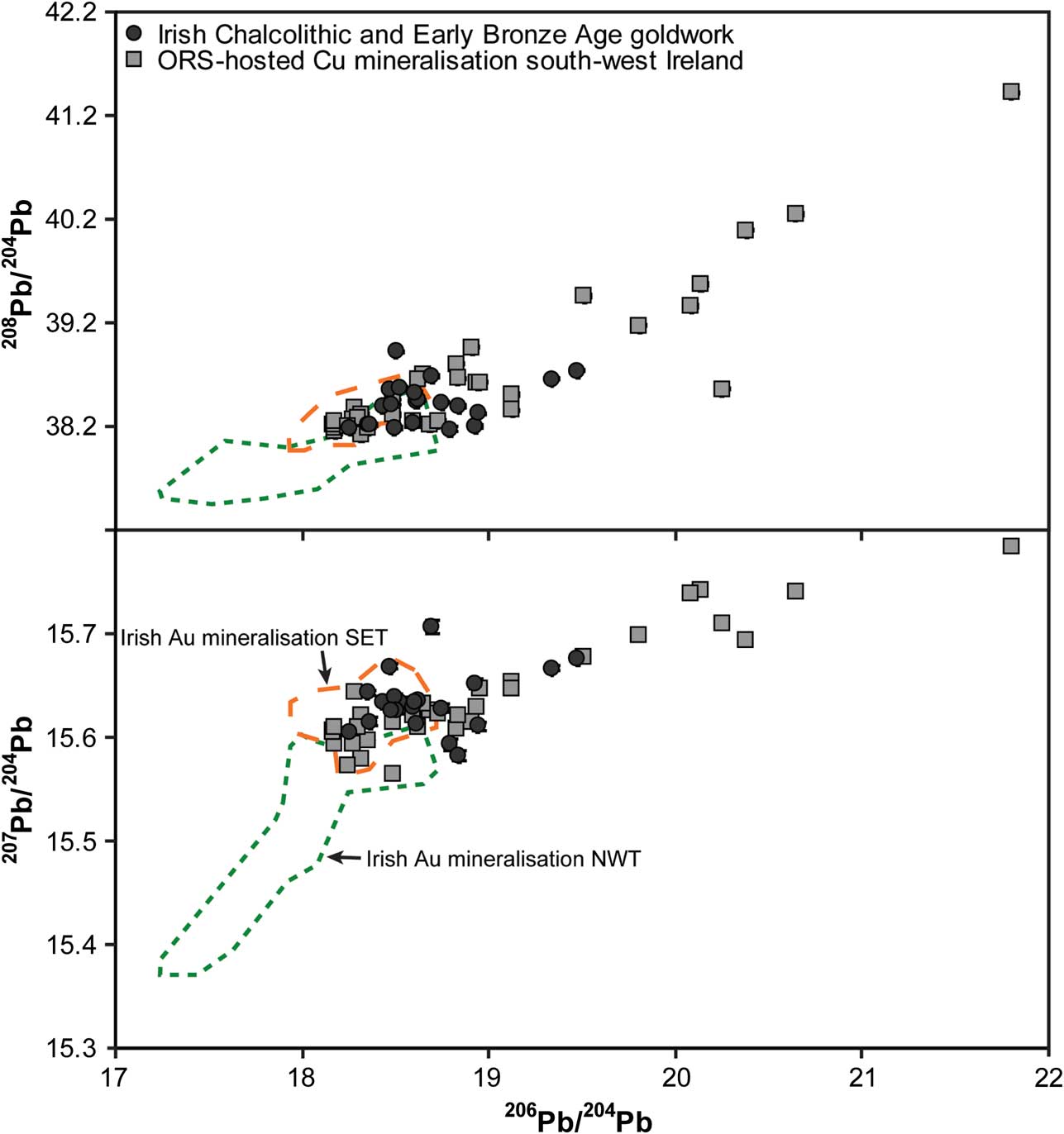
Widespread Carboniferous lithologies found throughout Ireland host numerous mineral deposits, and those located in southern Ireland inherited Late Caledonian or younger Pb derived predominantly from the SET basement source (O'Keeffe Reference O’Keeffe1986; LeHuray et al. Reference LeHuray, Caulfield, Rye and Dixon1987). However, unlike the gold artefacts, these Carboniferous-hosted deposits are not associated with any radiogenic Pb source, so therefore a Carboniferous-hosted Au source is doubtful. South-west Ireland is known for its Cu mineralisation, and these deposits are characterised by a Pb isotope signature dominated by SET Pb of Variscan age. Furthermore, those hosted by Old Red Sandstone (ORS) also incorporated Pb from a radiogenic source (Kinnaird et al. Reference Kinnaird, Ixer, Barreiro and Nex2002), meaning that the Pb isotope signature of south-western ORS-hosted Cu mineralisation demonstrates good consistency with the artefact gold (Fig. 8). If unknown Irish Au deposits were exploited during the Chalcolithic or EBA, the ORS-hosted Variscan ore field of south-west Ireland appears the most likely general location.
Pb isotope composition of ORS-hosted Cu mineralisation and Irish Chalcolithic and EBA gold artefacts. Data for Cu mineralisation from Rohl (Reference Rohl1995; Reference Rohl1996) and Kinnaird et al. (Reference Kinnaird, Ixer, Barreiro and Nex2002)

The archaeological record of south-west Ireland suggests this hypothesis is feasible, with widespread activity throughout the Chalcolithic and EBA that included bedrock mining of Cu at sites such as Ross Island and Mount Gabriel (O'Brien Reference O'Brien1994; Reference O'Brien1999; Reference O'Brien2004; Reference O'Brien2012). There is also no lack of Chalcolithic/EBA goldwork, with the region hosting the highest concentration of early Au in Ireland (Cahill Reference Cahill2006). However, there is little evidence for the presence of significant Au mineralisation.
Whilst the potential for red-bed hosted palaeo-placer type deposits has been discussed (Stanley et al. Reference Stanley, Carroll, Connolly and Doyle2000), no noteworthy deposits have been reported to date. All records of Au show that it is directly associated with the ORS-hosted Cu mineralisation, although the majority of accounts are historical mining reports of very dubious accuracy (McArdle et al. Reference McArdle, Morris and Gardiner1987; Cowman & Reilly Reference Cowman and Reilly1988) and the modest grade of most (Reilly Reference Reilly1986; Cowman & Reilly Reference Cowman and Reilly1988; Pracht & Sleeman Reference Pracht and Sleeman2002 and references therein) do not favour the region as a potential source of prehistoric Au.
This is the same mineralisation that was exploited during the EBA at sites such as Mount Gabriel and those in the Goleen area of the Mizen peninsula (O’Brien Reference O'Brien1994; Reference O’Brien2003). Yet there is no evidence for the processing of native Au at any of the excavated EBA Mount Gabriel-type mines, and current dating evidence suggests that these deposits were exploited from around 1800 bc (O’Brien Reference O'Brien1994; Reference O’Brien2003) and thus post-date the majority of the gold artefacts considered here. It is possible that earlier phases of exploitation of the Mount Gabriel-type deposits did occur. However, if so, it is hard to believe that this would not have included exploitation of the associated (and significantly more abundant) Cu mineralisation, and the chemical signatures of Chalcolithic and EBA Cu and bronze artefacts are consistent with the current chronology of Cu mining in south-west Ireland (eg Rohl & Needham Reference Rohl and Needham1998; Bray Reference Bray2012). Finally, Ni Wen (Reference Ni1991) reported native Au present as micron-scale inclusions within chalcopyrite and tetrahedrite at the Ballycummisk Cu deposit. Early exploitation of such deposits for the sole purpose of Au recovery when Au is not visible to the naked eye but is instead a trace element within other minerals is very doubtful; the Au is simply not in a form favourable for recovery by early metal prospectors. On the balance of available evidence, a Chalcolithic/EBA Au source in the south-western ORS-hosted Variscan ore field is considered unlikely.
A non-Irish gold source?
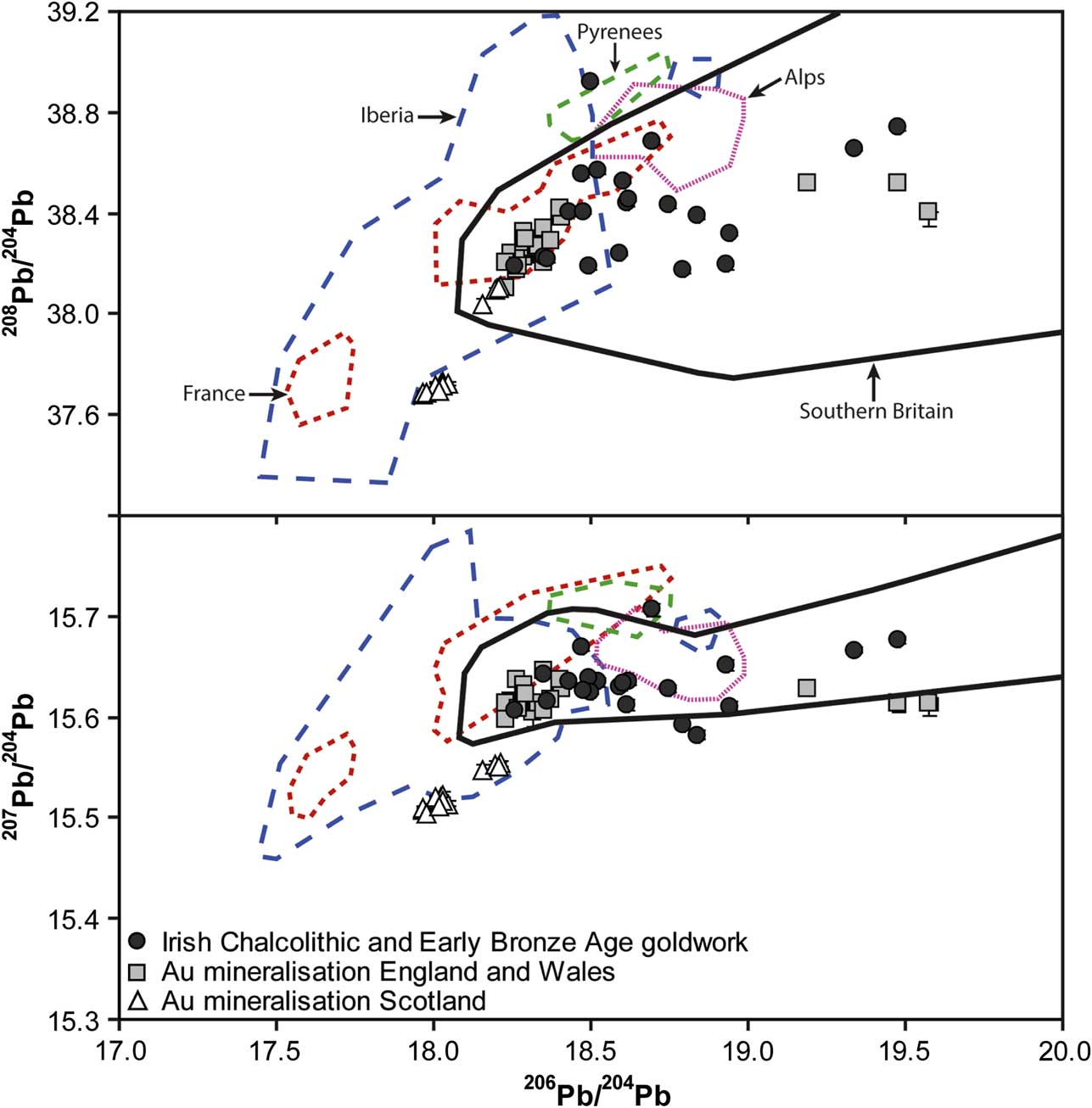
Serious doubt has been raised here regarding the Mourne Mountains source hypothesis, and more generally on an Irish source hypothesis, for Chalcolithic and EBA Au. As a result, a preliminary investigation was undertaken to evaluate the likelihood of a non-Irish source. Lead isotope analysis has rarely been performed on natural Au, but the Pb isotope signature of sulphide minerals can act as a proxy to the isotopic signature of associated Au mineralisation (Fig. 4 and Standish et al. Reference Standish, Dhuime, Chapman, Hawkesworth and Pike2014). The Pb isotope signature of the artefact gold was compared to that of sulphide mineralisation in southern Britain (Rohl & Needham Reference Rohl and Needham1998), Iberia (Arribas & Tosdal Reference Arribas and Tosdal1994; Arias et al. Reference Arias, Corretgé, Suárez, Villa, Cuesta and Gallastegui1996; Marcoux Reference Marcoux1998; Tornos & Chiaradia Reference Tornos and Chiaradia2004; Zalduegui et al. Reference Zalduegui, De Madinabeitia, Ibarguchi and Palero2004; Neiva et al. Reference Neiva, Andráš and Ramos2008), France (Oh et al. Reference Oh, Marcoux, Calvez and Touray1989; Touray et al. Reference Touray, Marcoux, Hubert and Proust1989; Le Guen et al. Reference Le Guen, Lescuyer and Marcoux1992; Gloaguen et al. Reference Gloaguen, Branquet, Boulvais, Moëlo, Chauvel, Chiappero and Marcoux2007), the Alps (Curti Reference Curti1987; Horner et al. Reference Horner, Neubauer, Paar, Hansmann, Koeppel and Robl1997), and the Pyrenees (Romer & Soler Reference Romer and Soler1995). The signature of sulphides from mineralisation in southern Britain (and in particular those from Cornwall), offer the best match to the artefact data (Fig. 9), and so British Au deposits were investigated further.
Pb isotope signature of European ore-fields (see text for references) and British Au mineralisation relative to Irish Chalcolithic and EBA artefact gold

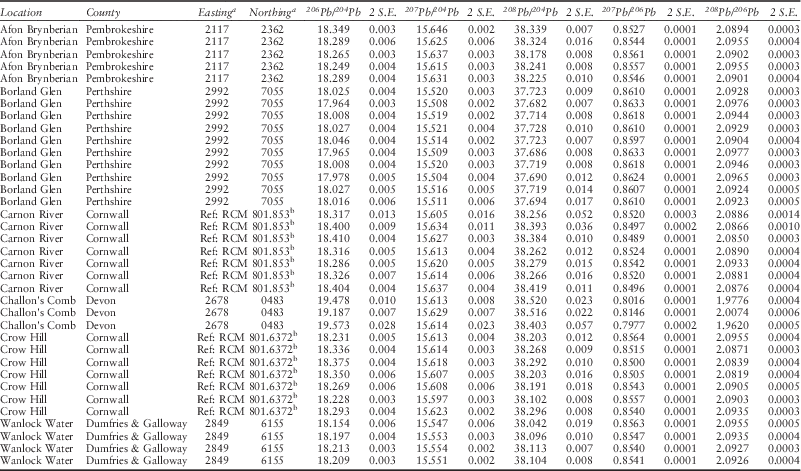
Sources of Au in Britain are confined to the north and west (Chapman et al. Reference Chapman, Leake and Moles2000a; Reference Chapman, Leake, Moles, Earls, Cooper, Harrington and Berzins2000b; Reference Chapman, Leake, Warner, Cahill, Moles, Shell and Taylor2006; Colman & Cooper Reference Colman and Cooper2000). Alluvial Au from six deposits were analysed for their Pb isotope composition (Fig. 9 & Appendix 4): Borland Glen, Perthshire, and Wanlock Water, Dumfries & Galloway (both Scotland); Afon Brynberian, Pembrokeshire (Wales); Carnon River and Crow Hill, Cornwall, and Challon’s Combe, Devon (England).
The geological terranes that underlie Ireland also underlie Britain, with the trace of the Iapetus Suture running approximately along the present day border between England and Scotland. As in Ireland, the Pb isotope ratios of British mineralisation overlying the NWT (ie the Scottish sites) contrast with the Pb isotope ratios of the artefacts; however, the Pb isotope ratios of mineralisation overlying the SET (from England and Wales) are consistent with those of the artefacts. Furthermore, the elemental compositions of some southern British Au deposits are also similar to the artefact alloys. Chapman et al. (Reference Chapman, Leake and Moles2000a) published median Ag concentrations for a number of Welsh deposits, including vein Au from the Tyn Y Cornel level of the Clogau mine (10.8% Ag), alluvial Au from the Afon Mawdach (11.7% Ag), and alluvial Au from the Afon Wen (10.2% Ag), whilst elemental compositions for nine Cornish Au deposits were published by Ehser et al. (Reference Ehser, Borg and Pernicka2011) and medians ranged from 3.8% to 33% Ag, 0.0022%–0.11% Cu, and 0.00078%–0.046% Sn. Clearly more sources need to be characterised for both Pb isotopes and elemental concentrations before artefacts and ore can be linked with any certainty, but these preliminary data suggest that the Au deposits of southern Britain warrant further investigation.
A southern British source of Chalcolithic and EBA gold?
Whilst no conclusive archaeological evidence exists for Au extraction in Wales or south-west England (defined here as Cornwall and Devon) during the Chalcolithic or EBA, their potential exploitation during the Bronze Age has previously been discussed (Penhallurick Reference Penhallurick1986; Reference Penhallurick1997; Craddock & Craddock Reference Craddock and Craddock1996; Needham Reference Needham2012b), and Ehser et al. (Reference Ehser, Borg and Pernicka2011) recently proposed a Cornish source for the first phase of the Nebra Sky Disc gold inlays based on major and trace element analysis. This followed an extensive study of natural Au from central and south-east Europe (Schmiderer Reference Schmiderer2009), although sampling of alternative western European sources was not as extensive and it is likely that other potential sources do exist.
It is therefore worth considering the hypothesis of a southern British Au source with regards to the archaeological record. The majority of the artefacts investigated here fall into the primary Beaker and lunula goldworking traditions, so the following discussion focuses on the second half of the 3rd millennium bc. As there are no known Au mines anywhere in north-west Europe at this time, evidence for: i) the presence of goldwork, and ii) mining of metal-bearing deposits, will first be considered.
Relatively few gold artefacts dating to this period have been found in Wales and south-west England. Two or three artefacts are known from the former: the Banc Tynddol disc from a grave located immediately below a copper extraction area on Copa Hill, Cwmystwyth, Ceredigion (Timberlake et al. Reference Timberlake, Gwilt and Davis2004; Timberlake Reference Timberlake2009), the ‘Provincial’ type Llanllyfni lunula from Caernarvonshire (Taylor Reference Taylor1980; Eogan Reference Eogan1994), and a possible basket ornament from Usk, Gwent (Needham & Sheridan Reference Needham and Sheridan2014). The assemblage from south-west England is similarly small and consists of four lunulae, all of which were found in Cornwall: two of Taylor’s ‘Classical’ type from St Juliot and Penwith, and two – one of ‘Classical’ type, the other ‘Provincial’ – from Harlyn Bay (Taylor Reference Taylor1980; Mattingly et al. Reference Mattingly, Marley and Jones2009). These represent the only confirmed examples of ‘Classical’ lunulae, stylistically and technically the most accomplished of all the lunulae types, to be found outside Ireland, and thus may be significant bearing in mind the proposed southern British Au source. Furthermore, the geographical distribution of their findspots places three (or possibly all) of them on the Irish-facing north coast of the county (Mattingly et al. Reference Mattingly, Marley and Jones2009). This suggests strong links between Cornwall and Ireland during the late 3rd millennium, and whilst it is likely that the export of tin from Cornwall to south-west Ireland for alloying with Ross Island copper was the key driver for this, perhaps the presence of exploitable Au deposits in Cornwall (and possibly also Devon) was another important reason for this connection.
The earliest evidence for prospection and mining of Cu deposits in Wales dates to the final two centuries of the 3rd millennium, or possibly even earlier (for example at Copa Hill and Erglodd: Timberlake et al. Reference Timberlake, Gwilt and Davis2004; Timberlake Reference Timberlake2006; Reference Timberlake2009). However primary output at most Welsh Cu mines occurred after c. 1900 bc (Timberlake Reference Timberlake1994; Reference Timberlake2009), post-dating both the initial Chalcolithic and lunula goldworking traditions and suggesting that Wales lacked a widespread tradition of metal extraction during the second half of the 3rd millennium. The earliest unequivocal evidence for the exploitation of any Welsh Au-bearing deposit comes from charcoal recovered from mining waste at Dolaucothi which was dated to the first half of the 1st millennium bc (Burnham Reference Burnham1997). Yet it could be argued that collection of alluvial Au from certain streams in northern Wales, where grains are both larger in size and relatively common, need not necessarily leave any trace in the archaeological record and thus it cannot be categorically ruled out at this stage. Further research and analysis is required to investigate this further.
Cornwall is one of the principal sources of tin in Europe and its tin was exploited from c. 2200 bc onwards (Shell Reference Shell1978; Muhly Reference Muhly1985; Penhallurick Reference Penhallurick1986; Reference Penhallurick1997; Craddock & Craddock Reference Craddock and Craddock1996; Pare Reference Pare2000; Sheridan Reference Sheridan2008). Penhallurick (Reference Penhallurick1986; Reference Penhallurick1997) lists over 40 prehistoric artefacts that have been recovered from the Sn grounds of Cornish rivers including an EBA flat axehead from the Carnon Valley, and both cassiterite and Sn slag have been found at the (late) EBA site of Caerloggas Down, St Austell (Miles Reference Miles1975). Numerous Au deposits are also present in Cornwall. Although bedrock mineralisation is rare, alluvial Au is found in association with cassiterite in the Sn grounds of many Cornish rivers, and it is well documented that over the last 500 years Cornish tinners would collect alluvial Au to sell in order to supplement their income (Penhallurick Reference Penhallurick1986; Reference Penhallurick1997; Camm Reference Camm1995). Furthermore, the Carnon nugget (~59 g in weight) attests to the presence of a large particle size of Au in Cornwall. In comparison, Taylor (Reference Taylor1980) calculates a mean weight of 54.3 g for the Classical lunulae (based on 19 examples). If it is accepted that these alluvial deposits were exploited for Sn during the EBA, then it seems inevitable that Au would also have been recovered during this period. In fact it becomes harder to explain why Cornish Au would not have been exploited at this time.
For these reasons, and because the geochemical data favour a source in southern Britain, the south-west of England, and Cornwall in particular, is currently seen as the most likely principal source region. The overall archaeological record for south-west England perhaps poses the main problem for a Cornish source hypothesis, with archaeological contexts securely dated to the second half of the 3rd millennium being particularly uncommon. For example there are no recorded burials dating to the Chalcolithic or early Beaker period (c. 2450–2200 bc), and few examples date from pre-1950 bc (Jones & Quinnell Reference Jones and Quinnell2013). Similarly there is an absence of settlement sites (Christie Reference Christie1986; Jones & Quinnell Reference Jones and Quinnell2011); the oldest securely dated Chalcolithic/EBA structure in the region, a Beaker-associated small sub-oval structure surrounded by pits at Sennen, Penwith, dates to c. 2400–2100 cal bc (Jones & Quinnell Reference Jones and Quinnell2011; Jones et al. Reference Jones, Taylor and Sturgess2012), although EBA settlements are not particularly common in Britain or Ireland in general (Rathbone Reference Rathbone2013). Beaker finds are also rare and are largely restricted to possible food preparation sites such as pits and burnt mounds (Jones & Quinnell Reference Jones and Quinnell2011; Jones et al. Reference Jones, Taylor and Sturgess2012), or pre-existing megalithic monuments (Christie Reference Christie1986).
The lack of securely dated archaeological sites is problematic, but it could simply relate to a bias in the archaeological record; Cornwall has been an important mining centre for centuries and significant volumes of land have therefore been disturbed. The case for Sn extraction in the region is strong, and due to the association of Au and cassiterite in the same alluvial deposits, EBA Au extraction is considered feasible. However the primary goldworking tradition in Britain and Ireland began during the Chalcolithic, ie before the exploitation of Sn. The lack of a known mining industry in Cornwall during this early period might lead one to assume that a south-western English gold source had not been used. Yet there is no distinction in either the Pb isotope or major element signature between artefacts dating to this earliest, Chalcolithic, period and those dating to the EBA, suggesting that the same source(s) may have been exploited at both times. Furthermore, during this early period the disparity between Britain and Ireland in terms of the amount of Au in circulation did not exist (see Eogan Reference Eogan1994; Cahill Reference Cahill2006; Needham & Sheridan Reference Needham and Sheridan2014 for summaries of Irish and British finds), and it is generally believed that at least some of the early artefact forms, namely the basket ornaments and discs, were British developments (Taylor Reference Taylor1980; Eogan Reference Eogan1994; Needham Reference Needham2011). A British gold source is therefore less problematic than perhaps it first seems. It is significantly more likely that metal-bearing alluvial deposits were first discovered due to the distinctive visual appearance of a gold nugget, rather than cassiterite, shimmering on a stream bed. A period of Au exploitation before that of cassiterite therefore seems likely. In this respect, the suggestion that Cornish copper may have been exploited during the Chalcolithic (Rohl & Needham Reference Rohl and Needham1998; Bray Reference Bray2012) should also be brought into consideration, vis-à-vis the possibility of an early use of south-west English gold.
An alternative scenario is that the earlier artefacts were manufactured using Au from a different source from that exploited during the EBA (La Niece Reference La Niece2011), but one that is characterised by similar Pb isotope ratios. Nocete et al. (Reference Nocete, Sáez, Bayona, Nieto, Peramoa, López, Gil-Ibarguchi, Inácio, García and Rodríguez2014) present Pb isotope and elemental composition data for six Spanish artefacts dating from c. 2500–2350 cal bc, and comparisons with the signatures of local gold deposits led the authors to conclude that they were derived from local sources. The compositional signatures of the Spanish artefacts partially overlap with the Irish artefact data-field presented here, therefore Iberia may yet constitute a potential alternative source to southern Britain for the earliest Au. Once again further research and analysis is required, but this hypothesis may find support from the apparent strong links between Iberia and Ireland at this time (Carlin & Brück Reference Carlin and Brück2012; O’Brien Reference O'Brien2012). This is demonstrated, for example, by influences from the Atlantic façade on Irish Beaker ceramics and associated traditions (Case Reference Case1966; Reference Case1995; Burgess Reference Burgess1979), the potential supply of Iberian Cu to north-west Europe (Needham Reference Needham2002), and from the occurrence of the same primary goldwork types such as the basket ornaments, plaques/diadems and discs in both regions (Case Reference Case1977; Taylor Reference Taylor1994; Needham Reference Needham2011; Armbruster Reference Armbruster2013; in fact it has been proposed that the Benraw basket ornament is an Iberian import: Taylor Reference Taylor1980).
Implications of a non-Irish gold source
The key implication of the data presented here is that the principal source of gold used for the manufacture of Chalcolithic and EBA Irish artefacts was not located in Ireland. Considering that Ireland hosts multiple gold sources, including a number that could account for the quantity of gold circulating at this time, a consideration of why local deposits were not being exploited must be made. It is possible that sources were sought after yet without success, or if gold was won from alluvial deposits then perhaps the knowledge of how to exploit such resources was yet to make it to the island. Alternatively, Irish societies may have viewed an esoteric and distant origin as being a key or defining quality of this material.
The significance of distance to traditional societies, particularly with regards to objects or materials originating from faraway, has been explored by Helms (Reference Helms1988; Reference Helms1993). Materials originating from distant, unfamiliar or mythical lands, those located outside the immediate world-view or cosmos of a society, could be charged with mystical and/or supernatural powers. Furthermore, people involved in acquiring these mythically-charged materials, transforming them into artefact form, or controlling their deployment, were inherently linked with the acquisition and control of the associated powers. Such ideas may help explain why non-Irish gold was being used for the manufacture of Irish goldwork.
Alongside the first appearance of gold, the EBA (and, to a lesser extent, the Chalcolithic) of Britain and Ireland witnessed an increase in the deployment of other exotic, non-utilitarian materials such as amber and jet. Whilst these materials (and in all likelihood gold as well) have been found local to their sources, there are a number of examples where centres of deployment are located some distance away, such as Baltic amber in and around Wessex (Beck & Shennan Reference Beck and Shennan1991) or Whitby (Yorkshire) jet in Scotland (Sheridan et al. Reference Sheridan, Davis, Clark and Redvers-Jones2002). Accordingly, Helms’ discussions on long-distance acquisition have been drawn upon when discussing the value of far-travelled materials in a Bronze Age context, for example by Beck and Shennan (Reference Beck and Shennan1991) in relation to Baltic amber and by Needham (Reference Needham2000a) in relation to the rich and varied grave assemblages of EBA Armorica and Wessex (in which Helms’ ideas were synthesised in the term cosmological acquisition: Needham Reference Needham2000a, 188). If Irish societies believed that cosmological acquisition helped to instil or strengthen the levels of supernatural power embodied in gold, then an esoteric and distant origin may have been vital for the role it played within these societies. Furthermore, if those who controlled its deployment were by proxy controlling the embodied forces, then perhaps active searching for local sources would have been unnecessary and even deliberately discouraged.
It is also relevant to reiterate the intrinsic value often associated with gold. Its brilliance, deriving from a combination of physical properties, has led to frequent associations with the embodiment of supernatural, magical or religious power (Betz Reference Betz1995; Saunders Reference Saunders2003; La Niece Reference La Niece2009). Furthermore, exotic materials such as amber and jet are also frequently associated with such properties (Sheridan et al. Reference Sheridan, Davis, Clark and Redvers-Jones2002; Woodward Reference Woodward2002; Sheridan & Shortland Reference Sheridan and Shortland2003). It is therefore easy to see how cosmological acquisition would be relevant here, and perhaps it helped to reinforce such links to otherworldly forces.
If a late 3rd millennium bc southern British gold source is to be believed then the reasons for the lack of finished goldwork in this region must also be considered. Again this could be a bias in the archaeological record. Alternatively the value of gold may have differed because it was locally available, and individuals or societies gained more by allowing it to move to other regions, perhaps in an economic sense through trade and exchange. Such ideas were discussed by Beck and Shennan (Reference Beck and Shennan1991) in relation to the Baltic amber trade in Denmark during the Neolithic and Bronze Age and the switch from its use as a rank indicator to exportation in exchange for metal. If this were the case, then what was moving in the opposite direction? Copper is an obvious answer, with Ross Island representing the principal source for Britain and Ireland at this time (Northover Reference Northover1982; Rohl & Needham Reference Rohl and Needham1998; O'Brien Reference O'Brien2004, Needham Reference Needham2002, although see Bray Reference Bray2012 on the possibility that Cornish copper was being exploited). Of course this system does not have to be based solely around metal and other items including those less visible in the archaeological record may have been involved, whilst it should also be noted that cosmologically driven acquisition does not have to be part of a reciprocal exchange network (Helms Reference Helms1993; Needham Reference Needham2000a).
Conclusion
Gold is considered special in numerous societies, it is commonly seen to embody supernatural, magical, religious, or political power, and it is often employed as a symbol of wealth. In Ireland, gold was first used during the Chalcolithic and EBA, a period that witnessed a marked growth in the deployment of other exotic materials, particularly in Britain. Of these materials, gold is poorly characterised in terms of provenance, which poses a significant obstacle if an understanding of the role this material played in prehistoric societies is to be achieved.
The Pb isotope signature of both single artefacts and the overall metal pool suggests that the gold was not well mixed. This implies that only limited fabrication techniques were employed, and perhaps favours an absence of centralised production loci where gold could have been controlled at source. As a result, trade or exchange may have been the principal mechanism for managing this metal, with the gold probably being exported in ingot form and worked up into artefacts in Ireland. The data do not indicate significant levels of gold reuse, so therefore the signature of the artefact gold is seen primarily to represent that of the sources exploited.
The Pb isotope and elemental composition of Irish Chalcolithic and EBA gold artefacts are not consistent with any Irish gold deposit characterised to date. Based on our current understanding of the Pb isotope signatures of Irish gold deposits, it has been possible to consider the likelihood that an unanalysed Irish gold deposit was exploited during this period. If an Irish source is to be assumed then it was most likely located in the Old Red Sandstone hosted Variscan ore field of south-west Ireland. However, there is currently little evidence to support this theory. As a result, a principal source outside of Ireland is currently favoured, and the use of gold in Ireland is consistent with patterns of cosmologically-driven acquisition and long-distance exotic material movement sometimes seen in north-west Europe at this time.
The currently available data favour south-west Britain as the most likely source region. The widely held belief that Cornish alluvial deposits were exploited for cassiterite during the Bronze Age highlights the presence of a tin-extraction industry in south-west England, and these deposits also contain native gold. As a result, an input of Cornish gold into the EBA gold supply arguably appears inevitable. A full investigation into the Pb isotope signature of southern British gold mineralisation is required before full conclusions can be drawn, however the present study highlights the potential for an important gold mining region in southern Britain from the second half of the 3rd millennium bc and raises interesting new questions regarding the role of gold in Irish Chalcolithic and EBA societies.
Acknowledgements
Mary Cahill and the National Museum of Ireland are thanked for providing the artefact samples analysed in this study, whilst we are grateful to Sara Chambers and the Royal Cornwall Museum for providing samples of Cornish alluvial gold. We thank Robert Standish and Gary Baddeley for helping with the collection of natural gold samples, Rob Chapman and Stuart Needham for their comments on earlier versions of the manuscript, whilst Richard Warner and Norman Moles provided helpful comments throughout the course of the study. We also acknowledge Chris Coath for assisting with mass spectrometry, and both Stuart Kearns and Benjamin Buse for assisting with EPMA analyses (furthermore we thank Eric Condliffe for conducting EPMA analysis on one of the samples studied). Finally, the paper was improved greatly thanks to the comments of three anonymous reviewers. Funding was provided by the Natural Environment Research Council (NERC) in the form of a research studentship to CS (NE/G524228).
APPENDIX 1: EPMA ANALYTICAL METHODS
Quantitative major element analysis was performed using a JEOL JXA 8600 Superprobe fitted with four wavelength dispersive (WD) spectrometers and an Oxford Instruments PCXA2 energy dispersive spectrometer at the Department of Earth Sciences, University of Bristol. Samples were prepared as detailed for laser ablation MC-ICP-MS analyses, and they were then carbon coated to a thickness of 15 nm. The EPMA was operated at 20 KV and 19.98 nA, with counting times varying between 10 and 40 seconds depending on the element in question. Quantified concentrations were calculated through the use of pure metal standards, with each sample analysed a minimum of three times and the data presented being the averages of these analyses, with the errors ±2 S.E. of the mean of the multiple analyses.
APPENDIX 2: LEAD ISOTOPE SIGNATURE OF IRISH CHALCOLITHIC & EARLY BRONZE AGE GOLDWORK
LEAD ISOTOPE SIGNATURE OF IRISH CHALCOLITHIC & EARLY BRONZE AGE GOLDWORK

Notes: 206Pb/204Pb, 207Pb/204Pb and 208Pb/204Pb collected by solution MC-ICP-MS, errors±2 standard errors (S.E.) of the mean of 50 integration cycles. 207Pb/206Pb and 208Pb/206Pb collected by laser ablation MC-ICP-MS, errors typically ±2 S.E. of the mean of 3 analyses, when sample size restricted the number of analyses errors are ±2 S.E. of the mean of 2 analyses or ±2 S.E. of the mean of 180 integration cycles.
a Laser ablation MC-ICP-MS Pb isotope data previously published in Standish et al. (Reference Standish, Dhuime, Chapman, Coath, Hawkesworth and Pike2013),
b All lead isotope data collected by solution MC-ICP-MS,
c all samples from the same artefact.
APPENDIX 3: MAJOR ELEMENT SIGNATURE OF IRISH CHALCOLITHIC & EARLY BRONZE AGE GOLDWORK
MAJOR ELEMENT SIGNATURE OF IRISH CHALCOLITHIC & EARLY BRONZE AGE GOLDWORK

Notes: Major element concentrations collected by EPMA, errors±2 S.E. of the mean of ≥3 analyses.
a Major element analysis performed by Eric Condliffe (School of Earth Sciences, University of Leeds),
b all samples from the same artefact.
APPENDIX 4: LEAD ISOTOPE SIGNATURE OF BRITISH GOLD MINERALISATION
LEAD ISOTOPE SIGNATURE OF BRITISH GOLD MINERALISATION

Notes: Errors±2 standard errors of the mean of 50 integration cycles.
a British National Grid,
b reference number for samples obtained from the Royal Cornwall Museum, Truro.