Introduction
Childhood adversity (CA) is a substantial societal problem. Approximately 4–16% of children are physically abused and 10% are neglected or emotionally abused every year in high-income countries and up to 25% of children suffer some kind of childhood sexual abuse (Gilbert et al. Reference Gilbert, Widom, Browne, Fergusson, Webb and Janson2009). It is well established that CA and maltreatment increases the risk of developing schizophrenia (Read et al. Reference Read, Perry, Moskowitz and Connolly2001; Varese et al. Reference Varese, Smeets, Drukker, Lieverse, Lataster, Viechtbauer, Read, van Os and Bentall2012; Matheson et al. Reference Matheson, Shepherd, Pinchbeck, Laurens and Carr2013). Thus, it is becoming increasingly apparent that both environmental factors such as CA and biological factors such as genetics contribute to an increased risk of schizophrenia (Barker et al. Reference Barker, Lawrie, Gumley and Schwannauer2015). What is less clear is the extent of the influence of these factors and how they interact in the pathogenesis of schizophrenia.
Schizophrenia is associated with structural brain abnormalities (Wright et al. Reference Wright, Rabe-Hesketh, Woodruff, David, Murray and Bullmore2000). Several magnetic resonance imaging (MRI) studies of unaffected relatives of patients with schizophrenia have found that they have similar abnormalities, albeit to a lesser extent than their affected siblings (Lawrie et al. Reference Lawrie, McIntosh, Hall, Owens and Johnstone2008). Similar structural abnormalities including alterations in grey-matter volume have been shown in healthy individuals who experience CA (Andersen et al. Reference Andersen, Tomada, Vincow, Valente, Polcari and Teicher2008). However, findings from familial high-risk (fHR) studies demonstrating regional deficits in cortical thickness and surface area in unaffected relatives of patients with schizophrenia are inconsistent (for review see Bois et al. Reference Bois, Whalley, McIntosh and Lawrie2014). One study in particular that examined the extent to which cortical thickness reductions were mediated by genetic risk identified widespread cortical thickness reductions in individuals with schizophrenia but found only a trend level for similar reductions of thickness in siblings (Goldman et al. Reference Goldman, Pezawas, Mattay, Fischl, Verchinski, Chen, Weinberger and Meyer-Lindenberg2009). Sprooten et al. (Reference Sprooten, Papmeyer, Smyth, Vincenz, Honold, Conlon, Moorhead, Job, Whalley, Hall, McIntosh, Owens, Johnstone and Lawrie2013) found that fHR subjects displayed cortical thinning in a restricted portion of the left middle temporal lobe. However, they found no differences between those who went on to develop symptoms of schizophrenia and those that remained well on scanning performed on average of 2.5 years before transition. Another fHR study found that fHR individuals had bilaterally thinner cortices in the superior temporal sulcus compared to controls. Interestingly, no significant differences in surface area or grey-matter volume were found (Goghari et al. Reference Goghari, Rehm, Carter and MacDonald2007). It has been shown that there is decreased cortical thickness associated with CA in those with schizophrenia (Habets et al. Reference Habets, Marcelis, Gronenschild, Drukker, van Os and Genetic2011).
It has been found that in the first 2 years of life overall cortical thickness increases by an average of 36% while cortical surface area increases by 115% (Lyall et al. Reference Lyall, Shi, Geng, Woolson, Li, Wang, Hamer, Shen and Gilmore2014). By age 2 cortical thickness has reached 97% of adult values but surface area is only 69% (Lyall et al. Reference Lyall, Shi, Geng, Woolson, Li, Wang, Hamer, Shen and Gilmore2014). This suggests that a significant amount of neurodevelopment occurs in childhood and surface area expansion contributes to this to a greater extent than cortical thickness. Surface area and cortical thickness have also been shown to be mediated by different neurodevelopmental processes (Rakic, Reference Rakic1985, Reference Rakic1988) and genes (Panizzon et al. Reference Panizzon, Fennema-Notestine, Eyler, Jernigan, Prom-Wormley, Neale, Jacobson, Lyons, Grant, Franz, Xian, Tsuang, Fischl, Seidman, Dale and Kremen2009), suggesting that the sensitivity of structural MRI (sMRI) studies to environmental influences such as CA may be improved by investigating these two cortical parameters separately.
This study examined whether CA as indicated by social work input or appearance before the Children's Panel in childhood influenced cortical thickness and surface area in individuals at fHR of schizophrenia. A Children's Panel hears cases as part of the legal and welfare systems in Scotland and makes decisions about vulnerable children and young people in need of care; it aims to combine justice and welfare for children and young people. The majority of children are referred on care and protection grounds. The most common grounds for referral in 2013/2014 were ‘lack of parental care’. Referral to social work or the Children's Panel represents a level of concern regarding the adversity that a child is exposed to such that intervention is deemed necessary. This is an objective indicator of exposure to adversity compared to more subjective retrospective self-report methods.
We hypothesized that there would be reduced cortical thickness and surface area in those individuals who had been exposed to CA, represented by involvement with social work or the Children's Panel.
Method
Participants and assessments
Data were collected on people at elevated familial risk of schizophrenia as part of the Edinburgh High Risk Study (EHRS). Details of this recruitment process have been described previously (Hodges et al. Reference Hodges, Byrne, Grant and Johnstone1999; Johnstone et al. Reference Johnstone, Abukmeil, Byrne, Clafferty, Grant, Hodges, Lawrie and Owens2000). In brief, high-risk individuals aged 16–25 years with no personal history of psychiatric disorder were identified and contacted based on the criteria that they had at least two first- and/or second- degree relatives with a diagnosis of schizophrenia. Those who agreed to participate were given a detailed clinical, neuropsychological, and brain-imaging assessment. Informed consent was obtained from all participants, as approved by the Psychiatry and Clinical Psychology subcommittee of the Multi-Centre Research Ethics Committee for Scotland. All applications for continuation and amendment to this study have been filed appropriately with the Scotland Research Ethics Committee.
As described previously (Johnstone et al. Reference Johnstone, Ebmeier, Miller, Owens and Lawrie2005) the fHR individuals were followed up at regular intervals during the course of the study, which ran until 2004. Present State Examination ratings were obtained at each point of follow-up and at diagnosis in subjects who became ill. Twenty-one individuals in the study went on to develop psychosis. The EHRS included full clinical and imaging data on 150 individuals at baseline. This study includes all those with grossly normal sMRI scans (n = 147) which generated adequate freesurfer edits (n = 145). At the time of the scans used in the present study, all individuals were psychiatrically well with no evidence of psychotic symptoms and were either in full-time employment or education. Social work involvement and appearance before the Children's Panel were used as indicators of CA. This information was obtained from maternal history combined with the subjects’ own accounts.
MRI scanning and analysis
Imaging parameters
The scans were taken between 1994 and 1999 and were done on a 42 SPE Siemens (Erlangen, Germany) Magnetom operating at 1.0 T. The scanning sequence was a three-dimensional magnetization prepared rapid acquisition gradient echo sequence consisting of a 180° inversion pulse followed by a fast low-angle shot collection (flip angle 12°, repetition time 10 ms, echo time 4 ms, inversion time 200 ms, relaxation delay time 500 ms, field of view 250 mm), giving 128 contiguous slices with a thickness of 1.88 mm. The sequence was selected in order to obtain optimal grey- and white-matter contrast.
Freesurfer aquisition
Cortical reconstructions were generated using the surface-based stream of the software FreeSurfer, version 5.3.0 (http://surfer.nmr.mgh.harvard.edu/fswiki/recon-all/). Briefly, this processing includes motion correction and averaging (Reuter et al. Reference Reuter, Rosas and Fischl2010) of T1 weighted images, removal of non-brain tissue using a hybrid watershed/surface deformation procedure, automated Talairach transformation, intensity normalization (Segonne et al. Reference Segonne, Pacheco and Fischl2007), tessellation of the grey-matter/white-matter boundary, automated topology correction (Sled et al. Reference Sled, Zijdenbos and Evans1998; Fischl et al. Reference Fischl, Liu and Dale2001), and surface deformation to place the grey/white and grey/cerebrospinal fluid borders optimally (Segonne et al. Reference Segonne, Pacheco and Fischl2007). Once the cortical models are complete, a number of deformable procedures can be performed in further data processing and analysis including surface inflation (Fischl et al. Reference Fischl, Liu and Dale2001), and creation of a variety of surface-based data. This method uses both intensity and continuity information from the entire three-dimensional MR volume in segmentation and deformation procedures to produce representations of cortical thickness, calculated as the closest distance from the grey/white boundary to the grey/CSF boundary at each vertex on the tessellated surface (Reuter et al. Reference Reuter, Rosas and Fischl2010). The maps are created using spatial intensity gradients across tissue classes and are therefore not simply reliant on absolute signal intensity. Procedures for the measurement of cortical thickness have been validated against histological analysis (Fischl & Dale, Reference Fischl and Dale2000) and manual measurements (Rosas et al. Reference Rosas, Liu, Hersch, Glessner, Ferrante, Salat, Van der Kouwe, Jenkins, Dale and Fischl2002).
All scans were manually checked for inaccuracies by a trained rater (C.B.) blinded to diagnostic status. At this stage, editing procedures outlined on the Freesurfer wiki (http://freesurfer.net/fswiki/Edits) were then performed on all scans to remove non-brain from brain, and white-matter edits to increase the accuracy of the pial surface. After these steps, five of the baseline scans and two of the follow-up scans were excluded due to defective surface generation that was not fixed by manual intervention procedures. Average global and lobar cortical thickness and surface area per hemisphere, were then extracted from individual images and compared across groups.
Statistical analysis
All statistical analyses were conducted in R (version 3.0.2). For each anatomical parameter, ANOVAs were conducted with the parameter of interest (left/right surface area/cortical thickness) entered as the outcome variable, with either Children's Panel involvement (yes/no) or social work involvement (yes/no) added as the predictor variable. Adjustments were made for age, gender, social class and IQ as determined by the Wechsler Adult Intelligence Scale (WAIS; Wechsler, Reference Wechsler1958).
Results
Surface area analyses
There was a significant effect of having Children's Panel referral on right hemisphere surface area (F 1,127 = 8.2, p = 0.0049). Analysis of means showed that this was because individuals with no involvement (mean = 105 297.0 mm, s.e. = 925.475 mm) had significantly larger right surface areas than those who had a referral to the Children's Panel (mean = 99.08289 mm, s.e. = 2102.374 mm). There was also a significant effect of Children's Panel referral on left hemisphere surface area (F 1,127 = 8.07, p = 0.0052). Analysis of means showed that this was because individuals not referred (mean = 105 198.42 mm, s.e. = 919.57 mm) had significantly larger left surface areas than those were referred (mean = 99 073.48 mm, s.e. = 2088.96 mm). There was a smaller but still significant effect of social work involvement on right hemisphere surface area (F 1,127 = 3.93, p = 0.0495). Analysis of means showed that this was because individuals with no involvement (mean = 105 572.4 mm, s.e. = 1040.46 mm) had significantly larger right surface areas than those who had a referral to social work (mean = 102 431.7 mm, s.e. = 1395.02 mm). There was also a similar significant effect of social work referral on left hemisphere surface area (F 1,127 = 4.09, p = 0.045). Analysis of means showed that this was because individuals not referred (mean = 105 496.8 mm, s.e. = 1032.71 mm) had significantly larger left surface areas than those were referred (mean = 102 318.9 mm, s.e. = 1384.64 mm). The effects of Children's Panel referral on right and left surface area remained statistically significant following Bonferroni correction for multiple comparisons.
Cortical thickness analyses
There was no significant effect of Children's Panel referral on right or left cortical thickness (F 1,127 = 0.86, p = 0.36 and F 1,127 = 0.97, p = 0.32, respectively). Analysis of means showed no difference between individuals with no involvement (right: mean = 2.27 mm, s.e. = 0.09 mm; left: mean = 2.27 mm, s.e. = 0.85 mm) and those who had a referral to the children's panel (right: mean = 2.29 mm, s.e. = 0.086 mm; left: mean = 2.29 mm, s.e. = 0.89 mm). Nor were there significant effects of social work involvement on cortical thickness (right: F 1,127 = 0.94, p = 0.33; left: F 1,127 = 2.15, p = 0.15). Analysis of means showed no difference between individuals with no involvement (right: mean = 2.27 mm, s.e. = 0.09 mm; left: mean = 2.27 mm, s.e. = 0.85 mm) and those who had a referral to social work (right: mean = 2.29 mm, s.e. = 0.094 mm; left: mean = 2.29 mm, s.e. = 0.84 mm).
Conclusions
This study shows that in individuals at fHR of schizophrenia Children's Panel referral was associated with a significant reduction in cortical surface area but not in cortical thickness. Social work involvement was also associated with a reduction in cortical surface area but not in cortical thickness. These findings are relevant given that total cortical surface area and average cortical thickness are both highly heritable (0.89 and 0.81, respectively) but have been found to be unrelated genetically (genetic correlation 0.08) (Panizzon et al. Reference Panizzon, Fennema-Notestine, Eyler, Jernigan, Prom-Wormley, Neale, Jacobson, Lyons, Grant, Franz, Xian, Tsuang, Fischl, Seidman, Dale and Kremen2009). As mentioned previously in the first 2 years of life overall cortical thickness increases by an average of 36% while cortical surface area increases by 115% and by age 2 cortical thickness has reached 97% of adult values but surface area is only 69%, suggesting that environmental factors may have a greater impact on the development of cortical surface area than thickness, which is in line with our findings (Lyall et al. Reference Lyall, Shi, Geng, Woolson, Li, Wang, Hamer, Shen and Gilmore2014). Cortical surface areas including for the medial prefrontal cortex, temporo-parietal junction, posterior superior temporal sulcus and anterior temporal cortex peak in early or pre-adolescence before decreasing to a stable level in the early twenties (Mills et al. Reference Mills, Lalonde, Clasen, Giedd and Blakemore2014). This suggests that environmental factors in childhood and early adolescence can influence structural changes in the brain and they are likely to have a greater impact on cortical surface area than on cortical thickness. This is supported by the findings of this study. If social work involvement and referral to Children's Panel can be seen as proxy measures of CA then it can be inferred that referral to the Children's Panel reflects a greater severity of CA than social work referral. Thus our data suggests that those with more severe CA show more highly significant differences in cortical surface area.
Theories of cortical development propose that surface area expansion is mainly driven by neuronal migration, in particular the symmetrical division of progenitor cells which give rise to cortical mini-columns. These are the basic organizational units of cortical circuitry, and thus reductions in cortical surface may be due to a loss of mini-columns. Stress has been shown to reduce dendritic arborization in animals and could lead to reduced cortical surface area (Mountcastle, Reference Mountcastle1997; Casanova & Tillquist, Reference Casanova and Tillquist2008). This may have crucial implications with regard to the development of pathological changes seen in schizophrenia.
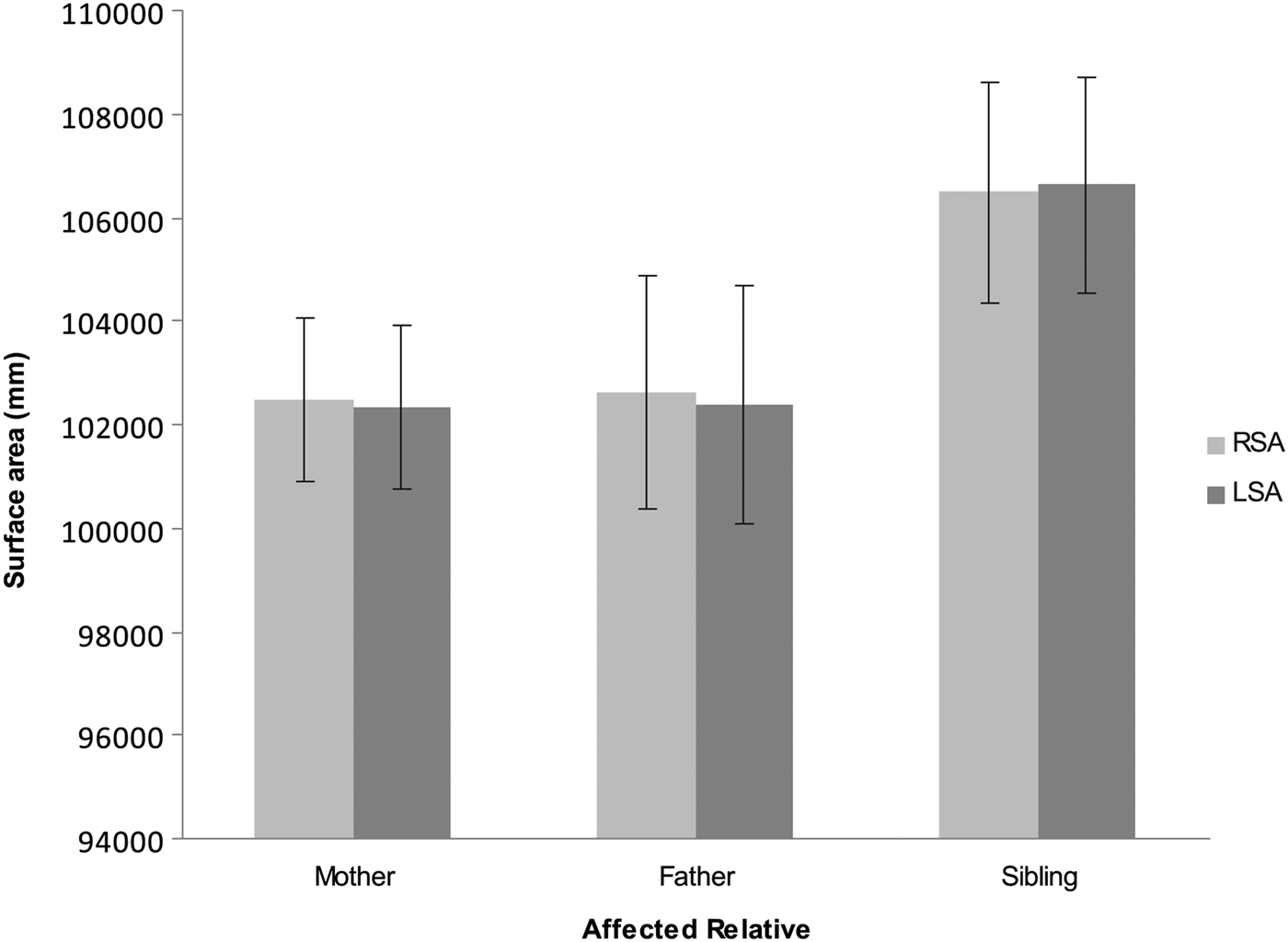
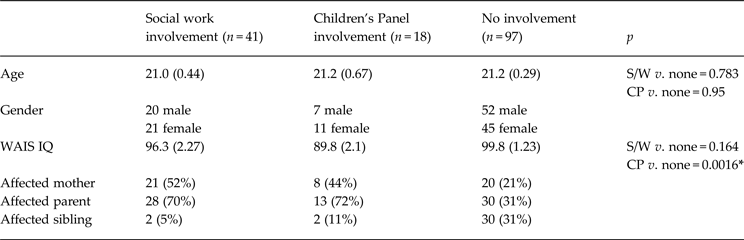
A previous examination of this population showed that those subjects with a mother or either parent affected by schizophrenia were significantly more likely to have social work involvement or be in foster care compared to those with other family histories (Johnstone et al. Reference Johnstone, Abukmeil, Byrne, Clafferty, Grant, Hodges, Lawrie and Owens2000). The same was found to be true in the current study (see Table 1). This may suggest that those individuals involved with social work/Children's Panel had a greater genetic loading and this was responsible for the structural changes seen. It may also be that in those families where the parents were affected by schizophrenia there was a lower threshold for social work or Children's Panel referral. If it was the case that the structural changes in surface area were related to genetic loading then it would be expected that the reductions in cortical surface area would be greater for those with affected siblings and thus with greater genetic load than those with affected parents. This was not the case (see Fig. 1). This suggests that the differences found in this study are more likely to be attributable to environmental factors. There was insufficient power in this study to examine gene × environment interaction statistically but the pattern of our data suggests that those with affected parents were more likely to show an apparent effect on cortical surface area than those with affected siblings.
Graph showing the mean left and right cortical surface area (mm) of those individuals at familial high risk of schizophrenia according to the relationship to the affected individual.

Table showing population demographics for those with and without social work or Children's Panel involvement

WAIS, Wechsler Adult Intelligence Scale.
*p < 0.005.
Limitations
There were certain limitations to this study including that social work involvement and referral to the Children's Panel are indirect proxies for CA. The information was obtained from maternal history combined with the subjects’ own accounts and we do not have a clear record of the exact types of CA that occurred, how severe this was or how long it went on for. It would have been preferable to have had a more precise measure of CA such as the Childhood Trauma Questionnaire. However, this was not done at the time the initial assessments were performed. What social work and Children's Panel involvement does indicate is that in these cases the severity of abuse was sufficiently severe as to warrant intervention. This is an area that can be expanded on in future research of fHR individuals. A further limitation is the relatively small number of subjects that reported social work or Children's Panel involvement. This meant that sub-analyses of the data based on reason for referral to the Children's Panel was not possible. A final limitation of the present study is the lack of a control group, as none of the original controls recruited for this study had had referral to social work or Children's Panel involvement. Thus we could not directly infer whether those at high risk were more susceptible to the effects of CA on brain structure than a sample of healthy individuals.
These findings provide further support for the hypothesis that while genetic factors contribute to the structural changes found in individuals with schizophrenia, environmental factors, specifically CA, lead to alterations in neurodevelopment which also result in structural changes in the brain and these may contribute to the development of schizophrenia. The finding that surface area is affected to a larger extent than cortical thickness is in keeping with other findings that this is the main source of structural changes secondary to post-natal environmental influences.
Acknowledgements
This work was funded by the Medical Research Council and the Dr Mortimer and Theresa Sackler Foundation. A.M.M., S.M.L., and H.W. have received research support from Pfizer Pharmaceuticals not relating to the current article. P.C.F. received consultancy from GSK not relating to the article. H.W. received a College Fellowship from the University of Edinburgh and the John, Margaret, Alfred and Stewart Sim Fellowship from the Royal College of Physicians of Edinburgh. The Edinburgh High Risk Study was supported by the Medical Research Council.
Declaration of Interest
None.