INTRODUCTION
The Karamoja region of northeastern Uganda is a semi-arid zone home to approximately 1·2 million residents who traditionally practiced pastoral and agro-pastoral livelihoods. Internal and external factors have resulted in a shift away from animal husbandry for many households over the past decade, with diversification into town-based livelihoods, settled agriculture, and seasonal and permanent out-migration from the region. Violence associated with cattle raiding has been an entrenched part of social, cultural and economic patterns in the region for generations.Footnote 1 A sustained government programme of forced disarmament starting in 2006 has increased overall levels of stability and expanded the reach and presence of international and national organisations, boosted trade, and allowed for population movements into some areas that were previously highly insecure.Footnote 2 Although security has improved overall, crime and violence continue to plague local communities. Most of this crime is committed by young men called lonetia by their communities, their peers and themselves.Footnote 3 This paper presents new data on the lonetia phenomenon and livelihoods from the perspective of the youth themselves and the communities they reside in.
The quantitative and qualitative data were collected as part of a pilot project entitled Engaging Male Youth in Karamoja Footnote 4 which ran from October 2012 until December 2013 in select locations in southern Karamoja.Footnote 5 The project had a two-fold objective: (a) to gather information on the current state of crime and violence from the perspective of young men and their communities, (b) to test the applicability of an adapted communication and relationships programme to reduce crime and violence perpetuated by male youth.Footnote 6 This pilot was funded by the World Bank's LOGiCA Program and aimed to generate operational knowledge and to test a method for mitigating violence in the region.Footnote 7
This paper presents data and provides analysis emerging from this study, but does not entail an in-depth discussion of the intervention itself. In short, the results showed the intervention to have little clear impact on the key variable of male youth engagement in crime; instead the major trends in the variables of interest were tied to seasonal effects and government policy which affected all areas. This paper takes advantage of a rich longitudinal data set tracking male youth in Karamoja over time in order to explore the lonetia in depth: the characteristics of this group compared with the rest of the population and observed variations within the lonetia category itself.
METHODOLOGY
Mixed Methods Design
This paper uses a combination of quantitative and qualitative data initially collected for the Engaging Male Youth in Karamoja impact evaluation. The study covers the span of one agricultural year with four sets of surveys complemented by qualitative data collection. Qualitative methods included semi-structured in-depth interviews, focus group discussions (with young men, older men and women of mixed ages), and key informant interviews. The research teamFootnote 8 conducted a total of 195 qualitative interviews which were transcribed and coded for analysis. Information was gathered on respondent demographics, livelihoods, experiences of crime and violence, power relations in the community, perceptions and attitudes, and personal criminal activity. The research team collected qualitative and quantitative data in 10 parishesFootnote 9 with voluntary programme participants, who made up the survey respondents, from 18 villages across the Pian, Tepeth and Bokora populations of southern Karamoja.Footnote 10
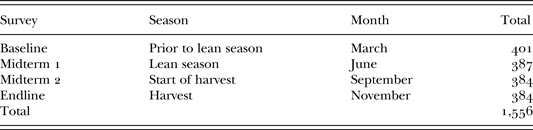
The quantitative data collection utilised a stepped wedge design where data were collected on the same respondents over four rounds of data collection in the span of one year.Footnote 11 This allowed for the collection of longitudinal data covering four time periods: right before the lean season,Footnote 12 the lean season, start of the harvest and during the harvest. A total of 1,556 surveys were conducted. The final number of respondents for whom quantitative data were collected in all four rounds was 384. Attrition from the baseline to the endline was small, with a loss of only 17 respondents (Table I).
Number of respondents by season and survey

Source: Calculations by the authors.
Analysis
Given that the data are longitudinal and hence have multiple correlated measurements on the same respondent, a mixed-effects model is ideal for analysing change over time and incorporating the design effect. All statistical analysis in this paper, unless otherwise stated, utilises the mixed effects model, controlling for time, parish level covariance and respondent level covariance over the four time periods. In order to test the role of seasonality, a polynomial model was tested with the inclusion of a squared time variable. Relationships between variables are reported as significant if the alpha value (level of significance) is lower than 0·1.
While the data collection was initially carried out in order to measure the efficacy of the intervention, the data set offers a unique opportunity to explore the changing perceptions and activity of the lonetia over the course of a year. In order to guarantee that all relationships captured in this analysis are between the key outcome variables and the lonetia, rather than possible intervention impacts, the intervention variable is consistently controlled for. All relationships captured here are significant both when controlling for the intervention and when excluding it. Furthermore, the initial programme evaluation was inconclusive regarding the intervention's impacts on theft or acts of violence. Taken together, the authors are confident that the findings presented here capture key characteristics of the lonetia rather than any intervention related impact.
Constraints
One of the central constraints to the data collection involves the self-reporting of engagement in crime and violence. We addressed this constraint in several ways. First, as discussed below, the survey included three questions for capturing lonetia activity, based on the assumption that respondents might not directly identify as lonetia but might admit to certain acts, or vice versa. Second, the FIC team was working mostly in areas where we were a known entity based on our research in the area since 2006, and much of this previous research had at least touched on issues of violence and criminal behaviour. This created a degree of trust and gave credibility to our role as unaffiliated researchers. Lastly, we used skilled enumerators and interviewers and ran an extended initial training and a later refresher course on how to conduct the surveys and how best to interact with communities and respondents. Quality control during data collection was ensured by a field research monitor who was present in the study sites. Regardless of our efforts, we assume that lonetia activity is underreported in the study data.
A second constraint was the duration of the survey. Given the importance of seasonality that came out in the analysis, it would have been beneficial to have collected data over the course of several years, covering both good and bad harvests. This would have allowed a clearer differentiation between seasonality versus overall trends, as well as the impact of different levels of food insecurity. The analysis attempted to account for this by utilising both linear and quadratic models in order to best capture the different time trends. Furthermore, the strong role of seasonality came out as significant in numerous variables, and overall trends were triangulated by gathering information from both perpetrators and victims and verified via qualitative interviews. However, future research into the lonetia phenomena should take into account the importance of intra and inter year variation by extending the length of data collection without sacrificing its frequency.
LIVELIHOODS AND VIOLENCE IN CONTEXT
Livelihoods
The population of Karamoja traditionally practiced a combination of pastoral and agro-pastoral livelihoods, balancing animal and crop-based assets through a diversified livelihood system. The region is part of the larger Karamoja Cluster, which extends into parts of western Kenya, southern Sudan, and southern Ethiopia, as well as Uganda. Karamoja is less arid than neighbouring regions; however, the climate fluctuates widely and its erratic variability in rainfall makes agriculture unsuitable as a subsistence livelihood (Ellis & Swift Reference Ellis and Swift1988, Otim Reference Otim2002, Markakis Reference Markakis2004). Although failed harvests today are often blamed on climate change, droughts were a regular event even half a century ago, with poor or nonexistent crop yields approximately one out of every three years (Dyson-Hudson Reference Dyson-Hudson1966). Given these unpredictable conditions, a system of semi-nomadic animal husbandry emerged as the most appropriate livelihood system for the extended region (Gray et al. Reference Gray, Leslie, Akol, Leonard and Crawford2002). Livestock ownership – especially of cattle – remains a prime determinant of both social and economic status (Gray et al. Reference Gray, Leslie, Akol, Leonard and Crawford2002), and livestock remain central to the collective consciousness and identity, even for those who have diversified their livelihood activities away from animal husbandry.
Livelihood roles within households and communities are differentiated by age and gender (Hodgson Reference Hodgson2000). Young men traditionally played a central role in animal husbandry and community security. Male youth in pastoral and agro-pastoral households would normally spend a substantial portion of the dry season in mobile cattle camps known as kraals, returning only as needed to the semi-permanent manyattas. Decision-making took place in conjunction with the kraal leader and other elders, but young men bore a great deal of responsibility for household well-being and food security through their management of the most valuable assets (livestock).
The last several decades have brought many livelihood shifts. Rampant internal insecurity and the breakdown of traditional allegiances curtailed semi-nomadic pastoral strategies. The growth of neighbouring agrarian populations, the tightening of national and international borders, and government policies of land management and preservation all severely limited the mobility that is central to sustainable and productive herd management. Animal ownership became less equitable and less communal (a trend that started with the massive raids in the 1980s; see Ocan Reference Ocan1992), with a growing divide between those households that were able to retain herds and those that were not. The Government of Uganda's most recent disarmament campaign (2006 to the present) fundamentally altered the ways in which communities managed and protected animals (Stites & Akabwai Reference Stites and Akabwai2010).
Overall, the erosion of the broad livestock base and associated livelihood system has left households and communities increasingly impoverished and more vulnerable to food insecurity brought on by failed harvests and other shocks that are common to the region. These livelihood changes have brought particular challenges for young men. As herds have dwindled or disappeared, many young men have lost their predominant and essential role as providers for their households and as protectors of their families and assets. FIC research over the last eight years indicates that young men who had lost their cattle-based livelihoods were increasingly described by other groups and by their peers as ‘idle’ and ‘without purpose’. When combined with the cultural and historical patterns of violence that were deeply imbedded in male livelihood strategies, a situation is created whereby young men are at high risk of seguing back into criminal and violent behaviours.
Crime, Violence and Security
Violence is not new to Karamoja. Cattle raiding has long been a part of pastoral livelihoods systems in eastern Africa. Raids fulfilled important social, political and economic functions within the pastoral system, as evidenced in the following quotation from the work of Kennedy Mkutu with a Karimojong elder: ‘Raiding was not just a means of restocking, but it was also an ancient form of wealth redistribution among the Karimojong. It is a traditional and central form of restocking. Young warriors were compelled to accumulate cows in order to gain status. Their respect depended on the number of successful raids' (Mkutu Reference Mkutu2008: 17).
Prior to the widespread availability of firearms, young men fought with spears and bows and arrows in carefully planned and orchestrated raids, the extent and intensity of which were regulated by the elders (Gulliver Reference Gulliver1953; Dyson-Hudson Reference Dyson-Hudson1966). Casualties occurred but were kept to a minimum through a ritualised fighting process that included advance warning of the attack and prohibitions on harming women, children or the elderly (Lamphear Reference Lamphear, Kurimoto and Somonse1998; Akabwai & Ateyo Reference Akabwai and Ateyo2007; Mkutu Reference Mkutu2008).
Historically, large-scale raids most commonly occurred among ‘traditional enemies’ – i.e. the Karimojong of southern Karamoja were most commonly in conflict with the Jie, Turkana and Pokot. The national and political upheaval of the 1980s led to a period of pronounced pillage by raiders from Karamoja of the neighbouring districts of north central Uganda. The influx of raided cattle into Karamoja introduced new strains of tick-borne disease to which the local herds had no resistance; large numbers of animals subsequently died. The tensions and upheavals of the 1980s also brought the start of conflict among groups within Karamoja that had previously experienced only small-scale thefts and problems that could largely be addressed by negotiation among the elders. The most notable disintegration of relations was in southern Karamoja within the Karimojong ethnic group; by the 1990s violence among the Bokora, Matheniko and Pian was pronounced, with implications for the neighbouring Tepeth.
Violence associated with cattle raiding or defending against raids was almost exclusively practiced by male youth. Violence practiced by young men became increasingly widespread and destructive in the 1990s and 2000s for a number of (largely cyclical and reinforcing) reasons: traditional institutions that had once mitigated violence were weakened (Stites Reference Stites, Tripp, Marx Ferree and Ewig2013a); weapons flowed into the region from neighbouring states (Mkutu Reference Mkutu2008); and acquisition and defence of livestock became more critical, charged and violent as the assets became increasingly scarce. In the words of a Sandra Gray, an anthropologist who was one of the few scholars conducting fieldwork during the extreme insecurity of the 1990s:
[I]t is clear that AK-47 raiding seriously constrained the bio-behavioral adaptability of the Karimojong in the last decades of the 20th century. Through its effects on seasonal migrations, subsistence activity, the structure of marriage, and the stability of social networks of the Karimojong, as well as on the operation of trade routes in and out of the district and on health care delivery, armed cattle raiding emerges as the critical factor in recurring famines and epidemics in Karamoja since the 1970s. (Gray et al. Reference Gray, Sundal, Wiebusch, Little, Leslie and Pike2003: S21)
Until very recently, the Ugandan government's most consistent policy towards Karamoja has been disarmament, followed by attempts to limit cross-border movement of people and animals.Footnote 13 Disarmament exercises have taken place regularly since 1911 but with little sustained impact. This appears to have changed with the disarmament campaign that began in 2006. The most recent campaign involved greater stakeholder consultation and an overt effort to protect assets of those communities that had been disarmed (a main complaint of previous efforts) (Bevan Reference Bevan2008). This resulted in the emergence of the so-called protected kraals, whereby herds were (and in many places still are) kept in often extremely large kraals adjacent or near to military barracks. While limiting losses from raids, the protected kraal system has brought a decline in animal health and an increase in mortality due to overcrowding and limited access to appropriate dry-season grazing and/or water sources. Of particular relevance, young men saw their roles as protectors and managers of the herds supplanted by soldiers (protectors) and the small boys who were allowed access to the herds for daily grazing (the older youth had mutually suspicious relations with the military) (Stites & Akabwai Reference Stites and Akabwai2010).
Importantly, research from 2006 to 2012 by FIC indicated a general rise in insecurity as a direct consequence of the disarmament campaign. This trend was due to the uneven nature of the disarmament, which left some communities unprotected.Footnote 14 In addition, this time period saw the rise in small-scale but often still violent criminal behaviour, a phenomenon that respondents attributed to lonetia.
The term lonetia refers to the (exclusively male) thieves who steal assets from homesteads, normally at night and through forced entry. Crimes by lonetia emerged subsequent to the start of the 2006 disarmament and in response to the known absence of weapons for self-defence. Although difficult to quantify, crimes by lonetia appeared to rise in the years following the start of disarmament; this was in parallel to the decrease of large-scale cattle raids over the same time period. The decline in raids was due to the progression of disarmament in geographic coverage and depth,Footnote 15 and to the steady loss of animals to disease or distress sales as a result of the protected kraal policy and weakened systems of animal husbandry.
In contrast to the accolades and tributes for cattle raiders of previous decades, discussion of lonetia is marked by general disdain and aggravation. Somewhat surprisingly, young men in the study population did admit to theft and/or outright involvement (by name) in lonetia activity. Violence often but not always accompanies the theft; a rise in sexual violence against women and girls does appear to correlate with the rise of lonetia attacks. In the research for this study, all of the crime and violence was described as being committed by the lonetia. Put another way, respondents no longer talked about ‘raids’ or ‘raiders’ and blamed all acts on the lonetia or ‘thugs’.Footnote 16
Importantly, although respondents continued to raise security as an issue, by 2013 and as supported by the qualitative data for this study, security appeared to be consistently if gradually improving in the study sites. Lonetia attacks continue but are relatively fewer in number in comparison to two or three years earlier, and both male and female respondents are able to engage in livelihood activities such as gathering firewood, going to market, and herding livestock with relative security – a marked change from 2009–2010 in the same area (Stites & Fries Reference Stites and Fries2010).
FINDINGS
We gathered data on lonetia behaviour in the four rounds of surveys with the male youth sample and triangulated these through qualitative interviews. Youth differed in their willingness to self-identify as lonetia, and hence we constructed variables to measure and record lonetia activity in the quantitative data:
1. Respondent reported having stolen livestock in the past two months and/or,
2. Respondent reported having stolen assets in the past two months and/or,
3. Respondent identified lonetia as one of the livelihood activities carried out to support themselves or their family.Footnote 17
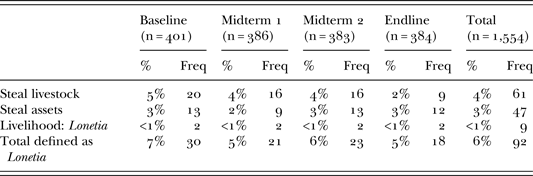
Based on the above variables, Table II illustrates the frequency and percentage of lonetia who appeared in the sample across the data collection periods.Footnote 18
Respondent reported stealing livestock, assets, and/or identified their livelihood as Lonetia in the past two months, by per cent and frequency
Source: Calculations by the authors.
As discussed in more detail later, the data illustrate that the category of lonetia is very fluid: most of the respondents categorised as lonetia through the quantitative variables do not steal across all periods. In other words, the numbers defined as ‘lonetia’ in the Table II are not always the same respondents across the four surveys. Qualitative data support this variation by time period: many young men talk about engaging in lonetia activity in previous periods but not at present.
Approximately 14% of the respondents qualified as lonetia at some point over the course of the study. In other words, 55 different men identified as lonetia at least once across the four rounds of data collection, based on the three variables listed above.
Marriage and Purchasing Power of Lonetia
Marriage is a central component of personal identity as well as household livelihood strategies, but traditional marriage in Karamoja requires the transfer of a large number of animals in bridewealth.Footnote 19 We examined marriage patterns among the study population in order to understand economic and social differences, with associated implications for livelihood strategies. All respondents said that the desire to marry is an economic stress that contributes to a young man's need for income. Official marriage requires wealth in the form of cattle, but a male youth respondent also pointed out that having wealth is important in order to attract a suitable mate in the first place: ‘Also, marriage, you need to officially marry. A woman is unique. A woman won't marry someone poor. If a man has all his teeth in his mouth, it means he has money, but when they say this man has no teeth, then he has no money and they won't want to marry you’ (Male youth 9.9.2013 int.).
While lonetia were no more or less likely to be officially or unofficially married than the study population as a whole, lonetia respondents were significantly more likely to say they planned on getting married in the next year. When examined over time, the rate of planned marriages stayed steady for the lonetia sub-set while significantly declining for the overall sample. Lonetia were also more likely than the general population to say that they expected to pay the pregnancy price (ekicul) in the next year (paid to the potential bride's family after she conceives a child).Footnote 20
The lonetia may be more likely to expect to marry for any number of reasons, including that they are more traditional in their viewpoints, that they are already in a better financial position (possibly through lonetia activities), or that they assume that they can acquire assets relatively easily through theft. As discussed further below, lonetia felt significantly more powerful (present and future expectations) than the study population as a whole. This sense of power may contribute to their optimistic expectations for marriage. The combination of their expected economic needs and their perceptions of their power may be driving the involvement of the lonetia in (at times violent) crime.
We analysed the extent to which respondents provided for their households. The data show that respondents in general were more likely to provide food, medicine and medical care for humans, medicine for animals, or clothing as the year progressed. While lonetia were no more or less likely to provide any individual item, they were significantly more likely to provide a larger number/variety of these goods than non-lonetia. In addition, lonetia households were significantly more likely than non-lonetia households to have purchased large livestock, guns or spears, and beads or jewellery; this variable decreased for the population as a whole but remained steady for lonetia.
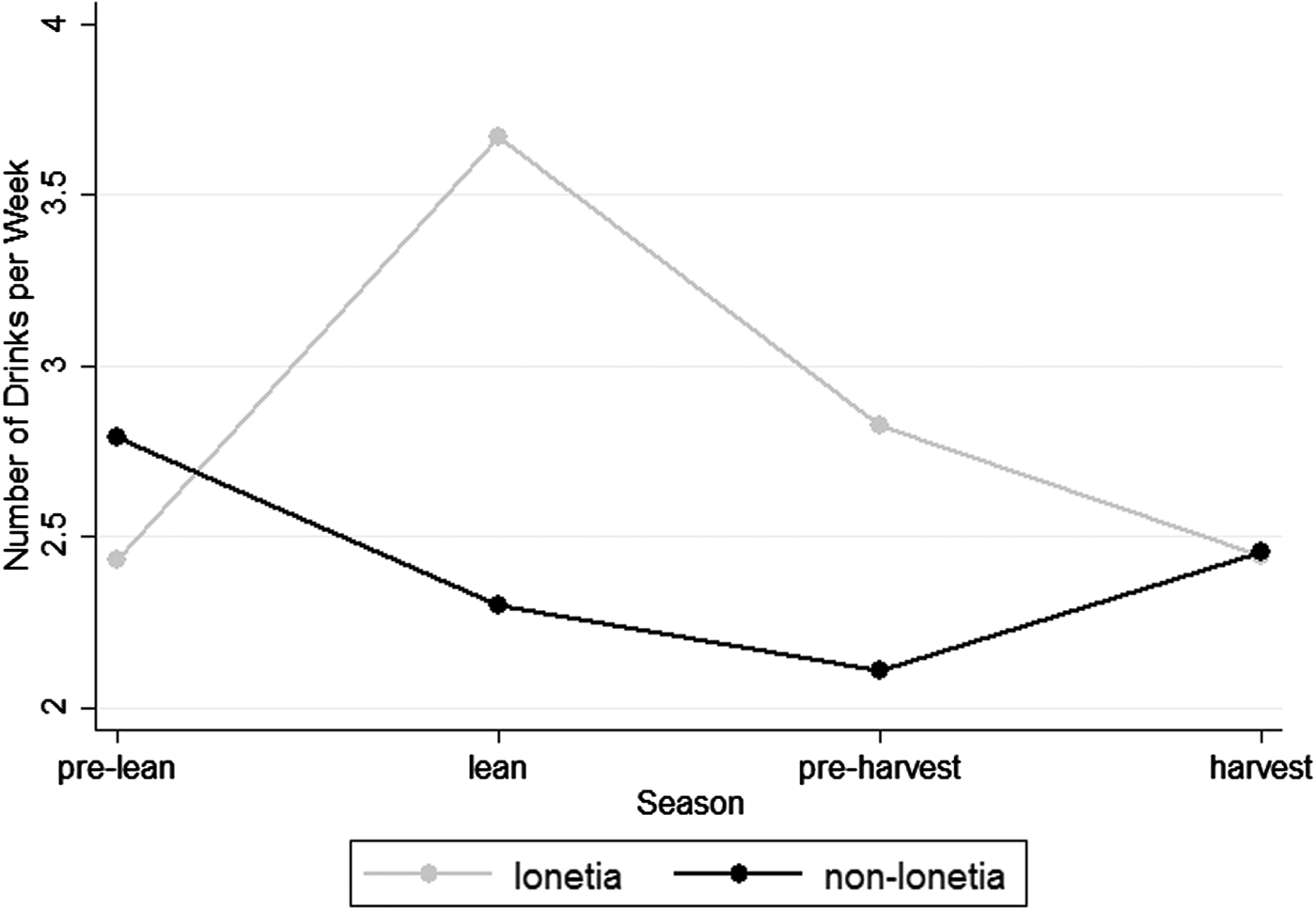
Related to purchasing power, we also found significant differences around alcohol consumption for lonetia. While 94% of the respondents reported the consumption of alcohol, there was variation by the number of drinks consumed and a significant seasonal effect. During the lean season (captured in the two midterm data sets) alcohol consumption dropped off and only rebounded late in the harvest season. For the lonetia, however, the boon in income as evidenced by alcohol consumption follows the opposite pattern – they consume significantly more alcohol during the hunger gap period (Figure 1). This pattern corresponds directly to the pattern observed in increased incidences of reported lonetia theft by victims during the hunger gap and decreased theft with the arrival of the harvest.
Alcohol consumption, by season and lonetia (Source: Authors).
The combined evidence on lonetia marriage, purchasing power and alcohol consumption is important for two reasons. First, these findings demonstrate that lonetia have more ready and regular disposable income than non-lonetia. They are more likely to plan to marry, they were more likely to plan on making at least one form of marriage-related payment to the bride's family, they are more likely to procure food and services for their families, and they purchase more alcohol for their own consumption. The common element across these variables is cash: the lonetia either already have it or have means to acquire it that are somehow different from the non-lonetia population. Perhaps most tellingly, the graph on alcohol consumption illustrates that the lonetia have more access to cash in periods during which the rest of the population has less access to cash. Second, taken together these patterns confirm common characteristics across the lonetia and provide further evidence that these individuals are engaging in specific and unique behaviours. These behaviours imply that they are lining their pockets through means not practiced by those who are not lonetia.
Community Status and Interactions
The data show that lonetia felt more powerful when compared with other members of their communities, both now and in regard to how they expected to feel in the future.Footnote 21 While feelings of power declined for the population as a whole during the length of the study, they stayed relatively consistent for the lonetia. However, just as important, there was no significant difference when asked about their level of respect in the community or the quality of their life now and one year from now; these declined identically for both the lonetia and non-lonetia over the four surveys. This demonstrates that being a member of the lonetia does bring a greater sense of power for young men, but that this power does not translate to the amount of respect they perceive to be receiving. Put another way, these young men appear to recognise that their criminal actions are not boosting their standing within their communities – this is in marked contrast to the ways in which raiders were lauded a generation ago. Furthermore, even though the data indicate that lonetia have more disposable income, are more likely to officially marry, and can better support their families, the young men who identify as lonetia do not feel that these aspects translate into a better quality of life, nor do they predict this to improve. We posit that both community members and young men themselves view engaging in lonetia behaviour as shameful and as a less-than-ideal livelihood option. This is supported by the shifts in language applauding the bravery of successful raiders to that castigating the lonetia, as illustrated by a quotation from a focus group discussion with male elders in Lorengedwat: ‘Today youth have guns and kill women, children, and their own parents. Youth also rape girls and the one who tries to rescue [the girl] is beaten. Youth do not respect their elders and parents and have taken to alcohol!’ (Male elders 11.4.2013 int).
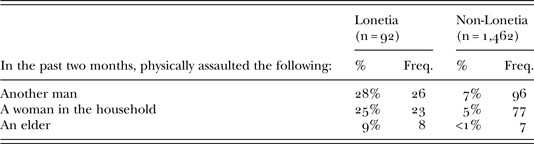
A final distinction of the lonetia was their likelihood to use physical violence at a significantly greater rate than non-lonetia. This violence could be against other men, women in their household, or elders (Table III).
The Lonetia and propensity for violence
Source: Calculations by the authors.
These findings indicate a clear correlation between propensity for theft and propensity for violence. This relationship could occur in at least two ways. First, those men who are lonetia may be the most likely to engage in physical violence due to personality traits and interpersonal relationships. Second, the criminal act associated with being a lonetia (such as theft of livestock or assets) may itself entail violence. In other words, the individual man might be referring to the same act (or acts) in response to the question that categorises him as a lonetia and in regard to his recent engagement in violence. While the data unfortunately do not contain more detail, we posit that this correlation points to a combination of these two aspects. As discussed further below, a certain type of individual is more likely to be a lonetia, and these characteristics very likely also correspond to more violent behaviour and more conflict-prone relationships. This overlap comes out the most clearly in the data regarding physical violence against an elder, which is a major taboo in the hierarchical social order of Karamoja. Even though the proportion of lonetia respondents who admit to assault on an elder is small, this action is more or less unheard of among the non-lonetia population. The link between lonetia and violence against elders is reinforced below in Figure 4. Lastly, the pervasiveness of and exposure to violence in Karamoja means that physical violence is readily employed and is a common part of acts of otherwise minor thefts. A group of women in Lotome explained that the lonetia came at night, perhaps after having shared food and drink with their victims during the day, and often use violence:
Late in the evening is when he comes in darkness … at daytime you are together with one [lonetia] and we drink, and then at night he says to me ‘you bring me that saucepan, that food you have’ … [You] can't recognise their face at night, and they flash a torch in your face so you can't see and they beat you with sticks so it's just the sound [of beating] you hear and you are beaten. (Women focus group 8.4.2013 int.)
This and other examples of lonetia abuse committed in the course of a crime argue that much of the violence shown in Table 3 above does, in fact, correspond to the lonetia crimes occurring in the same time period.
Fluidity and Differentiation
One of the most interesting findings regarding the lonetia is the high degree of fluidity within this category. Young men moved in and out of the lonetia category over the course of the study – in other words, most are not consistently engaging in lonetia acts over the four time periods. There were 92 observations of lonetia across the four data collection periods. Most of the men (60%) who were identified as lonetia only met the criteria one time. The data on repeat offenders (those who qualified as lonetia more than once) are as follows: 20% were identified as lonetia twice, 13% were identified as lonetia three times, and 7% were identified as lonetia all four times.
Those within the lonetia category share defining characteristics, but there was also significant differentiation along the spectrum of lonetia activity (i.e. ranging from one-time offenders to those who qualified as lonetia in all four time periods). Several patterns are of particular interest. First, more frequent lonetia offenders – specifically those that reported stealing on three or more occasions – were significantly more likely to report being officially married: 45% versus 20% of the total population. As discussed earlier, the correlation between being married and being a lonetia may be due to the more ready access to wealth and assets enjoyed by lonetia members; this hypothesis is supported by this finding.
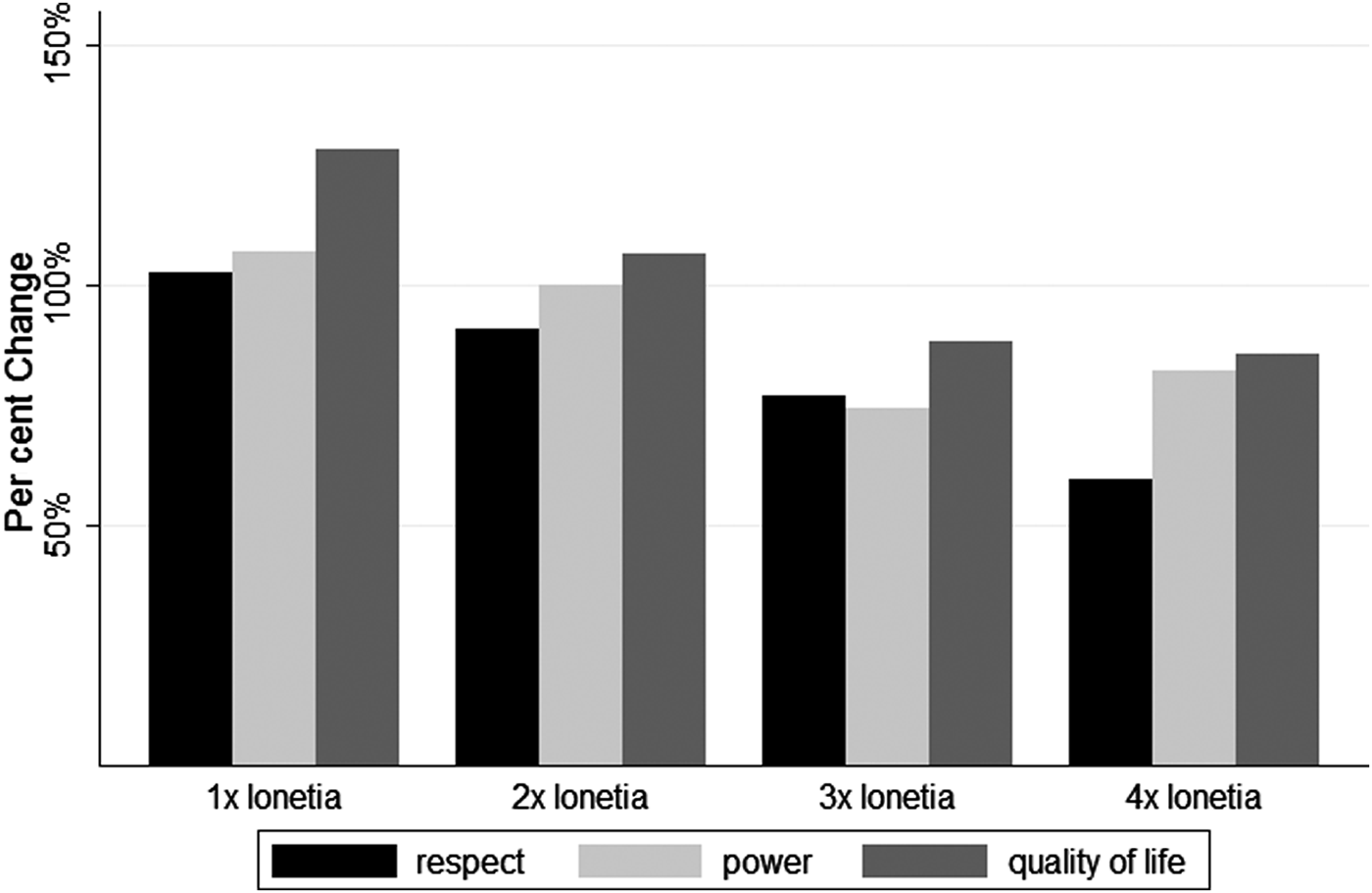
Second, the frequency of lonetia activity correlated with perceptions of the future. All respondents in this study envisioned having an improved future, but the lonetia that only reported stealing once expected significantly greater improvements in their quality of life and increased feelings of respect one year in the future: this surge in positive feeling in regards to improvements in quality of life was particularly high at the time period of reporting theft. In contrast, the more times an individual stole, the less likely he was to envision a difference between his present and future circumstances (Figure 2).
Difference in power, respect and quality of life between now and the future, by frequency of lonetia activity (Source: Authors).
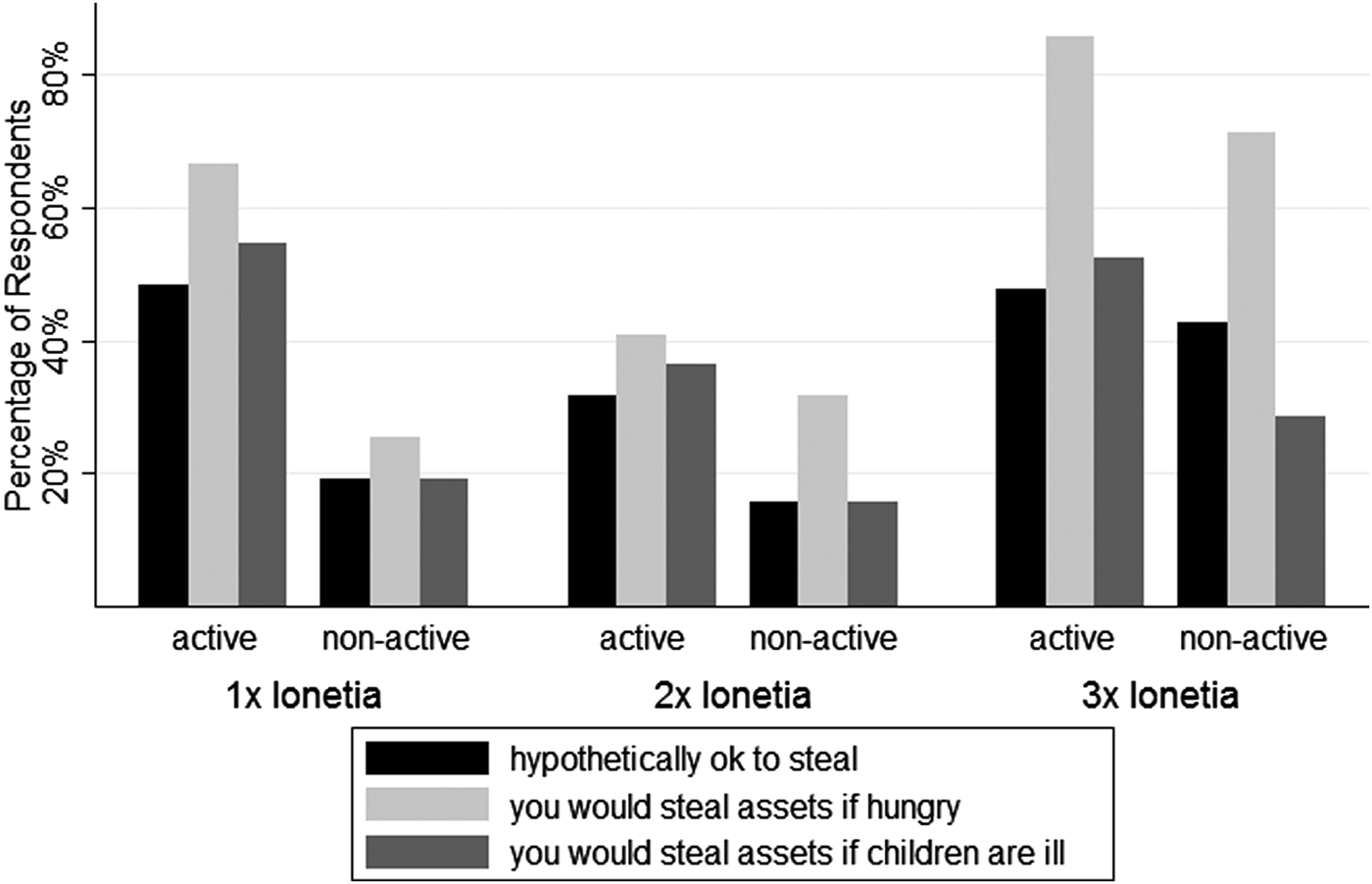
Third and not surprisingly, lonetia opinions on the morality of theft corresponded to how often they stole over the course of the study. The more an individual engaged in lonetia activity, the more likely he was to believe it was acceptable to steal when hungry or if his child needed medical care. However, the lonetia that reported only stealing once changed their views on stealing depending on whether or not they had stolen in a given time period (Figure 3). For the one-time offender, views on morality of theft switched significantly in conjunction with engaging in the act: when he steals, he perceives this as acceptable, when he doesn't steal, he views theft as wrong.
Hypothetical theft, by lonetia frequency (Source: Authors).
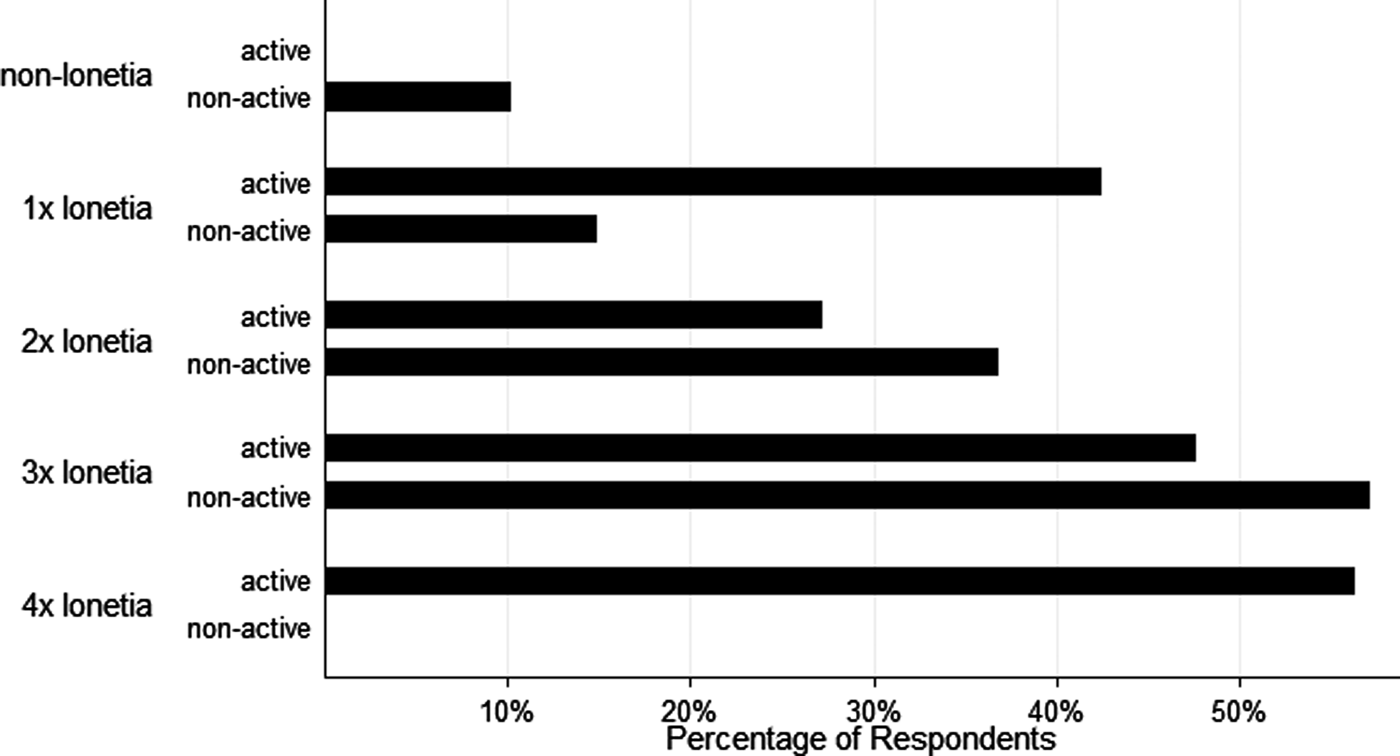
Lastly, just as there is a clear correlation between being a lonetia and engaging in violence (Table III), there is also a significant and positive relationship between frequency of theft and frequency of violence. The more often an individual stole, the more likely he reported a general physical altercation (Figure 4). For the one-time offenders, the extent of the difference of engagement in violence between periods of theft and non-theft is so great that there is a significant difference between when stealing and not stealing, and no significant difference in their propensity towards violence when not stealing compared with an average non-lonetia respondent. For the two, three and four-time offenders, on the other hand, we see the use of violence steadily increase in conjunction with the frequency of theft and no significant difference in violence between when they are actively and non-actively stealing.
Physical violence, by lonetia frequency (Source: Authors).
Two trends stand out in this discussion of fluidity of lonetia identity. First and as mentioned earlier, certain characteristics adhere to a clear continuum based on frequency of reported lonetia behaviour. Second, one-time offenders – who make up the bulk of lonetia observations – morph between those characteristics that resemble the average lonetia and those that resemble a non-lonetia¸ depending on whether or not theft took place in a given time period. In other words, these individuals are adjusting their actions, their beliefs, and their perceptions of self (based on measures of optimism for the future) in conjunction with their lonetia behaviour.
Motivating Factors
For the small group of lonetia in our sample who reported stealing livestock and assets four times during the study, theft appears to be an integral component of their livelihood. Of these respondents, 75% of them also self-reported that being a lonetia was one of their most important livelihood activities. This is further supported by the fact that frequent lonetia were significantly more likely to report converting the stolen assets into cash, rather than food or other uses, compared with the more infrequent lonetia. In other words, theft appears to be functioning as an important and relatively effective livelihood strategy for these individuals: they are more likely to be married and they are more likely to convert their loot to cash to meet their or their household's needs. That said, this strategy does not appear to bring sustainable satisfaction, as evidenced by the declining optimism for one's future and perceptions of current power as the frequency of theft increases.
In contrast, poverty appears to drive occasional theft. This is widely supported in the qualitative data, with men and women of all ages listing ‘hunger’ as the primary motivation for theft. Young men themselves confirm this, and often describe engaging in a crime out of desperation to provide for their families. This is captured in the notes from a focus group discussion with young men in Lorengedwat Sub-county: ‘The youths said lonetia are youths whose families are very poor and would want to help their parents but have no option but to steal. They steal because they don't want their children and parents to starve to death. These are youths whose children cry for food and milk’ (Male youth 13.4.2013 int.).
While hunger and poverty are clearly important drivers, another common justification for theft ties into pride and the nature of masculinity in Karamoja. Manhood in the region is bound to social hierarchy and economic status, which, as discussed earlier, is linked to one's ability to marry, procreate and provide for a family.Footnote 22 For many young men, masculinity is also closely tied to a warrior identity that was developed and promoted through folklore, the historical importance of raids as both a means of crisis-recovery and a way of conferring, in the words of Lamphear, an ‘assertive masculinity’ upon the raiders (Dyson-Hudson Reference Dyson-Hudson1966; Spencer Reference Spencer1976; Lamphear Reference Lamphear, Kurimoto and Somonse1998). In addition, some respondents made distinctions between ‘traditional’ and ‘non-traditional’ male youth. They explained that a traditional male youth was less likely to have attended school, was more likely to marry young and to take multiple wives, and more likely to produce many children. In contrast, non-traditional male youth were more likely to have attended school, to live outside the village, and to have access (or perceived access) to formal employment.Footnote 23 Both male and female interviewees were quick to say that traditional youth were more likely to engage in raids or thefts as part of a livelihood strategy, and to link this to a need to bolster pride. This was explained by one young man: ‘What [leads] traditional male youth to be thieves is they need pride, because being rich, being with animals in the community, gives you pride. If your animals have been stolen, you need to retaliate, that's when your heart will feel good’ (Male youth 9.9.2013 int.).
There are multiple and intertwined possible explanations for lonetia engagement. Motivations are likely complex even for a given individual and may change over time. The quantitative data indicate a possible continuum in the type of individual and motivating factors that separate out the lonetia from the non-lonetia, and the one-time lonetia from the repeat offenders. More research and a larger sample over a longer period of time would be required to parse out the individual influencing elements.
Trends in Lonetia Activity
Time trends vary depending on the perspective – i.e. self-reported theft by lonetia decreases in a linear fashion (from 7 to 5%), while victims report an overall increase of theft from the baseline to the endline (from 7 to 17%).Footnote 24 Disaggregating this information demonstrates the importance of seasonality and the likely influence of national and local policies.
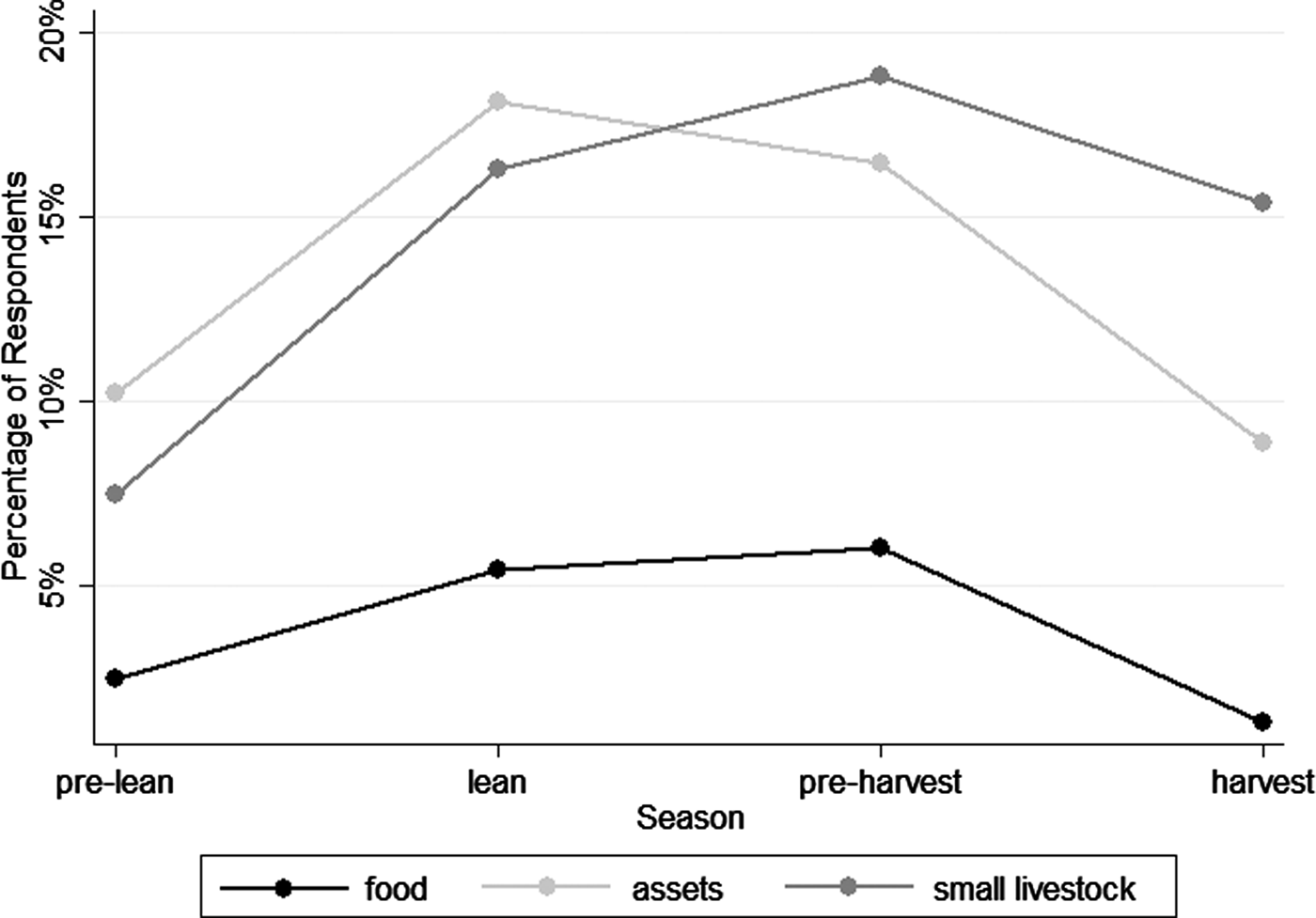
Seasonality emerges as a particularly important determining variable related to security. Reports of theft by victims follow a clear and significant seasonal pattern resembling an inverted-U (tested via the inclusion of the original and squared time variable in the mixed effects model). Theft increases during the two periods of time overlapping with the highest levels of food insecurity – the beginning of the lean season and immediately prior to the harvest – and begins to decline as harvesting is concluded (Figure 5). The quadratic, rather than linear, relationship follows the expected decrease and then increase in food security and was significant for the theft of food, assets and small livestock. Similarly, respondents' perceptions regarding the safety of their small livestock followed the same pattern, with the greatest concern regarding security of these assets occurring during the lean and pre-harvest seasons. The seasonal shifts in security support the earlier finding that many thefts are motivated by hunger. This trend was likely exacerbated by the poor harvest during the research year.Footnote 25
What was stolen, by season, as reported by victims of theft (Source: Authors).
Reports of self-reported theft by lonetia do not follow this same seasonal trend, but instead decrease in a linear fashion over the four data collection periods. To note, this overall decrease in theft is driven primarily by the drop in theft of large livestock over the course of the study; self-reported theft of food, assets and small livestock stayed relatively consistent.Footnote 26 The decline in reported theft of large livestock is noteworthy and is likely driven by related policy shifts at the national and local level that occurred over the course of the study. In July 2013 the local commander of the Uganda People's Defence Force (UPDF), in conjunction with local communities, instituted a policy whereby two heads of cattle had to be repaid for every one stolen (referred to as the ‘two-for-one’ policy by respondents and also known as the Nabilatuk Resolution). If the stolen cattle are tracked to a specific community, the community must then either turn over the perpetrator or suffer the punishment collectively. The community can either willingly release twice the number of stolen cattle or the UPDF will forcefully take animals at random. Respondents widely cited this policy as having a strong deterrent effect on cattle theft from July 2013 onward.Footnote 27
In addition and perhaps more importantly, male and female respondents reported in qualitative interviews that the new two-for-one policy instigated a shift in the relationship between the male elders and male youth. Many respondents in this and previous studies reported that customary systems of authority have eroded in recent decades. This is due to a variety of factors, including tensions surrounding the succession of power from one generation of men to the next; this is often cited (and debated) as a factor in the violence perpetrated by male youth in pastoral societies in the Karamoja Cluster and beyond (Dyson-Hudson Reference Dyson-Hudson1966; Gray Reference Gray2000; Knighton Reference Knighton2005; Stites Reference Stites2013b). However, the two-for-one policy seemed to catalyse the authority of the male elders, who were loath to see their communities lose animals. Male elders in Lotome reported that the two-for-one policy led to an overall decrease in theft, and that it ‘made the going very difficult for the male youth’ who had previously ‘survived on lonetia activity’. These elders added that they are seeing broader improvements in behaviour:
Male youth have now settled and have returned home nowadays. Their parents see them every day. The youth also tell their parents where they are going. They listen to their parents. They also bring their girls home to their parents rather than hiding them away. Their parents are able to guide them and counsel them. All groups sit under one tree and chat together with their parents. Before they used to leave early and come late or never come to sleep home. Because of this they were alone, separated from the family and could plan to do bad things. (Male elders 2.9.2013 int.)
Elders have reportedly been able to tighten their control over male youth. Respondents speak of the return and enforcement of ameto against alleged perpetrators, a system of collective physical punishment against the youth. Ameto for young men requires a man's peers to beat him upon instructions from the elders (Muhereza et al. Reference Muhereza, Ossiya and Ovonji-Odida2008; Gray Reference Gray2010); this brings shame (and physical pain) for the youth and annoyance for his peers, and hence the reinstitution of this penalty may have served as an effective deterrent.
The combination of the two-for-one policy and the increased role of the elders in implementing traditional forms of justice appear to have combined into an effective deterrent against cattle theft for the average youth. In addition, this may lead to an overall decrease in lonetia activity, but additional data would be required to confirm this pattern. Over half of all male youth respondents in qualitative interviews admitted to raiding cattle in the years prior to the start of this study (early 2013). The quantitative data find that this number (although likely biased downward) had dropped to 2·3% by the end of the data collection period. However, as identified in the above sections, there are multiple variations between the one-time and repeat lonetia offender, including important differences in apparent motives for the theft. The more frequent lonetia was significantly more likely to have reported stealing livestock, no matter the time period, even as the overall trend in lonetia activity declined. For these men, theft is an integral part of their livelihood – they steal no matter the state of their food security or the level of policing or current strength of customary justice. In contrast, for the one-time offenders theft is probably one of many coping strategies used to support themselves and their households during times of hardship. For the latter, the cost of stealing cattle now likely outweighs the possible gain.
CONCLUSION
For outsiders, Karamoja has long been viewed through a security lens, as levels in security have determined access, whether the nature of the desired access be for humanitarian, political, missionary, development, private sector investment or academic purposes. For communities, households and individuals within Karamoja, security has been not simply a consideration, but an over-arching and fierce determinant of daily life, social and political relations, economic choices and opportunities, and basic survival. From the outsider perspective, security in Karamoja has improved drastically since the start of the 2006 disarmament programme. Evidence collected over the years from local communities made it clear that these improvements were not nearly as uniform, far-reaching or widely enjoyed as may seem to be the case from the decrease in reports of road ambushes. While large-scale raids had decreased, there was a rise in small-scale and often-times incessant crime, including acts that took place within homesteads and that targeted essential and productive household assets. The lonetia were the alleged perpetrators of these acts, but this vague moniker was difficult to quantify. This paper aims to shed light on this more recent form of insecurity in the region and to examine this largely from the perspective of the perpetrators.
Overall, the motivation at the core of most lonetia activity is the desire to support and provide for one's family. Loot from theft is used to provide for households. While there is a short-term increase in expectations for a better life, these feelings erode as theft becomes more frequent and more entrenched within livelihood strategies.
Seasonal changes drive both household food security and livelihood options. This study identified just such a seasonal trend in lonetia activity and household theft. Theft of most items – assets, food and small livestock – followed an inverted-U curve pattern increasing during the most food insecure periods and again declining when food insecurity and other livelihood options became available.
There is significant variation along the spectrum of lonetia. For most lonetia, the drivers of theft appear to be food insecurity and lack of livelihood options, not a completely different understanding of the morality of theft or violence. This implies that carefully designed programming and community interventions, particularly during the lean season, may be able to curb lonetia activity and decrease theft. Furthermore, given the strong link between theft and violence at the time of stealing for the one-timers, a well-placed and designed programme would not only reduce the rate of theft, but also possibly the rate of violence.
Such interventions should target young men before they engage in lonetia activities and experience the rush in future optimism that is associated with one-time theft. As lonetia activity peaks during the hunger gap, programmes should start before this period and include both psychosocial support and livelihoods programming to bolster household food security and provide otherwise ‘idle’ young men with activities and, potentially, a sense of purpose. It is unlikely, however, that such interventions could have an impact on the more hard-core lonetia. This is a group for whom stealing is a form of livelihood –they do not receive any thrill from the activity, but they also do not see anything morally wrong with engaging in these acts, even in periods when they are not stealing. The disarmament and associated UPDF policies have not had a major impact on the activities of this group to date. It is yet unclear if the resurrection of some of the traditional justice mechanisms will act as a deterrent for this hard to reach group. Ultimately, the most effective means of change will likely be policies that support and protect pastoral livelihoods in a way that allows for the legitimate amassing of animals and vibrant systems of animal husbandry.