When assessing outcomes after congenital heart surgery, it is no longer sufficient to report only mortality and morbidity in terms of re-interventions. As survival improves for even the most complex heart defects, it is also important to know: What quality of life and what kind of challenges are these children facing, not only during childhood, but also when growing into adulthood? Some studies show that these children are at risk of impaired quality of life and psychological maladjustment.Reference Spijkerboer, Utens, De Koning, Bogers, Helbing and Verhulst1–Reference Landolt, Valsangiacomo Buechel and Latal3 Other studies show that quality of life is just as goodReference Ekman-Joelsson, Berntsson and Sunnegardh4, Reference Hovels-Gurich, Konrad and Wiesner5 and maybe even betterReference Culbert, Ashburn and Cullen-Dean6 than in normal children. However, most of these studies focused on selected defectsReference Spijkerboer, Utens, De Koning, Bogers, Helbing and Verhulst1, Reference McCrindle, Williams and Mitchell2, Reference Ekman-Joelsson, Berntsson and Sunnegardh4–Reference Culbert, Ashburn and Cullen-Dean6 or were based on parent reporting.Reference McCrindle, Williams and Mitchell2, Reference Ekman-Joelsson, Berntsson and Sunnegardh4, Reference Hovels-Gurich, Konrad and Wiesner5 Reviews have underlined the need for further research, especially with focus on self-reporting.Reference Latal, Helfricht, Fischer, Bauersfeld and Landolt7, Reference Pike, Evangelista, Doering, Koniak-Griffin, Lewis and Child8
In this study, we applied the validated Child Health Questionnaire to assess self-perceived physical and psycho-social well-being in a group of children and adolescents following previous surgery for congenital heart disease. The findings were compared with a population of schoolchildren. The association between physical and psycho-social outcomes, demographic and clinical factors was explored.
Methods
Study population
All children undergoing surgery for congenital heart disease at Aarhus University Hospital – Skejby, Denmark, between 1996 and 2002 were considered for inclusion in the study. The catchment area for congenital heart surgery is the Western part of Denmark with a population of three million inhabitants, resulting in a caseload of approximately 145 surgical procedures per year in children 15 years of age or younger. The children were identified using a clinical database in the intensive care unit, which was also used to identify prospectively collected pre-, peri- and post-operative information from the first operation in this period. Vital status was determined with the Civil Registration System that keeps daily updated records on changes in vital status of all Danish citizens including changes in address, date of emigration and death since 1968.Reference Pedersen, Gotzsche, Moller and Mortensen9 The National Danish Registry of Patients was used to determine subsequent operations and catheter-based interventions which were characterized as re-operations or re-interventions, if performed less than 30 days after an index procedure. This registry captures data on all discharges from hospitals in Denmark since 1977 including dates of all admissions, diagnoses and performed procedures.Reference Andersen, Madsen, Jorgensen, Mellemkjoer and Olsen10
The children were eligible if they were 10–20 years of age at the time of ongoing cross-sectional follow-up between December, 2007 and September, 2008; living in Denmark; had a civil registry number – a unique personal identification number given to all Danish citizen upon birth; could understand Danish well enough to complete the questionnaire; and did not have syndromes or mental disabilities precluding them from direct participation.
Informed consent was obtained from all study subjects and their parents. The study was approved by the Danish Data Protection Agency (record number 2007-41-0771).
Child health questionnaire
The Danish Child Health Questionnaire, Child Report version 87,Reference Landgraf, Abetz and Ware11 was sent to all children. If no response was received a reminder was sent, followed by two attempts to reach the family by phone, thereby reminding the child to complete the questionnaire.
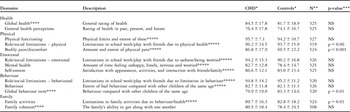
The Child Health Questionnaire is a validated generic questionnaire, designed to assess physical and psycho-social health status in children and adolescents aged 10–20 years, and is filled out by the children themselves. It consists of 87 questions, which condense to 14 domains -- 10 multi-items and four single items. All domains, except change in health are recoded and transformed into a score between 0 and 100; higher scores indicate better self-perceived function. Change in health is a categorical domain between one and five; it was left out of the analyses in order to make similar analyses of all domain scores. A description of each domain is included in Table 1.
Comparison between children operated for congenital heart disease and the normal population.

CHD, children operated for congenital heart disease; NS, no statistically significant difference
*Mean plus or minus standard deviation
**Number of patients included in the analyses
***Linear regression analysis of the ln-transformed score after adjusting for gender and age
****Single items
*****The past 4 weeks
The Danish version of the questionnaire was used in this study. Because of an error in printing, question 3_3_c (concerning limitations in activities due to physical health) was lost and therefore excluded from the analyses.
Data from 288 healthy children (46% male) with a median age of 15 years were used as controls. The data were collected from one elementary school and two upper secondary schools in the area around the hospital; 387 children were invited to participate (response rate 74%). Testing took place in the classrooms; two research assistants administrated the questionnaires according to the protocol. Part of this control population has been used in an earlier study from our institution.Reference Jacobsen, Thastum, Jeppesen and Pilegaard12
Statistical analysis
Data are presented using means with standard deviation, medians with 5th and 95th percentiles or frequencies, as appropriate. Domain scores are presented as means with standard deviation to allow comparisons with published studies, although not being normally distributed.
For comparison of pre-, per- and post-operative data between participants and non-participants χ2, Fisher’s Exact and Kruskal–Wallis tests were used, as appropriate.
Domain scores for participants and controls were compared using multiple linear regression analysis, adjusting for gender and age at assessment. Overall and category-specific according to the Risk-Adjusted Classification for Congenital Heart SurgeryReference Jenkins, Gauvreau, Newburger, Spray, Moller and Iezzoni13 comparisons were made between the patients and the controls. The classification group’s procedures were allocated into six risk categories according to the risk of in-hospital mortality; category 1 was the lowest and category 6 the highest risk. Studies have shown that the Risk-Adjusted Classification for Congenital Heart Surgery can predict in-hospital mortalityReference Jenkins, Gauvreau, Newburger, Spray, Moller and Iezzoni13–Reference Larsen, Pedersen, Jacobsen, Johnsen, Hansen and Hjortdal15 and is associated with post-operative length of stay.Reference Boethig, Jenkins, Hecker, Thies and Breymann14, Reference Larsen, Pedersen, Jacobsen, Johnsen, Hansen and Hjortdal15 In this study, there were no patients in category 5 and only one patient in category 6; the results from these categories are not reported.
Multivariate linear regression was also used to explore the association between demographic and clinical factors such as education of the parents, the Risk-Adjusted Classification for Congenital Heart Surgery, the Aristotle Basic Complexity ScoreReference Lacour-Gayet, Clarke and Jacobs16 and domain scores for children operated on for congenital heart surgery (all variables are listed in Appendix A). Preliminary models were created based on bootstrap bagging, cluster analysis, stepwise selection and an all-inclusive model. For bootstrap and cluster analysis, the factors were included in the model if they appeared in over 40% of the samples. In the step-wise and all-inclusive model, the cut-off point was a p-value under or equal to 0.05. Factors were included in the final model if they were significant in all four preliminary models. In multivariate analyses, missing values for predictor variables were informatively imputed and replaced with the mean of all non-missing values. Data on demographic factors were missing for between 3% and 19% and data on clinical factors were missing in 0–9% of the questionnaires.
A p-value under or equal to 0.05 was considered as statistically significant. Stata Statistical Software (release 10.0, Stata Corporation, Texas, United States of America) and SAS/STAT software (release 9.1, SAS Institute, North Carolina, United States of America) were used for the analyses. GraphPad Prism (version 5, GraphPad Software, California, United States of America) was used for graphic display.
Results
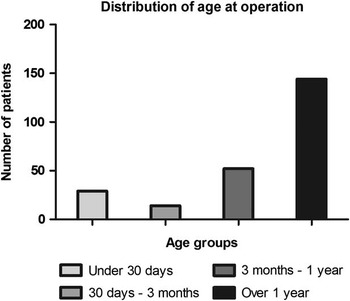
Between 1996 and 2002, 878 children at 15 years of age or younger with congenital heart disease were operated on at Aarhus University Hospital – Skejby; of these 422 children were alive and aged 10–20 years at the time of follow-up. Seventy-one children were not eligible for participation in the study: eight children had emigrated, two children did not have a civil registry number, one child did not understand Danish well enough to complete the questionnaire, and 60 children had syndromes or mental disabilities precluding their understanding and ability to complete the questionnaire. Of the 351 children eligible for participation in the study, 254 responded to the questionnaire; 10 did not want to participate, four had not completed the questionnaire, and for one patient the questionnaire was completed by the parents. After exclusion of these, 239 questionnaires were included in the analyses, giving a final response rate of 68%. Of the participants, 27% had a primary operation in category 1 according to the Risk-Adjusted Classification for Congenital Heart Surgery, 41% in category 2, 22% in category 3, 6% in category 4, 0% in category 5, and 0.4% in category 6. In 4%, a procedure that could not be assigned a category such as transplants and closure of premature ducts was used (see Fig 1 for age distribution of the participants).
Number of patients in different age groups among the participants.

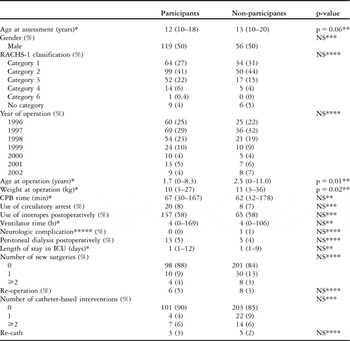
When comparing pre-, per- and post-operative data between the participants (in total 239) and the eligible non-participants (in total 112; Table 2), the participants were younger and weighed less at the time of operation and there was a tendency for participants being younger at assessment (p = 0.06). There were no other differences.
Participants versus non-participants.

NS, not statistically significant different; RACHS, Risk Adjusted Classification for Congenital Heart Surgery; ICU, intensive care unit; Re-cath, catheter-based intervention performed <30 days after a primary procedure; CPB, cardio-pulmonary bypass; h, hours.
*Median, 5th–95th percentiles
**Kruskal–Wallis test
***Chi-square test
****Fisher’s Exact test
*****Defined as coma, seizure, or paralysis observed in ICU
Comparison with controls
There were no differences between children operated on for congenital heart disease and controls in nine out of thirteen domains (Table 1). Children operated on for congenital heart disease reported better scores for freedom from bodily pain/discomfort and family activities and a tendency towards better scores in role/social limitations – physical as well (p = 0.06). However, the score of global behaviour was worse (Table 1).
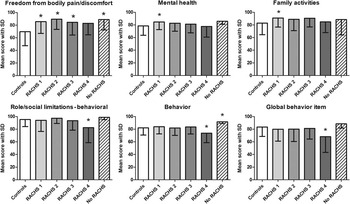
Differences between patients in risk categories according to the Risk-Adjusted Classification for Congenital Heart Surgery and controls are shown in Fig 2. For freedom from bodily pain/discomfort, patients in all risk categories, except category 4, reported better scores than controls. The scores for mental health and family activities were better for patients in risk category 1 as well. All three behaviour scores – role/social limitations – behavioural, behaviour and global behaviour – were worse for patients in risk category 4.
Differences between the Risk Adjusted Classification for Congenital Heart Surgery (RACHS-1) categories and controls with mean scores shown for each group; *indicate p-value under or equal to 0.05 when the category is compared with controls.

Demographic and clinical factors
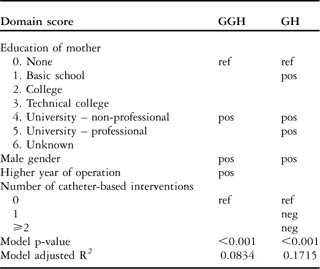
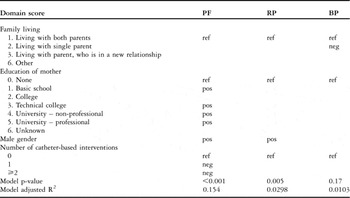
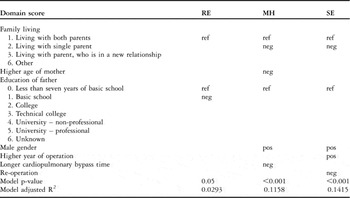
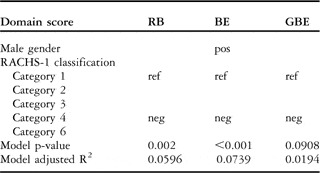
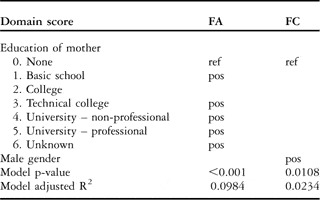
Factors associated with health, physical, emotional, behaviour and family domains are shown in Tables 3, 4, 5, 6, and 7, respectively.
Independent factors associated with health domains (global health and general health perceptions).

GGH, global health; GH, general health perceptions; ref, reference category; pos, positive association between variable and outcome; neg, negative association between variable and outcome
Independent factors associated with physical domains (physical functioning, role/social limitations – physical and freedom from bodily pain/discomfort).

PF, physical functioning; RP, role/social limitations; BP, freedom from bodily pain/discomfort; ref, reference category; pos, positive association between variable and outcome; neg, negative association between variable and outcome
Independent factors associated with emotional domains (role/social limitations –emotional, mental health, and self esteem).

RE, role/social limitations – emotional; MH, mental health; SE, self-esteem; Re-operation, surgery performed <30 days after a procedure; ref, reference category; pos, positive association between variable and outcome; neg, negative association between variable and outcome
Independent factors associated with behaviour domains (role/social limitations – behavioural, behaviour, and global behaviour item).

RB, role/social limitations – behavioural; BE, behaviour; GBE, global behaviour item; ref, reference category; pos, positive association between variable and outcome; RACHS, Risk Adjusted Classification for Congenital Heart Surgery; neg, negative association between variable and outcome
Independent factors associated with family domains (family activities and family cohesion).

FA, family activities; FC, family cohesion; ref, reference category; pos, positive association between variable and outcome
For both health domains (general health and general health perceptions), a university non-professional education of the mother and male gender of the child were associated with better scores. No consistent associations were found for physical domains – physical functioning, role/social limitations – physical and freedom from bodily pain/discomfort. However, male gender was positively associated with physical functioning and role/social limitations – physical. Male gender was also positively associated with two of the emotional domains – mental health and self esteem. Living with a single parent was negatively associated with the same two domains. No other similarities were found for the emotional domains. There was a negative association between the Risk-Adjusted Classification for Congenital Heart Surgery category 4 and all three behaviour domains (role/social limitations – behavioural, behaviour, and global behaviour). There were no consistent associations for the family domains (family activities and family cohesion). The Aristotle Basic Complexity Score was not associated with any domain.
Discussion
Quality of life and functional health are becoming integrated parts of outcome assessment in health research, also in congenital heart surgery. However, there is no consensus on a definition to distinguish between overall quality of life, health-related quality of life and functional health assessment.Reference Smith, Avis and Assmann17, Reference De, Regier, Alamgir, Anis, Fitzgerald and Marra18 Most agree that quality of life and functional health are multi-dimensional concepts, consisting of several aspects such as physical, emotional, and social well-being. Several instruments have been developed to measure these aspects in children.Reference Landgraf, Abetz and Ware11, Reference Marino, Shera and Wernovsky19, Reference Lewis, Pantell and Kieckhefer20 This study is the first using the Child Health Questionnaire, Child Report version 87, for a wide spectrum of children following congenital heart surgery.
Comparison with controls
We found no difference between the overall population of children following congenital heart surgery and controls in nine out of thirteen domains. Similar to other investigators,Reference McCrindle, Williams and Mitchell2, Reference Culbert, Ashburn and Cullen-Dean6, Reference van der Rijken, Maassen, Walk, Daniels and Hulstijn-Dirkmaat21 we found better scores for freedom from bodily pain/discomfort. This could reflect the fact that children operated on for congenital heart disease adapt to their disease and are physiologically strengthened after surviving an operation. The same robustness has been reported for chronically ill children and children with cancer.Reference Noll, Kozlowski, Gerhardt, Vannatta, Taylor and Passo22, Reference Noll, Gartstein, Vannatta, Correll, Bukowski and Davies23 This could also simply reflect that remembering the operation and pain associated with it give the children a different reference to what pain is. If this were true we would expect age at operation and time since last operation to be associated with freedom from bodily pain/discomfort. However, this association was not confirmed for age at operation in the multivariate analysis and unfortunately time since last operation was not included in the analyses.
When the Risk-Adjusted Classification for Congenital Heart Surgery was included in the analyses, all three behaviour domains (role/social limitations – behavioural, behaviour, and global behaviour) were found to be worse in risk category 4 compared with controls. The same association was identified in the multivariate analysis, indicating that this category is at risk of subsequent behavioural problems. Since there was only one patient in risk category 6, we were unable to clarify whether this finding suggested that patients with complex cardiac disease are at greater risk of behavioural problems and whether this risk increases according to the risk category. However, we did not find an association between the Aristotle Basic Complexity ScoreReference Lacour-Gayet, Clarke and Jacobs16 and any of the domains, thereby suggesting that increasing complexity measured by this instrument may not have an influence on functional health. These findings correspond to the findings of van der Rijken et alReference van der Rijken, Maassen, Walk, Daniels and Hulstijn-Dirkmaat21 who did not find an association between self-reported behavioural and emotional functioning and the complexity of procedures graded according to the Aristotle classification. However, parents in the same study reported that their children had more withdrawn behaviour, somatic complaints, and attention problems in the most complex procedure category. More studies in mixed populations of congenital heart disease with larger numbers of complex patients are needed to explore the association between complexity and functional outcome.
Demographic and clinical factors
Of the 24 factors considered for inclusion in the multivariate analyses, education of the parents and whether the child was living with a single parent were found to be associated with eight out of thirteen domains. Clinical factors such as age at operation, circulatory arrest time, and post-operative length of stay in the intensive care unit were not found to be related with any domain, and the time of cardiopulmonary bypass was only associated with mental health. Our study indicates that social background rather than clinical history is a greater influence on the overall well-being of the child. This is in contrast to several other studies: Hövels-Gürich et alReference Hovels-Gurich, Konrad and Wiesner5 found a negative association between quality of life and duration of cardiopulmonary bypass. Culbert et alReference Culbert, Ashburn and Cullen-Dean6 found circulatory arrest, ischaemic time, duration of cardiopulmonary bypass, and cooling temperature to be associated with a worse score on social limits and behaviour concepts. Dunbar-Masterson et alReference Dunbar-Masterson, Wypij and Bellinger24 reported a negative association between longer hospital stay and physical health and Williams et alReference Williams, Gelijns and Moskowitz25 have found physical health to be negatively correlated with circulatory arrest time. However, our findings correlate with Landolt et alReference Landolt, Valsangiacomo Buechel and Latal3 who did not find an association between self-reported health-related quality of life and duration of cardiopulmonary bypass nor length of hospital stay. The study by Landolt et alReference Landolt, Valsangiacomo Buechel and Latal3 was performed on a mixed population of children with congenital heart disease as ours, the other studies included only patients with transposition of the great arteriesReference Hovels-Gurich, Konrad and Wiesner5, Reference Culbert, Ashburn and Cullen-Dean6, Reference Dunbar-Masterson, Wypij and Bellinger24 and hypoplastic left heart syndrome.Reference Williams, Gelijns and Moskowitz25 However, further comparison of these studies is difficult since only Culbert et alReference Culbert, Ashburn and Cullen-Dean6 used the Child Health Questionnaire, Child Report version 87, and in only two other studies had the operations been performed during approximately the same time periods as ours.Reference Landolt, Valsangiacomo Buechel and Latal3, Reference Williams, Gelijns and Moskowitz25
We found R 2 values between 0.02 and 0.18 indicating that a large part of the variation in different domains is not explained by the variables in our data set. These findings are similar to Culbert et alReference Culbert, Ashburn and Cullen-Dean6 who found R 2 values between 0.024 and 0.26, when testing for association between clinical factors such as morphology and surgical repair and the Child Health Questionnaire, Child Report version 87 domains, thereby reflecting that functional health is multifactorial. This is supported by McCrindle et alReference McCrindle, Williams and Mitchell2 who included co-morbidity such as asthma, behaviour and learning problems, and social factors such as family income, thereby finding a higher degree of explained variation, when looking at parent-reported psycho-social functioning and physical functioning.
Limitations
There are several limitations associated with our study. By selecting a generic questionnaire we may be overlooking important disease-specific measurements for congenital heart disease. However, we chose the Child Health Questionnaire because it has been extensively validated,Reference Landgraf, Abetz and Ware11, Reference Raat, Landgraf, Bonsel, Gemke and Essink-Bot26, Reference Raat, Mangunkusumo, Landgraf, Kloek and Brug27 was available in a Danish version, and allowed a comparison with a normal population. If we had chosen the parent questionnaire we could have included children less than 10 years of age and thus had a larger cohort. However, we deliberately chose to use the Child Report since studies have shown a difference between parent and self-report,Reference Landolt, Valsangiacomo Buechel and Latal3, Reference Hovels-Gurich, Konrad and Wiesner5 and we wanted this study to focus on the perspective of the child. A major limitation of the questionnaire is that there is no established consensus on whether the observed statistically significant differences are also clinically important.
By excluding children with syndromes or mental disabilities we might report a false-positive view of the well-being of children with surgically treated congenital heart disease. However, the children were excluded since they were not able to answer the questionnaire by themselves and in order to allow comparison with other studies.
This study is population-based and represents an unselected cohort of patients in Western Denmark. The frequency of neonates and patients in higher Risk-Adjusted Classification for Congenital Heart Surgery 1 categories is therefore limited. Therefore, the results cannot be directly extrapolated to populations dominated by high-risk patients.
When comparing participants and eligible non-participants the only difference we found was that participants were younger and weighed less at the time of the operation; the potential bias of this difference is limited. Further, the control group was sampled from local schools in the area around our hospital and we cannot be certain that these children reflect the entire western part of Denmark.
A large number of variables were tested for association with all thirteen domains, thereby introducing a potential problem with multiple comparisons. To reduce this problem we chose to only include variables in the final model, which were significant in both the bootstrapping, cluster analysis, stepwise selection, and the all-inclusive model. Furthermore, we chose not to test for interactions.
Quality of life and functional health are dynamic concepts and changes throughout life can be expected. In order to account for such natural changes and to identify high-risk periods, prospective longitudinal studies of functional outcomes are needed.
Conclusion
We conclude that overall there are not many differences in functional health status when comparing children operated on for congenital heart disease with normal children. However, we found an association between category 4 according to the Risk-Adjusted Classification for Congenital Heart Surgery and behavioural problems. When examining the association between demographic and clinical variables and physical and psycho-social well-being, we identified male gender of the child and social factors such as education of the parents and living with a single parent as important factors. Age at operation, circulatory arrest time, the Aristotle Basic Complexity Score, and post-operative length of stay in the intensive care unit were not associated with self-reported well-being. The majority of variation in functional health was not explained by any of the known demographic and clinical variables. Further studies are needed to identify determents of functional health.
Acknowledgements
The authors thank all patients and parents participating in this study. They thank secretaries at the Department of Cardiothoracic Surgery at Aarhus University Hospital, in particular, Dorte Hindby, for their help in printing and sending out questionnaires and also thank Sally Cai, Congenital Heart Surgeons Society, Toronto, Canada, for sharing her statistical knowledge. The project has received funding from The Danish Heart Foundation and Aarhus University.