




Background
At the time this work was initially presented at the Nutrition Society of Australia Annual Scientific Meeting on the Gold Coast in late 2025, the heavy metal band Metallica were locally touring with their new album 72 Seasons. This album explores how the early seasons of life can shape our later identities. This idea links to a parallel concept in nutrition science: that the early experiences of feeding and mealtimes can shape how children eat and relate to food as they get older.
This review aims to synthesise evidence on how parental feeding practices in the first years of life can influence the development of children’s eating behaviours. In particular, the review explores how the parent/caregiver – child relationship can play a role in developing children’s emerging food habits and behaviours. From a long-term perspective, this relationship may be key to lifelong healthy and intuitive eating. This manuscript also explains how this fits with a Respectful Approach to parenting and details work underway in this field.
The Respectful Approach is informed by Resources for Infant Educarers (RIE), an approach to infant and toddler care (from 0 to 2 years) inspired by Hungarian paediatrician Dr Emmi Pikler(Reference Gerber, Greenwald and Weaver1,2) . RIE is a not-for-profit educational organisation, founded in the USA by Magda Gerber and Dr Tom Forrest in 1978. Magda (whose child was originally a patient of Dr Pikler) was inspired by the respectfulness of Dr Pikler’s care and went on to obtain a degree in early childhood education and work with Dr Pikler at the National Methodological Institute for Infant Care and Education in Budapest before moving to the USA(3). Within the RIE philosophy, an ‘Educarer’ is a caregiver who integrates education into everyday caregiving by responding to infants with respect, sensitive observation and responsiveness. Respect underpins RIE’s philosophy and the principles are relevant to all aspects of infant and child care, including the mealtime/feeding setting. Principles particularly relevant to mealtimes include:
-
• Basic trust in the child to be an initiator, an explorer and a self-learner (this includes trusting the infants’ cues for hunger and satiety).
-
• An environment for the child that is physically safe, cognitively challenging and emotionally nurturing.
-
• Involvement of the child in all care activities to allow the child to become an active participant rather than a passive recipient.
-
• Sensitive observation of the child in order to understand his or her needs. This includes creating space for the expression of feelings and emotions.
-
• Consistency, clearly defined limits and expectations to develop discipline. This also encompasses communication – explaining to the child what to expect and allowing time for the child to respond or acknowledge.
-
• Using caregiving times, like nappy changes, bathing and feeding, to provide full attention to the child and spend quality time that allows for bonding and strengthening the parent–child relationship.
-
• Children are unique humans with their own likes and dislikes.
Current guidelines and advice for parents around infant and child feeding tend to have a focus on ‘what’ foods are being offered. A Respectful Approach to feeding encompasses the ‘how’ of feeding. The following sections examines why this relational context of eating is important.
Fuel
Does a focus on food as fuel overlook opportunities to develop a healthy relationship with food?
Infancy and childhood involves a period of rapid growth. Naturally, parents want to provide their children with foods that can best fuel them for growth and development. When we think about establishing healthy eating behaviours in children, we traditionally tend to focus on the types of food provided. Nutrition guidelines also focus on the types of food – for example, early introduction of potential allergenic foods, minimisation of choking risks and early introduction of iron-rich solids. This is important for safety and immune development and physical health.
Generally this focus on ‘food as fuel’ takes precedence over the context and environment we feed children in. But should we also prioritise food parenting practices? As summarised by Almaatani et al, parental feeding practices is a term used to describe the methods parents use to shape the feeding environment(Reference Almaatani, Zurbau and Khoshnevisan4). A variety of factors can influence parent’s food parenting practices. There is a bidirectional or reciprocal relationship between food parenting practices and child eating behaviour, and also between a child’s weight and food parenting practices. For example, mothers who perceive their children as overweight may engage in restrictive feeding practices, whereas mothers who perceive their child as underweight may engage in coercive feeding practices(Reference Almaatani, Zurbau and Khoshnevisan4). Parental feeding practices are commonly grouped into three broad types: coercive control, structure and autonomy support(Reference Vaughn, Ward and Fisher5). These are described in more detail in the following sections.
Sad but true
How coercive control practices may negatively impact the food relationship
Ideally, we want children to be in tune with their ‘tummy voice’ – their interoceptive signals of hunger and satiety. Unfortunately, sometimes parental feeding practices can unintentionally override a child’s innate ability to respond to these cues. Coercive control practices such as restriction, pressure to eat and instrumental feeding (using food as way of regulating emotions or using food as a reward) have been found to be consistently linked with less optimal eating patterns in a review of the literature(Reference Costa and Oliveira6).
Restricting children’s access to discretionary foods (also known as treat or junk foods, generally high in energy but providing minimal nutritional benefit) can seem like a simple way for parents to limit the amount that their children consume. This restriction can happen by storing foods out of reach, allowing only small amounts, allowing certain foods only on special occasions or insisting children eat other foods first. For example, parents may direct children to finish their vegetables in order to get dessert. These types of strategies can limit intake in the moment by limiting opportunities to access certain foods, or work by meeting certain conditions. But do they help children down the track, when they have the freedom to choose what and how much they eat?
This ‘forbidden fruit’ concept was investigated in a well-designed study of children aged 3 to 5 years by Fisher and Birch(Reference Fisher and Birch7). The children participated in the study directly after consuming their normal lunch. Only children who indicated they were feeling full (as determined by cartoon stomach figures) were eligible to participate. Children were then given a 10 minute period of free access to a range of different snacks with a variety of tastes and textures, including foods like popcorn, chips, chocolate and ice cream. At the same time, the children also had access to toys to play with. This was done on an individual basis, and the child was told they could play with the toys or eat any of the foods. The child was given 10 minutes in the room by themselves (observed though a one-way mirror) and their intake of the snack foods was later measured. In addition, children were asked about their perceptions of restricted access to each of the snack foods (as part of their normal lives) and mothers were also asked questions around restriction of access to the snack foods used in the study.
Despite feeling full after their lunch, children went on to eat an average of 215 kcal in snacks. It was interesting to note a gender difference in the results: girls who felt more restricted in their access to snack foods ate more of those snacks when they were later available without limits, whereas boys showed no significant link between perceived restriction and intake. In addition, for girls only, higher levels of maternal restriction were associated with higher intakes of the snack foods(Reference Fisher and Birch7). This suggests that restricting access to snack foods is not necessarily an effective means of reducing self-regulated intake of these foods, especially for girls.
A replication of this study was undertaken by Rollins and colleagues(Reference Rollins, Loken and Savage8). The authors agreed that parents’ use of restrictive feeding practices is unlikely to be effective in decreasing children’s intake of restricted foods and may be counterproductive. This research also found that children with lower inhibitory control and greater responsiveness to rewarding stimuli were more susceptible to the adverse effects of parental food restriction.
In addition to these studies, there is some evidence that chronic restriction used by parents over months or years may have lasting consequences. Frequent parental restriction has been shown to predict increased eating in the absence of hunger among girls from 5 to 9 years(Reference Birch, Fisher and Davison9).
On the opposite end of the spectrum, parents may sometimes pressure young children to eat. This may come about due to concerns about underweight or a lack of nutrition. It is interesting to note that periods of being unwilling to eat some foods, accompanied by a limited variety of food in the diet, is common for children. Roughly half of children will be selective eaters at some point, with 3 year olds particularly likely to display this tendency(Reference Cardona Cano, Tiemeier and Van Hoeken10). It is considered a normal part of development in pre-school aged children(Reference Cardona Cano, Tiemeier and Van Hoeken10).
Research suggest that parents often notice food selectiveness in their children more than they notice satiety cues, likely because refusal tends to be more loud and obvious(Reference Ayre, Harris and White11). That can lead parents to pressure the selective child more intensely with requests to eat more. Food provision can also differ, with parents less likely to serve typical family meals to the child who is perceived as more avoidant(Reference Ayre, Harris and White11). This approach can end up resulting in children receiving less exposure to disliked foods. Repeated exposures to foods is known to support greater acceptance and healthier eating over time(Reference Nekitsing, Hetherington and Blundell-Birtill12).
The relationship between parent pressure to eat and child ‘fussiness’ with food (which we refer to as ‘selective’ – see later in this paper under ‘The memory remains’ for the rationale behind this wording) appears to be a bidirectional one. A study of over four thousand mother–child dyads in the Netherlands demonstrated that children’s selective eating prospectively predicted higher levels of parents’ pressure to eat when the child was 4 years old. However, parental pressure to eat at 4 years old consequently predicted later increases in selective eating in children when they were 6 years old – independently of selective eating at baseline!(Reference Jansen, de Barse and Jaddoe13). The authors suggested that although parents likely feel they are helping their child by pressuring them to eat, this strategy does not seem to improve food acceptance – if anything, it may have the opposite effect.
Many households have heard phrases like; ‘If you eat your vegetables, you get dessert’ or ‘If you behave well, you get a chocolate’. This use of food as a reward is termed instrumental feeding. It can also include restricting food for perceived incorrect behaviours, as a form of punishment(Reference Mason14). There is debate around whether using food in this way is useful or detrimental to eating habits, and research actually suggests the type of reward matters. Social rewards (like acknowledgement) and non‑food rewards (like stickers) generally have been shown to improve children’s willingness to try and accept foods, whereas using food as the reward is more likely to have negative effects(Reference Añez, Remington and Wardle15).
To investigate the effect of non-food rewards in terms of vegetable acceptance in an exposure-based intervention study, 137 children aged 4 to 6 years old were split into vegetable exposure intervention a control group (no exposure)(Reference Añez, Remington and Wardle15). In the intervention, children were offered daily tastes of a small amount target vegetable (one that they’d identified earlier as in the lower half of their vegetable preferences), but were also further allocated into one of three subgroups: with no reward for tasting, with a tangible, sticker reward for tasting or a reward in the form of praise. Researchers found that children in all intervention groups (exposed to small portions of their target vegetable) resulted in significant increases in liking of their vegetable, with no increase in children in the control group. This suggests that exposure is sufficient, and rewards are not necessary.
Interestingly, results of this study also showed that intakes of the target vegetable also significantly improved in the intervention, for those children in the sticker reward or praise reward groups (non-food rewards). For the intervention group not receiving any reward, improvement in intake was only seen in children who were not used to receiving food rewards as part of their usual lives(Reference Añez, Remington and Wardle15). This suggests that once children become used to receiving food rewards for eating disliked foods, a reward of some sort then becomes necessary for them to continue to eat certain foods. These findings also suggest that the type of reward matters – although non-food rewards may support vegetable intake, using food as the reward may have different and potentially less desirable consequences.
An insight into potential consequences of this concept is shown by a study of young children (aged between 1.5 to 2.5 years) and maternal instrumental feeding(Reference Rodgers, Paxton and Massey16). Higher levels of instrumental feeding were cross-sectionally associated with higher levels of child emotional eating and an increased tendency to overeat. This feeding practice also prospectively predicted children’s emotional eating and overeating one year later. These findings suggest that using food to reward behaviour or to manage children’s behaviours may contribute to children overriding internal satiety cues, with potential implications for their later relationship with food. If ongoing, reinforcement of positive behaviours with foods may also strengthen the preference for foods used as rewards.
A history of instrumental feeding in childhood may worsen emotion-related binge eating later in life. A study of university students found that those who reported low exposure to parental instrumental feeding showed low levels of binge eating when they experienced high levels of emotional distress, whereas those who recalled frequent parental instrumental feeding practices in childhood were more likely to engage in binge eating when experiencing similar distress(Reference Mason14).
Exposure to less controlling food parenting practices as a child has been associated with more positive eating behaviours and healthier food intake in adulthood(Reference Carbonneau, Studer-Perez and Lavoie17). In line with this, RIE based approaches discourage coercive feeding practices and instead prioritise responsiveness to children’s internal signals, as discussed in the following sections. Such practices are thought to support the development of internal regulation, rather than compliance with external control.
Enter sand(wich)man
The importance of structure and boundaries in early feeding environments
Structure around mealtimes for infants and children includes predictable routines, clearly defined rules and boundaries around eating and the physical organisation of the child’s eating environment, including the setting and food availability(Reference Vaughn, Ward and Fisher5). Rules and boundaries clarify parent’s expectations around mealtimes. This can include how foods are eaten (for instance, sitting at a table), guided choices (parent presents a variety of food and child chooses from the selection), amounts of foods (e.g. everyone can have up to two pieces each), meals for special occasions and clear beginnings and ends to mealtimes. In the Respectful Approach, boundaries are known in advance and are enforced calmly, consistently and without emotional escalation.
Structure and boundaries can look different for different families. The practical aspects of meal preparation and eating may be similar, but some rituals are distinct and unique to particular families, reflecting identity, culture and shared values(Reference Spagnola and Fiese18). This means that cultural and contextual factors (such as socioeconomic circumstances) can influence the interpretation of structure and boundaries which can vary between families, but consistency is important.
Having a regular meal routine enables children to develop their capacity for self-regulation. When daily routines are regular and predictable, children know what to expect. This sense of predictability can help children feel more secure and better able to manage their behaviour and emotions. Family routines provide predictable structure that guides children’s behaviour and creates consistent expectations for daily activities. Over time, this repeated exposure to structured interactions may support the development of self-regulation, with evidence linking regular household routines to improved regulatory outcomes in early childhood(Reference Spagnola and Fiese18). In contrast, unpredictable environments may make it harder for children to anticipate events and respond appropriately, and in extreme forms has been associated with poorer mental health outcomes later in life(Reference Koss, Kronaizl and Brown19).
Consistent meal and snack routines may also support children’s ability to attune to internal physiological cues by providing repeated, predictable opportunities to experience hunger and satiety cycles. Children can better understand how it feels to be hungry and conversely, satiated, which can help them tune in to their ‘tummy voice’. Experiencing these cycles and recognising hunger is thought to improve food intake regulation(Reference Ciampolini, Lovell-Smith and Kenealy20).
Structured feeding environments (in terms of timing, setting and family engagement), in conjunction with responsive feeding, has been associated with more favourable eating behaviours in children. This includes children displaying lower food ‘selectiveness’, a higher enjoyment of food and looking forward to mealtimes(Reference Finnane, Jansen and Mallan21). More structured meal timing may reduce unregulated snacking and support more stable energy intake patterns across the day, leading to better long-term dietary habits. For instance, a study following children for 4 years found that more frequent family meals at 4 years of age was associated with higher diet quality at 8 years of age(Reference Mou, Jansen and Raat22). This concept has also been demonstrated in older children, with structured family meal frequency in adolescence linked to higher diet quality in adulthood, including increased fruit and vegetable intake, more breakfast meals and lower intake of soft drinks(Reference Larson, Neumark-Sztainer and Hannan23). Similar results have been reported from early to late adolescence, with regular family meals being positively associated with intakes of vegetables, minerals and vitamins(Reference Burgess-Champoux, Larson and Neumark-Sztainer24).
The main objective from a Respectful Approach perspective is to create a calm and pleasant mealtime for both parents and children, while keeping clearly defined limits and expectations around safety and respect(Reference Marlen25). This provides a solid basis for quality time together, along with exploring and learning about food and eating, as discussed in the following section.
Wherever I may roam
Support for food exploration and autonomy while learning to eat
Young children often want to do things themselves, and rules and boundaries mentioned in the earlier section help them practice their skills in a safe and acceptable way. Autonomy support is defined as ‘promoting psychological autonomy and encouragement of independence’(Reference Vaughn, Ward and Fisher5). In practice, this involves caregivers trusting the child’s capacities while providing a consistent structure. In the Respectful Approach, caregivers retain responsibility for deciding what foods are offered and when, while children are supported to decide whether, what and how much they eat from what is provided. This approach aligns with Ellyn Satter’s Division of Responsibility in Feeding, which has been widely recognised for supporting children’s developing capacity for self-regulation(Reference Satter26). Responsive feeding places emphasis on caregivers’ capacity to observe and interpret children’s signals while also supporting children’s emerging independence and self-regulation(Reference Vaughn, Ward and Fisher5).
Respectful caregiving approaches emphasise children’s active participation in feeding, along with other everyday routines. Even young infants can be a competent partner in the interaction. Opportunities for autonomy may be embedded throughout the feeding routine, including small choices and involvement in preparatory steps. For example, a child could be asked if they would prefer a blue bib or the red bib, holding both in front of the child. Even a very young child who can’t point or talk may still indicate a preference by looking at one more than the other. The feeding routine is not rushed, and the child is informed by the parent or carer about what is happening at each stage. For example, for washing hands, the child would be told beforehand that we are going to wash hands now. The child is then invited to take an active part, for example, reaching their hands towards the water from the tap. Allowing tarry time (intentional pauses that give children time to observe, anticipate and respond) supports engagement and agency without rushing the interaction. At the meal, young children may like to touch, smell, poke and hold their food. This sensory exploration is a normal and important part of learning to eat.
A key point of the respectful feeding approach is to have all relevant foods, drinks and equipment ready before the meal starts. This allows the parent to be fully present during the meal. A tray nearby can be helpful to contain all mealtime items required, including food in glass bowls, water in a clear small glass, a metal spoon and washcloths for hand washing. Having food in a glass bowl means the child can see the food and better anticipate what is to come. The parent also explains what the food is each time, for example, “mashed avocado”, which assists in the development of understanding and communication. ‘Real’ glasses and metal spoons are used as the child is trusted to respect the equipment(Reference Marlen25).
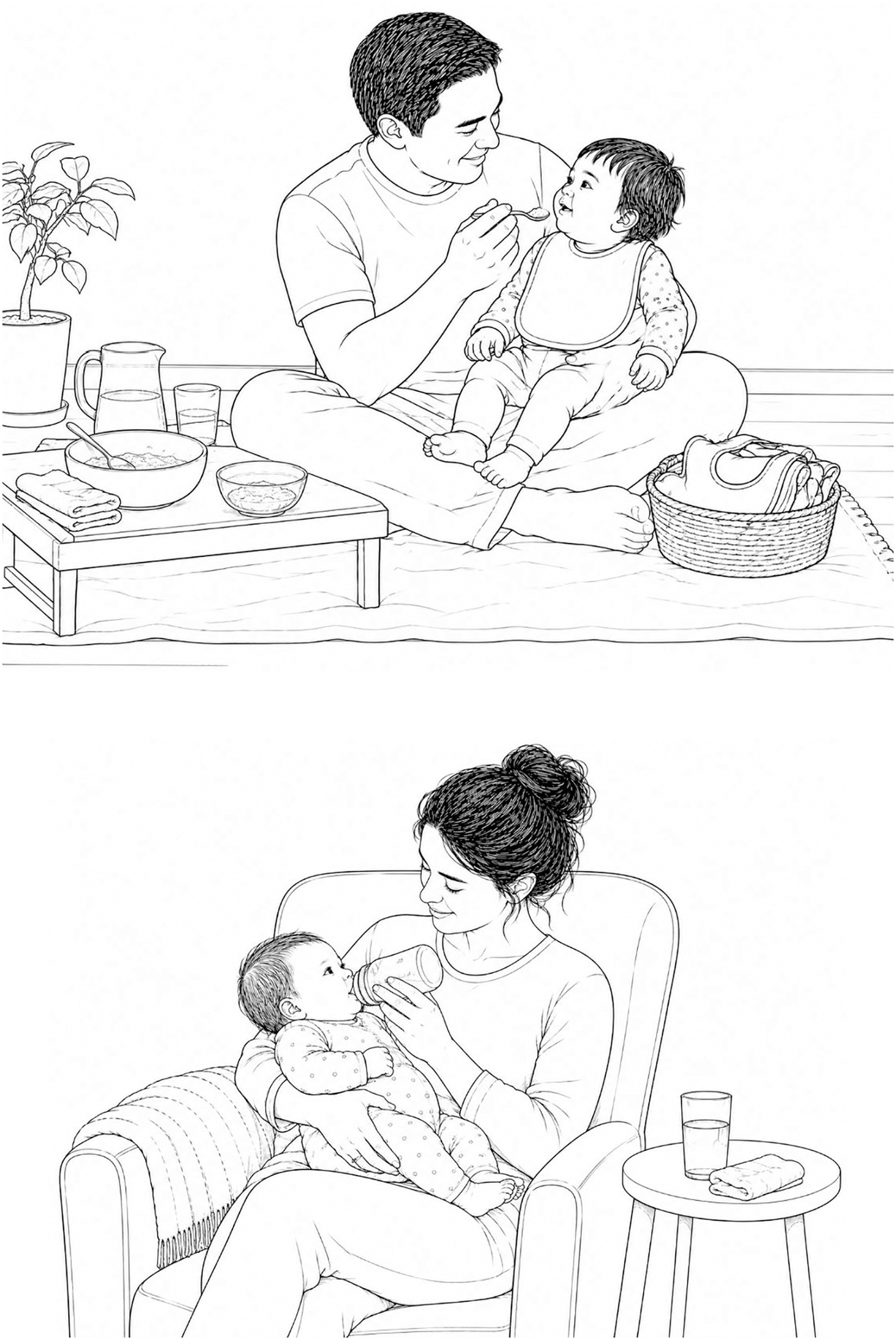
A calm, predictable environment free from competing distractions supports responsiveness and shared attention. Physical positioning that allows close proximity, eye contact and non-verbal communication allows connection during feeding interactions (see Fig. 1). RIE promotes lap feeding or feeding at a small table (when children are able to) over a high-chair where the child is restrained, or a chair where they cannot reach their feet to the floor or a support platform. Lap feeding allows more free movement than a high-chair and the parent is better able to pay attention and feel cues from the child. Children are able to leave the mealtime environment when they are satiated and are not forced to stay – as Magda Gerber noted, ‘young children are ready to eat, not to dine’. It’s not a realistic expectation for a child to finish everything that is on their plate or remain seated for an extended period of time.
Examples of responsive feeding environments consistent with RIE principles. The parent’s attention is fully on the child. Source: Author-generated illustration created using AI (ChatGPT, OpenAI).

Responsive feeding principles apply across different feeding modalities, including bottle-feeding. Holding infants close, observing hunger and satiety cues, pacing feeds and avoiding pressure to finish a meal all support feeding as part of relationship building. Alongside meeting nutritional needs, feeding times also provide opportunities for connection, reassurance and relationship building. Consistent parent responsiveness and support allows the child to use the parent as a secure base from which to explore both food and their broader environment.
The parent’s emotional regulation also plays an important role in shaping the mealtime environment. If a parent is feeling stressed, this may be conveyed to the child through tone, posture and pace. If parents approach mealtimes with stress, they are likely to download that to the child and sometimes this happens before any food is consumed. If parents are aware that they are approaching mealtimes with stress it can be helpful to practice some self-care, like having a cup of tea or doing some deep breathing, before engaging in a mealtime. Approaching meals as calmly as possible and minimising pressure may support children’s ability to attend to internal hunger and fullness cues. It is also worth acknowledging that it helps to have developmentally appropriate expectations! Mess and food refusal are typical aspects of early eating. Framing eating as a process of learning rather than a process of compliance may reduce pressure during meals and support more positive feeding relationships over time.
Ultimately the goal is to create an enjoyable mealtime environment that helps our children develop a healthy relationship with food and their bodies. The journey to reach this goal may look slightly different for everyone. Some ways to support autonomy and food exploration are summarised in Box 1.
Ways to support autonomy and food exploration in early feeding based on respectful principles
-
• Mealtimes provide opportunities for one-on-one connection between parent/caregiver and child
-
• Be prepared for mealtimes before bringing the child to the meal
-
• Observe cues and let the child lead the way. Are they signalling that they want more food, or that they’ve had enough?
-
• Let the child touch and explore their food (within your set boundaries). ‘Playing’ with food facilitates learning about the colour, texture, smell and properties of the food
-
• Limit distractions. Having a TV on in the background or having a mobile phone/other device nearby may mean cues are missed. Things like toys close by may also mean that the child is less attuned to their ‘tummy voice’
-
• Go slowly! When spoon feeding, allow tarry time and let bub come to the spoon
-
• Approach mealtimes positively – for example, if the child doesn’t appear to like a particular food, use positive phrases such as ‘you’re still practising with that food’ rather than ‘you don’t like that food’
-
• If parents feel concerned their child hasn’t eaten much during a meal, it can be helpful to ‘zoom out’ and consider intake over the longer term. Over a few days, are they getting a variety of foods from all the food groups?
-
• Expect mess, waste and a lot of exploring and fun!
The memory remains
Why strong relationships and trust are important in early feeding environments
Think back to how you were fed as a child. What are some of your feeding memories? Were these experiences helpful or a hinderance to your relationship with food later in life?
Transgenerational transmission of eating habits refers to the transfer of eating habits between parents and children, mediated by the interaction of genetic and environmental factors(Reference Fisberg, Gioia and Maximino27). Parents’ own eating behaviours influence how they feed their children, and these parental beliefs and practices are often based in the feeding environments and behaviours they experienced in their own childhoods.
Interestingly, this phenomenon extends beyond families. Early care and education staff were found to be more likely to align their childcare mealtime strategies with the feeding approaches that they themselves experienced in their own childhood, particularly for those who remembered child autonomy supportive mealtime experiences(Reference Zhang, Swindle and Fletcher28). These findings highlight the influence of early feeding relationships and the importance of reflective practice.
Central to respectful parenting approaches, and particularly important at mealtimes, is the concept of trust. Here, trust begins with the assumption that infants and young children are competent communicators, and mealtimes are a time for connection. Instead of being a chore, mealtimes are considered a valuable time that parents and children have guaranteed one-on-one time together. This time is valuable for the relationship and building trust. In terms of the Respectful Approach, part of this full attention of the parent means they don’t eat at the same time as the child, while the child is young and learning to eat. Although modelling of food intake and family meals are very important, this can come later when the child has mastered the basics of eating.
Trust in feeding involves believing that children can recognise and respond appropriately to their own internal hunger and satiety cues. When we allow children to eat when hungry and stop when full (without coercive control, as mentioned earlier in this article under ‘Sad but true’), we can support the child’s ability to tune in to their own ‘tummy voice’. Offering small portions of food initially and responding to requests for more allows children to practise communicating needs while remaining attuned to their bodies. Giving focused attention and having the child close during feeding (such as lap feeding) helps us to recognise these cues. For example, a child who becomes restless during a meal may initially appear to have reached satiety. However, close observation may reveal signs of discomfort, such as abdominal rumbling or trapped wind. Responding to these cues by pausing, repositioning the child or addressing the source of discomfort may enable the child to comfortably resume eating.
Applied to feeding contexts with young children, trust can be shown by:
-
• Observing hunger and satiety and other cues and acting on them
-
• Accepting food refusal without negotiation or power struggles
-
• Observing the child’s intake rather than attempting to control it
This represents a shift from coercive control towards relationship-focused principles (for instance, ‘finish all the veggies on your plate’ becomes ‘I trust your body’). This helps to support infants’ early efforts to navigate their food environment with growing independence.
Being fully present with the child during mealtimes also presents the opportunity for conversation. Mealtimes have been noted as an important time for conversations and provide a chance to reinforce vocabulary development(Reference Spagnola and Fiese18). The language we use around food is important. Many adults, including those with strong nutrition knowledge, may think about healthy eating as an all-or-nothing concept, labelling items as ‘good’ or ‘bad’, or ‘healthy’ and ‘unhealthy’. This can translate into parenting strategies that restrict foods deemed ‘bad’ and actively encourage foods deemed ‘good’, such as withholding biscuits while praising vegetable intake.
While often well intentioned, such strategies may have some unwanted consequences. For example, cultural or contextual factors may lead to ‘healthy food’ looking different in different families, and some children may have specific requirements due to allergies or other health reasons(Reference Orr29). It is important for children to trust that their parents feed them well, and receiving food from parents labelled ‘unhealthy’ has the potential to undermine the parent in the eyes of the child. Notably, some of the foods referred to as ‘bad’ or ‘unhealthy’ are foods eaten during celebrations like birthdays, creating mixed messages which can understandably lead to some confusion!(Reference Orr29).
Moralising food can also risk children internalising negative judgements about themselves. For example, when children eat and enjoy a food that has been labelled ‘bad’, they may interpret this as being ‘bad’ themselves, leading to feelings of guilt and shame around these foods(Reference Orr29). The Respectful Approach discourages moral language around food or using it as a behavioural tool. This helps to reduce power struggles and avoid emotional associations with eating.
Language choices also matter when describing children’s eating behaviour. Terms such as ‘fussy eater’ are commonly used but can imply intentional non-compliance. This is often not the case, with other factors likely at play such as normal developmental food neophobia, sensory sensitivities, anxiety or skill-based challenges (like managing new textures or learning to coordinate chewing and swallowing). Reframing children as ‘selective’ or ‘still learning to eat a variety of foods’ maintains a strength-based approach and supports trust in the child’s developmental process.
This approach to feeding is reinforced through everyday language such as:
-
• ‘You don’t have to eat it, but it’s here if you want it’
-
• ‘Let your tummy decide’
Together, strong relationships and trust form the foundation upon which children learn not only how to eat, but how to feel about food and their bodies. These early experiences are likely to shape eating patterns and attitudes well beyond childhood.
Future research
Many of the findings discussed in this review came from cross-sectional studies, which limits causal inference. More research is needed to confirm that the early feeding environment has long-term consequences for children’s relationships with food.
Although the RIE principles align closely with established responsive feeding frameworks, inclusion in an overall Respectful Approach has not been extensively examined within nutrition research and in the overall family and parenting context. It is therefore worth considering if more responsive parenting and a focus on the parent–child relationship can help prevent nutrition related issues arising and assist with the development of healthy eating habits.
A quasi-experimental study of the Respectful Approach intervention has demonstrated that following RIE principles like sensitive observation, encouraging active cooperation and having trust in children’s capabilities improves parenting confidence and reduces stress compared to a control group(Reference Richardson, Lo and Priddis30). Our research team is currently undertaking a study to extend this work by examining if this approach promoting connection, trust and responsive parenting could also improve the mealtime experience during the first few years of life.
This non-blinded, parallel-design trial compares in-person and online Respectful Approach classes with an outdoor playgroup social control (https://anzctr.org.au/Trial/Registration/TrialReview.aspx?ACTRN=12622001448730). Families participate in two eight-week blocks of parent–child classes during infancy (2–7 months) and toddlerhood (12–18 months). The intervention centres on principles of responsiveness, trust, sensitive observation and participatory caregiving, with explicit attention to everyday caregiving routines, including feeding. The study aims to assess the impact of the intervention on parent stress, parenting confidence, parent–child relationship quality, feeding practices, mealtime experiences and child developmental outcomes, using a combination of validated questionnaires, physiological stress measures (salivary cortisol) and narrative assessments of the parent–child relationship. By examining feeding practices and mealtime enjoyment alongside broader relational and psychosocial outcomes, this work is expected to provide novel insights into how relationship-centred, respectful caregiving approaches may shape early feeding environments and support the development of healthy relationships with food. Findings from this trial will help advance the understanding of mechanisms through which early parenting interventions may influence both mealtime experiences and longer-term child and family health and wellbeing.
It is important to consider that the capacity to implement structured meal routines and practices may be influenced by factors such as food insecurity, work schedules, family structure, other commitments or caring responsibilities, or housing instability. Future studies would benefit from the inclusion of families from a range of backgrounds, and exploration of how support can be made more accessible and effective across diverse family contexts.
Conclusion
Just as the 72 Seasons album reflects on how early life experiences shape later identity, the evidence examined in this review highlights the potential for early feeding interactions to influence children’s developing relationship with food. In line with the premise that ‘nothing else matters’, this body of work points to the central importance of the parent – child relationship in shaping eating behaviours. Our ongoing research in this area aims to better understand how respectful, responsive feeding practices from 0 to 2 years of age can support this process, particularly within real-world family contexts. It is notable that the foundations of eating behaviour, formed in the earliest ‘seasons’ of life, are fundamentally shaped through not just what we eat, but how we eat and who we eat with.
Acknowledgements
We would like to thank Jill Getto-Lee, Kate Russell and Emily McDonald for their inspiring RIE guidance, along with Nina Calogero, Mandy Richardson, Connie Ihlein and the rest of our wonderful Respectful Approach project team. Our gratitude also goes to our children, who continue to both challenge and motivate us on our parenting and research journeys. TOS would also like to extend a special acknowledgement to Alex, for his inspiration to think outside the box – and his excellent taste in music.
Author contributions
TOS drafted the manuscript based on concepts developed in conjunction with KDC. KDC revised the paper and both authors reviewed and approved the final version.
Financial support
The Respectful Approach parenting project is supported by the Channel 7 Telethon Trust and the Royal Perth Hospital Research Foundation.
Competing interests
KDC declares work as a private practice dietitian specialising in paediatrics; TOS declares none.
Declaration of artificial intelligence use
AI tools were used in the preparation of this manuscript to support figure development and writing refinement. For writing, Microsoft Copilot (based on the GPT‑5 chat model) was used between March and April 2026 to assist with language editing, reducing repetition and improving the clarity and flow of some of the text drafted by the authors. Decisions around selection and interpretation of the literature were made by the authors. Suggested text generated by the tool was critically reviewed and edited prior to inclusion.

 Open access

