Introduction
Diapause in insects has evolved as an important life history component at a particular stage, which plays a key role in controlling ecology, phenology, and physiology (Andrewartha, Reference Andrewartha1952; Xiao et al., Reference Xiao, Mou, Zhu and Xue2010). Diapause is genetically programmed physiological state of arrested metabolic activity that enables an insect to survive under predictable adverse climatic conditions and diminishing resources needed for development, reproduction and mutagenesis (Neal et al., Reference Neal, Chittams and Bentz1997; Youcum et al., Reference Youcum, Rinehart and Larson2011; Lehmann et al., Reference Lehmann, Lyytinen, Piiroinen and Lindström2015), and synchronizes activity cycles with favorable conditions thus ensuring effective resource utilization (Tauber et al., Reference Tauber, Tauber and Masaki1986; Arbab, Reference Arbab2014). During diapause, the insect passes through several processes such as induction, maintenance, termination and post-diapause development (Xiao et al., Reference Xiao, Mou, Zhu and Xue2010; Hodek, Reference Hodek2012), and undergoes several changes such as suppression of developmental and reproductive functions, accumulation of metabolic reserves, and reduced metabolic activity (Beck, Reference Beck1980; Qiang et al., Reference Qiang, Du, Qin, Yu, Zhou, Feng and Wang2012). Diapause is not always an adaptive advantage as it can also pose a threat to insects, for example, if an insect enter diapause early in the season or delay in emergence from diapause lead to copulation disruption and laying of unfertilized eggs, whereas delayed entrance or early termination of diapause might expose insects to harsh climatic conditions, which ultimately kill them (Irwin & Lee, Reference Irwin and Lee2000; Jiang et al., Reference Jiang, Cao, Zhang and Luo2010; Arbab, Reference Arbab2014). Furthermore, exposure of hibernating or overwintering individuals to further low temperature contribute to depletion of energy reserves, which directly affect survival, post-diapause development, reproduction, fecundity, and adult longevity (Ellers & van Alphen, Reference Ellers and van Alphen2002; Xiao et al., Reference Xiao, Mou, Zhu and Xue2010).
Spotted stem borer, Chilo partellus (Swinhoe) is one of the most serious constraints in increasing yield potential of maize and sorghum, causing yield loss of about 18–25% under different agro-climatic conditions in Asia and Africa (Khadioli et al., Reference Khadioli, Tonnang, Muchugu, Ong'amo, Achia, Kipchirchir, Krosche and Le Ru2014; Dhaliwal et al., Reference Dhaliwal, Jindal and Mohindru2015). Chilo partellus undergoes facultative diapause as mature larvae inside the old stems or stubbles, and is an important component of its biology, population dynamics and geographic distribution (Ofomata et al., Reference Ofomata, Overholt and Egwuatu1999; Kfir et al., Reference Kfir, Overholt, Khan and Polaszek2002). During diapause, larvae of C. partellus moult several times designated as supernumerary moults (Scheltes, Reference Scheltes1978). Occurrence of supernumerary moults and consumption of food during diapause have also been reported in several other stem borer species such as Diatraea saccharalis (Fab.) (Roe et al., Reference Roe, Hammond, Douglas and Philogene1984), Chilo suppressalis Walker (Koidsumi & Makino, Reference Koidsumi and Makino1958; Xiao et al., Reference Xiao, Mou, Zhu and Xue2010; Qiang et al., Reference Qiang, Du, Qin, Yu, Zhou, Feng and Wang2012), and Sesamia nonagrioides (Lefebvre) (Gadenne et al., Reference Gadenne, Dufour, Rossignol, Blcard and Franck1997). Diapause duration i.e., from its induction to termination has also been extensively studied in Busseola fusca (Fuller) (Kfir, Reference Kfir1993). The genetic determination of locally adapted life-history traits such as diapause and polyphenism in insects are important to understand their bio-ecology and population dynamics in response to climate change and the host plants on which it feeds (Sotherlind & Nylin, Reference Sotherlind and Nylin2011).
Initiation and termination of diapause is genetically predefined phenomenon, triggered by a number of stimuli such as temperature, photoperiod, humidity and food availability (Hodek, Reference Hodek2012; Fischer et al., Reference Fischer, Klockmann and Reim2014), and controlled by neuro-hormones (Nijhout, Reference Nijhout1975). Chilo partellus undergoes hibernation (winter diapause) under North Indian conditions. The information on critical threshold conditions for induction and termination of winter diapause, phenology of diapausing larvae, supernumerary moults, insect population loss due to diapause, etc. are some of the important points, which needs greater attention for better understanding the bio-ecology and population dynamics of insect pests for sustainable crop protection. Therefore, present studies were undertaken to examine: (i) effects of fluctuating and constant temperature coupled photoperiod treatments on the induction and duration of winter diapause, and phenology of diapausing and non-diapausing individuals; (ii) degree-day accumulations for the development of diapausing and non-diapausing individuals; (iii) occurrence of supernumerary moults during the course of hibernation, and (iv) population loss due to winter diapause in C. partellus. Such information will be highly useful for designing novel management strategies.
Materials and methods
Insect rearing and experimental conditions
Spotted stem borer, C. partellus larvae were collected from experimental field of Division of Entomology, ICAR-Indian Agricultural Research Institute (Latitude – 28°38′23″ N and Longitude – 77°09′27″E, height above mean sea level is 228.61 m), New Delhi, India and reared on artificial diet (Sharma et al., Reference Sharma, Taneja, Leuschner and Nwanze1992) at 27 ± 1°C, 70 ± 5% relative humidity, and 12 h photoperiod under laboratory conditions. Adults emerged from the culture were released in ovipostion cages. The oviposition cages were covered with wax-paper from outside to serve as oviposition substrate. The wax-papers were changed daily, and the papers with eggs were kept at 27 ± 1°C for hatching and use in different experiments. Relative humidity was 70 ± 5% during all the experiments. To determine the critical climatic conditions that enable C. partellus larvae to enter diapause, five temperature regimes i.e., 27 ± 1°C, 22 ± 1°C, 18 ± 1°C, 14 ± 1°C and 10 ± 1°C with respective photoperiod combinations 12:12, 11.5:12.5, 11:13, 10.5:13.5 and 10:14 (L:D), were calibrated in separate incubators (Calton, Narang Instruments Pvt. Ltd., India). These temperature and photoperiod combinations were framed in order to provide an environment, which mimics the natural conditions and induce hibernation in the test insect.
Diapause determination
Three basic criteria viz., behavioral, morphological and physiological were taken into account to determine larval diapause, and differentiate diapausing and non-diapausing larvae. Under the behaviural criteria it was noted that diapausing larvae fail to pupate (Scheltes, Reference Scheltes1978), construct a resting site (diapause chamber), and exceeded the normal development time. The morphological characteristics viz., absence of cuticular pigmentation (Scheltes, Reference Scheltes1978), absence of asetose tubercles (Mathez, Reference Mathez1972), turning of larval body from creamy to milky white, and turning of prothorasic shield from light brown to creamy in colour were determined for the diagnostics of larval diapause. Third criteria i.e., physiological changes that enable diapause larvae to moult extra (supernumerary moult) exceeding their genetically fixed ecdysis (normally six instars) (Kfir, Reference Kfir1991) was also taken into consideration to ensure larval diapause.
Development, survival and induction of diapause in C. partellus at different temperature and photoperiod ramping regimes
This experiment was set up with 50 neonate C. partellus larvae released on artificial diet in plastic jars (1000 ml capacity) per replication and there were three replications in a completely randomized design. Since, the neonate larvae of C. partellus exhibit strong phototectic behavior, the experimental jars were wrapped with a black paper immediately after larval inoculation, leaving only the diet portion uncovered to allow the larvae to properly settle into diet in the culture room at 27 ± 1°C and 12L: 12D photoperiod. Three days after inoculation, the black paper sheets were removed and the larvae shifted to calibrated experimental conditions, i.e., 27 ± 1°C and 12L: 12D photoperiod in the incubator. One week after inoculation, five randomly selected individual larvae per replication were removed from the experimental jars for observations on larval weight, head capsule width and larval length, and averaged thus making three replications. After observations the larvae were placed back to respective jars. Observations on larval weight were recorded using Pricision electronic balance (CB-Series, Contech); and the head capsule width and larval length were recorded using Leica StereoZoom microscope (Leica Microsystems Ltd, Heerbrugg, Switzerland). After completion of observations, the experimental jars were shifted to 22 ± 1°C and 11.5L: 12.5D in the incubator. After 1 week of exposure to each temperature and photoperiod conditions, similar morphometric observations as mentioned above were also recorded under each experimental condition, and the experimental jars were shifted to further lower temperature and photoperiod regimes, i.e., 18 ± 1°C + 11L:13D, 14 ± 1°C + 10.5L:13.5D, and 10 ± 1°C + 10L:14D at weekly intervals. Weekly exposure of the test insects to 27 ± 1°C + 12L:12D, 22 ± 1°C + 11.5L:12.5D, 18 ± 1°C + 11L:13D, 14 ± 1°C + 10.5L:13.5D, and 10 ± 1°C + 10L:14D conditions was designated as ramping 1. After completion of ramping 1, the test insects were exposed back from lower to higher temperature and photoperiod regimes at weekly intervals and designated as ramping 2. The rampings 3 and 4 followed the same trend as rampings 1 and 2, respectively. Similar observations on larval weight, head capsule width, and larval length were continued during rampings 3 and 4 till all the test individuals completed larval development. During the exposure of test C. partellus larvae to different temperature and photoperiod regimes during each ramping, the diapausing larvae (~45 days after diapause) were separated and reared on fresh diet at 27 ± 1°C, 12L:12D and 70 ± 5% RH, and the observations were recorded and expressed as percent larval survival, larval duration (days), and population loss due to diapause.
Development, survival and induction of diapause in C. partellus at constant temperature and photoperiod regimes
The experiment on induction of diapause in C. partellus at constant temperature and photoperiod regimes was designed at five temperature and photoperiod regimes, i.e., 27 ± 1°C + 12L:12D, 22 ± 1°C + 11.5L:12.5D, 18 ± 1°C + 11L:13D, 14 ± 1°C + 10.5L:13.5D, and 10 ± 1°C + 10L:14D in separate incubators. Fifty neonate C. partellus larvae were released on artificial diet in plastic jars (1000 ml capacity) per replication and there were three replications for each set of temperature and photoperiod regimes in a completely randomized design. Similar to previous experiment, the experimental jars inoculated with neonate C. partellus larvae were kept wrapped with a black paper sheet for 3 days to disrupt phototectic behavior and settle on the artificial diet. Keeping in view the slow rate of larval development at lower temperature regimes and length of larval duration at optimum temperature, the observations were started after 3 weeks of exposure to each treatment condition, and repeated at 5 day intervals till pupation. The observations were recorded on larval morphometrics, larval and pupal developmental durations, larval survival and adult emergence. The observations on larval morphometrics, i.e., larval weight, head capsule width, and body length were recorded on randomly selected five larvae per replication. The larvae were placed back in the respective jars after observations. The C. partellus larvae displaying diapause symptoms under each of the experimental conditions were removed from their respective treatment regimes, and reared separately under similar treatment conditions. After 45 days of entering diapause the larvae were provided with fresh artificial diet. The diapausing C. partellus larvae from each treatment regime were collected and counted separately, and observations were recorded and expressed as percent larval survival, larval duration (days), and percent population loss due to diapause.
Determination of supernumerary moults
There is little knowledge available on number of additional ecdysis or supernumerary moults the diapausing C. partellus larvae undergoes, and therefore, we performed an additional experiment to determine the actual number of supernumerary moults that occur during diapause in this insect. A total of 30 diapausing C. partellus larvae of same age were collected singly in the 6-well tissue culture plates with a piece of artificial diet, and placed at 27 ± 1°C + 12L:12D in the incubator. Daily observations were made on larval–larval ecdysis in each of the test insect and continued till pupation. The diet when became hard and dry was replaced with fresh diet. The dead larvae observed during the experiments were removed and excluded from data analysis. The data were expressed as distribution of percentage of diapausing larvae entered pupation according to number of supernumerary moults.
Statistical analysis
The percentage data were subjected to Arcsine transformation, and the analysis of variance (ANOVA) were carried out using statistical software SAS® version 9.2. Before analysis all the data sets were checked for normality using Kolmogorov–Smornov (K–S) test. The data on larval morphometric parameters (weight, length, and head capsule width), developmental durations and thermal requirements (degree-days) in diapausing and non-diapausing larvae across temperature and photoperiod rampings were subjected to repeated measurements one-way ANOVA, considering weekly intervals data in particular ramping as a factor, and the significance of differences were judged by χ2 test. Since, there were no symptoms of diapause induction in C. partellus during temperature and photoperiod rampings 1 and 2, and larval development was stopped after certain period of exposure at constant temperature and photoperiod treatments viz., 18 ± 1°C + 11L:13D, 14 ± 1°C + 10.5L:13.5D and 10 ± 1°C + 10L:14D, thus the data from these treatments were not included in further analysis. The differences between physiological states (diapausing and non-diapausing) across temperature and photoperiod rampings (rampings 3 and 4) for larval morphometric parameters (weight, length, and head capsule width), larval duration, pupal duration, and thermal requirements (degree-days) were compared using repeated measurements two-way ANOVA, and the significance of differences were judged by χ2 test. The data on different biological parameters (larval duration, larval survival, pupal period, pupal mortality, and adult emergence), and diapause initiation and termination parameters (diapause induction, diapaused larval survival, and C. partellus population loss due to diapause) under constant temperature and photoperiod regimes were analyzed using one-way ANOVA, while larval morphometric parameters (weight, length, and head capsule width), developmental durations and thermal requirements (degree-days) of diapausing and non-diapausing larvae and their interactions with constant temperature and photoperiod regimes were analyzed using two-factor factorial analysis, and the significance of differences were checked by F-test and treatment means were compared using least significant differences (LSD) at P ≤ 0.05.
Percent population loss due to diapause was calculated using the formula: Percent population loss due to diapause = (number of larvae died during diapause/total number of larvae entered diapause) × 100.
The degree-days were calculated using a modified formula given by Dhillon & Sharma (Reference Dhillon and Sharma2007): total degree-days = number of exposure days to particular temperature × respective temperature till completion of postembryonic development (e.g., total degree-days = d 1 × t 1 + d 2 × t 2 + d 3 × t 3 + ------ + d n × t n ; where d = days of exposure; t = particular temperature).
Results
Effect of different temperature and photoperiod ramping regimes on morphometric and developmental parameters of diapausing and non-diapausing larvae of C. partellus
The larval weight, body length, and head capsule width of non-diapausing C. partellus larvae across different temperature and photoperiod ramping regimes varied from 3.2 to 114.8 mg larva−1, 3.8–11.2 mm, and 0.5–1.2 mm, respectively (table 1). There was significant influence of temperature and photoperiod ramping regimes on the weight (χ2 < 0.001), body length (χ2 < 0.001), and head capsule width (χ2 < 0.001) of non-diapausing C. partellus larvae. The larval weight, body length, and head capsule width of non-diapausing C. partellus larvae were significantly higher at ramping 4 as compared with other ramping regimes (table 1). There were no symptoms of diapause induction in C. partellus exposed to different temperature and photoperiod regimes during rampings 1 and 2, while at rampings 3 and 4 the C. partellus larvae started entering diapause. The differences for larval weight (χ2 = 0.14), body length (χ2 = 0.61), and head capsule width (χ2 = 0.39) of diapausing C. partellus larvae during ramping 3 and 4 were statistically nonsignificant (table 1). However, the differences for these traits between diapausing and non-diapausing C. partellus larvae, during rampings 3 and 4, and their interactions were significant (χ2 < 0.001).
Effect of different temperature and photoperiod rampings on the morphometric parameters of non-diapausing and diapausing Chilo partellus larvae.

Values within column followed by different letters are significant at P = 0.05. ND = no diapause recorded during rampings 1 and 2. NS = nonsignificant at P = 0.05. N = 15 in every ramping for each type of larvae.
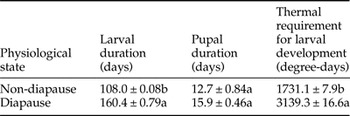
The diapause larvae of C. partellus took significantly longer time to turn into pupa as compared with non-diapausing counterpart (χ2 < 0.001) during different temperature and photoperiod rampings (table 2). Duration of pupal eclosion during different temperature and photoperiod rampings in diapause population was comparatively longer than the non-diapausing population, however, the differences were nonsignificant (χ2 = 0.102). Thermal requirements for overall development of C. partellus larvae across different temperature and photoperiod rampings was significantly more for diapusing (χ2 < 0.001) than the non-diapausing larvae (table 2).
Larval and pupal durations and numbers of degree-days required for the development of non-diapausing and diapausing populations of Chilo partellus across different temperature and photoperiod rampings.

Values within column followed by different letters are significant at P = 0.05. NS = nonsignificant at P = 0.05.
Effect of different constant temperature and photoperiod regimes on morphometric and developmental parameters of diapausing and non-diapausing larvae of C. partellus
The neonate C. partellus larvae exposed to constant temperatures and photoperiods viz., 18 ± 1°C + 11L:13D, 14 ± 1°C + 10.5L:13.5D, and 10 ± 1°C + 10L:14D survived upto 105.0, 104.5, and 91.0 days, respectively and failed to pupate, however at 27 ± 1°C + 12L:12D and 22 ± 1°C + 11.5L:12.5D the insect successfully completed the development. Furthermore, the larval duration of C. partellus exposed to 27 ± 1°C + 12L:12D was significantly shorter (F = 1683.46; df = 4,8; P ≤ 0.001) than those exposed to 22 ± 1°C + 11.5L:12.5D (table 3). However, the larval survival at 27 ± 1°C + 12L:12D and 22 ± 1°C + 11.5L:12.5D was on par with each other (F = 1.58; df = 1,2; P = 0.330). The pupal period was significantly shorter (F = 57.7; df = 1,2; P = 0.017) and pupal mortality lower (F = 49.0; df = 1,2; P = 0.020) at 27 ± 1°C + 12L:12D than at 22 ± 1°C + 11.5L:12.5D. The adult emergence was significantly higher at 27 ± 1°C + 12L:12D (F = 16.74; df = 1,2; P = 0.040) than at 22 ± 1°C + 11.5L:12.5D (table 3).
Development and survival of Chilo partellus at different constant temperature and photoperiod regimes.

Values within column followed by different letters are significant at P = 0.05. NDR = no development recorded after particular duration, and data were not included in further analysis. NS = nonsignificant at P = 0.05
A comparison between diapausing and non-diapausing C. partellus larvae at constant temperature and photoperiod treatments viz., 27 ± 1°C + 12L:12D and 22 ± 1°C + 11.5L:12.5D for various morphometric parameters such as larval weight, larval length, and larval head capsule width, was made using two-way ANOVA. The two-way ANOVA suggested significant differences for weight (F = 1183.24, df = 1,2, P ≤ 0.001), length (F = 17.73, df = 1,2, P = 0.006), and head capsule width (F = 6.25, df = 1,2, P = 0.046) of diapausing and non-diapausing larvae across thermo-photoperiod treatments. The diapausing C. partellus larvae had significantly lower larval weight, shorten length, and head capsule width than the non-diapausing larvae at both 27 ± 1°C + 12L:12D and 22 ± 1°C + 11.5L:12.5D, respectively (table 4).
Effects of constant temperature and photoperiod on the morphometric parameters of non-diapausing and diapausing Chilo partellus larvae.

Values within column and rows for each parameter followed by different capital and small letters, respectively are significant at P = 0.05.
Similarly, the developmental parameters i.e., larval duration, pupal duration, and thermal requirements (degree-days) were also compared between diapausing and non-diapausing C. partellus larvae at constant temperature and photoperiod treatments viz., 27 ± 1°C + 12L:12D and 22 ± 1°C + 11.5L:12.5D. Present studies revealed that the non-diapausing C. partellus larvae under ambient conditions (27 ± 1°C + 12L:12D) require a thermal threshold of 1068 degree-days. The two-way ANOVA showed significant differences for larval duration (F = 9.41, df = 1,2, P = 0.022), pupal duration (F = 8.19, df = 1,2, P = 0.029), and thermal requirement (degree-days: F = 12.03, df = 1,2, P = 0.013) of diapausing and non-diapausing larvae across thermo-photoperiod treatments. The diapausing C. partellus larvae had significantly longer larval and pupal durations, and higher thermal requirements than the non-diapausing larvae at both 27 ± 1°C + 12L:12D and 22 ± 1°C + 11.5L:12.5D, respectively (table 5).
Duration of developmental stages and degree-day requirement for the survival of non-diapausing and diapausing Chilo partellus larvae at constant treatments.

Values within column and rows for each parameter followed by different capital and small letters, respectively are significant at P = 0.05.
Initiation and termination of diapause
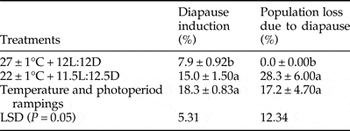
There was significant variability in induction of diapause (F = 11.87, df = 2,4, P = 0.021), survival of diapaused larvae (F = 28.07, df = 2,4, P = 0.004), and C. partellus population loss due to diapause (F = 28.10, df = 2,4, P = 0.004) across different temperature and photoperiod treatments (table 6). The observations on diapause during different temperature and photoperiod rampings revealed that the numbers of diapaused larvae recovered were significantly higher during ramping 4 (12.9%) than ramping 3 (5.5%) (F = 38.57, df = 1,2, P = 0.02). However, there were no significant differences between ramping 3 and 4 for survival of diapaused larvae (F = 0.91; df = 1,2; P = 0.64) and C. partellus population loss due to diapause (F = 0.92, df = 1,2, P = 0.43). No significant differences were observed in induction of diapause under 22 ± 1°C + 11.5L:12.5D (14.99%) and those exposed to different temperature and photoperiod ramping (18.3%) conditions, being significantly lower at 27 ± 1°C + 12L:12D (table 6). The population loss due to diapause under constant 22 ± 1°C + 11.5L:12.5D (28.3%) and different temperature and photoperiod rampings (17.2%) were on par, while no mortality was observed in diapausing larvae under 27 ± 1°C + 12L:12D treatment conditions (table 6).
Initiation and termination of diapause in Chilo partellus at various temperature and photoperiod treatment regimes.

Values within columns for each parameter followed by different letters are significant at P = 0.05.
Supernumerary moults during diapause
During the course of diapause, each diapaused larvae exhibited several larval–larval ecdysis last being the larval-pupal ecdysis. We observed up to five supernumerary moults in the diapaused C. partellus larvae before final ecdysis to pupation. Highest diapausing larvae (35.7%) exhibited two supernumerary moults followed by 25.0% twice, 21.4% once, 14.2% four times, and 3.5% larvae moulted five times before final ecdysis to pupation (fig. 1).
Frequency distribution of number of supernumerary moults by diapausing Chilo partellus larvae.

Discussion
Intensity of diapause is genetic and physiological attributes are governed by the duration of diapause under given environmental conditions (Masaki, Reference Masaki2002; Jiang et al., Reference Jiang, Cao, Zhang and Luo2010). Tropical and sub-tropical insects undergo facultative diapause induced by environmental cues such as photoperiod, temperature, humidity etc., and require certain period for development (Wu, Reference Wu2002; Sinclair et al., Reference Sinclair, Vernon, Klok and Chown2003). Such environmental cues have also been reported to induce diapause in B. fusca (Usua, Reference Usua1973; Dejen et al., Reference Dejen, Getu, Azerefegne and Ayalew2014), Chilo spp. (Scheltes, Reference Scheltes1978), Diatraea grandiosella Dyar (Kikukawa & Chippendale, Reference Kikukawa and Chippendale1983), and Scirpophaga incertulas (Walker) (Gu & Yin, Reference Gu and Yin1984). Present studies showed that the induction of diapause in C. partellus larvae takes from 46 to 56 days depending upon the temperature and photoperiod treatments. Induction of hibernation in C. partellus varied from 15.0 to 18.3% across temperature and photoperiod regimes, indicating that not all larvae undergo diapause, which could be due to genetic segregation. Induction of hibernation in some C. partellus larvae under ambient temperature and photoperiod conditions (27 ± 1°C + 12L:12D) during present studies could be due to synchrony between larval stage and physical and/or nutritional condition of the diet (as the larvae were reared on the same diet till pupation). These observations suggest substantial contribution of food along with other abiotic factors in induction of diapause in C. partellus. Further, the C. partellus larvae exposed to constant temperature and photoperiod treatments viz., 18 ± 1°C + 11L:13D, 14 ± 1°C + 10.5L:13.5D and 10 ± 1°C + 10L:14D did not allow the larvae to reach maturity leading to 100% mortality without any symptoms of hibernation, indicating that the induction of diapause is triggered towards maturity of the larvae. Dry condition of the host plants and deterioration of nutritional quality, i.e., increase in carbohydrate content and decrease in protein and water content in host plant have also been reported earlier to induce diapause in several cereal stem borer species even under favorable climatic conditions (Scheltes, Reference Scheltes1978; Sinclair et al., Reference Sinclair, Vernon, Klok and Chown2003; Tamiru et al., Reference Tamiru, Getu, Jembere and Bruce2012). Chilo partellus larvae exposed to constant 27 ± 1°C + 12L:12D presumed lower larval duration, higher larval survival, shorter pupal period, lower pupal mortality, and higher adult emergence as compared with those exposed to 22 ± 1°C + 11.5L:12.5D, reiterates that 27 ± 1°C temperature and 12L:12D photoperiod conditions are ambient for mass rearing of C. partellus under laboratory conditions.
During diapause C. partellus larvae exhibit several morphological changes, which aid in determining induction of diapause. We found that the morphological characteristics based criteria is more pronounced, reliable, and technically sound as compared with behavioral and physiological criteria for diapause determination. The morphological changes in C. partellus larvae could be due to physiological changes in response to unfavorable abiotic factors and food quality. Earlier studies have also reported that the diet deficient in protein content affect growth and development, and influence cuticular pigmentation leading to transformation of spotted morph to unspotted diapausing morph in D. grandiosella (Chippendale & Reddy, Reference Chippendale and Reddy1973). Abiotic factors like cooling and freezing, and rates of temperature change influence physiological responses of insects (Sinclair et al., Reference Sinclair, Vernon, Klok and Chown2003; Tamiru et al., Reference Tamiru, Getu, Jembere and Bruce2012), leading to effects on morphological traits such as larval weight, length and head capsule width. Present studies revealed that the larval weight, body length, and head capsule width of both diapausing and non-diapausing C. partellus larvae were significantly higher during temperature and photoperiod ramping 4 than other lower ramping regimes, which could be due to increased consumption and assimilation of food and prolonged larval duration. Further, the diapausing C. partellus larvae had significantly lower larval weight, larval length and head capsule width, and longer larval and pupal durations than the non-diapausing larvae at 27 ± 1°C + 12L:12D and 22 ± 1°C + 11.5L:12.5D treatment conditions. The reduction in body weight and length of diapausing C. partellus larvae could be because of reduced feeding, energy loss due to construction of diapause chamber, and reduction in body water content. Similar causal factors have also been reported earlier for reduction in weight and size of other diapausing insect species (Scheltes, Reference Scheltes1978; Kostal et al., Reference Kostal, Sula and Simek1998; Singtripop et al., Reference Singtripop, Wanichacheewa, Tsuzuki and Sakurai1999). Furthermore, Koidsumi & Makino (Reference Koidsumi and Makino1958) elaborated that the termination of hibernation in C. suppressalis is greatly accelerated by increase of water content in the body, resulting in the speeding up of certain enzymatic activities related to metamorphosis, and this increased water content is not expressed as increase in body weight but to serve for the production of metabolic water.
Insects adjust their life cycles to the seasonally variable environmental conditions in such a way that their growth, development, and reproduction coincide with favorable conditions (Wipking, Reference Wipking2000; Dhillon & Sharma, Reference Dhillon and Sharma2007; Khadioli et al., Reference Khadioli, Tonnang, Muchugu, Ong'amo, Achia, Kipchirchir, Krosche and Le Ru2014), and diapause is one such important component, which help insects to overcome and adjust variable climatic conditions. Induction and termination of diapause is regulated by temperature, which can simply be explained in terms of degree-days. The C. partellus larvae undergoing hibernation process under 27 ± 1°C + 12L:12D and 22 ± 1°C + 11.5L:12.5D constant temperature and photoperiod treatment conditions required 2561.7 and 2804.9 degree-days, respectively for completion of larval development, suggesting that the thermal requirement for diapausing C. partellus larvae (right from initiation to termination) decrease with increase in temperature. However, under fluctuating treatment (ramping) conditions the diapausing larvae required 3139.3 degree-days for completion of development, indicating influence of below optimum fluctuation in temperature and photoperiod conditions on the physiological response thus disrupting growth and development, and hence accumulating more numbers of degree-days (Wilson & Barnett, Reference Wilson and Barnett1983; Khadioli et al., Reference Khadioli, Tonnang, Muchugu, Ong'amo, Achia, Kipchirchir, Krosche and Le Ru2014).
The number of larval ecdysis in normal growing larvae of C. partellus is genetically fixed to six (Nijhout, Reference Nijhout1975). However, inter- and intra-specific variation in number of supernumerary moults in the diapausing insects cannot be ignored. This inter- and intra-specific variation in supernumerary moults could be because of food (Pipa, Reference Pipa1976), environmental conditions (Kadono-Okuda et al., Reference Kadono-Okuda, Kajiura and Yamashita1986), or juvenile hormone activity (Yin & Chippendale, Reference Yin and Chippendale1973; Tanaka & Takeda, Reference Tanaka and Takeda1993). During present studies we observed up to five supernumerary moults in the hibernating C. partellus larvae, wherein highest percentage of larvae (35.7%) exhibited two supernumerary moults followed by 25.0% twice, 21.4% once, 14.2% four times, and 3.5% larvae moulted five times before final ecdysis to pupation. This variation in supernumerary ecdysis in C. partellus could be due to variation in active forms of juvenile hormone titers during the entire course of diapause. Furthermore, the diapausing C. partellus larvae undergoing supernumerary or stationary moults exhibited reduction in larval weight and size, indicating that the supernumerary moults does not seem to provide any adaptive advantage to insects. Earlier studies reported seven supernumerary moults in diapausing C. partellus larvae (Kfir, Reference Kfir1991) and two additional moults in D. grandiosella larvae (Chippendale & Yin, Reference Chippendale and Yin1973; Yin & Chippendale, Reference Yin and Chippendale1976) with stationary larval growth.
Feeding activities in the beginning and end of hibernation period are considered to serve for the nutritive preparations for entering into and termination of hibernation in C. suppressalis, and the environmental conditions determine the feeding activity, diapause duration, and successful diapause termination (Koidsumi & Makino, Reference Koidsumi and Makino1958; Fischer et al., Reference Fischer, Klockmann and Reim2014). During present studies, the termination of diapause in C. partellus larvae occurred between 8 and 12 days on exposure to ambient conditions, and completed their development right from induction of diapause to pupation between 94.9 and 160.4 days. The C. partellus larvae undergoing diapause under different temperature and photoperiod conditions took 52.4–60.9 more number of days than the non-diapausing larvae to complete the development, suggesting that the correct combination of temperature and photoperiod is highly desirable for termination and post-diapause development. The pupal period exceeded from 3.2 to 6.2 days in the diapausing C. partellus larvae under different temperature and photoperiod conditions as compared with non-diapausing larvae, indicating significant effect of hibernation on development of adult characteristics during pupal stage and pupa-adult metamorphosis. Survival of C. partellus larvae undergoing diapause is critical for population pressure buildup on resumption of ambient conditions and damage threshold in the target host crop. Temperature range from 25 to 32°C is suitable for overwintering larvae of C. partellus to terminate diapause (Jalali & Singh, Reference Jalali and Singh2006). A few C. partellus larvae underwent diapause under ambient conditions (27 ± 1°C + 11.5L:12.5D) could be due to genetic segregation for diapause and some other unknown reasons, but no population loss was observed due to diapause under these conditions. Further, a population loss of 17.2–28.3% was recorded during hibernation process across different temperature and photoperiod conditions, which is significant number to determine population buildup of first brood after termination of hibernation and has implications for devising appropriate strategies for the management of C. partellus.
Acknowledgements
The technical and laboratory assistance of Mr. Brajendarnath and Ms. Prachi Tyagi, and funding by Ministry of Science and Technology, Department of Science and Technology (DST), New Delhi, India (SERB No:SB/SO/AS-020/2013) is gratefully acknowledged. The authors also sincerely thank the editor and five anonymous reviewers for constructive comments to improve quality of the manuscript.