Introduction
Cheilostomata, the dominant group in modern bryozoan assemblages, were sparse and poorly diversified for the first 50 Ma after their first appearance in the fossil record during the Late Jurassic (Taylor, Reference Taylor1994). However, they experienced a rapid diversification during the late Albian and early Cenomanian, with many evolutionary novelties appearing in a relatively short time interval (e.g., Cheetham, Reference Cheetham1954; Martha and Taylor, Reference Martha and Taylor2016, Reference Martha and Taylor2017). Compared to the Eurasian fauna, the known North American Albian fauna of cheilostome bryozoans is more diverse (Ostrovsky et al., Reference Ostrovsky, Taylor, Dick, Mawatari, Okada, Mawatari, Suzuki and Gautam2008) and several key innovations in cheilostomes, including the evolution of defensive polymorphs (avicularia) and of skeletal chambers for brooding of embryos (ovicells) were first reported in species from the late Albian of Texas (Cheetham, Reference Cheetham1954; Cheetham et al., Reference Cheetham, Sanner, Taylor and Ostrovsky2006). The North American Cretaceous bryozoan fauna described so far is highly endemic (Cuffey, Reference Cuffey, Hayward, Ryland and Taylor1994) and shows only a few, if any, species in common with the better known and more diverse Eurasian faunas. Still, the almost simultaneous appearance of key novelties in North American and European cheilostomes suggests some exchange between the two faunal provinces at least during the Albian.
The late Aptian to middle Albian Glen Rose Formation (Trinity Group) and Walnut Formation (Fredericksburg Group) contain frequent bryozoans encrusting bivalve shells. The cyclostome bryozoans from these formations are described elsewhere (Martha et al., Reference Martha, Taylor and Rader2019). Here, we describe the gymnolaemate bryozoans from the same deposits.
The Glen Rose and Walnut bryozoan faunas slightly antedate the commencement of the explosive evolutionary radiation of neocheilostomes (Taylor, Reference Taylor1988), and the cheilostome bryozoans present in these formations consist of simple, encrusting species dominated by malacostegines in the absence of neocheilostomes. Additionally, one bioimmured species of a soft-bodied arachnidiid ctenostome is reported from the Glen Rose.
In summary, the main aim of this contribution is to describe the gymnolaemate bryozoan faunas of the Glen Rose and Walnut formations of Texas, USA. In doing so, we introduce a new genus for Conopeum-like malacostegines with multiporous closure plates. The diversity of cheilostomes bryozoans in the Glen Rose and Walnut formations is discussed and compared to that of the cyclostomes.
Geological setting
The Glen Rose Formation is a unit of the Trinity Group resting on the Pearsall Formation and at the base of the Paluxy Sands in northcentral and southcentral Texas, USA. The formation was first proposed by Hill (Reference Hill1891) for exposures along the Paluxy River near Glen Rose and comprises a sequence of shallow-water carbonates deposited for ca. 5 Ma on a carbonate platform during the uppermost Aptian to the youngest part of the early Albian (Young, Reference Young and Hendricks1967; Scott et al., Reference Scott, Molineux, Löser and Mancini2007).
The Glen Rose Formation of southcentral Texas has been divided into a Lower Member consisting of two informal units, and an Upper Member comprising seven informal units (Stricklin et al., Reference Stricklin, Smith and Lozo1971; Ward and Ward, Reference Ward and Ward2007). The two members are separated by ~0.3–1.1 m thick Eoursivivas harveyi Marker Bed (Lozo and Stricklin, Reference Lozo and Stricklin1956; Scott et al., Reference Scott, Molineux, Löser and Mancini2007). The Aptian-Albian boundary is considered to occur within Unit 1 of the Lower Member. In northcentral Texas, the Glen Rose Formation is much condensed compared to southcentral Texas and subdivided into Lower, Middle, and Upper members, which do not correspond to the Lower and Upper members of the Glen Rose Formation in southcentral Texas. The three members of the Glen Rose Formation in northcentral Texas have been subdivided into several beds (see Bergan and Pittman, Reference Bergan and Pittman1990).
The Walnut Formation of the Fredericksburg Group overlies the Glen Rose Formation in southcentral Texas. It consists mainly of micritic or sparitic limestone and marlstone, and is divided into six members (e.g., Moore, Reference Moore1964). For a more detailed account of the geological setting, see Martha et al. (Reference Martha, Taylor and Rader2019).
Materials and methods
The material used in this study was collected by W.L. Rader, P.D. Taylor, A.B. Smith, and M.A. Wilson over a period of a few decades. Bryozoan colonies were mostly found encrusting bivalve shells in: Unit 2 of the Lower Member and units 1–4, 6, and 7 of the Upper Member of the Glen Rose Formation in southcentral Texas; beds 2–4 of the Lower Member, Bed 10 of the Middle Member and Bed 14 of the Upper Member of the Glen Rose Formation in northcentral Texas; and the Walnut Formation of southcentral Texas. Geographical and stratigraphical details of the collection sites of bryozoan material used in this study are summarized in Supplementary Data Sets 1and 2 accompanying Martha et al. (Reference Martha, Taylor and Rader2019). Preservation of the material varies from moderate to very good.
Scanning electron microscopy (SEM) was performed at the NHMUK on selected, ultrasonically cleaned specimens using a LEO 1455VP scanning electron microscope equipped with a low-vacuum chamber to accommodate uncoated specimens that were imaged using back-scattered electrons. For morphometry, SEM images were analyzed using the image-processing program ImageJ. Zooid measurements are given as range in μm and arithmetic mean (X̄) ± standard deviation with coefficient of variation (CV) and number of measurements (N).
Repository and institutional abbreviation
All specimens are housed in the collections at the Natural History Museum, London (NHMUK).
Systematic paleontology
Phylum Bryozoa Ehrenberg, Reference Ehrenberg1831
Order Ctenostomata Busk, Reference Busk and MacGillivray1852
Suborder Stoloniferina Ehlers, Reference Ehlers1876
Superfamily Arachnidioidea Hincks, Reference Hincks1880
Family Arachnidiidae Hincks, Reference Hincks1880
Genus Simplicidium Todd, Taylor, and Favorskaya, Reference Todd, Taylor and Favorskaya1997
Type species
Cellaria smithii Phillips, Reference Phillips1829 from the Cornbrash Formation (late Bathonian or early Callovian) of Scarborough, Yorkshire, England, by original designation.
Simplicidium jontoddi new species
Figure 1.1–1.4
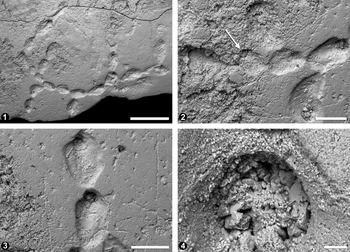
Simplicidium jontoddi n. sp. from Unit 2 of the Lower Member of the Glen Rose Formation (earliest Albian) of southcentral Texas, USA. Holotype (NHMUK BZ8165). (1) Bioimmured colony; scale bar is 1 mm; (2) ancestrula (white arrow) and early astogeny; scale bar is 250 µm; (3) two autozooids; scale bar is 250 µm; (4) D-shaped orifice; scale bar is 25 µm.

Holotype
NHMUK BZ8165, early Albian, Glen Rose Formation, Lower Member, Unit 2, 765 Astral Point, opposite entrance to White Acres Farm, Mystic Shores Subdivision, Spring Branch, Comal County, Texas.
Paratype
NHMUK BZ8166, same locality and stratigraphical information as for the holotype.
Diagnosis
Simplicidium budding daughter zooids that give rise to new branches laterally or proximolaterally; zooid orifice D-shaped.
Occurrence
Only known from the type locality.
Description
Colony encrusting, uniserial, unilaminar, consisting of slightly curved branches of distally budded autozooids, from which daughter branches arise laterally or proximolaterally and diverge at angles of ~90° to parent branch (Fig. 1.1). Branch ramification frequent, but branch overgrowth not observed. Ancestrula 238 µm long (N = 1) by 181 µm wide (N = 1), budding one proximolateral bud and one distolateral bud (Fig. 1.2). Pore chambers not observed.
Autozooids small, those from early astogeny ovoidal to longitudinally elliptical, 349–502 µm long (X̄ = 416 ± 48 µm; CV = 12; N = 9) by 198–311 µm wide (X̄ = 259 ± 39 µm; CV = 15; N = 9) (length/width ratio = 1.61); in later astogeny, elongate-pyriform, 518–675 µm long (X̄ = 600 ± 60 µm; CV = 10; N = 6) by 252–303 µm wide (X̄ = 273 ± 20 µm; CV = 7; N = 6) (length/width ratio = 2.20), narrow proximally, rounded distally (Fig. 1.3). Cauda absent or short. Frontal wall gently convex. Orifice terminal, 100–114 µm long (X̄ = 106 ± 6 µm; CV = 5; N = 5) by 60–84 µm wide (X̄ = 74 ± 9 µm; CV = 12; N = 5) in elliptical autozooids (length/width ratio = 1.42), and 110–130 µm long (X̄ = 119 ± 8 µm; CV = 6; N = 5) by 77–99 µm wide (X̄ = 86 ± 9 µm; CV = 11; N = 5) in pyriform autozooids (length/width ratio = 1.39), D-shaped with a slightly convex proximal edge and more strongly curved distal/lateral edges (Fig. 1.4), wider than long. Spines and kenozooids not observed.
Morphometry measurements were performed on specimen NHMUK BZ8165 (holotype).
Etymology
Named for Jonathan A. Todd (NHMUK), in recognition of his research on bioimmuration, especially of ctenostomes.
Remarks
Simplicidium jontoddi n. sp. is a non-boring ctenostome, both of the two known colonies being bioimmured following overgrowth by serpulids. The new species differs from the other two species assigned to Simplicidium, Simplicidium brandesi Voigt, Reference Voigt1968 and Simplicidium smithii (Phillips, Reference Phillips1829), in having: (1) a D-shaped orifice, and (2) new branches arising from irregular positions as lateral or proximolateral buds. In contrast, Simplicidium smithii and Simplicidium brandesi have circular to subcircular orifices and new branches originating as distal or distolateral buds.
Although bioimmured ctenostome bryozoans are well known from the Late Jurassic (e.g., Taylor, Reference Taylor1990) and the Late Cretaceous (e.g., Voigt, Reference Voigt1966), only one other species has been reported from the Early Cretaceous, Simplicidium brandesi Voigt, Reference Voigt1968 from the Berriasian to Barremian of Central and Eastern Europe. Several bioimmured ctenostome species, including arachnidiids, occur in the Grayson Formation (Cenomanian) of the Wishita Group in Texas (Todd, Reference Todd, Herrera-Cubilla and Jackson2000), but have yet to be formally described.
Order Cheilostomata Busk, Reference Busk and MacGillivray1852
Suborder Malacostegina Levinsen, Reference Levinsen1902
Superfamily Membraniporoidea Busk, Reference Busk1854
Family Electridae d'Orbigny, Reference d'Orbigny1851
Genus Rhammatopora Lang, Reference Lang1915
Type species
Membranipora gaultina Vine, Reference Vine1890 from the late Albian to Cenomanian of several localities in England, United Kingdom; by original designation.
Rhammatopora glenrosa new species
Figure 2.1–2.6
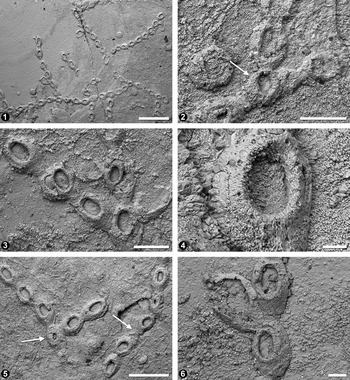
Rhammatopora glenrosa n. sp. from Unit 6 of the Upper Member of the Glen Rose Formation (early Albian) of southcentral Texas, USA. Holotype (NHMUK BZ8165). (1) Several uniserial, encrusting colonies; scale bar is 1 mm; (2) ancestrula (arrowed) overgrowing autozooid of another colony and budding one autozooid distally; scale bar is 250 µm; (3) branch trifurcation and several autozooids with three pairs of spine bases; scale bar is 250 µm; (4) autozooid with four pairs of spine bases; scale bar is 50 µm; (5) two uniserial colonies showing an autozooid with closure plate (left arrow) and bipolar zooid pair (right arrow); scale bar is 500 µm; (6) intramural, reparative budding in bottom autozooid; scale bar is 100 µm.

Holotype
NHMUK BZ8149 (1), early Albian, Glen Rose Formation, Upper Member, Unit 6 (lower Loriolia Marker Bed), cut below water tower at the intersection of FM 620 with Kollmeyer Drive, Lakeway, Travis County, Texas.
Paratypes
NHMUK BZ8149 (2–6), same locality and stratigraphical information as for the holotype.
Diagnosis
Rhammatopora with 6–8 circumopesial spines and with zooids that have a short, broad cauda.
Occurrence
Known from several outcrops west of Austin, Travis County, Texas.
Description
Colony encrusting, uniserial, with runner-like colonies, unilaminar, consisting of straight or slightly curved branches of distally budded autozooids, from which daughter branches arise distolaterally and diverge at angles of ~70−90° to parent branch (Fig. 2.1). Branch bifurcations frequent, but branch overgrowth not observed. Ancestrula 157–216 µm long (X̄ = 179 ± 27; CV = 15; N = 4) by 124–150 µm wide (X̄ = 139 ± 13; CV = 9; N = 4), longitudinally elliptical, spinose, with one distal bud (Fig. 2.2). Pore chambers not observed.
Autozooids small, 233–401 µm long (X̄ = 323 ± 52; CV = 16; N = 28) by 180–255 µm wide (X̄ = 213 ± 21; CV = 10; N = 28); zooids early in astogeny longitudinally elliptical; younger generations of zooids become slightly elongate-pyriform, narrow proximally, rounded distally (Fig. 2.3). Gymnocyst extensive, surrounding opesia, smooth, forming a short, broad cauda in later astogeny. Opesia 155–275 µm long (X̄ = 195 ± 33; CV = 17; N = 24) by 113–168 µm wide (X̄ = 136 ± 16; CV = 11; N = 24), occupying most of frontal surface, longitudinally elliptical. Spine bases circumopesial, numbering 6–8, one pair distolateral to opesia, second pair at about three-quarters of opesial length, third pair about one-quarter of opesial length, and fourth pair proximolateral to opesia; third pair of spine bases lacking in many autozooids (Fig. 2.3, 2.4). Cryptocyst narrow, sloping steeply into opesia, widest proximally and narrowing laterally and distally, smooth. Closure plates rare, depressed, with subcircular to longitudinally elliptical opening and a conspicuous crescent-shaped scar from opercular sclerites distally (Fig. 2.5). Bipolar pairs of zooids joined at their proximal ends and growing in opposite directions observed in two colonies (Fig. 2.5). Intramural reparative budding of zooids inside autozooidal opesiae occurs (Fig. 2.6). Kenozooids not observed.
Morphometry measurements were performed on specimen NHMUK BZ8149 (holotype and several paratype colonies).
Etymology
The species is named after the type stratum, the Glen Rose Formation of southcentral Texas.
Materials
For non-type material of this species, see Supplementary Data Set 1.
Remarks
The holotype of Rhammatopora glenrosa n. sp. is on a bivalve shell encrusted by several colonies of the new species. It has autozooids with no or very short caudae, and the number of spine pairs varies between three and four, with the spine pair located at about one-quarter of opesial length usually lacking. The arrangement of the spines in R. glenrosa n. sp. is comparable to that observed in Charixa bispinata n. sp., but in the material examined, all colonies of R. glenrosa n. sp. are uniserial and the ancestrula buds only one distal autozooid. The occurrence of bipolar zooid pairs, which are the result of branch lesion followed by regenerative budding from the broken end (see Taylor, Reference Taylor1986a), is another feature of R. glenrosa that was not observed in either Charixa bispinata n. sp. or in Charixa bispinata n. sp.
The new species was previously mentioned in an account of pre-Cenomanian cheilostomes by Ostrovsky et al. (Reference Ostrovsky, Taylor, Dick, Mawatari, Okada, Mawatari, Suzuki and Gautam2008) as the oldest representative of the genus Pyripora d'Orbigny, Reference d'Orbigny1852. However, the presence of circumopesial spines justifies assignment of the new species to Rhammatopora Lang, Reference Lang1915 instead. The type species of this genus, Rhammatopora gaultina (Vine, Reference Vine1890), has very long, narrow caudae and 15–20 circumopesial spine bases. The only other species assigned to this genus, Rhammatopora gasteri Thomas and Larwood, Reference Thomas and Larwood1956, was described from the early Cenomanian of Sussex, England and has somewhat shorter caudae and only 12 circumopesial spines. The ancestrula has not been observed in either of the two previously described species.
An older, supposedly Pyripora-like electrid was described by Mantell (Reference Mantell1844) from the Aptian of Kent, United Kingdom as Crisia johnstoniana Mantell, Reference Mantell1844. This species was later assigned to the genus Rhammatopora by Lang (Reference Lang1915). According to Mantell's drawing, this species has very long caudae, but spine bases are not evident and were not mentioned in the description. Because the type material is lost (Lang, Reference Lang1915; Taylor, Reference Taylor1986b), Crisia johnstoniana is best regarded as a nomen dubium.
Genus Iyarispora new genus
Type species
Iyarispora ikaanakiteeh n. gen. n. sp. from the early Albian of several localities in southcentral Texas, USA.
Occurrence
Early Albian, Glen Rose Formation; Texas, USA. Campanian, Mount Laurel Formation; Delaware, USA. Late Campanian to Maastrichtian, Simsima Formation; Hajar Mountains, Arabian Peninsula. Maastrichtian, Prairie Bluff Chalk; Alabama, USA and Ripley Formation; Tennessee, USA.
Diagnosis
Colony encrusting, multiserial, unilaminar or multilaminar. Autozooids arranged quincunxially. Ancestrula single, budding one distal autozooid and surrounded by six periancestrular zooids. Opesia occupying most of frontal surface, longitudinally elliptical. Closure plates present, perforated by multiple pores, distally indented by sclerites of operculum. Gymnocyst narrow, smooth. Cryptocyst pustulose, narrow, sloping steeply into opesia. Kenozooids small, subtriangular or polygonal, usually at proximolateral corners of each autozooid and sometimes becoming knob- or spine-like. Pore chambers, ovicells, and avicularia absent.
Etymology
From the native American Wichita language íyari (‘animal’) with the ending -pora from Greek πόρος (‘pore’).
Remarks
Iyarispora n. gen. is erected for electrid malacostegan cheilostomes with encrusting, multiserial colonies and autozooids with closure plates perforated by multiple perforations. The most similar genera are Wawalia Dzik, Reference Dzik1975, Charixa Lang, Reference Lang1915, and Spinicharixa Taylor, Reference Taylor1986b. However, the closure plates in Wawalia and Spinicharixa lack distinct perforations, while those of Charixa have one large central opening.
Other Cretaceous species that can be included in the new genus were formerly assigned to Conopeum Gray, Reference Gray1848. They include: C. (Alderina) nelsoni (Canu and Bassler, Reference Canu, Bassler and Wade1926); C. paranelsoni Taylor and McKinney, Reference Taylor and McKinney2006; C. spissamentum Taylor and McKinney, Reference Taylor and McKinney2006; and C. wilsoni Di Martino and Taylor, Reference Di Martino and Taylor2013. In the type species of Conopeum Gray, Reference Gray1848, the Recent species Millepora reticulum Linnaeus, Reference Linnaeus and Linnaeus1767, the ancestrula buds two distolateral autozooids and one proximal autozooid. Closure plates in Recent species of Conopeum are rare and, when present, as in Conopeum seurati (Canu, Reference Canu1928), they are incompletely uncalcified and have a single medial opening.
Iyarispora ikaanakiteeh new species
Figure 3.1–3.6
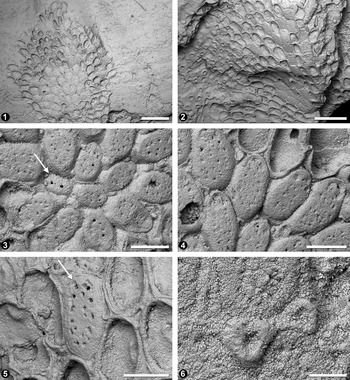
Iyarispora ikaanakiteeh n. gen. n. sp. from Unit 2 of the Upper Member of the Glen Rose Formation (early Albian) of southcentral Texas, USA (1, 2, 5, 6); from Unit 1 of the Upper Member of the Glen Rose Formation (early Albian) of southcentral Texas, USA (3, 4). (1) Encrusting colony (paratype, NHMUK BZ8124); scale bar is 1 mm; (2) colony encrusting on Reptomultisparsa mclemoreae Martha et al., Reference Martha, Taylor and Rader2019 (holotype, NHMUK BZ8111); scale bar is 1 mm; (3) ancestrula (arrowed) and early astogeny (paratype, NHMUK BZ8109); scale bar is 250 µm; (4) autozooids with multiporous closure plates and kenozooids (paratype, NHMUK BZ8109); scale bar is 250 µm; (5) autozooid with closure plate pierced by outer ellipse of twelve circular pores and incomplete inner ellipse consisting of five pores; the crescent shaped scar from opercular sclerite (arrowed) is also pierced by pores (holotype, NHMUK BZ8111); scale bar is 250 µm; (6) kenozooids, the left showing markedly raised margins (paratype, NHMUK BZ8112); scale bar is 100 µm.

Holotype
NHMUK BZ8111, early Albian, Glen Rose Formation, Upper Member, Unit 2, roadcut along River Ridge Road, Mystic Shores Subdivision, Canyon Lake, Comal County, Texas.
Paratypes
NHMUK BZ8112, BZ8124, same locality and stratigraphical information as for the holotype. NHMUK BZ8109, BZ8110, early Albian, Glen Rose Formation, Upper Member, Unit 1, 13500 Pecan Drive, Lakeway, Travis County, Texas.
Diagnosis
Iyarispora n. gen. with clusters of autozooids having closure plates; pores in closure plates arranged in single outer ellipse consisting of ~12 pores, with up to five smaller, inner pores; kenozooids at proximolateral corners of some but not all autozooids, occasionally raised to form knob-like tubercles.
Occurrence
All studied specimens are from units 1 and 2 of the Upper Member of the Glen Rose Formation of Comal, Kendall, and Travis counties in southcentral Texas.
Description
Colony encrusting, multiserial, unilaminar (Fig. 3.1). Autozooids arranged quincunxially, with occasional series divisions. Zooidal boundaries defined by distinct furrows (Fig. 3.2). Ancestrula single, 197–208 µm long (X̄ = 203 ± 8 µm; CV = 4; N = 2) by 118–121 µm wide (X̄ = 120 ± 2 µm; CV = 2; N = 2), occluded by closure plate containing one mediodistal and one medioproximal pore, budding one proximal autozooid, with five other periancestrular zooids budded from later autozooids (Fig. 3.3). Pore chambers not observed.
Autozooids 370–514 µm long (X̄ = 434 ± 38 µm; CV = 9; N = 30) by 194–364 µm wide (X̄ = 253 ± 31 µm; CV = 12; N = 30), longitudinally elliptical, sometimes almost rectangular with rounded corners (Fig. 3.4). Gymnocyst narrow, surrounding opesia, smooth. Opesia 290–477 µm long (X̄ = 373 ± 47 µm; CV = 13; N = 30) by 161–290 µm wide (X̄ = 209 ± 27 µm; CV = 13; N = 30), occupying most of frontal surface, longitudinally elliptical. Spine bases not observed. Cryptocyst slightly pustulose, sloping steeply into opesia. Closure plates usually present on all autozooids from early astogeny and in clusters of autozooids later in astogeny, covering entire frontal surface, planar, with conspicuous crescent-shaped scar from opercular sclerites distally, perforated by small, circular countersunk pores, ~12 pores forming an outer ellipse plus up to five inner pores (Fig. 3.5), pores 11–24 µm (X̄ = 17 ± 4 µm; CV = 25; N = 24) in diameter. Intramural reparative budding of zooids, ovicells and avicularia not observed.
Kenozooids 90–209 µm long (X̄ = 138 ± 24 µm; CV = 18; N = 30) by 66–150 µm wide (X̄ = 102 ± 20 µm; CV = 20; N = 30), subtriangular, usually at proximolateral corners of some autozooids, kenozooidal margins sometimes markedly raised to form knob-like tubercles (Fig. 3.3, 3.6). Kenozooidal opesia occupying most of frontal surface and of same shape as kenozooid (Fig. 3.5).
Morphometry measurements were performed on specimen NHMUK BZ8111 (holotype) and specimens NHMUK BZ8112 and NHMUK BZ8112 (paratypes).
Etymology
From Wichita ika : ?a (‘rock’), na (participle) and kita (‘on top’), together with the genus name meaning in a Wichita-Greek mixture ‘porous animal on top of rock’.
Materials
For non-type material of this species, see Supplementary Data Set 1.
Remarks
Iyarispora ikaanakiteeh n. gen. n. sp. is the oldest representative of the new genus, occurring in units 1 and 2 of the Upper Member of the Glen Rose Formation. It differs from Iyarispora chiass n. gen. n. sp., with which it does not co-occur, in having smaller and more numerous pores in the closure plates, which include additional pores inside the main ellipse of pores. The number of closure plate pores is usually much greater in younger species from the Campanian and Maastrichtian assigned to the new genus, except for Iyarispora paranelsoni (Taylor and McKinney, Reference Taylor and McKinney2006), in which the number and arrangement of pores is somewhat similar to I. chiass n. gen. n. sp.
Iyarispora chiass new species
Figures 4.1–4.6, 5.1–5.6
1969 Unnamed membranimorph cheilostome; Boardman and Cheetham, pl. 30, fig. 1.
2008 ‘Conopeum’ s.l.; Ostrovsky et al., fig. 1G.
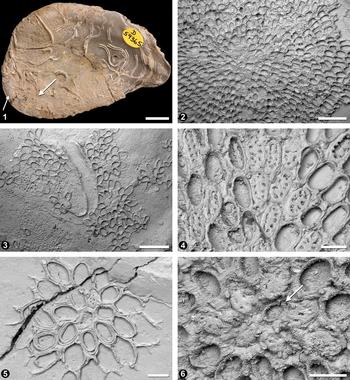
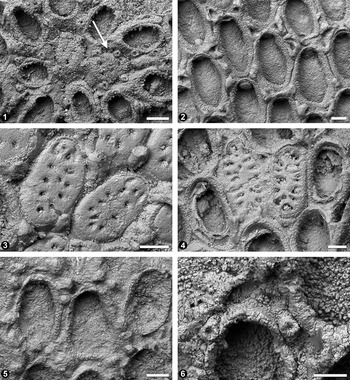
Iyarispora chiass n. gen. n. sp. from Bed 4 of the Lower Member of the Glen Rose Formation (early Albian) of northcentral Texas, USA (1, 2, 4); from Bed 4 of the Lower Member of the Glen Rose Formation (early Albian) of northcentral Texas, USA (5); from Unit 4 of the Upper Member of the Glen Rose Formation (early Albian) of southcentral Texas, USA (3); from Unit 6 of the Upper Member of the Glen Rose Formation (early Albian) of southcentral Texas, USA (6). (1) Bivalve shell encrusted by multiple colonies of Iyarispora chiass n. gen. n. sp. and Charixa bispinata n. sp., with the holotype colonies of Charixa bispinata n. sp. (left arrow) and Iyarispora chiass n. gen. n. sp. (right arrow) indicated (NHMUK D59365); scale bar is 1 cm; (2) encrusting colony, holotype, NHMUK D59365 (1A); scale bar is 1 mm; (3) several small, encrusting colonies, paratype, NHMUK BZ7906; scale bar is 1 mm; (4) autozooids with and without closure plates, holotype, NHMUK D59365 (1A); scale bar is 250 µm; (5) ancestrular region of small colony showing several intramural buds, paratype, BZ2338; scale bar is 250 µm; (6) ancestrula indicated by white arrow with one distal bud and surrounded by six periancestrular autozooids, paratype, NHMUK BZ8013; scale bar is 250 µm.

Iyarispora chiass n. gen. n. sp. from Unit 4 of the Upper Member of the Glen Rose Formation (early Albian) of southcentral Texas, USA (2); from Unit 6 of the Upper Member of the Glen Rose Formation (early Albian) of southcentral Texas, USA (1, 3−6). (1) Early astogeny with ancestrula (arrowed) and small kenozooids, paratype, NHMUK BZ7950; scale bar is 100 µm; (2) autozooids surrounded by knob-like kenozooids, paratype, NHMUK BZ7910; scale bar is 100 µm; (3) autozooids with closure plates pierced by subcircular pores, paratype, NHMUK BZ7984; scale bar is 100 µm; (4) autozooids with closure plates pierced by beveled pores, paratype, NHMUK BZ7951; scale bar is 100 µm; (5) knob-like kenozooids, paratype, NHMUK BZ8017; scale bar is 100 µm; (6) close-up view of two small kenozooids lateral to aperture, paratype, NHMUK BZ7949; scale bar is 50 µm.

Holotype
NHMUK D59365 (1A), early Albian, Glen Rose Formation, Lower Member, Bed 4, Cedar Brake Camp, Somervell County, Texas.
Paratypes
NHMUK D59364, early Albian, Glen Rose Formation, Middle Member, Bed 10, Barker Branch west of Glen Rose, Somervell County, Texas. NHMUK BZ2338, early Albian, Glen Rose Formation, Upper Member, Bed 14, Cedar Brake Camp, Somervell County, Texas. NHMUK BZ7906, early Albian, Glen Rose Formation, Upper Member, Unit 4, abandoned quarry on north side of SH 290, west of Dripping Springs, Hays County, Texas. NHMUK BZ7949, early Albian, Glen Rose Formation, Upper Member, Unit 6 (lower Loriolia Marker Bed), banks along creek beside Target department store off FM 620, Bee Cave, Travis County, Texas. NHMUK BZ8013, early Albian, Glen Rose Formation, Upper Member, Unit 6 (lower Loriolia Marker Bed), roadcut on the northwestern side of Quinlan Park Road near University Club Drive, Austin. NHMUK BZ7950, BZ7951, early Albian, Glen Rose Formation, Upper Member, Unit 6 (lower Loriolia Marker Bed), construction site at southwest corner of Ming Trail and Destination Way, Lago Vista, Travis County, Texas. NHMUK BZ7984, early Albian, Glen Rose Formation, Upper Member, Unit 6 (lower Loriolia Marker Bed), roadcut on the north side of FM 620 northwest of Mansfield Dam, Hudson Bend, Travis County, Texas. NHMUK BZ8017, early Albian, Glen Rose Formation, Upper Member, Unit 6 (lower Loriolia Marker Bed), roadcut on the northwestern side of Quinlan Park Road near University Club Drive, Austin. NHMUK BZ7910, early Albian, Glen Rose Formation, Upper Member, Unit 4, abandoned quarry on north side of SH 290, west of Dripping Springs, Hays County, Texas.
Diagnosis
Iyarispora n. gen. with closure plates occurring in clusters of autozooids; closure plate pores large, circular, arranged in single ellipse with no inner pores; kenozooids at proximolateral corners of some but not all autozooids, some raised to form knob-like tubercles.
Occurrence
This species has been found at several outcrops of the Lower, Middle, and Upper members of the Glen Rose Formation in Hood and Somervell counties, northcentral Texas, and in units 3–7 of the Upper Member of the Glen Rose Formation in Blanco, Burnet, Comal, Hays, and Travis counties in southcentral Texas. A specimen apparently belonging to this species was figured by Boardman and Cheetham (Reference Boardman and Cheetham1969) from the Albian DeQueen Limestone of Highland, Arkansas.
Description
Colony encrusting, multiserial, unilaminar (Fig. 4.1–4.3). Autozooids arranged quincunxially, with occasional series divisions. Zooidal boundaries defined by distinct furrows (Fig. 4.4). Ancestrula single, 147–209 µm long (X̄ = 183 ± 32 µm; CV = 18; N = 3) by 83–144 µm wide (X̄ = 116 ± 31 µm; CV = 27; N = 3), sometimes occluded by a closure plate pierced by three to five pores, budding one proximal autozooid only, with other five periancestrular zooids budded from later autozooids (Figs. 4.5, 4.6, 5.1). Pore chambers not observed.
Autozooids 293–393 µm long (X̄ = 345 ± 24 µm; CV = 7; N = 36) by 155–246 µm wide (X̄ = 195 ± 24 µm; CV = 12; N = 36), longitudinally elliptical, sometimes almost rectangular with rounded corners (Fig. 4.4). Gymnocyst narrow, surrounding opesia, smooth. Opesia 223–350 µm long (X̄ = 275 ± 34 µm; CV = 12; N = 36) by 117–185 µm wide (X̄ = 151 ± 16 µm; CV = 10; N = 36), occupying most of frontal surface, longitudinally elliptical. Unequivocal spine bases not observed. Cryptocyst pustulose, sloping steeply into opesia (Fig. 5.2). Closure plates sometimes present, occurring in clusters of autozooids or in single autozooids, covering entire frontal surface, planar, with conspicuous crescent-shaped scar of opercular sclerites distally (Fig. 5.3), perforated by ~10–14 large, circular to transverse, countersunk pores arranged in an ellipse, pores 18–41 µm (X̄ = 27 ± 6 µm; CV = 23; N = 24) in diameter (Fig. 5.3, 5.4). Intramural reparative budding of zooids occurs (Fig. 5.4, 5.5). Ovicells and avicularia not observed.
Kenozooids variable in shape and size, larger examples usually subtriangular and at proximolateral corners of some autozooids, 76–158 µm long (X̄ = 118 ± 19 µm; CV = 16; N = 36) by 59–136 µm wide (X̄ = 87 ± 16 µm; CV = 19; N = 36), their margins occasionally markedly raised (Fig. 5.2); opesia occupying most of frontal surface and of the same shape as the kenozooid. Smaller kenozooids may be knob- (Fig. 5.1, 5.5) or spine-like (Fig. 5.1, 5.3, 5.6), randomly interspersed between autozooids, typically clustered in certain areas of the colony and often present during the early astogeny.
Morphometry measurements were performed on specimen NHMUK D59365 (1A) (holotype) and specimens NHMUK BZ7984 and NHMUK BZ8013 (paratypes).
Etymology
From Wichita chí ?as’ (‘one’ or ‘only one’), referring to the species having only one ellipse of pores.
Materials
For non-type material of this species, see Supplementary Data Set 1.
Remarks
Iyarispora chiass n. gen. n. sp. is the most common bryozoan species found in the Glen Rose Formation. It is known from >100 colonies from units 3–7 (excluding Unit 5) of the Upper Member of the Glen Rose Formation of southcentral Texas and throughout the Glen Rose Formation of northcentral Texas. However, in the overlying Walnut Formation no colonies of either Iyarispora chiass n. gen. n. sp., or of I. ikaanakiteeh n. gen. n. sp. were found.
Iyarispora chiass n. gen. n. sp. differs from I. ikaanakiteeh n. gen. n. sp. in the closure plates containing fewer pores but of larger size and often transversely elongate in shape rather than strictly circular. Closure plate pores of Iyarispora chiass n. gen. n. sp. may be beveled. Intermediate stages between circular and transversely elongate pores in Iyarispora chiass n. gen. n. sp. occur (Fig. 5.4, 5.5), and both types of pores were occasionally observed in the same colony (e.g., Fig. 4.4). Therefore, we object defining different species based on the shape of the pores inside the closure plates as identification of these would most certainly prove unmanageable with the Glen Rose material.
Another important difference between Iyarispora chiass n. gen. n. sp. and Iyarispora ikaanakiteeh n. gen. n. sp. is the morphology and abundance of kenozooids. While in Iyarispora ikaanakiteeh n. gen. n. sp. they usually occur proximolateral to autozooids and are occasionally knob-like, kenozooids are more interspersed among the autozooids of Iyarispora chiass n. gen. n. sp. and are often knob- or spine-like.
The specimen imaged by Boardman and Cheetham (Reference Boardman and Cheetham1969, pl. 30, fig. 1) as an unnamed membranimorph cheilostome from the Albian DeQueen Limestone of Highland, Alabama shows closure plates with a similar pattern of pores to I. chiass n. gen. n. sp. Boardman and Cheetham (Reference Boardman and Cheetham1969) interpreted these as marking points of attachment of the parietal muscles to the underside of the frontal membrane. The irregular distribution of the closure plate pores in the autozooids, as well as the medial position of the pores in the ancestrula, argue against this interpretation.
Genus Charixa Lang, Reference Lang1915
Type species
Charixa vennensis Lang, Reference Lang1915 from the Black Ven Cliff near Charmouth, Dorset, England, United Kingdom; by original designation.
Amended diagnosis
Colony encrusting, composite multiserial (= generally multiserial but facultatively uniserial), unilaminar. Ancestrula single, budding one proximal or distal autozooid and occasionally an additional two (proximo-) lateral autozooids. Autozooids vary from caudate to non-caudate, caudate autozooids forming uniserial series, from which non-caudate autozooids bud to fill in spaces between lineal series. Spine bases either absent or present and typically variable in number within the colony, with a pair of oral spine bases being most frequent. Opesia occupying most of frontal surface, longitudinally elliptical. Closure plates present, central opening absent or single and large. Gymnocyst narrow laterally and distally, smooth, surrounding opesia. Cryptocyst slightly pustulose, sloping steeply into opesia. Pore chambers present. Kenozooids may be present. Avicularia and ovicells lacking.
Remarks
The current concept of the two genera Charixa and Spinicharixa Taylor, Reference Taylor1986b is challenged by the material found in the Glen Rose and Walnut formations. When Taylor (Reference Taylor1986b) introduced the new genus Spinicharixa, he based it on the presence of circumopesial spines, in contrast to Charixa in which spine bases are absent or oral only. Apart from the type species, Spinicharixa pitti Taylor, Reference Taylor1986b, only one other species, Spinicharixa dimorpha Taylor, Reference Taylor1986b, has been included in Spinicharixa.
Charixa sexspinata n. sp. shows a highly variable (0–6) number of spine bases per autozooid. Furthermore, Charixa bispinata n. sp. has four circumopesial spine bases during early astogeny, but two oral spines in later autozooids, while Charixa emanuelae n. sp. lacks spine bases entirely. In view of this variability within what seem to be three closely related species, the diagnosis of Charixa is amended. As for Spinicharixa, this can now be interpreted to include only species in which circumopesial spine bases are constantly present, even in autozooids from late astogeny, and closure plates lack a large central opening.
Charixa bispinata new species
Figures 4.1, 6.1–6.6
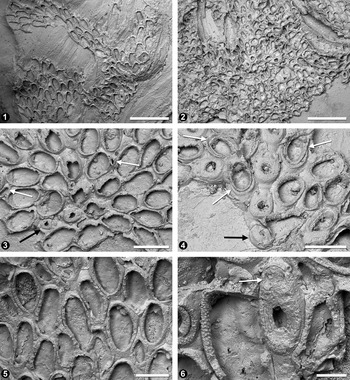
Charixa bispinata n. sp. from Unit 2 of the Upper Member of the Glen Rose Formation (early Albian) of southcentral Texas, USA (1); from Bed 4 of the Lower Member of the Glen Rose Formation (early Albian) of northcentral Texas, USA (2, 3). (1) Encrusting colony; paratype, NHMUK BZ7853; scale bar is 1 mm; (2) encrusting colony, paratype, NHMUK D59365 (2B); scale bar is 1 mm; (3) ancestrula (black arrow) with distal bud and autozooids from the early astogeny showing reduction of spine number from four to two; kenozooids are marked with white arrows, holotype, NHMUK D59365 (2A); scale bar is 250 µm; (4) ancestrula (black arrow) with one distal bud and autozooids from the early astogeny showing intramural buds (white arrows) and autozooids with two oral spines in both early and later astogeny, paratype, NHMUK D59365 (2C); scale bar is 250 µm; (5) autozooids and interzooidal kenozooids, paratype, NHMUK BZ7853; scale bar is 250 µm; (6) autozooid showing two oral spine bases and closure plate with straight, parallel scars of opercular sclerite distally (arrowed), paratype, NHMUK BZ7853; scale bar is 100 µm.

Holotype
NHMUK D59365(2A), early Albian, Glen Rose Formation, Lower Member, Bed 4, Cedar Brake Camp, Somervell County, Texas.
Paratypes
NHMUK D59365(2B, 2C), early Albian, Glen Rose Formation, Lower Member, Bed 4, Cedar Brake Camp, Somervell County, Texas. NHMUK BZ7853, BZ7854, early Albian, Glen Rose Formation, Upper Member, Unit 2, roadcut along River Ridge Road, Mystic Shores Subdivision, Canyon Lake, Comal County, Texas.
Diagnosis
Charixa with four circumopesial spine bases in autozooids from early astogeny and two oral spine bases in younger autozooids; pronounced autozooidal dimorphism between caudate autozooids forming lineal series and non-caudate autozooids filling the spaces between lineal series; closure plates with distocentral circular to longitudinally elliptical opening.
Occurrence
The holotype colony and two paratype colonies encrust a bivalve shell from Bed 4 of the Lower Member of the Glen Rose Formation at the Cedar Brake Camp in northcentral Texas (Fig. 4.1), while additional material comes from Bed 3 of the Lower Member of the Glen Rose Formation of northcentral Texas and from units 2–7 of the Upper Member of the Glen Rose Formation and the Walnut Formation in southcentral Texas (Bell, Burnet, Comal, Hays, and Travis counties).
Description
Colony encrusting, consisting of short uniserial runner-like segments and prevalently of multiserial sheet-like segments, unilaminar (Fig. 6.1, 6.2). Autozooidal dimorphism slightly pronounced, caudate autozooids forming uniserial lines and non-caudate autozooids interspersed between lineal series. Caudate autozooids bud one distal caudate autozooid and usually two distolateral non-caudate autozooids, while non-caudate autozooids usually bud up to three distal and distolateral non-caudate autozooids (Fig. 6.3, 6.4). Non-caudate autozooids may bud a distal caudate autozooid giving rise to a new lineal series of caudate autozooids. Ancestrula 133–161 µm long (X̄ = 147 ± 20 µm; CV = 13; N = 2) by 79–115 µm wide (X̄ = 97 ± 25 µm; CV = 26; N = 2), longitudinally elliptical, with closure plate, one proximal spine base ascertained, more spine bases presumed, with one distal bud (Fig. 6.3, 6.4). Pore chambers presumed present.
Caudate autozooids pyriform (Fig. 6.4); non-caudate autozooids elliptical, 217–378 µm long (X̄ = 282 ± 49 µm; CV = 17; N = 36) by 130–255 µm wide (X̄ = 176 ± 34 µm; CV = 19; N = 36) (Fig. 6.5). Gymnocyst completely surrounding opesia, smooth, forming a long cauda in caudate autozooids, narrowing laterally and distally. Opesia 162–307 µm long (X̄ = 216 ± 39 µm; CV = 18; N = 36) by 96–199 µm wide (X̄ = 128 ± 24 µm; CV = 19; N = 36), occupying most of frontal surface, longitudinally elliptical. Two oral spine bases in many autozooids, in some autozooids from the early astogeny, additional pair at about mid-length of opesia length (Fig. 6.3). Number of spine bases strongly variable, spine bases in many autozooids absent (Fig. 6.5). Cryptocyst narrow, sloping steeply into opesia, widest proximally, and narrowing laterally and distally, ornamented with radial rows of pustules. Closure plates very frequent in caudate autozooids, rare in non-caudate autozooids, covering entire frontal surface, usually slightly convex, with a subcircular to longitudinally elliptical opening distocentrally, 45–80 µm (X̄ = 67 ± 9 µm; CV = 13; N = 12) in diameter, with two conspicuous, straight and parallel scars of opercular sclerite distally (Fig. 6.6). Intramural reparative budding of zooids inside autozooidal opesiae occurs (Fig. 6.4). Kenozooids present, occasionally filling gaps between autozooids and overlapping gymnocyst of adjacent autozooids, variable in shape and size (Fig. 6.3, 6.5).
Morphometry measurements were performed on specimen NHMUK D59365 (2A) (holotype) and specimens NHMUK D59365 (2B) and NHMUK BZ7854 (paratypes).
Etymology
From Latin ‘bis-’ (‘two’) and ‘spina’ (‘spine’) referring to the common number of oral spines observed.
Materials
For non-type material of this species, see Supplementary Data Set 1.
Remarks
Charixa bispinata n. sp. is reported from few colonies found encrusting on bivalve shells of the Lower Member of the Glen Rose Formation in northcentral Texas and of Unit 2 of the Upper Member of the Glen Rose Formation in southcentral Texas. The spine bases are very large. Compared with Charixa sexspinata n. sp., Charixa bispinata n. sp. shows a less distinct autozooidal dimorphism and the number and distribution of articulated spines is more regular. Radial ridges and grooves around the distocentral opening in closure plates are less pronounced or even absent.
Charixa sexspinata new species
Figure 7.1–7.6
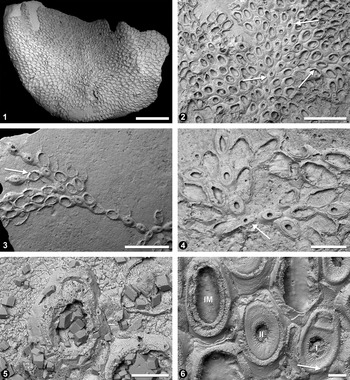
Charixa sexspinata n. sp. from Unit 3 of the Upper Member of the Glen Rose Formation (early Albian) of southcentral Texas, USA (1); from Unit 4 of the Upper Member of the Glen Rose Formation (early Albian) of southcentral Texas, USA (2); from Unit 7 of the Upper Member of the Glen Rose Formation (early Albian) of southcentral Texas, USA (3, 6); from the Walnut Formation (early Albian) of southcentral Texas, USA (4, 5). (1) Encrusting colony, paratype, NHMUK BZ7864; scale bar is 2.5 mm; (2) caudate autozooids forming uniserial rows (arrows) and non-caudate autozooids, holotype, NHMUK BZ7867; scale bar is 1 mm; (3) uniserial series of caudate autozooids, with new series diverging from the main series beginning with a non-caudate autozooid (arrow) followed by caudate autozooids, paratype, NHMUK BZ7895; scale bar is 1 mm; (4) early astogeny with inferred ancestrula arrowed, NHMUK BZ2056; scale bar is 500 µm; (5) autozooid showing six circumopesial spine bases, paratype, NHMUK BZ7896; scale bar is 100 µm; (6) three autozooids showing a broken intramural bud (IM), a completely preserved intramural bud with a type II closure plate (II) and a type I closure plate with straight, parallel scars of opercular sclerite distally (I), the latter zooid showing also one proximolateral spine base (arrow), while most other autozooids lack spine bases, paratype, NHMUK BZ2055a; scale bar is 100 µm.

Holotype
BZ7867, early Albian, Glen Rose Formation, Upper Member, Unit 4, abandoned quarry on north side of SH 290, west of Dripping Springs, Hays County, Texas.
Paratypes
NHMUK BZ7864, early Albian, Glen Rose Formation, Upper Member, Unit 3, Flanders Road, south of cattle pond, Legends Subdivision, Fischer, Comal County, Texas. NHMUK BZ7866, BZ7882, early Albian, Glen Rose Formation, Upper Member, Unit 4, abandoned quarry on north side of SH 290, west of Dripping Springs, Hays County, Texas. NHMUK BZ7888, early Albian, Glen Rose Formation, Upper Member, Unit 6 (lower Loriolia Marker Bed), cut below water tower at the intersection of FM 620 with Kollmeyer Drive, Lakeway, Travis County, Texas. NHMUK BZ7891, early Albian, Glen Rose Formation, Upper Member, Unit 6 (lower Loriolia Marker Bed), roadcut on the north side of FM 620 northwest of Mansfield Dam, Hudson Bend, Travis County, Texas. NHMUK BZ7895, BZ7896, early Albian, Glen Rose Formation, Upper Member, Unit 7 (upper Loriolia Marker Bed), abandoned quarry on north side of SH 290, west of Dripping Springs, Hays County, Texas. NHMUK BZ2055a, BZ2056, BZ2063, middle Albian, Walnut Formation, Stillhouse Hollow Dam, Spillway, Belton, Bell County, Texas.
Diagnosis
Charixa with varying number of circumopesial spine bases (maximum: six); pronounced autozooidal dimorphism between caudate autozooids forming lineal series and non-caudate autozooids filling the spaces between lineal series; closure plates with distocentral circular to longitudinally elliptical opening surrounded by radially aligned ridges and grooves.
Occurrence
The species is reported from several localities in Bell, Burnet, Comal, Hays, and Travis counties in southcentral Texas.
Description
Colony encrusting, consisting of short uniserial runner-like segments and prevalently of multiserial sheet-like segments, unilaminar (Fig. 7.1–7.3). Autozooids dimorphic, caudate autozooids forming uniserial lines and non-caudate autozooids interspersed between lineal series. Caudate autozooids bud one distal caudate autozooid and usually two distolateral non-caudate autozooids, while non-caudate autozooids usually bud up to three distal and distolateral non-caudate autozooids (Fig. 7.2, 7.3). However, the first non-caudate bud from a caudate autozooid may also bud a distal caudate autozooid, thus giving rise to a new lineal series of caudate autozooids (Fig. 7.3). Ancestrula 252 µm long (N = 1) by 151 µm wide (N = 1), longitudinally elliptical, with closure plate and six spine bases, with one distal and two (proximo-) lateral buds (Fig. 7.4). Pore chambers present.
Caudate autozooids pyriform, 349–654 µm long (X̄ = 488 ± 87 µm; CV = 18; N = 36) by 151–299 µm wide (X̄ = 223 ± 37 µm; CV = 17; N = 36) (length/width ratio = 2.32) (Fig. 7.3). Non-caudate autozooids elliptical, 316–551 µm long (X̄ = 437 ± 68 µm; CV = 16; N = 36) by 167–335 µm wide (X̄ = 254 ± 38 µm; CV = 15; N = 36) (length/width ratio = 1.72) (Fig. 7.4). Gymnocyst, completely surrounding opesia, smooth, forming a long cauda in caudate autozooids, usually extensive proximally and narrowing laterally and distally. Opesia 175–402 µm long (X̄ = 296 ± 65 µm; CV = 22; N = 36) by 115–223 µm wide (X̄ = 163 ± 29 µm; CV = 18; N = 36) in caudate autozooids (length/width ratio of opesia = 1.87) and 207–433 µm long (X̄ = 316 ± 72 µm; CV = 23; N = 36) by 109–286 µm wide (X̄ = 183 ± 43 µm; CV = 24; N = 36) in non-caudate autozooids (length/width ratio of opesia = 1.67), occupying most of frontal surface, longitudinally elliptical. Up to six spine bases encircling the opesia, one pair distolateral to opesia, second pair at about three-fourths of opesia length, third pair proximolateral to opesia (Fig. 7.5). Number of spine bases strongly variable, often reduced to one distolateral and one proximolateral pair, to one distolateral pair, or occasionally to just one proximolateral spine base (Fig. 7.5, 7.6), or spine bases absent. Cryptocyst narrow, sloping steeply into opesia, widest proximally and narrowing laterally and distally, ornamented with radial rows of pustules. Closure plates very frequent in caudate autozooids, rare in non-caudate autozooids, covering entire frontal surface, of two types. Type I closure plates concave, smooth, with a subcircular to longitudinally elliptical opening distocentrally that is surrounded by dense, straight, radially oriented ridges and grooves, opening 59–105 µm (X̄ = 79 ± 13 µm; CV = 16; N = 36) in diameter, with two conspicuous, straight and parallel scars of opercular sclerite distally and an elevated ridge perpendicular to the sclerite scars and presumably marking the proximal edge of the orifice (Fig. 7.6). Type II closure plates presumably formed by intramurally budded autozooid, slightly depressed below level of mural rim, slightly concave, smooth, lacking sclerite scars, with a central opening that is surrounded by dense, straight, radially oriented ridges and grooves (Fig. 7.6). Intramural reparative budding of zooids inside autozooidal opesiae present (Fig. 7.6). Kenozooids present, occasionally filling gaps between autozooids and overlapping gymnocyst of adjacent autozooids, variable in shape and size (Fig. 7.6).
Morphometry measurements were performed on specimen NHMUK BZ7867 (holotype) and specimens NHMUK BZ2055a and NHMUK BZ2056 (paratypes).
Etymology
From Latin ‘sex’ (‘six’) and ‘spina’ (‘spine’) referring to the maximum number of spines observed.
Remarks
The material here assigned to Charixa sexspinata n. sp. most likely represents more than one species. However, the high variability of characters observed in single colonies do not allow the description of several species for the material studied. For instance, the number of spines in Charixa sexspinata n. sp. may vary within a single colony. While six circumopesial spines is the highest number of spines observed, spines may be reduced or completely absent. In the holotype colony, autozooids may have six, four, or no spine bases. In some colonies from the Walnut Formation, some autozooids show one proximolateral (always sinistral) spine, while other autozooids completely lack spines and others have four spine bases. A correlation with the position in the colony and the number of spine bases was not observed,
Charixa sexspinata n. sp. differs from Charixa bispinata n. sp. in the variable number of spine bases and the stronger pronunciation of autozooidal dimorphism. Another clear difference is the budding pattern from the ancestrula with Charixa bispinata n. sp. budding one distal bud from the ancestrula, but the ancestrula in Charixa sexspinata n. sp. producing also lateral buds. Autozooidal polymorphism and budding pattern in Charixa sexspinata n. sp. are comparable to Spinicharixa dimorpha Taylor, Reference Taylor1986b from the Albian of England, but Spinicharixa dimorpha has up to eight circumopesial spine bases and closure plates with only one small opening.
Charixa emanuelae new species
Figure 8.1–8.4
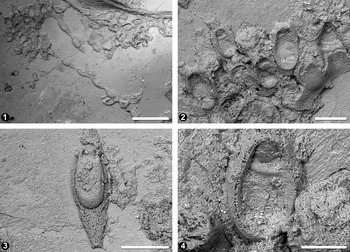
Charixa emanuelae n. sp. from Bed 10 of the Middle Member of the Glen Rose Formation (early Albian) of northcentral Texas, USA, holotype, NHMUK BZ2358. (1) Encrusting colony; scale bar is 1 mm; (2) multiserial, non-caudate autozooids; scale bar is 250 µm; (3) eroded caudate autozooid, giving the false impression of a highly convex closure plate; scale bar is 250 µm; (4) non-caudate autozooid with closure plate; scale bar is 100 µm.

Holotype
NHMUK BZ2358, early Albian, Glen Rose Formation, Middle Member, Bed 10, Barker Branch, west of Glen Rose, Somervell County, Texas.
Diagnosis
Charixa lacking spine bases; closure plates lacking a central opening.
Occurrence
The species is known from one specimen from Somervell County in northcentral Texas.
Description
Colony encrusting, composite multiserial, consisting of uniserial rows of caudate autozooids with non-caudate autozooids budded to fill in the spaces between. Ancestrula and early astogeny not observed. Pore chambers not observed.
Caudate autozooids pyriform, 463–562 µm long (X̄ = 505 ± 34 µm; CV = 7; N = 8) by 135–180 µm wide (X̄ = 164 ± 16 µm; CV = 10; N = 8) (length/width ratio = 3.09) (Fig. 8.1). Non-caudate autozooids elliptical, 332–421 µm long (X̄ = 378 ± 37 µm; CV = 10; N = 8) by 200–241 µm wide (X̄ = 222 ± 14 µm; CV = 6; N = 8) (length/width ratio = 1.70) (Fig. 8.2). Gymnocyst extensive, completely surrounding opesia, smooth, forming a long cauda proximally in caudate autozooids. Opesia 230–320 µm long by 100–190 µm wide in caudate autozooids (length/width ratio of opesia = 2.21) and 234–312 µm long (X̄ = 275 ± 25 µm; CV = 9; N = 8) by 120–190 µm wide (X̄ = 158 ± 25 µm; CV = 16; N = 8) in non-caudate autozooids (length/width ratio of opesia = 1.74), occupying most of frontal surface, longitudinally elliptical. Spine bases lacking. Cryptocyst narrow, sloping steeply into opesia, widest proximally and narrowing laterally and distally, ornamented with radial rows of pustules. Closure plates very frequent in both caudate and non-caudate autozooids, covering entire frontal surface, slightly depressed below the level of the mural rim, concave, smooth, sclerite scars not evident but elevated ridge presumably marking the proximal edge of the orifice present (Fig. 8.3, 8.4). Intramural reparative budding of zooids inside autozooidal opesiae occurs. Kenozooids not observed.
Morphometry measurements were performed on specimen NHMUK BZ2358 (holotype).
Etymology
The species is named for Emanuela Di Martino (Siracusa) in recognition of her contributions to bryozoan taxonomy.
Remarks
Unlike in Charixa bispinata n. sp. and in Charixa sexspinata n. sp., closure plates in Charixa emanuelae n. sp. lack a central opening. Furthermore, spine bases were not seen in any of the autozooids in the only known specimen, although the lack of early astogenetic stages in this small colony must be taken into account when evaluating the importance of this observation.
Discussion
Cheilostome turnover or facies-related dominance?
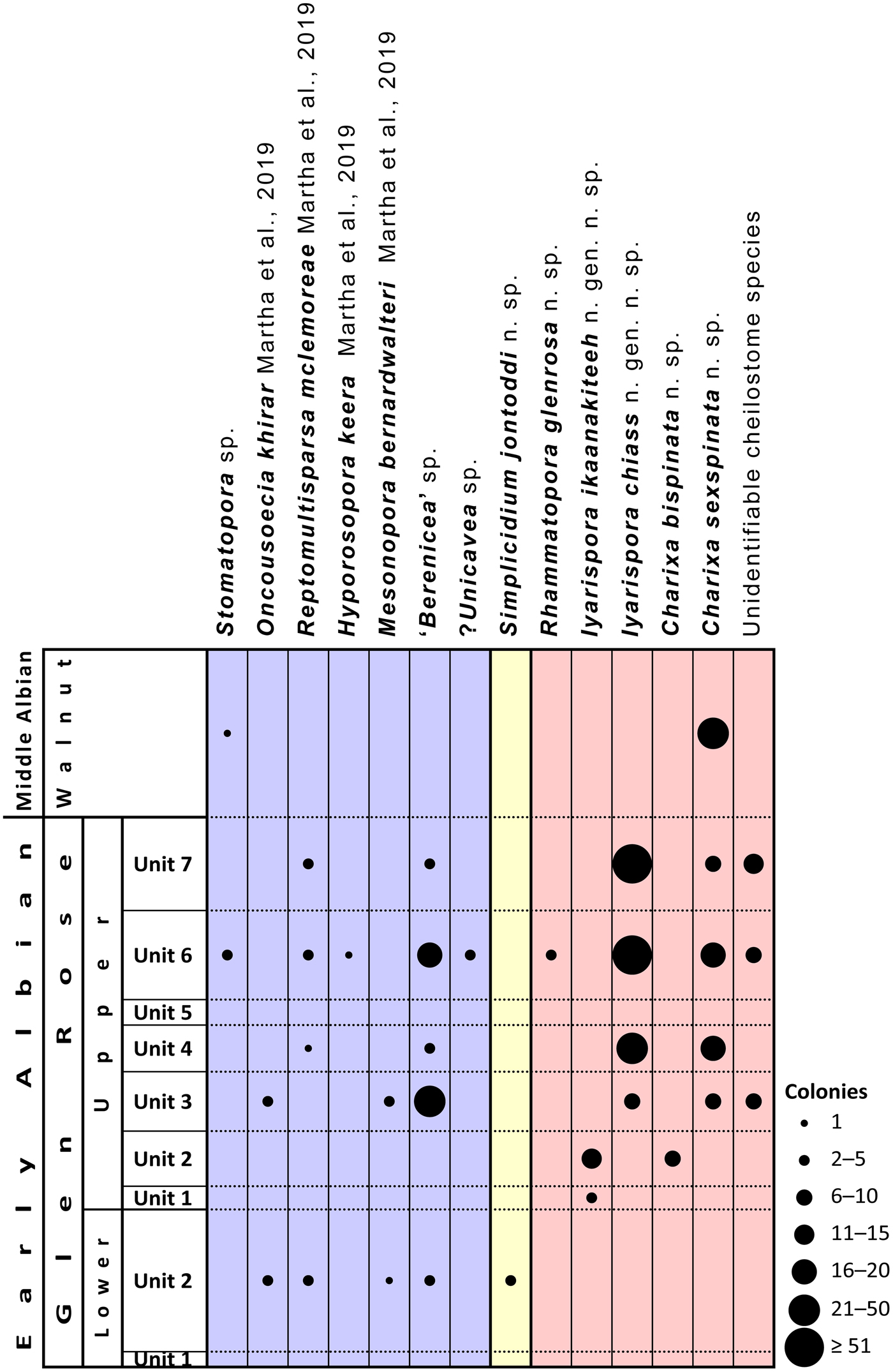
The bryozoan faunas from the early to middle Albian parts of the Glen Rose and Walnut formations has yielded a total of thirteen species, comprising six cyclostomes (Martha et al., Reference Martha, Taylor and Rader2019), one ctenostome, and six cheilostome species. The cyclostomes are mostly bereniciform sheet-like tubuliporines, while the cheilostomes are all malacostegines. All of the bryozoans studied encrust bivalve shells; no erect colonies were found. Despite a similar cheilostome and cyclostome diversity, the cheilostome colonies are usually much larger and more abundant (Fig. 9). Cyclostomes are dominant only in Unit 2 of the Lower Member, in which no cheilostomes were found, and in Unit 3 of the Upper Member of the Glen Rose Formation. In all other units of the Upper Member of the Glen Rose Formation and in the Walnut Formation, cheilostomes dominate in terms of abundance. The Glen Rose and Walnut formations are therefore the oldest known bryozoan assemblages in which cheilostomes have the largest estimated biomass of any bryozoan order, raising the possibility of a more widespread faunal turnover from cyclostomes to cheilostomes at this time. Cheilostome dominance increases upwards throughout the Glen Rose and Walnut formations. However, cheilostome species richness remains low and, following a peak in Unit 6 of the Upper Member of the Glen Rose Formation, decreases into Unit 7 and the Walnut Formation.
Stratigraphic chart (see Martha et al., Reference Martha, Taylor and Rader2019, fig. 1.2) with ranges and abundance (number of colonies) of bryozoan species in the Glen Rose and Walnut formations of southcentral Texas. Cyclostome species (see Martha et al., Reference Martha, Taylor and Rader2019) are in blue, the ctenostome species is in yellow, and cheilostome species are in red. ‘Berenicea’ sp. is used as a form-genus name for infertile bereniciform colonies not identified to the species or genus level, while ‘Unidentifiable cheilostome species’ comprises badly preserved specimens reminiscent of species assigned to Charixa and Rhammatopora.

Despite overall cheilostome dominance in terms of numerical abundance and colony size, cyclostomes are the only encrusting bryozoans to have been found on rudist shells. Cyclostomes of Unit 3 of the Upper Member of the Glen Rose Formation are mostly ‘Berenicea’ colonies encrusting rudists, while cheilostomes prevail on other bivalve shells in the same unit. The coral-rudist biostromes that developed below normal wave base but above storm wave base are usually found in the Lower Member of the Glen Rose Formation, while the Upper Member of the Glen Rose Formation is dominated by marine limestone and evaporite beds in which rudists are less abundant (Scott et al., Reference Scott, Molineux, Löser and Mancini2007). ‘Dominance’ of either cheilostomes or cyclostomes within the Glen Rose and Walnut formations may therefore be facies-related rather than the signal of a precocious cheilostome turnover during the early Albian. Cyclostomes apparently prevailed in more carbonate-rich facies (i.e., rudist-associated facies) that likely represented deposition in clear water, stenohaline environments, while cheilostomes were dominant in nearshore facies deposited above normal wave base that were potentially more turbid and where salinity may also have varied.
Malacostegine and neocheilostome evolutionary radiations
Cheetham (Reference Cheetham1954, Reference Cheetham and Pouyet1976), Thomas and Larwood (Reference Thomas and Larwood1956), and Cheetham et al. (Reference Cheetham, Sanner, Taylor and Ostrovsky2006) together described a total of nine cheilostome species from the Kiamchi, Fort Worth, Denton, Weno, Pawpaw, Main Street, and Grayson formations of the late Albian to early Cenomanian Washita Group of northeastern Texas and southeastern Oklahoma. Of these, eight are neocheilostomes assigned to the genus Wilbertopora Cheetham, Reference Cheetham1954, while malacostegines are represented by only one species, Pyripora texana Thomas and Larwood, Reference Thomas and Larwood1956. The Washita Group overlies the Trinity and Fredericksburg groups and the Washita neocheilostomes are the oldest known cheilostomes with calcified brood chambers (ovicells) and with specialized zooidal polymorphs (avicularia) possessing opesia enlarged to accommodate a mandible. The appearance of Wilbertopora during the late Albian of the Washita Group is usually regarded as the onset of the explosive radiation of cheilostomes (e.g., Taylor, Reference Taylor1988), while in contemporary European faunas cheilostomes were still rare and dominated by malacostegines (Martha and Taylor, Reference Martha and Taylor2017). The Glen Rose and Walnut cheilostome fauna is therefore of particular interest in the context of cheilostome evolution because it directly underlies the Washita Group and represents a fauna that is only slightly older and comes from the same geographical realm. Yet, the Glen Rose and Walnut bryozoan fauna is very different from that of the Washita Group. In the latter, neocheilostomes are dominant, while malacostegines are low in diversity and abundance (see Cheetham, Reference Cheetham and Pouyet1976).
Considering the geographical and stratigraphical proximity of the Glen Rose and Walnut malacostegines with the Washita neocheilostomes, the former might be hypothesized to include the possible ancestors of the Washita neocheilostomes. However, there is no morphological evidence supporting this hypothesis in any of the Glen Rose or Walnut cheilostome species described here. Instead, it is more likely that the Washita neocheilostomes migrated from elsewhere to replace the previously dominant malacostegines, a migration probably related to a change in the paleoenvironment. The mid-Cretaceous carbonate platform of Texas seems to have been particularly suitable for cheilostomes. Furthermore, the two Texan formations show that malacostegines experienced a short-lived, and possibly geographically localized, evolutionary radiation during the Albian before the explosive radiation of neocheilostomes commencing in the late Albian to early Cenomanian.
Summary and conclusions
Our study allows the following conclusions: (1) the gymnolaemate bryozoan fauna of the early to middle Albian Glen Rose and Walnut formations of Texas comprises one ctenostome and six cheilostome species; (2) species diversities of Cheilostomata and Cyclostomata in these formations are similar, but cyclostomes prevail in coral-rudist biostromes deposited below normal wave base, while cheilostomes dominate in terms of abundance and colony size in nearshore facies deposited above normal wave base; (3) the nearshore Glen Rose and Walnut fauna, which is the oldest known bryozoan assemblage dominated by (malacostegine) cheilostomes, slightly antedates the Washita fauna of northeastern Texas and southeastern Oklahoma, which is dominated by neocheilostomes; and (4) malacostegines experienced a short-lived and possibly geographically localized evolutionary radiation during the early to middle Albian before the onset of neocheilostome radiation in the late Albian to early Cenomanian.
Acknowledgments
We thank D.S. Rood (University of Colorado at Boulder) for help and advice with the Wichita language. M.H. Dick (Sapporo) and A.V. Koromyslova (Moscow), peer review administrator J. Kastigar (Cincinnati), and editor J. Jin (London, Ontario) provided helpful comments on the originally submitted manuscript. This research was funded in part by the Leverhulme Trust (Research Project Grant ‘Molecules meet fossils—an integrated approach to studying palaeodiversity,’ award no. RPG-2016-429).
Accessibility of supplemental data
Data available from the Dryad Digital Repository: https://doi.org/10.5061/dryad.fq24fr3.4