Introduction
Over 75% of mental disorders arise between early adolescence and young adulthood (Kessler et al. Reference Kessler, Berglund, Demler, Jin, Merikangas and Walters2005), often initially in milder, sub-threshold forms, with increasing severity over time (McGorry et al. Reference McGorry, Hickie, Yung, Pantelis and Jackson2006). Emerging at junctures of life that entail significant physiological, emotional and social developments, mental disorders have serious short- and long-term negative consequences especially when untreated, treated late or treated poorly. Such consequences include school/work failure, strained relationships, hospitalisation, suicide, homelessness, legal problems and violence (Stephens & Joubert, Reference Stephens and Joubert2001; Boivin et al. Reference Boivin, Roy, Haley and du Fort2005; Cheung & Dewa, Reference Cheung and Dewa2007). Mental illnesses also inflict immense suffering on affected persons and their families and great costs on society (Rossler et al. Reference Rossler, Salize, van Os and Riecher-Rossler2005; Mental Health Commission of Canada, 2013). Yet, the accessibility of mental healthcare to the youth remains limited. Just 20–25% of Canadian youths in need get help (Wang et al. Reference Wang, Berglund, Olfson, Pincus, Wells and Kessler2005) and treatment outcomes remain poor (Wang, Reference Wang2007; Freeman et al. Reference Freeman, King, Pickett, Craig, Elgar, Janssen and Klinger2011).
Specialised, youth-friendly early intervention services for serious mental disorders (particularly psychosis) promise long-term benefits (Greenberg et al. Reference Greenberg, Domitrovich and Bumbarger2001; McGorry et al. Reference McGorry, Tanti, Stokes, Hickie, Carnell, Littlefield and Moran2007c). Although, along with other countries, Canada has led the early intervention for psychosis movement (Malla et al. Reference Malla, Norman, McLean, Scholten and Townsend2003; McGorry & Yung, Reference McGorry and Yung2003; Iyer & Malla, Reference Iyer and Malla2014), its precepts have not been applied to broader youth mental healthcare. Most Canadian youths with mental health needs experience significant delays in seeking help, excessive wait times (Kowalewski et al. Reference Kowalewski, McLennan and McGrath2011) and long, circuitous, often traumatic pathways to care (Reid et al. Reference Reid, Cunningham, Tobon, Evans, Stewart, Brown, Lent, Neufeld, Vingilis, Zaric and Shanley2011; Anderson et al. Reference Anderson, Fuhrer and Malla2013). The unengaging nature of many conventional mental health services results in reduced youth participation, increased drop-out [22.3%; Wang, 2007] and minimal benefits (Cheung & Dewa, Reference Cheung and Dewa2007; Wang, Reference Wang2007; Freeman et al. Reference Freeman, King, Pickett, Craig, Elgar, Janssen and Klinger2011). Transitions into and out of services are often based on age and not on need. Services rarely offer effective social, psychological and biological treatments that are strongly indicated for many mental disorders. In Canada’s marginalised and Indigenous communities, even basic services remain unavailable (Kirmayer et al. Reference Kirmayer, Brass and Tait2000; Adelson, Reference Adelson2005).
Australia, Ireland and the United Kingdom have responded to similar challenges with a radical reconstruction of youth mental healthcare (McGorry et al. Reference McGorry, Bates and Birchwood2013). In Canada, however, these issues had, until recently, remained unaddressed at the systemic level. In 2012, the Canadian Institutes of Health Research (CIHR) and the Graham Boekch Foundation announced the ‘Transformational Research in Adolescent Mental Health’ (TRAM, 2014) grant to engender a Canadian response to the issue of unmet youth mental health needs.
The TRAM initiative
CIHR’s Strategy for Patient-Oriented Research (SPOR) aims to establish Canada-wide networks of federal and provincial/territorial partners to promote evidence-informed, high-quality, accountable, timely and accessible healthcare (CIHR, 2011). Launched in October 2012 as CIHR’s first SPOR initiative, TRAM provides $25 million in funds over 5 years, to create a pan-Canadian network to improve the identification of youths with mental illnesses and the timeliness and quality of their care. Framing the state of youth mental healthcare as a crisis meriting a paradigm shift (Handa, Reference Handa1986; Kuhn, Reference Kuhn2012), TRAM sought a network that would go beyond incremental changes to fundamentally transform how Canadian youths access and receive mental healthcare.
TRAM targeted youths aged 11 to 25 years, limited its scope to secondary and tertiary prevention, precluding primary prevention activities (e.g. better prenatal care), and prioritised bridging the science-practice divide by applying existing evidence to improve mental healthcare over the exclusive generation of new evidence. With its emphasis on philosophical and systemic change, TRAM was different from typical scientific grants, funding a project led not, as usual, exclusively by researchers, but by all stakeholders with an interest in youth mental health. After a rigorous, multi-stage application process, beginning with expressions of interest from 54 applicants in April 2013 the authors’ network, ACCESS, was awarded the grant on 22 May 2014.
ACCESS: detailed description
The ACCESS network includes youth, family/carer, community organisation, service provider, researcher, and policy and decision maker stakeholder groups from six Canadian provinces and one territory. The network’s vision is encompassed in its name: Adolescent/young adult Connections to Community-driven Early Strengths-based and Stigma-free services (ACCESS). All stakeholder groups, particularly youth, embraced this name.
Committed to service and sector integration, and a youth-friendly, empowering culture that alters the language and perceptions around mental illness, ACCESS will implement, evaluate and elaborate a transformation in youth mental healthcare to
(a) Improve stakeholder engagement with and awareness of mental health issues, leading to early needs identification
(b) Offer rapid, engaging, timely access to youths seeking help
(c) Provide evidence-informed, youth-friendly, appropriate mental healthcare for all severity levels and types of difficulties with needs-based transitions
The ACCESS service transformation will be implemented at 12 demonstration sites chosen to represent pan-Canadian variations in geography, culture and service availability. These include large urban sites, smaller urban and rural locations and small/remote Aboriginal communities. ACCESS will also target some particularly vulnerable youth groups (e.g. Indigenous, immigrant, minority and homeless youth; adolescents in state care; and youth in the criminal justice system).
The ACCESS transformation will be informed by site-specific resources, needs and contexts. This is important in the Canadian healthcare system (more accurately, systems), where although basic coverage guidelines are federally outlined, healthcare is provincially administered. Healthcare for Indigenous groups is delivered via a complex system governed by federal, provincial, territorial and Indigenous jurisdictions.
Guided by local needs and contexts, ACCESS will reinforce strengths; enhance capacities through inter-sector, inter-service and inter-stakeholder collaboration; add trained staff; and deploy e-technologies. ACCESS will also create/use youth-friendly physical spaces as portals for help-seeking and venues for youth peer support activities. New staff at these spaces will include ACCESS-trained clinicians and, where possible, a youth and a family peer support worker.
At each site, frontline mental health services will be supported by and connected to specialised services (e.g. for eating disorders or first-episode psychosis). Where such services are unavailable, ACCESS will deploy tele-mentoring, remote consultation with specialists or electronically delivered specialised interventions.
Being CIHR-funded, ACCESS, in addition to service transformation, is committed from the very outset to a global, systematic research and evaluation strategy.
Underpinnings: stakeholder input and established evidence
ACCESS members agreed that youth mental healthcare transformation must proceed from all stakeholders’ input and relevant established evidence.
Stakeholder input
Stakeholder input on barriers to seeking and providing/receiving appropriate care was sought through multiple means. Youths and families shared moving accounts of their experiences with the mental healthcare system, while, other stakeholders gave concrete examples of barriers operant at their sites. Inputs on barriers were also derived from a network-wide email exchange (over 40 pages) and descriptive site reports (over 100 pages). These materials were synthesised using qualitative analysis methods and consolidated into six key themes:
(i) Lack of knowledge about mental health, services, privacy legislation and patient rights;
(ii) limited accessibility;
(iii) services not meeting youth and family needs;
(iv) limited skills of mental health professionals in providing generic and specialised interventions to youth;
(v) negative attitudes towards marginalised and vulnerable populations;
(vi) negative and fearful perceptions of mental illness.
These barriers echo those identified in previous mental health research (Gulliver et al. Reference Gulliver, Griffiths and Christensen2010; Anderson et al. Reference Anderson, Fuhrer and Malla2013; Yap et al. Reference Yap, Reavley and Jorm2013). Notably, stakeholder-identified barriers pertained not only to accessibility but also to the ability of services to keep youths and families engaged. This may explain the reportedly high rates of youth mental healthcare drop-out (Armbruster & Fallon, Reference Armbruster and Fallon1994; Edlund et al. Reference Edlund, Wang, Berglund, Katz, Lin and Kessler2002). All stakeholders, particularly the youth and families, played an active role in developing ACCESS’s response to the barriers and deficits that they had identified.
Established evidence
The following sets of evidence were considered in developing the ACCESS model:
(A) Most mental disorders appear first as general distress and sub-threshold symptoms (often vague, overlapping or not accurately indicative of future diagnosis) that may progress to syndrome-level disorders (often still with overlapping symptoms; McGorry et al. Reference McGorry, Purcell, Hickie and Jorm2007b). Some youths presenting with serious complaints (e.g. hearing voices) do not necessarily develop psychotic disorders but remain vulnerable to other mental disorders (Patton et al. Reference Patton, Coffey, Romaniuk, Mackinnon, Carlin, Degenhardt, Olsson and Moran2014). ACCESS will therefore provide immediate access to assessment regardless of the youth’s presenting symptoms or stage of illness. Interventions will be available for a wide spectrum of disorders, be tailored to the phase of illness and address multiple problems challenging the same individual (e.g. depression and substance abuse).
(B) Evidence supports the benefits of early identification and intervention for specific mental disorders, particularly psychosis (McGorry et al. Reference McGorry, Yung, Phillips, Yuen, Francey, Cosgrave, Germano, Bravin, McDonald, Blair, Adlard and Jackson2002; Malla et al. Reference Malla, Norman and Joober2005b; Singh, Reference Singh2010). Such approaches have not been applied to other mental disorders, are unavailable to most youths, are generally restricted to specialised services and have not been incorporated into policy decisions. ACCESS will expand the reach of early intervention to other mental illnesses and broader sections of Canadian youth. Early psychosis services privilege individualised intervention plans that promote engagement (Malla et al. Reference Malla, Norman and Joober2005b; McGorry et al. Reference McGorry, Bates and Birchwood2013). This element will be retained and bolstered.
(C) Canadian youths needing mental healthcare often experience severe delays in seeking and/or accessing help. Treatment delays are associated with negative functional and social impacts (Williams et al. Reference Williams, Latta and Conversano2008; Sherman et al. Reference Sherman, Barnum, Buhman-Wiggs and Nyberg2009). Depending on their age and the nature of their difficulties, youths may first present through the healthcare, education, social service, youth protection or judicial system (Anderson et al. Reference Anderson, Fuhrer and Malla2013). The disconnections between these systems can complicate and delay help-seeking. Even initial contact with primary healthcare can be a missed opportunity (Lieske et al. Reference Lieske, Swearer and Berry2013; Vohringer et al. Reference Vohringer, Jimenez, Igor, Fores, Correa, Sullivan, Holtzman, Whitham, Barroilhet, Alvear, Logvinenko, Kent and Ghaemi2013) if it does not result in appropriate intervention or referral. Many youths access mental healthcare through crowded hospital emergency services (Anderson et al. Reference Anderson, Fuhrer and Malla2010) that can seem unfriendly and traumatising. ACCESS will therefore ease youths’ pathways to mental healthcare. Current knowledge of pathways to care and treatment delays will inform remedial strategies (e.g. single-point contact, multiple entry portals, youth-friendly access portals, etc.).
(D) Most youth mental health services are located in discrete, unconnected institutions (Greenberg et al. Reference Greenberg, Domitrovich and Bumbarger2001); unable to engage youths; not based on best practices; prone to delays (Boydell et al. Reference Boydell, Pong, Volpe, Tilleczek, Wilson and Lemieux2006; Reid & Brown, Reference Reid and Brown2008; Kowalewski et al. Reference Kowalewski, McLennan and McGrath2011; Canadian Institute for Health Information, 2012); and likely to yield poor functional impacts (Cheung & Dewa, 2007) and recovery perceptions (Scott et al. Reference Scott, Naismith, Whitwell, Hamilton, Chudleigh and Hickie2009). Rigid age cut-offs and administrative boundaries between paediatric and adult mental health services often result in abrupt, inappropriate transitions (Singh et al. Reference Singh, Paul, Ford, Kramer, Weaver, McLaren, Hovish, Islam, Belling and White2010). Eighteen is a common youth service cut-off age that has no real psychosocial basis. ACCESS will therefore focus on service and sector integration; a youth-friendly, empowering culture; and innovative strategies to increase the accessibility of appropriate, evidence-based care with needs-based and not age-based) transitions.
Organisational framework
Our organisational framework is the Theory of Change (Clark & Taplin, 2012), a formalised framework for identifying steps required to proceed from a starting point to a long-term goal. It can empower all stakeholders to contribute to the blueprint for change, to fully understand clearly articulated goals and to chart a course to their achievement. The process involves stating the long-term goal, identifying preconditions required to achieve it and backwardly mapping intermediate goals/interventions required to proceed to the preconditions. Figure 1 shows the Theory of Change framework for our long-term goal, improved youth mental health outcomes. The preconditions for achieving improved outcomes identified by all stakeholders were early identification; rapid access; and high-quality, appropriate care with needs-based transitions. Although not reflected here, Theory of Change also involves questioning the assumption that each short-term goal will lead to the next longer-term goal and using predefined indicators to evaluate the attainment of all goals. Each ACCESS site will produce its own Theory of Change grid based on its specific needs and resources, enhancing the replicability of our Theory of Change implementation model during scale-up.
The Theory of Change organisational framework for ACCESS.

Values and key activities
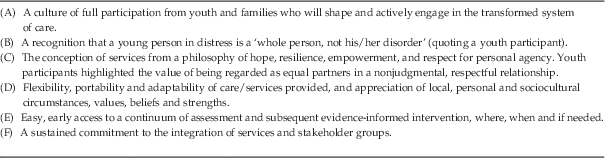
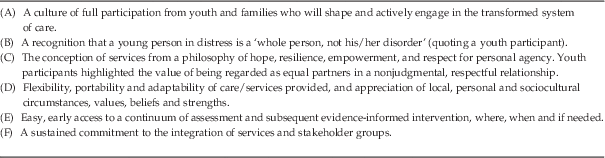
ACCESS’s transformation model stems from core values and comprises key activity components. Our core values, defined and agreed upon by all stakeholders, are listed in Table 1.
Core values of ACCESS
Activities
ACCESS activities will be conducted in youth-friendly, stigma-reducing, hopeful cultures of care. At all levels, youths and their families/carers will be involved, as appropriate, in peer support; peer-led interventions; service planning; service evaluation; site-level transformation; outreach; participatory research; e-services development (including a central website); and youth-driven and campus initiatives. Most significantly, the youth will be included as full partners in care through menus of treatment choices, informed consent, shared decision making, confidentiality and respect.
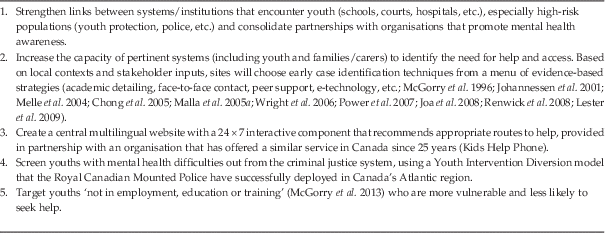
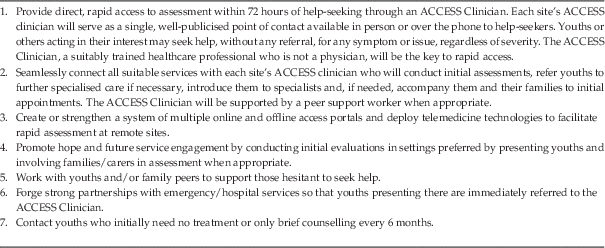
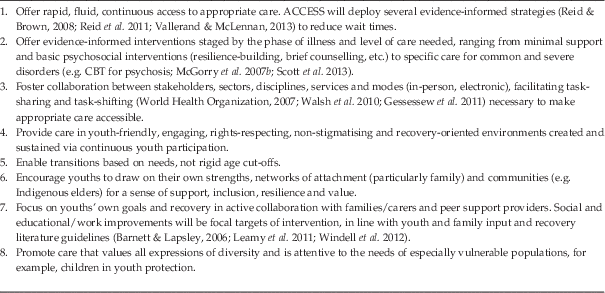
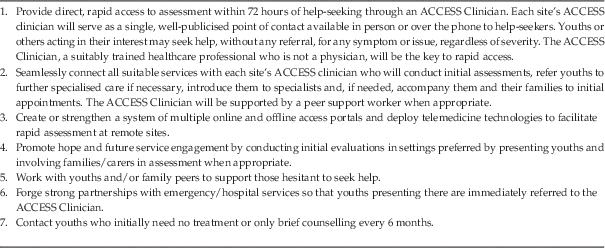
The activities related to the three preconditions (early case identification, rapid access and high-quality care) and activities enabling transformation to be conducted at all sites are listed in Tables 2–4.
Key activities to promote early case identification
Key activities to promote rapid access
Key activities to promote high-quality, appropriate care
Research and evaluation plan
ACCESS’s research and evaluation strategy, involving multiple informants and methods, has been collectively defined by all stakeholder groups in the spirit of participatory action (Baumbusch et al. Reference Baumbusch, Kirkham, Khan, McDonald, Semeniuk, Tan and Anderson2008) and integrated knowledge translation (Lomas, Reference Lomas1991; McGrath et al. Reference McGrath, Lingley-Pottie, Emberly, Thurston and McLean2009; CIHR, 2014). A brief overview of this strategy is presented below.
Our research will assess structures, contexts, processes and performance to answer the question, ‘How well does ACCESS work to identify youths in need and improve their access to high-quality mental healthcare?’ Given the diversity of our target populations and settings, we will also ask, ‘Among which youth and family/carer groups is the transformation most and least beneficial?’ and ‘In which contexts is ACCESS most and least effective?’.
Six ACCESS sites will participate in a community-led stepped wedge cluster randomised trial (Hussey & Hughes, Reference Hussey and Hughes2007; Dreischulte et al. Reference Dreischulte, Grant, Donnan and Guthrie2013). Two groups of three sites will be randomised to begin implementing the transformation at separate time points. The primary outcome of interest is the level of youth and family satisfaction (posited as a product of the entire complex of service accessibility, suitability and quality), in keeping with ACCESS’s ‘service user-oriented’ focus. Secondary outcomes in the trial design are wait-times to care and the number of help-seeking contacts before accessing appropriate care.
The stepped wedge design was chosen because our stakeholders thought it more ethical for all sites to receive the transformation rather than for some sites to serve as ‘controls’ as in a typical randomised control trial (RCT). Like traditional RCTs, a stepped wedge trial can generate evidence that has a higher impact on practice and policy (Andersson, Reference Andersson2011; Dreischulte et al. Reference Dreischulte, Grant, Donnan and Guthrie2013). Staggering the intervention roll-out allows second-stage sites to learn from and improve upon the transformational experiences of first-stage sites. It is also more feasible in resource allocation terms and facilitates easier expansion during the scale-up phase.
The remaining six sites with unique characteristics (e.g. a site serving homeless urban youth) will serve as special demonstration projects and allow us to evaluate the underlying processes and effectiveness of youth mental healthcare transformation in diverse settings.
At all sites, youth-focused outcomes like participation in education, employment and social roles; improvements in mental health, substance use and personal well-being; hope for the future; quality of life; satisfaction with and engagement in services; accessibility of care; etc. will be assessed for ACCESS’s overall evaluation. Individual sites may append measures in consultation with their stakeholders. For instance, a site whose catchment includes many immigrants may measure increases in the numbers of ethnic minority youths accessing its services.
An economic analysis of the benefits of the ACCESS transformation will be conducted in detail at two sites and on a more basic level at other sites. This will be critical for influencing policy and ensuring long-term scalability and sustainability. For a detailed, nuanced understanding of the barriers to and facilitators of the desired transformation, ACCESS will conduct an ethnographic study of the entire transformation process. Other components of the ACCESS research strategy include community surveys to assess unmet needs and help-seeking factors; traditional, participatory arts-based (e.g. PhotoVoice) and innovative qualitative (e.g. social media analysis) studies; and an evaluation of the impact of early identification efforts through pre- and post-transformation comparisons of administrative incidence figures of first mental health presentations among youth (Anderson et al. Reference Anderson, Fuhrer, Abrahamowicz and Malla2012).
ACCESS in the context of the global youth mental health movement
ACCESS was conceived in response to a CIHR grant initiative. This is unlike Australia where youth mental healthcare transformation evolved under a national deployment strategy and unlike Australia and Ireland where purpose-built central institutions (the National Youth Mental Health Foundation in Australia and The National Centre for Youth Mental Health in Ireland) have played a critical role in youth mental health transformation. ACCESS has also been conceived with a comprehensive evaluation plan built into the design, and, as such, is a large-scale pilot test of a health system redesign initiative.
Despite these differences, the values and elements of transformation that emerged from ACCESS stakeholder inputs closely resemble those of similar initiatives in Australia, Ireland and the United Kingdom (McGorry et al. Reference McGorry, Bates and Birchwood2013). The principles of and learnings from youth mental health transformation in these countries have informed the ACCESS model. As well, ACCESS is similar to its international counterparts in recognising unmet youth mental health needs, conceding the inability of extant systems to meet such needs and in committing itself to improving the accessibility and appropriateness of care for youths and their families. Finally, all these youth mental health initiatives – in Australia, Ireland, Canada, and the United Kingdom – accord primacy to the youth voice in designing services for the youth and recognise the value of avoiding harmful transitions.
Concluding thoughts
We expect to show that youths and families at our demonstration sites gain rapid access to appropriate, high-quality care via simple pathways, resulting in significant improvements in multiple outcome domains. Over time, these positive outcomes, youth and family empowerment and services that prioritise resilience and social inclusion will together reduce the stigma of mental illness. Such timely and appropriate youth mental healthcare can reduce human and financial costs by minimising social, educational and vocational impairments; reducing morbidity; and possibly forestalling the progression of illnesses.
At this early stage, ACCESS’s operational efficacy, emerging challenges and evolving opportunities remain to be seen. Nonetheless, simply creating the ACCESS proposal has sparked widespread interest in youth mental health and engendered dialogue around the youth-friendliness, appropriateness and accessibility of services. Our largest systemic effect may thus well be the bringing of youth mental health to the centre stage in Canada. ACCESS has united varied stakeholder groups from diverse geographic, cultural, economic and socio-demographic backgrounds and powerfully mobilised existing community capacities. Another important gain has been the consensus that service transformation must create a ‘culture of care’ that nurtures expectations among all stakeholders and meets these expectations with a highly-focused, well-conceived plan. We have also learnt that youths and families can and should have a strong voice in highlighting unmet mental health needs, demanding and driving change.
For the envisioned transformation to occur, our collaboratively conceived model must be implemented; iteratively improved upon through data-based, multi-stakeholder reflection and modification; and then scaled up. The scalability and sustainability of the ACCESS model is enhanced by its leveraging and strengthening of extant resources. However, in Canada as elsewhere, continuous advocacy for extensive policy-level support and commitment will be required for a pervasive, sustainable transformation that integrates services for all illness stages, all youth groups and all needs.
Acknowledgements
The ACCESS project is the first initiative launched under the aegis of the Canadian Institutes of Health Research’s (CIHR) Strategy for Patient-Oriented Research (SPOR) and is jointly funded by CIHR and the Graham Boeckh Foundation. We acknowledge the contributions of all members of the ACCESS network whose names are available upon request. Ashok Malla is funded in part through the Canada Research Chair Program.