1. Introduction
This paper examines the impact of aging societies on the politics of Japanese economic policy, specifically monetary policy. Populations across much of the developed world are aging, and the share of elderly is increasing. Currently, Japan is furthest along with this trend, but other Northeast Asian states – South Korea, Taiwan, and China – will face similar changes. Aging societies could portend important shifts in distributive politics over economic policy.
Existing research, discussed more below, has shown that the elderly as a group have distinct policy preferences. Recent scholarship also has shown that ‘grey power,’ i.e., the political power of the elderly population, matters. Most relevant to this paper, Vlandas (Reference Vlandas2018) finds that older voters tend to have higher aversion to inflation due to their higher reliance on income from savings, and that they punish incumbents when inflation rises, a dynamic that can drive down the inflation rate as the share of elderly increases.
This finding has implications for monetary policy, one of the key instruments for influencing prices. Since the global financial crisis in 2007, major central banks – including the Bank of Japan (BOJ), the Bank of England (BOE), European Central Bank (ECB), and Federal Reserve Bank (FRB) – embarked on an aggressive policy course to raise inflation. They employed ‘unconventional’ or ‘non-standard’ monetary policies – such as negative short-term interest rates and quantitative easing (QE) – specifically designed to provide monetary stimulus even in the context of low inflation or outright deflation. Now inflation is rising although the causes are partly attributable to shocks from the global pandemic and Russian invasion of Ukraine. In response, the US is tightening monetary policy; for now, the BOJ is taking a more circumspect policy and largely staying the course with its monetary policy as of now.
Unconventional monetary policies, such as QE, should adversely impact the elderly as group; the elderly tend to rely more on savings for income, but these new monetary policies drive down the real return. This paper explores the politics of monetary policy in this new environment. To what extent do the elderly understand the consequences of these monetary policies and how they might affect their interests? And if they have clear policy preferences, do the elderly exert collective ‘grey power’?
We use Japan as a most-likely case (Eckstein, Reference Eckstein, Greenstein and Polsby1975). With the highest share of elderly in the world, if there is a country where we would expect the elderly to be able to flex its political power, it would be Japan. Specifically, we focus on the role of preferences toward monetary policy as a possible channel for political influence among the elderly in Japan. We set out to address three related questions: (1) do the elderly in fact have different inflation preferences than the broader population; (2) even in the context of low inflation, do the elderly oppose monetary policies that lower the real interest rate, and (3) does grey power influence legislator policy preferences.
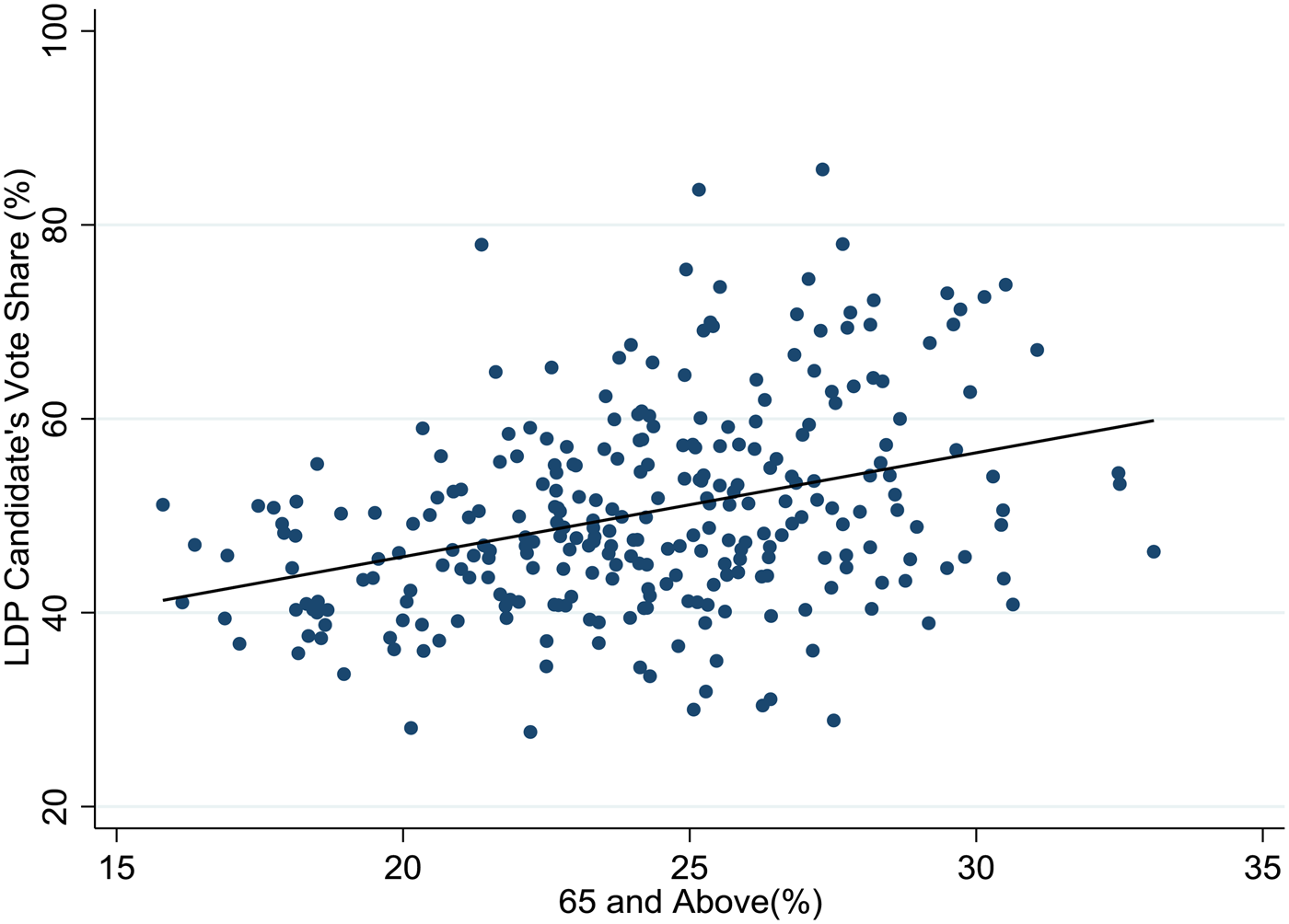
We find consistent with the existing work that the elderly in Japan tend to have higher aversion to inflation. Moreover, the elderly display some opposition to QE, suggesting an understanding of how these new policies affect their economic interests even in the context of low inflation. Grey power, however, does not translate into legislator preferences at the level of the electoral district. This is attributable to the fact that elderly opposition to QE is moderated by their partisan identification and the geographic distribution of the elderly. Elderly Liberal Democratic Party (LDP) voters have systematically lower opposition to QE, likely reflecting that these voters have aligned their preferences with the LDP's policies. Moreover, elderly voters tend to be concentrated in LDP strongholds. The result of the 2017 lower house election shows that the share of the elderly in the constituency is positively associated with the LDP candidate's vote share. This final finding may partly explain the apparent contradiction between Japan's large elderly population and government's reflationary monetary policies, although there are caveats that must be considered. These findings suggest a significant revision to Vlandas's work on the preferences of the elderly (Vlandas, Reference Vlandas2018), namely that partisan identification and electoral institutions play a critical role in mediating the ‘grey power.’ Partisanship can weaken the collective power of the elderly; thus, aging demographics is not necessarily destiny.
To address these questions, the paper proceeds as follows. The next section provides a brief overview of aging trends in Japan in comparative perspective. A subsequent section then describes Japan's embrace of ‘unconventional’ monetary policies to reflate the economy and its economic effects. The paper then lays out hypotheses for each research question. We then present empirical tests of these hypotheses and discuss our findings. Finally, the paper concludes with a discussion of some of the limitations of our findings and areas for future work.
2. Aging: Japan in comparative perspective
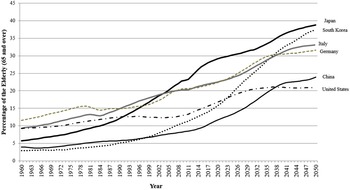
Understanding the effects of aging on politics matters for several reasons. First, a large and growing share of the population are elderly (65 and over). Currently, the elderly already account for 28% of the entire population in Japan. By the year 2030, the elderly are expected to account for 34% of the population. While Japan leads the world in aging, the share of elderly is growing across the developed world. In Europe, aging is advancing steadily, and the share of the elderly in Germany and Italy is not that far behind Japan. Both are at 22% of the population, and that figure is expected to rise to about 30% for both countries by 2040. In South Korea, while the share of elderly at 14% is lower than in Europe or Japan, by 2040 it is forecast to reach 32% of the population.Footnote 1 Figure 1 shows trends of the share of elderly in Japan and several other countries.
Aging trend.
Source: Organisation for Economic Cooperation and Development (OECD), Historical Population Data and Projections (1950–2050), https://stats.oecd.org/Index.aspx?DataSetCode=POP_PROJ (accessed on August 10, 2019).

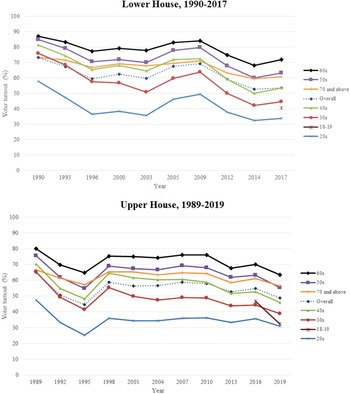
Second, there is an extensive and growing body of work that suggests that the elderly have distinct policy preferences. This research has examined elderly preferences across a variety of issue areas including health care, pensions, education, taxation, and more (Busemeyer et al., Reference Busemeyer, Goerres and Weschle2009; Fullerton and Dixon, Reference Fullerton and Dixon2010; Sørensen, Reference Sørensen2013; De Mello et al., Reference De Mello, Schotte, Tiongson and Winkler2016; McElwain and Noble, Reference McElwain and Noble2016; Vlandas, Reference Vlandas2018).Footnote 2 Thus, as the share of elderly increases, one may expect aging to shift aggregate policy preferences, bringing about political changes, and potentially creating new distributive battles across cohorts. The effect of aging on politics may be amplified by the fact that the elderly tend to have higher rates of political participation (Goerres, Reference Goerres2007), and indeed, voter turnout in Japanese national elections is higher for the elderly (Figure 2). Thus, politicians may be more likely to be sensitive to their preferences.
Voter turnout by age group in Japanese national elections.
Note: Data are from a sample of voting districts (tohyoku). Voting age was lowered from 20 to 18, starting from the 2016 upper house election.
Source: The Association for Promoting Fair Elections. ‘Voter Turnout by Age Groups over Time.’

3. Unconventional monetary policy and the Bank of Japan
Since the turn of the century, but particularly after the global financial crisis (GFC) of 2008, some of the world's major central banks have significantly reoriented monetary policy. During the 1970s and early 1980s, one of the key problems for central bankers was controlling inflation. After these periods of high inflation, inflation moderated significantly, giving way to the ‘Great Moderation,’ a long period of low inflation from the mid-1980s until 2007. Then, increasingly, deflation emerged as one of the key concerns of central bankers and other economic policymakers (Park et al., Reference Park, Katada, Chiozza and Kojo2018). Japan was the first major economy to slip into deflation in the late 1990s, but the threat of deflation then spread to other economies after the GFC.
Deflation not only can erode demand and investment, but it can also be difficult to escape.Footnote 3 Under deflation, monetary policymakers confront the zero lower bound problem, which is that the key instrument of conventional monetary policy, the short-term interest rate, cannot be lowered below zero, which, in a situation where prices are declining, may not be adequate to stimulate the economy and pull it out of deflation. To get around the zero lower bound, central banks have employed ‘unconventional policies.’ Under a policy of QE, the focus of this study, a central bank increases the monetary base by creating new money with which it then purchases financial assets, in particular government bonds. In principle, QE should stimulate the economy through several channels including driving down the exchange rate, lowering longer term interest rates, and driving up asset prices thus creating a wealth effect. QE has been used by BOJ, BOE, ECB, and FRB.
The BOJ was the first central bank to use QE employing it between 2001 and 2006. Deflation returned, and then an election at the end of 2012 brought to power Shinzo Abe, who had campaigned aggressively on overcoming deflation. Prime Minister Abe then appointed new leadership at the BOJ in early 2013. Under Governor Kuroda, the BOJ launched a very aggressive QE program, much larger than the earlier QE, and committed to raising the inflation rate to 2%. In 2016, the BOJ set a target yield for 10-year Japanese government bond to ‘around zero percent’ and also introduced an additional unconventional policy – a negative short-term interest rate.
By some metrics, the BOJ's policies have achieved some of the intended results. After 2013, the inflation rate picked up, albeit below the inflation target of 2%, and the economy seemed to have escaped deflation. With the onset of the pandemic in 2020, deflation returned, but then inflation returned with a spike in 2021 and approached the inflation target in mid-2022, in part due to the Russian invasion of Ukraine. Kuo and Miyamoto (Reference Kuo and Miyamoto2016) find that QE increased employment, and the labor market has improved with unemployment falling steadily. Studies have also found that QE has stimulated economic output (Hausman and Wieland, Reference Hausman and Wieland2014; Miyao and Okimoto, Reference Miyao and Okimoto2017).
Given the intended and actual effects from QE, how would we expect elderly voters to view the BOJ's monetary policy? The next section addresses this question.
4. The elderly and monetary policy: hypotheses
Drawing on the existing literature, we consider several dimensions of the politics of monetary policy. First, we are interested in establishing the inflation preferences of the elderly. Second and relatedly, we seek to determine if the elderly have specific policy preferences toward an actual monetary policy that runs against their economic interests, specifically QE. Lastly, we seek to test if voter preferences toward these policies can sway politicians. Specifically, we start with several hypotheses. The first three are based on assumed economic interests of the elderly, while the fourth one (Hypothesis 3b) draws on the work on partisan identification.
Hypothesis 1. The elderly tend to dislike inflation since it erodes their real return on savings.
Hypothesis 2. Even in the context of low inflation or deflation, the elderly will oppose QE, since it drives down the real interest rate impairing income from savings.
Hypothesis 3a. In electoral districts with higher shares of elderly, it will be more likely for candidates and incumbents in that district to also oppose QE.
Hypothesis 3b. The share of elderly will not be reflected in candidate or incumbent positions on QE since voter policy preferences are shaped by partisan identification rather than economic interest.
Starting with Hypothesis 1, conventional analyses of the politics of macroeconomic policy begin with inflationary preferences. Inflation has distributional effects on different groups, which informs the political contestation over economic policies. Scholars have suggested that inflation has distributional effects on economic classes (Hibbs, Reference Hibbs1977), economic sectors, and savers vs creditors (Kirshner, Reference Kirshner1998, Reference Kirshner2001; Blyth, Reference Blyth2013).
In this vein of work, scholars also have argued that inflation has distributional effects for different age cohorts (Bullard et al., Reference Bullard, Garriga and Waller2012; Vlandas, Reference Vlandas2018). Inflation benefits wage earners but lowers the real value of return on capital. The elderly, as they shift out of the labor market, rely less on wage income and more on pensions. While not monolithic, the elderly also rely more on returns from their accumulated savings. Thus, the elderly should be more sensitive to inflation insofar as it erodes their real return on their savings. They also tend to have less debt and thus would benefit less from inflation that might lower their real debt burden.
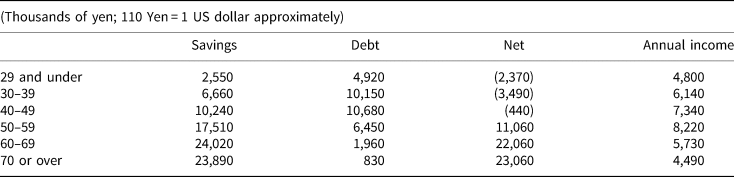
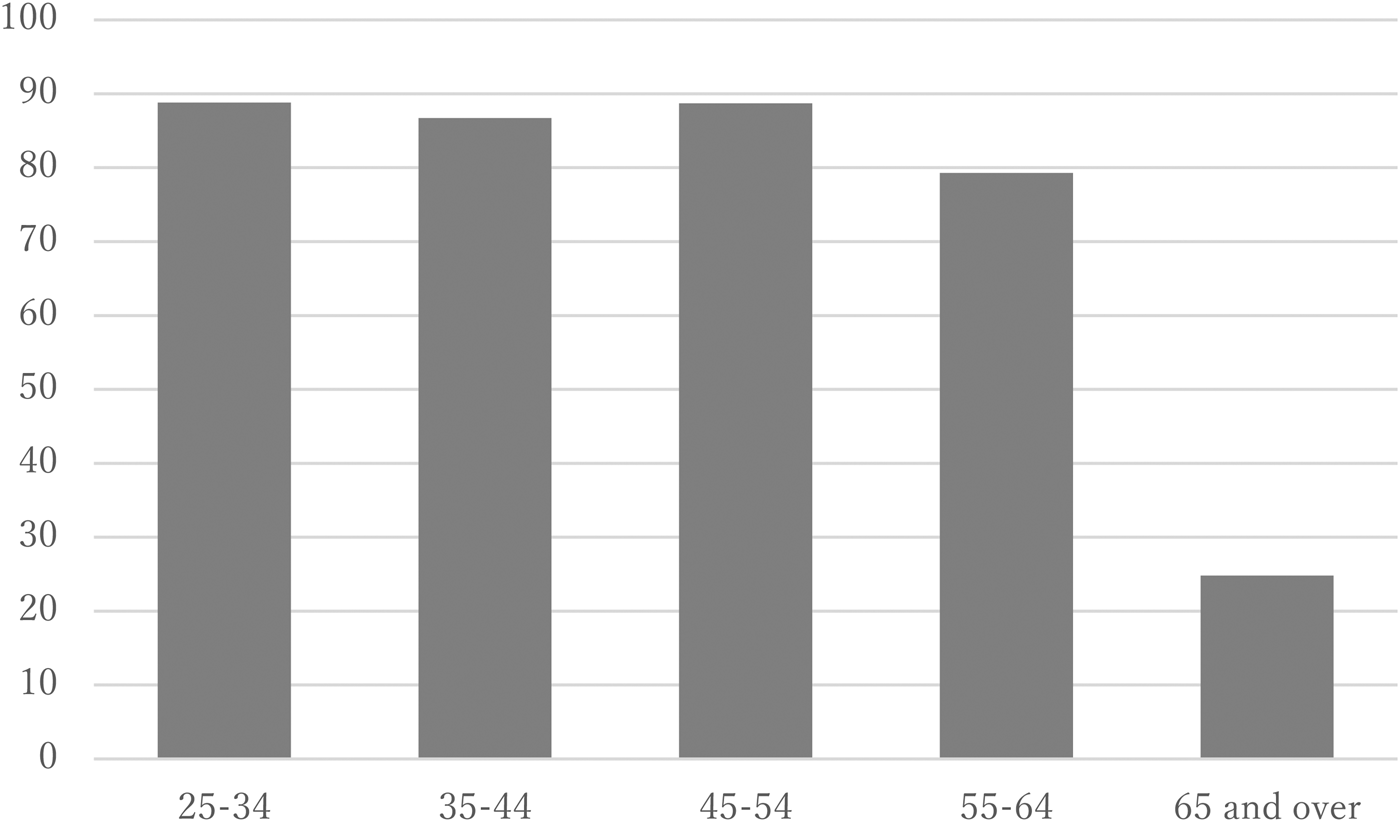
Households in Japan tend to follow this pattern. The overall level of savings is significantly higher for the elderly than for younger cohorts. For households with the head of the household (setai-nushi) between 60 and 69 years old or 70 and over, their level of total savings is much higher and their debt is much lower – see Table 1. These same groups also predictably tend to have lower workforce participation rates – see Figure 3. Likely reflecting lower workforce participation, the annual income for those 60 to 69 declines compared to those between 50 and 59, and drops further for those over 70 as shown in Table 1. Thus, for these reasons, we would expect the elderly to have greater inflation aversion due to their greater reliance on returns from their savings as a source of income.
Saving, debt, and income by age cohort

Note: Data are for households with two or more persons.
Source: Japanese Cabinet Office, https://www8.cao.go.jp/kourei/whitepaper/w-2017/html/gaiyou/s1_2_2.html
Labor force participation rate by age group (Feb 2020).
Source: Labour force participation rate [by age group] – Whole Japan, Monthly Data, Historical data 1 b-5, Statistics Bureau of Japan.

By contrast, those of working age prioritize employment and wages and rely less on returns generated from savings. Accordingly, this population should have lower inflation aversion than the elderly. Several studies have found empirical support for this argument (Scheve, Reference Scheve2004). Vlandas (Reference Vlandas2018) offers the most comprehensive evidence showing not only that the elderly tend to dislike inflation more than younger cohorts, but that they also punish incumbents when inflation is high.
While a good starting point, Hypothesis 1 is not adequate to understand the dynamics of monetary policy in the contemporary context. As discussed above, inflation has been very low, and policymakers have resorted to using new policies to raise the inflation rate. For Hypothesis 2, we conjecture that the elderly will tend to oppose monetary policies that drive down the real interest rate even in the context of very low inflation or deflation. Specifically, we expect the elderly to oppose QE, which simultaneously boosts inflation and drives down both short-term and longer-term interest rates. Such an outcome impairs their income from savings and fixed income securities even if inflation remains relatively low. Furthermore, the elderly tend to benefit less from improvements in the labor market, such as the increase in wages and employment that resulted in Japan from QE.
Hypothesis 3 is derived from the assumption that electoral accountability creates incentives for politicians to be responsive to voters. To get and stay elected, politicians take cues from public opinion. Thus, elected representatives align their preferences based on their constituencies (Miller and Stokes, Reference Miller and Stokes1963; Stone, Reference Stone1982; Kastellec et al., Reference Kastellec, Lax and Phillips2010). An extensive body of research has provided support for the view finding that voter preferences influence policies (Gerber, Reference Gerber1996, Reference Gerber1999; Erikson et al., Reference Erikson, MacKuen and Stimson2002; Lax and Phillips, Reference Lax and Phillips2012). From this perspective, we expect that candidate and politician views of QE will be influenced by the concentration of the elderly in their constituencies. Given that we expect the elderly to have more negative views of QE (Hypothesis 2), ceteris paribus, higher ratios of elderly in electoral districts should predict lower levels of candidate and incumbent support for QE.
Hypothesis 3b is an alternative hypothesis to 3a. An extensive literature on partisan identification has challenged the view that voters choose candidates that reflect their policy preferences (Lenz, Reference Lenz2012). Rather, voters draw on cues from their party and leaders and then align their policy preferences with these cues (Nicholson, Reference Nicholson2012; Lenz, Reference Lenz2012; Kousser and Tranter, Reference Kousser and Tranter2018). In the case of Japan, the LDP embraced very publicly QE as a policy as described earlier. As the head of the LDP, Shinzo Abe messaged the need for bolder monetary policy and very publicly appointed new members to BOJ's Policy Board to shift its policy course. Given these strong cues from the party and its leader, elderly LDP supporters should be more supportive of the LDP's policies. This effect should weaken the linkage between the economic preference and policy preference of the elderly and thus any systemic causal effect that the concentration of elderly in an electoral district might have.
5. Testing hypothesis 1
Existing work has already found empirical support for the claim that the elderly tends to be more inflation averse than the non-elderly. In this section, we specifically set out to test this claim in the Japanese context. To do so, we use data from the International Social Survey Programme, Role of Government from 2016.Footnote 4
To measure inflation sentiment, we use responses to the survey question that asks: ‘On the whole, do you think it should be or should not be the government's responsibility to keep prices under control.’ There are five possible responses: ‘definitely should be,’ ‘probably should be,’ ‘probably should not be,’ ‘definitely should not be,’ and ‘can't choose.’ Following Vlandas (Reference Vlandas2018), for respondents that selected ‘definitely should be’ or ‘probably should be,’ we code their responses as ‘1’ to indicate inflation aversion. For those selecting ‘probably should not be’ or ‘definitely should not be,’ the inflation aversion variable is coded ‘0.’ Observations with responses ‘can't choose’ or ‘no answer’ are excluded from the analysis. A contingency table reporting the relationship between age category and inflation aversion is reported in Appendix A.
We measure age in two ways. First, we use age as reported by the respondents (ranging from 16 to 96). Second, we create binary variables indicating (i) 60 and over, (ii) 65 and over, and (iii) 70 and over. We create three binary variables because Vlandas's work uses 65 years old as a cutoff to indicate the elderly, while the survey we report in Section 6 asks one's age groups. Since each category includes 10 years (e.g., 60–69 years old), we cannot use 65 for the cutoff; instead, we use 60 and 70. To be consistent with the analyses in Section 6, in this section we use the cutoffs at 60 and 70 in addition to 65.
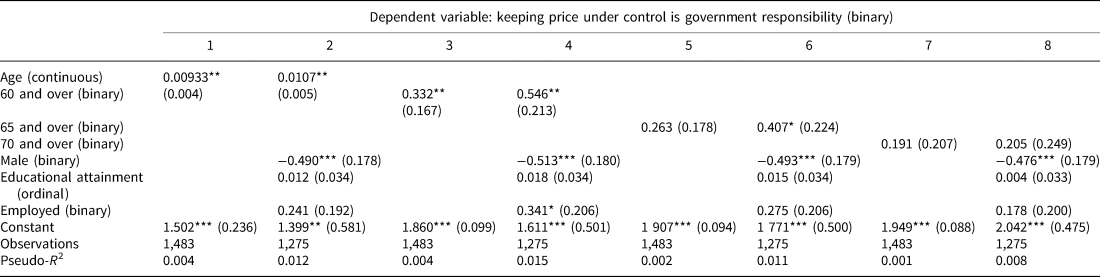
To examine if the difference in inflation preferences of the elderly and non-elderly is statistically significant, we report results of logit regressions. For each measure of age/elderly, we first report baseline models without any control variable. We then report models with control variables including gender, level of education, and employment status as these variables might be associated with age and could affect one's inflation preference.
The results, reported in Table 2, provide support for Hypothesis 1. Coefficients on age and the two binary variables indicating the elderly are positive and statistically significant: the elderly are more likely to express their support for the view that keeping prices under control is the government's responsibility (significant at 5% for the continuous age variable and the over-60 dummy; at 10% for the over-65 dummy).Footnote 5 On the other hand, the coefficient on the dummy variable indicating 70 and above has the expected sign but is not statistically significant. As for the control variables, male respondents are less likely to support the view that keeping prices under control is the government responsibility than female respondents. The coefficient on the binary variable indicating those who are employed is positive and statistically significant at the 10% level in one of the models, while educational attainment is not significantly associated with the dependent variable in any of the models reported.Footnote 6
Voter's age and inflation preference

Note: Results of logit regressions are reported. The dependent variable is a binary variable indicating answer choices associated with inflation aversion; it takes the value of one if the respondent selected ‘definitely should be’ or ‘probably should be’ when asked whether they think it should be the government's responsibility to keep prices under control and zero otherwise. We use four measures of age/elderly: (1) age as reported by the respondents; (2) a binary variable indicating those who are 60 and above; (3) a binary variable indicating those who are 65 and above; and (4) a binary variable indicating those who are 70 and above. Robust standard errors are reported in parentheses.
***P < 0.01, **P < 0.05, *P < 0.1.
6. Testing hypothesis 2
To test Hypothesis 2, we use a survey of voters conducted by University of Tokyo and Asahi Shimbun.Footnote 7 The research team randomly sampled 3,000 voters from all the prefectures in Japan. Two rounds of the self-administered, paper-based mail survey were conducted from 2014 to 2016, one shortly after the 2014 lower house election held on 14 December 2014, and the other after the 2016 upper house election held on 10 July 2016. In total, 1,813 responded to the first wave, while 1,376 did in the second wave. We focus on the second wave conducted in 2016 because it contains a question about QE, while the first wave does not.
To measure attitudes toward QE, we use the following question: ‘Do you approve or disapprove monetary easing by the Bank of Japan?’ Respondents were asked to rate the degree of approval in a five-point ordinal scale, which includes ‘disapprove,’ ‘somewhat disapprove,’ ‘neither disapprove nor approve,’ ‘somewhat approve,’ and ‘approve.’ We use OLS and examine whether one's age is associated with the dependent variable. We use four measures of age/elderly. First, we use an ordinal measure of age, following answer choices presented in the survey: (1 = 20–29, 2 = 30–39, 3 = 40–49, 4 = 50–59, 5 = 60–69, 6 = 70 and above). Second, following Vlandas (Reference Vlandas2018), we use a binary variable indicating those who are 60 years old and above. Given the age categories used in the survey were 20–29, 30–39, 40–49, 50–59, 60–69, and 70 and above, our categorization cannot not be the same as the one used in Vlandas (Reference Vlandas2018), which is 65 and above. Thus, we use 60 as a cutoff and create a binary variable indicating those who are 60 and up. Third, we use an alternative cutoff – at 70 years old – to create a binary variable indicating those who are 70 and above. Fourth, we insert binary variables indicating each age category, with those who are in the 20s used as a reference category. A contingency table reporting the relationship between age group and attitudes toward QE is reported in Appendix C.
We also control for individual-level characteristics, including gender, educational attainment, and employment status. In addition, we include one's responses to the following questions: (1) perception about the current economic condition; (2) self-reported ideology (left-right in 100-point scale); (3) whether the respondent voted in the 2016 upper house election; and (4) whether the respondent voted for the LDP in the proportional representation tier of the 2016 upper house election.Footnote 8
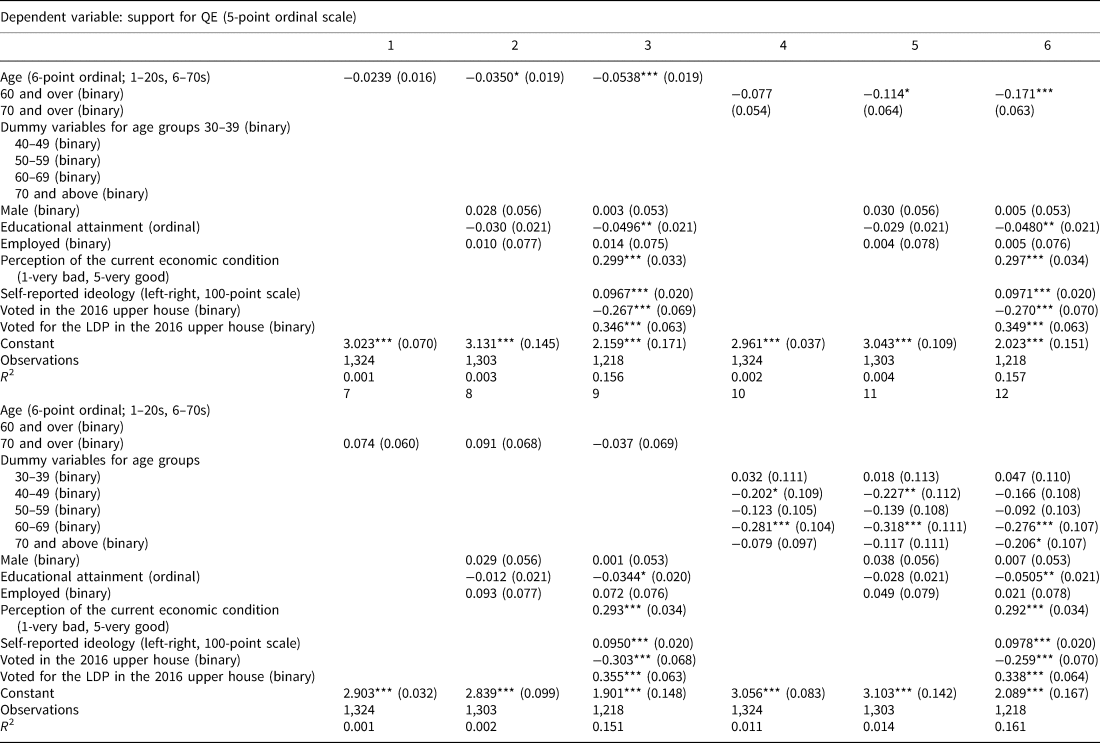
The results are reported in Table 3. We sequentially increase complexity of the model by reporting baseline results first (Models 1, 4, 7, 10), then adding respondents' characteristics (Models 2, 5, 8, 11), and finally including other relevant attitudinal variables mentioned above (Models 3, 6, 9, 12). We use robust standard errors since the variance of the unobserved factors may not be constant across age groups.
Voter's age and support for QE

Note: The unit of analysis is individuals (survey respondents). Results of OLS regressions are reported. The dependent variable is the responses to the following question: Do you approve or disapprove monetary easing by the Bank of Japan? It is measured in a five-point ordinal scale, with 1 indicating ‘disapprove,’ 2 ‘somewhat disapprove,’ 3 ‘neither approve nor disapprove,’ 4 ‘somewhat approve,’ and 5 ‘approve.’ The number of observations varies due to item non-responses. We use four measures of age/elderly: (1) age measured in the ordinal scale; (2) a binary variable indicating those who are 60 and above; (3) a binary variable indicating those who are 70 and above; and (4) binary variables indicating all the age categories. For each measure of age/elderly, we report three models: baseline model without control variables, model with respondents' characteristics (gender, educational attainment, and employment status), and model with additional control variables. Robust standard errors are reported in parentheses.
***P < 0.01, **P < 0.05, *P < 0.1
When all the control variables are included, age, measured on the ordinal scale, is negatively associated with the dependent variable (Model 3). The coefficient on the dummy variable indicating 60 and above is also negative and statistically significant (Model 6). The size of the effect seems important as well. For example, holding other things constant, being over 60 years old is associated with 0.171 unit decrease in the support for QE, which is approximately 17.5% of the standard deviation of this dependent variable (0.171/0.978). The dummy variable indicating 70 and above is negatively associated with the dependent variable but not statistically significant at conventional levels (Model 9). The model in which all the binary variables indicating all the age groups are included (with the 20s used as a reference group) shows that compared to those who are in their 20s, those in the 60s and 70s have a significantly lower level of support for QE (at 1 and 10% levels, respectively); the magnitude of the effect is larger for the 60s than for the 70s.Footnote 9
Our argument implies that among the elderly there might be variations in the preferences for QE. Specifically, we check whether the effect of being elderly is moderated by the respondent's employment status (those who are in the labor market may be more concerned about the employment conditions and more supportive of QE), whether the respondent voted for the LDP (elderly LDP supporters might be more supportive of QE than the other elderly since it was PM Abe's key campaign promise), and perception of the current economic condition (elderly who perceive the economic conditions to be favorable might be more supportive of QE than the elderly who do not since they may perceive the incumbent who brought about the good economic condition to be competent and are willing to support the campaign promise/policy emphasized by the incumbent PM).Footnote 10
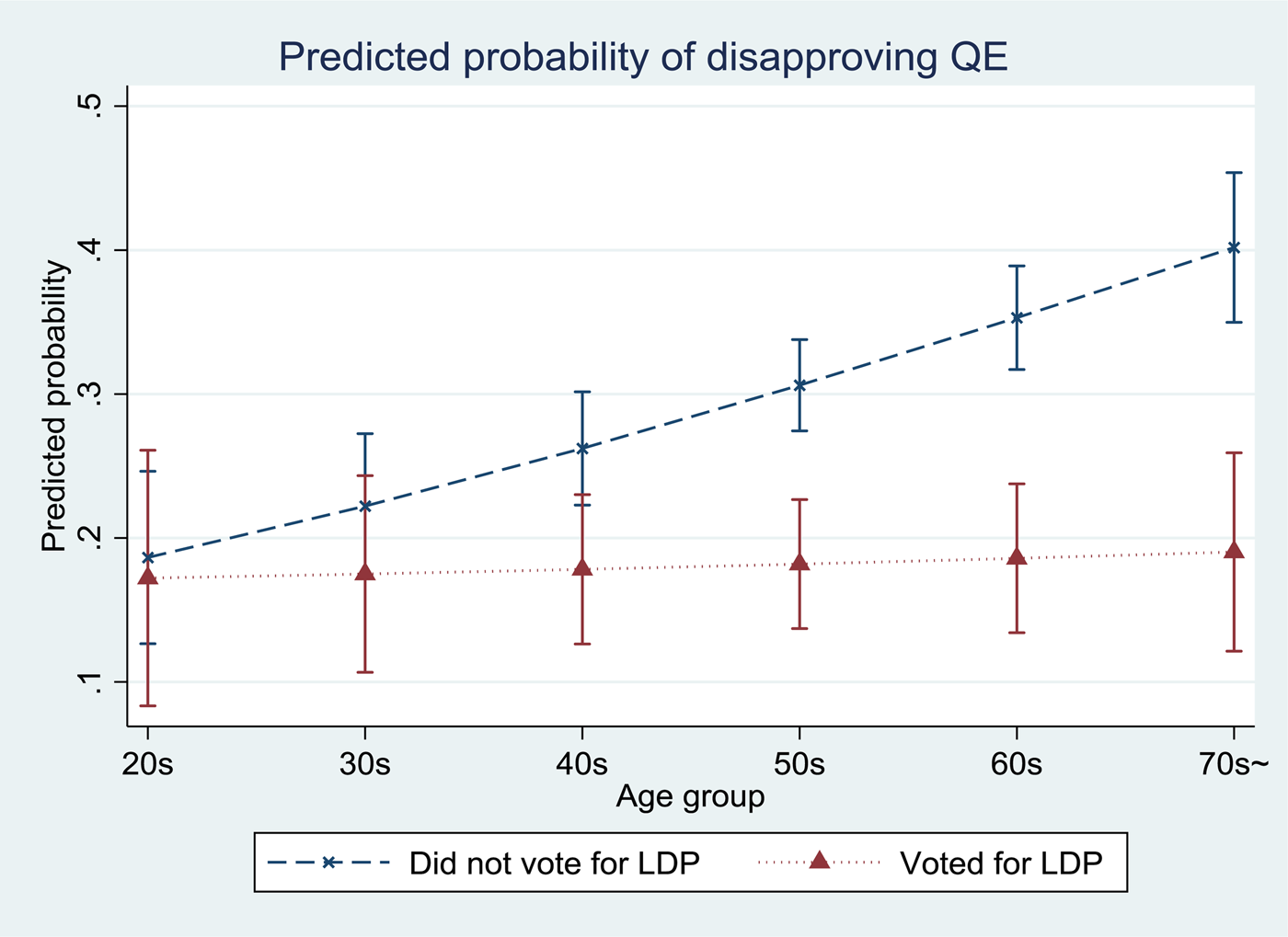
Results from the ordinal dependent variable with OLS and the binary dependent variable with logit regressions are reported in Appendix D5. Focusing on the results of logit regressions, three variables – interaction between the ordinal age variable and voting for the LDP, interaction between the over-60 dummy variable and voting for the LDP, and the over-70 dummy variable and the perception of the current economic condition – are found to have statistically significant effect. The following is our interpretation of the significant effects of interactions between age variables and the two variables listed above (voting for the LDP and the perception of the current economic condition). Regarding the interaction between age and voting for the LDP, for those who did not vote for the LDP in the most recent national election, the chance of disapproving QE is higher for older than younger respondents; however, among those who voted for the LDP, the chance of disapproving QE is low regardless of age groups. We will return to this finding in Section 7. Regarding the interaction between age and perception of the economic condition, for those who perceive that the current economic condition is bad, older respondents have a higher chance of expressing disapproval of QE than younger respondents, while the chance of disapproving QE is low regardless of respondent's age among those who perceive the current economic condition to be favorable.
7. Testing hypothesis 3
Finally, do politicians from constituencies with greater share of the elderly express a lower level of support for QE? To examine this question, we use a pre-election survey of candidates in the 2017 lower house election conducted by University of Tokyo and Asahi Shimbun (The UTokyo-Asahi Survey (UTAS) conducted by Masaki Taniguchi of the Graduate Schools for Law and Politics, the University of Tokyo and the Asahi Shimbun n.d.). We use the 2017 survey instead of previous waves of survey because a question about QE is included in the 2017 survey but not in the previous rounds of survey.
We use the following question, which roughly matches the question we used in the voter survey: ‘Do you agree or disagree with quantitative easing by the Bank of Japan, including the purchase of government bonds?’ The answer choices are presented in a five-point ordinal scale, with larger values indicating greater degrees of agreement. Appendix E reports frequency distributions of this variable for each party.
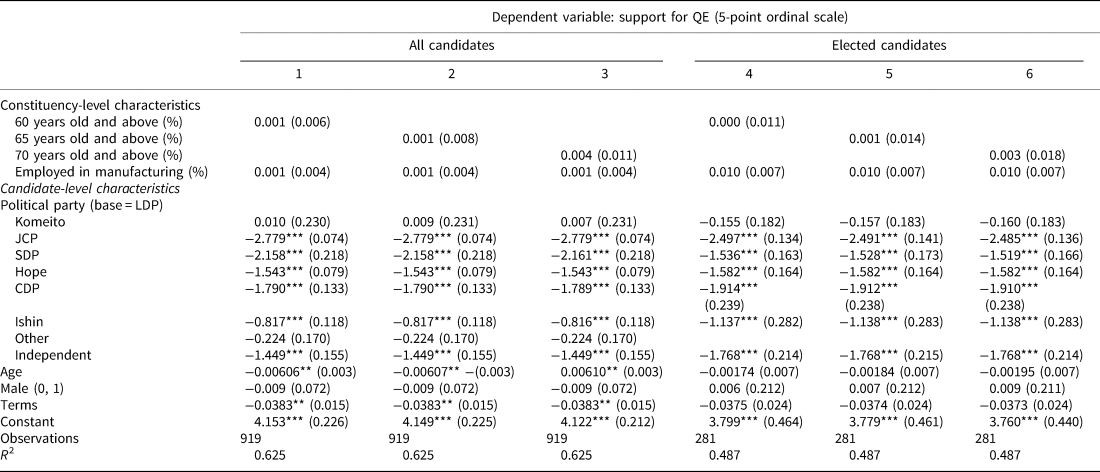
The key independent variable is the percentage of the elderly in the constituency: we use three cutoffs and calculate the percentages of those who are 60 and above, 65 and above, and 70 and above in the constituency. We also include the share of those who work in the manufacturing sector as a control variable because QE presumably brought about favorable conditions for the manufacturing sector and candidates in constituencies with more workers in the sector would support QE. For candidate-level control variables, we include the party from which the candidate is running, age, gender, and the number of consecutive terms elected to the lower house. The results are reported in Table 4. The share of the elderly does not have statistically significant effect on candidates' support for QE (Models 1–3). The results hold even if we focus on those who were elected (Models 4–6). Thus, Hypothesis 3a is not consistent with our data. Robustness checks and related analyses are reported in Appendix F; our main findings remain unchanged.Footnote 11
Share of the elderly in the lower house single-member constituency and candidate's support for QE

Note: The unit of observations is candidates in the 2017 lower house elections who ran in the single-member constituencies. Results of OLS regressions are reported. The dependent variable is responses to the following question: ‘Do you agree or disagree with quantitative easing by the Bank of Japan, including the purchase of government bonds?’ The answer choices are presented in a five-point ordinal scale, with larger values indicating greater degrees of agreement (1-disagree, 2-somewhat disagree, 3-neither agree nor disagree, 4-somewhat agree, 5-agree). The key independent variable is the percentage of the elderly, and three cutoffs are used – 60, 65, and 70. Results for all the candidates (Models 1–3) and elected candidates (Models 4–6) are reported. Since none of the candidates in the dataset running from non-major parties (indicated as ‘Other’) were elected, they are not included in the analyses with only elected candidates (Models 4–6). Robust standard errors are reported in parentheses.
***P < 0.01, **P < 0.05, *P < 0.10.
We then check H3b, the alternative hypothesis, namely that the share of elderly will not be reflected in candidate or incumbent positions on QE since voter policy preferences are shaped by partisan identification rather than economic interest. Using the 2016 survey of voters above, we analyze voter attitudes by disaggregating LDP voters from others. We find that for LDP voters, their attitudes toward QE are strongly associated with their partisanship. LDP voters have lower disapproval of the government's monetary policy, and crucially, age has no effect on monetary policy preference – see Figure 4. The same pattern holds not only for LDP voters but also those that identify with the LDP – see Appendix Figure D5(1). Conversely, when only looking at non-LDP voters, old-age voters show a stronger and more consistently statistically significant effect on monetary policy preferences compared to the model used to test Hypothesis 2. These findings suggest a stark difference in the age effect between LDP and non-LDP voters.
Impact of age on support for QE – voters who voted for the LDP in 2016 and voters who did not.
Note: The predicted probabilities of disapproving QE as one's age changes are plotted for those who voted for the LDP and those who did not vote for the LDP in the 2016 upper house election. The dependent variable is a binary variable that takes the value of one if the respondent disapproves QE and zero otherwise. The figure is based on Model 4 in Table D5 in Appendix D.

Finally, we find that the share of elderly is higher in constituencies where the LDP candidates' vote share is higher (Figure 5). Thus, this pattern would help explain why electoral districts with high concentrations of elderly might not result in the candidates and incumbents aligning against monetary easing, such as QE. While our data do not allow us to examine the extent to which partisan cues modified or shaped voters' attitudes, it is consistent with our expectation in H3b.
Relationship between the elderly share and LDP candidate's vote share.
Note: The unit of observations is single-member constituencies in the lower house. Data from the 2017 election are used. Single-member constituencies where the LDP candidates did not run are omitted from the figure.

8. Concluding discussion
To summarize, we find that the elderly have specific inflation preferences as we hypothesized: the elderly are more averse to inflation. We also find some evidence that the monetary policy preferences of the elderly tend to align with these preferences. The elderly are opposed to monetary easing, which has the effect of lowering the real interest rate and thus earnings on savings from fixed-income investments. However, we do not find evidence for collective grey power at the electoral district. Grey power is not reflected in legislator monetary policy preferences at the level of the electoral district. The concentration of elderly in electoral districts has no statistically significant effect on monetary policy positions of either candidates or elected officials for the House of Representatives.
Upon closer examination, we find that partisanship likely explains this null finding. LDP voters are much less critical of the LDP-backed monetary policy. Thus, there is support for our hypothesis (3b) that LDP voters follow cues from their leaders and align their policy preferences with those of the LDP-led government. We also find that elderly voters tend to be concentrated in LDP strongholds.
These finding suggests an important revision of the grey power thesis (Vlandas, Reference Vlandas2018). Demographics is not destiny. The political effects of aging – while partly driven by economic interest – are mediated strongly by partisan identification. This offers a possible explanation for understanding the seeming contradiction between Japan's relatively high level of elderly and the BOJ's monetary policy that ceteris paribus should work against the economic interests of the elderly.
We must concede that this research is unlikely to be the last word on this question. There may be limits to partisan loyalty that may become apparent in the future, especially if inflation increases more rapidly and further reduces the real rate of return. Also, our study has limitations. Alternative explanations could account for our null finding. Second, the effect of the Abe's monetary policy has not had large macroeconomic impacts (Hausman et al., Reference Hausman, Unayama, Wieland, Hoshi and Lipscy2021). Moreover, since monetary policy is complex and its effects can have a long lag, voters might have difficulty attributing economic phenomenon to monetary policy (Park et al., Reference Park, Cheung and Katada2022). As a result, there might not be very strong preferences on the part of elderly voters or candidates and incumbent politicians assessing the electoral implications of it.Footnote 12 Also, surveys do not necessarily reflect how candidates present their positions to the electorate. Their publicly stated positions might be better measured by other means such as speeches, TV appearances, and candidate manifestos (Catalinac, Reference Catalinac2015). For a future study, researchers could use text analysis on such sources to measure preferences toward monetary policy in order to verify our null finding with regard to grey power. Nonetheless, the divergence in policy preferences among the elderly by partisanship is a strong and important finding with broader implications.
Supplementary material
The supplementary material for this article can be found at https://doi.org/10.1017/S1468109922000226 and https://dataverse.harvard.edu/dataset.xhtml?persistentId=doi%3A10.7910%2FDVN%2FBA15EX
Acknowledgements
Special thanks to Michael Strausz our discussant at the ‘Demographic Challenges in Contemporary Japan’ conference at Indiana University and other participants including Angela Chin, Hilary Holbrow, Adam Liff, Kathryn Elissa Goldfarb, and Michael Sharpe. We are also grateful of participants at the Northeast Workshop on Japanese Politics at Dartmouth for their helpful suggestions.
Conflict of interest
None.