Introduction
As couples survive longer and live together into older age (FELICIE, 2006; Office for National Statistics, 2011a), they face many issues of financial management, including daily money management on reduced and/or reducing income, and paying for care or the additional costs of disability. While successive UK governments have grappled with how to finance pensions, health and social care in later life, the trend in policy has been to devolve responsibility for organising and financing late life away from the state to the individual and the market. Since public interest and the aim of government should be to secure the welfare of all individuals within households, this means that understanding the ways that couples interact in money matters increasingly becomes a matter of public concern. While women's life expectancy advantage has reduced since 2000, a woman of sixty-five today can still expect to live 2.6 years longer than her similarly aged male partner (Office for National Statistics, 2011b). Many women marry older men, and may find themselves becoming first carers then widows, having to deal with tasks previously tackled by husbands, including managing finances within the context of tax and benefits regulations, and the possible need to fund care.
Much of the early research on financial roles within households was based on the generations now in their seventies and eighties. Zweig's (Reference Zweig1961) research provides evidence of the extent of masculine control of household finances at that time, in that men controlled household spending in 70 per cent of couple households by means of a ‘housekeeping allowance’ system. By the 1980s, the prevalence of this system had reduced to about 22 per cent of households (Pahl, Reference Pahl1989), and by the 2000s it was down to 8 per cent (Vogler et al., Reference Vogler, Brockmann and Wiggins2006). However, when people now aged sixty-five or over were young newlyweds, typically men controlled the household money supply and bore the main responsibility for breadwinning (Vogler and Pahl, Reference Vogler and Pahl1993). While women may perform the day-to-day management of much of the household spending, this does not mean that they control the amount available for such spending, or make the strategic decisions about money (Pahl, Reference Pahl1989).
Household spending is known to be highly gendered. Pahl ‘s (Reference Pahl2000) analysis of the 1996 Family Expenditure Survey showed that within married couple households, while women conducted the spending on items like food, their own and children's clothes, school, child care and medical expenses, men were more often the purchasers of alcohol, cars, home repairs and various kinds of entertainment. In particular, when it comes to financial products, there is evidence that men feel more confident than women; in a 2003 UK survey, it was found that 70 per cent of men disagreed with the statement that ‘I felt unsure when choosing my investment based products’, whereas only 53 per cent of women disagreed (Howcroft et al., Reference Howcroft, Hewer and Hamilton2003). A 2002 survey in the USA showed that while women's influence on couples’ decision making seemed to have increased since the 1970s and 1980s, men were still more likely to make the major household decisions about financial services such as insurance (Belch and Willis, Reference Belch and Willis2002).
In this article, we draw on data from the ESRC project Behind Closed Doors: Older Couples and the Management of Household Money. We look particularly at the attitudes of the women in our sample towards the role they have taken within their marriage regarding household money, and discuss how this has or has not helped them prepare for older age and the possibility of having to assume the main responsibility for managing household money. We ask whether ageing changes the nature of male and female money management roles in the household, and, if so, what brings about such change; we also explore the way that older women perceive their financial situation.
Research methodology
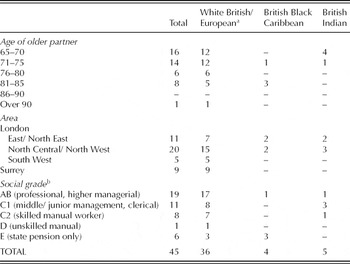
The project included a large qualitative study investigating how older couples view, manage and negotiate about money, comprising semi-structured interviews with forty-five heterosexual couples where at least one partner was sixty-five or over. Fieldwork took place during 2008 and 2009. A maximum variation sampling approach was taken, so as to include a range in terms of age, health (including some with severe health problems), ethnicity, social grade, income level and marital history. The areas, all in and around London, represented a spectrum of socio-economic characteristics. The characteristics of the sample are shown in Table 1.
Sample by ethnicity, age band, social grade and area

Notes: a Included individuals who were Welsh, Scottish, Irish, Italian, French, and Greek Cypriot but all had lived in the London area for many years. Also includes British Jewish.
b When retired, based on past occupation, except for those with state pension only.
Most interviews took place in the couples’ own homes. Partners were interviewed together first for forty-five to sixty minutes, followed by separate, simultaneous interviews lasting about one hour, generating over 130 recorded interviews. Two researchers conducted the interviews, and participants were usually interviewed by same-sex interviewers. An incentive of £40 per couple was given, handed over before beginning the interview.
Interviews were recorded (with consent) on digital recorders and were transcribed verbatim. Coding utilised QSR NVivo8, following the principles of grounded theory (Charmaz, Reference Charmaz2006) in its abbreviated version (Willig, Reference Willig2001). At least two of the research team read each transcript, and notes were made from which the initial categories and codes were generated. The detailed analysis and coding was shared between two researchers, who regularly compared and combined their code lists thus developing the higher level categories; all coding was discussed at research team meetings. All participant names are pseudonyms.
Does ageing change the nature of male and female money management roles in the household? If so, what brings about such change?
We found that ageing in itself does not cause any change in a couple's approach to money management − couples who had previously used a ‘housekeeping allowance’ system usually continued to do so − nor does retirement necessarily lead to such a change, even if associated with reduced income. Patterns established in earlier years of the relationship tended to continue, for example in terms of who paid the bills or who did the shopping. Couples also tended to preserve the configurations of bank accounts they had previously held.
Among the couples in the study, income in general had fallen with retirement. Pensions were usually less than earnings, and the general economic situation at the time of the fieldwork meant that in addition to retirement many couples’ income was reduced through low interest rates and low return on other investments. People had not only reduced spending on holidays, gifts and hobbies, but had also given up small pleasures such as smoking, betting, going to the pub and eating out.
In particular, women's income had fallen. Some had paid only the ‘married woman's stamp’Footnote 1 for their national insurance and therefore had only a small pension in their own right. Women with fragmented employment records might not have accumulated any significant occupational pension, and due to lower lifetime earnings any occupational pension they had accumulated was smaller than their husband's.
Even though the amounts of money contributed by the partners could change after retirement, the pattern of who paid for what did not necessarily change, and the division of responsibilities for household spending remained highly gendered. Some women reported that in spite of having a lower income than before retirement, and a lower income than their husbands, they had continued to pay for the items they had previously paid for. One example was Mary, who here explains that she pays some of the household bills:
Mary: He pays the rent and the poll tax.Footnote 2
Int: Okay, so rent, poll tax. But you pay the electric?
Mary: The gas, the telephone.
Int: Okay, and is that all out of your fifty pounds that that comes?
Mary: No it comes out of my savings.
Int: So you're drawing on the savings to pay.
Mary: Well you couldn't, I have to do my food shopping with the fifty quid, so I couldn't get all that out of it as well now could I? (Couple 11, Woman, aged 65–70, D, White British/Irish)
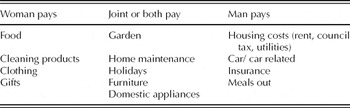
Echoing Pahl's (Reference Pahl2000) analysis, it was found that women generally paid for ‘discretionary’ expenditure such as food, clothing, small household products and gifts for family and others. Food spending is discretionary in the sense that it requires choosing which food to buy and how much to spend on it, often a burden on low income. While both partners might be involved in decisions about bank accounts, actual purchases tended to follow the pattern shown in Table 2.
Who pays for which household expenditure: general patterns
The development of health problems appeared to be the main driver of change in couples’ money management. If the man, usually the main controller of the household money, suffered ill health, it could fall to his wife to take over these responsibilities, and some had no previous experience of doing this. Nazma's husband, Ajmal (Couple 21), had looked after all their financial affairs, but suffered a heart attack which was followed by a spell in hospital. At that point, she had to take over looking after the bank account and household finances.
Women might also lack confidence in taking control of household finances. Marjorie's husband Derek (Couple 44) was not in good health, and she felt that if he had to go into hospital, she would have to rely on her sons to organise their financial affairs. One wife, Susan, was having to deal with her husband Alfie's developing dementia, and she subtly monitored the way he dealt with their bank account:
Susan: Unfortunately, you know, between you and I, Alfie is in the very early stages of . . . . his memory and everything like that's going. So ummm it's a matter of keeping an eye on things a little bit at the moment. (Couple 18, woman, aged 71–75, White British)
How do older women perceive their financial situation?
Many older married women in Britain clearly have lower income than men of their generation, and may have less experience of managing and/or controlling household finances. But how do they perceive the situation? We found that the women could be classified into three types in relation to money within their partnerships, related to experiences in their earlier lives, not only from the early years of marriage, but also from their childhood and the influence of their parents and the cultures in which they were raised.
One issue exemplifies the different approaches and attitudes of these three types of women: that of making purchases other than routine household shopping. A money-controlling husband might trust his wife to perform the routine shopping, even if he provided all the money via a housekeeping allowance arrangement. If the purchase was not routine, male power often extended to making quite large purchases without consulting wives. But the reverse was very often not true, and a number of female participants reported that if they wished to make a purchase for themselves, for the children or for the household, which was not strictly necessary, an element of ‘asking his permission’ existed. Damon and Gina (Couple 14) talked about his purchase of a car earlier in their lives, and revealed that Damon had bought a car without any consultation with Gina. However, Gina explained in her individual interview that if some exceptional purchase was needed, she had to ask Damon:
Int: Supposing you'd wanted to buy something for yourself would you have felt able to do that?
Gina: I'd just ask. He would give it to me . . . He gave me a certain amount and if I wanted more I'd say, ‘Could I have a new coat?’ Or ‘the children need shoes’. Or what have you. (Couple 14, both aged 71–75, C1, White British/European)
The same pattern held for Palmer and Irene, a white British couple both aged sixty-five to seventy. Palmer explains how he used to give Irene the housekeeping money on Fridays so she could do the household shopping, but if Irene needed anything for herself she would have to ask him. This behaviour pattern persisted to the present day, as Irene related the story of how she had similarly consulted Palmer about buying small items for their bathroom:
Irene: Just a couple of weeks ago. They always send me these magazines, errr, Bright Life, or something . . . And I went, ‘Oh, and in this book’, I said, ‘there's a couple of things I would like . . .Have a look.’ And he would have a look . . . it was a shower curtain. And . . . the mats to match. And I went, ‘I'd like that upstairs.’ And he went, ‘Right. Send for it.’
This did not happen if Palmer wanted to buy something:
Int: And can you remember a time when he asked you about spending something on himself?
Irene: No it, it wouldn't, he wouldn't say to me . . . he would just say, ‘I need shoes.’ And we'll go, or a coat, and we just . . . and then we'd go out. (Couple 37, both aged 65–70, C2, White British)
These examples illustrate the asymmetry in these couples’ relationships, regarding discretionary spending. Women ask permission; men spend as they wish. The women in our sample could be divided into three groups, with their attitudes, feelings and behaviour crystallising around this issue.
The typology
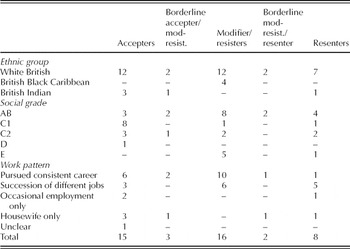
We have called the groups Accepters, Modifiers/Resisters and Resenters. Table 3 shows the distribution of the women in our couples across the sample, and by ethnicity, social grade and employment history.
Typology of women by ethnicity, social grade and work pattern

Note: The ‘Unclassifiable’ participant was White British, C1 social grade.
The groups are characterised as follows.
Accepters
Accepters seemed willingly to accept the female role they had played during their married lives, and appeared fully to support their husband in retaining his male role as the money provider and controller. Accepters, with or without their own income, seemed content to be dependent on their husbands. While most had held jobs, they saw their work as clearly secondary to their husband's. It appeared that some would have their pension severely reduced should they outlive their husbands, yet seemed not to have considered what would happen to them in widowhood. They might consult their husbands even about spending their own earnings or pension. Notably, some Indian women paid their money into their husband's, or a joint, account so that he might continue to take the traditional male role in controlling all their finances and in taking financial responsibility, even if the money being controlled had been generated by her.
One such accepter was Nazma, an Indian woman whose husband Ajmal had retired early due to ill health. Nazma was still working as a carer, and paid most of her salary into Ajmal's account, keeping some back only to spend on her (adult) children. Although Nazma was generating much of their income she would ask Ajmal's permission before spending money on herself.
Int: What would be something that you might have wanted for yourself? Clothes or something?
Nazma: Clothes, jewellery, yeah.
Int: How would you have gone about buying that?
Nazma: I always ask him first. I say, ‘Look, I want to buy this thing . . . is it OK? Is it enough for you know if I can buy it?’. . . Yeah, I would ask him. (Nazma, aged under 65, Indian Muslim, C1; husband aged 65–70)
Another ‘Accepter’ was Sonia, a British Jewish woman aged seventy-one to seventy-five. In contrast to Nazma, she had never had a job and had willingly taken the housewife role; in further contrast, her husband Michael did not expect her to consult him about her spending. Although Sonia could spend freely, she would talk to Michael if there was something particularly special that she wished to buy. She accepted, even welcomed, the dependent role, and it worked for her:
Int: So in general do you feel you're free to spend money as you wish?
Sonia: Yes, if I've got it. He would never interfere with me. Never.
Int: I mean would there be anything where you'd feel you should just check with him before you did something?
Sonia No, never. Not in the forty four years I've known him. Never . . . I remember once . . . I rather liked this ring. And I came back and I said, ‘I've seen this ring and it's a thousand pound’, I said, ‘I would love it.’ And he says, ‘Why don't you get it?’ I said, ‘But we haven't got a lot.’ He says, ‘Doesn't matter, if you want it.’
Int: That's lovely.
Sonia That's been the only time, I think, I've asked for anything, you know, and discussed it with him. ‘Cos it was a lot of money then. Yeah. No, he's never begrudged me anything. (Couple 23, Woman, aged 71–75, British Jewish, C2; husband aged 65–70)
Modifier/Resisters
In contrast, Modifier/Resister women tended to reject the traditional female role. Although not necessarily able to live the completely independent lives they might prefer, they had over the years resisted any pressure to adopt ‘dependent female’ behaviour, and had, so far as they could, modified the female role to suit their own circumstances and preferences. While they varied in current income, from the very well off to those on state pension only, most had pursued careers or held jobs for much of their lives, hence had money of their own, and maintained this independence in older age.
Notably, all Modifier/Resisters in our sample had had some experience earlier in their lives that had led them to step out of the traditional female money role and assume power over, and responsibility for, money management. This included failed first marriages, or relationships with financially unreliable men and working to keep the family afloat financially or even to get the family out of debt. Some had controlled the household money for much of their married lives for one reason or another, which meant that debilitation of their husband due to illness or old age did not cause them money management problems. All four of the Afro-Caribbean women in the sample fell into this group, and Georgia, seventy-six, was one of these. She had come to the UK from Jamaica in 1961. She had worked mainly as a domestic worker in hospitals and care homes. This was her second marriage, and she had seven children across both marriages. She had always had a job of some kind, even when her children were small and during a period of single parenthood. Independence was vital to her.
Georgia: I don't like to be, I don't like [to be] housewife (laughs). I like my own . . . I like to work or . . . go out. I love to be independent. I don't like ask people for money, ask people for anything. If I want something . . . I like to go and get it, I can get it, without have to . . . ask, ‘Oh daddy, can I have dress?’ No. That's not for me.
Int: So what did it mean to you to have your own money?
Georgia: Everything. It meant everything (said with meaning). I can't understand peoples that don't work, and are looking to their husband for everything they want.
She later added:
Int: So could you spend it how you liked? Or did you . . .
Georgia: I can spend it as I want, like nobody else ask me any question about it. That's what I am. It might sound terrible to you, but I'm . . . I love, I love to be independent person. (Couple 2, Woman, aged 76–80, E, Afro-Caribbean)
Georgia was thus expressing a definite rejection of the idea of being dependent on a man, insistent on her financial autonomy. Another Resister/Modifier was Sylvia, aged sixty-eight at the time of the research and married to Chris, who suffered from severe Parkinson's Disease. As a young mother, Sylvia had done a variety of jobs to fit in with childcare, such as office cleaning and running a market stall. She was used to economising, bargain hunting, living day to day on the money that was coming in, and she continued this strategy in older age. While Chris was disabled and had retired early, Sylvia just continued to manage the finances, making the most of a low income.
Sylvia: I've always managed.
Int: Hmm, but how did you sort of organise it then, was it . . .
Sylvia: I suppose you did organise it without knowing you was organising it, in a way. You, you got paid on a Friday, you got your shopping for most of the week on a Friday. Um, on . . . a Thursday you got eight shillings for having a second child, well that would buy a dinner . . . So I suppose yes, you did budget. But not on a bit of paper.
And now she operates the same way:
Int: It sounds, it sounds as if you, even if you weren't thinking about it, you were sort of deciding . . .
Sylvia: Budgeting. Yeah, budgeting, yeah. And I've always cooked. I've never bought precooked food. See I can make, for me and Chris I can buy a large chicken and I get three meals out of that, and we eat well. (Couple 3, Woman, both aged 65–70, E, White British/European)
Sylvia and Chris had always pooled their income, and as Sylvia had, of financial necessity, always worked, she had never been dependent on Chris or had to consult him before spending. Hence older age and its problems did not change her pattern of financial management.
Resenters
Women in this group had usually given up paid work for a role as a housewife and mother, though some had worked to pay for specific costs such as school fees. Now, in later life, they might have no or only a small pension, hence were financially dependent on their husbands, but strongly disliked this dependency. This led to resentment, even if the husband did not begrudge the money. Husbands appeared to be free to spend as they wished, while wives might have to ask for money, especially for themselves. George and Gillian, who were among our oldest participants, exemplified this pattern. George was the main decision maker on any larger purchase, and, while he said that he would always give her the money if she needed it, she did have to ask him.
George: Well whatever money, if she wanted money, I mean I would treat her to some money if I had it. Y'know if I had earned extra that week I would give her extra. But then if she needed money then she would ask me for it, and I would have to get it out the account. (Couple 10, Man, aged 81–85, E, White British)
While their account was technically a joint one, in practice Gillian did not have access to it, and George described it as ‘my account’. In her own interview, Gillian explained that she had earned a small amount herself, and kept that separate, but had occasionally used it to top up the housekeeping allowance from George, which had not increased when his pay rose: notably, he had used his extra income to pay for taking up golf. But when Gillian received an inheritance, they had decided to use it to refurnish and redecorate their flat. It seemed clear that in money matters, George had all the power. Rather than confront George about this power imbalance, Gillian managed financially by drawing on her own small reserves, and even gave money to their granddaughter in spite of George's disapproval.
This avoidance of confrontation appeared in other guises; indeed, ‘Resenters’ might use various stratagems to achieve their financial needs within the constraints of their marriage in order to spend money on something their husbands might not permit, or just to avoid having to ask their husbands for money. Ruksana, sixty-two, was married to Razak who was ten years older, and who controlled money in what she perceived as the tradition followed in their Indian culture. Her strategies included just ‘wearing him down’ by repeated requests when spending was needed, but she also resorted to more devious methods:
Ruksana: Because, I mean, I can trust him that he wouldn't go and spend money, you know, unnecessarily anywhere. But I suppose he cannot trust me that I'm going to go and spend money.
Int: Mmmm. But have you ever actually done that?
Ruksana: I've gone and bought something and left it in our garage about six months and then take it out . . . (Couple 22, Woman, aged under 65, C2, Indian Muslim (from East Africa))
A further ‘Resenter’ was Cathy, seventy-one, who had mainly been a housewife, but had worked as an Avon lady, a school playground supervisor, and in Marks and Spencer. Her husband Sidney had been a high-flying executive, and had spent a lot on smart clothes, whereas Cathy had relied on her own small earnings and Family Allowance. However, Sidney was unfaithful to her, and had become bankrupt, and it was only Cathy's modest income and pension that kept them afloat. Cathy was resigned to the situation; at her age, she felt it was too late to change things.
Cathy: I just got, you know, you get resigned to it because what are the options? You know, there's, I can't walk away from . . . this, it's too late. (Couple 29, Woman, aged 70–75, AB, White British)
Discussion
The past fifty years have seen enormous changes in the role of women in society. Some women in our research sample have lived through changes in the domains of employment opportunities, financial autonomy and equality legislation such as the 1970 Equal Pay Act, the 1975 and 1986 Sex Discrimination Acts, and the 2010 Equal Opportunities Act, as well as broader social changes. However, women still differ in the extent to which they feel able to deal with matters connected with household finances. While some have managed their own money with ease and feel confident, others, especially if they have mainly taken a domestic rather than an earning role in the household, lack such confidence. Confident or not, older women also differ in terms of their attitude towards taking on the role of managing household finances. Because of the gendered nature of household spending, taking on financial responsibilities for the first time in later life with the onset of a spouse's illness, or widowhood, may be particularly problematic.
This research suggests that women's feelings about gendered inequalities in power over money within the household will lead to their being differently affected by the changes and trials of ageing, and they will differ in their capacity to deal with the problems which older age may bring them. As well as potentially substantive psychological risks to identity, Accepters risk an income ‘cliff’ on widowhood, as they are highly dependent on their husband's pensions, yet have thought little about the implications of this ceasing on his death. This pension dependence is a known issue in the South Asian female population (Ginn and Arber, Reference Ginn and Arber2001), and we note that in our small sample, none of the Indian women was a Modifier/Resister. Some will be able to depend upon their children to advise and support them, but not all will have children equipped to do so. Resenters may be in a similar position in terms of having also taken housewife roles, albeit unwillingly; having done jobs rather than had careers, and facing problems of low incomes if widowed. Their well-being is affected by a sense that they have lost out in life but are powerless to change now. But in terms of being prepared for the vicissitudes of older age, they at least know there may be problems and may be better equipped than Accepters, to deal with them.
Modifier/Resisters are best placed for old age and widowhood in that they have always valued independence and have dealt with financial matters. This group is likely to grow as women who benefited from the expansion in female opportunities from the 1970s onwards move into retirement. Notably, while ‘career women’ fell into all three typologies, all of the Modifier/Resister women in our sample had worked at a consistent career, or pursued a succession of different jobs. However, as noted above, all of the Modifier/Resisters had also had some life experience that had led to their assuming power and control over money much earlier in their relationships. As our examples show, Modifier/Resisters are not necessarily career women or higher earners; indeed, we found that these typologies cut across income groups. It is known that Black Caribbean women strive to combine financial independence with home responsibilities (Holdsworth and Dale, Reference Holdsworth and Dale1997) and those in our small later life sample all fit that pattern.
Social policy has been slow to recognise the psychological and sociological differences between people, and that these might call for varying policy responses. Government, health and caring professions all interact extensively with older people in later life, and also rely very heavily on partners within couples to provide care and support to each other. Officials and health and care professionals in the formal and voluntary sectors have myriad dealings with couples over finance, which might include pensions, benefits, debt and money advice and assistance, planning domiciliary social care or admission to care homes, financial sustainability following a spouse's care home admission or bereavement, the prevention of financial abuse, and the treatment of depression and the provision of support for carers. Better understanding of the different emotional and instrumental responses to money within couples could greatly enhance the efficacy of these interactions. In addition, the increasing role of the private sector in the provision of financial advice and products and in completely different roles in the pre-retirement and counselling industries means that the private sector too needs to understand couple dynamics in later life if their provision is to be efficient and effective. How couples interact behind closed doors therefore has implications far beyond the financial capability and literacy policy agendas.
Acknowledgements
We are very grateful to the Economic and Social Research Council for funding the project Behind Closed Doors: Older Couples and the Management of Household Money, Research Grant RES-061–25-0090. We also express our gratitude to the men and women who participated in this study.