Introduction
The development and maintenance of satisfying relationships with close social partners is essential to health (Cohen Reference Cohen2004) and wellbeing (Demakakos, McMunn and Steptoe Reference Demakakos, McMunn, Steptoe, Banks, Lessof, Nazroo, Rogers, Stafford and Steptoe2010; Litwin and Stoeckel Reference Litwin and Stoeckel2014). The effect size of social relationships on mortality is comparable with many well-established mortality risk factors (Holt-Lunstad, Smith and Layton Reference Holt-Lunstad, Smith and Layton2010). The importance of close social relationships becomes particularly prominent as individuals age. Emotional closeness has been shown to become more salient as future-time horizons shorten (Carstensen, Isaacowitz and Charles Reference Carstensen, Isaacowitz and Charles1999). Additionally, older adults rely on their closest social relationships for emotional and practical support (Mejía and Hooker Reference Mejía and Hooker2015), and it is exchanges of support that draw social partners closer over time (Kahn and Antonucci Reference Kahn, Antonucci, Baltes and Brim1980). Close social relationships in older adulthood are also conditioned by experiences of ageing, such as disruptions in social ties (Rook Reference Rook2009) and gradual declines in physical and mental functioning (Broese van Groenou, Hoogendijk and van Tilburg Reference Broese van Groenou, Hoogendijk and van Tilburg2013). Men and women differ in their experiences of ageing (Arber, Davidson and Ginn Reference Arber, Davidson and Ginn2003), and this study closely examines the implications of gender for older adults’ closest relationships over time. Drawing from socio-emotional selectivity theory (Carstensen, Isaacowitz and Charles Reference Carstensen, Isaacowitz and Charles1999) and the convoy model of social support (Kahn and Antonucci Reference Kahn, Antonucci, Baltes and Brim1980), we examine gender differences in the likelihood of change in the type of relationship older adults identify as the closest, age-related trajectories of social support from the closest relationship, and implications of change in whom one identifies as closest for these support trajectories.
Theoretical framing
As the significance of social relationships increases with age, so does attention to enhancing emotional closeness within relationships (Carstensen, Fung and Charles Reference Carstensen, Fung and Charles2003). Two complementary theoretical frameworks characterise age-related changes in social relationships in late life. The social convoy model describes how a collection of social relationships, strengthened via exchanges of support, travels with individuals over time and adapts to changing personal and situational characteristics (Antonucci, Birditt and Ajrouch Reference Antonucci, Birditt, Ajrouch, Fingerman, Berg, Smith and Antonucci2011; Kahn and Antonucci Reference Kahn, Antonucci, Baltes and Brim1980). Similarly, socio-emotional selectivity theory posits that, as the perception of future time decreases, individuals orient their social goals towards attending to emotionally rewarding close relationships and proactively winnow peripheral social ties, so maintaining a desired emotional state (Carstensen Reference Carstensen2006; Carstensen, Fung and Charles Reference Carstensen, Fung and Charles2003). Together, these perspectives suggest that through the careful attention to and selection of close relationships, despite inevitable network changes with age, older people with enough resources to optimise their relationships are able to maintain or even improve relationship quality within their social networks (Gurung, Taylor and Seeman Reference Gurung, Taylor and Seeman2003; Lang, Rieckmann and Baltes Reference Lang, Rieckmann and Baltes2002).
Processes of optimisation, winnowing and adaptation to loss (Baltes, Lindenberger and Staudinger Reference Baltes, Lindenberger and Staudinger2006) would suggest that the identity of one's closest person changes over time. Change in close relationships could be due to efforts to manage emotional closeness, as suggested by socio-emotional selectivity theory, or change in characteristics of the person and situation over time, as suggested by the social convoy model. Convoys of support may be gendered because roles and expectations differ (Arber, Davidson and Ginn Reference Arber, Davidson and Ginn2003). Women have been found to have more extensive social networks and are more intimate in their relationships than men (Fuhrer and Stansfeld Reference Fuhrer and Stansfeld2002; van Tilburg and Broese van Groenou Reference van Tilburg and Broese van Groenou2002). On the other hand, evidence to date indicates that men tend to maintain close relations with fewer people, primarily their spouses (Fuhrer and Stansfeld Reference Fuhrer and Stansfeld2002), thereby drawing most support from these intimate ties (Gurung, Taylor and Seeman Reference Gurung, Taylor and Seeman2003). Yet less is known about the implications of stability and change in whom one feels closest to, the support he or she provides, and the extent to which these processes differ for men and women (Antonucci, Ajrouch and Birditt Reference Antonucci, Ajrouch and Birditt2013).
Gender differences in the likelihood of change in the closest person
Compared to their male counterparts, older women tend to live longer (United Nations Population Division 2013) and are more likely to experience age-related disadvantages, such as the loss of a spouse (Ajrouch, Blandon and Antonucci Reference Ajrouch, Blandon and Antonucci2005; Davidson Reference Davidson2001). Additionally, the emotional experience of close relationships has also been found to differ for men and women. Compared to their spouses, men have been found to be more defensive and less sensitive to appraisals of marital quality, whereas wives have been shown to be more expressive in affect (Boerner et al. Reference Boerner, Jopp, Carr, Sosinsky and Kim2014; Carstensen, Gottman and Levenson Reference Carstensen, Gottman and Levenson1995). These gendered relationship processes could differentiate patterns of stability and change in close relationships. Although change in the closest person has yet to be examined longitudinally, we would expect that change in close relationships is driven by change in the situation for men, and by both change in situation and socio-emotional processes for women.
Gender differences in trajectories of social support
Theory suggests that change in social relationships also has implications for social support. The most common support types derived from social relationships include emotional, instrumental, informational and appraisal support (House Reference House1981). Emotional support includes provisions of trust, reassurance and empathy. Instrumental support involves tangible aid and helping behaviours. Informational support represents advice and guidance, and appraisal support is related to help in decision-making and evaluative feedback. These four types of support can be regrouped into ‘emotional’ and ‘practical’, with informational and appraisal support allied to the emotional category given their more mental- than physical-based characteristics (Gottlieb and Bergen Reference Gottlieb and Bergen2010; Stansfeld Reference Stansfeld, Marmot and Wilkinson2006). Conversely, well-intentioned support may elicit social strain (negative encounters) if the recipient finds support is unsuitable, intrusive or over-controlling (Rook Reference Rook1984). Consistent with perspectives offered by socio-emotional selectivity theory and the social convoy model, most longitudinal studies of change in support later in life have found small yet significant age-related increases in emotional support and practical support (Gurung, Taylor and Seeman Reference Gurung, Taylor and Seeman2003; Martire et al. Reference Martire, Schulz, Mittelmark and Newsom1999; van Tilburg and Broese van Groenou Reference van Tilburg and Broese van Groenou2002), and relatively stable or decreased longitudinal patterns of change in negative encounters (Birditt, Jackey and Antonucci Reference Birditt, Jackey and Antonucci2009; Boerner et al. Reference Boerner, Reinhardt, Raykov and Horowitz2004; Krause and Rook Reference Krause and Rook2003; Shaw et al. Reference Shaw, Krause, Liang and Bennett2007).
However, evidence to date provides mixed results on how age-related changes in social support differ for men and women. Although cross-sectional studies find women have larger and more emotionally intensive relationships than men (Fuhrer and Stansfeld Reference Fuhrer and Stansfeld2002; van Tilburg and Broese van Groenou Reference van Tilburg and Broese van Groenou2002), little is known about how the process of ageing may moderate these trends over time. Some evidence suggests that as roles and priorities shift at different life stages, gendered differences in social relationships may attenuate with advancing age (Coventry et al. Reference Coventry, Gillespie, Heath and Martin2004). For example, men's stronger ties to paid work in mid-life may result in a greater shift following retirement towards family life and close interpersonal relationships (Arber, Davidson and Ginn Reference Arber, Davidson and Ginn2003). Evidence that older men experienced age-related increases in contact with their family (Martire et al. Reference Martire, Schulz, Mittelmark and Newsom1999), and received increasing levels of emotional and practical support (Shaw et al. Reference Shaw, Krause, Liang and Bennett2007) from their spouse and mature children (Coventry et al. Reference Coventry, Gillespie, Heath and Martin2004), supports this perspective. Given the gendered experience of ageing and the dearth of longitudinal studies in gender differences, it is important to examine how social support from close relationships may endure or change over time for men and women.
Gender differences in impact of changes in the closest person on support trajectories
In investigating gendered trajectories of social support with age, the impact of stability and change in the closest person should also be considered. To the extent that it reflects processes of selection and adaptation (Carstensen, Isaacowitz and Charles Reference Carstensen, Isaacowitz and Charles1999), change in the close relationships should foster stable or increased social support over time. However, this change may also result from variation in the characteristics of the situation and person beyond individual control. Insofar as change in close relationships reflects loss, it may be followed by decreased social support (Rook Reference Rook2009). Further, gendered differences in experiences of ageing and socio-emotional processes suggest that the implications of change in close relationships for support may also vary by gender. With less experience in expanding and managing their social ties, for example, men may fare worse following the loss of a close social relationship (Davidson Reference Davidson2001). If women are more likely to manage their close social ties (Fuhrer and Stansfeld Reference Fuhrer and Stansfeld2002; van Tilburg and Broese van Groenou Reference van Tilburg and Broese van Groenou2002), change in whom they identify as closest may be supportive of rather than detrimental to social support.
Using the Whitehall II prospective cohort, this study aims to investigate gender-specific age-trajectories of support from close social relationships. Our study has three aims: first is to examine gender differences in the likelihood of change in the type of relationship older adults nominate as their closest person. Drawing from known gender differences in age-related experiences and socio-emotional processes, we expect that women will be more likely than men to change the type of relationship that is identified as closest during the study period. Our second aim is to examine gender differences in the trajectories of social support beyond and above patterns of stability and change in the identity of the closest person. On the basis of previous evidence, we expect that age-related changes in support provided by the closest person will increase for men but not for women. Our third and final aim is to explore gender differences in the impact of changes in close relationships on these support trajectories over time. We expect that women are more likely to adapt to changes in close relationships, whereas for men, these changes will be a detriment to perceived social support from the closest social relationship.
Methods
Study participants
The Whitehall II cohort recruited 10,308 participants (66% male, aged 35–55 at baseline) from 20 London-based civil service departments in 1985–1988. At study baseline, all participants underwent clinical health check-ups and completed self-administrated questionnaires. Subsequent data collection was administered approximately every two years, alternating between postal questionnaires alone and postal questionnaires accompanied by clinic check-ups (Marmot and Brunner Reference Marmot and Brunner2005). Social support from the closest person was measured in the entire cohort at Phase 5 (1997–1999), Phase 7 (2002–2004) and Phase 9 (2007–2009). Ethical approval for the Whitehall II study was obtained from the University College London Medical School Committees on the Ethics of Human Research. All participants are asked to give written informed consent at each phase.
Of the 10,308 participants at Whitehall II inception (1985–1988), 306 (3%) had died and 752 (7%) had withdrawn before the start of Phase 5 data collection, the baseline of the current study. Among the 9,250 participants remaining in the cohort, 7,908 (85%) had at least one of the three close relationship measures over ten years; the current analyses were based on 6,718 (73%) participants who had at least one phase of social support measures and data on all covariates. Participants included had higher socio-economic positions and were more likely to be married than those who were not eligible for the current analysis. Participants with complete social relationship data for all three phases (76.5%) reported similar amounts of support at Phase 5 as those who had missing data during the study follow-up (for each support measure p = 0.09–0.74).
Support from close relationships
The Close Persons Questionnaire (CPQ) was used to assess support from the close relationships (Stansfeld and Marmot Reference Stansfeld and Marmot1992). Respondents were invited to nominate the person to whom they felt closest in the last 12 months. Over 70 per cent of participants identified their spouse or partner as the closest person, 16 per cent nominated another relative, 13 per cent a friend and less than 1 per cent nominated a heterogeneous group of others (e.g. God, pets and social workers, etc.). In calculating the stability and change in the identity of the closest person over time, we combined those nominating other relatives, friends and others into a ‘non-partner’ group (i.e. spouse/partner = 0, no partner = 1), as similar age-related trajectories of support were identified across these non-partner groups.
Factor analysis of the 14-item CPQ resulted in three sub-scales of support (Stansfeld and Marmot Reference Stansfeld and Marmot1992): emotional support, practical support and negative encounters. Emotional support (seven items, over the phases Cronbach's α = 0.85–0.86) included being given information and guidance, wanting to confide, sharing interests, boosting self-esteem, exchanging personal problems and reciprocity. Practical support (three items, Cronbach's α = 0.78–0.82) indicated the needs and perceived receipt of tangible support, such as financial assistance or aid in daily chores. These two support sub-scales measured the positive aspects of support. Negative encounters (four items, Cronbach's α = 0.63–0.65) captured adverse interactions (e.g. making things worse, giving worries, problems and stress) and inadequacy of support (e.g. need more help). Each item was rated on a four-point Likert scale (i.e. not at all = 1, a little = 2, quite a lot = 3, a great deal = 4), with higher scores indicating greater positive or negative aspects of close relationships.
Covariates
The following socio-demographic variables measured at Phase 5 were included: year of birth (range 1930–1952, centred at 1940) to adjust for the birth cohort effect, ethnicity (white = 0, non-white = 1), educational attainment (university or higher degree = 0, secondary education = 1, no formal education = 2) and the British civil services grades of employment (administrative: high = 0, professional or executive: medium = 1, clerical or support: low = 2). Marital status (married/co-habiting = 0, non-married = 1) at Phases 5, 7 and 9 was included as a time-varying covariate. Health status was assessed by the Short-Form 36 Health Survey (SF-36) (Ware and Sherbourne Reference Ware and Sherbourne1992). The eight scales of the SF-36 were summarised into physical and mental function components (range 0–100, centred at 50), with a lower score indicating poor function. Age (range 45–69, centred at age 60) and gender (male = 0, female = 1) were the main independent variables of interest, as we examined age-related trajectories of social support and gender variations in these trajectories.
Statistical analysis
Gender differences in the socio-demographic characteristics of the analysis sample were assessed by chi-square for categorical variables and the analysis of variance for continuous variables. To examine gender differences in stability and change in the closest persons, we used multinomial logit models to estimate the gender-specific probability of nominating a partner or non-partner as the closest person conditional on the covariates included.
Longitudinal trajectories of social support were estimated using multi-level models, which account for dependency between repeat measures within persons and unbalanced research designs (e.g. differences in length of follow-up). We utilised an age-based time metric to investigate how social support from the closest person changed as a function of age. A quadratic parameter (age squared) was tested and found to be non-significant. The following analysis uses the more parsimonious model with linear age only. Both intercept and slope were fitted as random effects to allow for individual differences both at mean age and annual rate of change. All models were controlled for socio-demographic and health conditions at baseline. Marital status was assessed at each measurement occasion and varied over time. The stability and change in the identity of the close person across the measurement occasions was also controlled for to assess the extent to which differences in nominating the closest social partner would explain variations in support trajectories. The main effects of the stability and change in the closest person represent the associations between these variables and the perceived level of social support at the mean age of the study sample (age 60); the multiplicative terms with age estimate their effects on the support trajectories over time. We then introduced a three-way interaction between type of close relationships, gender and age (type × gender × age) to estimate gender-specific support age-trajectories by stability and change in close relationships. Finally, to exclude further any artificial effect due to gender differences in marital status, we examined these age-trajectories of support by close person's identities among a sub-sample of continuously married participants. To facilitate interpretation, significant results are presented graphically.
Missing data were handled with full information maximum likelihood procedures, which uses both partially or fully complete cases to estimate parameters (Enders and Bandalos Reference Enders and Bandalos2001). Robust maximum likelihood estimation was used to provide corrected standard errors adjusted for the non-normality of the data. The model fit was tested using the log-likelihood ratio test, Akaike information criterion and Bayesian information criterion. All analyses were performed with Stata SE version 12.
Results
Sample description
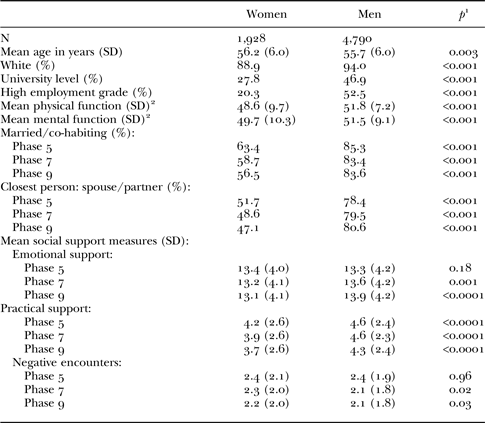
Table 1 presents the characteristics of the analysis sample by gender. Compared to men, women were slightly older and more likely to be ethnic minorities. Women were also much less likely to have a university education or be employed in a high-grade job, and also showed lower physical and mental functioning scores than their male counterparts. The majority of men were married or co-habiting at each phase of the study. In contrast, only half of the female participants were married or co-habiting by Phase 9. Most men nominated their spouse or partner as their closest person and the percentage of this nomination gradually increased over phases, whereas the opposite trend showed in their female counterparts. Gender differences were apparent in the raw scores of each support type over time. The average levels of emotional support increased for men but decreased for women. Women also reported significantly lower levels of practical support than men, but higher levels of negative encounters, except at the first phase of the study.
Sample description by gender

Notes: N = 6,718. SD: standard deviation. 1. Value for heterogeneity. 2. Functioning score range = 0–100, mean = 50, higher score indicates better function.
Probability of stability and change in the identity of the closest person
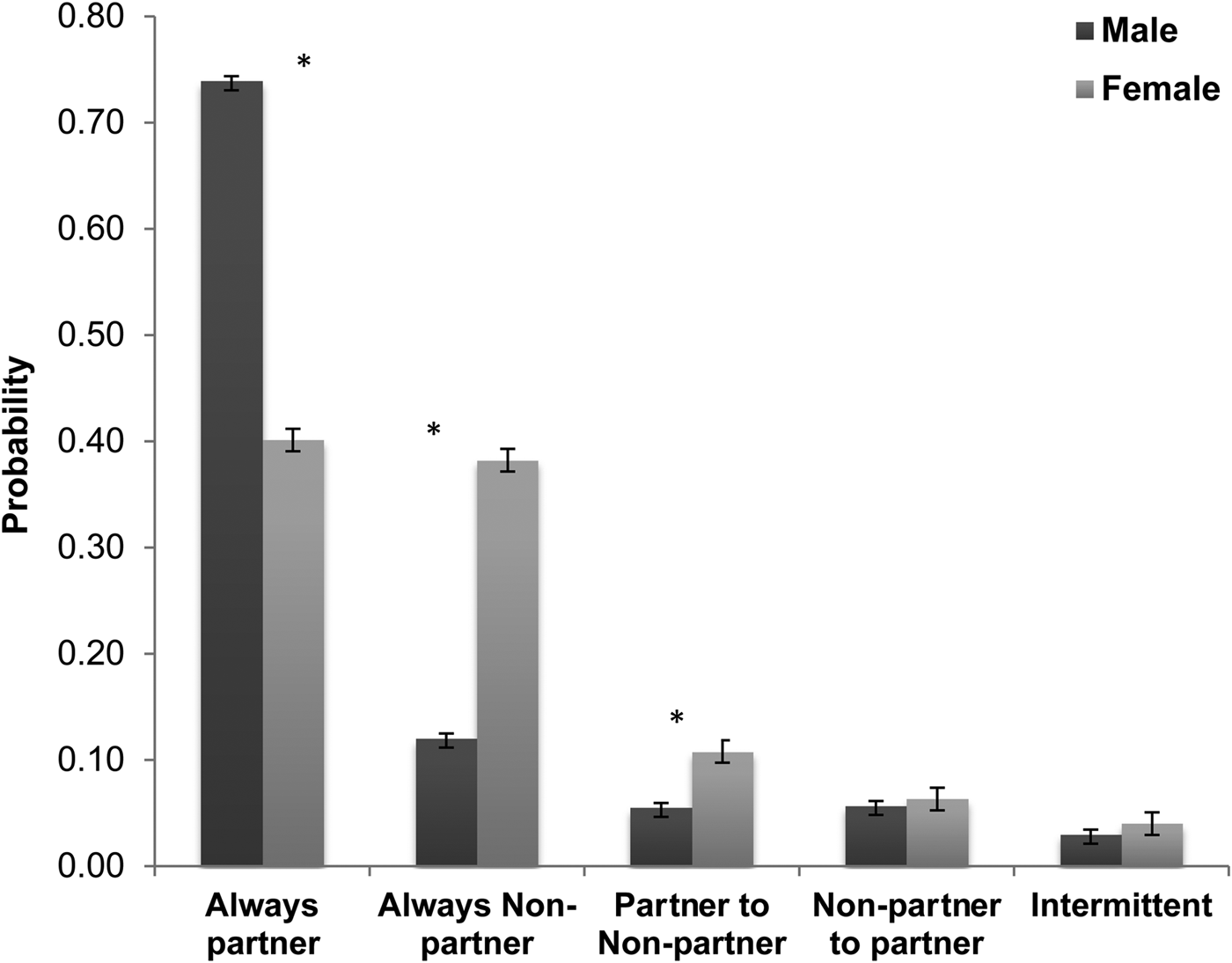
Figure 1 illustrates the gender-specific probabilities of stability and change in the identity of the closest person adjusting for variations in marital status, socio-demographic circumstance and health status. Over the ten-year follow-up, 74 per cent of men always nominated their partner as the closest social partner in comparison with 40 per cent of women. In contrast, similar to our hypothesis, women were substantially more likely to always nominate a non-partner as the closest person, and nearly twice as likely as men to change their nominated closest person from a partner to a non-partner.
Gender-specific probability of stability and change in close relationships, conditional on socio-demographic and health status.

Gender-specific trajectories of support from the closest relationship
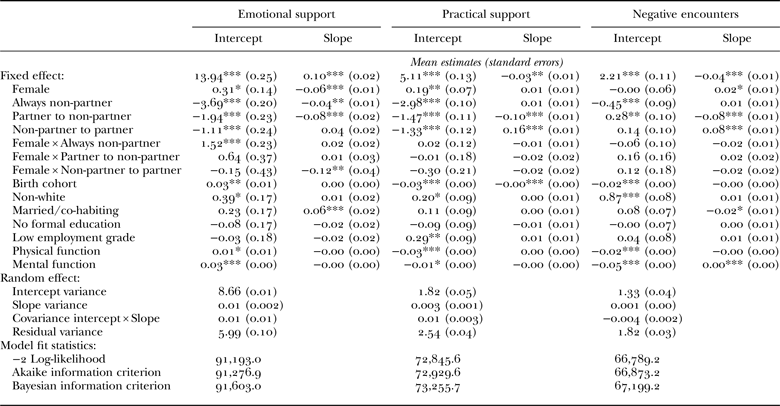
Table 2 provides the parameter estimates for gender differences in the age-based trajectories of support, taking into account the stability and change in close relationships. Consistent with our hypothesis, although the estimated mean level of emotional support at age 60 was higher in women than in men, this gender difference in emotional support became smaller as respondents aged (female × age = −0.06, standard error (SE) = 0.01). On the other hand, compared to men, women showed a similar rate of decline in practical support (female × age = 0.01, SE = 0.01) and a slightly more gradual decline in negative encounters (female × age = 0.02, SE = 0.01).
Mean estimates for multi-level models of support from close relationships, 1997–2007

Note: Mean estimates are in reference to aged 60 (intercept), male, white, always nominated partner as the closest person, had a university degree and in a high employment grade.
Implications of change in identity of the closest person on support trajectories
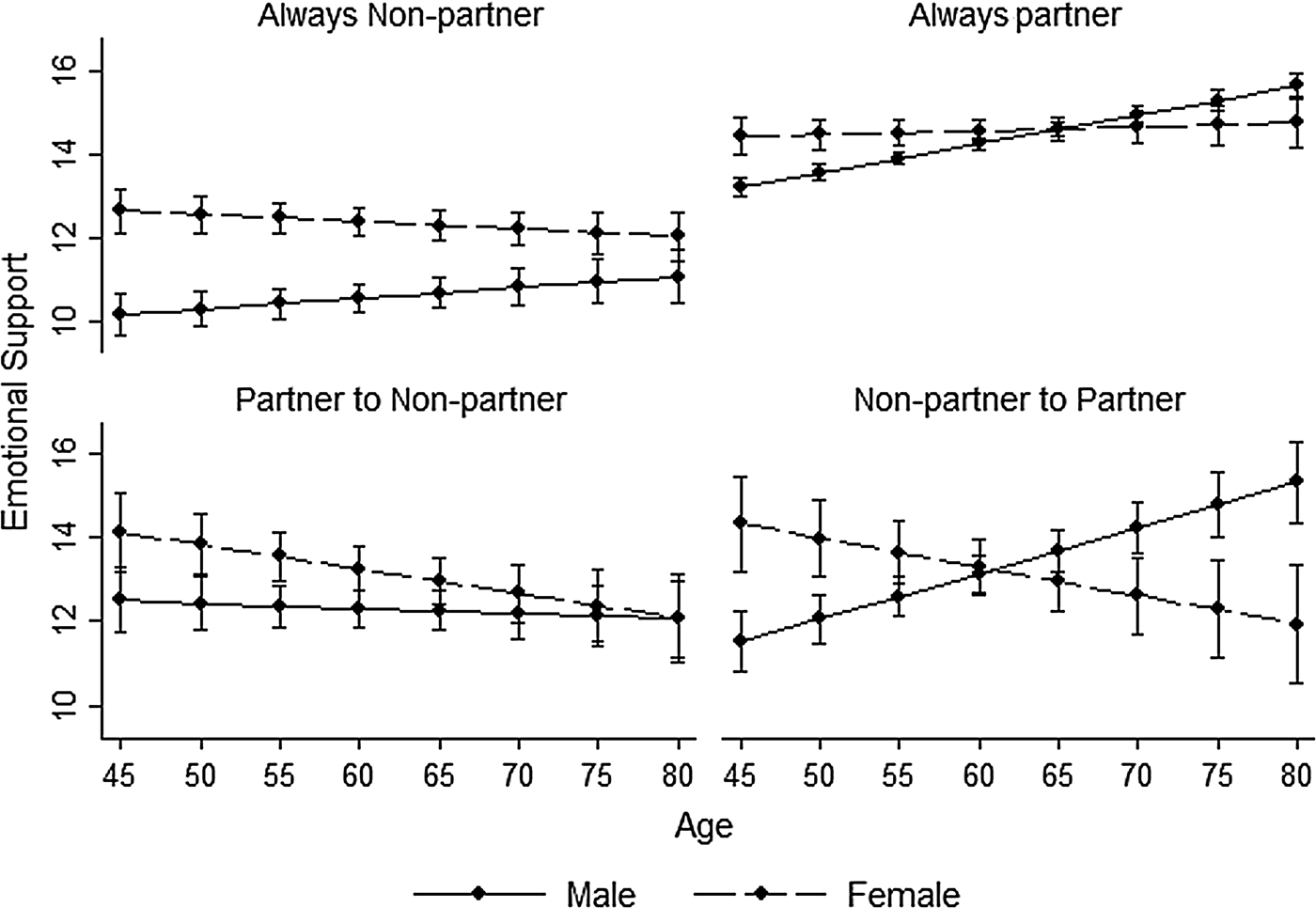
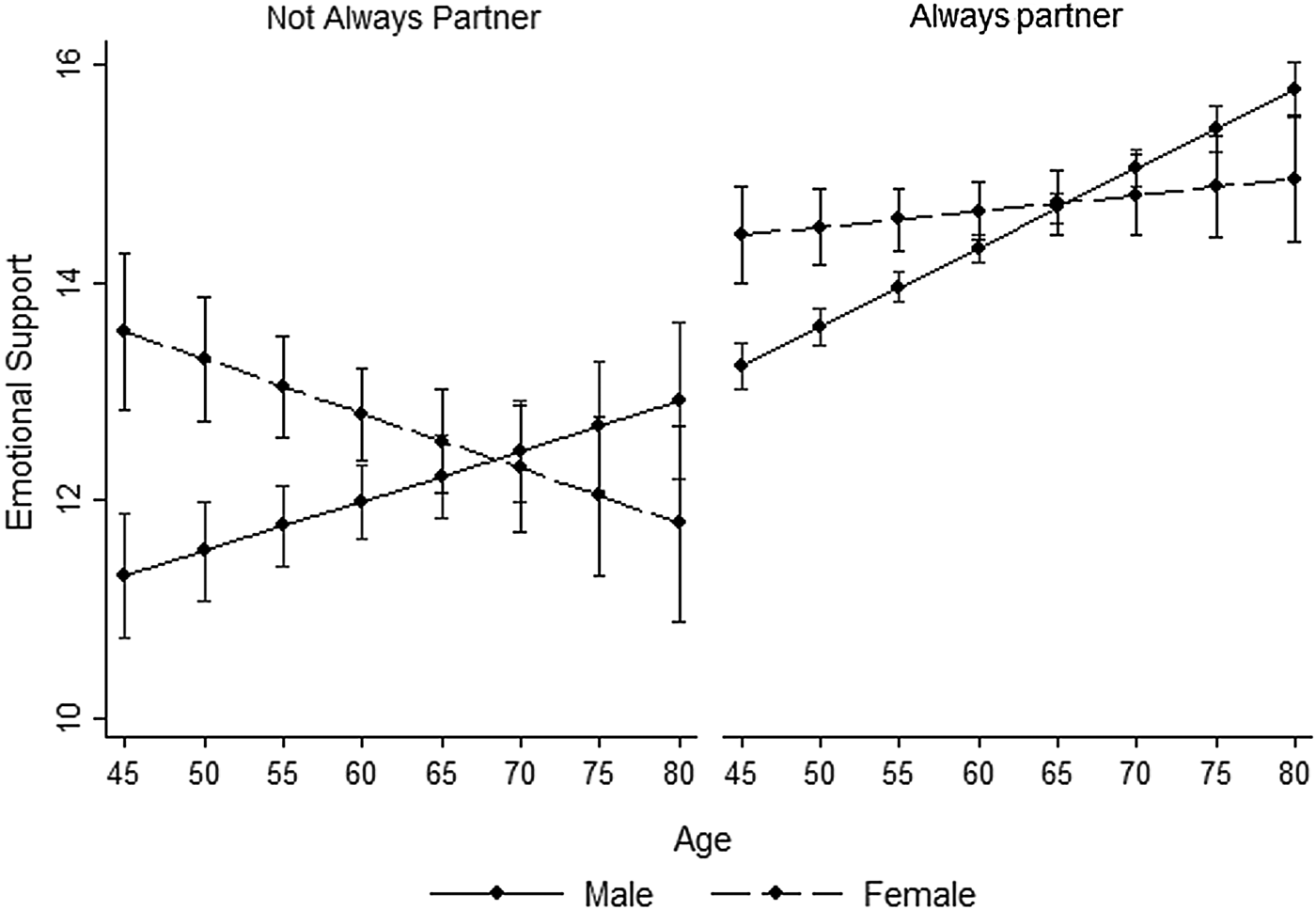
Table 2 also shows the parameter estimates for the effect of change in the identity of the closest person on support trajectories. Compared to participants who always nominated their partner, the levels of both emotional and practical support were lower and negative encounters were higher for those who switched from identifying a partner to a non-partner as their closest person. In contrast, switching from a non-partner to a partner was associated with both increased practical support and negative encounters. However, only the effect of change in the closest person on the trajectory of emotional support varied by gender, as illustrated in Figure 2. In contrast to our hypothesis, for men, emotional support increased with age in all categories except for those whose closest person shifted from their partner to a non-partner. For women, emotional support remained stable for those who consistently nominated the same closest person, but decreased markedly amongst those who changed whom they identified as their closest person.
Gender-specific emotional support trajectories (range 0–21) by stability and change in close relationships, controlled for ethnicity, birth cohort, education, employment grade, health status and time-varying marital status.

Supplementary analysis
Because women in this occupational cohort were much less likely than men to be married, we re-examined these gender patterns in the closest person identities and age-trajectories of support in a sub-sample of participants who were continuously married over follow-up (N = 4,717). Married men were more likely than married women to nominate a spouse as their closest person (89.7% versus 72.4%). The gendered pattern in trajectories of emotional support held in this sub-sample (Figure 3). Among all married men, emotional support increased with age, regardless of whether or not the closest person was their spouse. For married women, emotional support decreased dramatically for those who did not nominate their partner as their closest person.
Gender-specific emotional support trajectories (range 0–21) by source of close relationships among always married participants, controlled for ethnicity, birth cohort, education, employment grade and health status.

Discussion
In this study we examined gender differences in perceived support from older adults’ closest relationships. We found women to be less likely than men to nominate their partner as their closest person, and more likely to switch their nomination as they age. Only trajectories of emotional support varied by gender, with men reporting age-related improvements while women remained stable in emotional support from their closest relationships. Switching to a non-partner from a partner ameliorated negative encounters, but was accompanied by decreased emotional and practical support. Switching from a non-partner to a partner benefited practical support, but at the cost of increased negative encounters. Change in the closest person was largely detrimental to emotional support for women but not for men.
Gendered stability and change in the closest person
Our study is the first, to our knowledge, to examine the implications of change in the identity of whom one feels closest to over time. Consistent with previous cross-sectional studies of gender differences in close social relationships (Antonucci, Birditt and Ajrouch Reference Antonucci, Ajrouch and Birditt2013), we found men to be more likely than women to nominate their spouse as their closest person. Our longitudinal analysis further indicates that male participants are also less likely to change their nomination over the ten-year study period. This finding is in accordance with both theories on change in social relationships. As the social convoy model would suggest, this was in part due to differences in characteristics of the person and situation (Ajrouch, Blandon and Antonucci Reference Ajrouch, Blandon and Antonucci2005). Men were more likely than women to remain married during the study period, and women's higher chance of loss of a spouse may result in a higher percentage of change in the closest person from a partner to a non-partner. However, this gender difference persisted through old age and also applied to those who remained continuously married. Through the lens of socio-emotional selectivity theory, this finding is in line with the interpretation that change in close social relationships reflects a process of intentional selection for rewarding relationships (Carstensen, Fung and Charles Reference Carstensen, Fung and Charles2003). Previous studies reveal that men may derive more benefits from marriage than women do (Cohen Reference Cohen2004; Shye et al. Reference Shye, Mullooly, Freeborn and Pope1995; Umberson Reference Umberson1992), getting more spousal support (Coventry et al. Reference Coventry, Gillespie, Heath and Martin2004), control of health behaviours (Umberson Reference Umberson1992), and feeling less lonely and better protected in a stable relationship (Cavallero, Morino-Abbele and Bertocci Reference Cavallero, Morino-Abbele and Bertocci2007). Our study indeed showed that male participants reported receiving more practical support from their closest person at baseline than their female counterparts did. Thus, the stability in men's and change in women's closest social relationships may indicate motivational shifts to maximise emotional pay-offs.
Gender-specific trajectories of emotional support from close relationships
Our findings also demonstrate that age-related changes in support from close relationships are more pronounced among older men than women. Corresponding to findings reported by Shaw et al. (Reference Shaw, Krause, Liang and Bennett2007), we found gender differences in the levels of perceived emotional support narrowed with age. This trend was driven by a substantial age-related increase in emotional support for men only. There was also evidence to suggest that age-related declines in negative encounters were slightly greater for men than women. Taken together, our results suggest that men generally benefit from the social experiences of ageing, characterised in other studies by a greater family focus for men (Arber, Davidson and Ginn Reference Arber, Davidson and Ginn2003), and evidenced by convergence in gendered perceptions of social support (Coventry et al. Reference Coventry, Gillespie, Heath and Martin2004). Although men perceived more practical support at baseline than women, the trajectories of support did not vary across gender. Further, for both men and women, we observed a decline rather than increase in the level of practical support, contrary to other studies on older adults (Martire et al. Reference Martire, Schulz, Mittelmark and Newsom1999; Shaw et al. Reference Shaw, Krause, Liang and Bennett2007). This divergence from previous evidence on trajectories of practical support may be due to differences in age composition and participant characteristics of the present cohort. It has been suggested that age 75 could be assumed as the threshold when declines in social integration start (van Tilburg Reference van Tilburg, Carr, Crosone, Hughes and Pienta2009). Compared to previous research (mean age over 73 years) (Martire et al. Reference Martire, Schulz, Mittelmark and Newsom1999; Shaw et al. Reference Shaw, Krause, Liang and Bennett2007), the Whitehall II participants were relatively young (mean age was 66 years at the last study observation, Phase 9) and healthy, and therefore may have been in less need of practical support.
Impacts of change in the closest person on support trajectories in men and women
Our study further examined implications of change in close social relationships on these gendered support trajectories. An open question in research on social support in older adulthood has been whether managing close relationships is a detriment or benefit to perceived social support (Rook Reference Rook2009). Change in the identity of older adults’ closest person may reflect intentional selection, but could also represent an adaptation to loss. We found, for both men and women, that the switch from nominating a partner to a non-partner as the closest person was associated with a decline in both emotional and practical support, which suggests that feelings of support from a partner are not easily replaced. However, consistent with the proposal that avoiding negative relationships drives socio-emotional processes (Carstensen, Fung and Charles Reference Carstensen, Fung and Charles2003), switching from a partner to a non-partner was followed by decreases in negative encounters. Previous research suggests that negative encounters are more harmful than support is beneficial (Akiyama et al. Reference Akiyama, Antonucci, Takahashi and Langfahl2003). Identifying the long-term consequences of trading out the positive in favour of fewer negative interactions is an important avenue for future research.
The impact of changing the closest person on trajectories of social support was largely consistent across gender, except for emotional support. In contrast with our expectations, women fared worse than men in the context of nominating a new closest person. This finding is especially surprising in light of a large body of research that shows women to have broader social networks, be more active in managing relationships and more forthright with their emotions (Boerner et al. Reference Boerner, Jopp, Carr, Sosinsky and Kim2014; Carstensen, Gottman and Levenson Reference Carstensen, Gottman and Levenson1995). Perhaps this finding is indicative of depletion in available social resources for older women (Ajrouch, Blandon and Antonucci Reference Ajrouch, Blandon and Antonucci2005; Gray Reference Gray2009). Studies previously showed that higher socio-economic positions (e.g. higher employment grade, higher education attainments) confer greater opportunities for individuals to form diverse social ties beyond their immediate kin (Ajrouch, Blandon and Antonucci Reference Ajrouch, Blandon and Antonucci2005; Shaw et al. Reference Shaw, Krause, Liang and Bennett2007), the effect of which seemed to be more pronounced in older men than in older women (Ajrouch, Blandon and Antonucci Reference Ajrouch, Blandon and Antonucci2005). This may be particularly evident for this sample of retired white-collar women who may have dedicated less time to family and friends while they were working (Stringhini et al. Reference Stringhini, Berkman, Dugravot, Ferrie, Marmot, Kivimaki and Singh-Manoux2011). As for men, our findings are in agreement with the existing evidence that men with stable partnerships were in the most advantaged position (Curran, McLanahan and Knab Reference Curran, McLanahan and Knab2003), presenting the highest initial level of emotional support which increased steadily with age. The marked improvement of emotional support in men who changed close social ties from a non-partner to a partner may imply the benefits of being in a partnership for men (Cavallero, Morino-Abbele and Bertocci Reference Cavallero, Morino-Abbele and Bertocci2007; Chipperfield and Havens Reference Chipperfield and Havens2001; Cohen Reference Cohen2004).
Study limitations
Several limitations of the current study should be considered when interpreting the findings obtained in this study. One limitation is the use of self-reported measures of social support, which may be influenced by respondents’ personality traits (Stansfeld and Marmot Reference Stansfeld and Marmot1992). Subjective experience, however, reflects individual interpretation of their social environment. Derived from a well-established questionnaire (Stansfeld and Marmot Reference Stansfeld and Marmot1992), these self-rated measures are relevant indictors of social support that have established association with different health outcomes (Kouvonen et al. Reference Kouvonen, Stafford, De Vogli, Shipley, Marmot, Cox, Vahtera, Väänänen, Heponiemi and Singh-Manoux2011; Liao et al. Reference Liao, Head, Kumari, Stansfeld, Kivimaki, Singh-Manoux and Brunner2014). Second, these measures of perceived support refer to the closest person only, thus we were unable to investigate changes in social support in a more extended social network. Despite considerable consistency across different relationships (Akiyama et al. Reference Akiyama, Antonucci, Takahashi and Langfahl2003; Krause and Rook Reference Krause and Rook2003), it should be noted that trajectories of support derived from different types of social relationships may be source-specific (Coventry et al. Reference Coventry, Gillespie, Heath and Martin2004). Third, as the Whitehall II cohort is comprised predominantly of white-collar civil servants, their social relationships may function differently, on average, from those in less-affluent socio-economic positions (Krause and Borawski-Clark Reference Krause and Borawski-Clark1995). Women in this occupational cohort were less likely to be married and have a child than women in the general population or their male counterparts (Stringhini et al. Reference Stringhini, Berkman, Dugravot, Ferrie, Marmot, Kivimaki and Singh-Manoux2011) due to gender segregation in the workplace (Blake Reference Blake2003). Nevertheless, our cohort covers a wide occupational spectrum with salary difference more than ten-fold between the top and bottom of the socio-economic hierarchy. Consistent gender patterns were obtained from the restricted sample with married participants only, suggesting that differences in marital status do not confound these gendered age-trajectories of emotional support.
Through identifying gender-specific trajectories of support from close relationships over middle to early old age, this study contributes to the understanding of how social relationships evolve with age, showing more pronounced socio-emotional selectivity in men than in women. A comprehensive understanding of social relationship transitions in late adulthood may inform intervention programmes aimed at preventing social exclusion amongst our growing elderly population.