“An eight-pound baby is worth, at birth, $362 a pound. That is a child's value as a potential wealth-producer. If he lives out the normal term of years, he can produce $2900 more wealth than it costs to rear him and maintain him as an adult. The figures with regard to earning capacity are given by Irving Fisher, Professor of Political Economy.” Thus opens a page-long article in the New York Times on January 30, 1910. The title of the article was “What the Baby is Worth as a National Asset: Last Year's Crop Reached a Value Estimated at $6.96 Billion.”Footnote 1
While talk of baby crops and their price per pound was a bit extreme for the Progressive Era, the money valuation of varying aspects of everyday American life was far from uncommon.Footnote 2 It is also not unusual that the author of this piece got his price data from Yale economist Irving Fisher. Praised by Joseph Schumpeter as “the greatest economist the United States ever produced” and remembered fondly today by both liberal and conservative economists as the founding father of modern-day, mathematical “neoclassical” economics and monetarist theory, Fisher was also a serial progressive reformer and a walking statistical repository who rarely met a social problem he did not price.Footnote 3
While largely overlooked by historians of the Progressive Era—perhaps because he did not fit their preconceived notion of what a progressive reformer should be—Fisher was tremendously influential and a well-known figure in his day. As a New York Times contributor, best-selling author, health fanatic, public intellectual, “hygiene” expert, social reformer, economic forecaster, statistical wizard, indefatigable politico, and all-around progressive pundit, Fisher stood at the heart of the cultural and intellectual development one might coin the pricing of progressivism.Footnote 4 It was Fisher who first brought mathematical models into American economic departments by offering a neoclassical theory of marginal utility that claimed that market prices reflected subjective value. And it was Fisher, perhaps more than any other American, who formalized, legitimized, and popularized the use of price statistics in progressive political discourse, teaching the American people that if they wanted to argue over the nature of progress or the worthiness of a certain reform, they would have to price it first.Footnote 5
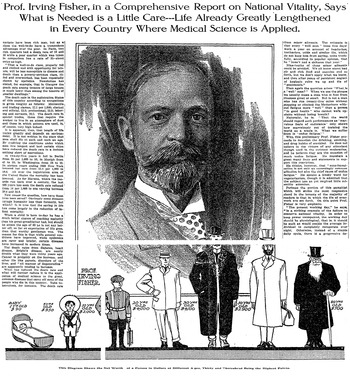
Fisher had compiled the price data cited by the New York Times article as part of his lobbying campaign for a National Health Department and the federal regulation of public health. These calculations first appeared in Theodore Roosevelt's National Conservation Commission after Fisher convinced the president that his commission should include a report on “national vitality” that would deal not only with the conservation of natural resources but human ones as well. It was in this report that Fisher methodically capitalized the American people at different ages by pricing their future income streams and discounting their future costs. Implementing the logic of cost–benefit analysis long before it became officially institutionalized by the Army Corps of Engineers in the 1930s, Fisher concluded that government reforms to improve public health were a good economic investment: the American baby was worth saving for he was worth 90 dollars more than he or she cost, a five-year-old 950 dollars, the average American $2900. Aggregating together people of all different ages and capitalizing their income flows into stocks of wealth, Fisher concluded that “our population may be valued as assets at more than $250,000,000,000” (Fig. 1).Footnote 6
An image in the New York Times depicting Irving Fisher and his pricing of American people at different ages. New York Times, March 5th, 1911.

Fisher's treatment of the American people as human capital found a willing audience in President Roosevelt, an avid supporter of the Progressive Era's efficiency movement. “Our national health is our greatest national asset,” Roosevelt wrote to Fisher in an open letter following the report, “to prevent any possible deterioration of the American Stock should be a national ambition.”Footnote 7
Fisher did not lack in such ambition. He would spend the next thirty years using similar price statistics to prove the viability of his countless reform initiatives, many of which appeared in his best-selling book How to Live, which went through ninety editions and sold nearly half a million copies. As president of the Committee on War-Time Prohibition, he argued that outlawing alcohol would “improve economic efficiency,” “speed up production probably at least ten percent,” and save American society $2 billion a year. In a groundbreaking cost–benefit analysis of tuberculosis, Fisher estimated that the annual social cost of the disease stood at $1.1 billion. Public health insurance, he argued, would save a whopping $3 billion a year, while treatment of the “insane and the feeble minded” cost the American economy $85 million a year.Footnote 8
The last statistic hints at Fisher's interest in eugenics, and it should come as no surprise that Fisher's interest in improving the market productivity of American bodies led him to become the first president of the American Eugenics Society. During his tenure as president, the society used price data as propaganda. At one eugenics “fair,” a light-blinking machine informed onlookers: “this light flashes every 15 Seconds. Every 15 Seconds $100 dollars of your money goes for the care of persons with bad heredity such as the insane, feeble-minded, criminals and other defectives.”Footnote 9
There are countless ideological strands that can be culled from Fisher's pricing of progressivism. There is his capitalization of the American body long after slavery and the chattel principal had ended; his use of cost–benefit analysis as the central arbiter of social policy and resource allocation; his equating of American progress with the increased growth of market productivity; his emphasis on society's overall wealth as opposed to its unequal distribution. While this article will touch on all of these issues, it will mostly focus on the most basic assumption that undergirds Fisher's pricing of progressivism: his implicit contention that units of money could serve as the basic measure of value, well-being, and progress.
As we shall see, in order for Fisher to infuse prices with such evaluative meaning he first had to construct a mathematical market model of human subjectivity and social power that made an assortment of radical assumptions regarding the relationship between individual agency and rational choice on the one hand and history, culture, custom, and coercion on the other. These models have become the cornerstone of American neoclassical economics. As economist James Tobin has noted, “much of standard neoclassical theory today is Fisherian in origin, style, spirit and substance.” While such neoclassical notions of market subjectivity remained somewhat marginal in Fisher's day, since the 1980s they have taken over large swaths of American social thought, legal theory, public policy, and mainstream economic discourse. More generally, such market approaches to self and society are often referred to today as “neoliberalism.”Footnote 10
In light of such a significant intellectual legacy, it seems imperative that intellectual historians of the Progressive Era—the age in which neoclassical economics, the pricing of progressivism, and neoliberal theories of market subjectivity first emerged—turn their attention away from the usual suspects of this period, such as Pragmatists William James and John Dewey, and shift their analytical focus onto thinkers such as Irving Fisher—a man they have long ignored. Fisher's almost complete absence from the progressive canon is striking, but it is not terribly surprising. Embraced, celebrated, and extolled by both Chicago School's Milton Friedman as well as Keynesians Paul Samuelson and Paul Krugman, Fisher defies the conventional narrative, still very much present today, which pits pro-government liberals against free-market conservatives. A mathematical economist who once built an actual hydraulic model of a perfectly equilibrating free market—yet also a leading progressive reformer who fiercely advocated for a government health care plan that would make Obamacare blush—Fisher complicates such a crude political binary as he is impossible to pigeonhole into the “statist-liberalism/laissez-faire-conservatism” dichotomy that has remained a historiographical staple since the days of Arthur Schlesinger.Footnote 11
Be it with adulation or criticism, American historians have done wonderful work tracing the origins of the “New Deal Order” and the liberal state back to the Pragmatist birth of the Progressive Era “social self.” But the New Deal Order has been dead for close to half a century now, and there is a second intellectual thread that needs to be pulled out of the Progressive Era: one that involves examining not the rise of a “Metaphysical Club” but rather a neoclassical one. This Neoclassical Club (Fisher may have led the charge but he was no lone wolf) argued not for an “associated life” in which individuals are shaped by the myriad of social forces around them, but rather an atomized, ahistorical, “Robinson Crusoe” understanding of human subjectivity. By portraying man as an isolated, fully autonomous, utility-maximizing island in a sea of hyper-rational, classless market exchange, Fisher believed than people could be ripped out of their social setting and abstracted (and priced) into a mathematical model or cost–benefit formula. Like most progressives, he rejected laissez-faire and believed in top-down, expert-based government reform based on quantitative bureaucratic principles. That said, unlike many other progressives, his reform agenda was nevertheless predicated on a belief that society was nothing more than a series of market transactions. Follow this Progressive Era thread of thought through the twentieth century, and it leads not to the New Deal, postwar liberalism, or the welfare state but rather the Federal Reserve, cost–benefit analysis, and the neoliberal pricing of the American people—babies and all.Footnote 12
THE MARGINALIST REVOLUTION
In the 1870s, in a span of a few years, three separate economists in three separate European countries unknowingly offered up a very similar and rather novel theory of economic value that was based not on an objective labor theory of value but rather on the subjective principal of marginal utility. According to these disparate thinkers, classical economists such as David Ricardo, Karl Marx, and John Stuart Mill had been mistaken: the price of a good was not determined by the tangible amount of labor required to produce it. Rather, these neoclassical economists believed value was subjective: the price of any good was set by how much people were willing to pay for it, which, in turn, was determined in large part by the marginal or final increment of utility one derived from consuming it. This principal of diminishing marginal utility opened the door to the first mathematical economic models in history since these small, minute changes in utility could only be conceived in mathematic terms as a derivative through the use of differential and integral calculus.Footnote 13
Don't, however, let the math fool you. Like all economic models, the neoclassical theory of marginal utility was not an empirical study of human behavior but rather a constructed narrative of how people act. It was a story. Since Fisher was a wonderful storyteller, capable of turning complex math into digestible and commonsense ideas, we will give him the honors of explaining marginal utility:
A housewife buys (say) 10 lbs. of sugar at 10 cents per pound. As she closes the bargain she roughly estimates that the last or tenth pound is about worth its price. She did not stop at five pounds for she wanted a sixth more than the 10 cents it cost her.Footnote 14
A rational, calculating housewife—the gendered aspects of Fisher's choice must be pursued further—purchases sugar until the marginal utility she receives from a commodity aligns with its market price. Instantaneously balancing the money cost of sugar with its utilitarian benefit to her family, the housewife fills her shopping cart until equilibrium has been reached between the market price and her own marginal utility. Simple, logical, relatable, and loaded with tacit assumptions regarding human subjectivity, this is vintage Fisher.
Neoclassical economics, however, was far from an immediate hit. In fact, when a young Irving Fisher turned to mathematical economics in his doctoral dissertation in the early 1890s, it was a nascent discipline in crisis due to one major weakness. Utility, that crucial concept which stood at the heart of the marginal revolution, seemed to be utterly immeasurable. Ironically, the very economic thinkers who were pushing for a quantifiable, mathematical economics had developed a concept that, unlike labor time, could not be measured empirically. “But what is the unit of utility?,” the Encyclopedia Britannica wondered in 1885. “If we cannot look for something more tangible—not to say more serviceable—than this, there is not much encouragement to pursue such researches, which will in fact never be anything more than academic playthings.”Footnote 15
The harsh criticisms hurled at the idea of marginal utility were not lost on the economists who had invented it. British economist Francis Edgeworth came to the conclusion that if mathematical economics were to have a future, utility must become an empirical, measureable unit. In his Mathematical Psychics written in 1881, Edgeworth solved this troubling issue by imagining a “hedonimeter,” a machine that would allow one to measure subjective pleasure and pain. “Imagine an ideally perfect instrument, a psychophysical machine, continually registering the height of pleasure experienced by an individual,” Edgeworth dreamed, “from moment to moment the hedonimeter varies; the delicate index now flickering with the flutter of passions, now steadied by intellectual activity … ”Footnote 16
While Edgeworth's “hedonimeter” was clearly an attempt to legitimize the scientific rigor of marginal utility theory, the fact that such a machine was far from becoming a reality ended up only weakening the marginalists' professional standing even more. Likely hinting at Edgeworth's machine, the Encyclopedia Britannica's entry concluded that the “mathematical method” was “necessarily sterile” because “the fundamental conceptions on which the deductions are made to rest are vague, indeed metaphysical, in their character.” Edgeworth, it appears, had only made things worse. It was at this moment, that a precariously young Irving Fisher entered the debate.Footnote 17
“Mathematical economists,” Fisher noted in the preface of his Yale dissertation, “have been taunted with the riddle: what is a unit of pleasure or utility?” For the confident Fisher, however, this was but a rhetorical question. As he explained in the following sentence, he had, in fact, solved the puzzle. “I have always felt that utility must be capable of a definition which shall connect it with its positive or objective commodity relations.” Utility, Fisher went on to explain, could be empirically measured, albeit indirectly, through the observation of market transactions. While measuring actual pain and pleasure was impossible, it was also unnecessary. Since consumers purchased goods until their marginal utility aligned with price (as we saw in the housewife example), money could serve as the basic unit of value measurement. Like tea leaves of human aspiration, prices could reveal humanity's wants and desires. “The concept of value is made to depend on that of price,” Fisher wrote in his 1911 textbook, going on to add in a later chapter that “prices are determined by the actual desires of men.”Footnote 18
Fisher had not been the first to think of this idea. In his groundbreaking Theory of Political Economy written in 1871, William Stanley Jevons, one of the three aforementioned marginalist revolutionaries, pretty much made the same point:
We can no more know nor measure gravity in its own nature than we can measure a feeling; but, just as we measure gravity by its effects in the motion of a pendulum, so we may estimate the equality or inequality of feelings by the decisions of the human mind. The will is our pendulum, and its oscillations are minutely registered in the price lists of the markets.Footnote 19
Such a hedonistic approach to human behavior, however, was challenged throughout the 1870s and 1880s by some of the leading British thinkers of the day, including Henry Sidgwick and Charles Darwin.Footnote 20 These men shared the same general objection to such theories of market subjectivity as later American Pragmatists. Who said that people make decisions based solely on the pleasure they will derive from their actions? What about other social forces such as custom, habit, or coercion? What determines people's tastes and preferences in the first place? Can one really insulate the individual from the social? With such questions in mind, Fisher offered a solution to this critique by submitting his own ontological “postulate” of human subjectivity:
The plane of contact between psychology and economics is desire. It is difficult to see why so many theorists endeavor to obliterate the distinction between pleasure and desire. No one ever denied that economic acts have the invariable antecedent, desire. Whether the necessary antecedent of desire is “pleasure” or whether independently of pleasure it may sometimes be “duty” or “fear” concerns a phenomenon in the second remove from the economic act of choice and is completely within the realm of psychology. We content ourselves therefore with the following simple psychoeconomic postulate:
Each individual acts as he desires. Footnote 21
This is a radical theory of subjectivity and selfhood. By suggesting that economists need not bother themselves with how preferences are created, shaped, or determined, Fisher had ripped human subjects from the fabric of their lives and reimagined them as fully individual, autonomous, atomized, and preexisting beings with a certain set of wants and desires that should simply be taken as a natural given. Each individual acts as he desires. Fisher's theory did not explore how social class, economic environment, or past cultures shaped and made individuals. In one short paragraph, he managed to erase both history and society from the study of economics. Gone, also, were all aspects of coercion. In Fisher's model there is no such thing as power, that social relation in which one imposes his or her will on the other. Each individual acts as he desires. In this very era, William James was suggesting that consciousness was “a kind of external relation.” John Dewey was arguing that “individuality is not originally given, but is created under the influences of associated life.” Thorstein Veblen was lamenting the fact that economics was not an evolutionary science in which individual agents would be seen as part of a greater historical whole. Irving Fisher was saying precisely the opposite.Footnote 22
But was not Fisher simply articulating the already existing arguments of classical economics? No, he was not. For all the individualizing impulses that existed in classical economics since the time of Adam Smith, their approach to society looked nothing like this. In The Wealth of Nations, for example, Smith's theory of value is founded on three principal actors: laborers who earn wages, landlords who earn rent, and capitalists who earn profits. Together, these three income streams make up the price of any object. Say what you will about how Smith may have legitimized certain exploitative social relations, his theory of value was still based on social relations. Social position and economic circumstance (for instance, whether one inherited land or owned the means of production) were central to his narrative, as well as those of all other classical economists.Footnote 23
In Fisher's economic theories, however, there is no notion of social relations or class or power or culture. There are only homogenous and autonomous individuals floating around ahistorical space voluntarily reaching contractual and mutually beneficial agreements of exchange with other autonomous individuals as they rationally calculate how many pounds of sugar they should buy in accordance with their preexisting utility preferences. Where do these utility preferences come from? Why does the housewife have such a sweet tooth? No need to explore that, according to Fisher, it is—to use the parlance of modern-day economists who followed Fisher's lead—“exogenous to the model.” Each person acts as he desires.
Fisher's approach to human subjectivity became a cornerstone of his economic modeling. The theory appears again, for instance, a few years later when Fisher sought to explain in his undergraduate textbook why some people end up capitalists while other wage laborers. According to Fisher, your social position vis-à-vis the means of production was determined by “human nature” and your own subjective, inherent, and preexisting time preferences:
Let us suppose that through some communistic or socialistic law, the wealth in the US were divided with substantial equality. It is proposed to show that this equality could not long endure. Differences in thrift alone would reestablish inequality. We cannot suppose that human nature could be so changed and become so uniform that society would not still be divided into “spenders” and savers.”… If two men have to start with the same income of 1000 a year, but one has a rate of impatience above the market rate of interest and the other has a rate below, the first will continue to get rid of future income for the sake of its equivalent in immediate income, and the other to do exactly the opposite.Footnote 24
Notice how in Fisher's narrative, people and society begin to look a lot like his unit of measure—money. Money is the ultimate homogenizer and leveler as exchange value flattens all of the hills and valleys of life, transforming them all into commensurable units of measure. The same can be said of the actors in Fisher's model as there are no laborers, capitalists, or rentiers—just flattened, homogenous, utility-maximizing consumers with inherent preferences (“savers” vs “spenders,” “rate of impatience”) we can observe but not explain, measure but not unpack.Footnote 25
In the above passage we also begin to see the ideological power of neoclassical economics. By erasing the class relations inherent in owning (or not owning) the productive property, Fisher's model painted a meritocratic picture of the United States in which the destiny of each man was determined only by his own choices and preferences. Do not blame social institutions or the inequities of wealth distribution for your economic problems, Fisher argued; blame yourself and your irresponsible rate of impatience above the market rate of interest.Footnote 26
Such a political message suited Fisher, who once referred to socialism as “the red flag of class war” and loathed both labor unions and agrarian Populists. In Fisher's radically abstract and homogeneously classless model of society, where labor could technically hire capital just as easily as capital hired labor, corporate profits did not stem from monopoly privileges or the exploitation of laborers—common accusations in the politically rambunctious 1890s—but rather from a firm's ability to supply consumers with the products their fully autonomous, utility-maximizing minds desired. As Fisher wrote to his brother around the time of his dissertation, the astronomical explosion in railroad profits came not from the asymmetrical power relations between capitalist and farmer but rather simply because the railroad's “usefulness to farmers in conveying wheat was immensely increased.”Footnote 27 By equating market price with subjective value, therefore, Fisher had created a functionalist logic that legitimized the capitalist status quo. If a corporation was raking in the money, it must be because it was increasing the utility of society. Over a hundred years later, Harvard economist Gregory Mankiw would make the same argument to legitimize the enormous income inequality in the United States in an article titled “Defending the One Percent.”Footnote 28
In a similar vein, Fisher's cost–benefit analyses also legitimized the interests of capital while hushing the cries of labor. They did so by consistently skirting the prickly issue of economic distribution. Fisher's $90 dollar baby calculations—much like his neoclassical models—depoliticized economic discourse by focusing exclusively on the overall size of the economic pie, but not how it was actually sliced. While Fisher did on rare occasion examine income inequality, in all of his cost-benefit analyses he would carefully price the productivity benefits of a given reform but never would he calculate who exactly was reaping the monetary rewards of such increased market efficiency. This was no coincidence. Referring to socialist or left-leaning economic thinkers as a “cult,” he believed that such theories “start with a false premise: namely, that the problem of economic mass welfare is primarily one of distribution whereas, in my opinion it is primarily one of production.”Footnote 29
Fisher's radical theory of market subjectivity was also shaped by his yearning to transform economics into an empirical and quantitative science that would be based not solely on deductive logic but also inductive data. As Schumpeter eulogized, “throughout and from the start, Fisher aimed at a theory that would be statistically operative.”Footnote 30 Fisher took on the thorny problem of utility measurement head-on in his dissertation, therefore, because he recognized that a mathematical, empirical economics would only thrive if there were a quantifiable and observable unit of measure. “In all mathematical sciences,” an aging Fisher would later declare, “the first essential is a unit for measurement.”Footnote 31
This first essential helped push Fisher to put forth a radical theory of human subjectivity that would allow him to link utility, value, and price. If prices were to become a convincing measure of utility, imbued with real subjective meaning, Fisher had to assume that market choices reflected inherent desire. Fisher erased history and society, therefore, in part because ideas of custom or coercion or class or institutional change would have disrupted the notion that people simply purchase what they want. Such a decoupling of utility, desire, price, and value would have been mathematically devastating as it would have pulled the empirical rug right out from under Fisher's precious price statistics. If the housewife had purchased six pounds of sugar because that is what her mother had always done, or because she had been bombarded by commercials, or because the neighborhood supermarket did not carry other natural sweeteners since the rise of the sugar trust, Fisher would have been at pains to align subjective utility with market price. But by ignoring such historical, cultural, or social questions regarding the intentions and motives of people, Fisher was able to shift the analytical spotlight solely on to consumers' observable (and priceable) market decisions.
One set of key questions, however, remain unanswered: Why were price statistics so vital to Irving Fisher in the first place? Why was it so important for him to align objective prices with subjective value? Why did he feel the need to place such an empirical emphasis on the evaluative powers of money? To address these issues we must do what previous biographers of Fisher usually have not and explore the connections between Fisher the mathematical economist and Fisher the progressive reformer.
THE PRICING OF PROGRESSIVISM
“The world consists of two classes—the educated and the ignorant—and it is essential for progress that the former should be allowed to dominate the latter.” So said Irving Fisher in an article titled “Why Has the Doctrine of Laissez Faire Been Abandoned?” As this comment suggests, Fisher's pricing of progressivism was—like many (although by all means not all) Progressive Era reform movements—both an elitist project of upper-middle class professionals and a rejection of laissez-faire principles in which the market, not the experts, have control.Footnote 32
Everyday working Americans, meanwhile, had their own ideas about this technocratic, monetizing mania. “Prof. Irving Fisher, says that a baby is worth $90 and adult $4000,” noted one daily Philadelphia paper. “That is very clever, no doubt, but figures are notoriously untrustworthy.” Continuing, the paper articulated a more plebian view of human capital. “Almost all of have known babies who were priceless,” the paper quipped, “and many an adult could not get a $4000 loan from a bank if he pledged himself, soul and all.”Footnote 33 This commentator was not alone in their skepticism. In fact, after his $90 dollar baby calculations “mystified some people and shocked others,” Fisher felt the need to explain himself and his calculations in a letter to the New York Times. Standing firmly by his data, Fisher made his case for the pricing of progressivism to the American public:
Newspapers showed a strong aversion to the harrowing side of the tuberculosis campaign but were always ready to “sit up and take notice” when the cost of tuberculosis in dollars and cents was mentioned. The objection of philanthropists and legislators to contribute funds to tuberculosis sanatorium on the ground of their cost was met by showing that even this money cost was more than repaid to society by saving the lives of breadwinners.
Fisher went on to say:
Human life is much more than a moneymaking machine, but it is only as a moneymaking machine that it has a calculable money value. The figures, which I gave in Boston, were, naturally, not intended to include any sentimental human values in human life. What a baby is worth to its mother could never be calculated; but its value, or rather the value of the average baby as a perspective breadwinner, can be and has been calculated many times.Footnote 34
This is a revealing letter for it demonstrates how Fisher's pricing of progressivism was, in part, a product of the corporate capitalist society developing around him. During the Progressive Era, if corporate institutions such as the National Civic Federation could be convinced that worker's compensation minimized risk and rationalized labor costs, these reforms had a great chance of becoming law. If, on the other hand, reformers could not persuade big insurance companies that government health insurance would increase their profit margins rather than eat away at their market share, these reforms were likely to be shelved. A savvy politician, it appears that Fisher turned to the pricing of progressivism in part because he understood that the fate of his precious reforms were often in the hands of cost-conscious lawmakers or managerial elites accustomed to viewing the world as a balance sheet and American laborers as priced factors of capitalist production. As he made clear in his letter to the editor, Fisher was willing to openly admit that people were, in fact, priceless. Yet he nevertheless chose to package his reformist agenda in a cost–benefit language of priced efficiency, treating people as capital and society as an investment, because this is what he believed would resonate with American elites—be they public opinion makers (“newspapers”), businessmen (“philanthropists”), or the state (“legislators”).Footnote 35
Recognizing that market empiricism was neoclassical economics' entry ticket into the halls of power, it appears that Fisher's mathematical models were partly motivated by his desire to use price statistics to get his proverbial foot in the door of the Carnegie Foundation, New York Times, or Congress. Human life is much more than a moneymaking machine, Fisher seemed to be saying in his letter, but it is only as a moneymaking machine that one could produce the kind of market-oriented statistics that would convince corporate, administrative, and philanthropic America to actively support federal regulation and social reforms.Footnote 36
Fisher's ambiguity toward the pricing of people, place, and things appear to be genuine. Caveats and qualifications are peppered throughout his voluminous writings. Yet Fisher did not turn to price statistics solely because he thought that this was what the power elite wanted. As his stance regarding the primacy of production over distribution indicates, he clearly believed that maximizing economic efficiency and productivity should be the overarching goal of life. “The duty of making money,” he wrote to a friend in the midst of his dissertation, “seems to me the most direct and imperative of all human obligations, though it be the most natural. This is counter to the views of most college professors; but careful observation has led me to it.”Footnote 37
The common denominator of all of Fisher's policy proposals, be it health care, world peace, eugenics, or calendar reform (Fisher believed that for accounting purposes there should be thirteen months with twenty-eight days each so that every month was the same length and each date fell on the same day of the week), was that they all would lead to an increase in market productivity and thus an optimization of human capital.Footnote 38 A well-known health nut, Fisher clearly internalized this capitalization of man, speaking of his own body much like Carnegie might refer to a blast furnace. “Applying my dearly brought knowledge of hygiene,” he wrote with pride in a draft of his autobiography, “to keep my working capacity as close as may be to 100 percent.” It is, in fact, in Fisher's penchant for market optimization where one sees the basic conceptual bridge that linked his economic models and progressive reforms. In his neoclassical model, individuals balanced the monied costs and benefits of a given commodity in order to optimize their individual well-being. In his reform proposals, bureaucrats balanced the monied costs and benefits of a given reform in order to maximize social progress.Footnote 39
THE FIRST NEOLIBERAL?
In Age of Fracture, Daniel Rodgers summarizes the intellectual revolution of the Reagan era by noting that “conceptions of human nature that in the post-World War II era had been thick with context, social circumstances, institutions, gave way to conceptions of human nature that stressed choice, agency, performance, and desire.”Footnote 40 Rodgers might as well have been describing Irving Fisher's dissertation. While Rodgers begins his narrative well into the twentieth century, the striking similarities between Fisher's Progressive Era theories of neoclassical subjectivity and late twentieth-century social science, economic discourse, political ideology, and identity culture cannot be denied.
Neoclassical economics holds an almost dictator-like grip on all but a handful of American economics departments today, and the Neoclassical Club's approach to the modern self has made great headway in other social science disciplines as well. It would not be too much of an exaggeration, in fact, to claim that Free to Choose is not only the title of one of Milton Friedman's most important books, but the unofficial motto of twenty-first-century social science. Law and Economics, rational choice theory, or public choice models in political science—to give but three examples—all have a close affinity to Fisher's neoclassical view of subjectivity, history, and power. As this worldview expanded out of economics departments it came to be known by another name: neoliberalism.Footnote 41
As Wendy Brown has argued, neoliberal thought “involves extending and disseminating market values to all institutions and social action,” even reaching into the very “soul of the citizen-subject” as “all dimensions of human life are cast in terms of market rationality.” From this neoliberal vantage point, individual decisions are “conducted according to a calculus of utility, benefit or satisfaction against a microeconomic grid of scarcity, supply and demand, and moral value-neutrality.”Footnote 42 This description fits Fisher's pricing of progressivism to a tee. Rather than focus solely on the price of cotton, pork bellies, or other commodities, Fisher hoped to place price tags on nonmarket entities as well, be it the bodies of American people, their education, their health, their desires—even their genes. Wielding his choice-centric models of marginal utility maximization in one hand and his cost–benefit analyses of social reform in the other, Fisher was able to transcend the customary boundaries of an economics discipline that had previously studied only that which was already exchanged in the market. In the invisible hands of the market, Fisher the mathematical economist showed, prices became wondrous signals of subjective desire that allocated resources according to the wants and dreams of the American people. In the visible hands of Fisher, the progressive reformer, these same prices also became invaluable technocratic tools that could allow government bureaucrats to evaluate the costs and benefits of the self, as well as the successes and failures of society. Long hailed as the father of neoclassical economics in America, Fisher may very well have been the nation's first neoliberal.
The term “neoliberalism” has come under attack of late, and rightfully so, for becoming a vacuous catchall for all things capitalistic.Footnote 43 An analysis of Irving Fisher's pricing of progressivism, however, allows for a more historically precise and analytically rigorous understanding of the term. If Fisher is to be viewed as an early progenitor of neoliberal ideology, the symbiotic coexistence between his free-market models and his advocacy of significant government intervention helps make plain what Brown and a number of sociologists have also come to recognize of late. Neoliberalism does not equal laissez-faire, and there exists within neoliberal thought far less of an antagonism between state and market than in classical liberalism.Footnote 44
By exploring Fisher's dual career as both a “free-market” economist and a “big government” reformer, we can bridge the oft-assumed gap between market modeling and statist reform in order to get at the neo of neoliberalism. Such a duality also complicates our view of statism in the Progressive Era as it reveals that not every government reform proposal of the era was necessarily antagonistic to a free-market ideology. Fisher could advocate for Prohibition or health reform while still staying loyal to his overarching goal of market optimization.
Perhaps the best way to elucidate this final point is to briefly examine Fisher's take on one of the most overlooked, yet also one of the most influential, Progressive Era government reforms: the establishment of the Federal Reserve.Footnote 45
In creating the theoretical infrastructure of modern neoclassical economics, Fisher had labored to create a model that could equate value with price. Yet for money to become, as Fisher desired, the basic unit for measuring not only exchange values but also social, cultural, and political ones, there were two major obstacles that still needed to be overcome: inflation and deflation. If money was going to serve as the new epistemic standard of everyday life and the unit of measure through which economic resources and social policy were to be allocated, its value had to remain consistent and stable.
Such price stabilization required government intervention on a massive scale. Yet Fisher was horrified by populist ideas that called for legislatures to democratically influence the supply—and thus the value—of money. Instead, he believed that the government needed to establish a price-stabilizing mechanism that would remain insulated from democratic or populist pressures. At first, Fisher believed that the government could simply create an auto-administrative mechanism that ensured that prices would be pegged to cost-of-living price indices (Fisher was considered the leading expert on such statistical indices). The use of such price statistics would “standardize” the dollar “without putting a dangerous power of discretion in the hands of government officials.”Footnote 46
Despite some vigorous lobbying on Fisher's part, this plan fell through, although it was much debated by Progressive Era economists. With the founding of the Federal Reserve in 1914, however, Fisher discovered the institution that could ensure the stability of the dollar via the actions not of legislatures but rather index-wielding financial experts. Anticipating Milton Friedman's monetarist theories by a half-century, Fisher believed that the Federal Reserve should not only serve as a lender of last resort during credit crunches but should also “use all of its powers” to stabilize the price level. Fisher and Oklahoma Senator Robert Owen tried to get a bill through Congress precisely on this matter, but it failed.Footnote 47 Only in the aftermath of the Great Depression and the rise of monetarist policy, did Fisher's vision become a reality. Since the 1970s, the Federal Reserve's mandate has been, along with maximum employment, to stabilize the dollar. An “independent” institution not subjected to the whims of directly elected officials, the Fed's monetary interventions ensure not only the stability of the dollar but the very functioning of free-market capitalism.Footnote 48
As for the fate of Fisher's pricing of progressivism, since the 1980s all major health and environmental regulations implemented by the United States government must, by law, undergo a cost–benefit analysis. Here, too, Fisher's reformist dreams have become institutionalized practice, and it has led to the pricing of just about everything, including babies. Today, a human life today is worth $9.1 million—up from $6.3 million under the Bush administration. The Environmental Protection Agency uses this figure in varying cost–benefit analyses, including one designed to set national emission standards on vehicular air pollution. The Federal Drug Administration and Transportation Department utilize similar figures all the time, be it in regards to warning labels on Tylenol bottles or stronger roofs on cars.Footnote 49
For its human prices, the American government leans on figures calculated by W. Kip Viscusi, a neoclassical economist at Vanderbilt University and the leading expert on the pricing of human life. Viscusi prices people by comparing the wages earned by low-risk jobs (let us say garbage men) with those of a higher risk (skyscraper window cleaners). He assumes that these labor prices are set by rational, utility-maximizing actors in a free, efficient labor market and, therefore, the price difference between high-risk and low-risk jobs reflects the subjective price of one's existence or, in other words, how much Americans are willing to pay for their lives. The American government is, in short, making life-and-death decisions based on the notion that subjective desire can be extracted solely from the prices in the market. Irving Fisher would most definitely approve.Footnote 50