INTRODUCTION
The pyramidellids are minute heterobranch gastropods, ectoparasitic on a variety of invertebrate hosts, including gastropods, bivalves, polyplacophorans, echinoderms and polychaete worms. The family comprises more than 6000 species (recent and fossil), with more than 150 species in the Mediterranean Sea alone (Schander et al., Reference Schander, Aartsen van and Corgan1999). Thirteen species of Erythraean alien pyramidellid species have been recorded from the Levantine Basin of the Mediterranean. The earliest recorded Erythraean alien pyramidellid was Syrnola fasciata Jickeli, 1882, collected in 1949 off the Israeli coast, and subsequently from Lebanon, Turkey and Cyprus (Bogi & Khairallah, Reference Bogi and Khairallah1987; van Aartsen et al., Reference Aartsen, Barash and Carrozza1989; Tringali & Villa, Reference Tringali and Villa1990; Micali & Palazzi, Reference Micali and Palazzi1992; Engl, Reference Engl1995; Mienis, Reference Mienis1995; Nofroni & Tringali, Reference Nofroni and Tringali1995; Buzzurro & Greppi, Reference Buzzurro and Greppi1996; Bogi & Galil, Reference Bogi and Galil2006; Öztürk & Can, Reference Öztürk and Can2006; Bitlis et al., Reference Bitlis, Öztürk, Doğan and Önen2012). Chrysallida maiae (Hornug & Mermod, 1924) was first recorded off the southern Turkish coast in 1963 (van der Linden & Eikenboom, Reference van Linden and Eikenboom1992) and is known to occur throughout the Levant (Nordsieck, Reference Nordsieck1972; Mienis, Reference Mienis1976; Barash & Danin, Reference Barash and Danin1977, Reference Barash and Danin1992; Bogi & Khairallah, Reference Bogi and Khairallah1987; Tringali & Villa, Reference Tringali and Villa1990; Micali & Palazzi, Reference Micali and Palazzi1992; Engl, Reference Engl1995; Nofroni & Tringali, Reference Nofroni and Tringali1995; Buzzurro & Greppi, Reference Buzzurro and Greppi1996; Bogi & Galil, Reference Bogi and Galil2006; Öztürk et al., Reference Öztürk, Bitlis and Filiz2011; Bitlis et al., Reference Bitlis, Öztürk, Doğan and Önen2012). Megastomia lorioli (Hornung & Mermod, 1924) was collected in 1974 off the Israeli coast and in 2007 off the Turkish coast (as Odostomia lorioli, van Aartsen, Reference Aartsen1987; van Aartsen et al., Reference Aartsen, Barash and Carrozza1989; Bogi & Galil, Reference Bogi and Galil2006; Delongueville & Scaillet, Reference Delongueville and Scaillet2007; Bitlis et al., Reference Bitlis, Öztürk, Doğan and Önen2012; Öztürk et al., Reference Öztürk, Bitlis and Micali2013). A spate of records were published in the 1980s and 1990s. Cingulina isseli (Tryon, 1886) was collected in 1980 off Israel (van Aartsen & Carroza, Reference Aartsen and Carrozza1983; van Aartsen et al., Reference Aartsen, Barash and Carrozza1989; Bogi & Galil, Reference Bogi and Galil2006), and later recorded from Lebanon and Turkey (Bogi & Khairallah, Reference Bogi and Khairallah1987; van Aartsen et al., Reference Aartsen, Barash and Carrozza1989; Micali & Palazzi, Reference Micali and Palazzi1992; Engl, Reference Engl1995; Buzzurro & Greppi, Reference Buzzurro and Greppi1996; Bitlis et al., Reference Bitlis, Öztürk, Doğan and Önen2012). Oscilla jocosa Melvill, 1904 and Turbonilla edgari (Melvill, 1896) were collected off Israel in 1984 (van Aartsen et al., Reference Aartsen, Barash and Carrozza1989; Bogi & Galil, Reference Bogi and Galil2006), the latter species was later recorded from Cyprus (Cecalupo & Quadri, Reference Cecalupo and Quadri1996) and Turkey (Micali & Palazzi, Reference Micali and Palazzi1992; Engl, Reference Engl1995; Buzzurro & Greppi, Reference Buzzurro and Greppi1996; Bitlis et al., Reference Bitlis, Öztürk, Doğan and Önen2012). Chrysallida pirinthella (Melvill, 1910) and Parthenina fischeri (Hornung & Mermod, 1925) were collected in 1988/1989 in Turkey (Micali & Palazzi, Reference Micali and Palazzi1992; Engl, Reference Engl1995; Buzzurro & Greppi, Reference Buzzurro and Greppi1996; Delongueville & Scaillet, Reference Delongueville and Scaillet2006; Bitlis et al., Reference Bitlis, Öztürk, Doğan and Önen2012), and Israel (van Aartsen & Carrozza, Reference Aartsen and Carrozza1979; Barash & Danin, Reference Barash and Danin1986; van Aartsen et al., Reference Aartsen, Barash and Carrozza1989; Bogi & Galil, Reference Bogi and Galil2006). Syrnola lendix (A. Adams, 1863) was recorded from material collected off Turkey in 1989 (as Styloptygma beatrix, Micali & Palazzi, Reference Micali and Palazzi1992) and off Israel in 1994 (Bogi & Galil, Reference Bogi and Galil1997, Reference Bogi and Galil2006; van Aartsen & Goud, Reference Aartsen and Goud2006). In 1994 Iolaea neofelixoides (Nomura, 1936) and Syrnola cinctella Adams A., 1860 were collected off Turkey (van Aartsen & Recevik, Reference Aartsen and Recevik1998; Bitlis et al., Reference Bitlis, Öztürk, Doğan and Önen2012). In 1997 Chrysallida micronana Özturk & Aartsen, Reference Öztürk and Aartsen2006 was described from material collected off Turkey (Özturk & Aartsen, Reference Öztürk and Aartsen2006). Oscilla galilae Bogi, Karhan & Yokes, Reference Bogi, Karhan and Yokeş2012 was collected in Tasuçu, Turkey (as Oscilla sp.; Buzzurro & Greppi, Reference Buzzurro and Greppi1996), but described from specimens recently (2007–2011) collected off Israel, Cyprus and Turkey (Bogi et al., Reference Bogi, Karhan and Yokeş2012). Monotigma fulva (A. Adams, 1853), Monotigma lauta (Adams A., 1853), Leucotina natalensis Smith, 1910 and Leucotina cfr. eva Thiele, 1825, considered pyramidellids by some authors, would be better placed in the family Amathinidae Ponder, 1987 (van Aartsen, personal communication).
In the course of recent studies of the benthic biota of Haifa Bay, Israel, made on the eve of a port enlargement project, specimens of one more pyramidellid species were collected. Upon examination, the morphological characteristics of the protoconch and the teleoconch sculpture led us to assign them to the genus Monotygma G.B. Sowerby II, 1839, a pyramidellid genus as yet unrecorded from the Mediterranean.
MATERIALS AND METHODS
The surveys of the shallow soft bottoms along the Mediterranean coast of Israel were made aboard the RV ‘Etziona', operated by Israel Oceanographic and Limnological Research. Surface sediments were collected by means of a Van Veen grab (KahlSico, WA265/SS214, 32 × 35 cm, volume 20 l). Three replicate samples were taken at each site. Upon collection the sediment samples were preserved in 4% formalin, and within days were sieved on a 250 µm mesh. The retained material was preserved in 70% alcohol, tinted with rose Bengal, and sorted.
RESULTS
SYSTEMATICS
Suborder PYRAMIDELLOIDEA Gray, 1840
Family PYRAMIDELLIDAE Gray, 1840
Genus Monotygma G.B. Sowerby II, 1839
Monotygma watsoni (Hornung & Mermod, Reference Hornung and Mermod1927)
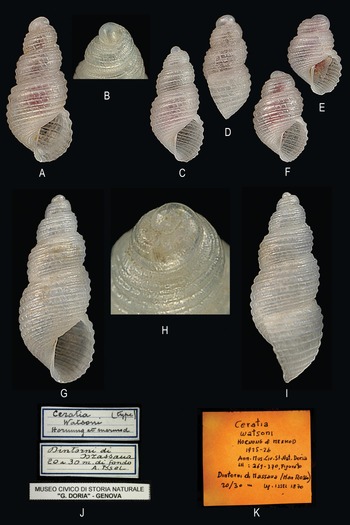
(Figure 1A–K)
Monotygma watsoni (Hornung & Mermod, Reference Hornung and Mermod1927), (A–F) Israel, Haifa Bay: (A) frontal view, specimen height 2.4 mm; (B) detail of the protoconch; (C) frontal view, specimen height 2.0 mm; (D) lateral view, specimen height 1.6 mm; (E) frontal view, specimen height 1.3 mm; (F) frontal view, specimen height 1.0 mm. (G–I) syntype of Ceratia watsoni Hornung & Mermod, Reference Hornung and Mermod1927, Museo Civico di Storia Naturale, Genoa: (G) frontal view, specimen height 4.5 mm; (H) detail of the protoconch; (I) lateral view; (J–K) original labels.

Ceratia watsoni Hornung & Mermod, Reference Hornung and Mermod1927: 369, figure 4; Dekker & Orlin, Reference Dekker and Orlin2000: 21.
MATERIAL EXAMINED
Mediterranean Sea: Haifa Bay, 10 November 2011: 31°49.083′N 034°35.329′E, depth 37.2 m, 2 specimens, shell height 1.0 and 1.3 mm respectively (Figure 1E, F); 31°47.066′N 034°35.687′E, depth 27.8 m, 1 specimen, shell height 2.4 mm (Figure 1A, B); 31°45.479′N 034°34.821′E, depth 26.44 m, 1 specimen, shell height 2.0 mm (Figure 1C); 31°44.823′N 034°33.055′E, depth 33.7 m, 1 specimen, shell height 1.6 mm (Figure 1D); 31°51.710′N 034°38.884′E, depth 18.8 m, 1 specimen, shell height 0.8 mm. Palmahim, 10 November 2012: 31°56.1772′N 034°40.9465′E, depth 22 m, 1 specimen, shell height 0.6 mm.
All specimens were complete with soft parts. One specimen is deposited in the Steinhardt National Collections of Natural History, Tel Aviv University, Israel (TAU MO-751844), and the others are retained in the private collection of C. Bogi.
Red Sea: Massawa, 1870, depth 20–30 m, 3 specimens, shell heights 4.5, 3.2 and 2.8 mm, Museo Civico di Storia Naturale, Genoa, Italy (MSNG-57358) (Figures 1G–K).
DIAGNOSIS
Shell small, brittle, transparent, with cylindriconical profile, colour uniformly whitish. Protoconch smooth, flat and heterostrophic (type B sensu van Aartsen, Reference Aartsen1987), with a single whorl. Teleoconch with convex whorls separated by well-marked and slightly oblique sutures. Sculpture consisting of very pronounced spiral ribs, slightly rounded and almost uniform, the interspaces between the ribs wider than the ribs and crossed by slightly prosocline axial lamellas. The spiral sculpture is present also on the rounded base. Aperture about one-third of the total height, oval, columella straight, forming an angle with inner lip, columella board raised, columella fold obsolescent, umbilicus not evident. Outer lip corrugated by the spiral sculpture. Last whorl half as high as shell.
REMARKS
The Mediterranean material was compared with the three syntypes of Ceratia watsoni Hornung & Mermod, Reference Hornung and Mermod1927, collected by Arturo Issel, in 1870, in the course of a scientific expedition to Assab and Massawa organized by the Società Geografica Italiana and deposited in the Museo Civico di Storia Naturale at Genoa. Of the three syntypes, only the largest (Figure 1G–K) is an adult and in good condition, the other shells are smaller and damaged. Our own specimens are sub-adult as well, but their protoconch (heterostrophic) and the sculpture of teleoconch perfectly match the syntypes. No other information concerning the species exists, although it is considered a Red Sea species (Dekker & Orlin, Reference Dekker and Orlin2000).
Morphological based identifications are difficult since pyramidellids underwent miniaturization and other structural adaptations to their parasitic mode of life. Yet, on comparing the specimens with members of closely resembling pyramidellid genera, it was found to best match Monotygma, which type species, Monotygma striata Gray, 1847, it resembles in the slender profile and a sculpture consisting of spiral ribs spaced by deep furrows. The genus is known from the tropical and subtropical Indo-West Pacific, and has not been hitherto represented in the Mediterranean Sea. Robba et al. (Reference Robba, Di Geronimo, Chaimanee, Negri and Sanfilippo2003:186, Plate 26, figures 7a–c) described a specimen from the Gulf of Thailand that closely resembles M. watsoni as M. speciosa Adams, 1851, though the shell of the type specimen of the latter species (deposited in the Natural History Museum, London, BM 1968328) is much more conical and its 6.5 whorls measure 8.2 mm (J.J. van Aartsen, personal communication). The Erythraean alien Iolaea neofelixoides (Nomura, 1936), which shell has a similar spiral sculpture, differs from M. watsoni in possessing a more conical and turreted profile, plane and carinated whorls, a smaller number of spiral ribs, a small tooth on the columella and a wider and deeper umbilicus.
DISCUSSION
There is considerable interest in the role parasites play in biological invasions. Studies concerning the degree of host specificity in pyramidellids revealed that species possess a range of hosts as well as an order of host preference (Bass & Merrill, Reference Bass and Merrill1965; Ward, Reference Ward1989; Solustri & Micali, Reference Solustri and Micali2004). The Red Sea top shell Trochus erithreus Brocchi, 1821, a host of Oscilla jocosa in the Red Sea (Mienis, Reference Mienis2003a), was first recorded off the Israeli Mediterranean coast in 1973 (Barash & Danin, Reference Barash and Danin1973), and followed a decade later by O. jocosa (van Aartsen et al., Reference Aartsen, Barash and Carrozza1989). Trochus erithreus is known to occur throughout the Levantine Basin and reaches Crete (Ghisotti, Reference Ghisotti1974; Bogi & Khairallah, Reference Bogi and Khairallah1987; Tornaritis, Reference Tornaritis1987; Engl, Reference Engl1995; Cosenza & Fasulo, Reference Cosenza and Fasulo1997). Mienis (Reference Mienis2003a: 1) suggested ‘It would be interesting to know whether Oscilla jocosa is also a parasite of Trochus erithreus in its new environment'—but that study has yet to be undertaken. Delongueville & Scaillet (Reference Delongueville and Scaillet2006) identified both Erythraean and native pyramidellids on the Erythraean spiny oyster, Spondylus spinosus Schreibers, 1793, collected off Yumurtalik, Iskenderun Bay, Turkey. Spondylus spinosus was first noted in the Mediterranean in 1988 (Mienis, Reference Mienis2003b), and by 2002 it was ‘well established along the entire coast [of Israel]. All the reefs are covered by an edge to edge carpet of these rock dwellers' (Singer, Reference Singer2002: 24). When ectoparasites are generalists, as many pyramidellids seem to be, they may be introduced to hosts native to their new range. Indeed, Leucotina natalensis (as Monotygma amoena, Oliverio, Reference Oliverio1994) was recorded parasitizing the native cockle Cardium tuberculatum Linnaeus, 1758. The large populations of a great number of Erythraean aliens in the Levantine Basin may serve as reservoir hosts for the ectoparasitic pyramidellids, permitting the increase in their numbers. The invasion of putative Erythraean hosts could also result in an increase in abundance of the native Mediterranean pyramidellids. Whatever the case may be, by modifying host–host interactions through their effects on host fitness, pyramidellids may determine the success of an invasion and its impact on the recipient community.
ACKNOWLEDGEMENTS
Thanks to Stefano Bartolini for the photographs of the shells and Jacobus J. van Aartsen (NMNH, Leiden, The Netherlands) for his valuable comments. Thanks also go to Dr Maria Tavano, curator at the Museo Civico di Storia Naturale, Genoa, Italy, for permission to examine the syntypes of Ceratia watsoni. Support for this research was provided by the European Community's Seventh Framework Programme (FP7/2007-2013) for the project Vectors of Change in Oceans and Seas Marine Life, Impact on Economic Sectors (VECTORS) (B.S.G.).