Introduction
Neuroticism is considered one of the personality traits most important to public health because of its association with, and its ability to predict, various mental (Ormel et al. Reference Ormel, Rosmalen and Farmer2004) and physical disorders (Lahey, Reference Lahey2009), including cardiovascular disease (Shipley et al. Reference Shipley, Weiss, Der, Taylor and Deary2007). Neuroticism measures refer to individual differences in the tendency to experience negative emotions, especially when confronted with threat, frustration or loss (Costa & McCrae, Reference Costa and McCrae1992a ). Operationally, neuroticism is defined by items referring to negative affect, such as anxiety, irritability, anger, worry, self-consciousness, frustration, reactivity, vulnerability, hostility, sensitivity to criticism of others, and accompanying behavioral and cognitive traits (Costa & McCrae, Reference Costa and McCrae1992b ). It has therefore been suggested that neuroticism is a measure for a person's set point of negative affect (Ormel et al. Reference Ormel, Rosmalen and Farmer2004). Moreover, neuroticism scores prospectively predict person-dependent stressful life events (i.e. adversities that a person might have brought upon themselves) and chronic adversity (Poulton & Andrews, Reference Poulton and Andrews1992).
Several studies have evaluated the potential role of the hypothalamic–pituitary–adrenal (HPA) axis in explaining the association of neuroticism with adverse health outcomes. Unfortunately, the results of investigations of the relationship between neuroticism and the HPA axis are inconsistent, with some studies reporting a positive relationship (Nater et al. Reference Nater, Hoppmann and Klumb2010; Madsen et al. Reference Madsen, Jernigan, Iversen, Frokjaer, Mortensen, Knudsen and Baare2012), some negative (Mangold et al. Reference Mangold, Mintz, Javors and Marino2012; Pineles et al. Reference Pineles, Rasmusson, Yehuda, Lasko, Macklin, Pitman and Orr2012) and others no relationship at all (Riese et al. Reference Riese, Rijsdijk, Rosmalen, Snieder and Ormel2009; Tabak & McCullough, Reference Tabak and McCullough2011; van Santen et al. Reference van Santen, Vreeburg, Van der Does, Spinhoven, Zitman and Penninx2011). Therefore, the mechanisms by which neuroticism may affect somatic health have yet to be elucidated. An interesting perspective is provided by findings that psychosocial stress (e.g. childhood adversities, caregivers stress) is associated with shorter telomere length (TL) both cross-sectionally (Epel et al. Reference Epel, Blackburn, Lin, Dhabhar, Adler, Morrow and Cawthon2004; Damjanovic et al. Reference Damjanovic, Yang, Glaser, Kiecolt-Glaser, Nguyen, Laskowski, Zou, Beversdorf and Weng2007; Kananen et al. Reference Kananen, Surakka, Pirkola, Suvisaari, Lonnqvist, Peltonen, Ripatti and Hovatta2010; Drury et al. Reference Drury, Theall, Gleason, Smyke, De Vivo, Wong, Fox, Zeanah and Nelson2012) and prospectively (Shalev et al. Reference Shalev, Moffitt, Sugden, Williams, Houts, Danese, Mill, Arseneault and Caspi2012), as shortening of telomeres is related to the process of cellular aging (Blasco, Reference Blasco2007). Moreover, a large cross-sectional study investigating the relationship between trait hostility and TL found telomeres to be significantly shorter in high-hostile men (Brydon et al. Reference Brydon, Lin, Butcher, Hamer, Erusalimsky, Blackburn and Steptoe2011). Telomeres are specialized chromatine structures that ‘cap’ the ends of chromosomes in eukaryotic cells. Telomeres prevent chromosome ends from being recognized as double-stranded DNA breaks, promoting chromosomal stability (Chan & Blackburn, Reference Chan and Blackburn2002). In addition, they play an important role in regulating the replicative lifespan of cells (Collado et al. Reference Collado, Blasco and Serrano2007) and in stem cell mobility (Flores et al. Reference Flores, Cayuela and Blasco2005). DNA polymerases cannot copy the end of chromosomes and a particular enzyme, telomerase, is needed to add telomere repeats during cell division. However, in somatic cells, only limited amounts of telomerase are present, thus telomeres shorten progressively with each cell division (Harley et al. Reference Harley, Futcher and Greider1990). Short telomeres are predictive of increased mortality rates (Cawthon et al. Reference Cawthon, Smith, O'Brien, Sivatchenko and Kerber2003; Honig et al. Reference Honig, Schupf, Lee, Tang and Mayeux2006) and increased incidence of various age-related diseases, such as cancer (Willeit et al. Reference Willeit, Willeit, Mayr, Weger, Oberhollenzer, Brandstatter, Kronenberg and Kiechl2010) and Alzheimer's disease (Honig et al. Reference Honig, Schupf, Lee, Tang and Mayeux2006).
As various forms of psychosocial stress are associated with shorter telomeres (Epel et al. Reference Epel, Blackburn, Lin, Dhabhar, Adler, Morrow and Cawthon2004; Damjanovic et al. Reference Damjanovic, Yang, Glaser, Kiecolt-Glaser, Nguyen, Laskowski, Zou, Beversdorf and Weng2007; Kananen et al. Reference Kananen, Surakka, Pirkola, Suvisaari, Lonnqvist, Peltonen, Ripatti and Hovatta2010; Tyrka et al. Reference Tyrka, Price, Kao, Porton, Marsella and Carpenter2010; Drury et al. Reference Drury, Theall, Gleason, Smyke, De Vivo, Wong, Fox, Zeanah and Nelson2012) and neuroticism scores prospectively predict exposure to person-dependent stressful life events and chronic adversity (Poulton & Andrews, Reference Poulton and Andrews1992), accelerated telomere shortening might be one of the mechanisms through which neuroticism leads to somatic disease. A longitudinal study might be able to provide insight into the sequence of events and make more accurate statements about the direction of causality.
The aim of the present study was to prospectively test the effect of neuroticism on TL in a large population-based cohort. We hypothesized that higher scores on neuroticism would be associated with shorter TL as neuroticism is a predictor of a person's habitual level of distress, exposure to stressful life events and interpersonal difficulties. This hypothesis has not yet been tested. If it were true, it could mean an important step forward in our understanding of the relationship between neuroticism and somatic disease and longevity.
Method
Study population
Our study was performed in a cohort derived from the Prevention of REnal and Vascular ENd stage Disease (PREVEND) study, a population cohort study originally designed to investigate microalbuminuria as a risk factor for renal and cardiovascular disease. The recruitment of participants to the PREVEND study has been described extensively elsewhere (Pinto-Sietsma et al. Reference Pinto-Sietsma, Janssen, Hillege, Navis, de Zeeuw and de Jong2000). In brief, all inhabitants of the city of Groningen between the ages of 28 and 75 years (85 421 subjects) were asked to send in a morning urine sample and to fill out a short questionnaire on demographics and cardiovascular history. A total of 40 856 subjects (47.8%) responded. After exclusion of subjects with insulin-dependent diabetes mellitus and pregnant women, all subjects with an elevated urinary albumin concentration (UAC) of ⩾10 mg/l (n = 7768), together with a randomly selected control group with a UAC of < 10 mg/l (n = 3395), were invited for further investigations (total n = 11 163). Finally, 8592 subjects completed the total screening program, providing the PREVEND study cohort. However, the PREVEND study is enriched for participants with higher albuminuria levels, a risk factor for developing renal disease, and we wanted to study a cohort that was a representative sample of the Groningen population and not at heightened risk for any specific disease. To that purpose we took all subjects with a UAC < 10 mg/l who had completed the first screening (n = 2592) and added a subset of the ‘oversampled’ subjects with a UAC > 10 mg/l by proportionally taking an SPSS-generated random subset (n = 840). This resulted in a group of 3432 subjects with a population representative ratio of albuminuria negative and positive subjects forming the basis for the current study. Three waves of data were available for this study: the baseline screening was completed in 1998 (T1), followed by two follow-up visits at 4.2 (T2) and 6.4 (T3) years from baseline. The study was approved by the Medical Ethics Committee for Human Research of the University Medical Center Groningen (UMCG). All participants were aged ⩾18 years and provided written informed consent for participation in the study.
Neuroticism
Participants completed the Dutch translation of the 12-item neuroticism scale of the Eysenck Personality Questionnaire – Revised Short Scale (EPQ-RSS-N; Sanderman et al. Reference Sanderman, Eysenck and Arrindell1991) at home prior to their visit to our research facilities at T2 and T3. The EPQ-RSS-N comprises 12 questions, representing nervousness, emotional lability, feelings of guilt and low self-esteem, in a ‘yes/no’ format. For each participant, a sum score was constructed by adding the questions answered in the affirmative. The sum score, therefore, represents the total number of neuroticism symptoms reported. Missing data were imputed according to the corrected item mean substitution (CIMS) method if at least half of the items were completed (Huisman, Reference Huisman2000). For the EPQ-RSS-N sum score, of the 135 participants who had at least one missing item, 12 were imputed, resulting in 2721 valid EPQ-RSSN sum scores (95.7% of the study sample at T2). The EPQ-RSS-N exceeded the criterion for acceptable instrument internal consistency reliability of ⩾0.70 (Kline, Reference Kline2000). The psychometric characteristics of the EPQ-RSS-N were as follows: Cronbach's α = 0.86; mean inter-item correlation, 0.35; range of item–rest correlations, 0.43–0.64. The test–retest coefficient for the EPQ-RSS-N sum score in this population was 0.73, the average test–retest interval 2.4 years.
Covariates
Covariates were selected for their known association with neuroticism or TL: body mass index (BMI) (Valdes et al. Reference Valdes, Andrew, Gardner, Kimura, Oelsner, Cherkas, Aviv and Spector2005), smoking (none, 1–5, 6–10, 11–15, 16–20, >20 cigarettes/day) (Valdes et al. Reference Valdes, Andrew, Gardner, Kimura, Oelsner, Cherkas, Aviv and Spector2005), frequency of sports (I don't exercise, once a week, at least twice a week) (Du et al. Reference Du, Prescott, Kraft, Han, Giovannucci, Hankinson and De Vivo2012), presence of a chronic disease [coronary heart disease (CHD), cerebrovascular accident (CVA), diabetes mellitus, chronic liver disease, chronic kidney disease, malignancy, rheumatoid arthritis, chronic obstructive pulmonary disease (COPD) or asthma, severe skin disease, severe bowel disease lasting > 3 months] and level of education (none, low, middle, high) (Steptoe et al. Reference Steptoe, Hamer, Butcher, Lin, Brydon, Kivimaki, Marmot, Blackburn and Erusalimsky2011). The somatic diseases, except for diabetes, CHD and CVA, were self-reported diseases that were present in the previous year. Diabetes was defined as the use of antidiabetic treatment according to self-report or pharmacy data. CHD and CVA were defined as self-report of CHD/CVA upon inclusion in the study and/or confirmed occurrence of CHD/CVA between inclusion and date of visit to the research facilities at T2. Low educational level was defined as lower secondary education or less, middle educational level was defined as higher secondary education, and high educational level was defined as tertiary education.
TL
Fasting blood samples were collected from all participants by a nurse during a visit to the research facilities. In case of influenza or a febrile temperature, blood collection was postponed to a later time. TL in the PREVEND cohort was measured in leukocytes at T1, T2 and T3 by a monochrome multiplex quantitative polymerase chain reaction (PCR) method, whereby telomere specific amplification and the reference gene amplification take place in a single reaction well (Cawthon, Reference Cawthon2009). All samples were measured in triplicate and the average of the three runs was used to provide the mean relative measure of TL for each individual. The mean telomere repeat sequence copy number (T) was compared to a reference single copy gene copy number (S) in each sample. T/S = 1 when the unknown DNA is identical to the reference DNA in its ratio of telomere repeat sequence copy number to single copy gene copy number. The calibrator sample used was made up of a mixture of DNAs from young adult individuals (age around 25 years). The intra-assay coefficients of variation (CVs) were 2% (T), 1.9% (S) and 4.5% (T/S ratio). Reproducibility data were obtained for 216 subjects from PREVEND and good agreement between the T/S ratios was observed (R 2 = 0.99, p < 0.0001, inter-run CV 3.9%). There was a highly significant decline in the T/S ratio with age in PREVEND [−0.0047 (s.e. = 0.0004) decrease in the T/S ratio per year increase in age (p < 0.0001), confirming the internal validity of the assay. TL was available for 3209 participants at T1 and for 2298 at T3. Unfortunately, DNA and thus TL at T2 was only available for a subset of the population (n = 1236)].
Statistical analyses
We used a linear mixed model to account for the non-independence of observations (repeated measurements were nested within individuals). The model contained TL at T2 and T3 as the dependent variable and neuroticism (at T2 and T3) as a time-varying predictor. The model included as covariates gender, BMI, smoking, frequency of sports, presence of a chronic disease, level of education, TL at baseline (T1) and time in years between measurement occasions. A composite specification of the model is given by:
 $$\eqalign{{\rm TL}_{ij} = & {\rm \gamma} _{00} + {\rm \gamma} _{01} {\rm TL}_i + {\rm \gamma} _{02} {\rm Neuroticism}_{ij} + {\rm \gamma} _{03} {\rm Age}_i \cr & + {\rm \gamma} _{04} {\rm Gender}_i + {\rm \gamma} _{05} {\rm Presence \ of \ a \ chronic \ disease}_i \cr & + {\rm \gamma} _{06} {\rm Education}_i + {\rm \gamma} _{07} {\rm Smoking}_{ij} + {\rm \gamma} _{08} {\rm Sports}_{ij} \cr & + {\rm \gamma} _{09} {\rm BMI}_{ij} + {\rm \gamma} _{10} {\rm Time}_{ij} + (\varepsilon _{ij} + \zeta 0_i )} $$
In this notation TL ij denotes the length of the telomeres for individual i at measurement occasion j; γ 00 denotes the intercept; γ 02 denotes the average effect of the sum score of neuroticism symptoms at T2 and T3 on telomere length (T2, T3), adjusted for telomere length at T1 (γ 01). The fixed effects of the other covariates age, gender, presence of a chronic disease, education, smoking, sport, BMI and time are denoted as γ 03, γ 04, γ 05, γ 06, γ 07, γ 08, γ 09, γ 10, respectively. The residuals at the level of within-person observations are denoted by εij . ζ0 i denotes the random intercept variance. The maximum likelihood method was used for model estimation. The distribution of TL was checked for normality. As it had a slight positive skew, TL was naturally log transformed to meet the assumption. For each model we checked whether the associations were linear, quadratic or cubic. The results were considered statistically significant for a two-sided p value < 0.05. All models were analyzed using the nlme package (Pinheiro et al. Reference Pinheiro, Bates, DebRoy and Sarkar2012) in R, version 2.15.2 (R Core Team, 2012).
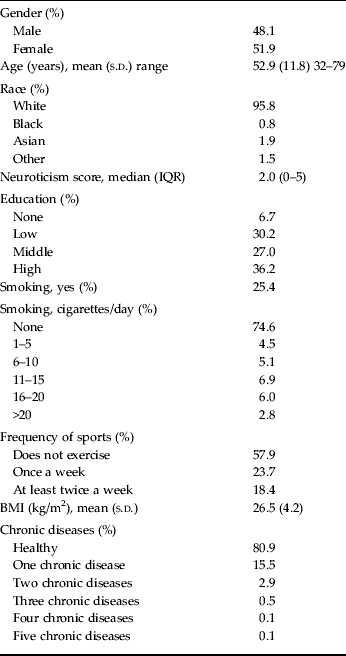
Results
Study population
Descriptive statistics for our study population are provided in Table 1. During the PREVEND study at T2 and T3, 540 and 1028 participants respectively did not attend the follow-up visit. Some of the participants, however, who were not present at the follow-up at T2 did attend the follow-up visit at T3 and vice versa. A total of 572 (17%) did not attend any of the follow-up visits and had only baseline data available. It therefore becomes clear that, like any longitudinal study, PREVEND suffered from attrition. We therefore investigated the pattern of missingness. We assumed data were missing at random (MAR) as missingness depended on the observed variables (Graham, Reference Graham2009). Attrition was related to heavier smoking, drinking more alcohol, having a higher BMI, exercising less, being lower educated, being more neurotic, and having shorter telomeres.
General characteristics of the study population at T2

T2, Follow-up visit after 4 years; BMI, Body mass index; IQR, interquartile range; s.d., standard deviation.
Previous longitudinal studies investigating TL have reported the possibility of both telomere attrition and telomere lengthening (Aviv et al. Reference Aviv, Chen, Gardner, Kimura, Brimacombe, Cao, Srinivasan and Berenson2009; Nordfjall et al. Reference Nordfjall, Svenson, Norrback, Adolfsson, Lenner and Roos2009; Chen et al. Reference Chen, Kimura, Kim, Cao, Srinivasan, Berenson, Kark and Aviv2011; Svenson et al. Reference Svenson, Nordfjall, Baird, Roger, Osterman, Hellenius and Roos2011). Most studies defined attrition as a decrease in TL > 15% and lengthening as an increase in TL > 15% between baseline and follow-up measures. We investigated the dynamics of TL in our cohort using these definitions. Over an average time of 6.5 years between baseline and follow-up, 65.2% showed a decrease in TL, 6.9% remained stable and 27.9% showed a lengthening of telomeres. This shows that TL is highly dynamic.
Neuroticism and TL
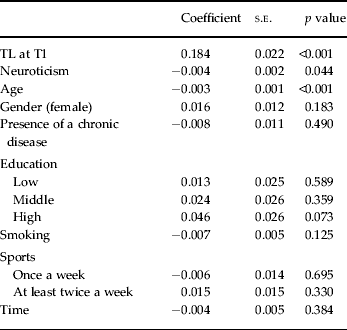
The results of the fully adjusted analysis are presented in Table 2. In a random intercept model adjusted only for gender, age, time and baseline TL, the sum score of neuroticism symptoms predicted a significant decrease in TL (coefficient = −0.005, s.e. = 0.002, p = 0.008). In our second and final model, we added BMI, smoking, frequency of sports, the presence of chronic diseases and education. The sum score of neuroticism symptoms remained a significant predictor of telomere attrition (coefficient = −0.004, s.e. = 0.002, p = 0.044). The coefficient of the sum score of neuroticism symptoms decreased only slightly, indicating that, although lifestyle factors explain a portion of the variance, neuroticism also still explains a unique portion of the variance in telomere attrition independent of lifestyle factors. Likewise, age was a significant predictor of telomere attrition. Furthermore, there was a non-significant trend of higher education being associated with telomere elongation. Surprisingly, smoking status, gender and the presence of a chronic disease did not predict changes in TL.
Mixed model predicting telomere length (TL) at T2 and T3 by the sum score of neuroticism symptoms, adjusting for baseline TL (n = 2156)

s.e., standard error.
Intercept and random intercept not shown.
Discussion
To our knowledge, this is the first prospective large population-based study showing that neuroticism is significantly associated with shorter TL over time, independent of BMI, frequency of sports, smoking, baseline TL, presence of a chronic disease, and level of education. Neuroticism can be viewed as a person's habitual level of distress and predicts exposure to psychosocial stress, in particular stressful life events and chronic difficulties (Ormel et al. Reference Ormel, Rosmalen and Farmer2004). Therefore, our results are in agreement with previous cross-sectional (Epel et al. Reference Epel, Blackburn, Lin, Dhabhar, Adler, Morrow and Cawthon2004; Damjanovic et al. Reference Damjanovic, Yang, Glaser, Kiecolt-Glaser, Nguyen, Laskowski, Zou, Beversdorf and Weng2007; Kananen et al. Reference Kananen, Surakka, Pirkola, Suvisaari, Lonnqvist, Peltonen, Ripatti and Hovatta2010; Tyrka et al. Reference Tyrka, Price, Kao, Porton, Marsella and Carpenter2010; Drury et al. Reference Drury, Theall, Gleason, Smyke, De Vivo, Wong, Fox, Zeanah and Nelson2012; Wikgren et al. Reference Wikgren, Maripuu, Karlsson, Nordfjall, Bergdahl, Hultdin, Del-Favero, Roos, Nilsson, Adolfsson and Norrback2012) and prospective studies (Shalev et al. Reference Shalev, Moffitt, Sugden, Williams, Houts, Danese, Mill, Arseneault and Caspi2012) demonstrating an association between psychosocial stress and decreased TL. Our results are also in concordance with two cross-sectional studies linking personality traits, hostility (Brydon et al. Reference Brydon, Lin, Butcher, Hamer, Erusalimsky, Blackburn and Steptoe2011) and pessimism (O'Donovan et al. Reference O'Donovan, Lin, Dhabhar, Wolkowitz, Tillie, Blackburn and Epel2009), to shorter TL. As mentioned earlier, both neuroticism (Shipley et al. Reference Shipley, Weiss, Der, Taylor and Deary2007; Mroczek et al. Reference Mroczek, Spiro and Turiano2009) and telomere attrition (Cawthon et al. Reference Cawthon, Smith, O'Brien, Sivatchenko and Kerber2003; Honig et al. Reference Honig, Schupf, Lee, Tang and Mayeux2006) are associated with increased all-cause mortality and various diseases of aging. Two mutually non-exclusive explanations for the entanglement of neuroticism, TL and somatic diseases and increased mortality can be offered. One possibility is that telomere shortening is part of the mechanism by which neuroticism leads to increased mortality rates through, for instance, chromosomal instability (Rudolph et al. Reference Rudolph, Millard, Bosenberg and Depinho2001) and cell senescence (Collado et al. Reference Collado, Blasco and Serrano2007). An alternative explanation, however, could be that, for a large part, decreased TL and increased mortality and neuroticism are the result of exposure to other shared risk factors, such as the amount of lifetime oxidative stress exposure and genetic vulnerability for psychosocial stress. Glucocorticoids, stress hormones released from the adrenal gland under conditions of psychosocial stress (Dickerson & Kemeny, Reference Dickerson and Kemeny2004), have been shown to increase damage by oxidative stress in neurons (McIntosh & Sapolsky, Reference McIntosh and Sapolsky1996; McIntosh et al. Reference McIntosh, Hong and Sapolsky1998). Because high neuroticism scores are prospectively associated with exposure to more psychosocial stress (Poulton & Andrews, Reference Poulton and Andrews1992), increased glucocorticoid exposure might be a mediating factor, explaining both telomere attrition and the increased morbidity and mortality that are associated with neuroticism. The results of a recently published study, showing that a hypocortisolemic state was associated with shorter TL in both patients with recurrent depression and healthy controls (Wikgren et al. Reference Wikgren, Maripuu, Karlsson, Nordfjall, Bergdahl, Hultdin, Del-Favero, Roos, Nilsson, Adolfsson and Norrback2012), contradicts the above stated hypothesis. We need to bear in mind, however, that this study was cross-sectional in nature, and therefore could not exclude the possibility that hypocortisolemia might be the end result of a repeatedly overstressed and finally exhausted HPA axis as suggested by Fries et al. (Reference Fries, Hesse, Hellhammer and Hellhammer2005).
There are several strengths and limitations of the current study that need to be taken into consideration when interpreting our results. The first major strength of this study is that it was conducted in a large population representative cohort, increasing the generalizability of our findings. It should be mentioned, however, that our population consisted mainly of white people and the results of our study cannot therefore be generalized to people with other racial or ethnic backgrounds. The second strength is the prospective nature of the design, allowing us to model telomere attrition over time. This is the first prospective study demonstrating a significant relationship between a personality trait and telomere attrition. All other studies to date have been cross-sectional, and thus have not provided insight into the sequence of events (Damjanovic et al. Reference Damjanovic, Yang, Glaser, Kiecolt-Glaser, Nguyen, Laskowski, Zou, Beversdorf and Weng2007; Brydon et al. Reference Brydon, Lin, Butcher, Hamer, Erusalimsky, Blackburn and Steptoe2011). One limitation of our study is that we measured TL by monochrome multiplex quantitative PCR. This makes it difficult to compare our findings to those of other cohorts as the results of the PCR are given in the form of a ratio and not in absolute kilobase pairs. This is, however, a commonly accepted and reliable method for measuring TL (Cawthon, Reference Cawthon2009) and our assay has good internal validity. A second limitation is that, like any longitudinal study, the PREVEND study suffered from attrition and no-show at some of the scheduled follow-up visits. The participants who dropped out of the study or missed a visit had significantly shorter TL, significantly higher scores of neuroticism at baseline, and a significantly unhealthier lifestyle than participants who had not dropped out. These attrition-associated differences will lead to either under- or overestimation of the true effect of neuroticism on TL, as the most extreme cases for most variables have ceased to participate in the study. Likelihood-based methods can, however, provide reliable estimates when the MAR assumption holds, as was the case in our study (Kenward & Molenberghs, Reference Kenward and Molenberghs1998). Finally, the observational design of our study does not permit us to draw any conclusions about causality.
In conclusion, this is the first study demonstrating that neuroticism is prospectively associated with telomere attrition. Future studies could investigate whether increased glucocorticoid levels caused by repeated stress exposure is one of the mechanisms through which neuroticism exerts its negative effects on TL and physical and mental health.
Acknowledgments
We thank all of those who participated in the PREVEND study. This study was supported by a grant from the Innovational Research Incentives Scheme Program of The Netherlands (NWO, VENI, P. van der Harst, grant no. 916.76.170).
Declaration of Interest
None.