

Introduction
In this paper, we present a benefit–cost analysis of Tulsa’s pre-K program. Our methodology starts with previously estimated effects of Tulsa pre-K on high-school graduation and college attendance (Amadon et al., Reference Amadon, Gormley, Fuller and Hummel-Price2022a; Gormley et al., Reference Gormley, Amadon, Magnuson, Claessens and Hummel-Price2023). Based on these estimates, this study project affects on future earnings. These projected earnings effects are the benefits that are compared with program costs.
In addition to the estimated Tulsa pre-K effects on high-school graduation and college attendance, these projected earnings effects also use a variety of other information. We make a range of plausible assumptions about how effects on college attendance translate into effects on educational attainment. We estimate how earnings in Tulsa currently differ by age and educational attainment. We project how earnings will change in the future due to secular economic growth. We adjust for the mortality rates of former pre-K participants at different ages.
Based on these projections, we estimate that the present value of Tulsa pre-K’s future earnings benefits, for the average participant, is $25,533 in 2021 national dollars, discounted back to when the participant was age four, compared to the program’s average cost per participant of $9,628 (again in 2021 national dollars, evaluated at age four), which means a benefit–cost ratio of 2.65. We regard this estimate as conservative, for two reasons. First, this estimate omits other potential benefits of pre-K, such as effects on reducing crime, or effects on future generations. Second, as we will explain below, we believe that our estimates may understate the effects of Tulsa pre-K on educational attainment and that the actual effects on earnings may exceed those projected from educational attainment effects.
This paper’s findings are of interest for at least three reasons. First, this evaluation is more relevant to proposed large-scale expansions of pre-K than is true of evaluations of small-scale experimental programs. Tulsa’s program is a large-scale program run through the public schools, with students of all income levels eligible for pre-K, and is funded at adequate but not extraordinary levels per student. Prior studies strongly suggest that Tulsa’s pre-K program is of high quality (Phillips et al., Reference Phillips, Gormley and Lowenstein2009). For state and local policymakers, the benefits versus the costs of Tulsa’s pre-K program suggest the potential for large-scale public expansion of universal pre-K if done in a high-quality but affordable manner.
Second, long-term evaluations of pre-K, while they exist, are sparse, particularly for large-scale pre-K programs, and particularly for large-scale programs with noteworthy percentages of non-low-income children, so this study significantly adds to the research literature.
Third, this new long-term evaluation of Tulsa pre-K provides a useful comparison with prior evaluations of Tulsa pre-K based on short-term data. Benefit–cost analyses of pre-K face the challenge that many of the benefits of pre-K, such as higher earnings of former participants as adults, are long-term, yet policymakers need to know “what works” based on short term data. Tulsa’s pre-K program has been subject to two prior benefit–cost evaluations, which focused on projecting future benefits of Tulsa pre-K based on short-term outcomes (kindergarten) and medium-term outcomes (middle school). A comparison of these two prior benefit–cost evaluations with this paper’s longer-term analysis, extending into early adulthood, allows us to see whether evaluations based on short-term information can approximate evaluations based on longer-term evidence. Can policymakers usually gauge pre-K’s benefits based only on effects at kindergarten? The answer here is “Yes,” which is useful to policymakers.
Our findings from these three studies of Tulsa pre-K—based on effects at kindergarten entrance, at middle school, and in early adulthood—suggest that Tulsa’s effects on student outcomes seem to “fade,” in terms of what they imply for future earnings, from kindergarten to middle school, yet re-emerge later on. As we will describe, this fading and re-emergence is also found in other pre-K studies. This pattern may be due to the importance of pre-K in helping to begin the cumulative development of some types of skills—“soft skills” such as social skills for dealing with people or having self-confidence, or the ability to persist and problem-solve—that are not always fully reflected in students’ test scores or other outcomes in third grade or ninth grade, but that may affect whether students graduate from high school, go on to college, and succeed in the economy. As we will explain further later, this is consistent with other evidence on Tulsa pre-K.
For policymakers, this pattern of fading and re-emergence implies that they should not be too discouraged if pre-K’s effects on traditional academic outcomes sometimes seem to weaken as children get into later grades. Indeed, an estimate of effects at kindergarten entrance arguably gives at least as good a prediction of long-term benefits, based on both this new paper and prior research.
Prior pre-K studies
To begin with, we review the prior pre-K literature’s findings. This sets the stage for the next section, which explains our new Tulsa study’s methodology, and how the Tulsa results enrich the research literature.
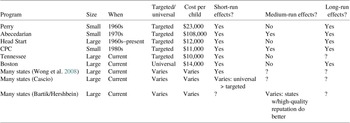
Many past studies have looked at the effects of pre-K in the short run (at or before kindergarten entrance), medium run (before high-school graduation), and long run (high-school graduation or beyond). Table 1 summarizes some of the prior studies and their settings.
Summary of prior pre-K studies.

Note: Costs are in 2021 national dollars. See text and Appendix A for more information on sources.
Short-run or medium-run effects are examined in studies of the Perry Preschool Project (Schweinhart et al., Reference Schweinhart, Montie, Xiang, Barnett, Belfield and Nores2005), the Abecedarian Project (Campbell et al., Reference Campbell, Pungello, Miller-Johnson, Burchinal and Ramey2001), Head Start (Puma et al., Reference Puma, Bell, Cook, Heid, Broene, Jenkins, Mashburn and Downer2012), the Chicago Child–Parent Centers program (Reynolds, Reference Reynolds2000), the Tennessee Voluntary Pre-K program (Durkin et al., Reference Durkin, Lipsey, Farran and Wiesen2022), the Universal Pre-K Boston program (Weiland and Yoshikawa, Reference Weiland and Yoshikawa2013; Weiland et al., Reference Weiland, Unterman, Shapiro, Staszak, Rochester and Martin2019), and multiple state programs in Wong et al. (Reference Wong, Cook, Barnett and Jung2008), Cascio (Reference Cascio2021), and Bartik and Hershbein (Reference Bartik and Hershbein2018).
Long-run estimates of pre-K effects are rarer but do exist. Long-run studies have been done of Head Start (Garces et al., Reference Garces, Thomas and Currie2002; Ludwig and Miller, Reference Ludwig and Miller2007; Deming, Reference Deming2009; Carneiro and Ginja, Reference Carneiro and Ginja2014; Bailey et al., Reference Bailey, Sun and Timpe2021), Perry Preschool Project (Heckman et al., Reference Heckman, Moon, Pinto, Savelyev and Yavitz2010), the Abecedarian Project (Campbell et al., Reference Campbell, Pungello, Burchinal, Kainz, Pan, Wasik, Barbarin, Sparling and Ramey2012), the Chicago Child–Parent Centers program (Reynolds et al., Reference Reynolds, Temple, Barry, Ou and Robertson2011), and Universal Pre-K Boston (Gray-Lobe et al., Reference Gray-Lobe, Pathak and Walters2023).
These programs differ widely in design. Perry and Abecedarian were small, experimental programs with very high costs per student, and were also tightly targeted to disadvantaged students. Head Start is a large-scale program that is more moderate in cost per student and tightly targeted to low-income students. The programs in Chicago, Tennessee, and Boston are all large-scale programs, also of more moderate costs than Perry and Abecedarian. Chicago and Tennessee tightly target disadvantaged children, but Boston’s program is more universal in scope.Footnote 1 Boston’s program is more expensive per child than is typical, while Tennessee’s program is cheaper. Chicago’s program is of more moderate total cost, but is relatively expensive for a program that is half-day, with about half of students participating for 2 years.Footnote 2 These greater expenses per child-hour in Chicago and Boston may in part be due to other services provided such as wraparound services for parents and extra support for staff; for example, the Boston program provides staff mentoring. The state programs examined in various studies were all large-scale programs, but they varied widely in how targeted they were to low-income children.
The long-term studies generally find that pre-K has sizable long-term effects, with high benefit–cost ratios. But, as mentioned, except for Boston, all these programs were targeted to disadvantaged students. Also, many of them focused on cohorts from the 1960s, 1970s, or 1980s, when counterfactual opportunities for preschool education were lacking. Of the prior studies reviewed in Table 1, Boston is the only program with long-run results for a large-scale, more “universal” contemporary program, which might be more typical of the kinds of programs that are often proposed as the most politically viable for state-funded and locally-funded preschool programs.
Most of the short-run and medium-run studies also find positive effects of pre-K, but not always. Exceptions include studies of the Tennessee program (Durkin et al., Reference Durkin, Lipsey, Farran and Wiesen2022) and some of the state programs in Cascio (Reference Cascio2021) and in Bartik and Hershbein (Reference Bartik and Hershbein2018). This pattern raises some doubts about whether more “typical” publicly funded pre-K programs will always have benefits.
The causes of the pattern of results across studies are not completely understood. Researchers tend to say that pre-K “quality” matters, which seems like a plausible proposition, but how to measure quality is uncertain. For example, Tennessee’s pre-K program was rated as high quality by NIEER on 9 out of 10 quality measures (Durkin et al., Reference Durkin, Lipsey, Farran and Wiesen2022), yet direct measures of program quality by classroom observations suggest the quality of this program was not so high, which is consistent with this program not having medium-run benefits (Farran et al., Reference Farran, Hofer, Lipsey and Bilbrey2014). As already mentioned, Tennessee’s program also spends less per student than some other programs studied, which might help explain its lesser results, but on the other hand, to our knowledge, there is no strong research evidence that preschool spending is positively correlated with effectiveness. Bartik and Hershbein (Reference Bartik and Hershbein2018) find that state programs that are reputed to be of high quality from outside observational studies tend to have higher medium-run effects than programs that do not have that reputation. All the programs with long-term effects are thought to be of high quality.
Cascio (Reference Cascio2021) finds that short-run pre-K effects are higher for universal than for income-targeted programs, including for low-income students. Universal programs may benefit from peer effects due to income integration, or from universal programs having greater political support for creating and sustaining higher quality. Johnson and Jackson (Reference Johnson and Jackson2019) find that Head Start’s long-term effects are greater if subsequent K-12 spending is higher, and vice versa—higher K-12 spending has greater effects when Head Start is more available. In other words, investments in pre-K and K-12 are complementary.
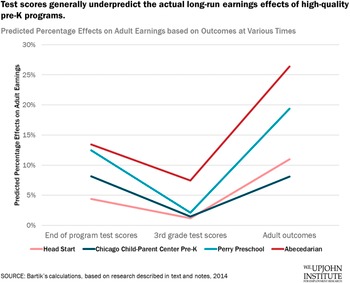
For the pre-K programs that have been studied at all three time horizons—short run, medium run, and long run—one curious finding is that short-run results often fade in the medium term, but then re-emerge in the long run. In other words, pre-K’s effects for the same program often follow a U-shaped or V-shaped pattern. “Fading and recovery” can only be defined if one measures pre-K effects in the same “units”—say, as predicted program benefits in dollar terms. For example, Bartik (Reference Bartik2014) presents a figure that used results from Perry, Abecedarian, Head Start, and Chicago to predict adult earnings effects in the short run, medium run, and long run (Figure 1). Similar results are found for Boston pre-K, at least in terms of statistical significance: effects were significant at kindergarten entrance, insignificant by third grade, but significant on college attendance, albeit for a different cohort (Weiland and Yoshikawa, Reference Weiland and Yoshikawa2013; Weiland et al., Reference Weiland, Unterman, Shapiro, Staszak, Rochester and Martin2019; Gray-Lobe et al., Reference Gray-Lobe, Pathak and Walters2023).
Test scores generally underpredict the actual long-run earnings effects of high-quality pre-K programs.

The usual explanation of the results is the importance of some type of “skill” that is not necessarily measured by school test scores or by other outcomes during the K-12 school year, combined with the hypothesis that this hard-to-observe “skill” shows some sign of leading to cumulative learning effects. For example, this U-shaped pattern could occur if pre-K helps develop “soft skills” such as the ability to get along with teachers and peers, or such as self-confidence—and if greater soft skills at kindergarten entrance lead to further soft-skill accumulation by the end of kindergarten, and so on into subsequent grades. In Nobel Prize-winning economist James Heckman’s famous phrase, this pattern can be explained if “skills beget skills”—and if the skills that beget themselves the most are hard-to-observe skills, such as soft skills.
In addition to this U-shaped pattern, one other finding that is consistent with pre-K increasing the acquisition of soft skills is that directly measured effects of pre-K on adult employment and earnings sometimes exceed those predicted by educational attainment effects. For example, this is true of Perry Preschool: Perry’s effects on the employment-to-population ratio of former participants at age 40 was 14 percentage points, which is far greater than the 2 percentage point effect predicted due to Perry’s effects on educational attainment (Bartik, Reference Bartik2011, p. 94).
In addition to shedding light on how and why pre-K affects economic and social outcomes, this U-shaped pattern is also important for practical policy purposes. Policymakers want to know the benefits or costs of pre-K. Yet its true benefits are long run, in how it affects a person’s life course. This creates a problem for evaluating a local area’s pre-K program. Policy analysis that looks directly at 40- or 50-year effects for place X’s pre-K program is hardly practical. But if early effects at kindergarten entrance tend to reasonably capture long-run effects, or at least could be a lower bound, then short-run studies of pre-K effects may be able to provide reasonable policy guidance.
Tulsa pre-K: Why it is of interest, prior studies, and the current study
Background on Tulsa pre-K, and why Tulsa pre-K is of interest
Tulsa Pre-K is a part of the public school system, as are other preschool programs in Oklahoma. In 1998, the state of Oklahoma extended aid to school districts to include 4-year-olds attending preschool in local school districts, and over time, as school districts decided to add preschool to their offerings, this has led to most children in Oklahoma being able to access free preschool. In addition to promoting universal access, preschool’s integration into the public school system has helped promote quality in various ways—for example, by encouraging preschool teachers to receive similar salaries as other K-12 teachers, and by encouraging an integration of the preschool curriculum with the K-12 curriculum.
Why might the Tulsa pre-K program be of particular interest? First, the program is a large-scale program of reasonably moderate costs, run by a public school district. The program’s estimated costs for a full-day pre-K program are $11,443, which is considerably less, for example, than programs such as Perry or Abecedarian, or even Boston’s program. Since some Tulsa pre-K participants participate only for a half-day, the average costs per child in pre-K are $9,628.Footnote 3 Because Tulsa’s pre-K program is a large-scale moderately priced program run by an ordinary school district, the effects of this program might be more relevant to other school districts as a model for what they might do, than is true for extremely expensive and small-scale experimental programs such as Perry and Abecedarian. The lower costs than in Boston make Tulsa’s program easier for other school districts to replicate.
Second, the Tulsa program seems to have features that promote high-quality, and which can potentially be replicated. Tulsa’s program is universal,Footnote 4 which, as noted above, has been shown by Cascio (Reference Cascio2021) to be associated with higher benefits. In addition, Tulsa’s program has direct evidence from systematic classroom observations that the program is high-quality (Phillips et al., Reference Phillips, Gormley and Lowenstein2009). Therefore, Tulsa’s program helps show the potential for local pre-K programs that are universal with high-quality features.
Third, Tulsa’s program now has data on long-term effects, which will be used in the current benefit–cost study. Furthermore, these long-term effects are for a program in a more contemporary setting than programs such as Perry and Abecedarian or CPC. In today’s society, for example, compared to the 1960s, there are many more private preschool options and more childcare subsidies, which might diminish the effects of public pre-K. With the exception of recent studies of Boston, the long-term Tulsa estimates used here are the only estimates for the long-term effects of a pre-K program in a contemporary setting.
Fourth, as will be explained below, with the current study added, Tulsa’s pre-K program will have benefit–cost analyses based on estimated pre-K effects in the short-term, medium-term, and long-term. This allows us to see whether the fading and recovery of pre-K effects, found in prior studies, is also found in the Tulsa pre-K program. As explained above, this fading and recovery is consistent with the importance of hard-to-measure “soft skills.” This fading and recovery is also relevant to determining how feasible it is to evaluate pre-K programs based on short-term effects.
Prior Tulsa pre-K benefit–cost studies
Tulsa’s pre-K Program has been subject to two benefit–cost analyses, and the current paper adds a third study. Each of these benefit–cost analyses is based on children entering Tulsa public kindergarten in the fall of 2006. The first of these benefit–cost analyses is based on effects on kindergarten test scores (Bartik et al., Reference Bartik, Gormley and Adelstein2012), the second is based on effects on grade retention as of middle school (Bartik et al., Reference Bartik, Belford, Gormley and Anderson2017), and the current study looks at high-school graduation and college attendance.
For the benefit–cost analysis based on kindergarten test scores, the underlying estimates of test-score effects were based on a regression discontinuity study which relied on how age affects eligibility for public-school attendance. In essence, the study is comparing test scores for two groups: students who just made the age cutoff for attending preschool the prior year and hence had completed a year of preschool at the time they were administered the test; students who just missed the age cutoff for attending preschool the prior year and hence were just starting preschool at the time they were administered the test.
For the latter two benefit–cost analyses, the underlying estimates of effects on middle-school grade retention, or on high-school graduation or college attendance, are based on comparing Tulsa preschool attendees entering kindergarten with other entering-kindergarten Tulsa students who did not attend Tulsa preschool or Head Start. This comparison group was reweighted using propensity-score weighting, so that on observable variables it resembles the treatment group.
For all three of these benefit–cost studies, we take the estimates of pre-K effects as simply being true, and we seek to calculate the resulting further effects on adult earnings.Footnote 5 These earnings effects are calculated using cross-sectional data by age from the American Community Survey (ACS) for the Tulsa metropolitan area.
Methodology of current benefit–cost study
To inform the present study, we use effects on college attendance from Gormley et al. (Reference Gormley, Amadon, Magnuson, Claessens and Hummel-Price2023). Effects on high-school graduation rates are from Amadon et al. (Reference Amadon, Gormley, Fuller and Hummel-Price2022a). The college attendance results are based on college enrollment data from 2019–2020 and 2020–2021 from the National Student Clearinghouse that are matched to Tulsa kindergarten attendees in the fall of 2006. For the purposes of these calculations, we assume that college enrollment implies attendance. The high-school graduation-rate estimates are based on data from the state of Oklahoma on whether students who remained in Oklahoma graduated from high school by 2021; the estimated effects here exclude students who moved out of state.
The college attendance results suggest that Tulsa pre-K increased college attendance rates by 10.1 percentage points, from 33.8 percent to 43.9 percent. The high-school graduation results suggest that Tulsa pre-K increased high-school graduation rates by 2.7 percentage points, from 85.8 percent to 88.4 percent. The college attendance results rely on an estimate that is statistically significantly different from zero, with a probability of occurring by chance, if the true effect was zero, of less than one-tenth of 1 percent. The high-school graduation result relies on an estimate that is only marginally statistically significant, with a probability of occurring by chance, if the true effect was zero, of around 9 percent.Footnote 6 See the two cited studies for more details on these estimates.
For both of these calculations, the underlying estimation technique was nonlinear, so to calculate “average” percentage-point effects, we simulated the effect of “treatment on the treated.” For each child who actually attended Tulsa pre-K in 2005–2006 before entering kindergarten, we compared that child’s actual high-school graduation or college attendance with the probability that would be predicted from the empirical estimates if the child had not attended Tulsa pre-K. Furthermore, because the estimation included multiple imputations of missing values, this was done separately for each imputed data set, then summed over all databases. We then calculated the average effect over all these “treated” children.Footnote 7
To measure the effects on future earnings, we start with 2015–2019 data from the American Community Survey for residents of the Tulsa metropolitan area. We calculate earnings by single year of age and educational attainment (high-school dropout; high-school graduate, no college attendance; associate degree; bachelor or higher degree) from the Public Use Microdata Sample (PUMS), using probabilistic matching to assign each Public Use Microdata Area to the Tulsa metropolitan area, and also using sample weights that reflect nonresponse.
In the PUMS data from the ACS, the earnings information is in 2019 dollars and implicitly has a real value that depends on Tulsa’s prices. We adjust these data to national prices using the most recent Bureau of Analysis information on Tulsa’s prices relative to those of the United States for 2020. This value is 92.903, to reflect Tulsa’s lower prices, so essentially, we blow up the earnings numbers by about 7.6 percent (100 divided by 92.903 is about 1.076). We also adjust the figures from 2019 to 2021 prices based on the national CPI, which increased by about 6 percent over this 2-year period.
We then adjust for assumed secular increases in real earnings over these individuals’ subsequent careers. We assume the ACS data represent earnings that are a reasonable representation of earnings by age and education for the midyear of the sample—that is, 2017. In that year, persons who had entered kindergarten in the fall of 2006 would have been around 16. We started our earnings analysis at age 18, and we go to age 79. These individuals therefore would be 18 in 2019, 19 in 2020, and so on up through age 79 as of 2080. To determine plausible earnings levels in those years, we assumed that earnings follow a secular growth pattern of 1.15 percent real earnings growth per year for all years during this time period, where 1.15 percent represents the long-term real earnings growth assumptions for the U.S. economy of the Trustees of the Social Security System (2022). Thus, the real earnings for a given year are blown up by 1.0115 taken to the appropriate power to determine projected real earnings.
We also adjusted for mortality from age four on. To do so, the Oklahoma Life Table for 2019 is used to calculate the expected number of residents who would be alive at any given age, compared to the number who were alive at age four (National Center for Health Statistics, 2019). Thus, the expected real earnings for a given age were adjusted downward by multiplying by the proportion of Oklahoma residents who would be expected to be alive, out of all those alive at age four. As one would expect, this adjustment is minor up through age 30 or 40 but then becomes more pronounced at older ages.
After these adjustments, the calculations are in two parts. First, we calculate the extra earnings expected due to the estimated effect on high-school graduation by looking at the high-school graduate only versus high-school dropout earnings differential, multiplied by the estimated pre-K effect on high-school graduation. Second, we also calculate the extra earnings expected due to the estimated pre-K effect on college attendance by looking at the difference in earnings between college attendees and high-school graduates only, under various assumptions about the effects of college attendance on earnings. One can show that the overall effect of the pre-K program on earnings is the sum of these two effects, due to effects on high-school graduation and college attendance.Footnote 8
The effects of college attendance on earnings, versus high school only, are calculated under three assumptions. The first assumption is extremely conservative: we assume that Tulsa’s pre-K’s effects on college attendance only increased the percentage of students with some college, but had no effect on the percentage of students with an associate degree or bachelor’s degree. The second assumption is optimistic: we assume that Tulsa’s pre-K effects on college attendance also increased the percentage of students who ended up receiving an associate degree or bachelor’s degree, with this percentage equal to the observed ratios among Tulsa residents ages 25–29 in the American Community Survey data. These observed proportions are as follows: among persons aged 25–29 in Tulsa who attended at least some college, 42.4 percent had no degree as of ages 25–29, 13.9 percent had an associate degree but no higher degree, and 43.7 percent had a bachelor’s degree or higher. The third assumption is conservative, but not so conservative as the first assumption. We assume that the earnings effect of the 10.1 percent extra who attended at least some college is halfway in between the two other assumptions.Footnote 9
We regard this third assumption as still being conservative, for two reasons. First, it is actually possible that the proportion of Tulsa pre-K students who complete a degree, out of all those who start college, may be greater than predicted based on observing all Tulsa residents as of 2015–2019. If pre-K improves “soft skills,” it may increase persistence in educational attainment efforts beyond the average. And in fact, we observe that the effect of Tulsa pre-K on college attendance, in percentage points, is greater than effects on high-school graduation, which is consistent with that hypothesis. So, the second “optimistic” assumption in fact could still be too pessimistic, and thus not be a true upper bound to plausible effects.
Second, Tulsa pre-K may have effects on employment rates, and hence earnings, that exceed those predicted based on educational attainment effects. This occurred, for example, for the Perry Preschool Project, as already mentioned. For Tulsa pre-K, we know it has effects on retention in grade, which has been associated with effects on crime. Effects on involvement with criminal activity would affect employment, even holding educational attainment constant, and hence would affect both current and future earnings.
In doing benefit–cost analysis, we then discount all future earnings effects back to age four, using a real social discount rate of 3 percent. Such a social discount rate is common in benefit–cost analyses (Moore et al., Reference Moore, Boardman, Vining, Weimer and Greenberg2004; Bartik, Reference Bartik2011). The discount rate issue is discussed further in Appendix C.
This present value of future earnings effects is then compared with the average cost per child of Tulsa pre-K, in 2021 national dollars. This average cost reflects the mix of full-time versus part-time pre-K and is $9,628 national dollars.
As mentioned, we compare these estimates with earnings effects estimated in two earlier studies based on Tulsa pre-K’s effects on kindergarten test scores and on grade retention by the time of middle school. These estimates use the same Tulsa cost estimates.Footnote 10 They also use similar although not identical procedures using American Community Survey estimates.Footnote 11 We updated these prior estimates to use the new ACS data.Footnote 12 With these updates, all three benefit–cost analyses use a consistent methodology.
Benefit–cost results
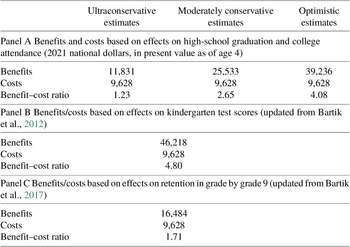
Table 2 shows the benefit–cost results. Even under ultraconservative assumptions—that Tulsa pre-K, despite large effects on college attendance, has zero effects on college degree completion—the present value of the future earnings increase exceeds pre-K costs. The benefit–cost ratio is 1.23.
Benefit–cost results for Tulsa pre-K, using different methodologies.

Note: See text for sources. Estimated benefits and costs are in 2021 national dollars, discounted to age four at a 3 percent social discount rate, for Tulsa pre-K students entering kindergarten in fall of 2006. Benefits are only effects on future earnings of former child participants.
Under more realistic assumptions, the benefits are higher, and so is the benefit–cost ratio. Under more optimistic assumptions, where we assume that the proportion of the added college attendees completing a degree is similar to what we find on average, the benefit–cost ratio jumps to 4.08.
As mentioned, although the last set of assumptions is optimistic, the derived benefit–cost ratio does not represent an upper bound. It is certainly possible that the effects of Tulsa pre-K on college degree completion are higher than the typical patterns of college completion, just as its effects on college attendance are higher than would be expected based on effects on high-school graduation rates. And earnings effects may occur in ways that are not mediated through educational attainment effects—for example, through extra employment effects.
A conservative approach is to take an average of the ultraconservative and the optimistic estimates. Essentially, this assumes that the added proportions completing a degree, of those attending college, are only half as great as what we observe on average among Tulsa residents who attended college and are aged 25–29. Under these moderately conservative assumptions, the benefit–cost ratio is 2.65. We regard these moderately conservative assumptions as a lower bound to expected true benefits.
These can be compared with benefit–cost estimates based on the prior two Tulsa studies. Using effects on kindergarten test scores, the estimated benefit–cost ratio is 4.80, which is even higher than the current study’s optimistic estimates.Footnote 13 However, as mentioned, the current optimistic estimates may understate Tulsa pre-K’s earnings benefits.
In contrast, using effects on whether students are retained in their grade by ninth grade, the estimated benefit–cost ratio is 1.71.Footnote 14 This is higher than the ultraconservative estimates but significantly lower than even a moderately conservative estimate of 2.65, let alone the more optimistic evidence from the current long-term study of 4.08, and also much lower than the kindergarten test-score estimate of 4.80.
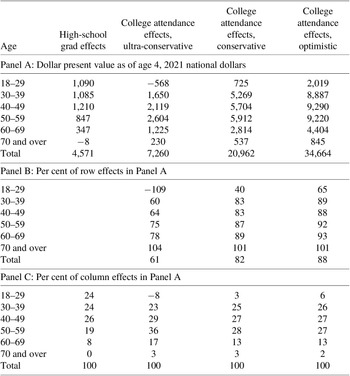
To gain more insight into these earnings benefits, Table 3 breaks out the earnings benefits under each of the three scenarios into two components according to whether earnings effects are due to effects on (1) high-school graduation or (2) college attendance. As shown, even under ultraconservative assumptions, a majority of the earnings benefits come from effects on college attendance, not high-school graduation ($7,260 for college attendance versus $4,571 for high-school graduation, out of the total of $11,831 given in Table 1). Panel B breaks this out as percentages of the total effect for each age range, and for the total, and shows that even under ultraconservative assumptions, the percentage total over all age ranges due to college attendance effects is 61 percent. (The 61 percent figure is in the bottom row of Panel B, the total row, and is under the ultraconservative column.)
Benefits broken down by high-school graduation effects versus college effects, and by age

Note: See text for sources. Panel B divides each row entry by total for high-school plus college effect at that age range, and reports as percent of this total. High-school percent of row total varies depending on scenario, and is 100 minus the college percent given in 3 scenarios. Panel C divides each column entry by total for that high-school or college effect over all ages, and reports as percent of this total.
For the “optimistic” and “moderately conservative” scenarios, the percentage due to effects on college attendance is even more overwhelming: 82 and 88 percent. This reflects both the very large earnings payoff to college degrees in today’s economy and the larger percentage-rate effect on college attendance in the underlying studies (10.1 percentage points for college attendance versus 2.7 percentage points for high-school graduation rates).Footnote 15
Table 3 also breaks down the present value of benefits by age, separately for both the high-school graduation effects and the college effects. As shown in Table 3, Panel C, almost half (48 percent) of the high-school graduation effects on increased earnings occur prior to age 40. In contrast, for the college effects on earnings, well more than half occur after age 40. (The actual percentages after age 40 are 85 percent for the ultra-conservative scenario, 72 percent for the conservative scenario, and 68 percent for the optimistic scenario.) This reflects that college has its largest dollar effects on earnings during later career years.
Implications and conclusion
As already mentioned, the results, as shown in Tables 1 and 2 and Figure 1, of this study and prior studies suggest a pattern of estimated future benefits of pre-K declining from kindergarten entrance through the K-12 years, before recovering once we begin getting more direct evidence on outcomes post-high school.
One possible implication is that pre-K’s long-term effects are primarily due to effects on “soft skills,” or on some type of skill or attribute that is not necessarily fully reflected in standardized test scores during K-12. This is consistent with other evidence on Tulsa pre-K. For example, Tulsa pre-K seemed to improve students’ behavior in high school, leading to reduced course failures, more AP course-taking, and better attendance (Amadon et al., Reference Amadon, Gormley, Claessens, Magnuson, Hummel‐Price and Room2022b). Current studies of the Tulsa pre-K program suggest that some Tulsa pre-K teachers seem to be able to improve students’ self-regulation, which may improve students’ long-run outcomes without necessarily improving standardized test scores (Phillips et al., Reference Phillips, Hutchison, Martin, Castle and Johnson2022).
Another implication is that policymakers may perhaps use near-term outcomes of pre-K as a rough indication of future benefits. Yes, these benefits may fade during K-12. But it is not at all obvious that “medium-term” benefit measures are superior to the short-term benefit measures as predictors of true long-term benefits.
Obviously, these conclusions may need to be modified as we continue to observe former Tulsa pre-K participants. It will be of great policy interest to see to what extent the effects on college attendance are reflected in effects on college degree completion. And it will be of even greater policy interest to observe the actual effects on adult earnings at different ages, as well as effects on involvement with crime, substance abuse, and other possible social problems. Earnings increases do not exhaust preschool’s potential social benefits.Footnote 16
Acknowledgments
We thank Claire Black and Ben Jones for their assistance.
Competing interest
The authors declare none.
A. Appendix A
A.1. More Information on Sources for pre-K costs per child in Table 1
A.1.1. Perry
Cost information is from Heckman et al. (Reference Heckman, Moon, Pinto, Savelyev and Yavitz2010). Updated to 2021 prices using CPI-U. No adjustment for local prices given uncertainty about local price differentials in 1960s. Cost is per child for program that was 2-year (ages 3 and 4) half-day pre-K program.
A.1.2. Abecedarian
Cost information is from Ludwig and Sawhill (Reference Ludwig and Sawhill2007). Updated to 2021 prices using CPI-U. No adjustment for local prices given uncertainty about local price differentials in 1960s. Cost is per child for 5-year program that is full-time full-year child care and preschool from shortly after birth until age 5.
A.1.3. Head Start
Cost information is from the U.S. Department of Health and Human Services (2022). Updated to 2021 prices using CPI-U.
A.1.4. CPC (Chicago Child–Parent Centers)
Cost information is from Karoly et al. (Reference Karoly, Cannon, Gomez and Whitaker2021) and is confirmed by using Reynolds et al. (Reference Reynolds, Temple, Barry, Ou and Robertson2011). Updated to 2021 prices using CPI-U. Adjusted by Karoly for local price differentials. Cost is per child for half-day pre-K program at ages 3 and 4, with costs given here based on 55 percent of children enrolling for 2 years, 45 percent for 1 year.
A.1.5. Tennessee pre-K
Cost information is from Karoly et al. (Reference Karoly, Cannon, Gomez and Whitaker2021). Updated to 2021 using CPI-U. Karoly et al. (Reference Karoly, Cannon, Gomez and Whitaker2021) adjust for local price differentials.
A.1.6. Boston pre-K
Cost information is from Karoly et al. (Reference Karoly, Cannon, Gomez and Whitaker2021). Updated to 2021 prices using CPI-U. Karoly et al. (Reference Karoly, Cannon, Gomez and Whitaker2021) adjust for local price differentials.
B. Appendix B
B.1. Sensitivity of Results to Low and High Treatment Effects
The main text estimates, in Tables 2 and 3, accept the point estimates from Amadon et al. (Reference Amadon, Gormley, Fuller and Hummel-Price2022a ) and Gormley et al. (Reference Gormley, Amadon, Magnuson, Claessens and Hummel-Price2023) as being accurate. The various scenarios then use different ways of extrapolating from the point estimates on college attendance to effects on college graduation. These college graduation effects are then added together with earnings effects from more high-school graduates.
But there is some uncertainty in these point estimates. Specifically, the standard error in Gormley et al. (Reference Gormley, Amadon, Magnuson, Claessens and Hummel-Price2023) is about 8 percent of the point estimate, and the standard error in Amadon et al. (Reference Amadon, Gormley, Fuller and Hummel-Price2022a ) is about 60 percent of the point estimate.
To deal with the uncertainly in estimated effects on college attendance and high-school graduation, we consider in this appendix how results vary under “low treatment effects” and “high treatment effects”. Just to clarify, this is different from our prior scenarios, which were based on different approaches to extrapolating from college attendance point estimates to college graduate effects. The “low treatment effects” and “high treatment effects” instead consider the possibility of different point estimates, for both college attendance effects and high-school graduation effects.
The low treatment effects subtract 1.96 times the percentage standard error is of the point estimates from the estimated effects on college attendance, and also does the same for the estimated effects on high-school graduation. This reduces the percentage point effect on college attendance from 10.1 percentage points to 8.5 percentage points, and reduces the percentage point effect on high-school graduation from 2.7 percentage points to MINUS 0.5 per cent.
Similarly, the high treatment effects add 1.96 times the standard errors in the underlying estimated effects on college attendance and high-school graduation. This modification increases the percentage point effect on college attendance from 10.1 percentage points to 11.7 percentage points, and increases the percentage point effect on high-school graduation from 2.7 percentage points to 5.8 percentage points.
Table 4 summarizes how the estimates change. The table reports the benefit–cost ratios for nine different calculations: the three treatment effect assumptions (low treatment effects, point estimate treatment effects, high treatment effects) times the three scenarios for translating college attendance rate effects into college graduate effects (ultra-conservative, conservative, and optimistic). The benefit–cost ratios under the point estimate treatment effects are identical to those reported in Table 2.
Benefit–cost ratios for Tulsa pre-K, different treatment effects, and college grad scenarios.

Note: Middle row estimates same as in Table 2. Low- and high-treatment effects derived as described in this Appendix.
As shown in Table 4, we get a benefit–cost ratio of less than one, at 0.55 in the upper-left-side corner, only if we simultaneously make two assumptions: low treatment effects; the ultra-conservative assumption that higher college attendance does not boost college graduation. Under all other variations in treatment effects, and assumptions about college attendance versus college graduation, the projected benefit–cost ratio is greater than one.
Why are results reasonably robust to alternative treatment effect assumptions? This robustness largely occurs because of the combination of two factors. First, the estimated college attendance results are reasonably precise. Second, as shown in Table 3, these college effects tend to dominate this benefit–cost analysis.
C. Appendix C
C.1. Discounting
The issue of discounting is obviously crucial to evaluating the impact of early childhood programs. These programs tend to have their greatest benefits at more than 30 years in the future, and the key question is therefore “How much should we spend today, to get some benefits more than 30 years later?” We briefly discuss this question here. A fuller discussion can be found in Bartik (Reference Bartik2011), Chapter 7, and Appendix 7A.
It is conventional to use a social discount rate of a 3 percent real rate, to reflect the reality that in the future we are likely to be wealthier. To express this more formally, it is common to use a Ramsey equation, in which the appropriate social discount rate depends on the growth rate of future consumption, the elasticity of marginal utility with respect to consumption, and a pure “time discounting factor,” or
 $$ r=d+ ge, $$
where r is the social discount rate, g is the assumed annual growth rate of per capita consumption, e is the elasticity of personal utility with respect to per capita consumption, and d is the assumed annual discount rate for future utility (sometimes called the pure rate of time preference). The basic idea is that we should discount the future more heavily, either because we have an inherent preference for the present over the future, or because our per capita consumption is rising, so we value consumption less in the future because we already have so much of it.Footnote 17
In the current case, we have g = 1.15 percent, based on the long-run economic growth assumptions of the Trustees of the Social Security Fund. There are various assumptions made about appropriate values of d and e. The Stern (Reference Stern2007) report on climate change assumed d = 0.1 and e = 1, which would yield a social discount rate of 1.25 percent. The well-known Moore et al. (Reference Moore, Boardman, Vining, Weimer and Greenberg2004) article on discounting assumed d = 1 and e = 1, which yields a social discount rate of 2.15 percent. In more recent work, Moore et al. (Reference Moore, Boardman and Vining2013a ,Reference Moore, Boardman and Vining b ) and Moore and Vining (Reference Moore and Vining2018) have assumed d = 1 and e = 1.35, which would yield a discount rate of 2.55 percent. Nobel Prize–winning economist Nordhaus (Reference Nordhaus2007) assumed e = 2 and d = 1.5, which would yield a social discount rate of 3.8 percent. The late well-known environmental and public-finance economist Weitzman (Reference Weitzman2007) advocated values of e = 2 and d = 2, which would yield a social discount rate of 4.3 per cent.
To understand how this might affect Tulsa pre-K benefits and costs, we can redo the benefit–cost model to see what social rate of return Tulsa pre-K has under various assumptions. By “social rate of return,” we mean the highest rate of return at which Tulsa pre-K has benefits exceeding costs. Doing so, it turns out that using high-school graduation and college attendance data, Tulsa pre-K’s real rate of return is 3.49 percent under ultraconservative assumptions, 5.48 percent under moderately conservative assumptions, and 6.68 percent under optimistic assumptions. Therefore, under moderately conservative or optimistic assumptions, Tulsa pre-K would have benefits greater than costs under any of the discount rates listed above, even Weitzman’s relatively high rate of 4.3 percent. On the other hand, under ultraconservative assumptions, Tulsa pre-K would not pass a benefit–cost test using the higher discount rates of Nordhaus or Weitzman.Footnote 18
What about the higher discount rate of 3.5 percent advocated in the recent papers by Moore et al. (Reference Moore, Boardman and Vining2013a ,Reference Moore, Boardman and Vining b ) and Moore and Vining (Reference Moore and Vining2018)? This social discount rate assumed a higher annual growth rate of future consumption per capita, and hence a higher growth rate of real earnings per capita. Specifically, Moore et al. (Reference Moore, Boardman and Vining2013a ) assumed annual growth rates of the economy’s productivity at 1.9 percent, and Moore and Vining (Reference Moore and Vining2018) assumed an annual growth rate of economic productivity of 2.0 percent. In both cases, some rounding was done to the resulting calculated social discount rates to get to 3.5 per cent.
If we are to use this suggested social discount rate of 3.5 percent, we should also use a higher assumed growth rate of future earnings per capita. Suppose rather than the 1.15 percent assumed in our projections in the text, we instead used 1.9 percent. And then suppose we used the suggested higher annual discount rate of 3.5 percent, rather than the 3 percent used in our text projections. This barely changes estimated benefit–cost ratios. The baseline benefit–cost ratios in Table 2 of the text under the ultra-conservative, conservative and optimistic scenarios are 1.23, 2.65, and 4.08. Under this higher discount rate of 3.5 percent, rationalized by a higher growth rate of economic productivity, the benefit–cost ratios shift upwards slightly to 1.26, 2.71, and 4.15, respectively.