Following the work of Edward Said, the last three decades have witnessed an eruption of scholarship on the relationship between Western conceptions of the Orient and British imperialism.Footnote 1 In recent years, increasing attention has also been paid to the ways in which the British empire in general was justified and perceived in the metropole.Footnote 2 There has, however, been little consideration of how discourses of empire and Orientalism were affected by Britain's imperial expansion into the Middle East during the First World War, the point when British domination of the Orient began in earnest. For the most part, it has been assumed that there was a marked continuity in underlying Western conceptions of the region during this period. According to this interpretation, the war merely witnessed the passing of Orientalist assumptions from the world of scholarship to the imperial expert and administrator, the culmination of a process that had developed throughout the nineteenth century.Footnote 3 To be sure, historians such as John MacKenzie have emphasized the protean nature of Orientalism, and the need to understand the specific historical context of how the Near East was understood in the West at a given moment.Footnote 4 Nevertheless, the turning point of the First World War has not, hitherto, received such focused scrutiny. It is argued in this article, however, that there was a fundamental shift during the war in Western representations of the Orient and Britain's role in the region.
Before 1914, the Ottoman empire was widely seen as inextricably linked with the Near East. It is highly significant that alongside terms such as the ‘Near East’ and the ‘Orient’ the area was frequently referred to as ‘Asiatic Turkey’.Footnote 5 The subject peoples of the empire, particularly the Arabs, were often described as degenerate, exotic, or admirably pre-modern.Footnote 6 Characterizations of the non-Turkish population varied, but a consistent motif was their inability to progress and thereby to recover the vitality of their pre-Ottoman and ancient heritage.Footnote 7 The dynamic agents of change in the area were the Ottoman Turks themselves, whose decline was often discussed but whose downfall was scarcely anticipated at any time soon. Indeed, a strong plank of British foreign policy prior to the war had been the perpetuation of Turkish rule, in order to prevent a dangerous scramble among the Great Powers.Footnote 8
By the end of 1918, a completely different picture of the Orient and its future emerged in Britain, and was disseminated across much of the globe. This new discourse was constructed by the British government through a largely overlooked, but far-reaching, propaganda campaign designed to generate support for the war effort and Britain's imperial move into the Near East. The objective was to justify the destruction of the Ottoman empire and to align Britain's war in the East with the principle of national self-determination, which had come to the fore in political discourse in the USA and Allied countries. In this climate, old Orientalist discourses were not sufficient to rally opinion in both the West and the Ottoman empire for Britain's Eastern campaign and her post-war dominance of the region. To meet this challenge, a new nation-based language of the Orient and empire had to be articulated. As a result, ‘Asiatic Turkey’ was discredited and re-invented as the ‘Middle East’, a term that had been coined in 1902, but rarely used until the war.Footnote 9 Rather than a stagnant territory of perennially backward peoples, this ‘Middle East’ was portrayed as a region of oppressed historical nations, the Arabs, Jews, and Armenians, who were on the verge of a remarkable renaissance following their liberation and future tutelage by Britain and the entente. Building on past narratives of imperial trusteeship, Britain was heralded as the natural protector of small, oppressed nations and the guarantor of national self-determination. Nationalism was thus brought to the very centre of justifications for empire. In this new vision of a re-animated Orient under British auspices, Jews played a central role. The significance of Jews in Western conceptions of the Orient has only just begun to be appreciated by scholars.Footnote 10 Part of the aim of this article is to contribute to this re-integration of Jews into British and European views of the ‘Middle East’ in the early twentieth century.
I
Despite the Sykes–Picot Agreement of May 1916 and British sponsorship of the Arab Revolt, the Asquith government had refused to undertake a military campaign in the Ottoman empire, after the disasters of the Dardanelles and Kut.Footnote 11 This state of affairs changed almost overnight with the coming to power of the Lloyd George coalition in December 1916. David Lloyd George, the new prime minister, saw British interests in the Near East as vital for the future of the empire, and considered an Eastern campaign to be critical for the war effort. He was determined to destroy the Ottoman empire and secure British control of the region, especially in Palestine and Mesopotamia, so as to protect the Suez Canal and the path to India.Footnote 12 Although there were some sporadic efforts to discuss a separate peace with the Turks under Lloyd George, the end of Ottoman rule in the Near East was considered to be an essential war aim that could not be compromised.Footnote 13
In reference to the future of Palestine, the prime minister famously told Lord Bertie, the British ambassador to France, ‘we shall be there by conquest and shall remain’.Footnote 14 But Lloyd George was quite aware that his plans for a British-dominated Near East would not be so easily achieved. The Ottoman empire had lasted for 400 years, and was seen by many as being synonymous with the Orient. According to Downing Street, the common Western perception of the Near East was that of a homogeneous land that was a natural part of Turkey.Footnote 15 In addition, there was thought to be widespread residual sympathy and admiration for traditional Oriental Turkish society, its chivalry, piety, and Eastern charm.Footnote 16 The ‘natural sympathy’ between ‘Turks and Englishmen’, an imagined bond that has been largely overlooked by scholars, continued to trouble officials in Whitehall until the end of the war.Footnote 17 These positive views of the ‘old Turk’ co-existed in Britain with a longstanding negative characterization of the Ottomans, particularly the Young Turks, as being innately despotic and murderous, and the antithesis of civilized Christian Europe.Footnote 18 Lloyd George belonged to the latter school of thought. So as to justify the dismemberment of the Ottoman empire, he placed great significance on propagating this view across the world, to dispel, once and for all, the notion that the Turks could not, or should not, be ejected from the Near East.
To this end, Lloyd George instructed the new head of the Department of Information, John Buchan, in February 1917 to initiate a propaganda campaign in Britain and across Allied and neutral countries under the banner ‘The Turk Must Go’.Footnote 19 This propaganda was to convey two principal messages: the immutable barbarism of the Turk and the illegitimate and destructive nature of his empire. The first message drew upon the longstanding discourse of Ottoman despotism, and the second derived from the Orientalist idea of the ancient East as the cradle of civilization. In both cases, history was the lens through which the Ottoman empire was to be shown as ‘not in any sense of the word a unit but a tortuous conglomeration which might well be taken to pieces again’.Footnote 20 Lloyd George wanted the world to believe, as he did himself,Footnote 21 that the Orient had been a flourishing and vibrant region that had given Europe the seeds of civilization, but had been forced into dramatic decline by Ottoman mis-rule. Buchan was instructed to disseminate articles across the world ‘as to the fertility and greatness of the lands now covered by the Turkish Empire, before the advent of the devastator: How the Turk, by his rule, made … these once rich lands … a wilderness’.Footnote 22 According to this historical narrative, the pre-Ottoman Near East and specifically the ancient nations of the area were depicted as the authentic basis and geography of the region. Government propagandists were requested to publish material on ‘the civilisation that once flourished in Mesopotamia, upon the history of Palestine, upon Syrian civilisation, upon the struggles of the Armenians to preserve Christianity, upon the cities of Asia Minor’.Footnote 23 Rather than the sanjaks and vilayets of ‘Turkey-in-Asia’, the Near East was thus to be portrayed as a landscape of oppressed nations. The nations that were cited by Lloyd George, such as Palestine and Mesopotamia, came directly from the Orientalist and Biblical literature of the ancient East, rather than any existing reality in the Ottoman empire.Footnote 24 Nevertheless, not only did Lloyd George believe in this vision of the Orient, but more to the point, it served to historicize and endorse the call to end Turkish rule in the region.
Following Lloyd George's instructions, writers described the glories of the ancient East, the bewildering diversity of the Ottoman empire, and the savagery of the modern Turk, ‘the embodiment of ruthless action and inflexible tyranny’.Footnote 25 The central focus for this narrative of Turkish barbarism was the Ottoman genocide of the Armenians in 1915, which was readily exploited by the British government.Footnote 26 The genocide was not just publicized as an event in and of itself, but as part of a broader narrative of Ottoman brutality and a policy of extermination across its territory. Buchan instructed his Department of Information to use ‘Constant journalistic reminders as to recent Turkish exploits – Armenian massacres, Syrian famine, the brutalities [of the ruling party] [and that] … the best elements in Turkey are incapable of setting their house in order.’Footnote 27 The Ottoman empire was cast as a landscape haunted by gallows, disease, and famine, which were not the result of the ravages of war, but the insatiable tyranny of ‘the Turk’.Footnote 28
The overriding goal of these narratives was, as Buchan explained, to make the ‘impossible position of Turkey … a platitude among Allies and neutrals’.Footnote 29 There was essentially nothing new about the content of the propaganda, which merely amplified longstanding myths to serve Lloyd George's imperial objectives. Indeed, the campaign constituted an attempt to mobilize pre-war Orientalism for the imperial cause. The original wish-list of writers, compiled by Buchan, speaks for itself, including as it did a number of Orientalist scholars and experts, such as Professors E. G. Browne, Anthony Bevan and Guy Le Strange of Cambridge, D. S. Hogarth, and Gertrude Bell.Footnote 30 The campaign was unsurprisingly focused on the glorious past and damnable present of the Orient, with special attention being paid to the murderous Ottomans. There was no emphasis on the future of the region as such, and thus no need to consider how Asiatic Turkey might have to be re-shaped without the Ottomans.Footnote 31 But as military and political events unfolded in 1917, it became necessary for British propagandists to focus on the future of ‘Asiatic Turkey’ and to justify the part that they hoped would be played by Britain in this new era. As a result, new conceptions of both the Orient and the British empire were formulated, which built upon Lloyd George's original and ongoing anti-Turkish campaign.
II
By April 1917, the War Cabinet had begun to clarify its post-war imperial desiderata in the Ottoman empire, which included British control of Palestine and Mesopotamia, and progress was being made in the military campaigns in these areas.Footnote 32 At the same time, however, Britain's ability to secure these objectives was far from certain. Both the Russian provisional government that had come to power in March and Woodrow Wilson were espousing the principles of national self-determination and no-annexations as the basis for the post-war peace. It was increasingly clear that Wilson, in particular, would be a dominating figure at the peace table, and that Britain's claims in the Near East would have to be presented in line with his declared goals.Footnote 33 There were also domestic concerns regarding liberal ‘semi-pacifists’ who were anxious about Britain's war aims, and were quick to see an ‘Imperialistic’ tendency in any diversion from the Western front.Footnote 34 In addition, the British government's new war aims in the Ottoman empire were at variance with the provisions of the Sykes–Picot Agreement, which had envisaged an internationalized Palestine and French influence in the Mosul vilayet. Somehow, the British government had to overcome French claims though, as the war progressed, the threat posed by Wilson came to be seen as a more significant factor.Footnote 35
Combined with these imperial considerations, there was a perceived need for propaganda to mobilize pro-British sentiment among the Arab population as the Eastern campaign advanced.Footnote 36 Since 1914, the British had desperately sought to maintain their prestige in the Near East, and to counter the spectre of anti-British pan-Islamic propaganda that was being fostered by the Germans and the Turks.Footnote 37 Due to the racial nationalist perceptions of Arab society that were held by policy-makers, it was believed that the promise of Arab national freedom would generate enthusiasm for the British cause, and ensure acquiescence to British control in the region during and after the war.Footnote 38 Moreover, the beneficent nature of nationalism in the minds of policy-makers meant that it was seen as the antidote to the pernicious threat of pan-Islam.Footnote 39
Winning opinion in the Middle East and overcoming the obstacles to British desiderata in the region were not the only considerations that raised the future of the Ottoman empire. By April 1917, war propaganda in general had become more critical than ever, due to the threat of pacifism in Russia and the growing need for resources and support from Allied and neutral countries, particularly the USA.Footnote 40 Significantly, it was mistakenly believed in Whitehall that ethnic groups, including the Arabs, Armenians, and to a far greater extent, the Jews, wielded influence in their host societies, and that their power had to be won over to the British and Allied cause from the clutches of the enemy. The influence of racial and nationalist thought among policy-makers led to a general assumption that nationalism was the key to winning over this ethnic sentiment.Footnote 41 By December 1917, it was also felt in the Foreign Office that the cause of a liberated Near East, and particularly the plight of the Armenians, was a powerful weapon that could be used to generate enthusiasm for the war in the United States.Footnote 42 In sum, the cause of national self-determination was seen as a panacea that would win hearts and minds in the USA, the Middle East and its diasporas, and gain acceptance for British expansion into the Ottoman empire.
As a result, the British government sought to portray the advance of British imperial troops into the Orient as a war of liberation for Zionism, Arab, and Armenian nationalism. These movements were, according to a prominent Whitehall adviser on the Near East, both ‘big Entente War assets and [Peace] Conference assets’.Footnote 43 The enlistment of these causes to cloak British war aims has been discussed by a number of scholars, who have contended that it led to official, carefully worded pro-nationalist pronouncements, including the Balfour Declaration, Lloyd George's war aims speech at Caxton Hall in January 1918, the ‘Declaration to the Seven’ of June 1918, which was given to seven Syrian nationalist leaders in Egypt, and the Anglo-French Declaration of November 1918.Footnote 44 These statements, however, were only one aspect of an elaborate Middle Eastern propaganda campaign that evolved in the course of 1917 and 1918. Britain's struggle for the principle of national freedom had to be explained and extolled, and, wherever possible, visualized and performed. Unlike Lloyd George's original anti-Ottoman initiative, this nationalist propaganda did not stem from a single, well-defined plan. Instead, there were a set of governing themes that underpinned a number of propaganda initiatives that escalated in intensity as the war progressed.
Much of this propaganda was managed by Sir Mark Sykes, a self-styled amateur Orientalist, who had become known in parts of Whitehall as ‘almost our greatest authority on Turks and Arabs’.Footnote 45 As a member of the War Cabinet Secretariat and then the Foreign Office, he developed the new vision of the post-Ottoman East that was intended to meet the Wilsonian threat, but also reflected his own personal conviction that the principle of nationality was the only basis for a stable post-war Near East.Footnote 46 According to this narrative, the Armenian, Jewish, and Arab nations constituted the genuine, historical basis of the region, which had been repressed by the Ottoman Turks. These nations had therefore to be liberated and revived by Britain and her allies, to enable the area to regain the glories of its ancient past. Reflecting this idea of a new, independent future ‘Asiatic Turkey’ was increasingly referred to as the ‘Middle East’, a term that Sykes had helped to popularize from the summer of 1916.Footnote 47 The precise geographical definition of the ‘Middle East’ was not worked out for the duration of the war, as that was beside the point.Footnote 48 Rather, its significance lay in what it served to represent as a concept: a revived nationalized landscape between East and West, that was to be free from Ottoman despotism and would achieve redemption under Allied protection. By the end of 1917, this concept was the clarion call of the British government regarding the future of the Ottoman empire. It was summed up in a published speech by Lord Robert Cecil, the parliamentary Under-Secretary of State for Foreign Affairs, in which he said, ‘[o]ur wish is that Arabian countries shall be for the Arabs, Armenia for the Armenians, and Judea for the Jews’.Footnote 49 Nationalism, as per the thinking of the time, was the redemptive force that was to take Western Asia back toward civilization.
This idea of a revived nation-based Orient was fundamentally different from previous conceptions of the region in Britain. To be sure, the oppression of the Armenians by the Turks, the idea of the Jewish return to Palestine, and the racial, if not nationalist, figure of the Arab were all present in Victorian and Edwardian culture.Footnote 50 In addition, the portrayal of the Jews as an integral part of the Middle East had its roots in a long history of European associations between Jews, Islam and the Orient.Footnote 51 Nevertheless, the Armenian, Arab, and Zionist nationalist movements did not feature significantly in mainstream European perceptions of the Orient and its future before the war.Footnote 52 The aims of these small but growing movements, however, provided a vehicle that fitted the zeitgeist of a war that was said to be fought for subjugated nations.
Whether the audience was in Western Asia or the USA, British propaganda regarding the Middle East was designed to re-fashion the image of the British empire in line with Wilsonian ideals, as much as it was intended to change views of the Orient. The British empire, or more accurately Great Britain, was re-packaged as the foremost agent of national self-determination. Although this narrative drew on longstanding ideas of imperial trusteeship, it constituted a new definition of Britain's mission in the world, which Sykes felt was required for public consumption at a time when imperialism had become tainted.Footnote 53 He declared in the House of Commons in July 1917, followed by the cheers of Lloyd George, ‘We British are fighting for Empire … I do not speak in the Imperialistic sense when I use the word “Empire” … we are fighting that we may carry democracy, civilisation and progress into Asia in the years to come.’Footnote 54 Presumably to avoid awkward explanations of how ‘Empire’ did not mean imperialism, the word itself was rarely used in the government's propaganda. Instead, Great Britain tended to be the preferred referent, hailed as the altruistic guardian of oppressed nations in the Middle East.
It is worth noting that this nationalist propaganda was not supported by all of the relevant departments involved in the making of Middle Eastern policy, particularly the India Office.Footnote 55 Such opposition, however, could not overcome the strong voices in the Foreign Office and the War Cabinet that stressed the critical importance of fostering the illusion of national self-determination.
III
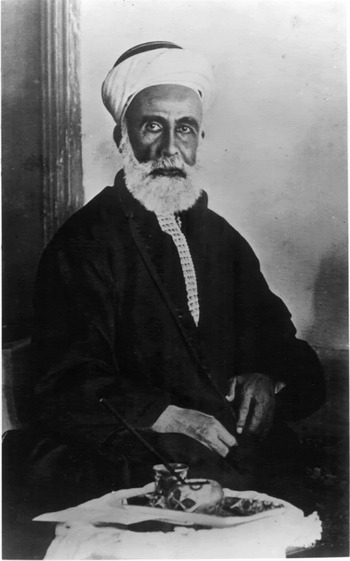
The key symbol of British support for the renaissance of the Arab nation was the Arab Revolt against the Turks that began in June 1916, led by the British-backed Sherif Hussein of Mecca. Armed with this testament to the Anglo-Arab alliance, the myth of an Arab national revival under British protection was widely disseminated, though it was not fully emphasized until 1917. This propaganda was distributed by the Department of Information, the Foreign Office, and the Arab Bureau in Cairo via Reuters, the news agency, posters, and Western and Arabic press, which included the ironically entitled pictorial newspaper Al-Hakikat (The Truth).Footnote 56 Not only did government agencies devise and publish such Arab propaganda, but, in many senses, they created the edifice of the Arab nation, as per European norms, for popular consumption. Hussein, who declared himself ‘King of the Arab nation’ in 1917, was publicized in the West and the Middle East as the leader and emblem of the national cause. The Foreign Office was careful not to label him ‘King of the Arabs’, and set upon ‘King of the Hedjaz’ as his official moniker, so as to avoid conflicts with other Arab leaders.Footnote 57 But despite this attention to detail in official pronouncements, the general narrative that was disseminated was much bolder, and acclaimed him as the leader of the nation in its struggle for independence.Footnote 58 A stock image of Hussein as the iconic symbol of the nation was circulated by the Department of Information and published in press and pamphlets.Footnote 59 As the war progressed into 1918, the emphasis shifted from Hussein to the Arab army, and its commander, Emir Feisel, Hussein's third son.Footnote 60 Written and photographic depictions of Feisal, the enthusiastic recruitment of Arab soldiers who were joining to fight for the cause of national liberation with Britain, and the advance of their campaign all served to demonstrate the nation's will to self-determination through the attributes of military valour, pride, and prowess on the battlefield.Footnote 61
Sherif Hussein of Mecca. Q.59888, courtesy of the Photograph Archive, Imperial War Museum.

Sykes completed this national symbolism with the invention of the Arab national flag, the essential European marker of a nation. Drawing together colours that represented the great dynasties of Arab history, Sykes fashioned a symbol that spoke of a renewed national unity, which fused the glories of the civilizations of old with the new nationalist, independent future: black for the Abbasids of Baghdad, white for the Omayyads of Damascus, green for the Alids of Kerbala, and red for Hussein and most of the Trucial Chiefs.Footnote 62 Together, the Arab national flag, army and leadership were used by British propagandists to project the myth of the Arab awakening under British protection.
The first major display of the rhetoric of Arab liberation followed the occupation of Baghdad on 11 March 1917, with General Maude's official entry and declaration. The declaration was carefully drafted by Sykes and refined by a War Cabinet subcommittee, which intended to make the most of Sykes's rhetoric, whilst avoiding any explicit commitments to Arab self-government in the future.Footnote 63 The War Cabinet placed considerable importance on inspiring the Arabs throughout the East with the façade of an Arab administration in Baghdad, and ‘announcing the fact in a manner that would appeal to their imagination’.Footnote 64 With Sykes's flowery and dramatic turn of phrase, the end product expressed the drama of Arab suffering under the Ottomans and the promise of the future. In contrast to the Ottoman oppressor, Britain was depicted as not only the agent of liberation, but also of Arab revival, returning all Arabs to the glories of their lost Golden Age. The British occupation of Baghdad was thus transformed into the display of the new rhetoric of empire, and the new, flourishing Orient.
It is the wish … of my King and his peoples … that you should prosper even as in the past, when your lands were fertile, when your ancestors gave to the world literature, science and art, and when Baghdad city was one of the wonders of the world.Footnote 65
To emphasize the idea of a new dawn of Arab freedom, King Hussein and the Arab Revolt were utilized as the symbol of what would now be the lot of the Arabs through British liberation: freedom, independence and unity.
In Hedjaz the Arabs have expelled … [those who] … oppressed them and proclaimed the Sherif Hussein as their King, and his lordship rules in independence and freedom, and is the ally of the nations who are fighting against the power of Turkey and Germany … I am commanded to invite you to participate in the management of your civil affairs in collaboration with the political representatives of GB … that you may be united with your kinsmen in North, East, South, and West in realising the aspirations of your race.Footnote 66
In addition to the proclamation, the moment of liberation was captured by a photograph of the official entrance of Anglo-Indian forces into the city.Footnote 67 This visual and textual imagery was publicized throughout the region and displayed the opening of a new era, unfolding with the Allied advance in Western Asia. As one official in the Department of Information put it, ‘we advertised our success very widely and by all possible means’.Footnote 68 For the English-speaking world, the myth of British liberation and the Arab revival was encapsulated in a pamphlet published by Wellington House, which was responsible for literary propaganda, entitled Arab independence and the king of Hedjaz.Footnote 69 Alongside Maude's Baghdad declaration, the pamphlet included a proclamation of independence from the Turks by Hussein, which emphasized the symbiotic relationship between British liberation and Arab national freedom. Sykes underlined Britain's selfless mission of restoring the greatness of the Arabs in an anonymous article in The Times distributed across the globe by the Department of Information, in which he wrote, ‘[t]o help the Arab once again to greatness, and begin afresh the great story of Semitic civilisation is more than an Imperial task, it is a contribution to the fulfilment of the destiny of mankind’.Footnote 70
By the summer of 1918, the need to step up the ongoing Arab propaganda campaign had become acute. The advance of Turco-German forces in the Caucasus after the Bolshevik revolution and the Treaty of Brest-Litovsk had sharply accentuated the importance of securing Britain's position in the Middle East. In the minds of a number of policy-makers Germany's Drang nach Osten, its determined eastward expansion, now posed a direct threat to the security of Britain's Eastern empire.Footnote 71 The impetus for an intensification of Arab propaganda, however, stemmed from the publication of the Sykes–Picot Agreement by the Bolsheviks at the end of 1917, and its dissemination by the Ottomans. Claiming only to have heard of the agreement in June 1918, Hussein was greatly perturbed, and had to be reassured of Britain's commitment to Arab independence after the war.Footnote 72 At the same time, there was profound concern in the Foreign Office and the Cabinet's inter-departmental Eastern Committee, which decided on policy in the Middle East, that in advance of the impending peace conference the British and French governments had to show, beyond any shadow of doubt, that their ambitions were fully in line with the principle of national self-determination. In order to convince Hussein, the Arab world, and the USA of the entente's pro-nationalist intentions, the British pressured the French into making a joint public statement.Footnote 73 The resulting Anglo-French declaration of November 1918 stated unequivocally that their aim was to assist the establishment of indigenous self-government in Syria, Mesopotamia, and other territories that were to be liberated by the Allies. The objective was, as Sykes put it, to ‘clear us of all possible charges of Imperialism’.Footnote 74
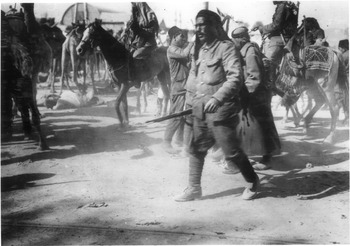
Against this backdrop, the British seized the opportunity to perform the culmination of the narrative of Arab liberation with the capture of Damascus on 1 October 1918. Through the occupation of this ancient Arab city, the British strove to promote the myth of Arab restoration and the great victory of the Arab national army. Prior to the capture of Damascus, the Allies, at the request of the Foreign Office, publicly recognized the belligerent status of the Arab army that was fighting in Palestine and Syria.Footnote 75 In addition, as the late Elie Kedourie argued, British imperial troops were instructed not to enter the city once the Turks had been defeated. The Sherifian army would be the first into Damascus, the Arab flag was to be raised across the city, and a civil administration was to be established under Feisal.Footnote 76 ‘Full publicity’ in The Times was demanded by Sykes for an article that narrated this Arab struggle for Damascus, and described Feisal's entry into the city on horseback at ‘full gallop’, like the Arab Emirs of the distant past.Footnote 77 A number of pictures were taken to show Arab independence in action, with images of Feisel, Sherifian troops, and the Arab administration in place in Damascus, flying the Arab national colours.Footnote 78 The façade of Arab independence was thus created, though it has to be noted that as a sign of the trouble that awaited Britain and later France, the British found that the Arab flag and administration had already been raised before they arrived.Footnote 79
‘Some Sherifian troops on arrival in Damascus, 1st October 1918’. Q.12369, courtesy of the Photograph Archive, Imperial War Museum.

It was after the end of the war, however, that the Arab army and its commander were truly lionized. A series of articles penned by T. E. Lawrence were published in The Times in November 1918 with the title ‘The Arab epic’, which narrated the romantic exploits and Figures of the Arab Revolt.Footnote 80 The accompanying editorial summed up the narrative of the new Middle East and the revival of the Arab nation under the British, which had been created since early 1917:
[The new states of Arabia, Palestine and Armenia will] call into a new existence an old and progressive civilization, in the hope that it will redeem this splendid heritage of the Middle East from the ruin to which the rule of the Turk has brought it. The cause for which we are fighting in the East … [is] to establish the rights of nationality and to replace the rule of force by justice and progress.Footnote 81
Alongside the revival and liberation of the Arab nation, therefore, British propagandists promoted the idea of the Armenian nation and the promise of Allied support for its rescue and renaissance. The Armenians were depicted as a nation defined by a history of persecution. As discussed above, the focus of this narrative was the Armenian genocide of 1915, which constituted the clearest proof of the iniquity of the Turk, and the most potent symbol of the Allied struggle for the principle of national self-determination. As one text declared, ‘what nobler … culmination to [the Allied and US cause] … than the redemption and re-birth of this thrice martyred ancient Christian people’.Footnote 82 In contrast to the Arabs, however, the visual display of a liberated and revived Armenian nation under British auspices was not possible due to the absence of a significant British military presence in the regions that constituted historic Armenia, in Eastern Anatolia and Transcaucasia. Unlike Mesopotamia, Syria, and Palestine, the British had no territorial desiderata in Armenia, which had been allotted to Russia and France in the Sykes–Picot Agreement.Footnote 83 For this reason, there was no Armenian equivalent to the symbol of the Arab army fighting for independence with the British. In 1915, Armenian proposals to establish military units for a campaign in Cilicia were turned down by the War Office. Armenians were incorporated in the Légion d'Orient that was established by the French in late 1916 to fight in the Palestine campaign, but it received little publicity, for fear of Turkish reprisals, and did not participate in any fighting that related to the future of Armenia.Footnote 84 It was only after the Russian collapse in the Caucasus, following the Bolshevik Revolution, that the Foreign Office decided to give considerable assistance to Armenian troops in the region, as they were seen to be a reliable force in the struggle to hold off the Turks.Footnote 85 Plans to equip and train the Armenians were, however, prevented by the chaotic conditions that engulfed the Caucasus at the time, and a lack of commitment by the War Office.Footnote 86 British involvement in the fight for a free Armenia was reduced to the encouragement of Armenian forces with rhetoric about their future independence in the event of an Allied victory.Footnote 87 The single tangible achievement of Armenian nationalism during the war was the establishment of a small Armenian Republic in Transcaucasia in May 1918, whose existence had nothing to do with the Allies, and which was quickly forced to make peace with the Ottomans. Clearly, this very limited realization of Armenian national ambitions did not fit with the narrative of a Middle East being liberated by the Allies, and was therefore ignored by British propagandists. There was, in short, no opportunity to act out the myth of Armenian national liberation. The last Armenian propaganda initiative undertaken during the war was a desperate attempt to counter the effects of a War Office communiqué to the press that claimed Armenians troops had betrayed the British by surrendering Baku in September 1918. Fearing an Armenian backlash, the Foreign Office published a carefully drafted letter from Lord Robert Cecil, then assistant secretary of state for foreign affairs, to Lord Bryce, the former ambassador to Washington and the foremost champion of the Armenian cause in Britain. The letter stressed Britain's commitment to the Armenians and the ‘charter of their rights for liberation’, which included an unceasing commitment to the Allied cause, the massacres at the hands of the Turks, and the valiant military record of Armenians who had fought the enemy with British, French, and Russian forces.Footnote 88 Such propaganda was paltry in comparison to the great fanfare that the British were able to concoct in relation to the Arab nation and its renewal, thanks to their military victories in Arab lands. This distinction reflected the very real absence of Britain's territorial ambitions in historic Armenia. Nevertheless, the perceived sympathy of the West for the Armenian cause after the genocide meant that the idea of a revived Armenian nation had remained an invaluable part of Britain's rhetoric of a post-Ottoman, nation-based Middle East.Footnote 89
In sharp contrast to the territory that constituted historic Armenia, Palestine was of great importance to Britain's military campaign and post-war designs in the Ottoman empire. The victories won by General Allenby's forces in the Holy Land, and particularly the capture of Jerusalem on 9 December 1917, afforded the ideal opportunity to display visibly the liberation of the Jewish nation and its restoration by the British. To a much greater extent than the occupation of Baghdad and Damascus, Allenby's orchestrated entrance into the Holy City was constructed and publicized as an event of global significance by the British government. It was believed by Lloyd George that its capture would generate pro-British sentiment across the world, among Christians, Muslims, and Jews.Footnote 90 In particular, great emphasis was placed on performing and disseminating the discourse of Jewish national rebirth. Due to the British belief in the power of the Jewish diaspora and the efficiency and organization of the government's Zionist allies, the narration of the Zionist renaissance was accorded far greater prominence in the West than its Arab counterpart.Footnote 91
There were a number of distinctions between the government's Zionist propaganda and the rest of its Middle Eastern campaign. First, the British worked in close co-operation with the Zionist movement in the creation and distribution of propaganda, and had the benefit of the latter's experience and organization. Second, unlike the Arab case, there was no need to invent the imagery and iconography of the Zionist nation, which had been keenly developed by the Zionist movement since its foundation at the end of the nineteenth century.Footnote 92 Rather, British officials and their Zionist partners used this discourse as the foundation for the language and symbolism that they crafted to narrate the restoration of the Jews. Third, the Zionist enterprise was portrayed by the Anglo-Zionist alliance as a developing, but already well-established, national movement that was bringing European science, culture, and civilization to the East.Footnote 93 In contrast, the Arabs were portrayed in the West as a people at an elementary stage in their national development.Footnote 94 When Sykes spoke of the Arab nation as the ‘child of the Entente’,Footnote 95 there was no sense, in the government's propaganda or in Whitehall, that the same could be said of the Jews, or indeed the Armenians.
Despite this image of the Zionist project in the official mind, the Zionist component of the government's Middle Eastern propaganda was, perhaps, the most striking testimony of the detachment between the myth that was being produced and the reality of the region. Not only were the Zionists, similar to the position of their Arab and Armenian nationalist counterparts,Footnote 96 a minority movement within the Jewish diaspora, albeit a growing one,Footnote 97 but the Jews of Palestine constituted only 10 per cent of the population. Nevertheless, British policy-makers were convinced that the majority of Jews were indeed Zionists, and armed with the Balfour Declaration of 2 November 1917 sought to show that the Jewish nation was, thanks to Great Britain, on the cusp of a new era of restoration in its national homeland.
Soon after the issuance of the Declaration, Albert Hyamson, a Zionist in the British civil service, was tasked with setting up a Jewish section in the Department of Information, which aimed to inspire Jewish support for the Allies and a post-war British Palestine.Footnote 98 Working in close co-operation with the Zionist leadership in London, Hyamson's office succeeded in establishing a propaganda network that spread across the Jewish and non-Jewish world, publishing news, pamphlets, photography, and books from the USA to North Africa.Footnote 99 Through these materials, the Balfour Declaration was constructed as ‘the greatest event in the history of the Jews since the dispersion’.Footnote 100 It was framed as the beginning of a new era of Jewish national existence in Palestine. As Cecil put it, the Declaration ‘was much more than the recognition of a nationality – it was the re-birth of a nation’.Footnote 101 The occupation of Palestine was presented as the enactment of this national restoration, as was highlighted by the title of one of the propaganda films ordered by Hyamson, ‘The British reconquering Palestine for the Jews’.Footnote 102
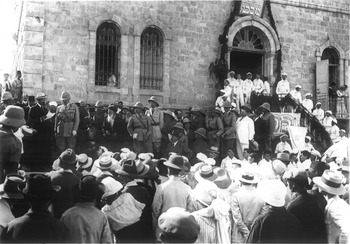
Aided by its Zionist allies in London and Palestine, the British government co-ordinated and displayed a series of theatrical acts in the Holy Land that communicated this message of deliverance. As a symbol of the new Anglo-Zionist entente, a Zionist Commission was sent to Palestine in March 1918, which, along with more practical objectives such as the improvement of Arab–Zionist relations, was intended to show that the Balfour Declaration was being put into practice.Footnote 103 Filmed and photographed by British personnel, the Commission participated in a number of ceremonies in the Jewish colonies, Tel Aviv, and Jerusalem,Footnote 104 and laid the foundation stones of the Hebrew University, which Balfour considered to be a sufficient ‘visible sign to the world that a new era in Palestine had been initiated.’Footnote 105
‘The reception to the commander-in-chief, Sir E. H. H. Allenby, in Jerusalem, by the Jewish community: address by Dr. Weizmann, chairman of the Zionist Commission’. Q.13209, courtesy of the Photograph Archive, Imperial War Museum.

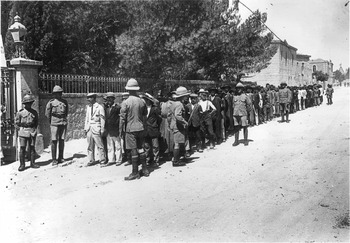
In addition to the Commission, the other key icon of Britain's support for the return of the Jewish nation was the Jewish Legion, the 38th battalion of the Royal Fusiliers,Footnote 106 which was ostensibly sent to Palestine in 1918 to join the fight for the liberation of the Holy Land. The Legion saw little active serviceFootnote 107 and was largely commissioned as a propaganda tool. The primary appeal of the Legion to Whitehall was, as its founder Vladimir Jabotinsky explained, ‘its obvious value for purposes of pro-entente and pro-victory propaganda’.Footnote 108 The Legion's chief function was as a symbol of national return, signifying the end of 2,000 years of exile with the restoration of Jewish manliness and strength. Known unofficially as ‘the Judeans’ the Legion represented the return of the nation that had been defeated by the Romans in 70 ce. This narrative was strikingly exhibited by a medal given to recruits that depicted a Roman retreat, and the awakening of Judaea from the torpor of subjugation and exile.Footnote 109 The Legion and its recruits were frequently photographed and filmed, both in Palestine and elsewhere, so as to portray the image of war enthusiasm, renewal, and pride.Footnote 110 As the member of the War Cabinet Secretariat, William Ormsby-Gore, wrote in one article, ‘These Jewish lads are coming forward willing sacrifices on the altar of a new national idealism the first fruits of that “risorgimento” of the Jewish people … and in doing so [have] committed their cause finally and irrevocably to the British people in whom they put their trust.’Footnote 111
‘Recruits for the 40th Battalion, Royal Fusiliers in Jerusalem, where 1,000 were recruited. Summer 1918’. Q.12671, courtesy of the Photograph Archive, Imperial War Museum.

Although these displays of the Jewish, Arab, and Armenian nations were undertaken separately, they were also held to represent a common ideal that would provide the heart of the re-built Middle East of the future, resurrecting a past Golden Age. Drawing on the racial myth of Semitic brotherhood, Nahum Sokolow, the Zionist leader, declared in a speech that was published by the Department of Information,
We look with fraternal love at the creation of the Arab kingdom, re-establishing Semitic nationality … and our heartiest wishes go out to the Armenian nationality for the realisation of their national hopes in their old Armenia. Our roots were united in the past, our destinies will be bound together in the future.Footnote 112
To exhibit this narrative, Arab, Armenian, and Zionist representatives were placed together on speaking platforms in Britain, attended the funeral of the Zionist leader, Yehiel Tschlenow, as a public show of solidarity, and were given a joint audience with Lloyd George in a visit to Manchester towards the end of the war.Footnote 113 Significantly, however, the concept of a shared Semitic revival in the Middle East was not a focus of the propaganda produced for the communities themselves. Evidently, it was not considered as having a resounding appeal, and was certainly regarded as out of touch with the realities of Arab, Armenian, and Jewish relations by British officials on the spot in the Middle East.Footnote 114 In the West, however, the message for general consumption was unequivocal. The commitments to Zionism, Arab, and Armenian nationalism were frequently discussed together as constituent parts of Britain's grand project to revive anew the lands of the Ottoman empire, and to construct what one journalist referred to as an ‘Asiatic Balkans’ – an epithet that would become more appropriate as the century wore on.Footnote 115
The idea of the ‘Middle East’ was thus created by the British government through its global propaganda campaign in the last two years of the Great War. The Orient was re-defined as a landscape of nations, the Arabs, the Armenians, and the Jews, which required liberation from the evil Ottoman Turks. The war in the East was therefore portrayed as a war of liberation, and Britain was acclaimed as the knowledgeable and civilized protector of these backward nations. Through this campaign it was hoped that Britain's post-war desiderata could be achieved at the eventual peace conference, and support for the war effort would be bolstered. In the end, the final agreements and the map of the Middle East were rather different. It was a tragic irony that the most recognized nationalist cause before the war, the Armenians, received nothing. By the time that the Mandate system was officially ratified by the League of Nations in July 1922, Britain's position of strength in the Middle East at the end of the war was also markedly undermined. Revolt and unrest in Iraq, Palestine, and Egypt, a need to minimize imperial expenditure, the emergence of the Bolshevik threat, and the resurgence of Turkish nationalism all combined to threaten Britain's geopolitical dominance of the Middle East.Footnote 116 Nevertheless, with the creation of the Mandates for the newly created countries of Palestine, Transjordan, and Iraq, Britain gained much of what Lloyd George had sought to grab, and the re-configured map of the former Ottoman empire was defined, in its own peculiar way, by the concept of the nation.
It is a tough task to assess the impact of the government's propaganda on how the Orient and its relationship with Britain were perceived in the West and the Ottoman empire. Towards the end of the war, A. J. Toynbee, the Middle East expert in the Foreign Office's Political Intelligence Department, reflected that ‘it has been hard to kill the superstition that the Turk is a gentleman and his subject races curs’.Footnote 117 The rhetoric of a non-imperialist war of liberation apparently failed to overcome scepticism in certain quarters, particularly in Britain. According to Toynbee, parts of the left-wing press had continually ‘taken the line that our professions of concern for the subject nationalities of Turkey are “camouflage”, and that H. M. G. are really pursuing a policy of annexations’.Footnote 118 With regard to the reception of British propaganda in the Near East, it was suggested in one report that the very premise of fighting for principles and altruism was not taken seriously by ‘the natives’,Footnote 119 though this assessment clearly said more about the assumptions of the author than it did about popular public opinion. Further research is still needed to gauge the full impact and consequences of the government's propaganda in the Middle East, as well as in Britain and elsewhere in the West. It is already clear, however, that the government's ability to shape perceptions of the Orient and the empire was limited. The new discourse of the Middle East did not supersede pre-war perceptions of Jews, Arabs, Armenians, and the Orient. Even in the government's own propaganda output, the political narrative of the new Middle East co-existed with escapist imagery designed to promote the romantic and mysterious charms of the East,Footnote 120 where British Tommies were fighting in a war that was a welcome distraction from the bloody carnage of the Western front. In the interwar period, this discourse came into full flower with the Lawrence of Arabia myth. In addition, acclaim for the revival of the Jewish nation as a positive contribution to the Middle East was accompanied after the war by the birth of political anti-Zionism in Britain.Footnote 121 In reference to the Armenians, sympathy for their cause soon withered away once the Armenian state failed to materialize.Footnote 122 Notwithstanding all of this, however, it is clear that the narratives disseminated by Britain's propaganda machine set a precedent for how the Middle East came to be perceived by many in a political sense in the West after the Great War: a region of nations, requiring Western, and in particular, British protection and intervention. In sharp contrast to the pre-war period, it was widely accepted, though not uncontested, that the Jews and the Arabs were nations, and that nationhood was the true essence of the Middle East, even though the idea of Semitic brotherhood was soon shown to be nothing but an Orientalist myth.