Methiozolin [(5-(2, 6-difluorobenzyl) oxymethyl-5-methyl-3-(3methylthiophen-2-yl)-1, 2-isoxazoline)] is an isoxazoline herbicide being investigated for selective POST annual bluegrass control in managed turfgrass (Koo et al. Reference Koo, Hwang, Jeon, Kim, Lim, Lee and Cho2014). Originally evaluated for barnyardgrass [Echinochloa crus-galli (L.) Beauv.] control in rice (Oryza sativa L.), methiozolin is highly efficacious for annual bluegrass control in a diversity of turfgrass species including Kentucky bluegrass (Poa pratensis L.), perennial ryegrass (Lolium perenne L.), zoysiagrass (Zoysia japonica Steud.), and creeping bentgrass (Agrostis stolonifera L.) (Hwang et al. Reference Hwang, Kim, Jeon, Hong, Song and Cho2005; Koo et al. Reference Koo, Hwang, Jeon, Kim, Lim, Lee and Cho2014). Methiozolin rates for effective POST annual bluegrass control range from 500 to 1,000 g ha−1 with sequential and timely applications required for eradication (Brosnan et al. Reference Brosnan, Henry, Breeden, Cooper and Serensits2013; Flessner et al. Reference Flessner, Wehtje and McElroy2013; Koo et al. Reference Koo, Hwang, Jeon, Kim, Lim, Lee and Cho2014).
Methiozolin is a soil-active herbicide that controls annual bluegrass via both root and shoot absorption (Brosnan et al. Reference Brosnan, Henry, Breeden, Cooper and Serensits2013; Flessner et al. Reference Flessner, Wehtje and McElroy2013). Sorption coefficients for methiozolin range from 0.4 to 29.4 mL g−1 across a range of sand-based soils containing variable quantities of organic matter, with minimal desorption and soil mobility (retardation factors [R f values] are less than 0.05 for soils containing organic matter) (Flessner et al. Reference Flessner, Wehtje, McElroy and Howe2015). Across a range of soils varying in organic matter content, Flessner et al. (Reference Flessner, Wehtje, McElroy and Howe2015) reported that 24% of applied methiozolin was available for root absorption. Flessner et al. (Reference Flessner, Wehtje and McElroy2013) reported 55% foliar absorption of 14C-methiozolin 24 h after treatment with 10% translocation above the treated leaf and only 1.3% translocation to foliage below the treated leaf. Responses following root exposure to methiozolin were similar, with substantial root absorption 24 hr after treatment with minimal translocation to annual bluegrass crowns and foliage, suggesting that methiozolin moves acropetally via xylem. Differences in absorption among annual bluegrass and desirable turfgrass species contribute to selectivity (McCullough et al. Reference McCullough, Gomez de Barreda and Yu2013).
There are conflicting reports regarding the mode of action of methiozolin. After conducting a series of experiments with duckweed (Lemna paucicostata L.), Grossmann et al. (Reference Grossmann, Hutzler, Tresch, Christiansen, Looser and Ehrhardt2012) suggested that methiozolin was an inhibitor of tyrosine aminotransferase (TAT), an enzyme involved in plastoquinone synthesis. Moreover, methiozolin increased concentrations of 3,4-dihydroxyphenylalinine (L-DOPA) in duckweed, a response that has been associated with phytotoxicity and reduced root growth (Hachinohe et al. Reference Hachinohe, Sunohara and Matsumoto2004; Hachinohe and Matsumoto Reference Hachinohe and Matsumoto2007). These findings conflict with those of Lee et al. (Reference Lee, Koo, Hwang, Hwang, Jeon and Kim2007), who suggested that methiozolin was an inhibitor of cellulose biosynthesis after observing that methiozolin treatment reduced incorporation of 14C-glucose into the cellulose and hemicellulose of root cell walls and inhibited root elongation in corn (Zea mays L.). Information pertaining to the mode of action of methiozolin in annual bluegrass is limited.
Effective herbicides for annual bluegrass control are critically important to turfgrass managers given widespread reports of herbicide resistance in annual bluegrass. At present, there are 12 reports of herbicide resistance in annual bluegrass, more than there are for any other turfgrass weed (Heap Reference Heap2016). These reports document annual bluegrass resistance to herbicides with diverse modes of action, including inhibition of microtubule formation (e.g., prodiamine), photosystem II (PSII) (e.g., simazine), acetolactate synthase (ALS) (e.g., trifloxysulfuron), and enolpyruvylshikimate-3-phosphate synthase (EPSPS) (e.g., glyphosate) (Heap Reference Heap2016). Multiple resistance in annual bluegrass has recently been confirmed as well (Breeden et al. Reference Breeden, Brosnan, Mueller, Breeden, Horvath and Senseman2017; Brosnan et al. Reference Brosnan, Vargas, Breeden, Grier, Aponte, Tresch and LaForest2016). We hypothesized that methiozolin may provide turfgrass managers with a tool for controlling herbicide-resistant annual bluegrass phenotypes, considering that it effectively controls annual bluegrass via a unique mode of action that is not thoroughly understood. To that end, glasshouse research was conducted to evaluate methiozolin efficacy for control of several herbicide-resistant annual bluegrass phenotypes.
Materials and Methods
Annual Bluegrass Phenotypes
Responses of herbicide-resistant annual bluegrass to increasing rates of methiozolin were evaluated in glasshouse experiments conducted at the University of Tennessee (Knoxville, TN; 35.56°N, 83.56°W) during spring of 2016. Four herbicide-resistant annual bluegrass phenotypes were included in these experiments: one with resistance to PSII-inhibiting herbicides such as simazine (R4), another with resistance to the EPSPS inhibitor glyphosate (R5), a third with resistance to both microtubule inhibitors (e.g., prodiamine) and glyphosate (R2), and a fourth with resistance to both PSII- and acetolactate synthase (ALS)-inhibiting herbicides (R3). Resistance in each phenotype was considered to be target site based. Glyphosate resistance in R2 and R5 was the result of a Pro-106-Ala substitution on EPSPS. Moreover, microtubule inhibitor resistance in R2 was the result of a Thr-239-Ile substitution on alpha-tubulin, whereas PSII inhibitor resistance in R4 was the result of a Ser-264-Gly substitution along the D1 protein. Resistance to PSII inhibitors in R3 was associated with the same Ser-264-Gly substitution, while ALS resistance was attributed to an Ala-205-Phe substitution on ALS (Brosnan et al. Reference Brosnan, Vargas, Breeden, Grier, Aponte, Tresch and LaForest2016). Complete DNA sequences for genes coding for EPSPS (KU382756–KU382767), alpha tubulin (KX524958–KX524970), and D1 protein (KX258687–KX258698) in the annual bluegrass phenotypes studied herein are available in GenBank (NCBI 2017). Primers used for DNA amplification are included as supplementary information. RNA sequencing (RNA-Seq) data characterizing R3 have also been made available by Brosnan et al. (Reference Brosnan, Vargas, Breeden, Grier, Aponte, Tresch and LaForest2016). An herbicide-susceptible (S) phenotype was included in all experiments for comparison.
All resistant and susceptible phenotypes were seeded into greenhouse flats (52 cm by 37 cm by 10 cm; Dillen Products/Myers Industries, Inc., Middlefield, OH.) filled with a peat moss growing medium (Growing Mix #2; Conrad Fafard, Inc., Agawam, MA) during August 2015 and placed in a glasshouse at the University of Tennessee. Phenotypes were supplied with complete fertilizer (20N-8.7P-16.6K; Howard Johnson’s Triple Twenty Plus Minors, Milwaukee, WI) at 49 kg N ha−1 wk−1 and irrigated to maximize growth and vigor. After a minimum of two leaves had formed on the plants, flats containing R3 and R4 germplasm were treated with simazine (Princep®, Syngenta Professional Products, Greensboro, NC) at 1,120 g ai ha−1 mixed with nonionic surfactant (Activator® 90, Loveland Products, Greeley, CO) at 0.25% (v/v). Herbicide was applied in an enclosed spray chamber (Generation III track sprayer, DeVries Manufacturing, Hollandale, MN) at 215 L ha−1 with a water carrier and 8004 EVS nozzle (TeeJet®, Wheaton, IL). After maturing to a three-tiller growth stage, R3 plants were treated with trifloxysulfuron (Monument®, Syngenta Professional Products, Greensboro, NC) at 28 g ai ha−1 plus nonionic surfactant at 0.25% (v/v) as well. Similarly, flats containing R2 and R5 germplasm were treated with glyphosate (Roundup® ProMax, Monsanto Company, St. Louis, MO) at 840 g ae ha−1 after the plants had formed a minimum of three tillers. Resistant plants (R2, R3, R4, and R5) surviving these applications was selected for use in methiozolin dose-response experiments described below.
Methiozolin Dose Response Experiments
On March 1, 2016, individual resistant (R2, R3, R4, and R5) and susceptible (S) annual bluegrass plants were transplanted from greenhouse flats filled with peat moss growing media into 164-cm3 cone-tainers (SC10 Super Cell Conetainer, Steuwe & Sons, Tangent, OR) filled with Sequatchie silt loam soil (fine-loamy, siliceous, semiactive, thermic humic Hapludult) with a pH of 6.2 and 2.1% organic matter. All peat moss media was removed from plants before they were transplanted into soil culture. Plants had a minimum of three tillers at the time of transplanting. After transplanting, cone-tainers were maintained in a glasshouse with 43% relative humidity and natural light. Daytime high temperatures averaged 30 C and nighttime low temperatures averaged 23 C. Plants received irrigation daily via an overhead misting system for five minutes per irrigation cycle, and nutrients were supplied a rate of 24 kg nitrogen (N) ha−1 every two weeks using the previously described complete fertilizer. After a two-week acclimation period, plants in cone-tainers were treated with methiozolin (MRC-01, Moghu Research Center, Daejeon, South Korea) at rates of 0; 125; 250; 500; 1,000; 2,000; 4,000; or 8,000 g ai ha−1 using the previously described spray chamber.
At 35 d after treatment with methiozolin, responses of the aforementioned annual bluegrass phenotypes to methiozolin were quantified by measuring percent control relative to the nontreated control (plants receiving 0 g ha−1 methiozolin). After visual assessments of annual bluegrass control were completed, all biomass above the soil line was harvested using scissors from each cone-tainer and dried in a forced-air oven at 105 C for 7 d and weighed. Dry biomass data were expressed as a percentage of the nontreated control (plants receiving 0 g ha−1 methiozolin) prior to statistical analysis.
Statistical Analysis
Experiments were designed as randomized complete blocks with four replications, and were repeated in time. A combined analysis of variance conducted in R (version 3.2.3) using expected means squares (McIntosh Reference McIntosh1983) determined that data could be combined across experimental runs. Nonlinear regression of the combined data set was conducted in Prism (Prism 6.0 for Mac OS X, GraphPad Software, La Jolla, CA).
Annual bluegrass control data were analyzed using a nonlinear regression equation (after Breeden et al. Reference Breeden, Brosnan, Mueller, Breeden, Horvath and Senseman2017):
 $$\eqalignno{ {\rm Control}\,{\equals}\,&{\rm Bottom}{\plus}\left( {{\rm Top}\!-\!{\rm Bottom}} \right)/\cr&{(\bigg {1{\plus}10^{{(({\rm Rate_{50}}}} _{{{\rm}}} {{^-}{^X}^{)}{^\asterisk}^K{^)}}} } \vskip-1pt\right).$$
In this equation, Rate50 represents the herbicide rate (X) at which 50% annual bluegrass control was achieved. Both asymptotes (bottom and top) are constrained to 0% and 100%, and K represents the slope of the best-fit line to model the response of resistant and susceptible phenotypes to increasing rates of methiozolin.
Dry biomass data were fit to an exponential decay nonlinear regression equation (after Breeden et al. Reference Breeden, Brosnan, Mueller, Breeden, Horvath and Senseman2017):
 $$\eqalignno{ {\rm Dry}\,&{\rm biomass}\,\left({\%\,\,{\rm nontreated}} \right)\,\cr&{\equals}\,\left( {{\rm Y0}-{\rm Plateau}} \right)\,{\asterisk}{\rm exp}\left( {{\minus}KX} \right){\plus}{\rm Plateau},$$
where Y0 and Plateau were constrained to 100 and 0, respectively, and K was the slope of the best-fit line to model the response of each phenotype to increasing rates of methiozolin (X). The methiozolin rate required to reduce dry biomass to 50% that of the nontreated plants (GR50) was calculated using the following formula: GR50=ln (2)/K. All data and analysis files are openly available (Brosnan Reference Brosnan, Vargas, Breeden, Grier, Aponte, Tresch and LaForest2016).
Results and Discussion
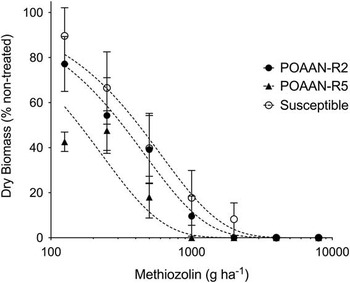
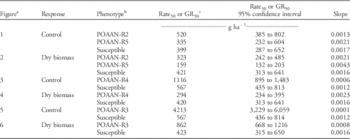
In our study, methiozolin effectively controlled one annual bluegrass phenotype with target site resistance to glyphosate (R5) and another with target site resistance to glyphosate and the microtubule-inhibiting herbicide prodiamine (R2) (Figure 1; Table 1). Rates of methiozolin required to effectively control 50% of the R5, R2, and S phenotypes were 335, 520, and 399 g ha−1, respectively, and were not significantly different from one another (Table 1). Assessments of biomass reduction following methiozolin treatment showed that less herbicide was required to reduce dry biomass of glyphosate-resistant annual bluegrass (R5) by 50% (GR50 value=159 g ha−1) than was required for a phenotype with resistance to both glyphosate and mitotic-inhibiting herbicides (R2; GR50 value=323 g ha−1) as well as a phenotype susceptible to both modes of action (S; GR50 value=421 g ha−1) (Figure 2; Table 1).
Control of annual bluegrass phenotypes with target-site resistance to glyphosate (POAAN-R5) as well as glyphosate and the microtubule inhibitor prodiamine (POAAN-R2) compared to that of a known susceptible phenotype, in response to increasing rates of methiozolin in glasshouse studies at the University of Tennessee (Knoxville, TN; 35.56°N, 83.56°W) in spring 2016. Means represent combined data from two experiments repeated in both time and space. Error bars indicate standard error of the mean for each assessment.

Dry biomass reduction of an annual bluegrass phenotypes with target site resistance to glyphosate (POAAN-R5) as well as glyphosate and the microtubule inhibitor prodiamine (POAAN-R2) compared to that of a known susceptible phenotype in response to increasing rates of methiozolin in glasshouse studies at the University of Tennessee (Knoxville, TN; 35.56°N, 83.56°W) in spring 2016. Data are expressed as a percentage of the nontreated control (0 g ha−1 methiozolin) for each phenotype with means combined from two experiments repeated in both time and space. Error bars indicate standard error of the mean for each assessment.

Regression parameters for control and biomass data representing annual bluegrass (Poa annua L.) responses to increasing rates of methiozolin in glasshouse experiments at the University of Tennessee (Knoxville, TN) in 2016 (Figures 1–6).

a
Control data in Figures 1 and 3 modeled using the following equation: Control (%)=Bottom + (Top–Bottom)/
 $${(\!\bigg {1\!{\plus}\!10^{{(({\rm Rate_{50}}}} _{{{\rm}}} {{^-}{^X}^{)}{^\asterisk}^K{^)\!}}})$$
, where Rate50 represents the herbicide rate (X) at which 50% annual bluegrass control was reached. Bottom and Top represent asymptotes that were constrained to 0% and 100%, and K represents the slope of the best-fit line to model the response of resistant and susceptible phenotypes to increasing rates of herbicide. Dry biomass data in Figures 2 and 4 modeled using the following equation: Dry biomass (% nontreated)=(Y0−Plateau)*exp(−KX) + Plateau, where Y0 and Plateau are constrained to 100 and 0, and K represents the slope of the best-fit line to model the response of each phenotype to increasing rates of herbicide (X). The herbicide rate required to reduce dry biomass to 50% that of the nontreated control (GR50) was calculated using the following formula: GR50=ln(2)/K.
b POAAN-R2=annual bluegrass with target site resistance to glyphosate and the microtubule inhibitor prodiamine; POAAN-R5=annual bluegrass with target site resistance to glyphosate; POAAN-R4=annual bluegrass with target site resistance to the photosystem II–inhibitor simazine; POAAN-R3=annual bluegrass with target site resistance to both photosystem II– and acetolactate synthase–inhibiting herbicides.
c Methiozolin rate (g ha−1) required to achieve 50% control of annual bluegrass (Rate50) or reduce dry biomass to 50% that of the nontreated control (GR50).
Similarly, methiozolin controlled annual bluegrass with target site resistance to the PSII-inhibiting herbicide simazine (R4) (Figure 3; Table 1). The methiozolin rate required to control 50% of annual bluegrass with target site resistance to PSII-inhibiting herbicides was 1,116 g ha−1 (Table 1), which was a higher rate than that required to control a susceptible phenotype (567 g ha−1). However, methiozolin rates required to reduce dry biomass of this PSII-resistant annual bluegrass phenotype (294 g ha−1) and the susceptible control (420 g ha−1) were statistically similar (Figure 4; Table 1).
Control of an annual bluegrass phenotype with target site resistance to the photosystem II inhibitor simazine (POAAN-R4) compared to that of a known susceptible phenotype in response to increasing rates of methiozolin in glasshouse studies at the University of Tennessee (Knoxville, TN; 35.56°N, 83.56°W) in spring 2016. Means represent combined responses of two experiments repeated in both time and space. Error bars indicate standard error of the mean for each assessment.

Dry biomass reduction of an annual bluegrass phenotype with target-site resistance to the photosystem II inhibitor simazine (POAAN-R4) compared that of a known susceptible phenotype in response to increasing rates of methiozolin in glasshouse studies at the University of Tennessee (Knoxville, TN; 35.56°N, 83.56°W) in spring 2016. Data are expressed as a percentage of the nontreated control (0 g ha−1 methiozolin) for each phenotype with means combined from two experiments repeated in both time and space. Error bars indicate standard error of the mean for each assessment.

Interestingly, a phenotype with target site resistance to PSII and ALS inhibitors (R3) was less sensitive to methiozolin in our studies than other resistant phenotypes tested (Figures 5 and 6; Table 1). For example, GR50 values for the R3 and S phenotypes were 862 and 423 g ha−1, respectively (Table 1). This result was unexpected, because target site mutations associated with PSII- and ALS-inhibiting herbicides should have no biological effect on methiozolin efficacy for annual bluegrass. It is possible that non-target-site resistance (NTSR) mechanisms may be upregulated in the R3 phenotype, reducing methiozolin activity in our experiments. Previous research exposing the R3 phenotype to combinations of herbicide with malathion or piperonyl butoxide concluded that resistance was not due to cytochrome P450 monooxygenase–mediated metabolism (Brosnan et al. Reference Brosnan, Vargas, Breeden, Grier, Aponte, Tresch and LaForest2016). However, RNA-Seq analysis conducted with ALS-resistant Lolium spp. illustrated that herbicide application upregulated four contigs linked with NTSR, including those regulating glycosyl-transferase and glutathione-S-transferase, in addition to cytochrome P450 monooxygenases (Duhoux et al. Reference Duhoux, Carrère, Gouzy, Bonin and Delyé2015). Additional research using RNA-Seq technology could determine if similar responses are elucidated following methiozolin application to the R3 phenotype used in our research. However, information regarding methiozolin metabolism in turfgrass is limited, and selectivity is commonly attributed to differential absorption and translocation (McCullough et al. Reference McCullough, Gomez de Barreda and Yu2013). Future biokinetics research should be conducted to determine if altered absorption or translocation is another NTSR mechanism, which could explain the reduced efficacy of methiozolin in controlling the R3 annual bluegrass phenotype in our work.
Control of an annual bluegrass phenotype with target-site resistance to both photosystem II– and acetolactate synthase–inhibiting herbicides (POAAN-R3) compared to that of a known susceptible phenotype in response to increasing rates of methiozolin in glasshouse studies at the University of Tennessee (Knoxville, TN; 35.56°N, 83.56°W) in spring 2016. Means represent combined responses of two experiments repeated in both time and space. Error bars indicate standard error of the mean for each assessment.

Dry biomass reduction of an annual bluegrass phenotype with target-site resistance to both photosystem II– and acetolactate synthase–inhibiting herbicides (POAAN-R3) compared to that of a known susceptible phenotype in response to increasing rates of methiozolin in glasshouse studies at the University of Tennessee (Knoxville, TN; 35.56°N, 83.56°W) in spring 2016. Data are expressed as a percentage of the nontreated control (0 g ha−1 methiozolin) for each phenotype with means combined from two experiments repeated in both time and space. Error bars indicate standard error of the mean for each assessment.

Implications for Turf Managers
Our findings indicate that methiozolin may provide turf managers with a tool for controlling select annual bluegrass phenotypes with target site resistance to glyphosate and microtubule formation– and PSII-inhibiting herbicides. Methiozolin was less efficacious on an ALS- and PSII-resistant phenotype, potentially due to NTSR mechanisms; however, additional research is needed to confirm this theory. While there is a need to better understand NTSR mechanisms in annual bluegrass, turf managers must also continue to diversify strategies for controlling annual bluegrass in order to reduce selection pressure for phenotypes with target or nontarget resistance mechanisms.
Acknowledgements
The authors would like to thank SJ Koo, Brian Scheffler, Tyler Campbell, and Mitchell Riffey for their efforts in this research. This work was supported by the Tennessee Agricultural Experiment Station and Moghu USA. Mention of trade names or commercial products in this publication is solely for the purpose of providing specific information and does not imply recommendation or endorsement by the University of Tennessee Institute of Agriculture or the United States Department of Agriculture (USDA). USDA is an equal opportunity provider and employer.
Supplementary material
To view supplementary material for this article, please visit https://doi.org/10.1017/wet.2017.13