


Coffee has for long been suspected of causing various illnesses, including CVD(Reference Kawachi, Colditz and Stone1, Reference James2) and cancer(Reference Tavani and La Vecchia3), but no long-term adverse health effects of coffee intake have been consistently identified. Recent studies suggest decreased incidence of some illnesses with increasing coffee intake, such as type 2 diabetes(Reference van Dam and Feskens4, Reference Tuomilehto, Hu, Bidel, Lindström and Jousilahti5) and Parkinson's disease(Reference Ascherio, Weisskopf, O'Reilly, McCullough, Calle, Rodriguez and Thun6). Some authors have even labelled coffee a functional food(Reference Dorea and da Costa7).
Few studies have examined the effect of coffee intake on total mortality. An early report from the USA found no relationship between coffee intake and mortality from all causes(Reference Heyden, Tyroler, Heiss, Hames and Bartel8), whereas a subsequent study found decreased mortality with increasing coffee consumption(Reference Murray, Bjelke, Gibson and Schuman9). Studies from Europe have reported a similar inverse association between coffee drinking and all-cause mortality in men(Reference Rosengren and Wilhelmsen10) or in both sexes(Reference Woodward and Tunstall-Pedoe11–Reference Jazbec, Simic, Corovic, Durakovic and Pavlovic13). Yet, there are findings of increased mortality among men(Reference Vandenbroucke, Kok, van 't Bosch, van den Dungen, van der Heide-Wessel and van der Heide14), and evidence of a J- or U-shaped association with CHD mortality(Reference LeGrady, Dyer, Shekelle, Stamler, Liu, Paul, Lepper and Shryock15, Reference Happonen, Voutilainen and Salonen16) and total mortality(Reference LeGrady, Dyer, Shekelle, Stamler, Liu, Paul, Lepper and Shryock15) in middle-aged men.
Most studies on coffee and mortality have excluded elderly participants. Exceptions include a small cohort study among residents of a home for the elderly in Italy(Reference Fortes, Forastiere, Farchi, Rapiti, Pastori and Perucci17) and a study in Seventh-day Adventist men(Reference Lindsted, Kuzma and Anderson18), the latter reporting a positive association of total mortality with coffee intake in middle-aged but not elderly individuals. In a recent prospective analysis, habitual intake of caffeinated beverages, coffee in particular, was associated with decreased heart disease mortality in elderly individuals(Reference Greenberg, Dunbar, Schnoll, Kokolis, Kokolis and Kassotis19).
To strengthen the evidence base on the health effects of coffee among the elderly, we studied the 14-year mortality experience of a home-dwelling population aged 70 years or over with reference to daily coffee consumption. We made a specific attempt to control for the ‘ill-abstainer effect’ bias resulting from a reduction of coffee intake due to underlying chronic illness.
Methods
Study design and participants
The present study is part of a large population-based project with the primary aim of examining the incidence and risk factors of falls in older individuals(Reference Luukinen, Koski, Hiltunen and Kivelä20). The intended study population consisted of all home-dwelling individuals born in 1920 or earlier in five municipalities in northern Finland (n 969). This population comprised 87 % of all individuals of those birth cohorts (n 1113) living in the study area. Individuals in long-term institutional care (n 144; 13 %) were not included. Altogether 833 subjects (86 % of the eligible) participated in the first or baseline survey including a postal questionnaire and clinical examinations during September 1991 to February 1992. Details are documented in previous articles(Reference Luukinen, Koski, Laippala and Kivelä21, Reference Luukinen, Laippala and Huikuri22). Institutional ethics committees of the local health centres approved the study protocol, and written informed consent was obtained from the participants.
Marital status, basic educational level, previous occupation, presence of diabetes mellitus (diet, tablet or insulin treated) and current smoking (yes v. no) were asked in the questionnaire. A physical examination was performed comprising measurements of body height and weight, and BMI (kg/m2). Data on previous myocardial infarctions were derived from the records of the Oulu University Hospital and were based on codes 410·00–410·99 (International Classification of Diseases (ICD)-8) during 1976–1986 and thereafter on codes 4100–4109 (ICD-9). Physical disability was defined as inability to manage at least one of the seven activities of daily living, as described earlier(Reference Luukinen, Koski, Laippala and Kivelä21). Cognitive status was assessed by a nurse, using the Mini-Mental State Examination(Reference Folstein, Folstein and McHugh23); cognitive impairment was defined as a score less than 24. Self-rated health was measured on a five-point ordinal scale from ‘very good’ to ‘very poor’. After pooling the extreme categories into the neighbouring ones, a three-category classification of ‘very good or good’, ‘moderate’, ‘poor or very poor’ was used.
Current coffee consumption was measured with one question: ‘How many cups of coffee do you drink daily?’ Neither the cup size nor the type of coffee consumed was specified, but in this population the usual-size cup holds approximately 125 ml coffee and the great majority is likely to consume caffeine-containing coffee only. Former coffee-drinking habits or the method of preparation of coffee were not asked, nor were there any questions on tea consumption. Although boiled coffee was common in Finland up to the 1970s, by the time of the surveys most coffee currently consumed was prepared by filtering.
A second survey was conducted 2–3 years later, including again a postal questionnaire sent in 1994 to the members of the study cohort who still lived in the study area. Among other items, current daily coffee consumption was asked similarly to the baseline survey.
Death certificates from Statistics Finland were obtained to record mortality. Mortality follow-up, described in detail in previous reports(Reference Luukinen, Koski, Laippala and Kivelä21, Reference Luukinen, Laippala and Huikuri22), was individually started on the date of entry (first postal survey) and ended on the date of exit: either the day of death, emigration from the study area, or the closing of the study on 31 December 2005, whichever occurred first.
The mortality experience was first related to coffee consumption assessed at baseline, and for this purpose we followed-up the cohort from the date of entry up to the date of exit. Second, we investigated mortality in relation to coffee consumption at both the first and the second survey. This analysis was restricted to those who were alive and responded to the second survey questionnaire, starting their follow-up from that date onwards.
Statistical methods
Individual follow-up times were jointly split by age and time since entry according to the common practice of person-time computations(Reference Clayton and Hills24). Current age was divided into six age bands (70–74 years, 75–79 years, …, 90–94 years, and 95–101 years). Time since entry was divided into three sub-periods both for the first follow-up (0 to < 5 years, 5 to < 10 years, and 10 to < 14·5 years) and for the second follow-up (0 to < 4 years, 4 to < 8 years, and 8 to < 12 years). In these computations we used the Lexis() function of the Epi package(Reference Carstensen, Plummer and Läärä25) attached with the R environment for statistical computing and graphics (R Foundation for Statistical Computing, Vienna, Austria)(26).
Hazard rate ratios (‘relative risks’) of total mortality and of mortality from CVD, cancer, and other or unknown causes of death, respectively, associated with categorised coffee consumption (five categories: none, one to two, three to four, five to six, and seven or more cups/d; one to two cups/d being the reference) were estimated by fitting a Poisson regression model with the logarithmic link(Reference Clayton and Hills24) using the glm() function in R. This estimation was adjusted for age, sub-period of follow-up, sex, marital status, basic educational level, previous occupational group, BMI, current smoking, history of myocardial infarction, presence of diabetes mellitus, physical disability, cognitive impairment, and self-rated health, as measured at baseline. Modification of the coffee effect by any of the covariates was evaluated with models including corresponding product (‘interaction’) terms.
Adjusted rate ratios were also estimated separately for the three sub-periods of follow-up with similar Poisson models. In addition, we fitted models in which daily coffee consumption was treated as a quantitative variable, considering both the linear and the quadratic term of the daily number of cups. The adequacy of the linear-term model against the quadratic model and against the model with the categorical coffee variable, respectively, was evaluated by the deviance statistics between the simple and the more complicated model. Modification of the linear trend by sub-period of follow-up was evaluated by fitting the pertaining product terms and comparing the deviance statistics(Reference Clayton and Hills24).
For the secondary follow-up starting at the second survey, we fitted Poisson models that included the daily number of cups in the first survey and the covariates as described above, but also the daily number of cups as reported in the second survey. We first fitted a model in which coffee intake both at the first and at the second survey was categorised into five classes as before. We then fitted models in which the numbers of cups at both surveys were treated as quantitative variables, evaluating both the linear and the quadratic terms of the two measurements. Finally we fitted a model in which the mean of the reported numbers of cups at the two occasions, and their difference between the second and the first survey were the indicators of coffee consumption.
Results
Out of the 833 eligible, 817 participants (311 men, 506 women) provided data on all variables considered here, and they formed the final study cohort. The age range at baseline was 70–94 years. Self-reported coffee consumption was none for 6 %; 21 % drank one to two cups, 40 % had three to four cups, 27 % had five to six cups, and 7 % consumed at least seven cups/d. The median and mean values were four and 3·8 cups, respectively, the maximum being twenty cups.
The baseline characteristics are displayed in Table 1. The non-drinkers did not differ from the pooled group of coffee drinkers in any of the covariates. Among coffee consumers, however, certain trends in the covariates were observed. Men drank coffee more frequently than women. Coffee consumption was positively associated with smoking but inversely with age, educational level, occupational status, history of myocardial infarction, presence of diabetes mellitus, cognitive impairment, physical disability, and self-rated health. Hence, heavy coffee drinkers appeared on average to have fewer health problems than those reporting lower consumption.
The distributions or prevalences (%) of baseline characteristics in the study population by category of daily coffee consumption (Number of subjects or percentages)

MMSE, Mini-Mental State Examination.
* Average cup size estimated as 125 ml.
† Dependence in at least one of seven activities of daily living.
During the 14·5-year follow-up, 623 members of the cohort died in 6960 person-years (251 deaths in 2386 person-years in men and 372 deaths in 4575 person-years in women). The hazard rate ratios for both total mortality and mortality from the three broad groups of causes of death followed a consistent pattern, the risk of death being inversely related to coffee consumption, when adjusted for the covariates (Table 2). The estimated relative mortality rates in the categories of coffee consumption (compared with the reference of one to two cups/d) had wide CI for all four outcomes. Assuming a log-linear model for the hazard as a function of coffee intake, however, an increment of one more cup per d was associated with an estimated 4 (95 % CI 0, 8) % reduction in the risk of death (Table 2). The estimated relative risk reductions (RRR = 1 − rate ratio, expressed in %) were 3 (95 % CI − 3, 8) % for vascular deaths, 3 (95 % CI − 7, 13) % for deaths from cancer and 6 (95 % CI − 2, 13) % for deaths from other or unknown causes of death, respectively.
Total person-time, numbers of deaths from major causes of death, and adjusted estimates of hazard rate ratios (RR) of death in the study population by category of daily coffee consumption during 14 years of follow-up* (Rate ratios and 95 % confidence intervals)

* Estimates of hazard RR adjusted for sex, current age, calendar period, marital status, educational level, previous occupational group, current smoking, BMI, history of myocardial infarction, presence of diabetes mellitus, cognitive impairment, physical disability, and self-rated health by Poisson regression model.
† Estimated average cup size 125 ml.
‡ Estimated multiplicative change in relative risk per each additional cup of coffee per d, adjusted for the same covariates as above* by a Poisson regression model in which the daily number of coffee cups was treated as quantitative, including its linear term only.
The goodness of fit of this simple linear-term model was evaluated against both the model treating daily coffee consumption as categorical and the model including the quadratic term of the number of cups. For total mortality, the differences in deviances were 1·7 with 3 degrees of freedom (df) and 1·1 with 1 df, respectively, indicating insufficient evidence against the linear-term model. For the three cause-of-death groups, similar model comparisons provided even less evidence against the linear-term model (data not shown). There was no evidence of modification of the rate ratios associated with coffee by any of the covariates considered (data not shown).
When limiting the analysis to each of the three 5-year sub-periods of follow-up, the estimated relative risk reductions for total mortality associated with incremental daily consumption of each additional cup, adjusted for the same covariates, were 7 (95 % CI 0, 13) % for the first period, 3 (95 % CI − 4, 10) % for the second period and 0 (95 % CI − 9, 8) % for the third period. Despite this apparent attenuation of the effect of baseline coffee consumption towards the end of follow-up, the evidence against assuming a constant relative risk reduction per cup across all sub-periods was insufficient (difference in deviances, 2·4 with 2 df).
From the original cohort, 610 participants (217 males, 393 females) were still alive and provided data on their current coffee consumption at the second survey in 1994. For 59 % of the respondents the category of coffee intake remained the same as in the first survey, 24 % had switched to a lower category and 17 % to a higher one (Table 3). Most switches took place between adjacent categories, and the overall net change was modest: among these participants, the mean numbers of cups/d were 3·8 and 3·6 at the first and the second survey, respectively.
Numbers of deaths, sizes of the population at risk (n) at the start of follow-up, and unadjusted total mortality rates (per 1000 person-years) during 12 years of follow-up of the study population starting from the date of the second survey in 1994, by joint classification of coffee consumption both at the first and second surveys

* Average cup size estimated as 125 ml.
† Mortality rates based on fewer than five deaths.
During the follow-up from the second survey until the end, 434 deaths occurred in 4322 person-years (163 deaths in 1403 person-years in men and 271 deaths in 2918 person-years in women). Descriptive cross-classification of crude mortality by cups/d at both surveys (Table 3) suggests that the mortality pattern according to coffee consumption reported at the second survey was overall very similar to that at baseline: those drinking three or more cups/d appeared to have a lower mortality rate than those with a daily intake of one to two cups. As indicated by the diagonal cells in Table 3, this pattern appeared even more pronounced among those who remained in the same consumption category.
Finally, Poisson models including current age and the same covariates as above were fitted to the 12-year follow-up data (starting from the second survey) for total mortality. We considered the effect of daily coffee consumption in four ways including: (1) the number of cups at baseline only; (2) number of cups at the second survey only; (3) numbers of cups at both surveys; (4) the individual mean of the numbers of cups at the two surveys plus their difference. Again, there was no evidence against the simple linear-term models when compared with the quadratic or categorical models (data not shown).
The daily coffee intake at baseline appeared to be a stronger predictor of mortality than the number of cups at the second survey (Table 4). Ignoring the measurement at the second survey, the estimated relative risk reduction per incremental consumption of one more cup per d at baseline was 4 (95 % CI − 1, 9) %, and this estimate remained essentially the same when the reported consumption at the second survey was allowed for. A similar relative risk reduction was observed for a one-cup increment in the mean daily intake at the two surveys, but no evidence existed for any impact due to change in consumption between the surveys (difference in deviances, 0·9 with 1 df).
Analysis of total mortality by coffee consumption during 12 years of follow-up from the second survey in 1994 using different quantitative measures of coffee intake*† (Relative risk reductions (RRR) and 95 % confidence intervals)
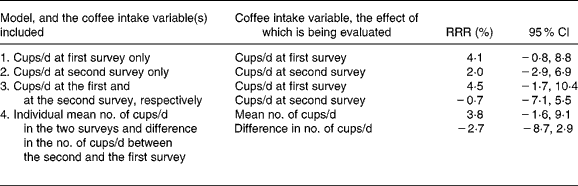
* Adjusted estimates of RRR associated with an additional cup of coffee per d, based on log-linear Poisson regression models including only (centred) linear quantitative terms of the coffee intake variables derived from coffee consumption reported at the first (1991–1992) and the second (1994) survey, respectively. Estimates adjusted for sex, current age, calendar period, marital status, educational level, previous occupational group, current smoking, BMI, history of myocardial infarction, presence of diabetes mellitus, cognitive impairment or physical disability, and self-rated health.
† Average cup size estimated as 125 ml.
Discussion
The present study observed an inverse association between the amount of daily coffee consumption and total mortality among elderly home-dwelling participants, even when many measured predictors of mortality were adjusted for. This association appeared stronger for mortality during the first few years since the assessment of coffee consumption and gradually attenuated towards the end of the 14-year follow-up, although there was insufficient evidence against a constant linear decrease. The observed overall association was qualitatively similar in three broad groups of causes of death: CVD, cancer, and other causes, respectively. The mortality rate was more dependent on coffee intake assessed at the baseline survey than on that recorded 2–3 years later, and no evidence was found for any impact of recent changes in consumption.
Interpreting the main results uncritically at face value, the estimated 4 % reduction of relative mortality per each additional daily cup of coffee (average coffee content, 125 ml) would imply that, for example, for an individual regularly drinking six cups of coffee daily, the mortality rate would be 18 % lower than that if drinking only one cup/d. Given the observational nature and the small size of the study, however, any such causal interpretations and conclusions must be done cautiously.
The present study has several strengths. We had a well-defined, relatively homogeneous and unselected study population comprising all home-dwelling individuals aged 70 years or older within a certain geographical area. The participation rate was high, and data were available to control for several known determinants of mortality. Very few individuals were lost to follow-up, and the coverage of total mortality data was virtually complete(Reference Luukinen, Koski, Laippala and Kivelä21, Reference Luukinen, Laippala and Huikuri22), as all deaths in Finland are centrally registered by Statistics Finland and each citizen has a unique personal identity code. (The validity of the causes of death, however, is more dubious, because only one-fifth of deaths underwent autopsy. In this area, one-quarter of the illnesses designated as causes of death are clinically undetected, and 15 % of the clinical causes of death are not confirmed by autopsy(Reference Stenbäck27).) Unlike most previous studies, we had data on coffee drinking at two occasions 2–3 years apart. Because the data on coffee consumption was gathered before the outcome occurred, the problem of differential misclassification of the main determinant was essentially avoided.
As for the shortcomings of the present study, the small size of the study cohort resulted in estimates of relative rates and their trends that overall were less precise than one would desire. For example, the results pertaining to the specific groups of causes of death had wide ranges of uncertainty, being thus less informative in quantitative terms than those for total mortality. In addition, the coffee consumer groups of special interest, such as those who did not drink coffee at all or those who drank more than six cups/d, were very small. Furthermore, data were lacking on coffee intake during the life span before the baseline survey. Consequently, the present study does not provide an adequate evidence-base for a more elaborate analysis of and discussion on the relative mortality of never-drinkers and former drinkers of coffee in comparison with, for example, those drinking regularly one to two cups/d, in spite of the obvious substantive interest in these specific contrasts.
Among elderly subjects, regular coffee drinking is presumably a habit that has typically been adopted decades ago, rarely any more after retirement. Hence, we believe that for most of the few individuals reporting zero consumption at baseline but one or more cups/d at the second survey, the baseline value was misclassified. According to evidence from nationwide surveys among the elderly in Finland, coffee intake tends to be gradually reduced by advancing age(Reference Sulander, Helakorpi, Nissinen and Uutela28).
Tea consumption was not asked in our questionnaires. In these age groups during the 1990s and early 2000s in Finland, however, about 60 % did not drink tea at all, 30 % had one to two cups/d, and less than 10 % consumed three or more cups/d(Reference Sulander, Helakorpi, Nissinen and Uutela28). Hence, even if consumption of black tea (the predominant type of tea consumed in Finland) had a positive impact on longevity(Reference Gardner, Ruxton and Leeds29), any potential confounding by tea consumption would most probably be negligible in this study population.
In spite of careful attempts to control confounding by several measured determinants of mortality, including self-rated health, some residual confounding may well remain. As coffee intake was positively associated with most indicators of good health, the residual confounding would probably be that of an ‘ill-abstainer effect’ resulting from reduced coffee intake among individuals with poorer health. Thus, the results could be biased towards an inverse association of coffee consumption with total mortality, even if such a trend did not exist in reality. Therefore our evidence for an inverse association, despite adjustment for several confounders, is vulnerable to the possibility of residual confounding.
On the other hand, the finding that the estimated relative risk reduction per one additional daily cup of coffee measured at baseline was virtually the same in the primary analysis as well as the supplementary analysis restricted to those alive at the time of the second survey is not consistent with such a bias, as presumably the sickest individuals would die first. Furthermore, the potential impact of this bias would in any case be qualitatively counteracted by the likely direction of the information bias in the present study. The measurement of coffee consumption was based on questionnaire surveys at two time points only. It is clear that the daily number of cups reported at these points, being subject to misclassification even for current consumption, can only imperfectly capture the exposure to coffee within a time window relevant to the mortality outcome (for example, the coffee consumption during the years before the baseline survey). Thus it was to be expected that the rate ratios of interest would attenuate during the course of a long follow-up since the point in time at which the exposure was assessed(Reference Clarke, Shipley, Lewington, Youngman, Collins, Marmot and Peto30). Although ‘non-significant’ statistically, this dilution was indeed observed, when the analysis was split into three sub-periods of follow-up. Because the misclassification of coffee intake overall may be judged essentially non-differential with respect to the outcome, the estimated rate ratios are diluted already for the first sub-period, in which the effect of baseline daily coffee consumption appeared stronger than in the later sub-periods. Finally, the finding in the analyses split by sub-period that the coffee effect appeared to vanish only after 10 years of follow-up also speaks against bias due to the ‘ill-abstainer effect’.
Hence, when both residual confounding and non-differential misclassification are operating simultaneously, the resultant net bias is most probably smaller than the absolute bias due to either source separately. Although we have no means for a quantitative evaluation of this net bias, this qualitative argumentation implies that the observed inverse association becomes more robust against being explained away by mere residual confounding.
When putting our observations into a wider context, we are encountered by a shortage of previous studies on the effect of daily coffee consumption on total mortality in community-dwelling elderly individuals. A 5-year follow-up among 162 self-sufficient men and women aged 65 years or older, who resided in a public home for the elderly in Italy, reported a 65 to 79 % decrease in the risk of death in consumers of one to two cups or more of espresso coffee per week v. less than once per week(Reference Fortes, Forastiere, Farchi, Rapiti, Pastori and Perucci17). As consumption of three or more cups of espresso coffee per week was considered high (and consumption of other types of coffee was not reported), it is obvious that the overall level of consumption was considerably lower than that in our population.
A 26-year follow-up study among 9484 California Seventh-day Adventist men, including nearly one-fifth of men aged 70 years or older, found elevated hazard rate ratios at most age intervals for consumers of one to two cups and three or more cups of coffee per d (compared with a group of essentially non-coffee drinkers), with evidence of a dose–response relationship but also a clear tendency for the relative rates to attenuate with age(Reference Lindsted, Kuzma and Anderson18). The effect on all-cause mortality was largely due to an effect on cardiovascular deaths. This population is unique in that Seventh-day Adventists are expected to abstain from tobacco and alcohol, and a vegetarian diet and abstention from coffee and other caffeine-containing beverages are encouraged. However, several unfavourable characteristics (such as low educational level, smoking, obesity and hypertension) were positively associated with coffee intake, suggesting that residual confounding due to unmeasured factors may well have operated in an opposite direction compared with our northern Finnish cohort.
A recent prospective analysis of the first National Health and Nutrition Examination Survey epidemiologic follow-up study (NHEFS), involving 6594 male and female participants aged 32–86 years, found that habitual intake of caffeinated beverages was associated with decreased heart disease mortality among those aged 65 years or more(Reference Greenberg, Dunbar, Schnoll, Kokolis, Kokolis and Kassotis19). In a secondary analysis of this study, this tendency was particularly strong for ground and instant caffeinated coffee, whereas the evidence was weaker for consumption of regular tea or decaffeinated coffee(Reference Greenberg, Dunbar, Schnoll, Kokolis, Kokolis and Kassotis19).
Previous evidence on the associations between coffee consumption and morbidity and mortality, mainly from studies conducted among middle-aged participants, is variable. In an eastern Finland cohort of middle-aged men heavy coffee consumption was associated with increased CHD incidence and mortality, when compared with moderate daily consumption(Reference Happonen, Voutilainen and Salonen16), while most other cohort studies have not observed a relationship between coffee intake and the occurrence of CHD(Reference Kawachi, Colditz and Stone1, Reference Lopez-Garcia, van Dam, Willett, Rimm, Manson, Stampfer, Rexrode and Hu31).
In large cohorts in Scotland(Reference Woodward and Tunstall-Pedoe11) and in Finland(Reference Kleemola, Jousilahti, Pietinen, Vartiainen and Tuomilehto12), moderate to heavy coffee drinkers had lower all-cause mortality than others. In the Scottish study, increasing coffee consumption was associated with beneficial effects on CHD morbidity and mortality in men but not in women(Reference Woodward and Tunstall-Pedoe11). Similar beneficial trends for CHD morbidity were observed in the Finnish study in both sexes, but for CHD mortality a beneficial effect was observed in women only(Reference Kleemola, Jousilahti, Pietinen, Vartiainen and Tuomilehto12). In a study among survivors of myocardial infarction, an inverse association between coffee drinking and mortality in the first 90 d after myocardial infarction was reported(Reference Mukamal, Maclure, Muller, Sherwood and Mittleman32). The thus-suggested health benefit may not necessarily be long lasting, however, as in the long term coffee consumption was not associated with an overall change in the post-infarction mortality rate(Reference Mukamal, Maclure, Muller, Sherwood and Mittleman32). A prospective study in type 2 diabetic patients found that coffee drinking was associated with reduced total, cardiovascular and CHD mortality(Reference Bidel, Hu, Qiao, Jousilahti, Antikainen and Tuomilehto33). In a large cohort study of postmenopausal women, total mortality and death rates due to CVD showed a shallow U-shaped association with coffee intake among coffee drinkers, and non-consumers of coffee had the highest risk(Reference Andersen, Jacobs, Carlsen and Blomhoff34).
The present results are thus partly in line with those of the above-mentioned Italian study among residents of a home for the elderly(Reference Fortes, Forastiere, Farchi, Rapiti, Pastori and Perucci17), the Scottish and Finnish studies among middle-aged participants(Reference Woodward and Tunstall-Pedoe11, Reference Kleemola, Jousilahti, Pietinen, Vartiainen and Tuomilehto12), the secondary analysis of the NHEFS cohort(Reference Greenberg, Dunbar, Schnoll, Kokolis, Kokolis and Kassotis19), the findings in type 2 diabetics(Reference Bidel, Hu, Qiao, Jousilahti, Antikainen and Tuomilehto33) and postmenopausal women(Reference Andersen, Jacobs, Carlsen and Blomhoff34), as well as some other studies in Europe(Reference Rosengren and Wilhelmsen10, Reference Jazbec, Simic, Corovic, Durakovic and Pavlovic13) and the USA(Reference Murray, Bjelke, Gibson and Schuman9).
In one study with 19-year follow-up and coffee-drinking habits classified similarly to ours, a J-shaped association of coffee drinking with CHD mortality and a U-shaped association with all-cause mortality was found(Reference LeGrady, Dyer, Shekelle, Stamler, Liu, Paul, Lepper and Shryock15). The non-CHD mortality was highest among those drinking no coffee at all. The authors hypothesised that the finding of increased non-coronary mortality among non-drinkers was explained by their poorer health, i.e. they had quit their coffee intake for health reasons. In the present study the number of deaths among the non-drinkers was too small for precise estimation of the relative mortality between this category and the others. Nevertheless, the adjusted point estimate was very close to that for drinkers of one to two cups of coffee/d.
Finland has the highest per capita coffee consumption in the world. Nearly all adults consume coffee daily or at least weekly. Caffeine-containing coffee accounts for the vast majority of consumption; habitual consumption of decaffeinated coffee is rare. Even though coffee consumption tends to be reduced with increasing age(Reference Sulander, Helakorpi, Nissinen and Uutela28), senior citizens who do not drink coffee at all are exceptional, especially in the countryside. Coffee drinking in Finland is not any new trend associated with urban lifestyle among educated young and middle-aged individuals, like in Great Britain(Reference Woodward and Tunstall-Pedoe11). Therefore, any confounding by lifestyle or socio-economic status would operate differently in Northern Finland from that in Britain.
The incidence of some chronic conditions observed to be inversely associated with coffee consumption, such as Alzheimer's disease(Reference Lindsay, Laurin, Verreault, Hebert, Helliwell, Hill and McDowell35), asthma(Reference Pagano, Negri, Decarli and La Vecchia36), colorectal cancer(Reference Woolcott, King and Marrett37), breast cancer(Reference Männistö, Pietinen, Virtanen, Kataja and Uusitupa38), liver cancer(Reference Shimazu, Tsubono, Kuriyama, Ohmori, Koizumi, Nishino, Shibuya and Tsuji39) and diabetes mellitus(Reference van Dam and Feskens4, Reference Tuomilehto, Hu, Bidel, Lindström and Jousilahti5), could potentially explain the health benefits of coffee intake suggested by the present study. Increased antioxidant capacity is one potential protective mechanism of coffee against morbidity and mortality(Reference Pellegrini, Serafini, Colombi, Del Rio, Salvatore, Bianchi and Brighenti40). Coffee is a rich source of polyphenols, and in the Nordic countries coffee is the greatest contributor of dietary antioxidants(Reference Svilaas, Sakhi, Andersen, Svilaas, Ström, Jacobs, Ose and Blomhoff41). As proposed earlier for heart disease incidence and mortality(Reference Greenberg, Dunbar, Schnoll, Kokolis, Kokolis and Kassotis19), the array of pharmacological effects of caffeine could also explain a protective effect on total mortality.
Nevertheless, we must be cautious in drawing strong conclusions about any beneficial effects on health of moderate or heavy coffee consumption based on an observational study. The strength of evidence is not optimal, the possibility of residual confounding remains, and there may have been undetected adverse effects. Furthermore, we cannot make any definite statements about the reasons for the reduced mortality rate among the moderate and heavy coffee drinkers. Yet it may be prudent to say at least that coffee drinking does not essentially shorten the lifetime of elderly individuals.
In conclusion, the present study in a representative sample of older adults strengthens the findings in some previous studies among middle-aged individuals of a beneficial effect of moderate or heavy coffee consumption on the risk of death. We expect results from more detailed studies in larger study populations to provide more insight about the advantages and disadvantages of coffee consumption, and to set critical recommendations of optimal consumption with regard to health.
Acknowledgements
We thank Mr Paavo Soini for assistance in data management. The study was supported, in part, by the Finnish Ministry of Social Welfare and Health, and the Oulu University Hospital Medical Research Fund (Oulu, Finland). The sources of funding had no role in the design or conduct of the study; collection, management, analysis, or interpretation of the data; or preparation, review, or approval of the manuscript. P. H. was responsible for writing the manuscript, L. H. conceived the idea and E. L. carried out the statistical analysis. H. L. was responsible for data acquisition, is the guarantor and accepts full responsibility for the conduct of the study, had access to the data, and controlled the decision to publish. All authors contributed to the analysis and interpretation of data and critical revision of the manuscript for important intellectual content. None of the authors has a conflict of interest.



