In July 1898, an Indian Parsi in Tehran wrote a remarkable letter to an Indian Parsi in London. In a flowing Gujarati hand, the Tehran Parsi documented his role in Parsi charitable activities for the beleaguered Iranian Zoroastrian community. Due to an abiding interest in ancient civilization—and presumably the ancient Zoroastrian homeland in particular—he had given up a well-paying position in Berlin in order to become the agent for a Bombay association concerned with improving Iranian Zoroastrians’ socioeconomic conditions. He explained that he was a worldly man: he had traveled across Greece, Turkey, Transcaucasia, Syria, Palestine, Egypt, and the eastern coast of Africa before returning to Bombay and then setting out for Tehran. And he had cultivated important connections in the Iranian capital, gaining influence with ministers, nobles, and members of the Qajar royal family.
Once settled in Tehran, he told the London Parsi, he had taken particular interest in women's affairs and women's uplift. In fact, he had gained the trust of so many Iranian women that he had been invited into the andarūn of Iranian households, both Zoroastrian and Muslim, to converse and dine with women. Women of influential families were now listening to his ideas on female social reform and women's duties. And so he asked the London Parsi for advice and support: could he put him in touch with leading British feminists and women's rights activists—such as the suffragists Millicent Fawcett or Lady Henry Somerset—in order to interest British women in reform activities for Iranian women?Footnote 1
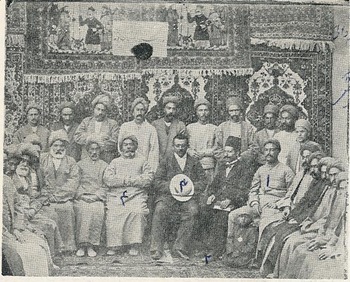
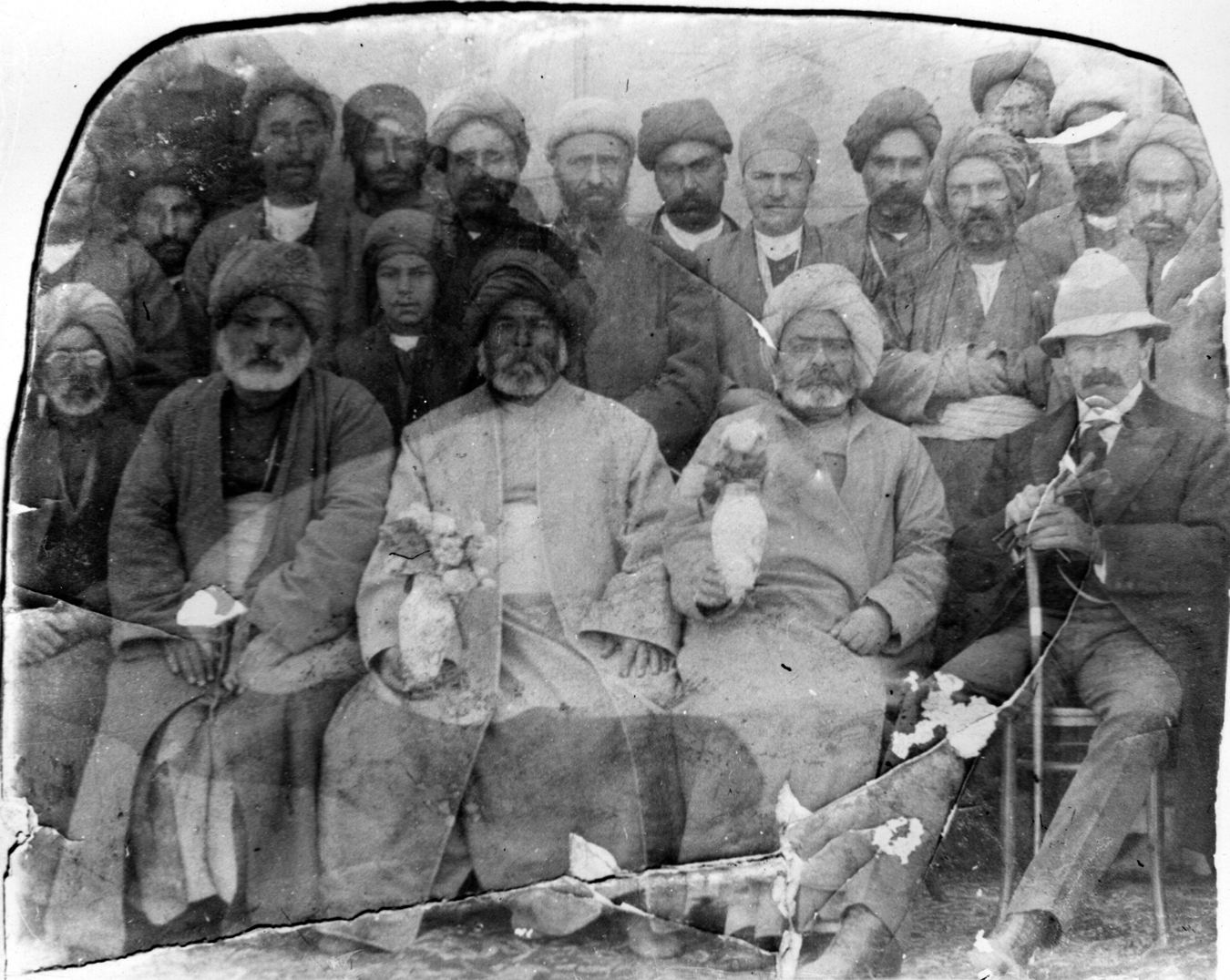
The Tehran Parsi was Ardeshir Edulji Reporter, who played an influential role in educational development and social uplift among Iranian Zoroastrians until his death in 1933 (Fig. 1). The London Parsi was Dadabhai Naoroji, the Indian nationalist leader who had recently served in the British House of Commons, had wide-ranging contacts with British women's activists, and had been involved in Iranian Zoroastrian affairs since the 1850s. Reporter's letter neatly encapsulates the globe-spanning networks that sustained Parsi activities in Iran in the late nineteenth century, while also hinting at how their activities drew in others—such as Muslim women or British suffragists—who have escaped scholarly notice.
Ardeshir Reporter (seated at center, marked “۳”) in Kerman around 1908. Kaikhosrow Shahrokh (marked “۱”) is two seats to the right. Courtesy of Mehrborzin Soroushian.

Reporter's letter is noteworthy for another reason. Reading between the lines, one theme is clearly discernable: power. Reporter's philanthropic activities in Iran gave him status, connections, and importance. With Naoroji's help, he hoped to augment that status by establishing connections in the very heart of the British Empire. What was the broader significance of these expressions of privilege and power, an ability to straddle imperial networks and yoke them toward a particular communitarian objective?
Reporter was part of a multi-decade project of the Parsis of India to ameliorate the conditions of their Iranian coreligionists—one of the most striking examples of Parsi philanthropy in the late nineteenth and early twentieth centuries.Footnote 2 Ground down after centuries of persecution, violence, impoverishment, and social marginalization, the Iranian Zoroastrians, nineteenth-century Parsis feared, were on the brink of extinction. Beginning in the 1850s, therefore, wealthy Parsis in Bombay began an organized program of assistance across the Arabian Sea which included the promotion of education, construction of religious and community infrastructure, and payment of the oppressive jizya tax levied upon the Zoroastrians as dhimmī subjects. This was an effort which required Parsis to muster incredible financial and diplomatic resources—transmitting money and men across borders, lobbying various governments, and delicately coordinating activities which unfolded everywhere from Buckingham Palace to humble schoolhouses in Yazd and Kerman.
And hence the need for power. Parsi philanthropy in Iran took place through the sustained flexing of the community's economic and political heft, which was transformed into diplomatic capital in the halls of power in London, Tehran, Bombay, Calcutta, and Simla. In particular, Parsis skillfully leveraged the might of the British Empire while pressuring Iranian authorities to improve conditions for the Iranian Zoroastrians, providing a fascinating glimpse into how colonized subjects could bend imperial power dynamics to their advantage.
Power thus enabled philanthropy. Importantly, philanthropy could also be a convenient conduit for the further acquisition of power. Parsi amelioration of the Iranian Zoroastrians, while moored in deep concern for the welfare of their coreligionists, could facilitate other objectives, such as the expansion of the community's economic interests. From the 1880s onward, it became the medium for cultivating ties with the shah of Iran and the Iranian government, something which had a transformative effect on the way Parsis conceptualized their ancient homeland. Although Bombay Parsis’ closer relations with Tehran had a positive influence on the condition of the Iranian Zoroastrians, such relations were primarily premised on the community's own political and economic benefit. They fueled a range of fantastical plans in the late nineteenth century, including the first stirrings of a movement for Parsis to “return” to Iran.
Power flowed in multiple directions, of course. With time, Iranian authorities saw economic and political value in fostering strong ties with wealthy, entrepreneurial Bombay Parsis. What is more unexpected, however, is how British authorities actively used their diplomatic leverage on behalf of Iranian Zoroastrians and Parsi charitable efforts in Iran. This article brings a new perspective to the study of Parsi relations with modern Iran by foregrounding British imperial dimensions. What explains Britain's marked interest in a tiny religious minority which numbered no more than 10,000 souls by the beginning of the twentieth century?
There are a few explanations. While examining Great Britain's nineteenth-century championship of Jewish rights in Muslim empires, Abigail Green has spoken of an “imperialism of human rights.”Footnote 3 This is an obvious counterpart to John Gallagher and Ronald Robinson's idea of how an imperialism of free trade explained the logic of empire during Pax Britannica.Footnote 4 In the Victorian era, protection of vulnerable religious minorities vis-à-vis Muslim rulers became an abiding part of British imperial policy, something which built on the humanitarianism of the abolitionist movement while providing a powerful legitimation of empire. As Michelle Tusan has noted with regard to Britain's interest in the “Armenian question” in the late Ottoman Empire, minority rights became “central to Britain's moral mission abroad.”Footnote 5
Countless British diplomats, consuls, and military officers (many with Indian connections) translated lofty humanitarian rhetoric into diplomatic pressure and on-the-ground assistance. This assistance was critical to the welfare of Iranian Zoroastrians facing hostile conditions in places like Yazd and Kerman. In this sense, amelioration of the Iranian Zoroastrians can be seen as yet another component of an imperialism of human rights. There were notable parallels with British championship of the rights of other minorities in Qajar Iran, such as Nestorian Christians and Jews. One sees further similarities between Bombay Parsis and figures like Moses Montefiore—the British Jewish leader who tirelessly lobbied for the relief of Jewish minorities living under Muslim rule—or organizations for charity and advocacy such as the Jewish Board of Deputies in London.Footnote 6
Britain's imperialism of human rights, however, had a pronounced Judeo-Christian orientation, fired by the evangelical fervor of the Victorian era. This helps explain the concentration of effort upon Jews, Armenians, or Nestorians. How, then, do we explain British interest in a relatively distinct group such as the Zoroastrians? Here is where the notion of an imperialism of human rights can become more complex and problematic—and, indeed, blend into an imperialism of free trade as well as pursuit of broader strategic interests. Scholars such as Green and Tusan are careful to note that British championship of Jewish or Armenian minority rights had significant economic and political components.Footnote 7 Popular support for amelioration, among religious Christian and Jewish subjects at home, could at least obscure hardnosed strategic motivations. This was decisively not the case for the Iranian Zoroastrians, who had no more than 90,000 coreligionists in distant India.
Instead, British involvement in Iranian Zoroastrian affairs was motivated by far more stark considerations of power. There was unquestionably a desire to appease an industrious and professedly loyal community like the Parsis. However, British diplomats bluntly saw the Iranian Zoroastrians through the lens of imperial geopolitics, particularly with regard to the Russian threat to British India. In this sense, Iranian Zoroastrians—as well as some Parsis—were drawn into Great Game politics, becoming part of a strategy for promoting British interests in southern Iran.Footnote 8 Reporter is an apt example of how this dynamic worked. While he relied upon Britannic might to improve the socioeconomic conditions of Iranian Zoroastrians, Reporter was widely rumored to perform some sort of function as a British intelligence agent, supposedly having a hand in all manners of imperial intrigues through the early Pahlavi era.Footnote 9
But British diplomats could go a step beyond such simple, mutually beneficial arrangements. In several instances, they actively encouraged, coaxed, and cajoled additional Parsi involvement in Iranian Zoroastrian affairs, seeing their philanthropy as a means for expanding British influence in Iran. Through such charity, “a certain, and perhaps considerable, political service is done to British interests in Persia,” Lord Lamington, the governor of the Bombay Presidency, acknowledged in 1904.Footnote 10 If there was, indeed, an imperialism of human rights, then it could, in case of the Iranian Zoroastrians, have some markedly coercive aspects, with Parsis seeking extraordinary diplomatic leverage and British officials pressuring Parsis to lavish more funds in a foreign country. The Iranian Zoroastrians offer a cautionary tale about the complexity of humanitarian impulses in British foreign policy. While acknowledging the sincere concern for minority rights among certain officials and diplomats, we must recognize how overriding imperial objectives fully dictated the nature of British intervention. Imperial proconsuls had no qualms about making such objectives explicit and categorical. At the same time, we must avoid validating the “paranoid style” of Iranian historiography, which has tended to see a foreign hand in so much of minority politics.Footnote 11 While British diplomats went to extraordinary lengths to use Parsis and Iranian Zoroastrians for their strategic objectives, members of both minority groups were not mere puppets: they exercised a degree of agency and independence, subverting imperial power for their own ends.
“Power is everywhere,” Michel Foucault famously remarked, “not because it embraces everything, but because it comes from everywhere.”Footnote 12 Such was the case with the complex interactions between Parsis, Iranian Zoroastrians, Iranian officials, British diplomats, British Indian mandarins, and a handful of Russian agents in late Qajar Iran. Power—networks of power, the deployment and tactical use of power, and imperial power dynamics—is the most useful prism for understanding the project of Parsi assistance toward their Iranian coreligionists. In unique and often unpredictable ways, their philanthropy became deeply enmeshed in the strategic, diplomatic, and commercial affairs of the British Empire.
Bombay, Tehran, London: Developing Transnational Networks of Power and Influence
In the history of Parsi philanthropy, amelioration of the Iranian Zoroastrians was nothing short of a landmark event. It built upon fundamental transformations in the ways Parsis thought about and conducted charity: in terms of its scope, organization, methods of finance, and global reach. Prior to the mid-nineteenth century, Parsi philanthropy had been mostly local, directed toward Zoroastrian religious institutions, assistance to poor coreligionists, or particular infrastructural projects in community strongholds like Bombay. It is true that the community's philanthropic horizons had begun to take a global turn by the 1850s: śeṭhiās (commercial elites) and a newly educated elite were now collecting funds for everything from Irish Potato Famine relief to the Patriotic Fund for the Crimean War, thereby taking part in a broader, empire-wide culture of Victorian philanthropy.Footnote 13 But amelioration of the Iranian Zoroastrians required going beyond such occasional gestures of imperial patriotism. It meant employing a modern organizational infrastructure which could sustain decades of lobbying, diplomatic outreach, and transnational finance.
This infrastructure emerged from piecemeal projects of assistance in the 1830s and 1840s, such as aid for Iranian Zoroastrian migrants to India and the construction of a new funerary dakhma in Yazd. In 1853, a group of Bombay Parsis established a formal organization which was eventually named the Society for the Amelioration of the Conditions of the Zoroastrians in Persia (Irān deśnā rehnārā garīb Jarthostīonī hālat sudhārnī maṇḍlī in Gujarati; hereafter: Society for Amelioration). They dispatched Manekji Limji Hataria, a well-traveled merchant and financial assistant for British expeditions in Sind, as their agent in Iran.Footnote 14 Manekji became a vital node as the organization expanded its operations out of Bombay to encompass Tehran, other Iranian cities and towns, and London.
Networks of power undergirded the activities of the Society for Amelioration. Many of the wealthiest, most influential, and most educated Parsis of mid-nineteenth-century Bombay populated its membership rolls: the merchant prince Jamsetjee Jejeebhoy (first baronet), progressive-minded śeṭhiās like Manekji Nasarvanji Petit and Kharshedji Nasarvanji Cama, and young reformers such as Navrozji Fardunji and Naoroji.Footnote 15 Aside from easy access to finance, these individuals possessed wide-ranging connections with British officials and Indian elites in the Bombay Presidency, which in turn could provide broader administrative and mercantile contacts across India, Iran, and the British Empire. They raised money in new ways and through increasingly sophisticated financial instruments. At the outset, the Society for Amelioration collected funds through more traditional methods, such as donations announced at uṭhamṇā ceremonies in memory of the deceased. With time, however, Parsi charitable activity in Iran took the form of subscriptions raised by masonic lodges (Manekji was a member of Bombay's Lodge of the Rising Star) or via municipal bonds.Footnote 16 Manekji even collected donations from the British minister in Tehran.Footnote 17
As this last episode hints, Parsis consciously leveraged British imperial connections. Dosabhai Framji Karaka, author of an English-language account of Parsi history and society, argued in the late 1850s that the community should recruit the British minister in Tehran to lobby the Iranian shah on their behalf—a remarkable assertion of Parsis’ confidence in their ability to harness British diplomatic machinery.Footnote 18 In India, British officials who enjoyed close ties with the Parsi community lent active support and assistance. A young George Birdwood, who became a high-ranking India Office official, encouraged Parsi charity in Iran while living in Bombay in the 1850s.Footnote 19 In later years, the Society for Amelioration used such connections to appeal directly to Indian government authorities for assistance in their activities in Iran.
But it was Manekji who cultivated some of the most significant transnational connections. He quickly established contact with the British legation in Tehran. Here, he came in touch with Henry Rawlinson, briefly minister to Iran in the late 1850s, who helped Manekji have an audience with Nasir al-Din Shah in 1860 (scholar-diplomats, especially those like Rawlinson who had served in India, proved to be among the Parsis’ greatest supporters in their endeavors in Iran).Footnote 20 While laboring to reduce the oppressive jizya tax upon Iranian Zoroastrians, Manekji worked closely with Rawlinson's successor, Charles Alison, who established a notable track record of championing minority rights while in office.Footnote 21 As a point of contact for American Christian missionaries and European Jewish leaders, Alison regularly made representations to Iranian authorities on behalf of the Nestorian and Jewish communities, thus demonstrating how Parsi activities were part of a much broader international project of recasting minority relations in Qajar Iran.Footnote 22
Importantly, while searching for opportunities to lobby the shah and his ministers, Manekji also looked beyond the British legation. He seemed particularly adept at cultivating ties in the wider diplomatic community in Tehran, such as with the French minister Joseph Arthur de Gobineau, who might even have considered appointing Manekji as the French consul in Yazd in 1861.Footnote 23 Gobineau, who drew upon ancient Iranian history to buttress his Aryan racial theories and derogatory views of Islam, expressed a “deep interest” in Parsi campaigns against the jizya tax. In 1862, he wrote to a “Général Hayia Khan”—perhaps Mirza Yahya Khan, a Qajar minister and brother-in-law of the shah—introducing Manekji and taking care to note that he was a British subject. Like Alison, he employed an emerging language of human rights to make his case, noting that “anything akin to religious persecution is absolutely contrary to the ideas of the present era” and would do great harm to Iran's international reputation. But what is truly significant about the letter is how Gobineau alluded to the prosperity and influence of the Parsi community in India, effectively urging the shah and Iranian authorities to seriously consider their representations. Bombay Parsis, “so rich, so influential, so listened to in England,” would no doubt express, in the most public matter, their gratitude toward the shah if the jizya tax was abolished.Footnote 24
Gobineau's language illustrates how Parsi wealth and prestige translated into a measure of diplomatic heft by the mid-nineteenth century—both inside and outside of the British Empire. How else can we explain a French diplomat counseling an Iranian sovereign to listen to British colonial subjects about internal minority affairs? In the following decades, Manekji greatly expanded his contacts among the diplomatic, mercantile, and administrative elite in Tehran. In December 1882, not long after Nasir al-Din Shah issued a farmān formally revoking the jizya tax for Zoroastrians, Manekji organized a jaśan in Tehran which boasted a remarkable diversity of attendees: Iranian government officials, European and Ottoman diplomats, and Armenian merchants.Footnote 25 Events like this jaśan demonstrated how Parsi charity in Iran was not simply a matter of internal relief. It reflected the community's cosmopolitanism, status, and transnational influence—and how its achievements were to be broadcast and celebrated well beyond the Zoroastrian fold.
Tehran, therefore, became the scene of energetic Parsi diplomatic efforts on behalf of the Society for Amelioration. So was London. During the early 1870s, Navrozji and Naoroji, both now well-recognized as leading voices of Indian political reform, incorporated Iranian Zoroastrian affairs into their roster of activities while living in the imperial capital. They harnessed Indian political connections and organizations in order to sustain this work, demonstrating how networks of reform buttressed one another. In 1874, for example, Navrozji delivered a paper before the London-based National Indian Association where he contrasted the conditions of Indian Parsis and Iranian Zoroastrians, whetting British interest in the fate of the latter community. Navrozji was careful to credit British rule in India for the dramatic difference between the fate of the Parsis and Iranian Zoroastrians, thus displaying how Parsis could use the depressed state of their coreligionists as a foil while asserting loyalty to the Crown.Footnote 26
Both Navrozji and Naoroji were leaders of the East India Association, which Naoroji established in London in 1866 to bring together Indians and reform-minded Britons to lobby for administrative change in India. When Nasir al-Din Shah visited London in 1873, the two Parsis relied upon East India Association connections to present a memorial, authored by the Society for Amelioration in Bombay, praying for better treatment of the Iranian Zoroastrians. The memorial was delivered to the Iranian minister in London, Malkom Khan, with whom Naoroji labored to cultivate good relations. Afterwards, two Association members took the lead in pressing the Parsis’ case upon the shah and his delegation. One was Rawlinson, who met with the shah at Buckingham Palace to discuss the Bombay memorial and the “very depressed condition” of the Iranian Zoroastrians. The other was Edward B. Eastwick, a fellow scholar-diplomat with experience in India and Iran, who counseled the grand vizier, Mirza Hosayn Khan Mushir al-Dawlah, “how much it is for the interests of Persia that an enterprising people like the Parsis should be encouraged.”Footnote 27 In subsequent years, Naoroji relied upon prominent British orientalists, such as the Pali scholar Thomas Williams Rhys Davids and Edward Granville Browne, to meet with Malkom Khan or dispatch further memorials to the Iranian legation in London.Footnote 28 Parsis in London, therefore, proved adept at bending scholarly, diplomatic, and Indian political networks in the direction of the Society for Amelioration's activities. They, too, mixed a language of human rights with appeals to Parsi wealth and status.
What about Bombay? While the Bombay-based leadership of the Society for Amelioration managed networks of correspondence between Tehran, London, and elsewhere, its primary responsibility was raising money. Parsis’ participation in imperial networks of philanthropy inspired donations from outside of the community, especially during the Persian famine of 1871, which sent waves of enfeebled Iranian migrants toward Bombay's shores.Footnote 29 In June 1871, a British chaplain in Rajkot, Arthur Polehampton, urged fellow Europeans to contribute to Parsi relief efforts. “No class of men contributed more liberally to the relief of our distressed Lancashire operatives,” Polehampton noted, referring to how Parsis collected funds for unemployed British millworkers during the “cotton famine” at the beginning of the American Civil War. “It is our privilege as well as our duty to show every willingness to help their brethren, as the Parsees themselves helped ours.”Footnote 30 Elsewhere, Indian mercantile networks played a role in amelioration. When a group of Zoroastrian famine refugees arrived in Bandar Abbas in May 1871, Godrez Mehrban and Co., a trading company run by Iranian Zoroastrian brothers who had settled in Bombay, relied upon a Nashir Ruttonsey, presumably a Gujarati Khoja merchant living in the Iranian port city, to provide money, food, and clothing.Footnote 31 Parsi (and increasingly, as the Godrez brothers indicate, Bombay Irani) activities in Iran thus attracted wide-ranging interest and assistance from across India and even in Indian diasporic settlements.
But such activities did not meet with universal approbation within the community. Relief of Iranian coreligionists “never did gain a top position on the impressive list of charitable projects endowed by wealthy Parsis, and occasionally the whole project was severely criticized in India.”Footnote 32 This became dramatically apparent during the Persian famine, which caused some Parsis to question the efficacy of the Society for Amelioration's labors to date.
One such critic was Navrozji. At a meeting for famine relief held at Bombay's Albless Baug in June 1871, Navrozji caused consternation by claiming that further transfer of funds to Iran was “a waste of money.” “A simpler way is to call them to India,” he suggested, relocating the entire population of Iranian Zoroastrians to the subcontinent. At least one other speaker at the meeting agreed, noting the steady diminishment of the population and warning that the community would soon be completely annihilated.Footnote 33 A few days later, after a similar meeting was held in Karachi, Kavusji Dinshah Khambata, a Parsi lawyer from this city, laid out a plan for the evacuation of Iranian Zoroastrians to agricultural settlements in India. Khambata argued that Parsi assistance in Iran had been ineffective due to the “crimes and offences of the Persian Government and of the Muhomedan population”—a general atmosphere of oppression and intolerance.Footnote 34 Some Parsi stakeholders in Iranian activities, therefore, had come to the opinion that Qajar-era Iran was just too inhospitable an environment for a vulnerable religious minority.
Significantly, such plans for a wholesale population transfer comingled with incipient Parsi ambitions for a measure of sovereignty and territoriality in India. Not long after the meeting at Albless Baug, the Native Opinion reported on how some Parsis were floating the incredible idea of “buying Pondicherry from the French Republic and of establishing a Parsee government.” The plan ostensibly had something to do with finding agricultural land for displaced Iranian Zoroastrians, but clearly greater ambitions were at play. Native Opinion, for its part, cautioned against Pondicherry, subtly hinting that people of a very different culture already lived there. But the paper encouraged Parsis to look elsewhere, to “large tracts of waste lands which might be bought for a mere song either from the British Government or from some native princes; even an island in the ocean, or among the Laccadives.”Footnote 35 Others called for agricultural settlements in Sind, the Panch Mahals in Gujarat, or around Bombay. The plight of famished Iranian Zoroastrians could thus serve as a convenient justification for proposals which smacked of Parsi sub-imperialism.
Mutual Interests: Rapprochement between Parsis and Iranian Authorities
Given these plans for a wholesale population transfer at the time of the Persian famine, it is astonishing to see the utter transformation in Parsi attitudes toward Iran and the Iranian government only a decade later. The trigger was Nasir al-Din's farmān in 1882 abolishing the jizya tax for Iranian Zoroastrians, an achievement which was widely celebrated in Bombay (although the farmān's writ proved to be limited in places distant from the imperial gaze). This development opened up new lines of diplomacy on Bombay Parsis’ home turf—specifically, with the Iranian consul in the city—and ushered in a new era where Parsis and Iranian authorities increasingly focused on mutual interests. At some junctures in this new relationship, the plight of the Iranian Zoroastrians seemed to entirely recede from view.
In 1885, Nasir al-Din Shah dispatched Hosaynqoli Khan (later known as “Haji Vashangton,” the first Iranian minister to the United States) to Bombay as Iran's consul, apparently instructing him to “cultivate friendly relations” with the Parsis. This was clearly apparent during Hosaynqoli's brief term: he invited leading Parsis, such as Jamsetjee Jejeebhoy (third baronet) and Dosabhai Framji Karaka, to celebrate events like the shah's birthday. He presented Jamsetjee with a shiny gold medal issued by Nasir al-Din Shah. Hosaynqoli flattered the community, grandly claiming that the “venerated Shah of Persia, and his entire Persian subjects” held Parsis in great esteem, recognized their “ancient Iranian stock,” and endeavored to treat Iranian Zoroastrians with fairness and justice.Footnote 36 Now it was the Iranians who were invoking Parsi wealth and employing a language of minority rights. Finally, he appointed a leading Parsi, Dadabhoy Rustomjee Banajee, as his vice-consul.
Parsis responded with aplomb. “By this appointment both his Majesty and his advisers have given evidence of a spirit of friendliness towards the Parsees, which we view with satisfaction,” Nusserwanjee Petit declared at a meeting organized by the Society for Amelioration.Footnote 37 They hosted the consul at lavish parties and dinners—he was apparently the first-ever non-Parsi invited to dine at Bombay's Elphinstone Club, an exclusive venue patronized by community stalwarts.Footnote 38 The Society for Amelioration saw these ties as evidence that its efforts on behalf of the Iranian Zoroastrians were working.
But Parsis went a step further. Demonstrating how Parsi assistance was about much more than philanthropy, they thought of ways how Parsi activities in Iran could be expanded into other realms. At a reception organized by the Society for Amelioration, Dinshaw Petit (first baronet), the head of the Society, told Hosaynqoli that Parsis were eager to establish a business and commercial presence in the country.Footnote 39 Another Society member, Jamsetjee Cursetjee Cama, suggested to the consul that the shah should appoint some Parsis to political and military positions in his government.Footnote 40 These Parsi overtures indicate precisely how their evolving relationship with the Iranian government was built on mutual political and economic benefit. The shah and other Iranian officials clearly identified the wealthy Parsi community as a potential source of investment—why else would the Bombay consul go to such extents to ingratiate community members? Parsis, for their part, eagerly looked forward to absorbing Iran within their commercial orbit. In 1889, a Parsi even suggested that the community invite the shah to Bombay and cover the expenses for his visit.Footnote 41
It is no surprise that in the late 1880s we see, for the first time, significant Parsi discussion about “returning” to Iran: the overtures of the Iranian government convinced some Parsis that they would receive favorable treatment from the shah if they settled down in his realm. Again, this was a stunning about-face. Only a few years earlier, leading Parsis had judged conditions in Iran to be too inhospitable for Zoroastrians. News reports from Yazd and Kerman continued to convey a bleak picture of oppression and violence—indeed, as late as 1894, the Kaysare Hind expressed alarm at the condition of Iranian Zoroastrians, despaired at the ineffectiveness of Parsi diplomacy in Tehran, and called for the Zoroastrian community's immediate evacuation to India.Footnote 42 And yet, some Parsis imagined that the ground in Qajar Iran had decisively shifted in their favor. Discussion of return reached such a fever pitch in 1888 that the Jāme Jamśed of Bombay published a satirical skit where the shah invited Parsis to establish a colony under the protection of Hosaynqoli.Footnote 43 In the Zoroastrian imagination of the time, therefore, Iran could be a place of both emigration and immigration, of dreams and nightmares.
Such talk of return, along with the cozy ties between the Parsis and Iranian consul, fueled controversy. “Is it not time,” the Bombay Gazette remarked in late 1886, “to ask whether the pleasant exchange of compliments between the Parsees of Bombay and the highly-accomplished gentleman who represents His Majesty the Shah in this country has not gone far enough?” For a British-run broadsheet like the Gazette, the sudden upsurge of Parsi sentiment toward the imperial throne in Tehran must have come at a delicate moment: tensions were already emerging between British Indian authorities and the newly established Indian National Congress, which included a large contingent of Parsis, raising questions of Indian loyalty to the British Crown. In this light, what did it mean when some Indians began cultivating ties with a decisively non-Anglo-Saxon monarch? The Gazette ridiculed the development, arguing that Parsis actually “kn[e]w nothing” about the shah and that they might as well render praise to “the Sultan of Zanzibar, the Sultan of Muscat or, the Sultan of Johore.” There was nothing for the Parsis, furthermore, “in the past, present, or future of Persia to warrant them in looking to that country as their land of promise.”Footnote 44
Britons were not the only ones unnerved by the bonhomie between Parsis and Iranian authorities. Among Iranian subjects, Hosaynqoli's special disposition toward the Parsis created ripples as far away as Baghdad. Here, Muhammad Bagher Shushteri, an Iranian subject with access to Bombay newspapers, took up the Gazette's line of argument. Shushteri upbraided Hosaynqoli for favoring Parsis over actual Persian subjects living in Bombay—and for lavishing hospitality upon Zoroastrians at the expense of Muslims. He poured cold water on the Parsis’ newfound affinity for Iran and the imperial throne. “The Parsees of Bombay, it is true, are a Persian race, but they severed their connection with Persia 1,200 years ago,” he noted. “Fancy the Mongholian nomad tribes of Persia and Afghanistan sending an address to the Emperor of China and calling him Ruler of their Fatherland!”Footnote 45
As Parsis augmented their ties with Iran and the shah, therefore, they risked stirring up resentment and ill-feeling among different constituencies. Nevertheless, these improved ties had remarkably positive implications for the Iranian Zoroastrians. Two incidents—murders of prominent Iranian Zoroastrians—dramatically bring to light how complex diplomatic connections between the Parsis and the Iranian government evolved in the late nineteenth and early twentieth centuries—and how Parsis’ political and economic influence, along with British mediation, changed official Iranian attitudes toward Zoroastrian affairs.
In 1874, Rashid Mehrban, a wealthy Yazd merchant and community leader—and the sibling of the Bombay brothers who ran Godrez Mehrban and Co.—was gunned down by a Muslim in the city's bazaar. The murderer escaped with official connivance. Mehrban's brothers in Bombay petitioned the Iranian consul in the city and sent telegrams to officials in Tehran, with little effect. Four years later, an agent of Godrez Mehrban and Co. in Bushire assisted in the arrest of the murderer as he attempted to make a pilgrimage to Mecca. Although the Godrez brothers directly consulted with the governor of Shiraz to make sure that the murderer was brought to justice, he was allowed to escape while in transport and was subsequently pardoned by a cleric who saw no offense in killing a non-believer. Pleas and petitions from Bombay did nothing to change the situation. Dosabhai Framji Karaka, the Parsi author, cited this ordeal as an example of official indifference toward—and abetment in—Iranian Zoroastrian persecution.Footnote 46
In 1907, another Zoroastrian merchant in Yazd, Parviz Shahjahan, was killed, illustrating how persecution continued despite changing official attitudes and the improved socioeconomic conditions of the Iranian Zoroastrians. Shahjahan apparently had a business dispute with a Yazd tax official who was subsequently implicated in the crime. As a result, the British consul in the city reported, local authorities dragged their feet about apprehending the murderer.Footnote 47 Parsis therefore brought incredible pressure upon Iranian authorities in Tehran—and officials responded (initially, at least). In London, Mancherji Bhownaggree, until recently a member of the British Parliament, contacted the Iranian legation and received immediate assurance that the government would pursue the murderer.Footnote 48 Meanwhile in Tehran, Cecil Spring-Rice—the British minister to Iran, who had friendly relations with many Parsis—informed the Indian viceroy about the murder and cabled the Iranian foreign minister and Mohammad Tabatabaʾi, a leading cleric in the recent Constitutional Revolution. In his note to the foreign minister, Spring-Rice reminded him of Parsis’ economic clout and their ties to British power:
I need not explain to you how very advantageous it would be for Persia to possess the sympathies of so powerful and opulent a community as that of the Indian Parsees and any incident of the character of this murderous assault on a prominent member of the Parsee [Iranian Zoroastrian] community is very much to be regretted in the interest of Persia itself as it is sure to alienate the sympathies of those who are the national and inevitable friends of the Persian Government, and people.
I venture to add that the Parsees are very influential in England where they have considerable business relations and are very much respected owing to their character for industry and capacity, and are also able to exercise a considerable amount of influence in the English press.Footnote 49
Here is a classic example of how Parsi economic and political influence was wielded in the diplomatic sphere—in a far more decisive and weighty manner than Gobineau's attempts nearly five decades beforehand.
The foreign minister and Tabatabaʾi, not surprisingly, went out of their way to assure the British and the Parsis that they would pursue the murderer: Tabatabaʾi told British authorities that he “fully realized the unfortunate consequences which such incidents would bring about if repeated or if the perpetrators were unpunished.”Footnote 50 He even telegraphed the mullahs of Yazd, warning them “on no account to protect the miscreant.”Footnote 51 Bombay Parsis seemed satisfied with the government's quick response. The Times of India directly compared this incident with the murder of Mehrban in 1874, indicating how much the situation in Iran had changed. “There is good reason to hope that history will not repeat itself in this latest instance of Yezd fanaticism,” it wrote in an editorial.Footnote 52 Unfortunately, such a judgment was premature. Local Yazd authorities offered stiff resistance against arresting the murderer, which pushed Tehran to dispatch a special commissioner with troops to the city. As the British consul in Yazd reported, two suspects were released after a “mock trial” and subsequently took sanctuary. However, persistent British officers successfully pressured authorities to dismiss the local tax official implicated in the crime.Footnote 53 By the dismal standards of minority affairs in Qajar Iran, it was a partial victory. And it demonstrated how, by the first few years of the twentieth century, Zoroastrian affairs could sometimes constitute a significant component of Anglo-Iranian relations.
Zoroastrians in the Great Game: The Strategic Importance of an Iranian Minority
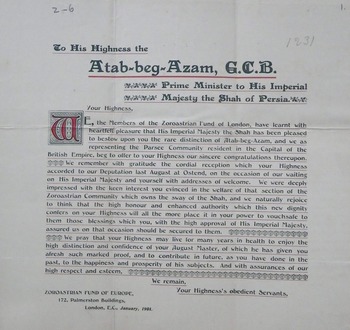
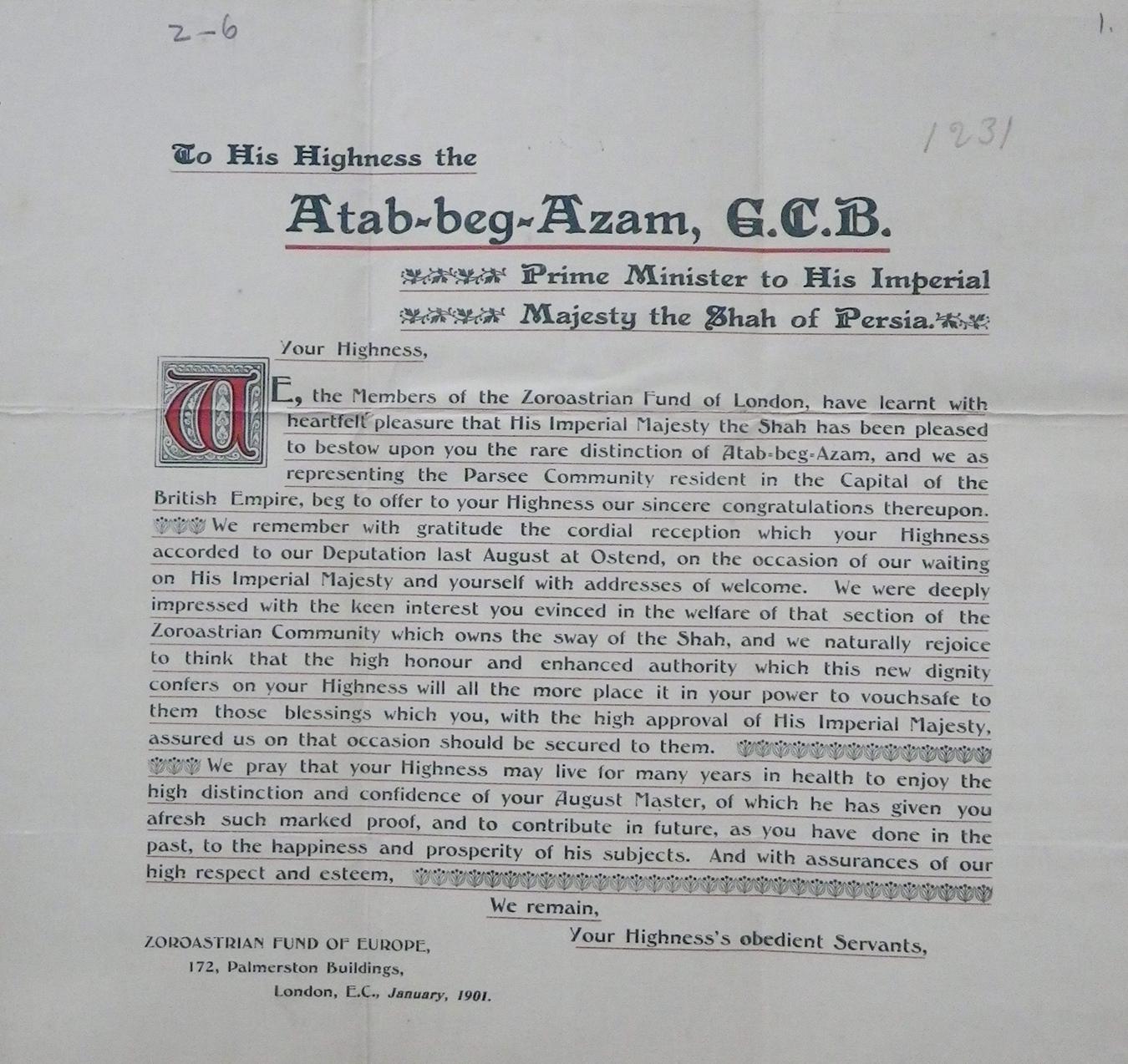
By the early twentieth century, as the response to Shahjahan's murder indicates, both Parsis and British diplomats were exercising far greater influence over Iranian authorities in Tehran—even though such influence did not always extend to local officials in places like Yazd or Kerman. Parsis had crafted ties with the Foreign Office in London which allowed them incredible access to the levers of diplomatic power. For example, when Muzaffar al-Din Shah visited Europe in 1900, British authorities assisted Parsis with scheduling an audience in Belgium. Both Bhownaggree and Naoroji met the shah and presented an address signed by wealthy Parsi luminaries such as Jamsetji Tata, Cowasji Jehangir (first baronet), and R. D. Sethna. Responding to Parsi wealth and political power, Muzaffar al-Din Shah pledged to “always look after the welfare of his Zoroastrian subjects.”Footnote 54 A few months later, the London Parsi community sent a flowery letter of appreciation to the Iranian prime minister, Mirza Ali Asghar Khan Amin al-Soltan (Fig. 2). They recalled meeting him in Belgium and congratulated him for receiving from the shah the title of atābak-e aʿzam.Footnote 55 Matters were very different from 1873, when Naoroji and Navrozji struggled to meet Nasir al-Din Shah and relied on the goodwill of some British Indian political contacts.
Letter from the Zoroastrian Fund of Europe, the organization of the Parsi community of London, to Mirza Ali Asghar Khan Amin al-Soltan, the Iranian prime minister, January 1901. Courtesy of the National Archives of India.
What explained strong British interest in Zoroastrian affairs and a willingness to do so much of the diplomatic bidding of the Parsis? Constant pressure from Bombay Parsis, after all, could only go so far. It is certainly important not to discount a sincere commitment toward minority rights among certain British officials: diplomats like Charles Alison or Ronald Thomson worked tirelessly on behalf of the rights of Armenians, Jews, Nestorians, and Bahais. Championship of the Iranian Zoroastrians definitely played a role, albeit minor, in burnishing a reputation for humanitarianism in British foreign policy. As importantly, it was helpful for stroking the egos of particular imperial proconsuls. Improved conditions for the Iranian Zoroastrians were “due in large measure to British interest and British protection,” Lord Curzon, newly returned from India, proclaimed in 1906, something about “which it was pardonable to be somewhat proud.”Footnote 56
But a diplomat like Curzon would have been shrewd enough to realize the true, overriding motivations behind such sustained British involvement in Zoroastrian affairs: imperial geopolitics. Parsi activities in Iran, quite simply, were useful in expanding British interests in Iran and checking the influences of other powers, especially Russia. British diplomats quickly realized that they could also go around Parsis and directly cultivate Iranian Zoroastrians as strategic chess pieces in Great Game politics. In the tense years before the Anglo-Russian Convention of 1907, at a time when both London and St. Petersburg actively contemplated occupations of Iran, the British eagerly sought out local allies to forestall a prospective Russian advance.Footnote 57 The geographic concentration of the Zoroastrian population heightened their strategic value: in Yazd, just beyond Russia's area of primary influence in northern Iran, and in Kerman in southeastern Iran, an area of particular sensitivity for the British, athwart trade and communication routes to India. Earlier, Parsis had constructed diplomatic networks spanning Bombay, Tehran, and London. Now, considerations of British Indian interests brought two other centers of power to the fore: the imperial capitals of Calcutta and Simla. An imperialism of human rights, therefore, only goes so far in explaining British engagement with the Iranian Zoroastrians. Humanitarian impulses formed, at best, a shallow veneer upon the stark military and diplomatic considerations animating Anglo-Russian imperial rivalries.
The scholar Edward Granville Browne was one of the first Britons to elucidate the special economic importance of the Iranian Zoroastrian community. Visiting Yazd in 1887 or 1888, he was impressed by its prosperity, noting that its merchants had “a large connection not only through Persia, but with India, China, [and] Beyrout, and some of them have a large command of capital.” The Zoroastrian merchants, many of whom had spent time in Bombay and had acquired British colonial subjecthood, particularly caught his attention: they were “warmly attached to the English, of whose greatness they have very high ideas.” As an example he cited Ardeshir Mehrban, one of the Mehrban brothers who operated Godrez Mehrban and Co. between India and Iran and who was now considered the “chief merchant” of the Yazd Zoroastrians. There were strong hints of the community's incipient Anglophilia. “Those of them who are under British protection or are British subjects, are extremely proud of the fact,” Browne noted in his diary, “and many who were not so were anxious to become British subjects, if possible.” As perhaps the most striking example of this pro-British sentiment, several Zoroastrians in Yazd and Kerman asked Browne when their towns would be connected to the sea by one of Britain's favorite tools for expanding its imperial influence, the railway.Footnote 58
It took a military man from India to translate this economic importance and pro-British sentiment into a strategic policy proposal. In early March 1888, Henry Bathurst Vaughan, a lieutenant in the Seventh Bengal Infantry, arrived in Yazd as part of an intelligence-gathering mission in Iran for the Indian government. Like Browne, he immediately grasped the city's economic importance, noting the special role of Iranian Zoroastrian merchants, through which “half the trade with Bombay passes.” Prominent merchants like Ardeshir Mehrban, “who is a B. A. of one of the Indian Colleges,” were “disposed to be loyal towards the British Government” but suffered from continued persecution, a lack of security, and the corruption of local officials. Consequently, Vaughan suggested to his military superiors that Great Britain extend special protection to Yazd's Zoroastrian merchants as well as to some Muslims and Bahais. If the British dispatched a “native agent to look after their safety and the interests of trade,” or if a British agent in Iran became their protector, “the effect on British trade would be astonishing.” These merchants, he claimed, could quadruple their volume of trade. Zoroastrians, in particular, “would form companies and firms, establish factories and banking corporations, and import and export goods of English manufacture,” Vaughan continued. “English commercial influence would then, as it should, become paramount in these parts.”Footnote 59 He added, for good measure, that the Russians had already appointed a local merchant as their agent and were steadily expanding their commercial influence in Yazd.Footnote 60
Vaughan saw augmented British trade and influence directly through the prism of the Great Game, offering a remarkable insight into how minority politics could influence Anglo-Russian rivalries. Britain's trade in the region, he claimed, was “decidedly at a disadvantage” in comparison to Russia's since St. Petersburg could rely on another minority, local Armenians. Armenian merchants, “whether naturalised or native, carry on extensive business in perfect safety and security owing to the protection afforded by that Government to all its subjects.”Footnote 61 They were also important from the standpoint of commercial intelligence: Armenians helped facilitate Russians’ “better knowledge of the tastes and requirements of the Persian people than we have.” Establishing a similar dynamic with Zoroastrians could therefore level the playing field. Importantly, however, Vaughan was sensitive to the issue of minority rights, arguing that a British Indian connection could help from the standpoint of promoting general tolerance in the region. “From long residence in India,” he argued, several Muslim merchants “have learnt to look with toleration upon men of other creeds,” thereby setting themselves apart from “their stay-at-home and more fanatical fellow-citizens.”Footnote 62 On the arid plains of Yazd, an imperialism of free trade and an imperialism of human rights could march in lock step.
Charity and Commerce as Proxy Politics: Percy Sykes, the British Indian Commercial Mission, and Anglo-Russian Intrigues in Southeastern Iran
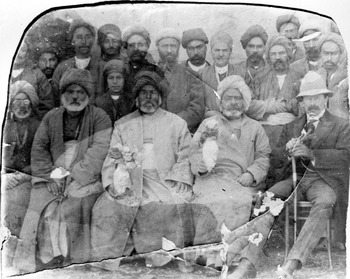
Some years after Vaughan trekked back to the subcontinent, another military man with Indian connections became the preeminent champion of crafting the Iranian Zoroastrian community into a British proxy. Percy Molesworth Sykes, one of the most important British diplomats in Iran through the First World War, developed an interest in the Iranian Zoroastrians during his first visits to Yazd and Kerman in 1893 and was distressed by the spate of murders of community members (Fig. 3). Once he was posted as the British vice-consul in Kerman in 1894 and then as consul around 1902, he specially reached out to local Zoroastrians since “90 per cent. of the followers of Zoroaster are British subjects”—the Parsis.Footnote 63 The broader Zoroastrian community quickly recognized him as an important ally. He was praised in the Kaysare Hind for the enthusiasm he displayed in improving Zoroastrian education and business in Kerman.Footnote 64 While in Bombay in 1902, Iranis petitioned him to help improve security and educational opportunities for their brethren in Iran.Footnote 65 Sykes noticed Parsi assistance in Kerman but he found it inadequate. He called for increased Parsi philanthropy and wanted the British Indian government to coax Parsis to loosen their purse strings—or even help foot the bill.
Percy Sykes (first from right in front row) with members of the Zoroastrian anjoman of Kerman, around 1899. Courtesy of Mehrborzin Soroushian.
Sykes, therefore, upturned patterns of diplomacy which had held for half a century: instead of Parsis seeking out British support, the British would now play a forward role in the amelioration of Iranian Zoroastrians. Closer British ties with Zoroastrians would in turn help ward off creeping Russian diplomatic and commercial influence in southern Iran, only a stone's throw away from the sensitive western frontier of British India. Sykes was therefore instrumental in crafting a British Indian strategic dimension in the broader program of promoting minority rights in Qajar Iran.
In 1904, Sykes urged the viceroy, Lord Curzon, and the Indian government to subsidize a plan floated by Dinshaw Petit (second baronet), president of the Society for Amelioration, to educate some Kermani Zoroastrian youths in Bombay. It was in British strategic interests, Sykes claimed, to help this community and make it a political ally. “I would represent that, in the Parsi [Iranian Zoroastrian] community which is rapidly monopolising the wealth of Kerman, we have a powerful political instrument which should be turned to good account,” he stated. Along with a better educated Iranian Zoroastrian community, Sykes felt that Parsi “capitalists and philanthropists” could help consolidate British dominance. In a follow-up letter, Sykes made his intents even clearer: “we shall gradually forge the Parsis of Persia [Iranian Zoroastrians] into a political weapon that will, I anticipate, help to baffle Russian intrigues in South-East Persia.”Footnote 66
Sykes's entreaties to the Indian government were well timed. His predecessor as consul, D. C. Phillott, had despaired to a visiting British Indian political assistant of Russian attempts to woo the Zoroastrians of Kerman. St. Petersburg's representative in Mashhad was “endeavouring to induce the Kirman Parsees [Iranian Zoroastrians] to visit Russia by holding out hopes that under Russian protection they will become even more prosperous than their Bombay brethren.”Footnote 67 And Sykes's new Russian counterpart in Kerman—a certain A. Miller, “known for his extreme Anglophobia”—carried out sustained outreach to local Zoroastrians while also “trying to organise a Mahomedan agitation against the English Missionaries.”Footnote 68 While apparently unsuccessful, these Russian diplomatic offensives in southeastern Iran might have influenced the timing of a special commercial mission to the region hatched by the British Raj.
This was the British Indian Commercial Mission to South-Eastern Persia, organized by government officials in Simla and Calcutta and meant to survey business opportunities in region. The mission also had clear political and intelligence-gathering components, including investigation of Russian commercial competition.Footnote 69 Perhaps wanting to stimulate Parsi business interest in Iran, the Indian government was eager to include at least one Parsi in this mission. Government officials worked through Dinshaw Petit, who recruited a bright young official in the Bombay Municipal Corporation, Rustom P. Masani (bureaucratic squabbles ultimately prevented Masani from joining).Footnote 70
Although British officials, including Curzon, prevaricated about funding Petit's educational program, they did consider clubbing it with the Commercial Mission. Doing so would allow “the possibility of killing two birds with one stone”: combining ostensibly commercial and educational ventures with a broader program of extending British political influence in southern Iran. Like Sykes, these officials understood the strategic value of Parsi philanthropy. The finance member of the viceregal council, Edward FitzGerald Law, wondered openly whether British support for Petit's program would mean “the foundation of a ‘Robert College’ in Bombay”—drawing a comparison with the American school in Constantinople which also played a role in US diplomacy with the Ottoman Empire. It would be “possibly a grave political step.”Footnote 71 For his part, Petit clearly understood the utility of his plan in Great Game politics. In an attempt to win government backing, he now claimed that its “main object” was “to raise in Persia a class of educated and trained Persian Zoroastrians who would be the medium of increasing British prestige and influence in that quarter.”Footnote 72
It was with this backdrop that Arthur Hills Gleadowe-Newcomen, a British Indian colonel, led the Commercial Mission to southeastern Iran. He sent lengthy dispatches to Curzon in Calcutta which freely mixed business and trade matters with the imperative of cultivating allies “should necessity arise for us to take over this part of Persia.” Arriving in Kerman in late 1904, the Commercial Mission therefore lavished attention on the local Zoroastrian community. Gleadowe-Newcomen offered their anjoman a gold medal to be presented annually to the Zoroastrian pupil who was the most academically accomplished in the English language. Since Gleadowe-Newcomen wanted the medal to “remind the community of the interest taken by His Excellency the Viceroy in Persia,” he specifically asked Curzon if he could affix the viceroy's image on its face. Separately, Gleadowe-Newcomen encouraged the viceroy to endorse Petit's educational plan. He was prepared to take the initial group of students back with him to Bombay, “thus, as it were, forging one more link in a scheme for increasing British influence in Persia.”Footnote 73
Like Sykes, Gleadowe-Newcomen trained his sights on countering Russian influence. The prominent Iranian Zoroastrian merchant Jamshid Jamshidian, he noted with regret, was “unfortunately pushing Russian manufactures.” While in Bam, therefore, Gleadowe-Newcomen met with Jamshidian's local agent and counseled him to switch to British Indian goods. It was evidently an easy task. After examining samples of cotton pieces from India, the agent, a Zoroastrian named Ardishir, pronounced that “Indian goods were cheaper and better than Russian” and speculated whether Indian firms could manufacture Russian patterns which were popular with Iranians. “If the Cawnpore firms would enter into correspondence with the head of the firm in Tehran,” Ardishir continued, “it will in all probability lead to the closing of the Russian communication and the enlargement of Indian trade.” It was certainly significant that the two men discussed ties with the textile mills in Kanpur, where British industrialists held a significant stake, rather than the Bombay mills over which the Parsis exercised sizeable influence.Footnote 74 Gleadowe-Newcomen was ecstatic at his coup. Elsewhere, he noticed other signs of the success of the Commercial Mission. In Kerman, the Zoroastrian anjoman snubbed the Russian consul and did not invite him to their annual meeting.Footnote 75
The British Indian Commercial Mission to South-Eastern Persia clearly irked the Russians. We know this because, shortly after Gleadowe-Newcomen and his colleagues left Kerman, Russian diplomats pulled off their own coup and demonstrated a certain measure of influence over Iranian Zoroastrians.
For some years, the British and Russian consuls had been fiercely battling for influence over—of all things—the local Zoroastrian schoolhouse in Kerman. Why on earth were the world's two biggest empires competing over some classrooms in the desert? The school, it turns out, sat at the crossroads of a few important international links. It received funding from Bombay Parsis, most likely from the Society for Amelioration. Furthermore, the British noted that, of the twelve indigenous residents of Kerman who knew English, three of them had connections with the Parsi school.Footnote 76 In an era when modern education in Iran remained substantially undeveloped, the Zoroastrian school was a relatively prominent and prestigious institution.
Sykes understood this. He attended school events and even donated a large world map “showing the British Empire in red” (the Russian legation, he anxiously noted, had recently given local Zoroastrians a gift of a hundred Russian books and two maps, presumably with their own empire highlighted).Footnote 77 Both Sykes and his Russian counterpart, A. Miller, cultivated ties with Mirza Kai Khusru, the schoolmaster, who had spent time in Bombay, received his salary from Parsis, and “on account of a certain knowledge of English has much influence with the Parsi Anjuman.” From his humble school desk, Mirza Kai Khusru evidently decided to hedge his bets. Aside from learning English, he also studied Russian and he maintained friendly ties with both consuls. Sykes's predecessor, Phillott, resented such nonaligned behavior. He characterized Mirza Kai Khusru as “sly, untrustworthy and cringing.”Footnote 78 But Sykes, in contrast, tried to decisively win him over to the British side. He vigorously campaigned for Mirza Kai Khusru to be awarded a Victoria Medal. The Zoroastrian schoolmaster, Sykes claimed, had “shown much zeal in warning his co-religionists to have no intercourse with the Russian Consulate.”Footnote 79 By June 1904, some months before the arrival of the Commercial Mission, Sykes set this plan in motion by gaining support from the British minister in Tehran and the British foreign minister, Lord Lansdowne.Footnote 80
It backfired spectacularly. In mid-January 1905, Mirza Kai Khusru absconded from Kerman in the company of Sykes's Russian nemesis, A. Miller, and an escort of Russian Cossacks. As a red-faced Sykes soon informed Indian authorities, the Zoroastrian schoolmaster had “accepted a post at Odessa in connexion with Russian efforts to develope their trade in South-East Persia.”Footnote 81 The Russian consul had an impeccable sense of timing: he executed this operation right after the British Indian Commercial Mission to South-Eastern Persia had left town for Bam, far enough to offer no interference yet close enough to hear the news. “This is evidently meant as a counterblast to the Mission,” Gleadowe-Newcomen correctly surmised in a note dispatched to India.Footnote 82
In Tehran, the saga of the Zoroastrian schoolmaster caused a minor diplomatic crisis. The Kerman Zoroastrian anjoman sent angry telegrams to authorities in the capital. A telegraph officer promptly leaked these messages to the Russian consul, who had evidently made his way to the city. Expressing regret, Miller offered to meet a leader of the Zoroastrian community and Reporter, who now occupied Manekji's place as the preeminent Parsi agent in Iran. Reporter, for his part, “declined to receive him.”Footnote 83
Aside from the embarrassment caused to the British, and the difficulties faced by the now-leaderless Zoroastrian school in Kerman, this episode neatly illustrated a few processes at work. First, the Iranian Zoroastrian community was now important enough for the British and Russians to engage in tit-for-tat maneuvers while competing for influence. Second, Reporter's involvement—and his snub of the Russian consul—indicated that Parsis were still deeply involved in broader diplomatic machinations concerning the Iranian Zoroastrians. And lastly, as for Mirza Kai Khusru, his decision to go to Odessa revealed that Iranian Zoroastrians were now learning how to leverage imperial competition for their own personal benefit. The Great Game could occasionally be profitable for those locals caught in the crossfire.
It took another year or so for Sykes to hatch one last, audacious plan to cultivate stronger British ties with the Iranian Zoroastrians. It revolved around education but, this time, Sykes had something far more ambitious in mind than a local schoolhouse or even Petit's earlier idea to educate Kermani youths in Bombay (this plan had since fallen through). In May 1906, Sykes delivered a talk at London's Society of Arts on “The Parsis of Persia,” chaired by Lord Curzon. Amidst the Georgian splendor of the Society of Arts’ quarters in Adelphi, a long line of Parsi notables in the imperial capital streamed in to listen to the proceedings: Bomanji Petit, Bhownaggree, Cowasji Jehangir, Dorab and Meherbai Tata, and Ratanji and Navajbai Tata. These were some of the richest, most influential Parsis of the day. They were joined by Britons like Birdwood who had enjoyed decades of close relations with the Parsi community. A correspondent at the event gushed that it had been some time since a Society of Arts meeting had been “so full, so distinguished, and so enthusiastic.”Footnote 84
Before this august assemblage, Sykes described the conditions of the Iranian Zoroastrians, explicated on British attempts at amelioration, and then made an extraordinary appeal to the Parsis. He castigated Bombay Parsis for not expending more of their wealth on their Iranian coreligionists. The much-maligned Mirza Kai Khusru was brought up as an example: he had left his schoolhouse duties in Kerman because he was “badly paid” and “the Parsis of Bombay gave no help.” During his interactions with Iranian Zoroastrian students at the struggling schoolhouse, Sykes “felt keenly that the crumbs from some rich Parsi's table would suffice to put matters on a proper footing.” And this observation provided Sykes with an opportunity for much sterner criticism. “Is it not then your bounden duty and your obvious interest to provide adequate funds to educate and help your backward section?” he asked Parsis. “Is it not to your obvious advantage to push development and trade in Southern Persia ...?” Sykes was “astonished” at Parsis’ relative indifference, contrasting the munificence of Parsi philanthropy in Bombay with the situation in Iran, where Zoroastrians “have no doctor or dispensary of their own.” Shouldn't Parsis realize that their own destiny was “bound to their ancient home of Irán with links of steel”?Footnote 85
After Sykes made these provocative appeals, it was Curzon's turn. The former viceroy praised the work of British officers, particularly Sykes, in improving conditions for the Iranian Zoroastrians. At the same time, he lamented “the languid interest” of Bombay Parsis in Iran and their Iranian coreligionists. Curzon offered a pointed comparison with the British Jewish community, which had “certain features of resemblance to the Parsi community in Bombay,” and noted how they were energetically helping their own coreligionists in Palestine and around the world. “Were the Parsis of Bombay,” Curzon inquired, “going to lag behind?”Footnote 86
From a transcript of the meeting, a clear sense emerges of the deep embarrassment which Sykes's and Curzon's comments aroused among Parsi listeners, standard bearers of a community otherwise known for its munificent charity. A startled Bhownaggree acknowledged that “there was something almost approaching an aspersion upon the charitable instincts of the Parsi community.” But Sykes's tactics worked: they elicited pledges of further Parsi philanthropy in Iran. Bhownaggree signaled to Bomanji Petit in the audience, noting that he was a member of the Society for Amelioration and that the organization “would gladly put their hands into their purses and come forward to assist their Persian co-religionists in any manner that Major Sykes might indicate.”Footnote 87 In terms of initiative in Iranian philanthropic activities, this was a notable abdication: Parsi donors now looked to British diplomats for direction and advice.
Sykes gladly took up a position of leadership, building on the momentum from his London talk. “The result has been—probably thanks to Lord Curzon's strong support—exactly what I hoped,” he exclaimed to Louis Dane in the Indian Foreign Department.Footnote 88 First, he floated a revised version of Dinshaw Petit's educational plan, instructing the Parsi baron to reopen lines of communication with the Indian government. Next, once Petit arrived in London, he organized a meeting with Spring-Rice (soon to take up ambassadorial duties in Tehran), Birdwood, Richmond Ritchie (an India Office official), and Bhownaggree to hammer out details. Sykes had grand plans: training Zoroastrian students in Bombay and then giving them a monthly stipend for five years after their return to Iran, with the Indian government subsidizing costs and Sykes handling all arrangements in Kerman. Declaring that the Society for Amelioration's funds were “totally inadequate to embark on the developments which are essential,” he envisaged a corpus of “perhaps four lacs of rupees” (Rs. 400,000).Footnote 89 Ratanji Tata had already contributed £500 or Rs. 7,500, which would form the “nucleus” of the funds; Irani Zoroastrians in Bombay had pledged an additional Rs. 21,000.Footnote 90
These plans went right to the summit of political power: to John Morley, the secretary of state for India in London, and Lord Minto, the Indian viceroy in Calcutta. Sykes complemented this by directly suggesting to Petit that Parsi charitable activities would be far more effective if backed up with economic investment in Iran—once more illustrating the complementary nature of business and philanthropy. Both, however, were yoked to geopolitical imperatives. Parsis, Sykes dictated, were to “be encouraged to devote more attention to Southern Persia”—Britain's area of greatest strategic concern—“by the knowledge that His Excellency the Viceroy approved of their so doing.”Footnote 91 As the Constitutional Revolution unfolded in Iran, and as London and St. Petersburg moved toward the Anglo-Russian Convention, Sykes was playing a long game. And Zoroastrian communities, both in India and Iran, were at the very heart of his strategy.
Conclusion: Minorities, Empires, and Political Power
Unfortunately for Sykes, his well-laid plans for cultivating Iranian Zoroastrians probably went nowhere: the archival paper trail simply runs out by the end of 1906. This timing is significant. By then, several factors had begun transforming the power dynamics between the British, Parsis, and the Iranian Zoroastrian community, ending the nexus between British diplomacy and Parsi philanthropy in Qajar Iran.
For the British, the most obvious factor was rapprochement with Russia, already underway by the end of 1906. According to the terms of the Anglo-Russian Convention, signed in St. Petersburg in August 1907, Great Britain and Russia recognized respective spheres of influence in southern and northern Iran.Footnote 92 While hardly bringing a close to Anglo-Russian rivalries in the region, the convention at least took out much of the steam from Great Game intrigues—for example, reducing Kerman's strategic significance and that of the local Iranian Zoroastrian community. On occasion, such as in 1911, the idea of promoting British Indian educational links for the Iranian Zoroastrians resurfaced in diplomatic communiques. But there was no longer a whiff of urgency in the proposal. There were no offers of British funding or special support.Footnote 93
In the case of Iranian Zoroastrian amelioration, therefore, a British imperialism of human rights was, ultimately, mostly just imperialism. From London's perspective, the community faded in importance once shifting strategic imperatives threw up new potential allies and threats. By the First World War, Britain's strategic considerations in southern Iran had changed beyond recognition. Sykes witnessed this firsthand: as commander of the South Persia Rifles, he trained his sights on agents of Kaiser Wilhelm, while receiving support from the representatives of Tsar Nicholas.Footnote 94 And he consequently lavished far less attention on Parsis and Iranian Zoroastrians. His last major intervention seems to have been in 1922, when he wrote to Gustaspshah Kaikhusroo (G. K.) Nariman, a Parsi scholar and leader of the newly established Iran League of Bombay. He continued to express deep frustration with the level of Parsi interest and investment in Iran, particularly in the southeastern sphere around Kerman.Footnote 95
By the time that Sykes wrote his letter, Parsi relations with Iranian Zoroastrians had already transformed in momentous ways. The Society for Amelioration had gone into terminal decline: as early as 1898, in his letter to Naoroji, Reporter acknowledged that the Society's management was in such disarray that he had been compelled to offer his resignation in the previous year.Footnote 96 New associations rose in its place. Bombay Iranis founded the Iranian Zoroastrian Anjuman in 1917, where much closer cultural ties facilitated a range of charitable and literary activities—most notably a brand of “textual philanthropy” which transformed modern Iranian understandings of Zoroastrianism. Parsis like G. K. Nariman, meanwhile, established the Iran League in 1922, which had its own checkered history of involvement in Iranian affairs based on twin political developments, the rise of Reza Shah Pahlavi and the advancing tenor of Indian nationalism.Footnote 97
The activities of the Iran League demonstrated how Parsi and British interests had begun to diverge with respect to Iran. Someone like Nariman could issue searing criticism of British policy in the country, claiming that it was “one of unabashed jingoism, only less flagrantly immoral than that of Russia.”Footnote 98 At the same time, the Iran League helped fuel resurgent Parsi fantasies of “return” in the interwar years. British Indian officials expressed bewilderment at the sudden upsurge of “Parsi Zionism,” dismissing it as “castles in the air.” Bombay's police commissioner, nevertheless, felt it prudent to keep tabs on such Parsi advocates, while a British official in Tehran wondered whether a foreign hand, perhaps French or American, was behind Parsi activities. The police commissioner presciently noted that someone like Nariman, although a critic of Britain's role in Iran, was keen to recruit “foreign Governments and in particular the British Government, to assist them in effecting a footing in their ancient motherland.” Albeit with radically different goals in mind, some Parsis still sought out British power and influence to assist in their Iranian activities.Footnote 99
But it was the gathering political and economic clout of the Iranian Zoroastrians themselves which ultimately limited the scope of Parsi and British involvement. The Constitutional Revolution provided Zoroastrians with a deputy in the first Majles, a privilege which Armenians and Jews did not enjoy (Abdollah Behbahani justified this with a direct nod to Parsi power, noting that Parsis “have a seat in the British Parliament,” a reference to Naoroji and Bhownaggree).Footnote 100 Improved socioeconomic conditions and the rise of influential leaders such as Kaikhosrow Shahrokh shattered preexisting power dynamics. Consequently, Iranian Zoroastrians became more assertive in their dealings with the Parsis. By 1917, British diplomats picked up signs of growing Iranian Zoroastrian discontent with Reporter and his role as the chief Parsi agent. Zoroastrians in Kerman complained to Bombay authorities of Reporter's “incompetency” and they were soon joined by their brethren in Yazd in denouncing Reporter's interference in the selection of local anjoman members. Most significantly, Zoroastrians unfavorably contrasted Reporter with Shahrokh, even claiming that Reporter tried to “thwart” him. The Parsi agent might very well have resented the appearance of an Iranian Zoroastrian rival for community leadership and allocation of charitable funds.Footnote 101
Shahrokh inaugurated a fundamentally different chapter in Iranian Zoroastrian relations with the British, as well (thus putting to rest any notion that the community was acting as mere agents of British interests). He was, at times, stridently critical of British interference in Iranian affairs, prompting the British commercial secretary in Tehran to comment that his “political attitude is of the ‘Gott strafe England’ type.” Working through the Indian government, the British minister in Tehran even asked the Parsi community to publicly rebuke Shahrokh for his “anti-English activities.” Incredibly, British diplomats now worried that someone like Shahrokh could stir up anti-British sentiments among the Parsis. They watched with concern when, in 1922, one Parsi visitor from Bombay, a guest of Shahrokh and an advocate of Parsi migration to Iran, began loudly proclaiming the imminent demise of British rule in India.Footnote 102 The episode vividly illustrates how, by the beginning of the Pahlavi era, many earlier networks of power and influence had been scrambled and rearranged in ways which were simply unimaginable at the dawn of the twentieth century.
In spite of this transformed landscape, it is remarkable to see how microscopic communities like the Parsis and Iranian Zoroastrians exercised such influence vis-à-vis the greatest empire in human history. And this brings us to an important final question: what does Parsi activity in Iran tell us about minorities and political power, particularly within imperial contexts?
Similar to the case of an imperialism of human rights, a comparison with Jewish activities in the Muslim world helps us formulate an answer. This article has noted similarities in how both Parsis and Jews shaped British policy in Iran. At times, the parallels between the two communities’ efforts can be striking. Bombay Parsis and Moses Montefiore worked closely with many of the same British diplomats in London and Tehran. Montefiore sought a guarantee of minority rights through the shah's direct intervention, such as with a written farmān, at precisely the same time when Parsis were seeking an imperial farmān about the jizya tax.Footnote 103 Both Parsis and Jews deployed an emerging language of human rights. At times their diplomatic activities quite literally overlapped. During his final visit to London in 1889, Nasir al-Din Shah received back-to-back deputations at Buckingham Palace from Parsis and Jews regarding minority rights: first from Naoroji, and thereafter from members of the Jewish Board of Deputies and Abdallah-Albert Sassoon, the Baghdadi Jewish leader from Bombay.Footnote 104 The two Bombay natives no doubt heartily greeted one another while at the very epicenter of British power.
As Sassoon's presence indicates, Bombay played a special role in Jewish transnational networks of community charity and amelioration. The city's wealthy Baghdadi Jewish community worked closely with Jewish leaders abroad, like Montefiore, while their commercial agents in Iran had a mixed agenda of business, diplomacy, and philanthropy for the Iranian Jewish community. And they were cultivated by the shah: both Sassoon and Bhownaggree were made members of the Order of the Lion and the Sun.Footnote 105 Given these parallel networks operating between Bombay, London, and Tehran, one wonders if Jewish and Parsi leaders were in direct conversation about their experiences and activities. Both minority groups had mastered the art of harnessing imperial power from below.
But several factors made the Parsis an extraordinary case of minority political agency. Baghdadi Jews worked in concert with large, prosperous Jewish communities in Europe and North America—communities where Jews were citizens and domestic political and economic leaders (albeit subject to systemic anti-Semitism). Aside from a hundred or so migrants in Great Britain, Parsis had no such advantages: the bulk of their activities emanated from faraway Bombay, within an exclusively colonial context. Members of the Baghdadi Jewish community, furthermore, made concerted efforts for British citizenship, actively lobbying to be considered as white Europeans. Many achieved the status of a “British Protected Person,” putting them a notch above Parsis.Footnote 106
In this light, it is hard to describe the scale and complexity of Parsi activities in Iran— orchestrated by so few people, and in absence of rights and privileges of citizenship—without resorting to superlatives. It was an utterly unique example of how a colonial community could amass extraordinary power and expend it in a foreign country. Other colonial minorities sought similar forms of diplomatic leverage: through the Khilafat Movement, for example, millions of Indian Muslims deployed their own transnational links, many orchestrated through Bombay, to influence British policy toward Turkey.Footnote 107 They failed. Parsis were exceptional in their ability to utilize their economic and political heft in the diplomatic arena. They were extraordinarily skilled in aligning their objectives with imperial policies.
From the perspective of imperial power politics, the Parsi example is less exceptional but perhaps more instructive. It is no secret that modern imperial powers have relied upon ethnic and religious minorities—and threats to their safety—to maintain the conditions of colonial control. Great Britain assumed the role of protector for Muslims in India; the French established a special relationship with the Maronite Christians of Lebanon; and, most recently, the United States has cultivated strong relations with Iraqi Kurds.Footnote 108 The Parsi and Iranian Zoroastrian communities are of a different order: they are micro-minorities in comparison to the above-mentioned groups. Such micro-minorities nevertheless performed specific imperial functions. Parsis—and, eventually, Iranian Zoroastrians—were ideal proxies in the informal empire, particularly in a country like Iran which was being contested by a rival imperial power. They generated concentrated economic influence, which could later be converted into regional political influence. Russia played a somewhat similar game, employing Armenians to expand their commercial influence across Iran and then directly competing with Britain for sway over the Iranian Zoroastrians of Kerman.Footnote 109
As compact and relatively affluent communities, perhaps the Parsis and Iranian Zoroastrians were ideally suited to the task of making minor yet critically important maneuvers in the Great Game. Parsi philanthropy in Iran can help us form a corollary of sorts to Foucault's famous observation that power is everywhere. Power might come from everywhere, but some groups are able to force multiply power and deploy it in ways which dramatically expand their own political horizons.
Acknowledgments
I would like to thank Afshin Marashi and Murali Ranganathan for their comments on earlier drafts of this article. Mehrborzin Soroushian has kindly provided the images which feature in this article as well as permission for their publication. John Gurney shared his insights on Edward Granville Browne and Henry Bathurst Vaughan, while Alexandra Buhler answered my queries on the position of Iranian Zoroastrians during and after the Constitutional Revolution. I must thank the staff of the National Archives of India, the Manuscripts Room at the Nehru Memorial Museum and Library, and the Asian and African Studies Reading Room at the British Library for their assistance during visits. During pandemic conditions, the Churchill Archives Centre at Churchill College, Cambridge University, generously provided me with free scans of archival material. My wife, Parinaz Madan, assisted me with some Gujarati translations and Ranganathan assisted me with some French translations. The Office of Research and Innovation at the S. P. Jain Institute of Management and Research has funded research undertaken for this article. I must thank the Lakshmi Mittal and Family South Asia Institute at Harvard University, where I have been a Research Affiliate. Lastly, I must thank Sussan Siavoshi and Aria Fani for their assistance in shepherding to completion this special edition on Parsis and Iran.