The early views of parents as the main agents of socialization have been subsequently revised as a result of the growing recognition that children may also play an active role in the socialization process. That active role was perceived mostly in terms of children's ability to elicit conflict, resist and challenge the parent, and thus “pull” for harsh parenting (Bell, Reference Bell1968; Kuczynski & Kochanska, Reference Kuczynski and Kochanska1990; Lytton, Reference Lytton1990; Patterson, Reid, & Dishion, Reference Patterson, Reid and Dishion1992; Putnam, Sanson, & Rothbart, Reference Putnam, Sanson, Rothbart and Bornstein2002). Recently, approaches to the child's active role have become conceptually and methodologically sophisticated (e.g., see the introduction by Pardini, Reference Pardini2008, and the following special section of Journal of Abnormal Child Psychology). Current studies often examine the evolving mutually adversarial and mutually coercive parent–child transactions as leading to maladaptive developmental outcomes, with varying degree of emphasis on the causal role of the parent versus the child (e.g., Lipscomb et al., Reference Lipscomb, Leve, Harold, Neiderhiser, Shaw and Ge2011; Lorber & Egeland, Reference Lorber and Egeland2011).
However, most studies continue to place the emphasis on the child's negative characteristics (e.g., difficult temperament or aversive behavior) and the resulting maladaptive, coercive cycles that evolve within the parent–child relationship. This approach does not acknowledge that children can also act as active agents in their own socialization in a positive sense and that they can willingly, even enthusiastically, embrace parental influence, despite the growing interest in positive socialization mechanisms in general (Criss, Shaw, & Ingoldsby, Reference Criss, Shaw and Ingoldsby2003).
The recognition of children's capacity for active cooperation with parents has a long history, dating back to the neopsychoanalytic model that described children's willing identification with warm, emotionally available parents (Emde, Biringen, Clyman, & Oppenheim, Reference Emde, Biringen, Clyman and Oppenheim1991). Those approaches have evolved further into the attachment perspective that has depicted secure children as eager to embrace parental rules (Bretherton, Golby, & Cho, Reference Bretherton, Golby, Cho, Grusec and Kuczynski1997; Thompson, Reference Thompson, Damon, Lerner and Eisenberg2006; van IJzendoorn, Reference van IJzendoorn1997). In addition, Maccoby (Reference Maccoby, Collins and Laursen1999, Reference Maccoby, Grusec and Hastings2007) advocated a view of children as able to develop a uniquely receptive, willing orientation toward their parents. In all those approaches, such a “willing stance” has been considered a powerful mechanism of successful socialization. In those models, the child's willing stance is typically seen as evolving within a mutually responsive parent–child relationship. Children of responsive and supportive parents develop an eager, receptive, cooperative orientation toward them (Kochanska, Reference Kochanska2002; Kochanska, Forman, & Coy, Reference Kochanska, Forman and Coy1999; Londerville & Main, Reference Londerville and Main1981; Lytton, Reference Lytton1977; Martin, Reference Martin1981; Matas, Arend, & Sroufe, Reference Matas, Arend and Sroufe1978; Parpal & Maccoby, Reference Parpal and Maccoby1985). Despite the long-standing interest and potentially key implications for socialization, however, children's willing, receptive, eager, positive stance toward parents remains largely underappreciated in developmental psychology and psychopathology.
We have proposed that the child's willing, receptive stance toward the parent may be reflected in multiple observable behaviors. Among others, they may include the child's responsiveness to the parent's cues (Kochanska, Barry, Aksan, & Boldt, Reference Kochanska, Barry, Aksan and Boldt2008); committed, enthusiastic compliance with the parent's agenda (Kochanska, Aksan, & Carlson, Reference Kochanska, Aksan and Carlson2005); and eager, responsive imitation in parent–child teaching contexts (Forman, Aksan, & Kochanska, Reference Forman, Aksan and Kochanska2004; Kochanska et al., Reference Kochanska, Forman and Coy1999, Reference Kochanska, Woodard, Kim, Koenig, Yoon and Barry2010). Across several low-risk samples, all measures of willing stance have been robustly associated concurrently and longitudinally with a host of positive developmental outcomes. However, they have all been treated as separate observed variables, based on the theoretical assumption that they reflect a latent generalized receptive, cooperative, willing stance toward the parent. The first goal of this study was to test this assumption empirically, using confirmatory factor analysis (CFA).
The child's willing stance plays a key role in socialization. Its significance is particularly paramount as a factor that prevents (or, when compromised or weakened, as one that leads to) antisocial, externalizing, disruptive trajectories. An eager, receptive, willing stance toward the parent is crucial for the child's genuine embrace, acceptance, and internalization of the parent's values and socialization messages. A compromised willing stance leads to defiance, anger, hostility toward the parent, rule breaking, aggression, disregard for standards of conduct, and other typical externalizing behavior problems. In our past work, we have shown robust links between the child's compromised willing stance and externalizing problems or closely related conscience development (Forman et al., Reference Forman, Aksan and Kochanska2004; Kochanska et al., Reference Kochanska, Barry, Aksan and Boldt2008).
In contrast to the key role child willing stance has in the origins of antisocial, disruptive problems, its role in the development of internalizing problems, such as anxiety and depression, is not obvious. In our past research, we have not yet studied empirically relations between willing stance or its components and children's internalizing developmental trajectories, and we are not aware of such investigations. To elucidate the links between the child's willing stance at toddler age and both externalizing and internalizing problems at preschool age was another goal of the current work. We used a well-established clinical diagnostic instrument that produced measures of externalizing problems (symptoms of opposition, defiance, and conduct problems) and related measures of child social functioning and aggression (peer conflicts), and internalizing problems (generally symptoms of depression and anxiety). Those outcomes were all examined simultaneously and modeled as intercorrelated outcome variables. We expected willing stance to be significantly associated with externalizing problems and the related peer conflicts. We had no specific hypotheses about its links with internalizing problems.
As ecological models of development have ascended (Belsky, Reference Belsky1984), adversity and risks impinging on the family have been increasingly recognized as contributors to a broad range of children's poor developmental outcomes. Multiple such risks have been studied in relation to both externalizing and internalizing problems in young children and to the quality of early childrearing environment. Those risks have typically included the mother's young age, low education level, and low income, as well as an unstable family structure (e.g., single or divorced), a high number of children, and a high number of stressful events impinging on the family.
Considerable research has supported negative implications of ecological adversity for young children. Maternal young age has been often found to serve as a broad risk factor (Berlin, Brady-Smith, & Brooks-Gunn, Reference Berlin, Brady-Smith and Brooks-Gunn2002; Bornstein, Putnick, Suwalsky, & Gini, Reference Bornstein, Putnick, Suwalsky and Gini2006; Ragozin, Basham, Crnic, Greenberg, & Robinson, Reference Ragozin, Basham, Crnic, Greenberg and Robinson1982; Wakschlag et al., Reference Wakschlag, Gordon, Lahey, Loeber, Green and Leventhal2000). In addition, maternal low education and low income have been identified as negative predictors of multiple emotional, behavioral, and cognitive child outcomes (Baharudin & Luster, Reference Baharudin and Luster1998; Lanza, Rhoades, Nix, Greenberg, & the Conduct Problems Prevention Research Group, Reference Lanza, Rhoades, Nix and Greenberg2010; McLoyd, Reference McLoyd1998). The mother's family status, which reflects the stability of her relationship with her partner or the absence of a partner (married, cohabitating, single, or divorced), has been found to have broad and pervasive effects on children, with children growing up in married households having advantages (Amato & Keith, Reference Amato and Keith1991; Bachman, Coley, & Carrano, Reference Bachman, Coley and Carrano2011; Osborne & McLanahan, Reference Osborne and McLanahan2007). A high number of children has also been a risk factor (Keenan, Gunthorpe, & Grace, Reference Keenan, Gunthorpe and Grace2007; Trentacosta et al., Reference Trentacosta, Hyde, Shaw, Dishion, Gardner and Wilson2008). Finally, the number of stressful events that have impacted the family has been linked to preschool children's broadly ranging emotional and behavioral problems (Abidin, Jenkins, & McGaughey, Reference Abidin, Jenkins and McGaughey1992).
The most common approach to the study of the implications of adversity on mothers and young children is to treat interrelated multiple stressors present in the family's ecology as cumulative rather than to examine them separately (Ackerman, Izard, Schoff, Youngstrom, & Kogos, Reference Ackerman, Izard, Schoff, Youngstrom and Kogos1999; Deater-Deckard, Dodge, Bates, & Pettit, Reference Deater-Deckard, Dodge, Bates and Pettit1998; Lanza et al., Reference Lanza, Rhoades, Nix and Greenberg2010; Rutter, Reference Rutter, Hersov and Schaffer1978; Sameroff, Seifer, Barocas, Zax, & Greenspan, Reference Sameroff, Seifer, Barocas, Zax and Greenspan1987; Shaw, Vondra, Hommerding, Keenan, & Dunn, Reference Shaw, Vondra, Hommerding, Keenan and Dunn1994; Shaw, Winslow, Owens, & Hood, Reference Shaw, Winslow, Owens and Hood1998). Risk factors are typically scored as present or absent, and the tally of those present is seen as representing the risk variable (or sometimes cumulative variables for various domains; Deater-Deckard et al., Reference Deater-Deckard, Dodge, Bates and Pettit1998). However, more sensitive indices based on means have been advocated (Burchinal, Vernon-Feagans, Cox, & Key Family Life Project Investigators, Reference Burchinal, Vernon-Feagans and Cox2008).
In this study, we followed our earlier work, conducted with a community sample (Kochanska, Aksan, Penney, & Boldt, Reference Kochanska, Aksan, Penney and Boldt2007), although we further refined the earlier approach. We graded the amount of risk associated theoretically with each factor to produce a more fine-grained final index. We considered six ecological risk factors discussed above (the mother's education level, her age, marital status, the number of children, family income per member of the household, and the total amount of stress experienced in the last year). Each was graded on the same metric from the lowest (0) to the highest (3) level of risk, based on the extant research. Those values were then added to reflect cumulative ecological adversity.
In most studies, disrupted parenting has been seen as a key mechanism that accounted for the link between ecological adversity and children's maladaptive outcomes (e.g., Burchinal et al., Reference Burchinal, Vernon-Feagans and Cox2008; Dumka, Roosa, & Jackson, Reference Dumka, Roosa and Jackson1997; Lengua, Honorado, & Bush, Reference Lengua, Honorado and Bush2007; Masten, Reference Masten2011; Seifer, Sameroff, Baldwin, & Baldwin, Reference Seifer, Sameroff, Baldwin and Baldwin1992; Trentacosta et al., Reference Trentacosta, Hyde, Shaw, Dishion, Gardner and Wilson2008; Wyman et al., Reference Wyman, Cowen, Work, Hoyt-Meyers, Magnus and Fagan1999). However, such an approach, although certainly accurate, is incomplete. We believe that it does not acknowledge a key mediator linking parenting with child developmental outcomes: the child's willing, receptive stance toward parental socialization. In our view, a disrupted or compromised willing stance is the proximal cause of behavior problems, and particularly externalizing, antisocial outcomes. To test this hypothesis was the second goal of this study. We tested such a mediational model using structural equation modeling (SEM), with the child's willing stance at toddler age modeled as a latent variable that mediates the impact of maternal responsiveness on children's adjustment outcomes (and responsiveness as mediating the impact of ecological adversity on willing stance). We examined both externalizing and internalizing behavior problems.
The conceptual model was tested in a large, low-income, relatively diverse sample. All of our previous research on children's willing stance has been conducted with community samples that were limited in diversity. To generalize the model to a higher-risk sample of low-income mothers and children has been a long-stated, important objective.
Method
Participants
Mothers of young children responded to flyers distributed broadly in several counties in Eastern Iowa. The study targeted low-income families, and the flyers specified low income as one of the eligibility criteria. The flyers were posted on community boards in libraries, stores, and daycare centers, as well as in locations frequented by low-income families (e.g., Women, Infants, and Children nutritional program offices; local Department of Health and Human Services offices; thrift stores; free medical clinics; pediatric offices; Head Start locations; mobile homes parks; subsidized housing complexes). To be eligible, the mother had to receive or qualify for some form of aid from a federal, state, or faith-based agency, or for Earned Income Tax Credit. Additional criteria included the child's normal developmental and health history and the mother's ability to speak English while observed.
Based on a screening telephone interview, 186 mothers of children (90 girls) ranging in age from 24 to 44 months were accepted. The average annual family income was $20,385 (SD = $13,010); 55% of mothers had no more than a high school education, and 45% had an associate, bachelor's, or technical degree. Mothers' average age was 27.58 years (SD = 4.88). They came from multiple ethnic and racial groups (11% Hispanic and 88% not Hispanic; 73% White, 15% African American, 2% Asian, 2% American Indian, and 8% more than one race or unreported). Fifty-four percent were married, 13% cohabitated with a partner, 6% were divorced, 25% were single, and 2% were in other arrangements.
Overview of design
The study tested an early play-based intervention. The initial assessment was conducted when the mother–child dyads were recruited (child age, M = 30.33 months, SD = 5.40). The data on ecological adversity, children's willing stance, and maternal responsiveness were collected at that time. After that assessment, the dyads were randomized into two groups, and the intervention was implemented for approximately 10 weeks (child-oriented play vs. play-as-usual). However, this article reports the data for the entire sample. There were no differences between the two groups in any of the outcome measures, which were collected approximately 10 months later (child age, M = 39.98 months, SD = 5.56), reported in this article. The intervention status was nevertheless included as a covariate in the analyses as an added safeguard.
Upon entry to the study, mothers and children were seen in an approximately 3-hour session in the laboratory, and mothers completed several questionnaires that provided data for the ecological adversity index. During the session, behavioral data on mother and child behavior were collected in naturalistic but standard contexts and paradigms. Those data served as components of the child's willing stance toward the mother. Approximately 10 months later, mothers (N = 162) completed a well-established instrument that assesses young children's mental health.
All measures comprising the child's willing stance toward the mother (responsiveness during naturalistic interactions, responsive imitation in the teaching context, and committed compliance with the maternal prohibition) and maternal responsiveness were coded from digital recordings of the mother–child laboratory session by independent teams of coders. The coders established reliability on approximately 20% of cases and subsequently realigned frequently to prevent observer drift. Kappas were typically used for categorical variables and intraclass correlations (ICCs) for continuous measures.
Measures
Ecological adversity index
The ecological adversity index was created by assigning 0, 1, 2, or 3 risk points for each of the following six criteria: the mother's education, her age, marital status, the number of children, family income per member of the household, and the total amount of stress experienced in the last 12 months, reported in the Life Experiences Survey (LES; Sarason, Johnson, & Siegel, Reference Sarason, Johnson and Siegel1978). The LES lists multiple life events (e.g., deaths, illnesses, relationship with partner, and financial problems), with each rated from 1 (not stressful) to 4 (very stressful), M = 25.87, SD = 18.84. The risk points were assigned as follows (higher scores denote higher risk):
1. mother education: bachelor's degree or a technical degree = 0, associate degree = 1, high school or GED = 2, less than high school = 3
2. mother age: 26 and older = 0, 23–25 = 1, 20–22 = 2, and 19 and younger = 3
3. marital status: married = 0, cohabitating = 1, divorced = 2, single or in other arrangements = 3
4. number of children: 1–2 = 0, 3 = 1, 4 = 2, 5 or more = 3
5. income per member of household: >$7,500 = 0, $5,000–$7,500 = 1, $2,500–$5,000 = 2, <$2,500 = 3
6. total stress in the last 12 months: lowest 25% of the LES scores = 0, between 25% and 50% = 1, between 50% and 75% = 2, and above 75% = 3
Thus created ecological adversity index ranged from 0 to 13. There were 44 mothers in the 0–3 range, 54 mothers in the 4–6 range, 62 mothers in the 7–10 range, and 25 mothers in the 11–13 range (1 mother did not provide sufficient information). Families of girls and boys did not differ (girls, M = 6.20, SD = 3.14; boys, M = 6.36, SD = 3.49), t (183) < 1.
The child's willing stance toward the mother
The child's responsiveness to the mother in naturalistic interactions
Observed contexts
The child's responsiveness to the mother was coded during naturalistic interactions (42 min total) that encompassed five scripted contexts: the introduction to the laboratory room (5 min), mother busy with questionnaires (10 min), a snack (12 min), play (10 min), and gift (5 min).
Coding and data aggregation
For each context, the coders rated the child's responsiveness from 1 (highly unresponsive) to 7 (highly responsive). The code integrated the child's positive attention and orientation toward the mother, sensitivity to her cues, promptness of response, enjoyment of interaction, and cooperation with the mother's bids. Reliability among the coders (ICCs) ranged from 0.90 to 0.92.
The scores cohered across the observed contexts (Cronbach α = 0.83). Thus, the scores were averaged across all contexts into the child's overall responsiveness score toward the mother. Girls had higher scores than boys (girls, M = 4.89, SD = 0.82; boys, M = 4.48, SD = 1.14), t (184) = 2.81, p < .01.
The child's responsive imitation in a teaching context
Observed contexts
The child's responsiveness to the mother's teaching influence was coded in elicited imitation contexts, based on our previous work (Forman et al., Reference Forman, Aksan and Kochanska2004). The mother (who had been given a detailed script beforehand) demonstrated two scripted play sequences, using standard props: “Feed the bear” (put the bear in the toy chair, put the bib on the bear, give the bear a “sip” from the cup, and wipe bear's mouth) and “Clean the table” (spray the table, wipe with one piece of paper, wipe with another piece of paper, and throw both pieces of paper in the trash). After demonstrating each sequence, the mother asked the child to imitate. Up to 7 min were allowed for the paradigm.
Coding and data aggregation
The child's eager, responsive imitation of the mother's actions was coded for each play sequence, on a 4-point scale (1 = unresponsive or adversarial, 2 = fairly or minimally responsive, 3 = reasonably responsive, and 4 = very responsive). The judgment integrated three criteria: postural orientation toward the mother (turned away or toward the mother, and eye contact), quality of attention and promptness of response, and affective engagement. The intercoder ICC was 0.79.
The scores for the two play sequences correlated, r (185) = .50, p < .001. Thus, they were averaged into one score of responsive imitation. Girls had higher scores than boys (girls, M = 3.21, SD = 0.59; boys, M = 3.00, SD = 0.69), t (184) = 2.24, p < .05.
The child's committed compliance with the mother's prohibition
Observed contexts
Mothers were asked to keep children from touching very attractive toys displayed on a low shelf in the laboratory. The prohibition was introduced as soon as the mother and child entered the laboratory room. All mother–child control encounters that involved the prohibited toys were recorded during approximately 45 min in the laboratory, in the contexts when the child had easy access to the shelf.
Coding and data aggregation
The first team of coders coded all instances when the child oriented toward the prohibited toys (looked at, touched, approached, talked about, etc.) or when the mother commented on the toys. This marked the onset of an episode; the episode continued until its offset was marked (when the child reoriented away from the toys for at least 30 s). The reliabilities for the onset–offset coding (ICC) ranged from 0.85 to 0.99.
A second team of coders then coded the child's behavior for each 30-s segment within the marked episodes. On the average, there were 46.63 (SD = 12.71) segments. Reliability for the coding of child behavior (kappa) was 0.88. In this article, we focus on committed, willing compliance with the mother's prohibition: self-regulated, “wholehearted,” internalized adherence with the maternal rule, without the need for maternal sustained control, often accompanied by indications that the child has endorsed the prohibition (e.g., pointing to the toys, shaking head, and saying “no no,” “We don't touch these”; Kochanska & Aksan, Reference Kochanska and Aksan1995). To create the score of committed compliance, all of its instances were tallied and divided by the number of the 30-s segments. Girls had higher scores than boys (girls, M = 0.72, SD = 0.18; boys, M = 0.60, SD = 0.22), t (184) = 3.99, p < .001.
The mother's responsiveness to the child
Observed contexts
Maternal responsiveness was coded in two contexts, nonoverlapping with the child's responsiveness (20 min total): free play (10 min) and toy cleanup (10 min).
Coding and data aggregation
For each context, the coders rated the mother's responsiveness from 1 (highly unresponsive) to 7 (highly responsive). The code integrated the classic dimensions (Ainsworth, Bell, & Stayton, Reference Ainsworth, Bell, Stayton and Schaffer1971): sensitivity–insensitivity to the child's cues and signals, cooperation–interference, or support for the child's autonomy, and acceptance–rejection, or affection and enjoyment of the interaction. Reliability among the coders (ICCs), ranged from 0.81 to 0.93. The scores cohered across the observed contexts, r (186) = .49, p < .001, and were averaged into the mother's overall responsiveness score toward the child. There were no differences in mothers' responsiveness to girls or boys (girls, M = 4.89, SD = 0.96; boys, M = 4.64, SD = 1.21), t (184) = 1.61, ns.
The child's developmental outcomes: Behavior problems
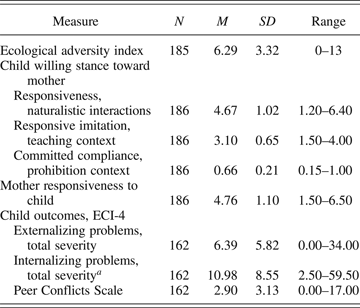
Approximately 10 months later, the mothers completed the Early Childhood Inventory (ECI-4; Gadow & Sprafkin, Reference Gadow and Sprafkin2000). The ECI-4 is a well-established clinical instrument for children aged 3–5 that produces scores for multiple disorders, compatible with DSM-IV. We used the symptom severity scoring approach, where most items are rated as 0 = never, 1 = sometimes, 2 = often, or 3 = very often, according to the guidelines. We then created externalizing behavior problems and internalizing behavior problems scores. The former was the sum of items targeting oppositional defiant disorder and conduct disorder, and the latter was the sum of items targeting separation anxiety, specific phobia, obsessive–compulsive disorder, tics disorder, general anxiety disorder, depression, adjustment disorder, social phobia, and posttraumatic stress disorder (several items that are counted toward more than one disorder were only counted once). Furthermore, we used the Peer Conflict Scale that targets peer aggression. Girls had lower externalizing behavior problems scores: girls, M = 5.38, SD = 5.15; boys, M = 7.35, SD = 6.28, t (160) = –2.18, p < .05, and marginally lower peer conflict scores: girls, M = 2.42, SD = 2.73; boys, M = 3.36, SD = 3.42, t (160) = –1.94, p < .10. There were no gender differences in the internalizing scores: girls, M = 11.26, SD = 9.81; boys, M = 10.72, SD = 7.20, t (160) < 1. The descriptive statistics for all measures are in Table 1.
Descriptive data for all measures

Note: ECI-4, Early Childhood Inventory—4.
aThe ECI conventions specify assigning 0.5 points to certain internalizing items, rather than a 0–3 rating.
Results
Overview of the analyses
First, we computed the intercorrelations among the study's measures. Second, we addressed the first goal of the study: the analysis of the latent structure of children's willing stance (CFA). Third, we addressed the second goal and tested the model that posed the child's willing stance as a key mediator of the impact of maternal responsiveness on the three developmental outcomes and maternal responsiveness as a mediator of the impact of ecological adversity on child willing stance using SEM (Bollen, Reference Bollen1989).
Preliminary intercorrelations
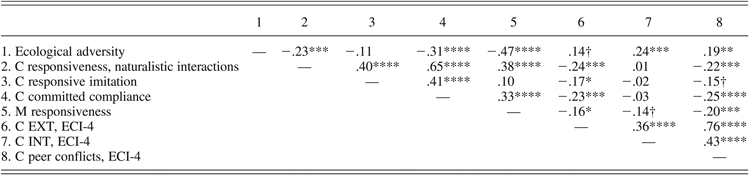
The intercorrelations are in Table 2. Ecological adversity, as predicted, correlated negatively with aspects of the child's willing stance and maternal responsiveness, and positively with all measures of behavior problems in ECI-4: externalizing (marginally), internalizing, and peer conflicts. All three measures of the child's willing stance were positively interrelated, and most were negatively correlated with measures of externalizing behavior problems and peer conflicts. Interrelations among the ECI-4 scores showed a typical pattern, with externalizing, internalizing, and peer conflicts positively correlated with each other.
Intercorrelations among the measures
Note: C, Child; M, mother; EXT, externalizing behavior problems; ECI-4, Early Childood Inventory—4; INT, internalizing behavior problems; peer conflicts, Peer Conflicts Scale.
†p < .10. *p < .05. **p < .025. ***p < .01. ****p < .001.
The testing of the latent structure of children's willing stance toward the mothers
In the CFA model, the four observed indicators, or the child's behaviors toward the mother (responsiveness in naturalistic interactions, committed compliance with her prohibition, and responsive imitation in each of two teaching contexts), were proposed to measure a single latent factor, the child's willing stance. Note that because at least four indicators are needed to test model fit, we treated the child's responsive imitation scores in the two contexts (“Feed the bear” and “Clean the table”) as two separate observed indicators for the CFA model. Given their measurement similarity, we allowed a correlation of error terms between those two indicators.
In the test of normality assumption, none of the four indicators exceeded West, Finch, and Curran's (Reference West, Finch, Curran and Hoyle1995) recommended standards in their univariate statistics: in all indicators, skewness was <2, and kurtosis was <7. However, the omnibus test of multivariate normality provided by DeCarlo's (Reference DeCarlo1997) macro did not indicate that the normality assumption was satisfied. Therefore, as a more conservative approach, we used the robust maximum likelihood estimation based on the scaled chi-square and robust standard errors (Yuan & Bentler Reference Yuan and Bentler1998, Reference Yuan and Bentler2000). Missing values were handled by the listwise deletion method because only 1 out of 186 cases had incomplete data.
The CFA model produced good model fit indices. Chi-square tests indicated that the model was acceptable at the 0.05 α level (χ2 = 1.453, df = 1, p = .228). The comparative fit index (0.997) and Tucker–Lewis index (0.985) were >0.95, and the root mean square error of approximation (0.049), and standardized root mean square residual (0.010) were <0.05, satisfying conventional standards of good model fit (Bentler, Reference Bentler1990; Hu & Bentler, Reference Hu and Bentler1999; Steiger & Lind, Reference Steiger and Lind1980). The standardized factor loadings for the single latent factor, children's willing stance, ranged from 0.37 to 0.81 (ps < .001). Consequently, we can conclude that our four measured child behaviors all reflected an underlying latent construct of willing stance.
Ecological adversity, maternal responsiveness, children's willing stance, and developmental outcomes: Externalizing behavior problems, internalizing behavior problems, and peer conflicts
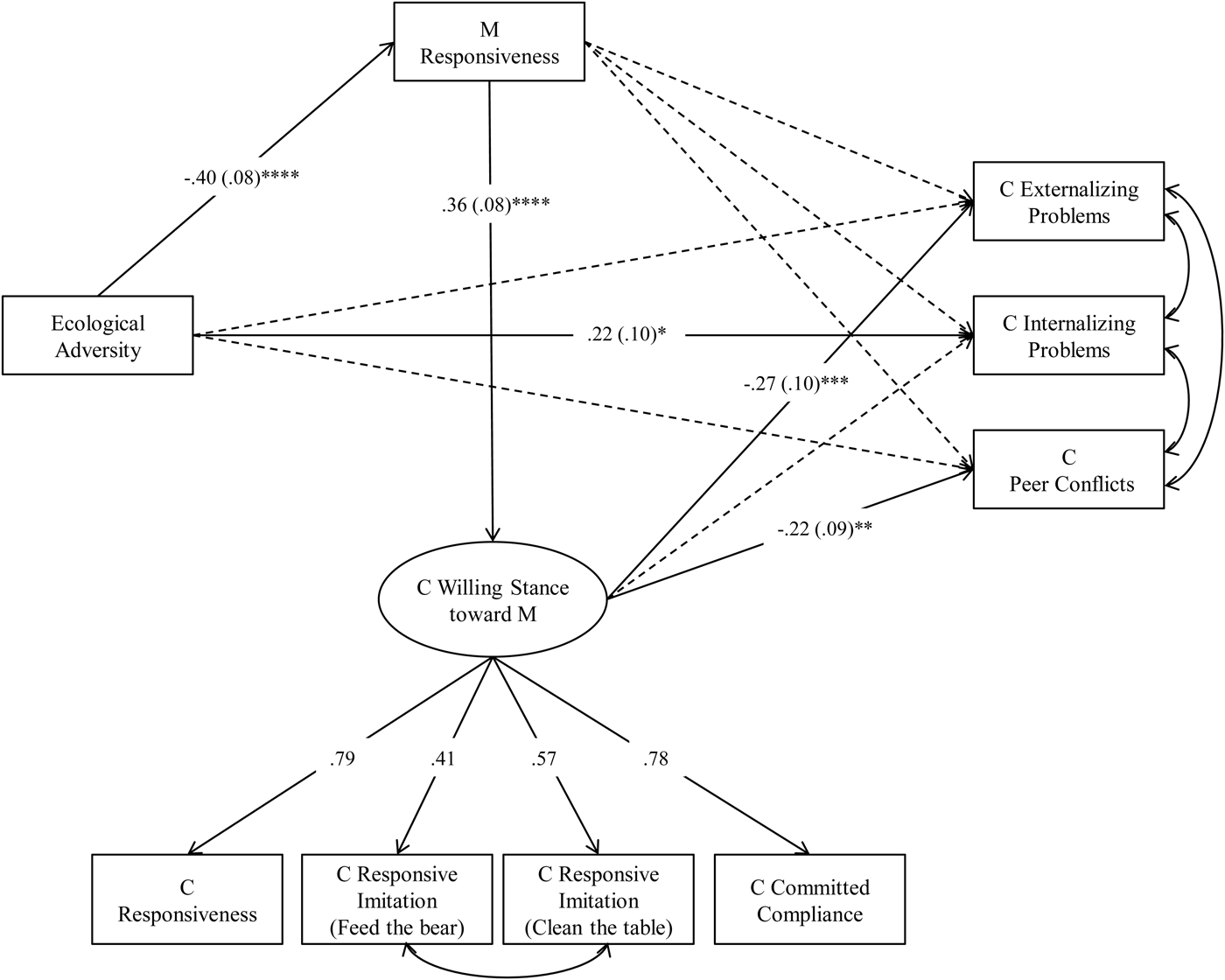
Figure 1 represents the SEM analysis for the three different developmental outcome variables (children's externalizing behavior problems, internalizing behavior problems, and peer conflict).
A structural equation model estimating the effects of the family's ecological adversity, maternal responsiveness, and the child's willing stance on developmental outcomes (externalizing behavior problems, internalizing behavior problems, and peer conflicts). Factor loadings and structural coefficients are standardized scores (standard errors in parentheses). Solid lines represent significant effects (*p < .05, **p < .025, ***p < .01, ****p < .001). Dashed lines represent nonsignificant effects. M, mother; C, child.
The child's willing stance was modeled as the mediator of the effect of maternal responsiveness on the three outcome variables. Maternal responsiveness was modeled as the mediator of the effect of ecological adversity on the child's willing stance. In addition, ecological adversity and maternal responsiveness were modeled to have direct influences on the three outcomes. Although not depicted, the child's sex, age, and intervention status were considered covariates.
As in the CFA model, we used robust maximum likelihood estimation. Because less than 20% of the data were missing, we opted for listwise deletion of missing data (Arbuckle, Reference Arbuckle, Marcoulides and Schumacker1996). To check any possible influence of the missing data on the results, we also ran the same SEM analysis with the full information maximum likelihood method. The overall patterns of the structural coefficients did not change.
The SEM model had good overall fit in all indices (χ2 = 27.370, df = 26, p = .390; comparative fit index = 0.996, Tucker–Lewis index = 0.992, root mean square error of approximation = 0.018, standardized root mean square residual = 0.031). Higher ecological adversity significantly predicted lower maternal responsiveness, and higher maternal responsiveness significantly predicted higher willing stance.
The child's willing stance toward the mother significantly predicted his or her externalizing problems and peer conflicts, such that children with higher scores had fewer externalizing problems and fewer peer conflicts. Maternal responsiveness, however, did not have any significant direct effect on the three outcomes. The indirect effects of maternal responsiveness on the child's externalizing problems and peer conflicts, mediated by his or her willing stance, were both significant (b = –0.10 SE = 0.05, p < .05, and b = –0.08, SE = 0.04, p < .05, respectively).
Higher ecological adversity significantly and directly predicted the child's higher internalizing problems scores. However, the child's willing stance and maternal responsiveness did not have significant effects on this outcome. The indirect effect of the ecological adversity on the child's willing stance, mediated by maternal responsiveness, was significant (b = –0.14, SE = 0.05, p < .01).
Discussion
Despite the long-held consensus that young children have an active role in the process of socialization, the portrayal of that role in development has been relatively one-sided and far from complete. When children are depicted as active contributors, it is mostly in the context of coercive, adversarial, mutually negative transactional cycles unfolding in parent–child relationships owing to their aversive behavior, such as angry defiance, negative emotionality, or difficult temperament (e.g., Lipscomb et al., Reference Lipscomb, Leve, Harold, Neiderhiser, Shaw and Ge2011; Lorber & Egeland, Reference Lorber and Egeland2011; Shaw, Winslow, Owens, Vondra, et al., Reference Shaw, Winslow, Owens, Vondra, Cohn and Bell1998). Even when a possibility of long-term mutually positive parent–child trajectories is explicitly acknowledged and studied, the measures of children's early characteristics typically focus on difficult temperament (e.g., Trentacosta et al., Reference Trentacosta, Criss, Shaw, Lacourse, Hyde and Dishion2011). Consequently, very few studies have focused on young children's actively positive role in the socialization process, although such a role has long been postulated as critical in several theories, including the neopsychoanalytic, attachment-based, and reciprocity-based conceptualizations of development.
Given this long theoretical history, the lack of attention to children's role as positive, eager agents of socialization is unfortunate and ought to be remedied. Furthermore, as this study and our earlier work indicate, the child's eager, willing stance toward the parent is a key factor responsible for the child's accepting, embracing, and internalizing the parent's rules and values. Conversely, a compromised or diminished willing stance is associated with the child's rejection of the parent's socialization messages, disregard for rules, defiance, aggression, and other symptoms typical for an externalizing, disruptive trajectory. Thus, understanding determinants and consequences of children's willing stance has significant implications for developmental psychopathology.
Our earlier work has shown that young children's positive, active, willing stance toward their mothers and fathers can be measured behaviorally. However, the assumption that the child's willing stance is a latent, generalized quality, manifested in various observable behaviors has not been rigorously tested beyond demonstrating their intercorrelations. To our knowledge, the results of the present study, based on CFA, are the first clearly to support a notion that a toddler's diverse behaviors postulated to be part of a positive, eager, receptive orientation toward the mother (responsiveness in naturalistic interactions, responsive imitation in teaching contexts, and committed compliance with maternal prohibition) all reflect an underlying latent construct.
In this context, it is important to draw a distinction between the construct of the child's willing stance and that of “compulsive compliance,” a rigid, maladaptive compliant style, sometimes found in maltreated toddlers (Crittenden & DiLalla, Reference Crittenden and DiLalla1988). The coding guidelines for the latter describe, for example, constrained affective expression, lack of pleasure or interest, and avoidance of eye contact (Crittenden & DiLalla, Reference Crittenden and DiLalla1988, pp. 589–590). In contrast, children who score highly on the measures of willing stance typically clearly show positive and open affective expression, appear genuinely pleasurably involved when following the parent's direction or imitating the parent, and engage in shared positive emotion and eye contact with the parent. Skillful coders would not be likely to confuse those constructs.
Furthermore, the results of the SEM analyses indicated that the child's willing stance, modeled as a latent construct, is an important, and heretofore ignored, factor in the development of behavior problems under the conditions of ecological adversity. Adversity is typically assumed to exert its negative effects on children's adjustment by eroding the quality of parenting. Our study suggests that this account may be only partially true and, without considering the child's active, positive role in socialization, incomplete. The child's receptive, eager, willing stance toward the mother is quite literally “the missing link” between suboptimal parenting and children's future externalizing behavior problems.
Mechanisms linking adversity with diminished maternal responsiveness have been well studied: limited resources, instability, and multiple forms of stress present in mothers' lives undermine warm, accepting, supportive, and child-focused parenting. In our data, adversity impinging on the family undermined maternal responsiveness toward the child. That diminished responsiveness, however, had no direct links with children's externalizing outcomes. Rather, poor responsiveness undermined toddlers' willing, receptive stance toward their mothers, and that compromised willing stance was the proximal, direct cause of a high level of externalizing behavior problems.
The mechanisms linking the child's willing stance with future externalizing problems are clearly articulated in our model. As expected, the child's willing stance was a significant predictor of externalizing problems (symptoms of oppositional defiant disorder and conduct disorder) and of aggression in peer relations. Conceptually, this pattern of findings fits well with modern views of children's internalization of values, where the child's willing acceptance of parental values is seen as key (Grusec & Goodnow, Reference Grusec and Goodnow1994; Kochanska et al., Reference Kochanska, Barry, Aksan and Boldt2008). The child's rejection of parental socialization messages, defiance and resistance toward authority, disregard for rules, and other deficits of an internalized system of standards of conduct are essential components of externalizing behavior problems.
We did not have specific predictions regarding children's willing stance and their internalizing problems, because largely those problems do not centrally involve the rejection of and disregard for rules of conduct. The path from willing stance to children's internalizing problems was not significant. In our data, those problems were directly related to ecological adversity impinging on the family. Adversity had a direct, unmediated detrimental effect on children's internalizing problems.
This finding is consistent with the extant evidence showing that ecological risks predict internalizing problems (Shaw, Keenan, Vondra, Delliquadri, Giovanelli, Reference Shaw, Keenan, Vondra, Delliquadri and Giovanelli1997). Perhaps the link is attributable to the disrupted physiological stress regulation (Evans & Kim, Reference Evans and Kim2007) and impaired emotion regulation, both related to depression and anxiety in children (Cole, Luby, & Sullivan, Reference Cole, Luby and Sullivan2008; Keenan, Reference Keenan2000; Keenan et al., Reference Keenan, Gunthorpe and Grace2007).
In this context, we note that although disrupted emotion regulation has been linked to both externalizing and internalizing problems (Cole & Deater-Deckard, Reference Cole and Deater-Deckard2009; Keenan, Reference Keenan2000), in the current data, ecological adversity did not have a direct effect on externalizing outcomes. Disrupted emotion regulation is most closely linked to externalizing problems associated with attention-deficit/hyperactivity disorder symptoms (Barkley, Reference Barkley1997), and we purposely did not include attention-deficit/hyperactivity disorder scales in our externalizing problems measure. This may explain the absence of a relation between ecological adversity and externalizing outcomes.
The lack of associations between maternal responsiveness and children's internalizing problems was surprising. Such links are found typically, although it is important to note that some studies have failed to do so (e.g., Mullineaux, Deater-Deckard, Petrill, & Thompson, Reference Mullineaux, Deater-Deckard, Petrill and Thompson2009). It is often assumed that parents' reports of young children's internalizing problems are less reliable than their reports of externalizing problems. Both types of children's outcomes in this study were assessed through parental reports. Perhaps this partly accounts for the presence of the links between children's willing stance and externalizing problems (with children less receptive to mothers being judged as more oppositional) and for the absence of the links with internalizing problems that may be harder for mothers to perceive. Future research would benefit from the use of behavioral outcome measures.
This study has several limitations. Although children in low-income families are generally considered to be at risk for adjustment problems, the children in our sample appeared quite comparable to the normative sample described in the ECI-4 Norms Manual (Gadow & Sprafkin, Reference Gadow and Sprafkin1997, pp. 151–160). For example, both boys' and girls' severity scores on oppositional defiant disorder and conduct disorder were very similar to the normative sample, and their T scores were around 50. The peer conflict severity scores were somewhat elevated, but they were still in the normative range (T score ranges: boys = 51–54, girls = 52–55). In future research, it would be important to examine the role of willing stance in children who present with significantly elevated externalizing symptoms.
Although all mothers in our sample had low incomes and they came from multiple ethnic backgrounds (with 11% Latino and 27% minority mothers, the sample was considerably more diverse than the population of Iowa), the majority of mothers were nevertheless White and married. Including a higher proportion of single parents might further increase the range of ecological adversity scores.
Long-term longitudinal research will be best suited to elucidate parent–child socialization processes. In longitudinal research, both the parent's and the child's behaviors are best modeled as causally influencing each other over time (e.g., Lorber & Egeland, Reference Lorber and Egeland2011). For example, it is possible that the child's anger proneness and negativity may underpin both willing stance and externalizing problems over time. To reduce this possibility, we conducted all analyses including the child's anger proneness, assessed in two standardized observational paradigms at 30 months, as a covariate, and the findings were unchanged. In future work, examining this process over time would be useful. A longitudinal approach is also best suited for understanding mediational processes (Hoyle & Robinson, Reference Hoyle, Robinson, Sansone, Morf and Panter2003).
Note that genetic factors, which were not measured in this study, may underlie in complex ways several constructs examined here, including child-rearing environment, maternal and child traits, and families' ecological niches (Caspi, Roberts, & Shiner, Reference Caspi, Roberts and Shiner2005; Maccoby, Reference Maccoby2000; Wade & Kendler, Reference Wade and Kendler2000). Incorporating genetic measures in future research would be informative.
In summary, in future research on the origins of externalizing problems, more focus will be needed on positive transactional cycles, with both the parent and the child contributing to a mutually receptive, willing orientation, in contrast to the currently predominant emphasis on mutually adversarial and coercive cycles. Furthermore, a focus on the child's eager, receptive role is consistent with the tenets of the attachment theory, which emphasizes the importance of the early parent–child relationship as a factor that sets in motion future positive socialization processes. We demonstrated in two separate longitudinal community samples that early security indirectly amplifies the future positive implications of the child's willing stance (Kochanska et al., Reference Kochanska, Woodard, Kim, Koenig, Yoon and Barry2010). Such focus is consistent with an innovative agenda proposed for research on antisocial developmental trajectories (Shaw, Reference Shaw2003).
Negative and positive processes both occur in parent–child relationships. Consequently, models that incorporate both are likely to be the most complete and most fruitful for the understanding of both adaptive and maladaptive development and to have the most useful translational implications. Consequently, treatment programs that aim to reduce or prevent children's oppositional behaviors should incorporate measures of children's willing, receptive stance toward the parent and interventions that target such a stance. Clinical prevention research and conceptual and empirical research on young children's willing, receptive stance, mutually informing each other, can lead to significant progress in our understanding of adaptive and maladaptive development, consistent with the objectives of developmental psychopathology.