Schizoid psychopathologyFootnote 1 has long been recognized in psychopathology, holding the interests of researchers and clinicians alike, particularly those in the schizophrenia (e.g., Bleuler, 1911/Reference Bleuler and Zinkin1950; Essen-Möller, Reference Essen-Möller1946; Fairbairn, Reference Fairbairn1952; Guntrip, Reference Guntrip1968; Wolff, Reference Wolff1991, Reference Wolff1995; Wolff, Townshend, McGuire, & Weeks, Reference Wolff, Townshend, McGuire and Weeks1991). Perhaps the most striking feature of the schizoid is the nearly complete absence of affiliative or interpersonal bonds with other human beings. Although affiliation and the formation of social relationships represents one of the defining features of humans and is linked to a well-instantiated neurobehavioral system (Depue & Morrone-Stupinsky, Reference Depue and Morrone-Stupinsky1999), the schizoid individual appears to have a primary and severe aberration in this most basic of human systems. In short, the schizoid person lacks the desire or ability to form social relationships (Bernstein, Arntz, & Travaglini, Reference Bernstein, Arntz, Travaglini, Blaney and Millon2009). According to the DSM-IV (American Psychiatric Association, 1994), “The essential feature of Schizoid Personality Disorder is a pervasive pattern of detachment from social relationships and a restricted range of expression of emotion in interpersonal settings” (p. 638). Affecting approximately 0.8% to 1.7% of the general population, schizoid pathology is not especially rare (Lenzenweger, Reference Lenzenweger2008). However, most people who have the disorder rarely present to clinical settings because of their detached, emotionally disconnected, and withdrawn way of relating to the world. To neither desire nor enjoy close relationships with other people, to almost always chooses solitary activities, to have little, if any, interest in having sexual experiences with another person, and to have no close friends or confidants (other than first-degree relatives) clearly appears to demarcate a mode of human existence that contradicts our basic mammalian preference for affiliative relatedness.
Schizoid personality disorder (SZDPD) resides in the “odd/eccentric” Cluster A section of the DSM system Axis II taxonomy with both schizotypal PD and paranoid PD. However, whereas schizotypal and paranoid PD have come to be considered alternative expressions of schizophrenia liability (Lenzenweger, Reference Lenzenweger, Lenzenweger and Dworkin1998, Reference Lenzenweger2010), SZDPD appears to be somewhat less related to schizophrenia liability. SZDPD affected individuals rarely come to the attention of treating clinicians as most do not appear in either inpatient or outpatient settings; they instead live and function in the community. Those SZDPD individuals that present to clinical services are more likely than not to present in some form of crisis (e.g., drug abuse, suicidal behavior, depressive episode). SZDPD individuals make up a small proportion of those seeking clinical services; a recent study of the prevalence of PDs in a large series of outpatients found relatively few (1.4%) to have SZDPD (Zimmerman, Rothschild, & Chelminski, Reference Zimmerman, Rothschild and Chleminski2005). Finally, the disorder seems to appear with comparable frequency in men and women (Bernstein et al., Reference Bernstein, Arntz, Travaglini, Blaney and Millon2009).
In this context, it is worth noting the differences between adult SZDPD and Asperger syndrome, which is a commonly discussed developmental disorder thought to reside within the autism spectrum (see Eagle, Romanczyk, & Lenzenweger, Reference Eagle, Romancyzk and Lenzenweger2010). The distinction between adult SZDPD and Asperger syndrome, however, has not received a great deal of attention within the autism spectrum literature (R. Romanczyk, personal communication, June 15, 2010). Thus, the relevant empirical corpus is quite limited. Tantam (Reference Tantam1988) reported in a study of 41 “eccentric” and “socially isolated” individuals that Asperger syndrome features were correlated with abnormal nonverbal expression and a history of developmental abnormalities, whereas schizoid inventory scores were not correlated with either of these. Tantam (Reference Tantam1988), on the basis of the overall pattern of data, suggested that Asperger syndrome was distinct from both schizoid and schizotypal PD. According to Khouzam, El-Gabalawi, Pirwani, and Priest (Reference Khouzam, El-Gabalawi, Pirwani and Priest2004), “Asperger's disorder differs from adult schizoid personality disorder by the predominance of stereotyped behavior and interests that severely impair social interactions” (p. 186). Woodbury-Smith and Volkmar (Reference Woodbury-Smith and Volkmar2009) note that Wolff's (1991) original basis for separating Asperger syndrome from “schizoid personality of childhood,” despite the two conditions having some phenomenological similarities, was based on the facts that schizoid disorder of childhood was associated with greater conduct problems, better adult adjustment, and a slightly increased risk for schizophrenia. It is important to keep in mind that the current report and the distinction at hand concerns SZDPD in emerging adulthood, not childhood schizoid disorder. Finally, in an overview discussion of disorders associated with impaired reciprocal social interaction, Scheeringa (Reference Scheeringa2001) noted that Asperger syndrome was associated with multiple disorders of development similar to those observed in autism, whereas SZDPD is reflected in “impaired social interaction skills because of indifference toward relationships” (p. 74). In sum, SZDPD seems best conceptualized as a profound disinterest in (or inability to develop or pursue) affiliative bonds with others whereas Asperger syndrome reveals evidence of impaired reciprocal social interaction as well as a bevy of neurological deficits, psychomotor features (e.g., clumsiness), and other developmental problems.
Beyond knowing that schizoid psychopathology tends to aggregate in the biological relatives of individuals that have schizophrenia, little is known about what causes SZDPD. Clearly, it is axiomatic that both genetic influences, probably in large part those associated with schizophrenia, as well as environmental inputs, determine SZDPD. The nature of those specific environmental inputs is known only minimally. The manner in which these environmental inputs might relate to (or interact with) the underlying developing affiliation system to yield SZDPD remains opaque. In other words, we cannot answer the question “how genes and environment combine to yield a profound disturbance in affiliation and interpersonal connectedness that is SZDPD.” To begin to make this question tractable, one must ponder what we do know about the early experiences of the schizoid.
What is known about the early environmental and/or interpersonal experiences of SZDPD affected individuals? What is known about the emotional and parenting climate in which many schizoid individuals develop as children? There are data on these issues, although they are not without their complexities and shortcomings. A primary shortcoming, although clearly not representative of a fatal flaw, is the use of retrospective reporting of impoverished emotional relations with parents in childhood by adult schizoid patients. Retrospective and prospective research has shown that SZDPD in adulthood has been associated with emotional neglect in childhood. The connection between early emotional neglect and later SZDPD represents an empirical association. Bernstein, Stein, and Handelsman (Reference Bernstein, Stein and Handelsman1998) reported a positive association between schizoid personality in adulthood and emotional neglect in childhood (r = .27, a medium effect) in 339 adult drug or alcohol patients. Roberts, Yang, Zhang, and Coid (Reference Roberts, Yang, Zhang and Coid2008), in their Prisoner Cohort Study conducted in the United Kingdom, reported the presence of both increased social withdrawal in childhood and increased childhood emotional abuse in adult schizoid PD cases (which affected 7% of their sample). Both the Bernstein et al. (Reference Bernstein, Stein and Handelsman1998) and Roberts et al. (Reference Roberts, Yang, Zhang and Coid2008) studies relied on retrospective reports for the evaluation of childhood emotional abuse. Clearly, the potential shortcomings of retrospective recall are known (Brewin, Andrews, & Gotlib, Reference Brewin, Andrews and Gotlib1993; Maughan & Rutter, Reference Maughan and Rutter1997a, Reference Maughan and Rutter1997b) and give some pause in the service of caution in interpreting observed associations between childhood adversity and later psychopathology. However, at the same time, it is just as important not to “throw out the baby with the bathwater” in considering the potential value of associations discovered between retrospectively assessed input variables and later output variables (Brewin et al., Reference Brewin, Andrews and Gotlib1993; Maughan & Rutter, Reference Maughan and Rutter1997a, Reference Maughan and Rutter1997b). This is so because the common methodological complaints about retrospective reports, namely, lower reliability (and by implication lower validity), are probably overblown or exaggerated (Brewin et al., Reference Brewin, Andrews and Gotlib1993).
Fortunately, other data also suggest that early childhood adversity is associated with later adult SZDPD. Johnson et al. (Reference Johnson, Cohen, Smailes, Skodol, Brown and Oldham2001), using a prospective methodology, found that more verbal abuse in childhood was associated with increased SZDPD features in Cohen's large-scale Children in the Community Study (CIC). This finding from the CIC is especially noteworthy, as the empirical association between verbal abuse and adult SZDPD features maintained a net of the effects of age, sex, difficult childhood temperament, as well as other potential confounds (e.g., parental psychopathology). In a further exploration of the CIC data, Johnson, Cohen, Chen, Kasen, and Brook (Reference Johnson, Cohen, Chen, Kasen and Brook2006) reported that “low parental affection/low parental nurturing” leads to increased SZDPD features net of age, sex, and parental psychopathology effects. In an earlier report from the CIC, Johnson, Cohen, Brown, Smiles, and Bernstein (Reference Johnson, Cohen, Brown, Smailes and Bernstein1999) reported an association between childhood physical abuse and later adult SZDPD. The findings from these studies using retrospective reporting and those from the CIC, which has the specific advantage of prospective reporting on emotional climate variables, implicate a relationship between diminished parental nurturing and/or emotional neglect/abuse in childhood and later SZDPD features in adulthood. The picture that has emerged thus far is one that suggests a failure of parents to meet basic emotional needs of the child. This perhaps suggests inattention to the emotional needs of the child, failure to provide a healthy emotional involvement with the child, and/or failure to engage with the child in an emotionally invested manner.
One possible approach to understand the manner in which environmental inputs interact with developing psychological systems, such as the affiliation system, is to use the proximal process construct advocated by Bronfenbrenner and Morris (Reference Bronfenbrenner, Morris, Damon and Lerner1998). According to Bronfenbrenner's person–process–context–time model (Bronfenbrenner & Morris, Reference Bronfenbrenner, Morris, Damon and Lerner1998, p. 996):
… human development takes place through processes of progressively more complex reciprocal interaction between an active, evolving biopsychological human organism and the persons, objects, and symbols in its immediate external environment. To be effective, interaction must occur on a fairly regular basis over extended periods of time. Such enduring forms of interaction in the immediate environment are referred to as proximal processes. Examples of enduring patterns of proximal process are found in … making plans, performing complex tasks, and acquiring new knowledge and know-how.
This conceptualization of the proximal process owes a considerable intellectual debt to Vygotsky's (Reference Vygotsky1978) theoretical concept of the zone of proximal development, which refers to that difference between what a person seeking to learn or master a task or skill can do without assistance versus and what he or she can do with assistance. In other words, in attempting to master a skill, one can reach a certain level of accomplishment on one's own, yet there is additional accomplishment possible if one gets help or guidance; this is the zone of proximal development. Examples of what Bronfenbrenner and Morris (Reference Bronfenbrenner, Morris, Damon and Lerner1998) would consider proximal processes are making plans with a child to pursue an activity or project, problem solving with a child, doing reading, artwork, or other creative activities with a child, learning to play a musical instrument, or developing other goals and pursuing them. An essential aspect of proximal processes so conceived is that they require reciprocal interaction between the child and people in their environment as well as other aspects of their environment. According to Bronfenbrenner's model (Bronfenbrenner & Ceci, Reference Bronfenbrenner and Ceci1994; Bronfenbrenner & Morris, Reference Bronfenbrenner, Morris, Damon and Lerner1998), a proximal process describes a mechanism of organism–environment interaction such that “the effect of increased levels of proximal processes” “foster the development of effective psychological functioning” (Bronfenbrenner & Ceci, Reference Bronfenbrenner and Ceci1994, p. 571) and “proximal processes raise [italics added] levels of effective developmental/psychological functioning” (p. 572). Bronfenbrenner further speculates that proximal processes are the mechanism “through which genetic potentials for effective psychological functioning are actualized” (Bronfenbrenner & Ceci, Reference Bronfenbrenner and Ceci1994, p. 568), and they may help “to buffer genetic potentials for developmental dysfunction,” showing their greatest effect in disadvantaged/disorganized environments (less so, in stable/advantaged environments). Finally, the term effective, as used in this formulation, means “(a) differentiated perception and response; (b) directing and controlling one's own behavior; (c) coping successfully under stress; (d) acquiring knowledge and skill; (e) establishing and maintaining mutually rewarding relationships; and (f) modifying and constructing one's own physical, social, and symbolic environment (p. 569).” For this to be optimal, the engagement needs to help bring the child along to a higher level or more complex level of psychological functioning. In short, proximal processes are thought to (a) have health producing effects; (b) help to actualize the genetic potentials that underpin psychological development; and (c) serve as a mechanism by which the developing child can advance in psychological adaptation, complexity, and health over time. A clear assumption in this model is that social experience and processes can influence the development of psychological and psychosocial systems that are mediated by neurobiological systems, an assumption that is viewed as entirely plausible (e.g., Cicchetti, Reference Cicchetti2002).
In this context it is important to clarify precisely what proximal process is and is not. Proximal process refers to the specific quality of an active, engaged interpersonally based psychological interaction that occurs between an adult and a child as proposed by Bronfenbrenner (Bronfenbrenner & Ceci, Reference Bronfenbrenner and Ceci1994; Bronfenbrenner & Morris, Reference Bronfenbrenner, Morris, Damon and Lerner1998). Insofar as other common developmental psychology constructs are concerned, proximal process is not perceived parenting quality on the part of the child or observer, it does not refer to inner working models hypothesized by the attachment perspective, nor does is refer to social support in childhood as commonly described in sociological–developmental approaches. The primary person involved in the proximal process relationship, in addition to the child, is often a parent or other caregiver, but not necessarily so. For example, a child could have a significant adult in his or her life that serves to engage the child in the manner hypothesized by the proximal process notion, even when his/her parents are dysfunctional themselves. In this latter scenario the presence of an adult/child relationship characterized by rich proximal process may be even more important in facilitating development in the face of adversity.Footnote 2
The Present Proposal and Study
In this special issue that focuses on developmental cascades, I use the schizoid personality as a focus to discuss a heuristic proposal that seeks to link a potential source for the disorder through a cascade involving a proximal process, temperament, the affiliation system, and, ultimately, psychopathology. The data for this exercise are from The Longitudinal Study of Personality Disorders (LSPD; Lenzenweger, Reference Lenzenweger2006). This represents an effort toward understanding a mechanism for linking childhood adversity through mediating variables to adult psychopathology, a clear priority in developmental psychopathology (see Maughan & Rutter, Reference Maughan and Rutter1997a). In overview, a proximal process measure will be related to a psychometric indicator of the childhood temperament of sociability, which is then related to the adult personality affiliation system (communal positive emotion [PEM-C]), which is then related to schizoid psychopathology in prospective longitudinal perspective. SZDPD will then persist over time. An important assumption concerning the putative role played by proximal processes in development is that proximal processes help to actualize genetically determined potentials for various psychological and behavioral outcomes, that is, proximal processes help to moderate the expression of latent genetic potentials for expressed psychological or behavioral phenotypes. Thus, it is important to document that the intermediate and end-product constructs at play in the model at hand concerning SZDPD are known to be subject to genetic influences. The temperament constructs under consideration in this study, which are emotionality, activity, and sociability, are well established as being under considerable genetic influences in childhood and adulthood (Plomin, Reference Plomin1986). The affiliation system, which is the neurobehavioral system of adult personality that facilitates connections and bonds to other human beings (see Depue & Lenzenweger, Reference Depue, Lenzenweger, Lenzenweger and Clarkin2005; Depue & Morrone-Stupinsky, Reference Depue and Morrone-Stupinsky1999), is clearly biologically based (it is underpinned by oxytocin, vasopressin, and endogenous opiate activity) and subject to substantial genetic influences. Moreover, the psychometrically assessed construct that is typically used to tap the affiliation system is known as PEM-C (Depue & Lenzenweger, Reference Depue, Lenzenweger, Lenzenweger and Clarkin2005; Depue & Morrone-Stupinsky, Reference Depue and Morrone-Stupinsky1999), which consists of social closeness and well-being components. The affiliation system in adult personality reflects enjoying and valuing close interpersonal bonds, and being warm and affectionate (Depue & Lenzenweger, Reference Depue, Lenzenweger, Lenzenweger and Clarkin2005). These components (social closeness, well-being) are highly heritable, largely reflective of additive genetic influences; social closeness is also impacted by shared family environment (Tellegen, 1988). The psychopathology outcome in this study, SZDPD, is also known to be subject to considerable genetic influences (Kendler et al., Reference Kendler, Czajkowski, Tambs, Togersen, Aggen and Neale2006; Kendler, Myers, Torgensen, Neale, & Reichborn-Kjennerud, Reference Kendler, Myers, Torgersen, Neale and Reichborn-Kjennerud2007) as is social avoidance (Livesley, Jang, Jackson, & Verson, Reference Livesley, Jang, Jackson and Vernon1993; Torgersen et al., Reference Torgersen, Lygren, Øien, Skre, Onstad and Edvardsen2000). Finally, in this context, it is important to consider whether there is some empirical basis in the extant corpus to suggest a possible link between indicators of the affiliation system and dysfunction in social relations. To this end, it has been shown that social introversion (if taken as a rough proxy for schizoid pathology) is associated with lower levels of social closeness and well-being (if taken as a proxy for the affiliation system; Markon, Krueger, Bouchard, & Gottesman, Reference Markon, Krueger, Bouchard and Gottesman2002).Footnote 3
Thus, the intention of the present empirical study is to examine a possible cascade of etiological significance for SZDPD of adulthood by examining a specific psychological process in childhood in relation to the affiliation system that represents one of the major neurobehavioral processes underpinning personality. Thus, there are two broad hypotheses at work in this proposal:
Hypothesis 1
Diminished proximal process in relations with parents and/or caregivers during childhood will undermine the development of the affiliation (human bonding) system by impacting, first, the child's development of the sociability aspect of temperament and, second, the affiliation system within adult personality.
Hypothesis 2
An impaired affiliation system will undermine that capacity of the individual to form rewarding affiliative bonds with others that leads to an indifference to social relationships and the emergence of SZDPD.
The empirical cascade proposed here is thus delineated as follows: the relative absence of psychological proximal processes in early childhood (i.e., at specific theory-guided process that is associated with nurturance and the facilitation of more complex development) predicts impairment in the actualization of the affiliation system (i.e., that system that facilitates interpersonal connectedness and social bonds in human beings) first through the temperament of sociability and then, downstream, through the adult affiliation system, which then predicts the appearance of SZDPD symptoms in emerging adulthood (late teens/early 20s), which then serves to maintain itself (i.e., it persists over time) into emerging adulthood. Furthermore, it is argued that the relationship between proximal processes and the affiliation system maintains independent of childhood temperament factors that might adversely impact parent/caregiver and child interpersonal relations. For example, those temperamental characteristics such as anger, distress, fear, and activity that might serve diminish the likelihood that a parent or caregiver would be inclined to engage with a child in the many delineated by the proximal process concept. The data used for illustration of this heuristic proposal are drawn from LSPD (Lenzenweger, Reference Lenzenweger2006), which is a prospective, multiwave study of PDs, personality, and temperament.
Method
The LSPD study and procedures
The LSPD (Lenzenweger, Reference Lenzenweger1999, Reference Lenzenweger2006; Lenzenweger, Johnson, & Willett, Reference Lenzenweger, Johnson and Willett2004), begun in 1991 as the first National Institutes of Mental Health sponsored longitudinal study of PDs, has a prospective multiwave longitudinal design with subjects evaluated in their first, second, and fourth years in college. Interview assessments for PD (i.e., Axis II) and Axis I disorders were conducted at each of the three assessment waves by PhD or advanced Master's of social work clinicians with extensive Axis II diagnostic experience (Lenzenweger, Loranger, Korfine, & Neff, Reference Lenzenweger, Loranger, Korfine and Neff1997). All subjects in the LSPD also completed a self-report inventory for personality pathology at all three assessment waves. Finally, as the LSPD is a naturalistic prospective study, subjects were free to seek psychological treatment of their own accord. Extensive detail regarding the LSPD, including reliability assessments and other technical matters, is given in prior publications and the interested reader is referred to those papers (Lenzenweger, Reference Lenzenweger1999, Reference Lenzenweger2006; Lenzenweger et al., Reference Lenzenweger, Loranger, Korfine and Neff1997).
Subjects
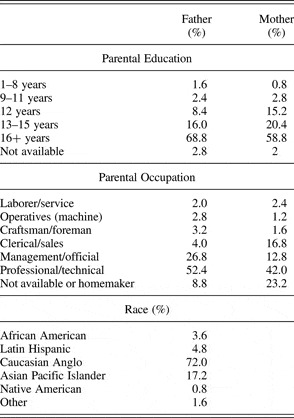
The 258 subjects in the LSPD were drawn initially from an initial population consisting of 2,000 first-year undergraduate students (Lenzenweger, Reference Lenzenweger1999; Lenzenweger et al., Reference Lenzenweger, Loranger, Korfine and Neff1997, Reference Lenzenweger, Johnson and Willett2004). A total of 1,684 subjects, from the initial 2,000 that were targeted, completed the screening inventory (response rate = 84.2%). This response rate far exceeded the initial goal of 70% and, of more importance, indicated that the sample drawn from the population was highly representative of first-year students. After excluding a subset of subjects because of invalid test-taking performance, a total of 1,646 persons were available to use to compose the study groups needed for subsequent longitudinal study as described below. The subjects were recruited from both the private and public (State University of New York) colleges at Cornell University in Ithaca, New York, which helped to ensure diversity across sociodemographic background variables. All subjects gave voluntary written informed consent and received an honorarium of $50.00 at each wave of data collection. Extensive detail concerning the initial subject selection procedure and sampling is given elsewhere (Lenzenweger, Reference Lenzenweger1999; Lenzenweger et al., Reference Lenzenweger, Loranger, Korfine and Neff1997) and is not repeated here. Of the initial 258 participants, 250 completed all three assessment waves and are included in the current analysis. A summary of a selection of subjects' demographic characteristics appear in Table 1.
Descriptive statistics and selected demographic characteristics of participants in The Longitudinal Study of Personality Disorders sample (N = 250)

As a prospective, multiwave study, it is important to delineate the precise schedule of assessments in the LSPD. At each wave of data collection, the study subjects (a) were interviewed by experienced, trained clinicians for both Axis I and all Axis II conditions as noted above and (b) assessed on a wide variety of self-report measures of PD, personality, temperament, sex role conformity, and mental state (anxiety and depression). It is important to note that all study staff were blind as to the group membership status (i.e., possible PD [PPD] vs. no PD [NPD]) of the study subjects throughout the study period. Moreover, for the interview-based assessments, the same interviewer never saw the same subject more than once during the three waves of data collection. The subjects were seen for their Wave I, II, and III assessments in their first, second, and fourth years in college, respectively. The intervals between each of the assessments across the study waves and across subjects vary somewhat, as is the case for longitudinal research (i.e., all subjects in a protocol cannot be seen on the same days for their assessments). The intervals between assessments for each subject were calculated in days in relation to the date on which the study began. The mean time (days) between the start of the study and the assessments for the subjects were as follows: Wave I (M = 55.94, SD = 30.46), Wave II (M = 403.53, SD = 67.51), and Wave III (M = 1,084.62, SD = 90.78). The average age of study subjects at the assessment waves were Wave I (M = 18.78, SD = 0.51), Wave II (M = 19.83, SD = 0.54), and Wave III (M = 21.70, SD = 0.56). The mean time (years) between entry into the study (Wave I) and Wave II was 0.95 years (SD = 0.14) and Wave III was 2.82 years (SD = 0.23).
Initial PD screening measure (young adulthood, age 17/18)
International Personality Disorder Examination (IPDE) DSM-III-R screen (IPDE-S)
The IPDE-S is a 250-item self-administered true–false PD screening inventory developed by A. W. Loranger. The diagnostic efficiency and psychometric properties of the IPDE-S, which were evaluated in a two-stage screen application, were generally excellent and were described previously (Lenzenweger et al., Reference Lenzenweger, Loranger, Korfine and Neff1997). The grouping variable for the study subjects described below was based on this measure and is thus retained as a control variable in the analyses reported below; specific scores from the IPDE-S are not used in the analyses. The group variable described participants' initial assignment (established prior to the longitudinal PD assessments) to either a PPD or NPD group according to the IPDE-S (Lenzenweger, Reference Lenzenweger1999; Lenzenweger et al., Reference Lenzenweger, Loranger, Korfine and Neff1997). As detailed in Lenzenweger et al. (1997), PPD subjects met the diagnostic threshold on the IPDE-S for at least one specific DSM-III-R PD, whereas NPD participants (a) did not meet the DSM-III-R defined threshold for diagnosis and (b) had fewer than 10 PD features across all disorders on the screener (for details, see Lenzenweger, Reference Lenzenweger2006). The group variable (PPD vs. NPD) is not a focus of the current set of analyses, but it is described because it is a study design feature.
Clinical and individual difference measures (emerging adulthood, ages 18–21)
Axis II measurement: SZDPD features
IPDE
The IPDE is the well-known semistructured interview procedure that assesses both DSM and International Classification of Disease, Tenth Edition. PD features (Loranger, Reference Loranger1999; Loranger et al., Reference Loranger, Sartorius, Andreoli, Berger, Buchheim and Channabasavanna1994; Loranger, Sartorious, & Janca, 1996) and was used in the World Health Organization/Alcohol, Drug Abuse, and Mental Health Administration sponsored International Pilot Study of Personality Disorders (Loranger et al., Reference Loranger, Sartorius, Andreoli, Berger, Buchheim and Channabasavanna1994, Reference Loranger, Sartorius and Janca1996). The IPDE has excellent psychometric properties and has been shown to be robust as a diagnostic assessment tool for PDs even in the face of mental state (anxiety, depression) changes. The DSM-III-R criteria were assessed in this study because these were the criteria in effect at the time the LSPD was undertaken. Note that the DSM-III-R and the later DSM-IV criteria bear considerable resemblance to one another and the fundamental PD constructs are the same in both nomenclatures. Clinically experienced interviewers received intensive training in IPDE administration and scoring by Dr. Armand W. Loranger and were supervised throughout the project by the author (M.F.L.), who was blind to the participants' identity, putative PD status, and all prior assessment information. The interrater reliability for IPDE assessments (based on intraclass correlation coefficients) was excellent at all three waves, ranging between .84 and .92 for all PD dimensions. The interviewers were (a) blind to the putative PD group status of the participants, (b) blind to all prior LSPD PD assessment data, and (c) the same interviewer never assessed the same subject more than once. I defined the SZDPD outcome variable as the dimensional score total for the disorder derived from the IPDE.
Axis I disorders: Diagnostic measurement
Structured Clinical Interview for DSM-III-R: Nonpatient Version (SCID-NP)
The SCID-NP (Spitzer, Williams, Gibbon, & First, Reference Spitzer, Williams, Gibbon and First1990) is a semistructured DSM-III-R (American Psychiatric Association, 1987) Axis I clinical interview for use with nonpatients. The clinical interviewers were trained on the use of the SCID-NP using the videotape-based training system provided with the SCID-NP. All interviewers achieved high reliability with criterial cases (all intraclass correlation coefficients >.80 for symptom assessments). The SCID interview was done first followed by the IPDE as is customary practice for thorough Axis II assessments. The Axis I diagnostic information generated by the SCID is not a primary focus of this report.
Individual difference measurement: Communal positive emotion and temperament
Temperament (early adulthood assessment of childhood temperaments)
The Emotionality, Activity, and Sociability (EAS) Adult Temperament Scale (Buss & Plomin, Reference Buss and Plomin1984) is a 20-item self-report measure of the three major temperament constructs thought to underlie personality processes in children and adults: emotionality (which breaks down further to “fear,” “distress,” and “anger” subdimensions), activity, and sociability. The EAS requires a subject to read 20 statements and decide how characteristic or typical each statement is of him/herself on a 5-point scale. Factor analysis of the childhood and adult versions of the EAS has revealed a consistent structure that supports the basic three temperaments model of Buss and Plomin (Reference Buss and Plomin1984; see also Mathieson & Tambs, Reference Mathieson and Tambs1999; Nærde, Røysamb, & Tambs, Reference Nærde, Røysamb and Tambs2004) and test–retest reliability of the adult EAS is acceptable. Finally, as noted above, the major components of the EAS have been shown to be highly heritable (Plomin, Reference Plomin1986).
Affiliation system indicator: Positive emotion, communal type
The negative emotion (NEM); nonaffective constraint (CON); positive emotion, agentic type (PEM-A); and PEM-C dimensions are hypothesized to be reflective of the four primary neurobehavioral systems that Depue and Lenzenweger (Reference Depue, Lenzenweger and Livesley2001, Reference Depue, Lenzenweger, Lenzenweger and Clarkin2005) posit as critical to PD development and maintenance. The PEM-A, PEM-C, NEM, and CON dimensions that they described correspond phenotypically with those identified by Tellegen (Reference Tellegen1982, Reference Tellegen, Tuma and Maser1985; Watson & Tellegen, Reference Watson and Tellegen1985). However, Depue and Lenzenweger relied heavily on the neurobiological animal and human literature in deriving the neurobehavioral systems thought to underlie these dimensions. Although Tellegen's measure for these dimensions was not included in the LSPD at the time of initial data collection, the LSPD did include another personality measure, the original NEO Personality Inventory (NEO-PI; Costa & McCrae, Reference Costa and McCrae1985). Reasonable representations of the PEM-A, PEM-C, NEM, and CON dimensions can be extracted from the NEO-PI dimensions using algorithms derived from the factor analytic work of Church (Reference Church1994) comparing the NEO-PI and Tellegen's constructs (see Appendix A for technical detail regarding the estimation of the PEM-A, PEM-C, NEM, and CON trait scores). The NEO-PI (Costa & McCrae, Reference Costa and McCrae1985) is the original version of the well-known, Likert-style self-report measure of normal personality traits. The NEO-PI has generally excellent psychometric properties as an assessment instrument, with dimensions showing high internal consistency and reliability over time (Costa & McCrae, Reference Costa and McCrae1985). Finally, note that scores on the four personality trait dimensions, including PEM-C, were relatively normally distributed at each assessment point in the LSPD. The PEM-C measure, which was the focus of this study, was therefore not transformed prior to analysis.
Proximal process assessment (early to middle childhood, ages 5–12)
At the time LSPD data collection commenced in the fall of 1991, there was no existing measure of a proximal process construct such as that hypothesized by Bronfenbrenner (Bronfenbrenner & Morris, Reference Bronfenbrenner, Morris, Damon and Lerner1998). Bronfenbrenner's person–process–context–time model that included the proximal process construct was not fully formed or articulated. Therefore, in consultation with Urie Bronfenbrenner, I developed a rough and ready measure of proximal process, provisionally designated the proximal process index, that consisted of four focal questions. These four questions were designed to be asked within a semistructured interview format. The use of an interviewer-based assessment in which questions were asked, examples were provided, and clarifications were sought was seen as preferable to simple self-report approach. In short, the interviewer could use his or her skills to elicit more information from the subjects. Assessment of these proximal process items did rely upon retrospective recall on the part of the subjects, with a focus on the childhood/preteen years (covering the 5–12 year age span). The benefits of interviewer-based assessments for retrospective reports have been described (Brewin et al., Reference Brewin, Andrews and Gotlib1993; Maughan & Rutter, Reference Maughan and Rutter1997b).
Covariates
Although none of their effects were a principal focus of the analysis reported here, I also included five important covariates in a sensitivity analysis in order to control for intrinsic features of the study's sampling and research design. The sensitivity analysis represented a supplemental hierarchical regression analysis that extended the primary regression analysis. The covariates included in the sensitivity analysis regression were (a) the subject's age at entry into the study, (b) the subject's sex, (c) the subject birth order amongst his/her siblings, (d) the group status (PPD vs. NPD) of the subjects, and (e) childhood temperament characteristics that would suggest a more challenging or emotional temperament in the subject. Age at entry was measured in years and was included to account for marginal heterogeneity in the ages of subjects at the beginning of the study. Sex was distributed in the sample relatively evenly, with 121 males (47%) and 137 females (53%). Birth order was coded simply as first born or later born and it served as an index of one feature of the context (Bronfenbrenner & Morris, Reference Bronfenbrenner, Morris, Damon and Lerner1998) in which the child developed. The temperamental characteristics of (distress, fearfulness, anger) were used to serve as measures of a challenging or emotional childhood temperament.
Overview of the assessment schedule
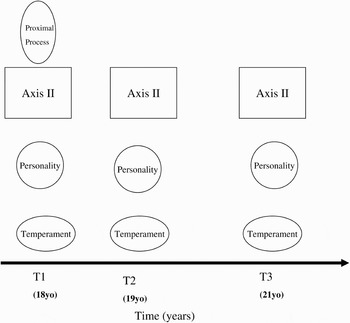
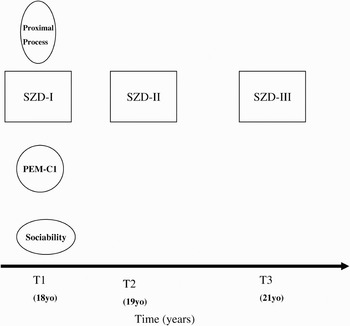
Figure 1 provides an overview of the assessment schedule for the major construct domains in the LSPD. In short, all subjects completed all individual difference measures at each assessment point in the LSPD. All personality and personality constructs assessed in the LSPD were tapped by two different measures (e.g., personality was assessed using two different personality inventories; for detail, see Lenzenweger, Reference Lenzenweger2006). Figure 2 depicts those specific constructs/measures that are the focus of the present study. Thus, as seen in Figure 2, proximal process was measured once in retrospective fashion as described above at Wave I. Childhood temperament was approximated through assessments of adult temperament using the EAS, which is known to tap those temperament constructs in adults in a manner that corresponds well to their childhood counterparts. The EAS was administered at all three waves of the LSPD, but only those EAS scores from Wave I are used in this illustration. PEM-C was derived from the NEO-PI inventory, as described above and in Appendix B, and the NEO-PI was administered at all three waves of the LSPD. Only the Wave I PEM-Communal score was used in this analysis. Finally, adult SZDPD was assessed at all three waves in the LSPD, as were all of the other DSM-III-R Axis II PDs. The SZDPD dimensional scores from the IPDE from each of the waves (I, II, and III) were used in the present analysis. The present report is limited to these selected dimensions/measures given the express focus on the proposed cascade for proximal process, sociability, affiliation, and SZDPD.
The assessment schedule for the major constructs assessed in The Longitudinal Study of Personality Disorders (for details, see Lenzenweger, Reference Lenzenweger2006). Axis II refers to the DSM-III-R Axis II personality disorders assessed at each of the three study waves. Personality and temperament refer to the personality and temperament measurements done at each of the three assessment waves. Axis I disorders were also assessed at each of the three study waves, but they are omitted here to enhance clarity.

The schematic overview of the variables used in the current analyses. The proximal process assessed at Time 1 (T1) is based on a retrospective account of early to middle childhood (5–12 years old). SZD-I, SZD-II, and SZD-III, schizoid personality disorder (SZDPD) features assessed at Waves I, II, and III; PEM-C1, positive emotion, communal type assessed at Wave 1. Sociability refers to an approximation of childhood sociability (assessed at Wave I) using the Emotionality, Activity, and Sociability (EAS) Adult Temperament Scale (Buss & Plomin, Reference Buss and Plomin1984).

Statistical analysis for evaluation of a cascade pattern
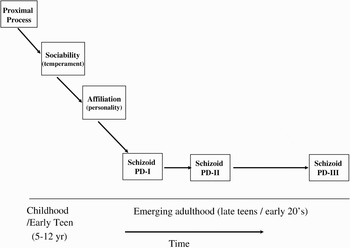
The primary statistical analytic approach used in this study utilizes hierarchical regression. The level of SZDPD features was regressed on a hierarchical model of predictors that consisted of five steps. The predictor variables were entered in the following manner at each step of the regression: Step 1, proximal process; Step 2, the EAS sociability dimensional score from Wave I; Step 3, the positive emotion communal type dimensional score from Wave I; Step 4, the SZDPD dimensional score from Wave I; and Step 5, the SZDPD dimensional score from Wave II. The increment provided by additional predictors entered at each step was evaluated by examining the change in R 2 at each step. The β weights for each predictor were evaluated for statistical significance at each step as well. The thrust of this analytic approach was to determine if each succeeding step in the proposed cascade could be predicted from the prior step and, importantly, to determine that each succeeding step incremented prediction of adult SZDPD features at Wave III over that provided by the previous step. This analytic approach directly implements the proposed model heuristic and can be depicted visually as in Figure 3.
Hypothesized relations among constructs proposed as important in the development of schizoid pathology. Proximal process was assessed at Wave I of the study and was based on retrospective recall from the ages 5–12 years. Childhood sociability (an aspect of temperament) was approximated by assessing temperament at Wave I using the Emotionality, Activity, and Sociability (EAS) Adult Temperament Scale (Buss & Plomin, Reference Buss and Plomin1984). Affiliation, assessed at Wave I, is defined as positive emotion, communal type (see text for derivation). Wave I, II, and III schizoid personality disorder measurements are also depicted because they are elements of the proposed developmental cascade.

A control/sensitivity analysis using hierarchical regression was done following the principal analyses in the prediction of SZDPD Wave III scores. This control/sensitivity analysis regression was done by entering a block of additional predictors prior to the principal predictors entered as described above. This block of control predictors consisted of (a) birth order; (b) subject sex; (c) age at entry into study; (d) study group (PPD vs. NPD); and (e) the Wave I EAS temperament scores for anger, fear, distress. The temperament scores were included in this block because one could easily imagine a child, especially boys, with a more challenging temperament “pushing away” adults that might otherwise engage with them in the manner suggested by the items on the proximal process index (e.g., What person helped you with homework when needed?). Might it be that a low level of proximal process, rather than being influential in the proposed direction, actually results from the presence of a “thorny/difficult/challenging” temperament in the child? Thus, anger, fear, and distress were included in the block of control variables. The impact of birth order was important to consider in this control/sensitivity analysis as one could view birth order as a context variable from the vantage point of the Bronfenbrenner person–process–context–time model (Bronfenbrenner & Morris, Reference Bronfenbrenner, Morris, Damon and Lerner1998), where the context of development is viewed as especially potent.
Results
The analyses for this report are based on the 250 subjects that have complete data across all three waves of LSPD. Of the original 258 LSPD subjects, 5 PPD and 3 NPD subjects did not complete all three waves of data collection; 2 of these noncompleting subjects died during the course of the study, 1 in each subject group. The study period covered in this phase of the LSPD corresponds to what is often termed “emerging adulthood,” which is the years from 18 through 21.
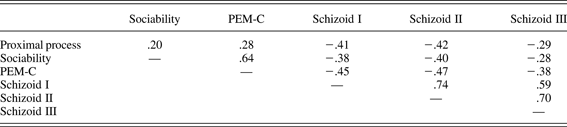
Before moving on to the results of the hierarchical regression analyses, it is useful to examine the table of zero-order correlations among those variables in the proposed model. It is evident in Table 2 that the proximal process, which is argued to be the “trickle” that serves as the source for the proposed cascade leading to SZDPD, is significantly correlated with the outcome of interested, adult SZDPD features at Wave III. Moreover, all other predictors in the model are correlated with the outcome measure of SZDPD at Wave III. This is an important pattern to note; because the predictors in Table 2 target different parts of the life span (proximal process [early childhood], sociability [childhood temperament assessed in early adulthood], communal positive emotion [adult personality], and SZDPD [adulthood]), they all predict the outcome of interest (SZDPD at Wave III). Lower levels of proximal process, sociability temperament dimension, and communal positive emotion are all negatively associated with SZDPD at Wave III in the LSPD. Finally, inspection of Table 2 reveals that all of the variables in the proposed model are significantly intercorrelated (all p < .001), which is not an atypical state of affairs for rich, developmentally relevant predictors.
Correlations among the variables included in the proposed cascade for schizoid personality disorder (N = 250)
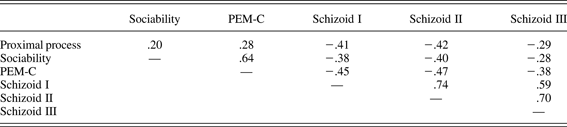
Note: Values are Pearson product-moment correlation coefficients based on 250 cases (all subjects have complete data). All correlations are significant at p < .001 or lower. Sociability refers to the Early Adulthood Assessment of Childhood Temperaments (Buss & Plomin, Reference Buss and Plomin1984) sociability dimensional score assessed at Wave I. The personality measure known as positive emotion, communal type (PEM-C) is used to index the underlying affiliation system (see text for derivation). Schizoid I, II, and III refer to the dimensional score for DSM-III-R schizoid personality disorder as assessed using the International Personality Disorder Examination (Loranger, Reference Loranger1999).
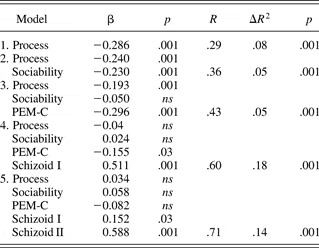
The principal analytic approach to evaluating the proposed cascade in this report is hierarchical regression. The results from the regression are presented in Table 3, which lists the predictor variables of interest and the order in which they were entered into the regression in the prediction of SZDPD assessed at Wave III. What is immediately evident in these results is that each succeeding step in the regression was predictable from the previous one. Most importantly, perhaps, is the pattern of results across the regression analysis that each succeeding step incremented the prediction afforded by the prior step. Thus, inspection of Table 3 reveals that the change in R 2 is relatively noteworthy as well as statistically significant. It is also noteworthy that the R for the model increases consistently across the steps and ends at a nontrivial value of .714 for the model, with an associated R 2 of .51. Further inspection of the results in Table 3 reveals that the proximal process variable, which is of central importance to the proposed cascade model, shows an influence that extends from Step 1 through Step 3 of the chain of events in the proposed cascade. The proximal process remains a significant regressor (p < .001) in all three steps in the model predicting SZDPD at Wave III. Overall, the results of this regression analysis are consistent with the proposed theoretical cascade that seeks to link proximal process, childhood temperament (sociability), personality/neurobehavioral system construct (affiliation; communal positive emotion), and psychopathology (SZDPD).
Hierarchical regression analysis results for cascade regressors in the prediction of schizoid personality disorder symptoms at Wave III of The Longitudinal Study of Personality Disorders (N = 250)

Note: Process refers to the proximal process score. Sociability refers to the Early Adulthood Assessment of Childhood Temperaments (Buss & Plomin, Reference Buss and Plomin1984) sociability dimensional score assessed at Wave I. PEM-C, positive emotion, communal type (see text for derivation). Schizoid I, II, and III, the dimensional score for DSM-III-R schizoid personality disorder as assessed using the International Personality Disorder Examination (Loranger, Reference Loranger1999); β, standardized coefficients; R, multiple correlation; ΔR 2, change in squared multiple correlation compared with the previous model; p, p value for change.
In considering these results, one must examine the possibility that other factors might be influential, especially as might be connected to the proximal process measure. The supplementary control hierarchical regression described above was conducted in which the additional covariates were entered early in the analysis as a block. In short, the control analysis results were very nearly identical to those obtained from the primary regression analyses.Footnote 4 The block of “control” variables did not result in a significant change in the R 2 for that step. This was the case whether the block of control variables was entered at Step 1 prior to the other steps in the model, or at later steps (e.g., Step 2 or Step 3). Thus, factors such as birth order, sex, age at entry into the LSPD, study group in the LSPD (PPD vs. NPD), and measures indicating a more challenging or “thorny” childhood temperament did not increment the prediction of SZDPD features at Wave 3, whether entered initially as a block at Step 1 or at other later steps in the regression model. The absence of significant associations between these predictors in the sensitivity analyses and the outcome, serves to lend some additional support to the proposal cascade (and the variable proposed therein). Some researchers might be more interested specifically in one or another covariates as potentially important in understanding the effect of proximal process on key variables in the proposed model. For example, one possibility to consider is whether the sex of the child is important in explaining the correlation between the proximal process and PEM-C. Is it possible that parents and caregivers are more likely to interact with girls in the manner suggested by the proximal process index? The female LSPD subjects had a significantly higher mean (M = 3.86, SD = 0.45) than male LSPD subjects (M = 3.67, SD = 0.67) t (248) = 2.65, p < .009; Cohen d = 0.33. The partial correlation between the proximal process index and PEM-C, controlling for the effect of biological sex, is .24 (p < .001), suggesting that the removal of variance attributable to sex does not alter the zero-order relationship substantially. The same is true for the proximal process and EAS–sociability relationship, which remains significant (r = .19, p < .003) after the removal of the influence of sex.
Discussion
A substantial empirical literature has begun to emerge from longitudinal follow-up studies supporting the association between the absence of nurturant parenting styles and/or the presence of emotional neglect/emotional abuse in the early childhood histories of those adults that were diagnosed with SZDPD later in the life course. This association was observed in studies that used retrospective as well as prospective data collection methods. However, beyond the establishment of the basic association between the parenting factors and later schizoid pathology, little is known about the mechanism or process by which a child might proceed from the parenting processes noted and later schizoid PD. In this report, a heuristic model is advanced to account for this relationship, namely, that early parenting failure and/or abuse results in a diminished proximal process (Bronfenbrenner & Morris, Reference Bronfenbrenner, Morris, Damon and Lerner1998), which impacts the developing affiliation system (a system subject to genetic influences and linked to neurobiological processes), and this impairment in the affiliation system is associated downstream with schizoid PD. In this model, SZDPD then persists in the future. One can conceive of this hypothetical string of events as a cascade phenomenon (cf. Dodge et al., Reference Dodge, Malone, Lansford, Miller, Pettit and Bates2009; Masten et al., Reference Masten, Roisman, Long, Burt, Obradović and Stenne-Boelcke2005).
The observed correlations between an index of proximal process and both measures of sociability and (later) PEM-C (as a proxy indicator for affiliation) suggested, consistent with the primary tenet of the Bronfenbrenner model (Bronfenbrenner & Morris, Reference Bronfenbrenner, Morris, Damon and Lerner1998), that the presence of an engaged parent/caregiver in childhood was associated with higher levels of sociability and PEM-C. Given that levels of sociability and PEM-C can be taken as (a) some degree of evidence of the proclivity of the individual to experience social closeness with others and the potential for bonding and (b) the underlying affiliation system is under considerable neurobiological control as well as subject to noteworthy genetic influences (Depue & Lenzenweger, Reference Depue, Lenzenweger, Lenzenweger and Clarkin2005), then these results are consistent with the possibility that proximal processes are impacting the development of the affiliation system. The observed inverse correlations between the sociability and PEM-C variable with SZDPD features across time is consistent with the emergence (or presence) and persistence of schizoid pathology, potentially reflective of an impaired affiliation system. This would be consistent not only with the Depue–Lenzenweger model of PD (Depue & Lenzenweger, Reference Depue, Lenzenweger, Lenzenweger and Clarkin2005). Finally, as predicted by the later stages of the cascade described here, schizoid pathology remains stable over time, such that schizoid pathology observed at age 18 persists 1 year at age 19 (Wave II) and 2 years (Wave III) later at age 21 in the LSPD subjects.
How can these results connect with other studies of broadly comparable phenomena in longitudinal perspective? The empirical corpus linking environment inputs, early interpersonal experience, temperament, personality, and PD is extremely small. Of the existing prospective multiwave longitudinal studies of PD, only the LSPD includes all of these measures (see Lenzenweger, Reference Lenzenweger2006). Could we consult studies early personality manifestations in children with later manifestations of affiliation in those children grown up to be adults? The informative study of Shiner, Masten, and Roberts (Reference Shiner, Masten and Roberts2003) is poignant in this regard. These results for the present study in terms of the cascade of effects in the prediction of Wave III SZDPD features are particularly interesting because factors such as “mastery motivation,” “academic conscientiousness,” “surgency,” and “agreeableness” assessed at 10 years of age are not predictive of social closeness (which taps the affiliation system) in adult personality (at age 30; Shiner et al., Reference Shiner, Masten and Roberts2003). Surgency, which is the child's tendency to be actively engaged in the social and nonsocial worlds, was minimally related to social closeness as an adult in Shiner et al. (Reference Shiner, Masten and Roberts2003). What could explain this apparent discrepancy in results with those of the current study? The difference in the two studies in terms of outcome variables is important. Whereas the Shiner et al. (Reference Shiner, Masten and Roberts2003) study indexed social closeness in adulthood as a personality outcome, the present study not only tapped those factors underpinning social closeness (sociability, communal positive emotion) but also measured clinically significant impairment in social relations as indexed by SZDPD. Thus, these two studies are perhaps best viewed as complementing one another, with the differences best understood in the results being a function of the final outcome variable (i.e., a normal personality measure [social closeness] vs. a psychopathology measure [SZDPD]). The results of the present study also raise interesting possibilities with respect to the transmission of the capacity to engage in what Bronfenbrenner would term a health-producing proximal process. For example, Shaffer, Burt, Obradović, Herbers, and Masten (Reference Shaffer, Burt, Obradović, Herbers and Masten2009) found that the transmission of parenting quality from one generation of parents to the next appears to be mediated by the social competence of the children. Although proximal process per se is not isomorphic with parenting skills (although one could argue that effective parenting might include what is termed here as proximal process), it would be interesting to see if the transmission of defects in the proximal process are mediated by SZDPD. Such mediation might be through the interpersonal impairment of SZDPD or perhaps other specific components of schizoid pathology (e.g., working memory defects, Lenzenweger, Reference Lenzenweger, Blaney and Millon2009, Reference Lenzenweger2010; see also Lenzenweger & Gold, Reference Lenzenweger and Gold2000).
A number of features of this study should be kept in mind when considering these results. For example, one might wonder if the effects of proximal processes might still be seen at work in this study sample (see Bronfenbrenner & Ceci, Reference Bronfenbrenner and Ceci1994), recalling that Bronfenbrenner (Bronfenbrenner & Ceci, Reference Bronfenbrenner and Ceci1994; Bronfenbrenner & Morris, Reference Bronfenbrenner, Morris, Damon and Lerner1998) argued that the effects of proximal processes would be greatest in conditions characterized by severe disadvantage. The LSPD study sample consisted of individuals that were not typically subject to severe disadvantage. In other words, the vast majority of the study subjects in the LSPD were not drawn from the outer edges of the socioeconomic range. Rather their average expectable childhood rearing environments consisted of influences associated with relatively mainstream environments. More than 80% have some college or beyond (mothers and fathers), of those working most have managerial or professional occupations. It could very well be that the associations between the proximal process index and both sociability and PEM-C in the LSPD sample actually underestimates these relationships, owing to the restriction of range on rearing environment variability among the subjects. Another feature of this sample is that the assessments were conducted during the early adult years, covering a 4-year period. One might consider whether schizoid pathology will persist further into adulthood as suggested by this model. This empirical question can be answered and will be a focus of data analyses associated with the planned Wave IV assessments of the LSPD subjects, who are now in their later 30s. Moreover, one might consider mixture modeling (Lenzenweger, McLachlan, & Rubin, Reference Lenzenweger, McLachlan and Rubin2007; Lenzenweger & Moldin, Reference Lenzenweger and Moldin1990) and/or taxometric approaches (Lenzenweger, Reference Lenzenweger2004; Waller & Meehl, Reference Waller and Meehl1998) to resolve more clearly any existing demarcations in the developmental landscape that makes up SZDPD in order to determine if the proposed cascade has general application or is but one potential cascade for SZDPD (cf. Woodward, Lenzenweger, Kagan, Snidman, & Arcus, Reference Woodward, Lenzenweger, Kagan, Snidman and Arcus2000).
Other potential limitation issues must also be kept in mind. The assessments of proximal process levels were done using a retrospective methodological approach. Although substantial methodological reviews (e.g., Brewin et al., Reference Brewin, Andrews and Gotlib1993) have supported the general utility of the retrospective recall approach, a degree of caution in the evaluation of data gathered using this method is reasonable. For example, could it be that socially withdrawn/schizoid young adults recall erroneously a childhood characterized by the absence of interpersonal connections with parents/caregivers? A related concern is that the initial variables in the proposed cascade (proximal process, PEM-C) were assessed at the same point in time (LSPD Wave I). Thus, the proximal process assessments did not occur in the manner that would have been optimal, such as proximal process during childhood.
Another concern is that the EAS was used to collect information on temperament, and it is claimed that the EAS, when administered in adulthood, can actually tap temperamental dispositions that were likely in place in childhood (Buss & Plomin, Reference Buss and Plomin1984). Irrespective of the validity of this claim on the part of the EAS as an assessment device, it remains remarkable nonetheless that the statistical removal of those temperament features putatively suggestive of a difficult or challenging childhood temperament (anger, distress, fear, activity) did not diminish substantially the observed association between the proximal process index and PEM-C. The cascade model proposed here was not subsequently tested with the popular structural equation modeling method used in some considerations of developmental cascades. This is largely because the assessments of proximal processes were not actually done in the early childhood and preteen years, which precludes unambiguous definition of a true temporal sequence with respect to PEM-C. The proximal process variable was assessed retrospectively at the Wave I assessment, the childhood temperament of sociability was approximated through the use of the adult EAS at Wave I, and the PEM-C measurement was also done at Wave I; hence, these are technically cross-sectional relationships (albeit proximal process data were collected with clear instructions to the subjects to reflect on early childhood experience before coming to college). The problems associated from making longitudinal inferences from cross-sectional relations are well known (Cole & Maxwell, Reference Cole and Maxwell2003). However, I suggest that the present findings are of interest because of the heuristic value of the model in which they are imbedded. In this context it is worth noting that this analysis does not address causality as is typical for any study of individual differences (not unlike structural equation modeling analyses, which also do not address causality in any strict sense; see Lenzenweger, Reference Lenzenweger2010).
Conclusion
The results of the present study suggest an important role for an environmental input to the cascade of effects that eventuates in adult SZDPD. It is important to emphasize, however, that the present model and set of findings are not suggesting that the etiology of SZDPD is environmental in origin, rather that the level of proximal process present in the early childhood years may impact the developing affiliation system. Clearly, the schizophrenia-related genetic component that is harbored within SZDPD likely exerts a powerful etiologic role. The proposed cascade is but one theoretical possibility, albeit a plausible one at that. Similar to the situation with autism (Szatmari, Reference Szatmari2003), a definitive unifying cascade does not exist for SZDPD. However, the present model is intended to move the discourse beyond what has been primarily an epidemiological approach to a model-guided developmental psychopathology perspective.
Appendix A: Compositing the Depue and Lenzenweger Personality Dimensions Linked to Neurobehavioral Systems From the NEO-PI
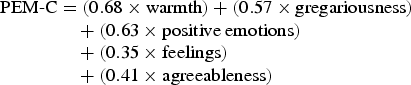
I employed the published factor solution of Church (Reference Church1994, table 4) as the source of weights for creating optimal composite measures from the NEO-PI data, which I then used as indicators of the neurobehavioral systems dimensions in these analyses. Church (Reference Church1994) used a principal-axis factor extraction method coupled with a varimax rotation in his analysis of the NEO-PI and Tellegen Multidimensional Personality Questionnaire inventories (N = 575). The precise weights that were used to construct the measures are given below, illustrating that I capitalized only on salient loadings (0.35 or higher) in the construction of the NEM, CON, PEM-A, and PEM-C factor scores. Moreover, based on substantive considerations, I required that each NEO-PI facet load on only one of the constructs (NEM, CON, PEM-A, PEM-C). For instance, NEO-PI agreeableness was assigned to the PEM-C composite and NEO-PI Conscientiousness was assigned to CON. These composite indicators of the NEM, CON, PEM-A, and PEM-C dimensions therefore reflect the application of Church's weights in the LSPD data set. The focus of the present report is PEM-C. However, the creation of the other neurobehaviorally relevant personality dimensions are provided as well for the interested reader.



Appendix B: Proximal Process Index
This index is an unpublished inventory (Lenzenweger, 1991).
Directions to interviewee: “I am now going to ask you to think about your life before you came to college. Please think of the person in your life that you would most closely associate with the following experiences and tell me who that would be (e.g., mother, father, other adult, peers, siblings, close friend of same or opposite sex, girlfriend/boyfriend).”
As you were growing up and before coming to college, who would you associate with the following experiences. What person …
1. helped you learn how to organize things?
2. read books with you?
3. helped you with homework when needed?
4. did activities with you that were challenging and rewarding?
Scoring: These items are scored dichotomously (0 or 1). If a person does not indicate any person associated with the index item, a score of 0 is assigned for that item. If a person does indicate that a specific person was associated with the index item, a score of 1 is assigned for that item. The total score for this index is the summed total of all the items. Scores can range from 0 to 4.