1. Introduction
In western and central Europe, fragments of Precambrian basement are essential parts of the Variscan collisional orogen. These fragments embrace the widespread Neoproterozoic to lower Cambrian sediments and magmatic rocks (Ugidos et al. Reference Ugidos, Valladares, Recio, Rogers, Fallick and Stephens1997; Dörr et al. Reference Dörr, Finger, Linnemann and Zulauf2004; Kemnitz, Reference Kemnitz, Linnemann, Nance, Kraft and Zulauf2007; Linnemann et al. Reference Linnemann, Gerdes, Drost, Buschmann, Linnemann, Nance, Kraft and Zulauf2007; Pin & Waldhausrová, Reference Pin, Waldhausrová, Linnemann, Nance, Kraft and Zulauf2007) that were involved in the peripheral Cadomian orogen at the northern margin of West Gondwana. The Cadomian orogeny terminated in Ediacaran–early Cambrian times and was followed by rifting of the thickened Gondwana margin in the middle to late Cambrian until the Rheic Ocean opened in early Ordovician times (Linnemann et al. Reference Linnemann, Gerdes, Drost, Buschmann, Linnemann, Nance, Kraft and Zulauf2007).
In the Saxothuringian Zone of the Variscan orogen, an angular unconformity separates the Cadomian orogenic successions from overlying lower Cambrian onlap sedimentary rocks (Buschmann, Elicki & Jonas, Reference Buschmann, Elicki and Jonas2006). An unconformity between Precambrian and Palaeozoic metasedimentary rocks has also been proposed in the Orlica–Śnieżnik Dome in the eastern part of the West Sudetes as a boundary between Proterozoic basement and lower Palaeozoic supracrustal units (Fischer, Reference Fischer1936; Don et al. Reference Don, Dumicz, Wojciechowska and Żelaźniewicz1990; Don, Skácel & Gotowała, Reference Don, Skácel and Gotowała2003 and references therein). The Orlica–Śnieżnik Dome is located in the NE part of the Bohemian Massif and represents the eastern part of the Saxothuringia Terrane (Franke & Żelaźniewicz, Reference Franke, Żelaźniewicz, Franke, Haak, Oncken and Tanner2000) (Fig. 1). No proven Precambrian basement is, however, exposed there and, because the protolith age of the metasedimentary rocks is unknown, the presence of an unconformity cannot be confirmed (Fig. 2). Thus, the protolith ages of these rocks have been of primary importance for regional interpretations and for more general palaeogeographic reconstructions.
(a) Cadomian and Variscan massifs in central Europe (after Linneman et al. Reference Linnemann, Pereira, Jeffries, Drost and Gerdes2008b). (b) Position of the Orlica–Śnieżnik Dome on a map showing the distribution of terranes in the Bohemian Massif (after Franke & Żelaźniewicz, Reference Franke, Żelaźniewicz, Franke, Haak, Oncken and Tanner2000). (c) Schematic geological map of the Orlica–Śnieżnik Dome (modified after Sawicki, Reference Sawicki1995) showing outcrops of the Młynowiec and Stronie formations (after Don, Skácel & Gotowała, Reference Don, Skácel and Gotowała2003).

Sample localities plotted on a detailed geological map after Don, Skácel & Gotowała (Reference Don, Skácel and Gotowała2003) and hypothetical stratigraphic column of the metasedimentary rocks (based on Koszela, Reference Koszela1997 and Don, Skácel & Gotowała, Reference Don, Skácel and Gotowała2003). See text for details.

In this paper, we report U–Pb sensitive high-mass resolution ion microprobe (SHRIMP) ages of detrital zircons from the metamorphic rocks of the Orlica–Śnieżnik Dome and discuss the implications of the resultant dates in terms of the following: (1) maximum depositional ages of the original sediments, (2) position of the source areas for the original clastic sediments in relation to palaeogeography of the northern Gondwana margin during the extensive early Palaeozoic rifting in the region and the opening of the Rheic Ocean, and (3) the geodynamic evolution of the Gondwana-derived terranes within the central European Variscides.
2. Geological setting and lithostratigraphy
In the Orlica–Śnieżnik Dome, the Młynowiec Formation and the Stronie Formation (Fischer, Reference Fischer1936; Vangerow, Reference Vangerow1943; Don & Dowidar, Reference Don and Dowidar1988; Don, Skácel & Gotowała, Reference Don, Skácel and Gotowała2003) are two metasedimentary successions that are assumed to represent two distinct diastrophic cycles. The Młynowiec Formation comprises monotonous paragneisses (Don & Dowidar, Reference Don and Dowidar1988), whereas the Stronie Formation is a lithologically diverse set of mica schists with interlayers of light-coloured and graphitic quartzites, amphibolites, marbles and leptynites (Don et al. Reference Don, Dumicz, Wojciechowska and Żelaźniewicz1990; Żelaźniewicz, Mazur & Szczepański, Reference Żelaźniewicz, Mazur and Szczepański2002). The Młynowiec Formation contains only minor metabasites, which are interpreted as metamorphosed dykes related to younger volcanic activity (Don, Skácel & Gotowała, Reference Don, Skácel and Gotowała2003). Despite the differences and uncertain ages, all the metasedimentary rocks in the Orlica–Śnieżnik Dome have often been treated as a single metasedimentary succession (e.g. Oberc, Reference Oberc, Sokołowski, Cieśliński and Czermiński1968; Ansilewski, Reference Ansilewski1966; Smulikowski, Reference Smulikowski1979). No structural differences between the two formations are apparent, but these might have been obliterated by the later regional polyphase Variscan tectonometamorphic overprint (e.g. Wojciechowska, Reference Wojciechowska1975; Dumicz, Reference Dumicz1979; Don et al. Reference Don, Dumicz, Wojciechowska and Żelaźniewicz1990; Murtezi, Reference Murtezi2006; Jastrzębski, Reference Jastrzębski2009). Pressure–temperature conditions established for various lithological units of the Stronie and Młynowiec formations show that they underwent metamorphism under mid-amphibolite facies conditions with maximum locally attained at 600–640 °C and 8–9 kbar (Murtezi, Reference Murtezi2006; Jastrzębski, Reference Jastrzębski2009).
Earlier palaeontological and petrogenetic investigations on rocks of the Stronie Formation suggest that they were deposited either around the Proterozoic–Cambrian boundary (e.g. Gunia, Reference Gunia1984a,Reference Guniab, Reference Gunia1990) or during early Palaeozoic times (Koszela, Reference Koszela1997). Metarhyolites of the Stronie Formation contain zircons that were dated at c. 500 Ma using the U–Pb SHRIMP technique (M. Murtezi, unpub. Ph.D. thesis, Inst. Geological Sciences, Polish Acad. Sciences, 2005; Murtezi & Fanning, Reference Murtezi and Fanning2005). A similar age is inferred for mafic rocks of this formation, but there are no age data for the Młynowiec Formation.
The provenance of the detritus within the metasedimentary rocks of the two formations remains unspecified. To date, the only data on the pre-early Palaeozoic history of the Orlica–Śnieżnik Dome have been from U–Pb dating of a few inherited Cadomian- and Grenvillian-age zircons found both in the basement orthogneisses (e.g. Turniak, Mazur & Wysoczański, Reference Turniak, Mazur and Wysoczański2000; Kröner et al. Reference Kröner, Jaeckel, Hegner and Opletal2001) and in the acidic metavolcanic rocks of the Stronie Formation (Murtezi & Fanning, Reference Murtezi and Fanning2005), and from estimations of Nd crustal residence ages for the orthogneisses (Hegner & Kröner, Reference Hegner, Kröner, Franke, Haak, Oncken and Tanner2000; Kröner et al. Reference Kröner, Jaeckel, Hegner and Opletal2001; Lange et al. Reference Lange, Bröcker, Armstrong, Żelaźniewicz, Trapp and Mezger2005). Based on the latter data, the Orlica–Śnieżnik Dome may have belonged to Eastern Avalonia (Hegner & Kröner, Reference Hegner, Kröner, Franke, Haak, Oncken and Tanner2000; Kröner et al. Reference Kröner, Jaeckel, Hegner and Opletal2001); this is in contrast to the palaeogeographic reconstructions that have placed the Orlica–Śnieżnik Dome within the Armorican Terrane Assemblage (e.g. Franke & Żelaźniewicz, Reference Franke, Żelaźniewicz, Franke, Haak, Oncken and Tanner2000; Mazur et al. Reference Mazur, Aleksandrowski, Kryza and Oberc-Dziedzic2006).
The lithostratigraphy of both formations is also uncertain and rests primarily on mapping carried out by Fischer (Reference Fischer1936), Don & Dowidar (Reference Don and Dowidar1988) and Don, Skácel & Gotowała (Reference Don, Skácel and Gotowała2003). Neither the base of the Młynowiec Formation nor the top of the Stronie Formation are known. The overall thickness of the Stronie Formation is not well established but is probably less than 6000 metres (Don, Skácel & Gotowała, Reference Don, Skácel and Gotowała2003). The Młynowiec Formation is separated from the Stronie Formation by a long, continuous ‘horizon’ of light-coloured, K-feldspar-bearing quartzites (Fig. 2) that have been interpreted either as metamorphosed basal sandstones of the Stronie Formation (Don, Skácel & Gotowała, Reference Don, Skácel and Gotowała2003) or as metasedimenatry and metavolcanogenic rocks (this paper). The Stronie Formation has infrequently occurring graphitic quartzites in its lower part, marbles in its middle part, and basic (c. 500 Ma) metavolcanic rocks in its upper part (Don, Skácel & Gotowała, Reference Don, Skácel and Gotowała2003). The isolated marble bodies are often associated with the metavolcanic rocks, suggesting a spatial and temporal relationship between both basic volcanism and carbonate sedimentation in the Stronie Formation (Oberc, Reference Oberc, Sokołowski, Cieśliński and Czermiński1968; Koszela, Reference Koszela1997). All these rocks form numerous inserts and lenses within the dominantly schistose matrix of the Stronie Formation, that is, mica schists and paragneisses (e.g. Don, Reference Don1964; Smulikowski, Reference Smulikowski1979) (Fig. 2).
3. Sample description
Representative samples of the Młynowiec Formation and the Stronie Formation were taken using the geological map of Don, Skácel & Gotowała (Reference Don, Skácel and Gotowała2003) and the petrogenetic study of Koszela (Reference Koszela1997) as guides.
Sample MT-1 (Młynowiec Formation) is a medium-grained paragneiss that comes from an exposure on the SW branch of Mt Gołogóra, between the Młynówka and Popówka streams (Fig. 2), about 300 m below the contact with the Stronie Formation. The MT-1 paragneiss is composed of white mica, biotite, quartz, plagioclase, staurolite and garnet with accessory zircon, apatite and monazite, and it exhibits a moderate to strong metamorphic foliation. The zircons retrieved from this sample range in morphology from ovoid to euhedral, the latter displaying prismatic and pyramidal crystal faces. MT-1 zircons are colourless and transparent and range in size from 50 μm to 130 μm in width and up to 250 μm in length. Cathodoluminescence images clearly reveal oscillatory zoning, occasional sector zoning, and, in one third of the population studied, the presence of distinct, inherited cores.
Sample MT-6 is a light-coloured quartzite, representing the stratigraphically lowermost member of the Stronie Formation, and was collected from an exposure situated 100 m south of a bend of the road leading from Stronie Śląskie to Młynowiec (Fig. 2). It is a greyish-yellow, fine-grained, quartzite composed predominantly of quartz (> 95 %) but with subordinate white mica, K-feldspar, and accessory apatite and zircon. The quartzites are usually massive, but become more schistose with increasing white mica content. Most MT-6 zircons in this sample are prismatic, colourless and clear; they are 50–120 μm in width and 100–200 μm in length. They usually have an internal zoning pattern, often with well-defined rims and cores.
Sample Z-33 is a well-foliated mica schist and was collected from an abandoned quarry near the village of Mielnik (Fig. 2). This schist probably represents the middle part of the Stronie Formation because mica schists are associated with large marble bodies in this area. Sample Z-33 is composed of the assemblage biotite, quartz, white micas, garnet, plagioclase, apatite and zircon. The zircons in Z-33 are 50–120 μm long, and hence are smaller than those found in MT-1 and MT-6; they differ from zircons from these latter samples by being rounded or ovoid in shape. The Z-33 zircons are predominanly colourless and transparent, although brownish, semi-transparent grains also occur, and they all show internal zoning patterns.
Morphology and inner structure of zircons from the three samples MT-1, MT-6 and Z-33 are shown in Figures 3, 4 and 5, respectively. More detailed petrographic descriptions of the metasedimentary rocks themselves can be found in Ansilewski (Reference Ansilewski1966) and Smulikowski (Reference Smulikowski1979).
Transmitted light photomicrographs and cathodoluminescence images of representative zircon grains from sample MT-1 (Młynowiec Formation). See text for details.

Transmitted light photomicrographs and cathodoluminescence images of representative zircon grains from sample MT-6 (Stronie Formation). See text for details.

Transmitted light photomicrographs and cathodoluminescence images of representative zircon grains from sample Z-33 (Stronie Formation). See text for details.

4. Analytical methods
Zircons were extracted from rock samples weighing between 5 and 8 kg and separated using standard sodium polytungstate heavy liquid and magnetic separation techniques. The zircons were handpicked under a microscope, mounted in epoxy resin and polished. Zircon morphology and colour were also factors accounted for in the SHRIMP study. Transmitted and reflected light photomicrographs and cathodoluminescence (CL) images were made so as to avoid cracks and inclusions in the grains that were selected for SHRIMP analysis. Around 60 representative crystals from each sample were placed on the mount.
The SHRIMP II machine at the Center of Isotopic Research (CIR) of the All-Russian Geological Research Institute (VSEGEI), St Petersburg, was used to perform in situ U–Pb analyses by applying a secondary electron multiplier in a peak-jumping mode following the procedure described in Williams (Reference Williams, McKibben, Shanks III and Ridley1998) and Larionov, Andreichev & Gee (Reference Larionov, Andreichev, Gee, Gee and Pease2004). A primary beam of molecular oxygen bombarded the zircon in order to sputter secondary ions. The elliptical analytical spots were about 27 × 20 μm, and the corresponding ion current was about 4 nA. The sputtered secondary ions were extracted at 10 kV. The 80 μm wide slit of the secondary ion source, in combination with a 100 μm multiplier slit, allowed a mass-resolution of M/ΔM ≥ 5000 (1 % valley), so that all the possible isobaric interferences were resolved. One-minute rastering over a rectangular area of about 60 × 50 μm was employed before each analysis in order to remove the gold coating and any possible surface contamination with common Pb.
The following ion species were measured in sequence: 196(Zr2O)–204Pb-background (~ 204 AMU)–206Pb–207Pb–208Pb–238U–248ThO–254UO, with an integration time ranging from 2 to 20 seconds. Four cycles for each spot analysis were acquired. Every fifth measurement was carried out on the zircon Pb/U standard TEMORA 1 (Black et al. Reference Black, Kamo, Allen, Aleinikoff, Davis, Korsch and Foudoulis2003), which has an accepted 206Pb/238U age of 416.75 ± 0.24 Ma. The collected results were then processed with the SQUID v. 1.12 (Ludwig, Reference Ludwig2005a) and ISOPLOT/Ex 3.22 (Ludwig, Reference Ludwig2005b) software, using the decay constants of Steiger & Jäger (Reference Steiger and Jäger1977). The common lead correction was done using measured 204Pb, according to the model of Stacey & Kramers (Reference Stacey and Kramers1975).
5. Results of U–Pb dating
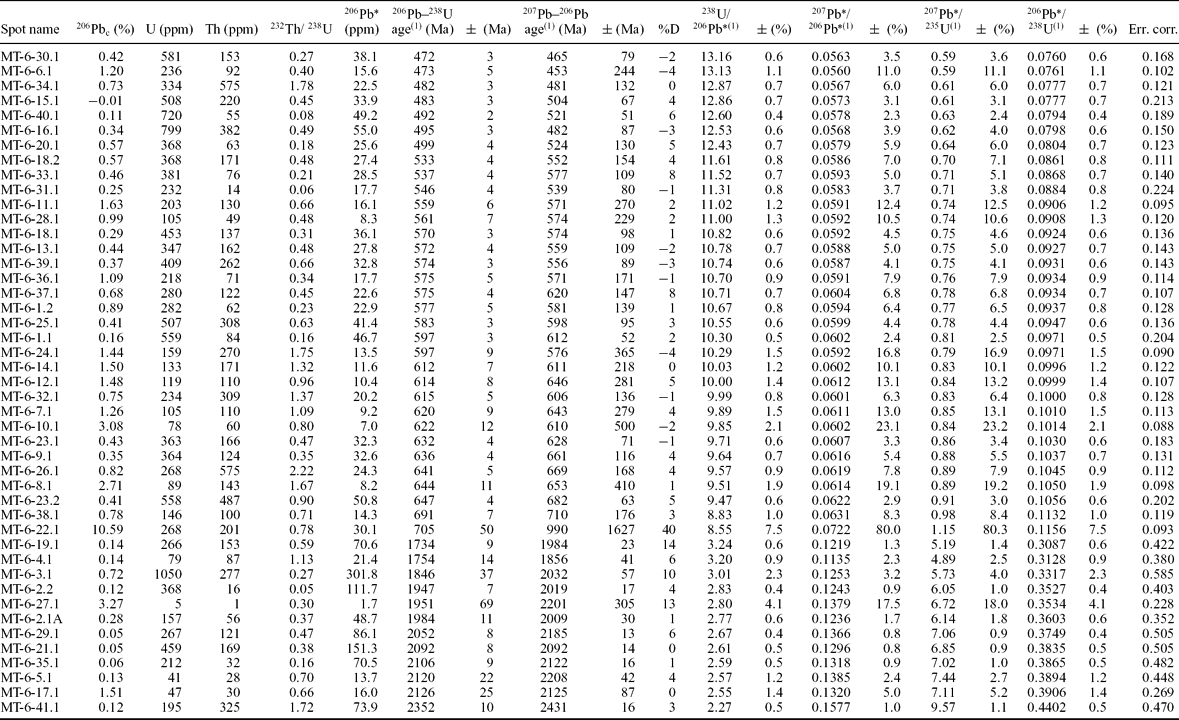
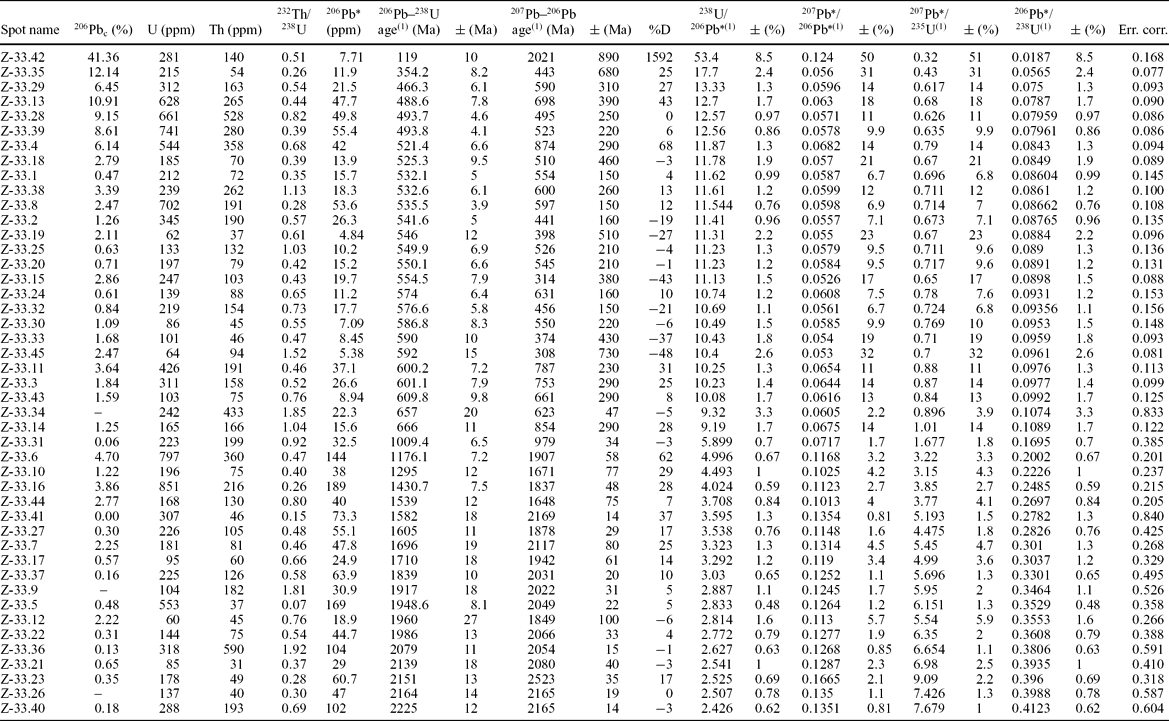
The SHRIMP dates are listed in Tables 1, 2 and 3 and shown on the concordia diagrams in Figures 6 and 7. Zircon ages older than 1.0 Ga refer to 207Pb–206Pb ages, whereas younger zircon ages refer to 206Pb/238U age.
Results of U–Pb SHRIMP dating of zircons from paragneiss of the Młynowiec Formation (sample MT-1)

Errors are 1σ; Pbc and Pb* indicate the common and radiogenic portions, respectively. 1σ error in TEMORA Standard calibration was 0.30% (average of 15). Standard zircon Common Pb corrected using measured 207Pb. (1)Common Pb corrected using measured 204Pb. %D – discordance.
Results of U–Pb SHRIMP dating of zircons from light-coloured quartzite of the Stronie Formation (sample MT-6)

Errors are 1σ; Pbc and Pb* indicate the common and radiogenic portions, respectively. 1σ error in TEMORA Standard calibration was 0.25% (average of 16 out of 17, PbC corrected using 207Pb). (1)Common Pb corrected using measured 204Pb. %D – discordance.
Results of U–Pb SHRIMP dating of zircons from mica schist of the Stronie Formation (sample Z-33)

Errors are 1σ; Pbc and Pb* indicate the common and radiogenic portions, respectively. Error in Standard calibration was 0.43%. (1)Common Pb corrected using measured 204Pb. %D – discordance.
Concordia diagrams showing the results of sensitive high-mass resolution ion microprobe (SHRIMP) dating of zircons from paragneiss of the Młynowiec Formation (MT-1), light-coloured quartzites of the Stronie Formation (MT-6) and mica schists of the Stronie Formation (Z-33).

Concordia diagrams and histograms showing the distribution of Neoproterozoic–early Palaeozoic U–Pb zircon ages from metasediments of the Orlica–Śnieżnik Dome.

For the Młynowiec Formation paragneiss (sample MT-1), 45 spots within 37 grains were analysed (Fig. 3). With the exceptions of samples MT-1–30.1 and MT-1–34.1, all analyses are concordant or discordant within 20 % (Figs 6, 7a). Two normal-prismatic zircon grains, which had rounded pyramid tips and were weakly zoned, revealed Archaean (3.01 Ga, 2.71 Ga) ages. These were the oldest zircons found. There were several Palaeoproterozoic ages and most of them cluster around 2.34 Ga and between 2.02 Ga and 1.79 Ga. This group of zircons is represented by rounded grains, suggestive of a prolonged process of sediment transport. Interestingly, these crystals are even more rounded than the Archaean ones. They also have rather weakly developed zoning. One analysis (MT-1.8.2), which was obtained from a rounded core, gave a concordant Mesoproterozoic age of 1.17 Ga (Statherian Period of the Palaeoproterozoic). More than half of the analyses yielded Neoproterozoic to early Cambrian ages. This group of zircon ages can be subdivided into three age clusters: 660–640 Ma (late Cryogenian Period–early Ediacaran of the Neoproterozoic), 618–590 Ma (Ediacaran) and 578–531 Ma (late Ediacaran–early Cambrian) (Table 1). Twelve analytical points which define the latter Neoproterozoic age cluster were obtained from both inner and outer zircon growth zones (Fig. 3) and gave nearly concordant ages (Table 1, Fig. 7a). These normal-prismatic crystals (mean elongation ~ 2) usually showed well-terminated pyramid tips, were brighter under CL than the older ones and often had distinct oscillatory zones. Their morphology was dominated by the {110} prism and {211} pyramid forms, and, following the typological classification of Pupin (Reference Pupin1980), point to S-type granitoids as their source rocks. Sample MT-1–20.2, obtained from a high-U zircon core, had the youngest age of 515 Ma; however, the rim of the same crystal (MT-1–20.1) yielded an age of 590 Ma, which strongly suggests that the 515 Ma age of the core reflects subsequent lead loss.
For light-coloured quartzite of the Stronie Formation (sample MT-6), 45 spots within 41 grains were analysed. This sample yielded Palaeoproterozoic (2.35–1.73 Ga) and Neoproterozoic to early Cambrian (660–640 Ma, 590–530 Ma) zircon age populations. The analyses are concordant or nearly concordant (MT-6–22.1 and MT-6–27.1) within their rather large uncertainties. A correlation between the age and morphology of the zircons is similar to that obtained in sample MT-1 and shows that rounded zircons are usually older than Neoproterozoic, whereas zircons with preserved prism faces are predominantly Neoproterozoic in age (Fig. 4). The Neoproterozoic to early Cambrian zircons are, like their equivalents from sample MT-1, normal-prismatic and have obvious zoning. They belong to a similar group of zircons, with a dominance of {110} prism and {211} pyramid forms. No Mesoproterozic zircons were found in this sample. In contrast to sample MT-1, seven points from sample MT-6 gave younger, near concordant ages ranging between 499 Ma and 472 Ma (Table 2, Figs 4, 7a). These zoned zircons are clear, colourless and normal-prismatic. They belong to a population of relatively well-preserved euhedral crystals in which {100} prism and {101} pyramid forms are dominant. According to the typological classification of Pupin (Reference Pupin1980), they belong to acidic volcanic rocks such as rhyolites or trachytes.
For the mica schists of the Stronie Formation (sample Z-33), 45 spots within 41 grains were analysed. This sample contained Palaeoproterozoic (2.2–1.65 Ga), Neoproterozoic to early Cambrian (c. 660 Ma, 610–574 Ma, 554–521 Ma) and early Palaeozoic (493–466 Ma) zircon ages (Table 3). In contrast to samples MT-1 and MT-6, several points in sample Z-33 gave discordant ages, possibly indicating an episodic Pb-loss in the c. 2.0 Ga old zircons, due to opening of the isotopic system during Neoproterozoic times (Fig. 6). One zircon gave a concordant age of 1.0 Ga. Three points from the Z-33 sample gave U–Pb ages of 493–488 Ma (Z-33.13, Z-33.28, Z-33.39), which are very similar to the early Palaeozoic ages recorded in sample MT-6. In sample Z-33, a few obviously young U–Pb ages of 466 Ma (Z-33.29) and 354 Ma (Z-33.35) were recognized. Together with the Early Ordovician grains, they are characterized by a high common 206Pb concentration (Table 3). In terms of morphology, all zircons from this sample have generally less legible structure, thereby impeding the typological analysis. Proterozoic crystals, in case of the two other samples (MT-1 and MT-6), are more ovoidal and blurry.
Most of the analysed zircons had moderate Th/U ratios that ranged between 0.1 and 1.6. Two of the c. 640 Ma zircons (MT-1.12.1 and MT-6.26.1) had anomalously high Th/U ratios (2.39 and 2.22, respectively). Six zircon analyses (MT-1.6.1, MT-1.36.1, MT-6.2.2, MT-6.31.1, MT-6.40.1 and Z-33.5) had very low Th/U ratios, between 0.05 and 0.08.
6. Discussion
The presence of c. 540–530 Ma detrital zircons in the Młynowiec Formation indicates that this formation could not have been deposited in the Proterozoic because its maximum depositional age is early Cambrian. Therefore, and contrary to previous hypotheses (Fischer, Reference Fischer1936; Don et al Reference Don, Dumicz, Wojciechowska and Żelaźniewicz1990; Don, Skácel & Gotowała, Reference Don, Skácel and Gotowała2003), the Młynowiec Formation can no longer be considered a part of the Precambrian basement that was consolidated during the Cadomian (or earlier) orogeny.
Samples MT-6 and Z-33 contain seven and three zircons, respectively, which yielded Cambro-Ordovician ages in a range of 500–470 Ma (Fig. 7), and three of the seven analysed zircons in sample MT-6 had a low Th/U ratio (< 0.27). This latter geochemical signature is commonly considered characteristic of metamorphic zircons (e.g. Hoskin & Schaltegger, Reference Hoskin, Schaltegger, Hanchar and Hoskin2003), but caution has been urged in making such an interpretation (Harley, Kelly & Möller, Reference Harley, Kelly and Möller2007). The Cambro-Ordovician ages for the Młynowiec–Stronie Group could be related to a contemporary high-grade tectonometamorphic event: the intrusion of porphyritic (Śnieżnik-type) granites (Don et al. Reference Don, Dumicz, Wojciechowska and Żelaźniewicz1990; Don, Skácel & Gotowała, Reference Don, Skácel and Gotowała2003; Přikryl, Schulmann & Melka, Reference Přikryl, Schulmann and Melka1996; Żelaźniewicz et al. Reference Żelaźniewicz, Nowak, Larionov and Presnyakov2006; Żelaźniewicz & Larionov, Reference Żelaźniewicz and Larionov2008). However, zircons from the Cambro-Ordovician population commonly show internal oscillatory zoning (Fig. 4), which is typical of igneous zircons. This strongly argues for these zircons crystallizing from a felsic magma and that the low Th/U ratio is not a discriminant feature in this case. Alternatively, they might have come from Cadomian magmatic rocks that subsequently suffered Pb-loss. In sample MT-1, such an option is prompted by the zircon sample (MT-1–20.2), whose core yielded a substantially younger age than did its rim. If Pb-loss was the cause, more zircons in this and other samples could have been affected by Pb-loss in Cambro-Ordovician or later times. Only one analysis (Z-33.35) gave a U–Pb age of 354 Ma, which might indicate a superposed Variscan metamorphism, but the high common 206Pb in this case does not support this interpretation. The apparent lack of late Palaeozoic ages means that Variscan metamorphic overprinting was not capable of affecting the studied zircons.
Therefore, we can assume that the c. 500–470 Ma zircons grew in felsic magmas of middle/late Cambrian–early Ordovician age and were probably delivered to the Stronie depositional basin via pyroclastic falls/flows from contemporaneous active volcanic centres. This view is consistent with the presence of numerous intercalations of acidic metavolcanic rocks within the Stronie Formation, where massive metarhyolites are intimately associated with more schistose metatuffitic rocks, the geochemistry of which suggests sedimentation in shallow waters (Murtezi, Reference Murtezi2006). It is also possible that the pyroclastic material was accumulated in the area adjacent to the active volcanoes and then transported by turbidity currents into the sedimentary basin or it was derived from erosion of the volcanic rocks (Fig. 9). Further support comes from the similarities in morphological features of the c. 500–470 Ma zircons retrieved from the light-coloured quartzites and mica schists of the Stronie Formation (this study) and from the acidic metavolcanic rocks (M. Murtezi, unpub. Ph.D. thesis, Inst. Geological Sciences, Polish Acad. Sciences, 2005). The zircons from both this study and Murtezi's thesis are mostly euhedral, long-prismatic crystals with evident oscillatory zoning, and both sets have well-developed {100} prism and {101} pyramid forms. Moreover, zircon ages of 500–470 Ma from the light-coloured quartzites are roughly comparable to the 507–496 Ma ages from the zircons in three samples of acidic metavolcanic rocks (M. Murtezi, unpub. Ph.D. thesis, Inst. Geological Sciences, Polish Acad. Sciences, 2005; Murtezi & Fanning, Reference Murtezi and Fanning2005). A slight difference between these ages could have resulted from insufficient U–Pb zircon data from the metasedimentary rocks. The overall similarities of magmatic zircons from acidic metavolcanites with youngest zircons from the light-coloured quartzites strongly suggest that both rock units represent the same widespread Cambro-Ordovician magmatic event. The massive light-coloured quartzites often contain remarkable amounts of K-feldspar (Smulikowski, Reference Smulikowski1979), which is in line with the suggestion here that there is a volcanogenic component to this quartzite. Given that in the Stronie Formation there are detrital zircons that range from lower Cambrian (c. 530 Ma) to lower Ordovician (igneous zircons in pyroclastics), the entire Młynowiec–Stronie Group must have been deposited during the Early Palaeozoic times.
In contrast to the two samples from the Stronie Formation, the MT-1 paragneiss sample lacked concordant ages younger than 530 Ma. The observed differences in the lower Palaeozoic zircon age spectra in the samples studied, along with an absence of meta-igneous rocks in the Młynowic Formation, indicate that the protolith of this formation was deposited prior to volcanic activity. The volcanogenic rocks are associated with the mudstone–shale–carbonate deposits of the Stronie Formation (Fig. 8). A change in sedimentary facies is marked by an intervening, continuous horizon of light-coloured quartzites, which occurs over the Młynowiec paragneisses (Don, Skácel & Gotowała, Reference Don, Skácel and Gotowała2003). Although a paraconformity cannot be ruled out, there is no evident angular discordance or disconformity between the Młynowic Formation and the Stronie Formation; thus we interpret the quartzites to be the conformable base of the Stronie Formation. This interpretation differs from the previous assumption that there is a wide time gap between the two formations and that the boundary between the two represents the onset of a new diastrophic cycle (e.g. Fischer, Reference Fischer1936; Don, Skácel & Gotowała, Reference Don, Skácel and Gotowała2003). The boundary between the Młynowiec and Stronie formations may be explained by changes in sedimentary environment: continental slope grading towards littoral shallow-sea environments in which the deposition of the Stronie Formation rocks took place (Koszela, Reference Koszela1997). These environments were associated with an outburst of magmatic activity that produced predominantly acidic and, less commonly, basic lavas and supplied volcaniclastic components to the Stronie basin. Timing of the onset of sedimentation of the Stronie Formation is unclear. Taking into account a Pb–Pb zircon age of 520 Ma that was derived from two samples of acidic metavolcanic rocks (A. Kröner, pers. comm.) and mica schist (Hegner & Kröner, Reference Hegner, Kröner, Franke, Haak, Oncken and Tanner2000), an interval of 520–470 Ma is probably the time of deposition of this formation. As the Młynowiec Formation is younger than 530 Ma, any possible time gap between the two formations within the Młynowiec–Stronie Group, if there was one, must have been short.
Lithostratigraphy of the Młynowiec–Stronie Group based on mapping (Don, Skácel & Gotowała, Reference Don, Skácel and Gotowała2003), petrogenetic studies (Koszela, Reference Koszela1997) and U–Pb zircon data (Murtezi & Fanning, Reference Murtezi and Fanning2005 (*); this paper).

At the same time as the Młynowiec–Stronie Group was being formed, an S-type porphyritic granite, the precursor to the Śnieżnik augen gneisses, was emplaced (Żelaźniewicz, Mazur & Szczepański, Reference Żelaźniewicz, Mazur and Szczepański2002; Grześkowiak, Żelaźniewicz & Fanning, Reference Grześkowiak, Żelaźniewicz and Fanning2005). This event probably took place between 515 Ma and 480 Ma (e.g. van Breemen et al. Reference van Breemen, Aftalion, Bowes, Dudek, Mísař, Povondra and Vrána1982; Turniak, Mazur & Wysoczański, Reference Turniak, Mazur and Wysoczański2000; Kröner et al. Reference Kröner, Jaeckel, Hegner and Opletal2001; Lange et al. Reference Lange, Bröcker, Armstrong, Żelaźniewicz, Trapp and Mezger2005). The granitic protolith of the augen orthogneisses developed from unknown supracrustal rocks, as deduced from geochemical evidence (Borkowska et al. Reference Borkowska, Choukroune, Hameurt and Martineau1990), and probably originated at lower crustal depths, as suggested by the presence and pressure–temperature paths of migmatitic enclaves (A. Grześkowiak, unpub. Ph.D. thesis, Adam Mickiewicz Univ. Poznań, 2004; Grześkowiak, Żelaźniewicz & Fanning, Reference Grześkowiak, Żelaźniewicz and Fanning2005). No direct evidence has been found that the Śnieżnik magma intruded the Młynowiec–Stronie Group; all the observed boundaries are more or less sheared so that the originally intrusive contacts, if any, might have been subsequently tectonized. Nevertheless, the mapped outcrop pattern does not preclude such an option (Don, Reference Don1964; Don, Skácel & Gotowała, Reference Don, Skácel and Gotowała2003). Geochemical similarities between the acidic metavolcanic rocks of the Młynowiec–Stronie Group and the Śnieżnik augen gneisses strongly suggest that the former are the volcanic equivalents of the latter and that both these originally igneous rocks had, roughly, a common magma source that was related to an active continental arc (Wojciechowska, Ziółkowska-Kozdrój & Gunia, Reference Wojciechowska, Ziółkowska-Kozdrój and Gunia2001; Murtezi, Reference Murtezi2006). The intrusive rocks probably crystallized at mid-crustal depths coeval with the deposition of the marine sediments and the effusive rocks in the Stronie basin. Therefore, although we conclude that both events occurred at roughly the same time (between 520 Ma and 480 Ma; Fig. 9), the possibility exists, based on the tectonometamorphic histories of the Stronie Formation and the Śnieżnik gneisses, that the deposits of the Młynowiec–Stronie Group were metamorphosed prior to the intrusion of the granitic magma. A fine-grained variant of the Śnieżnik orthogneisses has often been interpreted as a marginal facies of the pluton that cooled against the country metasedimentary rocks (e.g. Don, Reference Don1964; Borkowska et al. Reference Borkowska, Choukroune, Hameurt and Martineau1990).
Model for the deposition of the Młynowiec–Stronie Group and for the location of the Młynowiec-Stronie Group basin on the Gondwana margin during early Palaeozoic times.

The inferred c. 520–470 Ma age (middle Cambrian to Early Ordovician) of sedimentation of the Młynowiec–Stronie Group is slightly younger, on average, than the early Cambrian age of the marbles and light-coloured quartzites from the Stronie Formation, this latter age being inferred from micropalaeontological data (Gunia, Reference Gunia1984a,Reference Guniab, Reference Gunia1990). The stratigraphic range of the (problematic) microflora and microfauna genera and species is from latest Neoproterozoic (Ediacaran) to Ordovician, which generally fits with the isotopic data and also agrees with findings of undetermined fossil skeletons in the Orlica–Śnieżnik Dome marbles (Koszela, Reference Koszela1997). All these data strongly suggest an early Palaeozoic age for the Stronie Formation.
Our new detrital zircon ages allow for some provenance inferences. The Variscan orogenic belt is a product of an amalgamation of Amazonia-derived and West Africa-derived microplates (e.g. Linneman et al. Reference Linnemann, Gehmlich, Tichomirowa, Buschmann, Nasdala, Jonas, Lützner, Bombach, Franke, Haak, Oncken and Tanner2000, Reference Linnemann, McNaughton, Romer, Gehmlich, Drost and Tonk2004, Reference Linnemann, Gerdes, Drost, Buschmann, Linnemann, Nance, Kraft and Zulauf2007; Friedl et al. Reference Friedl, Finger, McNaughton and Fletcher2000; von Raumer, Stampfli & Bussy, Reference von Raumer, Stampfli and Bussy2003; Nance et al. Reference Nance, Murphy, Strachan, Keppie, Gutierrez-Alonso, Fernandez-Suarez, Quesada, Linnemann, D'lemos, Pisarevsky, Ennih and Liégeois2008), which were accreted to the northern margin of Gondwana in the course of the peripheral Avalonian–Cadomian orogeny in Neoproterozoic times (Nance & Murphy, Reference Nance and Murphy1994; Tait et al. Reference Tait, Bachtadse, Franke and Soffel1997). In Cambrian times, a rifting at the Gondwana margin caused continental fragments to separate off, all with Avalonian/Cadomian basement, and eventually the Rheic Ocean formed, in which several terranes drifted northward to Laurentia and Baltica (Linnemann et al. Reference Linnemann, Gerdes, Drost, Buschmann, Linnemann, Nance, Kraft and Zulauf2007). The Orlica–Śnieżnik Dome, whether part of the Saxothuringian Terrane (Franke et al. Reference Franke, Żelaźniewicz, Porębski and Wajspyrch1993; Franke & Żelaźniewicz, Reference Franke, Żelaźniewicz, Franke, Haak, Oncken and Tanner2000) or the Moldanubian Terrane (Matte et al. Reference Matte, Maluski, Rajlich and Franke1990; Mazur et al. Reference Mazur, Aleksandrowski, Kryza and Oberc-Dziedzic2006), belonged to the Armorican Terrane Assemblage (Tait et al. Reference Tait, Bachtadse, Franke and Soffel1997). After reviewing the isotopic data, Linnemann et al. (Reference Linnemann, McNaughton, Romer, Gehmlich, Drost and Tonk2004) concluded that the Saxothuringian Terrane has strong affinity with the West Africa Craton of Gondwana from which it might have been liberated even as late as Carboniferous times. Our data for the Orlica–Śnieżnik Dome support, albeit cautiously, the African origin.
The Młynowiec paragneisses as well as the light-coloured quartzites and mica schists of the Stronie Formation originated from a source area that contained Archaean–Palaeoproterozoic (3.0–2.3 Ga), Palaeoproterozoic (2.0–1.8 Ga) and Neoproterozoic–lower Cambrian (660–530 Ma) rocks (Fig. 10). The Palaeoproterozoic (2.0–1.8 Ga) basement was the second most important source of detrital zircons for the Młynowiec–Stronie basin. Zircons from the Stronie acidic metavolcanic rocks also yielded concordant ages at 1.9 Ga (M. Murtezi, unpub. Ph.D. thesis, Inst. Geological Sciences, Polish Acad. Sciences, 2005). The lack of ages between 1.7 Ga and 1.2 Ga supports the African connection, as the Amazonia-derived terranes would contain discrete Mesoproterozoic components (Tassinari & Macambira, Reference Tassinari and Macambira1999) (Fig. 10). In addition, despite the Młynowiec–Stronie Group protoliths probably being deposited in the West African section of Gondwana, the presence of two concordant ages of 1.0 Ga and 1.1 Ga indicates that the sedimentary basin must have still been within the delivery reach of detritus ultimately derived from Grenville-age belt(s). Xenocrystic and detrital zircon ages as well as Nd crustal residence ages from the West Sudetes and other units of the NE Bohemian Massif (Hegner & Kröner, Reference Hegner, Kröner, Franke, Haak, Oncken and Tanner2000; Kröner et al. Reference Kröner, Jaeckel, Hegner and Opletal2001) cluster around 1.4–1.0 Ga. This would connect, via a Rodinian river system, these regions with Amazonian and/or the Avalonian parts of Gondwana. If the Orlica–Śnieżnik Dome was connected to the Armorican Terrane Assemblage, then this would contrast with the Amazonian affinity of the Moravo-Silesian Zone of the Brunovistulia Terrane (Friedl et al. Reference Friedl, Finger, McNaughton and Fletcher2000). In the Brunovistulia Terrane, there are c. 1.4 Ga inherited zircons from the Thaya Dome (Friedl et al. Reference Friedl, Finger, Paquette, Quadt, McNaughton and Fletcher2004), the Keprník Dome (Kröner et al. Reference Kröner, Jaeckel, Hegner and Opletal2001), the Desna Dome (Żelaźniewicz et al. Reference Zelaźniewicz, Nowak, Bachliński, Larionov and Sergeev2005) and the eastern part of the Fore Sudetic Block (Oberc-Dziedzic et al. Reference Oberc-Dziedzic, Klimas, Kryza and Fanning2003). Further isotopic data should refine this regional picture.
Histograms showing age distribution of detrital zircons from metasediments of the Orlica–Śnieżnik Dome compared to age distributions of detrital zircons from the contemporaneous Amazonian, West African and Baltica cratons (compiled by Zeh et al. Reference Zeh, Brätz, Millar and Williams2001). Age groups of zircon from the Młynowiec–Stronie Group are shown at 10 Ma intervals. Only zircon ages concordant or discordant within 20 % are graphed. Several Proterozoic zircons from sample Z-33 underwent Pb loss, probably due to a Neoproterozoic thermal event.

More than half of analysed zircons fall into a group that comprises three age clusters: two Neoproterozoic clusters (660–640 Ma and 620 Ma) and one Neoproterozoic–early Cambrian cluster (570–530 Ma). These age groupings agree very well with the detrital zircon ages obtained from the western part of the West Sudetes (Linnemann et al. Reference Linnemann, Gehmlich, Tichomirowa, Buschmann, Nasdala, Jonas, Lützner, Bombach, Franke, Haak, Oncken and Tanner2000; Kryza et al. Reference Kryza, Zalasiewicz, Mazur, Aleksandrowski, Segeev and Larionov2007), which belong to the Saxothuringia Terrane. According to Linnemann et al. (Reference Linnemann, D'Lemos, Drost, Jeffries, Gerdes, Romer, Samson, Strachan and McCann2008a), the three age clusters can be respectively identified as the development of an early island arc (660–640 Ma), crustal thickening (c. 620 Ma), and final magmatic pulses in the Cadomian orogen (570–530 Ma). Neoproterozoic zircon ages are also known from other members of the Armorican Terrane Assemblage in the Bohemian massif (Dörr et al. Reference Dörr, Zulauf, Fiala, Franke and Vejnar2002; Friedl et al. Reference Friedl, Finger, Paquette, Quadt, McNaughton and Fletcher2004; Teipel et al. Reference Teipel, Eichhorn, Loth, Rohrmüller, Höll and Kennedy2004). During Neoproterozoic times, the Orlica–Śnieżnik Dome could have occupied the edge of the Gondwana continent, as it possibly represents one of the most peripheral units related to the West African/Armorican part of Gondwana (Fig. 9). Collision of the West Africa- and Amazonia-derived terranes occurred during the Variscan orogeny. In the Sudetes, the boundary zone between these disparate terranes is located directly to the east of the Orlica–Śnieżnik Dome, where a complex intermingling exists between units of African and Amazonian provenance (Żelaźniewicz et al. Reference Żelaźniewicz, Buła, Fanning, Seghedi and Żaba2009).
The above data suggest that all the metasedimentary rocks of the Orlica–Śnieżnik Dome represent one originally middle Cambrian–early Ordovician sedimentary succession (the Młynowiec–Stronie Group), probably deposited on yet-to-be-identified Neoproterozoic-age crust. Although the bedrock of this succession is unknown, the detrital zircon ages, when combined with other geological data, indicate that the sedimentary basin initially developed in the peripheral parts of West Gondwana after that region had enjoyed a 10–20 Ma period of post-Cadomian tectonic quiescence. The early Palaeozoic geodynamic evolution of the Gondwana-derived terranes took place in an extensional setting, either related to subduction and back-arc rifting or to intra-continental rifting. The mafic members of the volcanic suite in the Stronie Formation developed in an ensialic rift on the northern margin of Gondwana during this continent's Early Palaeozoic break-up (Floyd et al. Reference Floyd, Winchester, Seston, Kryza, Crowley, Franke, Haak, Oncken and Tanner2000). However, the felsic metavolcanic rocks possess the geochemical signature of an active margin and suprasubduction magmatism (Wojciechowska, Ziółkowska-Kozdrój & Gunia, Reference Wojciechowska, Ziółkowska-Kozdrój and Gunia2001; Murtezi, Reference Murtezi2006); this would favour an extensional back-arc setting (Fig. 9). Such a scenario is in line with a number of observations that indicate the importance of c. 500 Ma back-arc and pull-apart extensions in these peri-Gondwana terranes that were later incorporated in the western part of the Variscan belt (Arenas et al. Reference Arenas, Martínez Catalán, Sánchez Martínez, Fernández-Suárez, Andonaegui, Pearce and Corfu2007; von Raumer & Stampfli, Reference von Raumer and Stampfli2008). In the light of such data, the sedimentation of the greywacke protolith of the Młynowiec Formation was likely controlled by the extensional tectonics related to the onset of rifting. During subsequent deposition of the Stronie Formation, continued back-arc spreading involved both intrusive and effusive emplacement of bimodal volcanic rocks. A subordinate volume of basic metavolcanic rocks within the metapelites and marbles of the Stronie Formation suggests that the extension did not reach a truly oceanic stage and that the c. 520–470 Ma rift activity abruptly stopped in the Orlica–Śnieżnik Dome region (Fig. 9).
7. Conclusions
The new U–Pb age data that have been derived from detrital zircons within the metasedimentary rocks of the Orlica–Śnieżnik Dome suggest the following general conclusions:
(1) The maximum depositional age for the rocks of the Orlica–Śnieżnik Dome is approximately 530 Ma.
(2) No ‘Cadomian unconformity’ compatible with that reported from Thuringia (Linnemann et al. Reference Linnemann, Gerdes, Drost, Buschmann, Linnemann, Nance, Kraft and Zulauf2007) was detected in the Orlica–Śnieżnik Dome.
(3) The newly defined metasedimentary Młynowiec–Stronie Group represents a continuous succession deposited not earlier than 530 Ma, and probably at c. 520–470 Ma.
(4) All the clastic detritus for the Młynowiec–Stronie Group originated from the same source area.
The lithostratigraphy of the Młynowiec–Stronie Group has herein been refined: the monotonous greywackes of the Młynowiec Formation form the lower part of the group, and the lithologically diverse schists of the Stronie Formation form the upper part. Feldspathic quartzite separates the two formations. In the middle part of the Stronie Formation, bimodal volcanic rocks are abundant, felsic rocks dominating over limited mafics and associated carbonates. The tops of both formations are dominated by mica schists. Based on the zircon data, sediment deposition and volcanic activity apparently ceased during early Ordovician times.
The Młynowiec–Stronie Group was deposited in middle Cambrian–early Ordovician times (520–470 Ma), presumably at the northern edge of West Gondwana after the 10–20 Ma period of tectonic quiescence which followed the terminal Cadomian collision. A greywacke protolith of the Młynowiec Formation was deposited on the slopes of a subsiding rift basin, and thinning of the crust probably led to increasing arc-style magmatism. The change from greywacke (Młynowiec) to a more lithologically diverse (Stronie) sedimentation coincided with the onset of a rather short-lived pulse of volcanic activity that climaxed around 505–495 Ma and that supplied the volcanogenic components to the Stronie Formation.
The evidence of Mesoarchaean–early Palaeoproterozoic (3.0–2.3 Ga), Palaeoproterozoic (2.1–1.8 Ga) and Neoproterozoic–early Cambrian (660–530 Ma) isotopic ages, and the lack of 1.7–1.2 Ga zircons, suggest that the source areas for the Orlica–Śnieżnik Dome metasedimentary rocks may have been in the West Africa Craton, similar to other parts of the Armorican Terrane Assemblage. However, the presence of 1.1–1.0 Ga detrital zircons suggests an Amazonian affinity, which would agree with similar findings made in Orlica–Śnieżnik Dome rocks by Hegner & Kröner (Reference Hegner, Kröner, Franke, Haak, Oncken and Tanner2000). Three age groups of the Neoproterozoic to earliest Cambrian zircons testify to several tectonothermal pulses during the Cadomian orogeny, at 660–640 Ma, 620 Ma and 570–530 Ma, respectively. Our new data further stress the importance of the uplifted Cadomian orogen as a source of clastic sediments in Palaeozoic basinal successions that developed upon the extended Cadomian basement and the need for provenance studies to reconstruct Gondwana-derived terranes that were later incorporated in the European Variscides.
Acknowledgements
The authors thank Ilya Paderin for carrying out the part of the SHRIMP analyses used in this paper. We thank two anonymous referees for constructive comments that greatly improved the presentation. Patrick Roycroft is thanked for critically reading the manuscript and correcting the English. This research was financed by the MNiSW grant no. N307 068 32/4102.