1. Introduction
Payment for Environmental Services (PES) schemes are increasingly being used around the world in an attempt to increase the supply of environmental services that are not traded in markets (see, for example, Scheufele, Reference Scheufele and Bennett2016). PES schemes aim to link those who are willing to supply these environmental services with those who are willing to buy them, so that an exchange can occur. Linking prospective suppliers with potential buyers can be achieved through the lowering of transaction costs. This can be achieved through the actions of an intermediary or broker who independently provides information on supply and demand to intending producers and consumers so that prices can be determined.
The demand for non-market environmental services can be estimated by means of the discrete choice experiment method. This method facilitates the estimation of both use and non-use values provided by environmental assets in monetary terms. The discrete choice experiment method, based on Lancaster's ‘characteristics value theory’ (Lancaster, Reference Lancaster1966), originated in the marketing and transport literature (Louviere and Hensher, Reference Louviere and Hensher1982; Louviere and Woodworth, Reference Louviere and Woodworth1983) and was first applied to an environmental context by Carson et al., Reference Carson, Hanemann and Steinberg1990. Discrete choice experiments involve respondents to a survey being asked to make trade-offs between a range of characteristics, called attributes, which jointly describe a particular good or service. The attributes can take several levels and are bundled in choice options that are presented to respondents in choice questions. By making trade-offs in the choice questions, respondents reveal their preferences associated with each of these attributes.
The choice experiment method is widely used to estimate benefits associated with non-market environmental services. Examples of applications in developed countries include Doherty et al., Reference Doherty, Murphy, Hynes and Buckley2014, Dias and Belcher, Reference Dias and Belcher2015, Chaikaew et al., Reference Chaikaew, Hodges and Grunwald2017, and Lew and Wallmo, Reference Lew and Wallmo2017. Examples of application in developing countries include Bennett and Birol, Reference Bennett and Birol2010, Villalobos and Huenchuleo, Reference Villalobos, Huenchuleo, Bennett and Birol2010, Wang et al., Reference Wang, Bennett, Xie, Zhang, Bennett and Birol2010, Mejía and Brandt, Reference Mejía and Brandt2015 and Rai et al., Reference Rai, Shyamsundar, Nepal and Bhatta2015.
This study presents the results of discrete choice experiments used to estimate the demand for reducing biodiversity loss in the context of designing a PES scheme intended to facilitate the supply of wildlife protection. The choice experiments targeted demand from international tourists visiting the Lao People's Democratic Republic (PDR)Footnote 1 (henceforth called ‘tourists’) and the residents of urban districts of Vientiane City,Footnote 2 (henceforth called ‘residents’).
The choice experiment questionnaire and the survey techniques employed included innovative elements to address challenges encountered in a developing country context and where cultural and language differences are apparent across respondents and between interviewers and respondents.
The choice experiments were especially designed to facilitate the use of their results in the development of prices to be paid for the supply of actions that will produce environmental services. The demand estimates elicited were used to inform the development and implementation of two pilot PES schemes.Footnote 3 Both schemes are based on a design that aims to mimic market processes by ‘negotiating’ pricing based on comparable estimates of demand and supply and hence require detailed information regarding the strength of demand (Scheufele and Bennett, Reference Scheufele and Bennett2017). The estimates of demand reported in this paper were used conjointly with the relevant marginal cost estimates (Scheufele and Bennett, Reference Scheufele and Bennett2018) to set the ‘price’ per anti-poaching patrol (Scheufele et al., Reference Scheufele, Bennett and Kyophilavong2018), with a stochastic wildlife population model used to convert patrol effort into wildlife diversity outcomes (Hay et al., Reference Hay, Kragt, Renten and Vongkhamheng2017; Renton et al., Reference Renton, Scheufele, Kragt and Vongkhamheng2017).
The remainder of this paper is structured as follows. Section 2 sets out the application by providing information on the research design, survey logistics and associated practical challenges, experimental design and econometric framework. Section 3 presents the results. Section 4 closes with a conclusion.
2. Applications
The demand for increased biodiversity protection was estimated for the two pilot PES scheme areas: the Phou Chomvoy Provincial Protected Area (PCPPA) and the Green Peafowl Species Conservation Zone (GPSCZ). The marginal willingness to pay of tourists and residents for biodiversity protection in the two areas was estimated using four discrete choice experiments (split-samples).
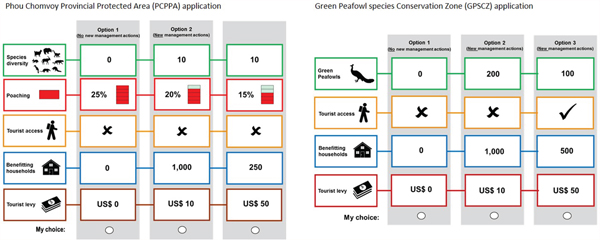
The survey material consisted of an interviewer protocol, a questionnaire script, show cards, answer sheets, and choice booklets that contained the choice questions.Footnote 4 The respondents were asked to record their choices in a paper booklet without being observed by the interviewer. The booklet was then submitted in a sealed envelope to ensure anonymity and confidentiality and minimise drivers of response bias. Additionally, the respondents were assured by the interviewers that the survey was anonymous (no names were recorded) and confidential. Potential drivers of response bias, especially for the resident split-samples, included the desire to please the interviewer and/or an unwillingness to have their true preferences revealed to the interviewer. The use of show cards and the choice question booklets was also designed to reduce communication barriers between the Lao interviewers and the tourist respondents who had a range of English language competence. Where language was a barrier, it was found that reading skills were superior to oral skills. Furthermore, where oral skills were not restrictive, the slow pace of spoken delivery by the Lao interviewers was found to be frustrating to respondents. To enhance communications further, graphics and images were used extensively (see figure 1 for an example). Potential interviewer bias was minimised by using show cards, envelopes for submitting the choice booklets, and interviewer training.
Example choice sets presented to tourist respondents

The survey material was customized to the two target populations (tourists and residents). The survey material differed between the split-samples with respect to target groups in terms of the language of delivery, filter questions, questions regarding socio-demographic characteristics, the payment vehicle and the levels of the cost attribute. The resident questionnaires were presented in Lao, whereas the tourist questionnaires were in English. The use of additional languages to account for the diversity of international tourists was not possible due to language limitations of the Lao interviewers. The survey material was also made specific for the two protected areas (the PCPPA and the GPSCZ) in further split-samples. This resulted in four split-samples: PCPPA/tourists; PCPPA/residents; GPSCZ/tourists; and, GPSCZ/residents.
The PCPPA is a mainly mountainous part of the Northern Annamite Ranges covering about 22,300 hectares. It is located in the Bolikhamxay Province on the border with Vietnam. The GPSCZ covers about 8,000 hectares within the Phou Khao Khouay National Protected Area located in the Vientiane Capital Province. Both areas are ‘biodiversity hotspots’ providing habitat for a range defined by IUCN as Endangered and Critically Endangered species (IUCN, 2016). The PCPPA application focussed on the protection of 19 wildlife species classified as Endangered and Critically Endangered (IUCN, 2016). The GPSCZ application focussed on the protection of a single wildlife species, the Critically Endangered (IUCN, 2016) Green Peafowl (Pavo muticus).
The questionnaires were structured as follows. After some filter questions relating to the travel purpose, visa requirements and country of origin of tourist respondents and citizenship/permanent residence of local residents, respondents were provided with background information including photographs and explanations about the protected area and future management options. The respondents were told that the protected area (PCPPA and GPSCZ) was home to a range of wildlife species, which are under pressure from poaching. They were further informed that some of these species were threatened with extinction, that their current populations range from 5 to 50 animals per species, and that about 25 percent of these animals are poached each year.
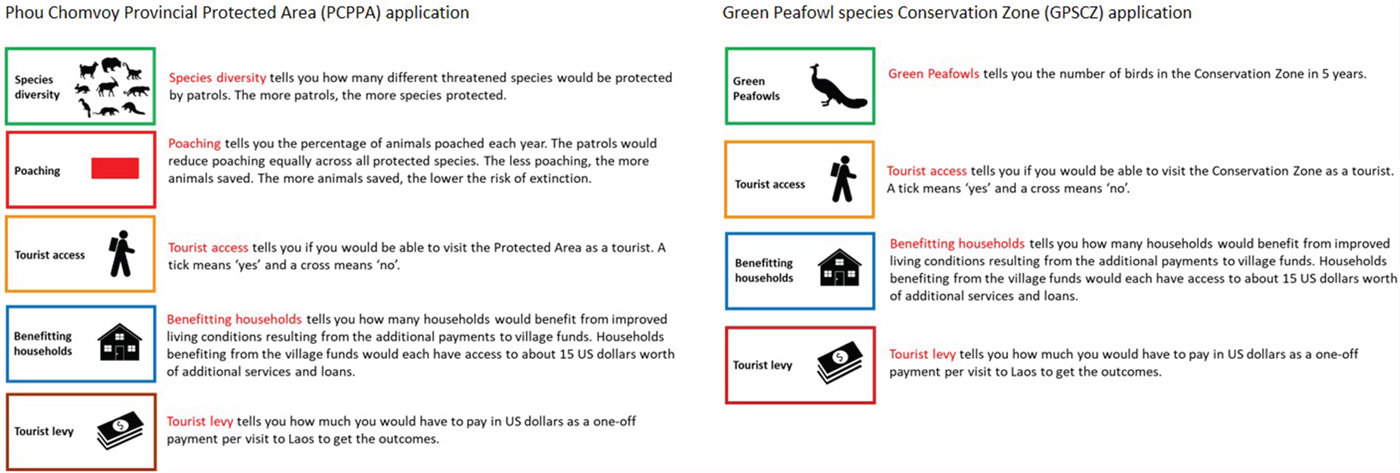
This was followed by the choice tasks, which asked respondents to make a sequence of five choices between three management options regarding wildlife protection. Each choice consisted of one ‘no new management actions’ option at no additional cost and two ‘new management actions’ options at an additional cost. Respondents were presented with a show card and an example choice question that provided detailed information on the attribute levels (called ‘outcomes’ in the show cards) associated with each choice option (figures 1 and 2). The choice options were mainly described by symbols to assist resident respondents with low literacy levels and tourist respondents' (potential) English language limitations.
Attribute descriptions
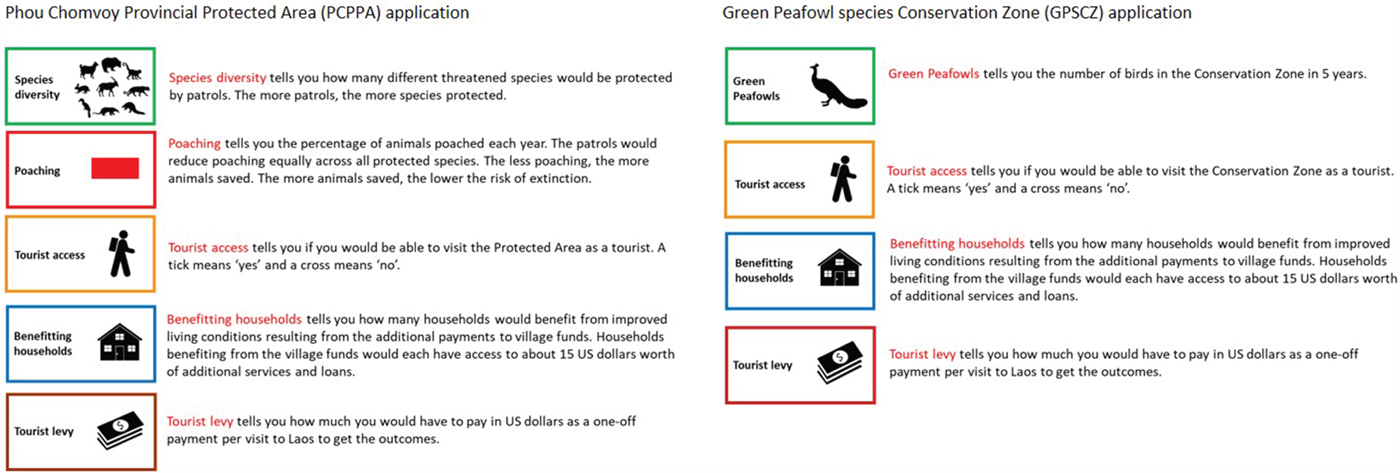
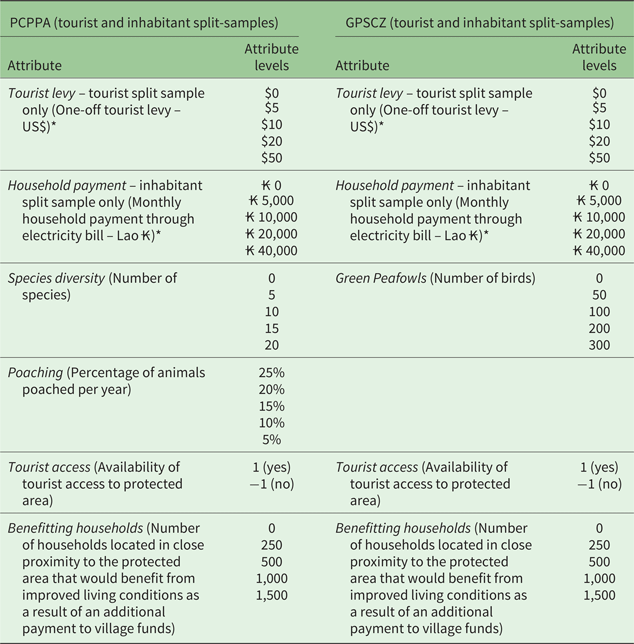
Each choice option was described by attributes (five for PCPPA and four for GPSCZ), representing a combination of environmental services (species diversity: number of species present in PCPPA; poaching: percentage of animals poached per year in PCV; Green Peafowls: number of birds present in GPSCZ), social services (tourist access: availability of tourist access to protected area; benefitting households: number of households located in close proximity to protected area that would benefit from improved living conditions as a result of an additional payment to village funds), and the associated costs to enjoy these services (tourist levy: one-off tourist levy; household payment: monthly household payment through electricity bill). The attributes levels are summarized in table 1.Footnote 5
Attributes and their levels

Note: * $\hbox{US} \$ 1={\rlap{--}{K}}8,177.68$ (27.01.2017 Oanda.com).
A BayesianFootnote 6 s-efficient experimental designFootnote 7 was used to generate the choice sets.Footnote 8 An s-efficient design optimizes for sample size. This design type was used because data collection was restricted to face-to-face interviews (instead of a less costly but impractical Internet survey). Consequently, the achievable sample size was limited. Four separate designs were generated to account for different payment vehicles (across the two groups of respondents) and different attributes (across the two zones).
Each design consisted of 20 choice sets divided into four blocks that were randomly assigned to the respondents. The sequence of the choice sets in each block was randomized to minimise any ordering effects. This resulted in 20 different choice booklets per split-sample.
The discrete choice experiment surveys were conducted through personal interviews.Footnote 9 Data were collected from 5 to 15 December 2015 by drawing two samples from each of the two ‘PES buyer’ populations. Tourists were interviewed in the departure lounge at Wattay International Airport in Vientiane City using a random sampling method. The interviews were scheduled to cover the departure times of all international flights leaving the Lao PDR. The residents were interviewed at their homes. Maps showing district boundaries were not available. Interviewers were equipped with the Google Earth app on their mobile phones, which provided information on the location of the randomly selected starting points for random household sampling.
The econometric models used to analyse the choice data are based in random utility theory (Thurstone, Reference Thurstone1927; McFadden, Reference McFadden and Zarembka1974, McFadden, Reference McFadden1980). The collected data were analysed using a mixed logit model specification, which relaxes the restrictive assumptions of the conditional logit model (Revelt and Train, Reference Revelt and Train1998; Train, Reference Train1998). All non-cost parameters were assumed to be normally distributed (1,000 Halton draws) to account for preference heterogeneity. The cost parameter for the two populations (tourist levy and household payment) were specified as non-random. Generic error components were included to allow for differences in the variances of the error terms between the ‘no new management actions’ option and the two ‘new management actions’ options, and thus to relax the IID (independent and identically distributed random variables) assumption. Panel specifications were used to account for repeated choice observations. All models were estimated in STATA 13 using the Newton-Raphson algorithm.
The inclusion of a cost attribute in the choice sets facilitates the estimation of implicit prices. An implicit price is a monetary value of a unit change in the provision of a particular non-monetary attribute. Implicit prices (IP) for attributes were derived by taking the ratio of estimated distributions of cost and non-cost parameters obtained from a choice model defined in utility space (Hanley and Barbier, Reference Hanley and Barbier2009):
 $$IP_k =-\displaystyle{{\beta_k}\over{c}}\comma \; $$
where  $\beta _{k} \forall k\in 1\comma \; \ldots \comma \; K$ represents the vector of the non-cost parameter estimates and c is the cost parameter estimate. A parametric bootstrapping procedure (10,000 repetitions) was used in the estimation of the attribute implicit prices to account for sampling errors (Krinsky and Robb, Reference Krinsky and Robb1986).
3. Results
The two tourist split-samples consisted of 345 respondents who participated in the PCPPA survey and 333 respondents who participated in the GPSCZ survey. The response rates (excluding protestersFootnote 10) were about 60 per cent and 78 per cent, respectively. The response rate differences may be explained by differences in the level of rigour by which interviewers followed the sampling protocol.Footnote 11
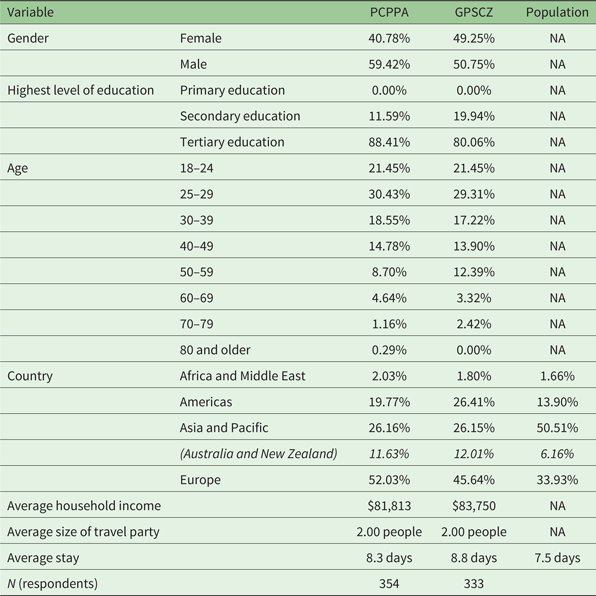
The characteristics of both tourist split-samples and the tourist populationFootnote 12 are presented in table 2. χ 2 tests were conducted to check for differences. The split-samples are statistically different from the population data with respect to the socio-demographics that were available at the population level. The respondents, on average, stayed longer in the Lao PDR. Asian respondents are under-represented while Europeans, North Americans and Australians/New Zealanders are over-represented. The difference in representation may be explained, to some extent, by language problems, given that the surveys were conducted exclusively in English.
Respondent characteristics of the two tourist split-samples

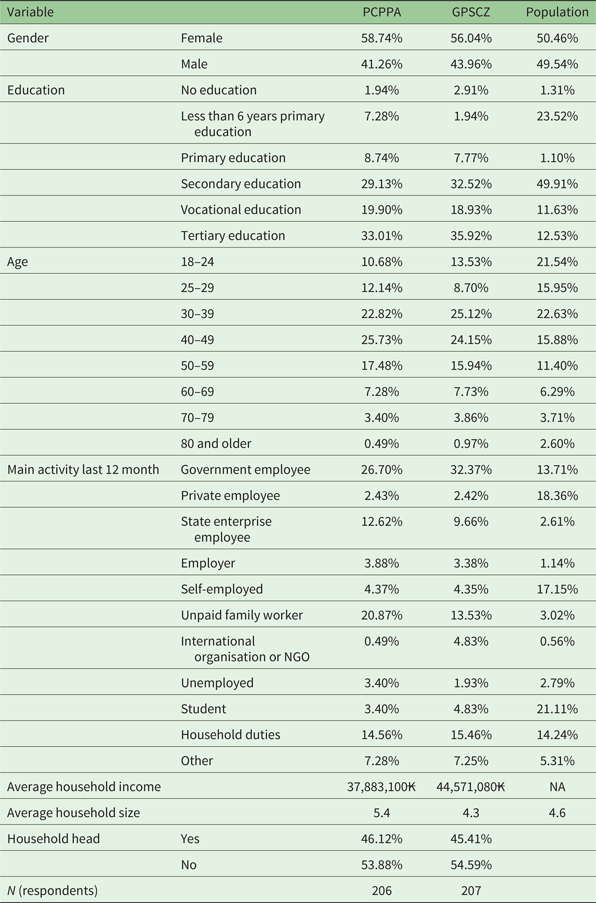
The two resident split-samples consisted of 206 respondents who participated in the PCPPA survey and 207 respondents who participated in the GPSCZ survey. The response rates (excluding protestersFootnote 13) were 42 per cent and 48 per cent, respectively.Footnote 14 The characteristics of both resident split-samples and the resident populationFootnote 15 are presented in table 3. χ 2 tests were conducted to check for differences. The split-samples are statistically different from the population data with respect to the socio-demographics that were available at the population level. Females are overrepresented in the sample. The respondents, on average, have achieved higher education levels than the population. The age group from 18 to 24 years is under-represented, whereas the age group from 40 to 59 is over-represented. Government employees, state enterprise employees and unpaid family workers are over-represented. Private employees, self-employed respondents, and students are under-represented. The differences between the split-samples and the corresponding populations may be explained by the schedule used for sampling: interviews could only be conducted between 8:30 am and 6:00 pm. Interview times outside this schedule were deemed to be unsafe (for the interviewers) and impolite (with respect to the respondents).
Respondent characteristics of the two resident split-samples

Note:  $\hbox{US} \$ 1\, =\, {\rlap{--}{K}} 8\comma \; 177.68$ (27.01.2017 Oanda.com).
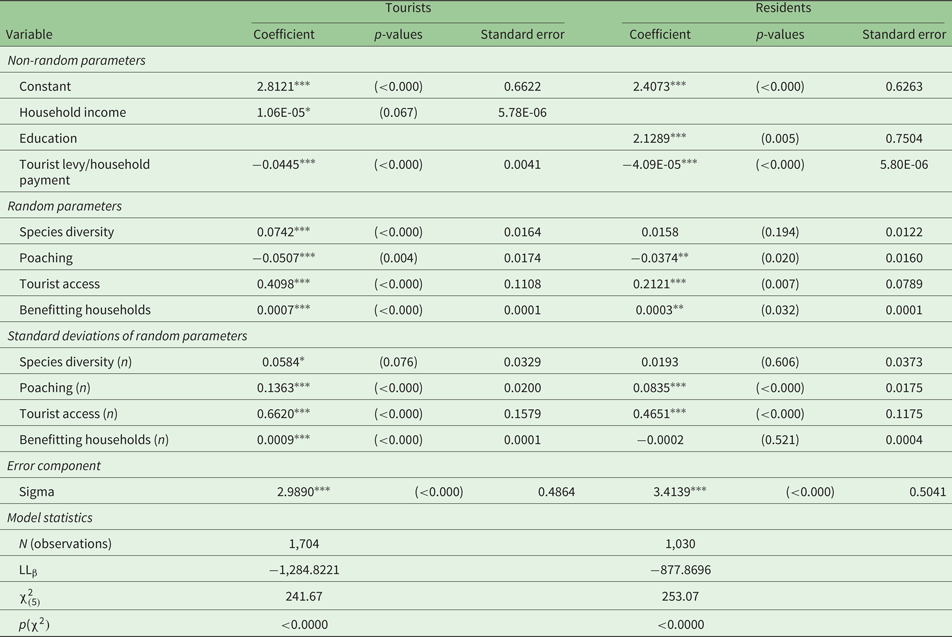
The econometric results of the PCPPA application are presented in table 4. The tourist levy/household payment parameter estimates are statistically significantly different from zero (p < 0.000) and have the expected negative signs. This suggests that lower cost options are preferred to higher cost options, ceteris paribus. For the tourist split-sample, the species diversity parameter estimate is statistically significantly different from zero (p < 0.000) and has the expected positive sign. This indicates that a higher degree of species diversity provides a higher utility than a lower degree, ceteris paribus. The species diversity parameter estimated for the resident split-sample is not statistically significantly different from zero (p = 0.194), suggesting a zero marginal utility from more species diversity. The poaching parameter estimates are statistically significantly different from zero (p = 0.004 and p = 0.020, respectively) and have the expected negative signs. This indicates that lower poaching levels provide a higher utility than higher poaching levels, ceteris paribus. The tourist access parameter estimates are statistically significantly different from zero (p < 0.000 and p = 0.007, respectively) and have the expected positive signs, indicating that the opportunity of having access to the protected area provides a higher utility than not having access, ceteris paribus. The benefitting households parameter estimates are statistically significantly different from zero (p < 0.000 and p = 0.032, respectively) and have the expected positive signs. This suggests that the respondents' utility increases with an increase in the number of households benefitting from improved living conditions through payments to the village development funds, ceteris paribus. The parameter estimate of the income variable (interacted with the constant) is positive and statistically significantly different from zero at the 10 per cent confidence level (p = 0.067) in the tourist split-sample. This indicates that respondents with higher household income were more likely to choose a ‘new management actions’ option than those with lower household income, ceteris paribus. The parameter estimate of the education variable (interaction with the constant) is positive and statistically significantly different from zero at the 1 per cent confidence level (p = 0.005) in the resident split-sample. This suggests that respondents who have achieved a higher education level were more likely to choose a ‘new management actions’ option compared to those who achieved a lower education level, ceteris paribus. Footnote 16
Panel mixed logit model – PCPPA application

Notes: The orders of magnitude of the attribute data were adjusted to facilitate the estimation process. The results are presented in the original units as described in table 1. Different models were estimating including a range of socio-demographics. Model fit criteria (AIC, BIC) were used to decide on exclusions from the model.
*** = significant at 1% level, ** = significant at 5% level, * = significant at 10% level; p-values in parentheses.
For the tourist split-sample, the estimated standard deviations of the random parameters are statistically significantly different from zero at the 1 per cent confidence level for all parameter estimates (p < 0.000) except species diversity (p = 0.076). This indicates preference heterogeneity for poaching, tourist access and benefitting households across respondents. For the resident split-sample, preference heterogeneity is only found with respect to the poaching and tourist access attributes as indicated by the significance levels of their estimated standard deviations (p < 0.000).Footnote 17 The error component parameter estimates are statistically significantly different from zero (p < 0.000) for both split-samples, indicating that the variances differ between the ‘no new management actions’ option and the two ‘new management action’ options.
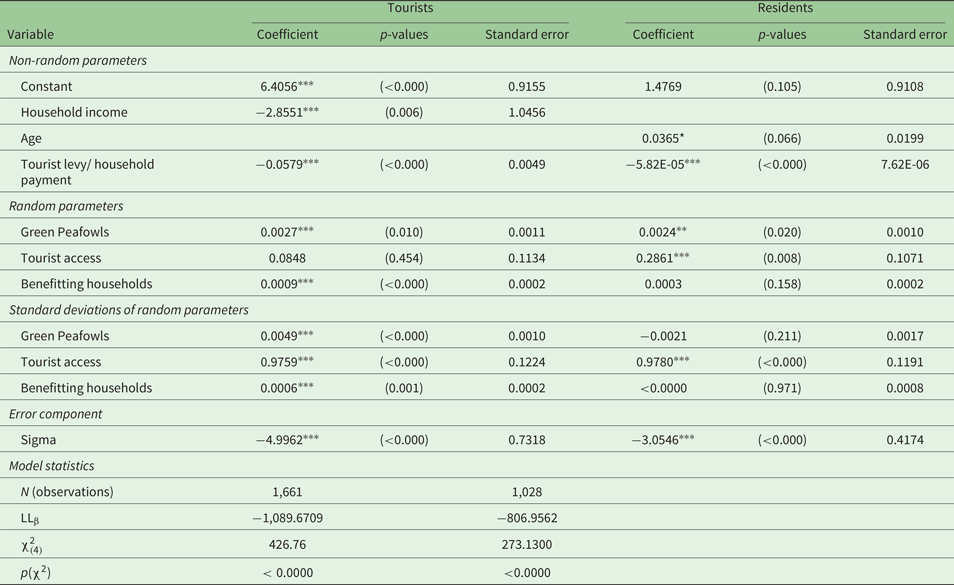
The econometric results of the GPSCZ application are presented in table 5. The GPSCZ results are interpreted in the same way as the PCPPA results. All parameter estimates are statistically significantly different from zero (at least at the 5 per cent confidence level) and have the expected signs with the exception of the tourist access parameter estimated for the tourist sample and the benefitting households parameter estimated for the resident split-sample. The parameter estimate of the income variable (interacted with the constant) included in the tourist model is negative and statistically significantly different from zero at the 1 per cent confidence level (p = 0.006). This indicates that respondents who did not disclose their household income and were assigned the sample average were less likely to choose a ‘new management actions’ option than those who disclosed their household income. The parameter estimate of the age variable (interacted with the constant) included in the resident model is positive and statistically significantly different from zero at the 10 per cent confidence level (p = 0.066). This suggests that older respondents were more likely to choose a ‘new management actions’ option compared to younger respondents.Footnote 18
Panel mixed logit model – GPSCZ application

Notes: The orders of magnitude of the attribute data were adjusted to facilitate the estimation process. The results are presented in the original units as described in table 1.
*** = significant at 1% level, ** = significant at 5% level, * = significant at 10% level; p-values in parentheses.
For the tourist split-sample, the estimates of the standard deviations of the random parameters are statistically significantly different from zero at the 1 per cent confidence level for all parameter estimates. Given that the tourist access parameter estimate is not statistically significantly different from zero at the 1 per cent confidence level, this may indicate a bimodal distribution associated with this attribute. For the resident split-sample, preference heterogeneity is only found with respect to the tourist access attribute as indicated by the 1 per cent significance level of the estimated standard deviation.Footnote 19 The error component parameter estimates are statistically significantly different from zero at the 1 per cent confidence level for both split-samples.
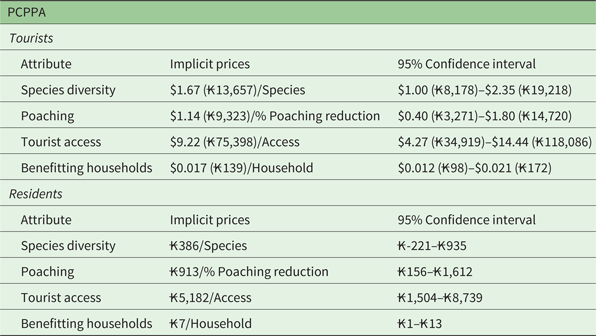
The implicit prices of the PCPPA application are presented in table 6. All implicit prices are statistically significantly different from zero at the 5 per cent confidence level with the exception of the implicit price for species diversity estimated for the resident split-sample.
Implicit prices – PCPPA application

Note:  $\$ \hbox{US}1\, =\, {\rlap{--}{K}}8\comma \; 177.68$ (27.01.2017 Oanda.com).
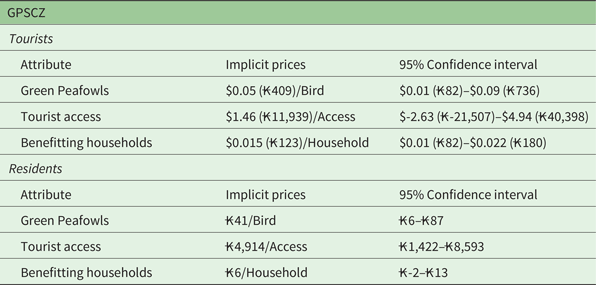
The implicit prices of the GPSCZ application are presented in table 7. All implicit prices are statistically significantly different from zero at the 5 per cent confidence level except for the implicit prices for tourist access estimated for the tourist split-sample and for benefitting households estimated for the resident split-sample.
Implicit prices - GPSCZ application

Note:  $\$ \hbox{US}1\, =\, {\rlap{--}{K}}8\comma \; 177.68$ (27.01.2017 Oanda.com).
4. Conclusions
This study presented the results of choice experiments used to estimate the demand for environmental services (biodiversity protection in the PCPPA and the GPSCZ) and social services (tourist access and improvement in living conditions). The demand estimates of two groups of environmental and social services ‘buyers’ were used to inform the implementation of two pilot PES schemes designed to mimic market processes by ‘negotiating’ pricing based on comparable estimates of demand and supply.
The results suggest that both tourists and residents are willing to pay for reducing biodiversity loss through wildlife protection actions in both the PCPPA and the GPSCZ. Tourists were also willing to pay for an improvement in the living conditions of households that are located in close proximity to both the PCPPA and the GPSCZ, whereas the willingness to pay of the residents for improved living conditions is limited to the PCPPA. Residents are willing to pay for access to both the PCPPA and GPSCZ. Tourists are only willing to pay for access to the PCPPA, whereas their mean willingness to pay for access to the GPSCZ is zero.
The estimated implicit prices were fed into the PES design process. The flexibility inherent in choice experiment applications makes their results particularly suitable to this task. First they were aggregated from sample to population for a range of attribute level combinations. These aggregated implicit prices were then converted from ‘output space’ (reduction of biodiversity loss) into ‘input space’ (wildlife protection actions) (Scheufele et al., Reference Scheufele, Bennett and Kyophilavong2018) using stochastic wildlife population models (Hay et al., Reference Hay, Kragt, Renten and Vongkhamheng2017; Renton et al., Reference Renton, Scheufele, Kragt and Vongkhamheng2017) to allow the estimation of a demand schedule. This schedule was compatible with marginal cost estimates in ‘input space’ generated through a sequence of conservation auctions for integration into a pseudo market model (Scheufele and Bennett, Reference Scheufele and Bennett2018).
Customizing the survey material and the sampling protocols to different environmental and social services, to a developing country context, as well as to different buyer groups and their respective social and cultural contexts, presented a range of challenges. They included the language diversity of respondents, diversity in respondents' literacy levels, language limitations of the interviewers, and socio-cultural conventions. Procedures to maximise confidentiality and minimise response bias were included in the interviewer protocols. Of particular concern was the potential desire of respondents to please the interviewer or the unwillingness of respondents to see their true preferences disclosed to the interviewer. This was addressed by designing and applying special procedures on choice set delivery and collection. For example, mixing oral and written survey material, presenting the choice attributes by symbols, using choice booklets to enable unobserved choices and thus confidential and anonymous delivery. Further research is needed to test if such procedures affect response bias, particularly across countries with different cultural mores and political constraints. Other measures that could be taken to reduce response bias include dissonance-minimising formats used in contingent valuation (Blamey et al., Reference Blamey, Bennett and Morrison1999; Tran and Navrud, Reference Tran and Navrud2009).
Choosing a sampling method customised to the Lao PDR context presented further challenges. None of the samples drawn from the buyer populations were fully representative with respect to the tested socio-demographics. Possible explanations are the restrictive interview schedules, which only allowed residents to be interviewed between 9 am and 6 pm. The lack of maps showing district boundaries prevented a stratified sampling approach. A possible explanation for the non-representative nature of the tourist sample may be language barriers since the survey material was only available in English.
Nevertheless, this paper has demonstrated how choice experiments have the flexibility to produce demand estimates for environmental and social services for different buyer groups that can be used to inform the design and implementation of PES schemes in developing country contexts where cultural and language barriers exist across respondents and between respondents and interviewers.
Acknowledgements
Funding for the research reported in this paper was provided by the Australian Centre of International Agricultural Research. Assistance with the content of the survey and the analysis of results was provided by Michael Burton, Phouphet Kyophilavong and Marit Kragt and is gratefully acknowledged. Students from the National University of Laos are also acknowledged for their interviewing and survey management support. Responsibility for this research remains the responsibility of the authors.