Introduction
Psychotic symptoms (or psychotic-like experiences) are not specific to psychotic disorders, but are present in other psychiatric disorders, and even in a significant part of the general population (Linscott and van Os, Reference Linscott and van Os2013). Psychotic symptoms comprise experiences such as paranoid ideation, magical thinking or thought broadcasting, that are also part of schizotypy (Barrantes-Vidal et al., Reference Barrantes-Vidal, Grant and Kwapil2015; Fonseca-Pedrero et al., Reference Fonseca-Pedrero, Ortuño-Sierra, Sierro, Daniel, Cella, Preti, Mohr and Mason2015). Besides these positive psychotic symptoms, schizotypy includes also negative (e.g. lack of activity), disorganised (e.g. strange speech, bizarre behaviour) and affective (e.g. depressive) symptoms. It is a complex construct intimately related to psychosis, particularly at phenotypic and genetic levels (Schürhoff et al., Reference Schürhoff, Laguerre, Szöke, Méary and Leboyer2005; Nelson et al., Reference Nelson, Seal, Pantelis and Phillips2013; Barrantes-Vidal et al., Reference Barrantes-Vidal, Grant and Kwapil2015).
According to theories of a psychotic continuum, (i) the expression of psychosis is continuous across psychotic and non-psychotic disorders, (ii) isolated psychotic symptoms and schizotypal traits are attenuated versions of psychotic disorders and (iii) the presence of isolated psychotic symptoms is predictive of further psychotic disorders (Kaymaz et al., Reference Kaymaz, Drukker, Lieb, Wittchen, Werbeloff, Weiser, Lataster and van Os2012; van Os, Reference van Os2014).
The dimensional structure of schizotypy has been studied extensively. The prevailing theory is that schizotypy is comprised of three factors. These three factors are similar to the positive, negative and disorganised dimensions of schizophrenia (Nelson et al., Reference Nelson, Seal, Pantelis and Phillips2013). However, as in schizophrenia, in some studies, additional dimensions have also been found, e.g. depressive or a social anhedonia dimension instead of the disorganised one (Fonseca-Pedrero et al., Reference Fonseca-Pedrero, Ortuño-Sierra, Sierro, Daniel, Cella, Preti, Mohr and Mason2015; Reference Fonseca-Pedrero, Ortuño-Sierra, Lucas-Molina, Debbané, Chan, Cicero, Zhang, Brenner, Barkus, Linscott, Kwapil, Barrantes-Vidal, Cohen, Raine, Compton, Tone, Suhr, Bobes, Fumero, Giakoumaki, Tsaousis, Preti, Chmielewski, Laloyaux, Mechri, Lahmar, Wuthrich, Larøi, Badcock, Jablensky, Barron, Swami, Tran and Voracek2017).
The Community Assessment of Psychic Experiences (CAPE) is a 42-item self-report questionnaire that has been developed to measure the dimensions of psychosis in the general population (Stefanis et al., Reference Stefanis, Hanssen, Smirnis, Avramopoulos, Evdokimidis, Stefanis, Verdoux and Van Os2002). To this end, the authors added several items to an existing instrument – the Peters Delusions Inventory (Peters et al., Reference Peters, Joseph and Garety1999) – an instrument that assesses positive psychotic symptoms in the general population. The added items assess auditory hallucinations, and negative and depressive symptoms.
The dimensional structure of the CAPE has been assessed in several studies. Stefanis et al. (Reference Stefanis, Hanssen, Smirnis, Avramopoulos, Evdokimidis, Stefanis, Verdoux and Van Os2002) found a three-dimensional structure, with positive, negative and depressive dimensions. However, later studies have shown other dimensional structures, e.g. four- or five-factors, or differences in the composition of the factors (i.e. items belonging to different factors depending on the study) (Brenner et al., Reference Brenner, Schmitz, Pawliuk, Fathalli, Joober, Ciampi and King2007; Fonseca-Pedrero et al., Reference Fonseca-Pedrero, Paino, Lemos-Giráldez and Muñiz2012; Schlier et al., Reference Schlier, Jaya, Moritz and Lincoln2015). Nevertheless, a recent meta-analysis found that taken together, the studies of the CAPE are consistent with the three-dimensional structure described by Stefanis et al. (Mark and Toulopoulou, Reference Mark and Toulopoulou2016). The three CAPE dimensions have demonstrated good psychometric characteristics; e.g. regarding internal consistency (levels >0.77) (Brenner et al., Reference Brenner, Schmitz, Pawliuk, Fathalli, Joober, Ciampi and King2007), and temporal stability (associations between baseline scores and scores 7.7 months later: β > 0.71, p < 0.001) (Konings et al., Reference Konings, Bak, Hanssen, Van Os and Krabbendam2006).
To our knowledge, the cross-national equivalence of the CAPE has never been assessed. Without such assessment, the validity of studies that are based on samples from different countries is not warranted (Ortuño-Sierra et al., Reference Ortuño-Sierra, Badoud, Knecht, Paino, Eliez, Fonseca-Pedrero and Debbané2013). Indeed, unless such an equivalence is established, it is not possible to infer if differences between samples from different countries are due to different levels of the construct of interest (schizotypy/psychosis in the current study) – true differences –, or to spurious differences due to the instrument measuring different constructs or measuring the same construct differently, depending on the country (Mellenbergh, Reference Mellenbergh1989). Cross-national equivalence has to be established before using data that originate from different countries especially when using translated versions, i.e. different languages.
Our aim in the current study was to investigate the cross-national (and cross-language) equivalence of the CAPE in six different countries.
Methods
Background
Data were collected in the European Union Gene-Environment Interaction (EU-GEI) study: a major multicentre case-sibling-control study of genetic and environmental determinants of the occurrence, severity and outcome of psychotic disorders. For the second work-package of the study (WP2 – Functional Environmics), three types of subjects were included: subjects presenting with a first-episode of a psychotic disorder (FEP), controls and siblings of FEP cases. They were recruited across different countries: Brazil, France, Italy, the Netherlands, Spain and the UK (Table 1) (EU-GEI, 2014; Jongsma et al., Reference Jongsma, Gayer-Anderson, Lasalvia, Quattrone, Mulè, Szöke, Selten, Turner, Arango, Tarricone, Berardi, Tortelli, Llorca, de Haan, Bobes, Bernardo, Sanjuán, Santos, Arrojo, Del-Ben, Menezes, Murray, Rutten, Jones, van Os, Morgan and Kirkbride2017).
Number and proportions (%) of cases, controls and siblings in the different samples across countries

Subjects
FEP subjects were recruited during incidence studies, and were living in specific catchment areas in the different countries. They had to be diagnosed with an affective (ICD10: F30–33) or non-affective (F20–29) psychotic disorder according to the Diagnostic and Statistical Manual of Mental Disorders (DSM)-IV criteria (Jongsma et al., Reference Jongsma, Gayer-Anderson, Lasalvia, Quattrone, Mulè, Szöke, Selten, Turner, Arango, Tarricone, Berardi, Tortelli, Llorca, de Haan, Bobes, Bernardo, Sanjuán, Santos, Arrojo, Del-Ben, Menezes, Murray, Rutten, Jones, van Os, Morgan and Kirkbride2017). A portion (46.7%) of the incident cases that gave their consent were included in the study and completed the CAPE. The sociodemographic characteristics (gender, age, proportion of migrants) of the included and non-included FEP cases are in online Supplementary Table S1.
Controls and siblings had no history of psychosis, and controls were recruited from the same catchment areas as the cases. According to EU-GEI design, controls were recruited on a voluntary basis, and according to a quota sampling method, i.e. the recruitment of a sample of controls with the same characteristics of the general population on predefined variables. In the EU-GEI study, these characteristics were age, sex and migration characteristics. First- and second-generation migrants were oversampled twofold. All subjects completed (among other questionnaires) the CAPE. The numbers of subjects in the different samples are in Table 1. To test the cross-national equivalence of the CAPE, the three types of subjects (FEP, siblings and controls) were analysed together.
CAPE
The CAPE uses a four-point Likert scale (1–4) to indicate symptom frequency for the 42 items (‘never’, ‘sometimes’, ‘often’ and ‘nearly always’). In our sample, the modalities indicating a high frequency of the symptom (often/always) were rarely reported by the participants. Indeed, for a majority of items (24 out of 42), as in prior studies (Wigman et al., Reference Wigman, Wardenaar, Wanders, Booij, Jeronimus, van der Krieke, Wichers and de Jonge2017), <5% of the sample reported the modality ‘often’ or ‘nearly always’. Thus, as done in previous studies (Yung et al., Reference Yung, Nelson, Baker, Buckby, Baksheev and Cosgrave2009; Wigman et al., Reference Wigman, Vollebergh, Raaijmakers, Iedema, van Dorsselaer, Ormel, Verhulst and van Os2011), we decided to use dichotomised answers: symptoms present (i.e. item responses score >0), or not. The shared variation between scores using the Likert and binary versions was around 0.80 for all centres (0.77–0.85, see Table 2).
Spearman correlation coefficients between CAPE scores with Likert and binary versions of the scale

There is also a four-point Likert ‘distress’ assessment for each of the symptoms present (Stefanis et al., Reference Stefanis, Hanssen, Smirnis, Avramopoulos, Evdokimidis, Stefanis, Verdoux and Van Os2002). As in the majority of the analyses of the CAPE (Mark and Toulopoulou, Reference Mark and Toulopoulou2016), this distress assessment was not used in the current study.
To assess the different levels of equivalence, we used the dimensions described by Stefanis et al. (Reference Stefanis, Hanssen, Smirnis, Avramopoulos, Evdokimidis, Stefanis, Verdoux and Van Os2002) (i.e. positive, negative and depressive). The symptoms corresponding to the 42 items of the CAPE and their distribution on the three dimensions are available in online Supplementary materials (see Table S2; for versions of the scale in different languages, see http://cape42.homestead.com/).
Ethical procedures
Ethical approval was obtained from local research ethics committees in each country. The EU-GEI Project is funded by the European Community's Seventh Framework Programme under grant agreement no. HEALTH-F2-2010-241909. The funder had no involvement in study design, data collection, analysis, interpretation of findings, manuscript preparation or the decision to submit the paper for publication (EU-GEI, 2014).
Statistical analysis
The configural, metric and scalar invariances
A multigroup categorical confirmatory factor analysis (MGCFA) was used. As described in Davidov et al. (Reference Davidov, Meuleman, Cieciuch, Schmidt and Billiet2014), the MGCFA starts with the determination of a well-fitting multi-group baseline model, and continues by testing the configural invariance, the metric invariance and the scalar invariance in a hierarchical fashion. To do this, the constraints are raised at each successive step in the model parameters. The configural invariance requires identical factor structures in the different samples. To this end, the items were constrained to load on the same factors in all the groups, with all parameters freely estimated in each group, but with constrained factor variances across groups (Hong et al., Reference Hong, Malik and Lee2003). The metric invariance, tested in the second step, guarantees cross-national equivalence of the factor loadings on which the latent concept is measured. In other terms, if the scale demonstrates metric invariance, an increase of one unit on the scale has the same meaning across the compared groups. It is tested by constraining the loadings of the three factors (Steenkamp and Baumgartner, Reference Steenkamp and Baumgartner1998). Third, the scalar invariance (the most stringent level of measurement equivalence) means that respondents from different groups with the same value on the latent factor (i.e. positive, negative or depressive dimension) have the same score on the observed indicators, i.e. equivalent items threshold. It means that the factors have equivalent intercepts in the different samples. It is tested by comparing the different group intercepts after constraining both the factors loadings and the items thresholds (Steenkamp and Baumgartner, Reference Steenkamp and Baumgartner1998; Hong et al., Reference Hong, Malik and Lee2003; Davidov et al., Reference Davidov, Meuleman, Cieciuch, Schmidt and Billiet2014). Each model was compared with the least constrained model (i.e. configural invariance model), according to different goodness-of-fit (GOF) indices (see below).
The partial scalar invariance
Finally, we wanted to assess if the fit of the model could be enhanced by specifically removing some of the items from the different versions of the scale. To this end, we conducted a partial scalar invariance model. This model permits us to free the thresholds of certain items in some of the groups (i.e. countries), in order to enhance the GOF of the model. The choice of the items for which thresholds should be freed was based on MPLUS modification index (MODINCES). An improvement in the model fit after the freeing of these items thresholds is an argument to remove them from the scale in the case of analysis of pooled cross-national samples.
Criteria for model comparison
To test the invariance, as stated before, each successive model of the MGCFA was compared with the configural invariance model according to GOF criteria. Several GOF criteria were used: the comparative fit index (CFI), the Tucker–Lewis index (TLI), and the root mean square error of approximation (RMSEA), with these cut-off criteria that indicate acceptable fits: CFI and TLI >0.9; RMSEA <0.05 (Marsh, Reference Marsh, Tenenbaum and Eklund2007; Davidov et al., Reference Davidov, Meuleman, Cieciuch, Schmidt and Billiet2014; Marsh et al., Reference Marsh, Morin, Parker and Kaur2014). In the absence of invariance between the different groups, a significant deterioration of GOF criteria (between constrained and unconstrained models) is to be expected. We followed the recommendations for cut-offs, considering that models with decreases of ⩽0.010 for CFI and TLI, and increases of ⩽0.015 for RMSEA were proof of invariance (Chen, Reference Chen2007).
All statistical analyses were done using procedures implemented in Mplus (Schnabel et al., Reference Schnabel, Kelava, van de Vijver and Seifert2015). The weighted least squares means and variance adjusted estimator was used throughout for the estimation of parameters (Asparouhov and Muthén, Reference Asparouhov and Muthén2010).
Results
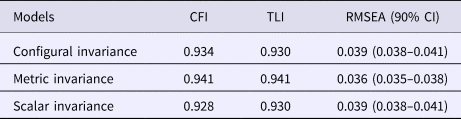
The values of the GOF criteria of the configural, metric and scalar invariance models are shown in Table 3.
Measures of the GOF criteria of the different models of measurement equivalence

CFI, comparative fit index; TLI, Tucker–Lewis index; RMSEA, root mean square error of approximation; 90% CI, 90% confidence interval.
The configural invariance model fitted well, providing evidence for identical factor structure across countries (CFI and TLI >0.9 and RMSEA <0.05 in the first unconstrained model).
The assumption that factor loadings can be considered as identical across countries was granted, based on the negligible change between the configural and the metric invariance models (except for a borderline ΔTLI = 0.011). The values of the unconstrained factor loadings in the configural invariance model, and of the unconstrained thresholds in the metric invariance model are available in online Supplementary materials (Figs S1 and S2; for the mean loadings by country and factor, see Supplementary Table S3).
Non-significant changes in fit indices (between the configural and the scalar invariance models) suggested that the CAPE also shows scalar invariance across countries (see Table 3).
Based on MPLUS MODINCES suggestions, we freed the thresholds of v21 and v38 in Brazil, v39 in France, v16 in the Netherlands, v25 in Italy, v25 and v13 in Spain and v35 in UK. The difference in the different GOF between the configural invariance and the partial scalar invariance models was negligible (ΔCFI = 0.002; ΔTLI = 0.004; ΔRMSEA = 0.001) (see online Supplementary Table S4).
Discussion
This is, to our knowledge, the first study testing the cross-national invariance of the CAPE. Across the six countries (Brazil, France, Netherlands, Italy, Spain and UK) and six different languages, the CAPE showed measurement invariance. Based on our results, any differences in scores between samples from the countries involved in the study or in individual scores of subjects from these countries should be considered as reflecting true differences in the construct of interest (Meredith, Reference Meredith1993). In other words, our study rules out the possibility that artefacts due to the instrument measuring different constructs in different countries, or measuring the same construct differently (i.e. with different scales or intercepts) depending on the country, could be the source of any observed difference in CAPE scores.
Our study is of interest for several reasons. First of all, the CAPE is an instrument that has been widely used in a variety of settings: clinical, research and the general population [see Mark and Toulopoulou (Reference Mark and Toulopoulou2016) for a review]. It has been studied and its structure validated in several large samples, in different countries and different languages (Konings et al., Reference Konings, Bak, Hanssen, Van Os and Krabbendam2006; Brenner et al., Reference Brenner, Schmitz, Pawliuk, Fathalli, Joober, Ciampi and King2007). Although a majority of studies have been conducted in samples from the general population, several studies showed that the CAPE could be used in clinical populations. For instance, Hanssen et al. (Reference Hanssen, Peeters, Krabbendam, Radstake, Verdoux and van Os2003) showed that subjects with affective disorders had higher positive, negative and depressive scores than controls. Yung et al. (Reference Yung, Buckby, Cotton, Cosgrave, Killackey, Stanford, Godfrey and McGorry2006) used the CAPE to identify the prevalence and the clinical correlates of psychotic symptoms in a sample of referrals to a youth psychiatric service (they found three subtypes of psychotic symptoms: bizarre experiences, persecutory ideas and magical thinking). In line with the continuum hypothesis, increases in CAPE scores have been associated with known risk factors for schizophrenia. For example, Verdoux et al. (Reference Verdoux, Sorbara, Gindre, Swendsen and van Os2003) and Stefanis et al. (Reference Stefanis, Delespaul, Henquet, Bakoula, Stefanis and Van Os2004) showed that a cannabis exposure was associated with an increase in positive and negative dimensions. Furthermore, Mossaheb et al. (Reference Mossaheb, Becker, Schaefer, Klier, Schloegelhofer, Papageorgiou and Amminger2012) showed that the CAPE is a valid and cost-effective instrument for detecting individuals at ultra-high risk for psychosis.
Our study is also of interest because of the methods used. Indeed, in an era of trans-national collaborative studies, the measurement of cross-national equivalence is a necessary preliminary step before analyses of cross-national samples (Millsap and Everson, Reference Millsap and Everson1993; Millsap, Reference Millsap1997). Comparisons of samples without preliminary assessment of equivalence could lead to aberrant conclusions. In an article aptly titled ‘What happens if we compare chopsticks with forks?’, Chen (Reference Chen2008) has reviewed the putative consequences of cross-cultural differences without preliminary invariance assessment. For instance, differences in factor loadings can lead to aberrant associations or differences in the total scores. Differences in intercepts (i.e. absence of scalar invariance) can lead to aberrant differences in the means. The MGCFA constitute the most frequent method of test of the cross-national invariance (Putnick and Bornstein, Reference Putnick and Bornstein2016).
Several of our methodological choices deserve discussion. First, we decided to dichotomise answers, because of the low rate of the ‘often’ and ‘nearly always’ responses. This may have lessened putative differences in the measurement properties of the CAPE across the six countries, especially because of potential differences of meaning of the words ‘sometimes’, ‘often’ and ‘nearly always’ in the respective countries. Moreover, removing the Likert values involves loss of information. Thus, the analyses were less sensitive to detect cross-national differences of measurement of the three dimensions assessed by the CAPE. However, if differences between countries exist in the Likert version, they should be rather small in magnitude. Otherwise, differences in the measurement properties of the CAPE would also have been observed in the analyses using dichotomised items. Moreover, binary and Likert values of the scores were highly correlated (between 0.82 and 0.94, see Table 2). Nevertheless, it must be kept in mind that formal invariance was demonstrated only for this method of (binary) scoring. Larger samples could allow for analyses of the cross-national equivalence of the Likert-score of the CAPE.
The inclusion of FEP subjects in our analyses also deserves discussion, as the CAPE was initially developed for the study of psychosis in the general population. However, several studies demonstrated that the CAPE could be meaningfully used in clinical populations (Hanssen et al., Reference Hanssen, Peeters, Krabbendam, Radstake, Verdoux and van Os2003; Yung et al., Reference Yung, Buckby, Cotton, Cosgrave, Killackey, Stanford, Godfrey and McGorry2006), including subjects with psychotic disorders (Schlier et al., Reference Schlier, Jaya, Moritz and Lincoln2015; van Os et al., Reference van Os, Marsman, van Dam and Simons2017). Furthermore, we decided to include FEP in our analysis for theoretical and pragmatic reasons. From a theoretical point of view, this enabled us to study the entire psychosis continuum. Moreover, inclusion of FEP permitted us to increase the variance of CAPE scores, and in doing so enhanced our power to identify cross-national invariance.
Another point that deserves discussion is the fact that some of the items showed differences in thresholds between countries (see online Supplementary Figs S1 and S2). For example, v16 (‘No interest in others’) in the Netherlands, v25 in Italy (‘Lack of activity’) or v39 in France (‘Feelings of failure’) appeared for lower levels of severity than in other countries. Conversely, the items v21 (‘Lack of energy’) and v38 (‘Feelings of guilt’) appeared for higher levels of severity than in other countries in Brazil. The current study shows that the scores were equivalent cross-nationally, and that removing these items from the CAPE in the different countries does not seem justified. As long as only the global dimensional scores are used, there is no reason to alter the CAPE (or the different translations). However, it remains interesting to analyse country/language differences at the level of individual symptoms.
Our study also has several strengths. First of all, with 2664 subjects, it is one of the largest studies to have used the CAPE. Furthermore, the methods used for the recruitment of subjects and collection of data were the same across the six countries involved. For a study of cross-national invariance, this is a major strength as it protects against spurious variation due to differences in the methods used (Davidov et al., Reference Davidov, Meuleman, Cieciuch, Schmidt and Billiet2014). Finally, we based our study on data from six countries, using a version of the CAPE in six different languages including some of the most used in the world.
Although we found arguments for cross-national invariance across all the countries/languages studied, it is important to keep in mind that our results concern only the CAPE with binary items, and cannot be generalised beyond these six languages and countries.
Conclusion
The current study suggests that comparing the scores between countries or analysing some data together from subjects of different EU-GEI samples for further analyses on the CAPE score is legitimate. We hope that these findings will encourage the use of CAPE in trans-national studies and the test of trans-national and trans-language equivalence of other instruments.
Supplementary material
The supplementary material for this article can be found at https://doi.org/10.1017/S0033291718003574.
Author ORCIDs
Baptiste Pignon 0000-0003-0526-3136
Acknowledgements
We thank Sarah Boster for English editing of the final text.
Financial support
The EU-GEI Project is funded by the European Community's Seventh Framework Programme under grant agreement no. HEALTH-F2-2010-241909.
Conflict of interest
The authors have declared that there are no conflicts of interest in relation to the subject of this study.
EU-GEI WP2 Group Authors
Jim van Os1,6, Bart P. Rutten1, Ulrich Reininghaus1,5, Craig Morgan5, Robin M. Murray6, Marta Di Forti6, Charlotte Gayer-Anderson5, Kathryn Hubbard5, Stephanie Beards5, Simona A. Stilo5,6, Diego Quattrone6, Giada Tripoli6, Celso Arango13, Mara Parellada13, Miguel Bernardo14, Julio Sanjuán15, Julio Bobes16, Manuel Arrojo17, Jose Luis Santos18, Pedro Cuadrado19, José Juan Rodríguez Solano20, Angel Carracedo21, Enrique García Bernardo13b, Laura Roldán13, Gonzalo López13, Bibiana Cabrera14, Esther Lorente-Rovira15, Paz Garcia-Portilla16, Javier Costas21, Estela Jiménez-López18, Mario Matteis13, Marta Rapado13, Emiliano González13, Covadonga Martínez13, Emilio Sánchez13b, Mª Soledad Olmeda13b, Lieuwe de Haan24, Nathalie Franke24, Eva Velthorst24,79, Jean-Paul Selten1,23, Fabian Termorshuizen1,23, Daniella van Dam24, Elsje van der Ven1,23, Marion Leboyer25,26,27,28, Andrei Szoke25,26,27,28, Franck Schürhoff25,26,27,28, Pierre-Michel Llorca28,29,52, Stéphane Jamain26,27,28, Andrea Tortelli26,30, Flora Frijda30, Grégoire Baudin25,26, Aziz Ferchiou25,26, Baptiste Pignon25,26,28, Jean-Romain Richard26,28, Thomas Charpeaud28,29,52, Anne-Marie Tronche28,29,52, Peter Jones42, James Kirkbride42,43, Hannah Jongsma42, Ilaria Tarricone44, Domenico Berardi44, Daniele La Barbera48, Caterina Erika La Cascia48, Alice Mulè49, Lucia Sideli48, Rachele Sartorio49, Laura Ferraro48, Fabio Seminerio48, Giada Tripoli48, Paulo R. Menezes74,77, Cristina M. Del-Ben76,77, Silvia H. Gallo Tenan76,77, Rosana Shuhama76,77, Mirella Ruggeri65, Sarah Tosato65
1Department of Psychiatry and Neuropsychology, School for Mental Health and Neuroscience, South Limburg Mental Health Research and Teaching Network, Maastricht University Medical Centre, P.O. Box 616, 6200 MD Maastricht, The Netherlands
2Mondriaan Mental Health Trust, South Limburg, Maastricht/Heerlen, PO Box 4436, 6401 CX Heerlen, The Netherlands
3University Centre of Psychiatry, Rob Giel Clinical Research, University of Groningen, University Medical Centre Groningen, Hanzeplein 1, PO Box 30.001, 9700 RB Groningen, The Netherlands
5Department of Health Service and Population Research, Institute of Psychiatry, King's College London, De Crespigny Park, Denmark Hill, London, SE5 8AF, UK
6Department of Psychosis Studies, Institute of Psychiatry, King's College London, De Crespigny Park, Denmark Hill, London, SE5 8AF, UK
7Department of Psychology, Institute of Psychiatry, King's College London, De Crespigny Park, Denmark Hill, London, SE5 8AF, UK
8Medical Research Council (MRC) Centre for Neuropsychiatric Genetics and Genomics, Cardiff University, Hadyn Ellis Building, Maindy Road, Cardiff CF24 4HQ, UK
9Central Institute of Mental Health, Department of Psychiatry and Psychotherapy, Square J5, 68159 Mannheim, Germany
10Department of Psychiatry, School of Medicine, Ankara University, Cebeci Hospital, Mamak cad, Ankara, 06100, Turkey
11Ankara University Brain Research Center, Ankara University, Mamak Cad, No. 33, Cebeci Mamak, Ankara, Turkey
12Dışkapı Y.B. Research and Training Hospital, İrfan Baştuğ Cad, Dışkapı, Ankara, Turkey
13Department of Child and Adolescent Psychiatry, Hospital General Universitario Gregorio Marañón, School of Medicine, Universidad Complutense, IiSGM (CIBERSAM), C/Doctor Esquerdo 46, 28007 Madrid, Spain
13bDepartment of Psychiatry, Hospital General Universitario Gregorio Marañón, School of Medicine, Universidad Complutense, IiSGM (CIBERSAM), C/Doctor Esquerdo 46, 28007 Madrid, Spain
14Department of Psychiatry, Hospital Clinic, IDIBAPS, Centro de Investigación Biomédica en Red de Salud Mental (CIBERSAM), Universidad de Barcelona, C/Villarroel 170, escalera 9, planta 6, 08036 Barcelona, Spain
15Department of Psychiatry, School of Medicine, Universidad de Valencia, Centro de Investigación Biomédica en Red de Salud Mental (CIBERSAM), C/Avda. Blasco Ibáñez 15, 46010 Valencia, Spain
16Department of Medicine, Psychiatry Area, School of Medicine, Universidad de Oviedo, Centro de Investigación Biomédica en Red de Salud Mental (CIBERSAM), C/Julián Clavería s/n, 33006 Oviedo, Spain
17Department of Mental Health and Drug-addition assistance, Health Service of Galicia, Psychiatric Genetic Group IDIS, Hospital Clínico Universitario de Santiago de Compostela, affiliated center to Centro de Investigación Biomédica en Red de Salud Mental, (CIBERSAM), Servicio Gallego de Salud, Edificio Administrativo de San Lázaro s/n 15706 Santiago de Compostela, Spain
18Department of Psychiatry, Servicio de Psiquiatría Hospital ‘Virgen de la Luz’, C/Hermandad de Donantes de Sangre, 16002 Cuenca, Spain
19Villa de Vallecas Mental Health Department, Villa de Vallecas Mental Health Centre, Hospital Universitario Infanta Leonor / Hospital Virgen de la Torre, C/San Claudio 154, 28038 Madrid, Spain
20Puente de Vallecas Mental Health Department, Hospital Universitario Infanta Leonor/Hospital Virgen de la Torre, Centro de Salud Mental Puente de Vallecas, C/Peña Gorbea 4, 28018 Madrid, Spain
21Fundación Pública Galega de Medicina Xenómica, Hospital Clínico Universitario, Choupana s/n, 15782 Santiago de Compostela, Spain
22Hospital Psiquiatrico de Conxo. ext 251951, Plaza Martin Herrera 2, 15706 Santiago de Compostela, A Coruña, Spain
23Rivierduinen Centre for Mental Health, Leiden, Sandifortdreef 19, 2333 ZZ Leiden, The Netherlands
24Department of Psychiatry, Early Psychosis Section, Academic Medical Centre, University of Amsterdam, Meibergdreef 5, 1105 AZ Amsterdam, The Netherlands
25AP-HP, Groupe Hospitalier ‘Mondor’, Pôle de Psychiatrie, 51 Avenue de Maréchal de Lattre de Tassigny, 94010 Créteil, France
26INSERM, U955, Equipe 15, 51 Avenue de Maréchal de Lattre de Tassigny, 94010 Créteil, France
27Faculté de Médecine, Université Paris-Est, 51 Avenue de Maréchal de Lattre de Tassigny, 94010 Créteil, France
28Fondation Fondamental, 40 Rue de Mesly, 94000 Créteil, France
29CMP B CHU, BP 69, 63003 Clermont-Ferrand, Cedex 1, France
30EPS Maison Blanche, Paris 75020, France
31UPC KU Leuven, Campus Kortenberg, Department of Neurosciences, UPC, KU Leuven, Leuvensesteenweg 517, B-3070 Kortenberg, Belgium
32Research Group Psychiatry, Department of Neurosciences, UPC, KU Leuven, Herestraat 49, 3000 Leuven, Belgium
33Department of Psychiatry and Psychotherapy, Medical University of Vienna, Währinger Gürtel 18-20, 1090 Vienna, Austria
34Center for Gender Research and Early Detection, Psychiatric University Clinics Basel, Kornhausgasse 7, CH-4051 Basel, Switzerland
35Diagnostic and Crisis Intervention Centre, Psychiatric University Clinics Basel, Kornhausgasse 7, CH-4051 Basel, Switzerland
36Department of Psychiatry and Psychotherapy, University of Cologne, Kerpener Str. 62, 50937 Cologne, Germany
37Centre for Genomic Sciences, State Key Laboratory of Brain and Cognitive Sciences and Department of Psychiatry, Li Ka Shing Faculty of Medicine, The University of Hong Kong, 5 Sassoon Road, Pokfulam, Hong Kong SAR, PR China
38State Key Laboratory of Brain and Cognitive Sciences and Department of Psychiatry, Li Ka Shing Faculty of Medicine, The University of Hong Kong, New Clinical Building, Queen Mary Hospital, 102 Pokfulam Road, Hong Kong SAR, PR China
39Inter-University Chair in Law and the Human Genome (Provincial Government of Biskay) in University of Deusto, University of the Basque Country, Avda de las Universidades Street 24, 48007 Bilbao, Bizkaia, Spain
40Department of Neurology, Ghent University, Ghent University Hospital, De Pintelaan 185, B9000 Ghent, Belgium
41Criminal Law, University of Zaragoza, Pedro Cerbuna Street, 50.009 Zaragoza, Spain
42Department of Psychiatry, University of Cambridge, Hercel Smith Building for Brain & Mind Sciences, Forvie Site, Robinson Way, Cambridge, CB2 0SZ, UK
43Division of Psychiatry, University College London, 6th Floor, Maple House, 149 Tottenham Court Road, London, W1T 7NF, UK
44Department of Medical and Surgical Science, Psychiatry Unit, Alma Mater Studiorium Università di Bologna, Viale Pepoli 5, 40126 Bologna, Italy
45Department of Medical and Surgical Science, Genetic Unit, Alma Mater Studiorium Università di Bologna, Massarenti 9, 40138 Bologna, Italy
46National and Kapodistrian University of Athens, Medical School Eginition Hospital, 72–74 Vas. Sofias Ave., Athens 11528, Greece
47Department of Mental Health and Pathological Addictions, Local Health Trust, Viale Carlo Pepoli 5, 40127 Bologna, Italy
48Department of Experimental Biomedicine and Clinical Neuroscience, Section of Psychiatry, University of Palermo, Via G. La Loggia n.1, 90129 Palermo, Italy
49Unit of Psychiatry, ‘P. Giaccone’ General Hospital, Via G. La Loggia n.1, 90129 Palermo, Italy
50Centre for Youth Mental Health, University of Melbourne, 35 Poplar Road (Locked Bag 10), Parkville, Victoria 3052, Australia
51Melbourne Neuropsychiatry Centre, University of Melbourne, Levels 2&3, 161 Barry St, Carlton South, Victoria 3053, Australia
52Université d'Auvergne, EA 7280, Clermont-Ferrand, 63000, France
53Department of Clinical Psychology, VU University and EMGO Institute of Health and Care Research, Van der Boechorststraat 1, 1081 BT Amsterdam, The Netherlands
54Department of Psychosis Research, Parnassia Psychiatric Institute, Zoutkeetsingel 40, 2512 HN, The Hague, The Netherlands
55Psychotic Disorders Research Unit, Department of Psychiatry, İstanbul Faculty of Medicine, İstanbul University, Fatih/Çapa, İstanbul, 34093, Turkey
56Department of Advanced Neurological Sciences, Institute for Experimental Medical Research, İstanbul Faculty of Medicine, İstanbul University, Fatih/Çapa, İstanbul, 34093, Turkey
57Department of Psychiatry, School of Medicine, Dokuz Eylül University, Kültür Mh., Cumhuriyet Blv No. 144, 35210 Konak, Turkey
58Manisa Mental Health Hospital, Şehitler Mh. 814 Sk. 28 Merkez, Manisa, Turkey
59Turkish Federation of Schizophrenia Associations, Mareşal Fevzi Çakmak Caddesi 39/6 Beşevler, Ankara, Turkey
60Psychiatry Clinic, Ataturk Training and Research Hospital, Bilkent Yolu 3. Km. Çankaya Ankara, Turkey
61Department of Psychology, Middle East Technical University ODTÜ Üniversiteler Mah. Dumlupınar Blv. No. 1, 06800 Çankaya, Ankara, Turkey
62Department of Psychiatry, Yale University Medical School, Department of Psychiatry, 34 Park St., New Haven, CT 06519-1109, USA
63Department of Human Genetics, University Hospital Gasthuisberg, Katholieke Universiteit Leuven, B-3000 Leuven, Belgium
64Association for Scientific Research in Multiple Births, Ghent, Belgium
65Section of Psychiatry, Department of Public Health and Community Medicine, University of Verona, Piazzale L.A. Scuro 10, 37134 Verona, Italy
66Department of Psychiatry, Royal College of Surgeons in Ireland, Education and Research Centre, Beaumont Hospital, Dublin 9, Ireland
67School of Medicine, University of Belgrade, Dr Subotica 8, 11000 Beograd, Serbia
68Departament de Psicologia Clínica i de la Salut, Universitat Autònoma de Barcelona, Bellaterra, 08193 Barcelona, Spain
69Departament de Salut Mental, Sant Pere Claver-Fundació Sanitària, Vila i Vilà 16, 08004 Barcelona, Spain
70Department of Psychology, University of North Carolina at Greensboro, P.O. Box 26164, Greensboro, NC 27402-6164, USA
71Spanish Mental Health Research Network, CIBERSAM, Spain
72PRISMA Early Intervention Program, Department of Psychiatry, Federal University of São Paulo, Rua Pedro de Toledo, 669, 3rd Floor, CEP 04039-032, São Paulo, Brazil
73Department of Psychiatry, Psychotherapy and Psychosomatics, Martin-Luther-University Halle-Wittenberg, Julius-Kühn-Strasse 7, 06112 Halle, Germany
74Departamento de Medicina Preventiva, Faculdade de Medicina, Universidade de São Paulo, Avenida Doutor Arnaldo 455, CEP 01246-903, SP, Brazil
75Copenhagen University Hospital, Research Unit, Mental Health Centre Copenhagen, Bispebjerg Bakke 23, DK-2400 Copenhagen, Denmark
76Departamento de Neurociências e Ciencias do Comportamento, Faculdade de Medicina de Ribeirão Preto, Universidade de São Paulo, Av. Bandeirantes, 3900, Monte Alegre, CEP 14049-900, Ribeirão Preto, SP, Brazil
77Núcleo de Pesquina em Saúde Mental Populacional, Universidade de São Paulo, Avenida Doutor Arnaldo 455, CEP 01246-903, SP, Brazil
78Hôpital Sainte-Anne, Service Hospitalo-Universitaire, Faculté de Médecine Paris Descartes, University Paris Descartes, Paris, France
79Departments of Psychiatry and Preventive Medicine, Icahn School of Medicine at Mount Sinai, New York, NY, USA
Non-author EU-GEI collaborators
Kathryn Hubbard1, Stephanie Beards1, Simona A. Stilo2, Mara Parellada3, Pedro Cuadrado4, José Juan Rodríguez Solano5, Angel Carracedo6, Enrique García Bernardo7, Laura Roldán3, Gonzalo López3, Bibiana Cabrera8, Esther Lorente-Rovira9, Paz Garcia-Portilla10, Javier Costas6, Estela Jiménez-López11, Mario Matteis3, Marta Rapado3, Emiliano González3, Covadonga Martínez3, Emilio Sánchez7, Ma Soledad Olmeda7, Nathalie Franke12, Fabian Termorshuizen13,14, Daniella van Dam12, Elsje van der Ven13,14, Elles Messchaart14, Marion Leboyer15,16,17,18, Franck Schürhoff15,16,17,18, Stéphane Jamain16,17,18, Grégoire Baudin15,16, Aziz Ferchiou15,16, Baptiste Pignon15,16,17,18, Jean-Romain Richard16,18, Thomas Charpeaud18,19,21, Anne-Marie Tronche18,19,21, Flora Frijda22, Giovanna Marrazzo23, Lucia Sideli22, Crocettarachele Sartorio22,23, Fabio Seminerio22, Camila Marcelino Loureiro24,25, Rosana Shuhama24,25, Mirella Ruggeri26, Sarah Tosato26, Chiara Bonetto26, Doriana Cristofalo26
1Department of Health Service and Population Research, Institute of Psychiatry, King's College London, De Crespigny Park, Denmark Hill, London, SE5 8AF, UK
2Department of Psychosis Studies, Institute of Psychiatry, King's College London, De Crespigny Park, Denmark Hill, London, SE5 8AF, UK
3Department of Child and Adolescent Psychiatry, Hospital General Universitario Gregorio Marañón, School of Medicine, Universidad Complutense, IiSGM (CIBERSAM), C/Doctor Esquerdo 46, 28007 Madrid, Spain
4Villa de Vallecas Mental Health Department, Villa de Vallecas Mental Health Centre, Hospital Universitario Infanta Leonor / Hospital Virgen de la Torre, C/San Claudio 154, 28038 Madrid, Spain
5Puente de Vallecas Mental Health Department, Hospital Universitario Infanta Leonor / Hospital Virgen de la Torre, Centro de Salud Mental Puente de Vallecas, C/Peña Gorbea 4, 28018 Madrid, Spain
6Fundación Pública Galega de Medicina Xenómica, Hospital Clínico Universitario, Choupana s/n, 15782 Santiago de Compostela, Spain
7Department of Psychiatry, Hospital General Universitario Gregorio Marañón, School of Medicine, Universidad Complutense, IiSGM (CIBERSAM), C/Doctor Esquerdo 46, 28007 Madrid, Spain
8Department of Psychiatry, Hospital Clinic, IDIBAPS, Centro de Investigación Biomédica en Red de Salud Mental (CIBERSAM), Universidad de Barcelona, C/Villarroel 170, escalera 9, planta 6, 08036 Barcelona, Spain
9Department of Psychiatry, School of Medicine, Universidad de Valencia, Centro de Investigación Biomédica en Red de Salud Mental (CIBERSAM), C/Avda. Blasco Ibáñez 15, 46010 Valencia, Spain
10Department of Medicine, Psychiatry Area, School of Medicine, Universidad de Oviedo, Centro de Investigación Biomédica en Red de Salud Mental (CIBERSAM), C/Julián Clavería s/n, 33006 Oviedo, Spain
11Department of Psychiatry, Servicio de Psiquiatría Hospital “Virgen de la Luz”, C/Hermandad de Donantes de Sangre, 16002 Cuenca, Spain
12Department of Psychiatry, Early Psychosis Section, Academic Medical Centre, University of Amsterdam, Meibergdreef 5, 1105 AZ Amsterdam, The Netherlands
13Rivierduinen Centre for Mental Health, Leiden, Sandifortdreef 19, 2333 ZZ Leiden, The Netherlands
14Department of Psychiatry and Neuropsychology, School for Mental Health and Neuroscience, South Limburg Mental Health Research and Teaching Network, Maastricht University Medical Centre, P.O. Box 616, 6200 MD Maastricht, The Netherlands
15AP-HP, Groupe Hospitalier “Mondor”, Pôle de Psychiatrie, 51 Avenue de Maréchal de Lattre de Tassigny, 94010 Créteil, France
16INSERM, U955, Equipe 15, 51 Avenue de Maréchal de Lattre de Tassigny, 94010 Créteil, France
17Faculté de Médecine, Université Paris-Est, 51 Avenue de Maréchal de Lattre de Tassigny, 94010 Créteil, France
18Fondation Fondamental, 40 Rue de Mesly, 94000 Créteil, France
19CMP B CHU, BP 69, 63003 Clermont Ferrand, Cedex 1, France
20EPS Maison Blanche, Paris 75020, France
21Université Clermont Auvergne, EA 7280, Clermont-Ferrand, 63000, France
22Department of Experimental Biomedicine and Clinical Neuroscience, Section of Psychiatry, University of Palermo, Via G. La Loggia n.1, 90129 Palermo, Italy
23Unit of Psychiatry, “P. Giaccone” General Hospital, Via G. La Loggia n.1, 90129 Palermo, Italy
24Departamento de Neurociências e Ciencias do Comportamento, Faculdade de Medicina de Ribeirão Preto, Universidade de São Paulo, Av. Bandeirantes, 3900 -Monte Alegre- CEP 14049-900, Ribeirão Preto, SP, Brasil
25Núcleo de Pesquina em Saúde Mental Populacional, Universidade de São Paulo, Avenida Doutor Arnaldo 455, CEP 01246-903, SP, Brasil
26Section of Psychiatry, Department of Neuroscience, Biomedicine and Movement, University of Verona, Piazzale L.A. Scuro 10, 37134 Verona, Italy